

Inbound Leads vs Outbound Leads: 2026 Benchmarks
Marketing celebrates a record inbound month - 30,000 website visitors, demo requests up 40%. Sales looks at the pipeline and says the leads are garbage. Meanwhile, the outbound team is grinding through 200 cold emails a day and booking three meetings a week. Both sides think they're right. Both sides have data to prove it.
Inbound captures existing demand - higher conversion rates, lower cost per lead, but it takes 6-12 months to build and you can't control who shows up. Outbound creates new demand - you pick the accounts, control the deal flow, and outbound campaigns generate about 50% larger deal sizes on average. But it costs more per lead and lives or dies on data quality.
Companies running both motions see 2x faster revenue growth than teams relying on a single channel. And if your outbound is underperforming, fix your data before you rewrite a single email.
What Are Inbound and Outbound Leads?
Inbound leads come to you. They find your blog post through search, download a whitepaper, request a demo, or get referred by a colleague. The buyer initiates contact because they already have a problem and they're actively looking for solutions. Channels include SEO, content marketing, paid search, webinars, and referrals - you're capturing demand that already exists.
Outbound leads are the ones you go find. Your team identifies target accounts, researches contacts, and reaches out directly through cold email, cold calls, direct mail, or social outreach. The buyer didn't ask to hear from you. You're creating demand by introducing a problem or solution they weren't actively shopping for.
The practitioner framing that actually matters: inbound captures demand, outbound creates it. They aren't competing strategies. They're different tools for different jobs.
2026 Benchmarks Side by Side
Most comparison articles give you vibes. Here are the actual numbers.
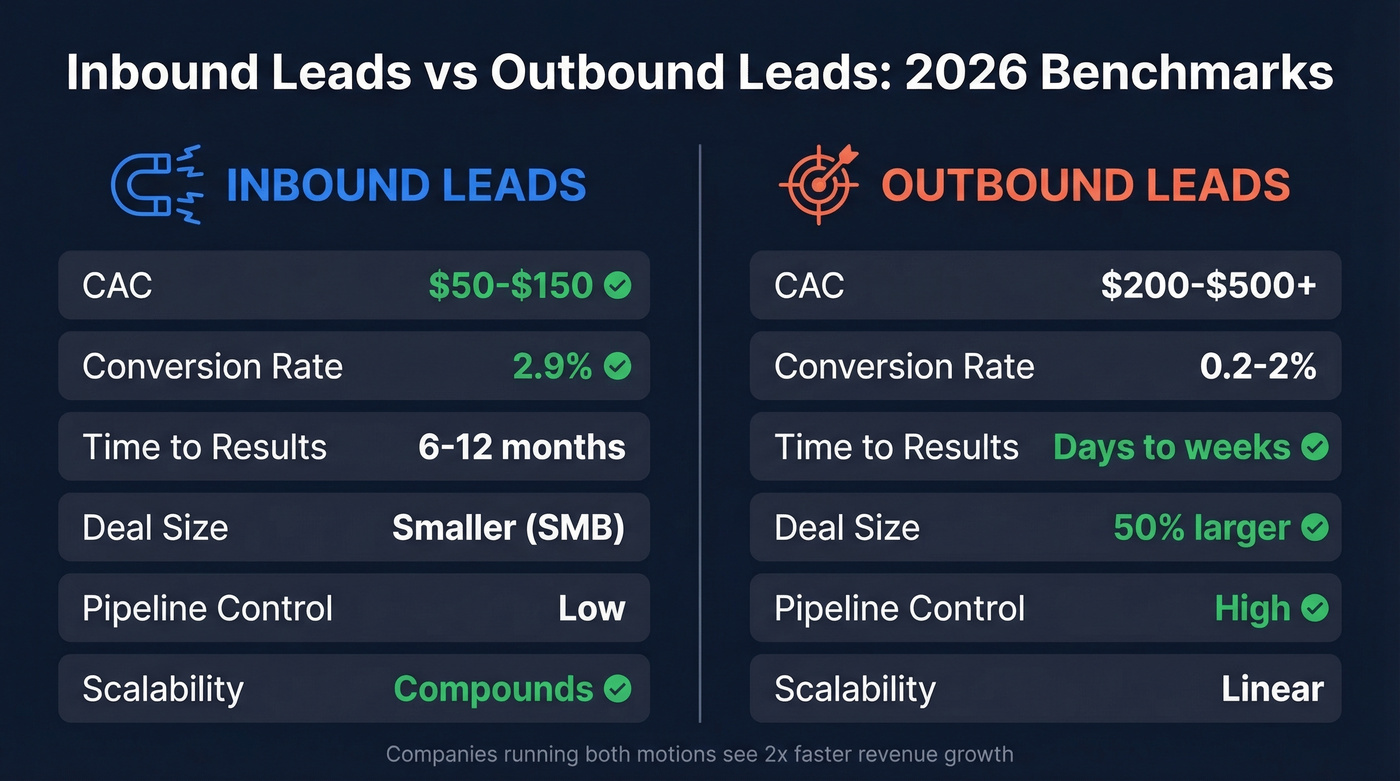
| Dimension | Inbound | Outbound |
|---|---|---|
| Who initiates | Buyer | Seller |
| Estimated CAC | $50-$150 (mature engine) | $200-$500+ (enterprise motion) |
| Time to results | 6-12 months | Days to weeks |
| Conversion rate | 2.9% qualified lead avg; 2.4% B2B email conversion | 0.2-2% cold email; 6.7% cold call to meeting |
| Lead-to-opportunity | ~12% for SaaS | Varies by ICP targeting quality |
| Deal size | Smaller (SMB-heavy) | ~50% larger |
| Pipeline control | Low (depends on traffic) | High (you pick accounts) |
| Scalability | Compounds over time | Linear with headcount |
| Data dependency | Moderate | Critical |
A few things jump out. Inbound conversion looks better on paper - 2.9% qualified-lead rate across 100M+ data points versus cold email's 0.2-2%. But that comparison is misleading because inbound's 2.9% measures visitors who already raised their hand, while outbound's 0.2-2% measures cold strangers who've never heard of you. You're comparing warm to cold.
The deal size gap is where outbound earns its keep. Outbound campaigns targeting ICP accounts generate roughly 50% larger deals than inbound. You're choosing enterprise accounts instead of waiting for whoever searches your category.
On the inbound side, sites with 25,000+ monthly visitors see visitor-to-demo rates drop below 1%. More traffic doesn't mean proportionally more qualified opportunities.
Cold calling deserves a mention because the narrative is wrong. The average cold call meeting-booking rate sits at 6.7% - up from roughly 2% in 2023. That's not a dying channel. 69% of B2B buyers accept cold calls, and 57% of C-level and VP buyers actually prefer phone contact. Calling between 4-5 p.m. yields 71% better results than the 11 a.m.-noon slot most reps default to.
The Hidden Variable: Data Quality
Look, most benchmarks don't account for this: 17% of cold emails never reach the inbox. Not opened and ignored - never delivered. Your outbound conversion rate isn't 0.2-2% if a fifth of your emails are bouncing into the void.
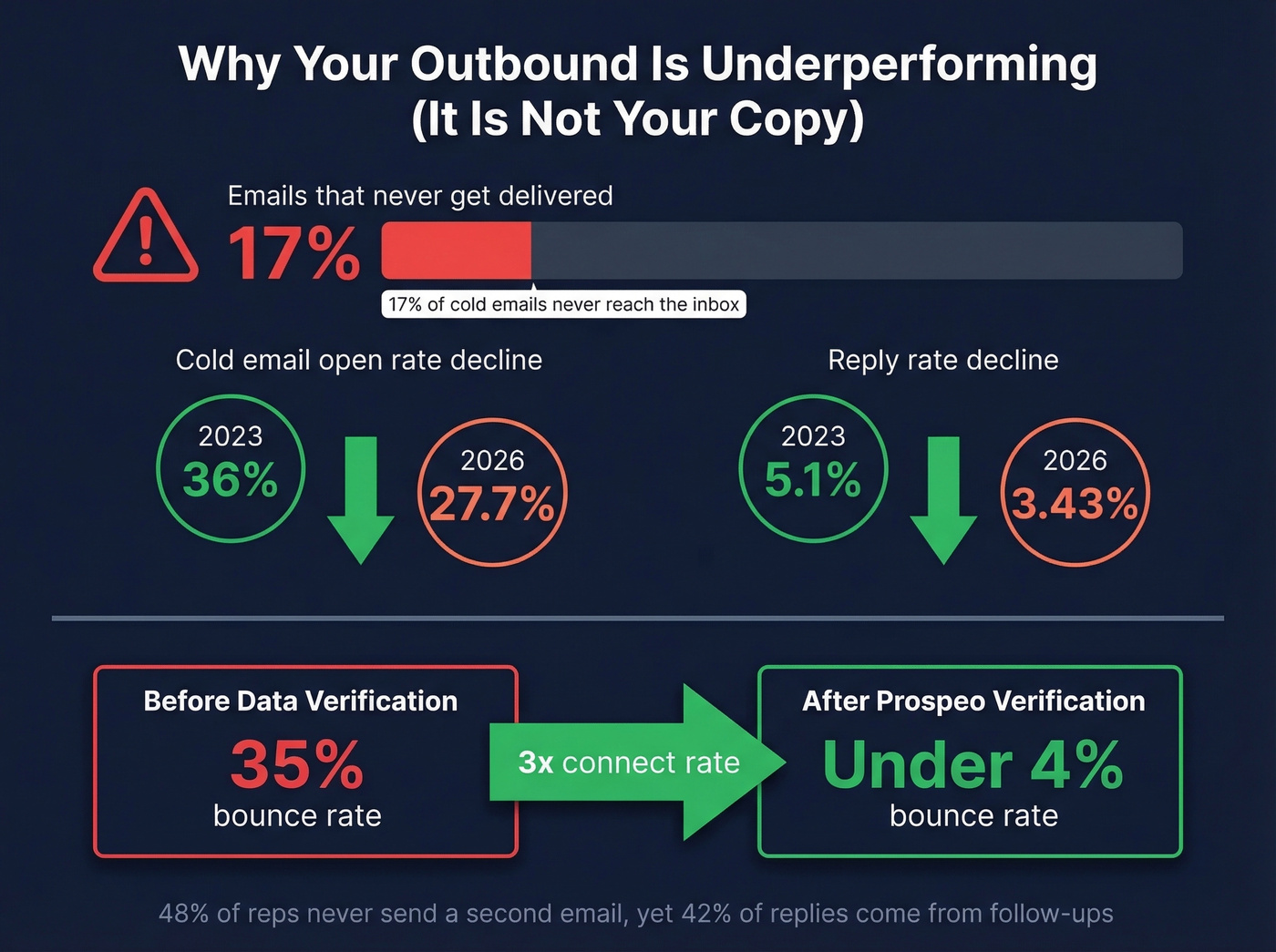
Cold email open rates have dropped from ~36% in 2023 to a 27.7% average across 2024-2026. Reply rates fell from 5.1% to 3.43%. Every guide blames "bad copy" or "wrong subject lines." In our experience, the real culprit is stale data. When your list is full of job-changers, defunct domains, and catch-all traps, no amount of copywriting fixes the problem.
Follow-ups compound the issue. 42% of all cold email replies come from follow-up messages, yet 48% of reps never send a second email. If your first email bounced, every follow-up bounces too - and your domain reputation takes the hit.
Before you rewrite a single cold email, verify your list. We've seen teams triple their connect rates just by switching to weekly-refreshed, verified data - no new copy, no new sequences, just accurate emails hitting real inboxes. When Meritt switched to Prospeo's verification infrastructure, their bounce rate dropped from 35% to under 4% and their connect rate tripled. That wasn't a messaging fix. It was a data fix.

You just read that 17% of cold emails never reach the inbox and bounce rates destroy domain reputation. Prospeo's 5-step verification and 7-day data refresh cycle cut bounce rates from 35% to under 4% for teams like Meritt - tripling their connect rate without changing a single word of copy.
Fix the data and your outbound benchmarks stop looking like the cold side of that table.
When to Use Each Motion
Stop treating this as an either/or decision. The right motion depends on your stage, your ACV, and where demand already exists.
If your average deal is under $10k, you probably don't need an outbound team at all. Inbound will almost always win on unit economics at that price point. But the moment you're selling deals above $50k, outbound's pipeline control and larger deal sizes justify the higher cost per lead. Most mid-market teams need both.
Start with outbound if you're pre-$5M ARR. You need to learn your ICP fast, and waiting 9 months for SEO traffic isn't an option. Outbound gives you direct feedback - who responds, what resonates, which titles convert. That intelligence feeds everything else you build.
Double down on inbound if you have strong organic traffic and a content-led product. If 10,000+ qualified visitors hit your site monthly, your job is conversion optimization, not cold outreach. Add targeted outbound only for enterprise accounts that won't find you through search.
Intent data changes the equation entirely. Platforms tracking 15,000+ buyer-intent topics let you identify which companies are actively researching your category right now. Intent-triggered outbound converts at 2-3x the rate of blind cold outreach because you're reaching buyers who are already in-market - layer that with firmographic filters like headcount growth, funding stage, and tech stack, and outbound starts to feel like inbound.
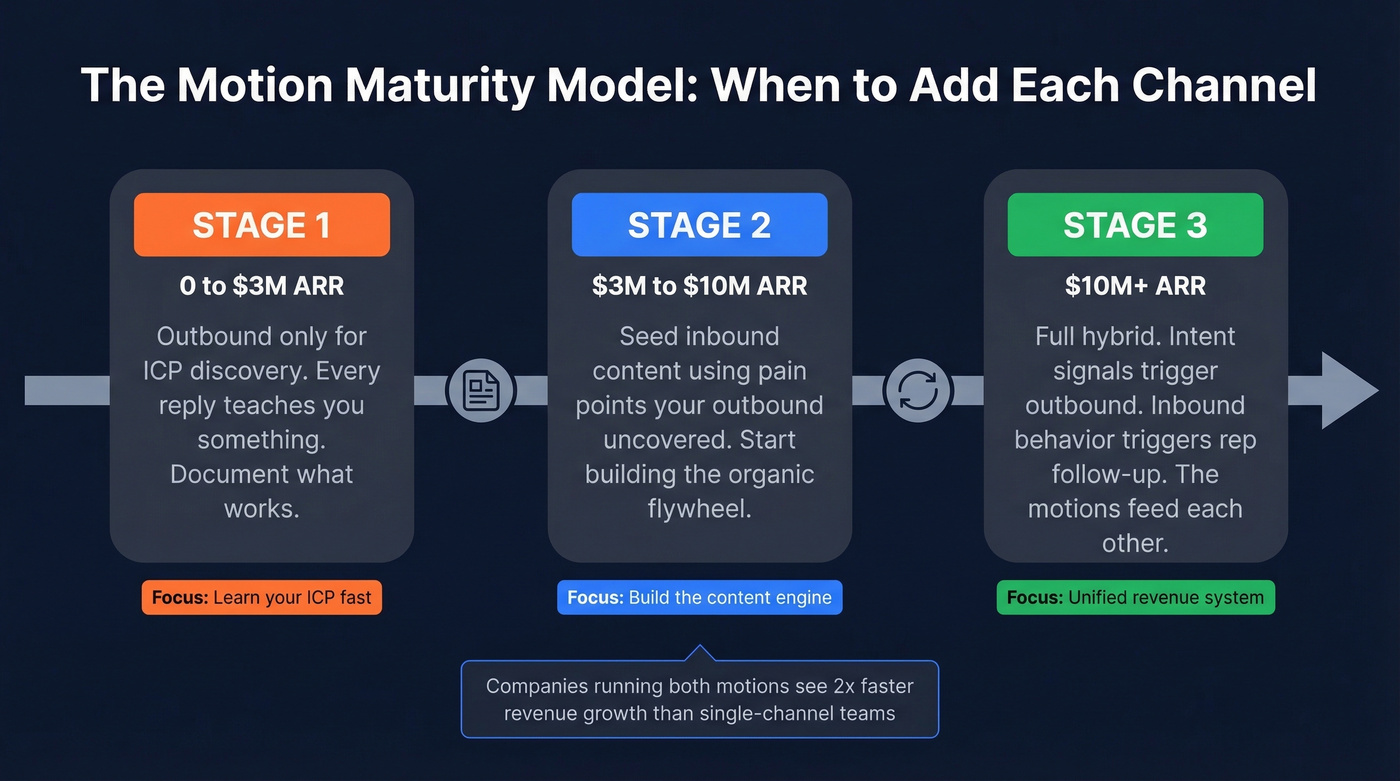
Here's the motion maturity model we recommend:
Stage 1 (0-$3M ARR): Outbound-only for ICP discovery. Every reply teaches you something. Document what works.
Stage 2 ($3M-$10M ARR): Seed inbound content using the messaging and pain points your outbound uncovered. Start building the organic flywheel.
Stage 3 ($10M+ ARR): Full hybrid. Intent signals trigger outbound sequences. Inbound behavior like pricing page visits and content downloads triggers rep follow-up. The motions feed each other.
Mistakes That Kill Both Motions
Responding too slowly to inbound leads. The average response time to an inbound lead is 42 hours. Responding within 5 minutes increases conversion by up to 9x. Only 7% of companies hit that 5-minute window. If you're investing in inbound and then letting leads sit for two days, you're lighting money on fire.
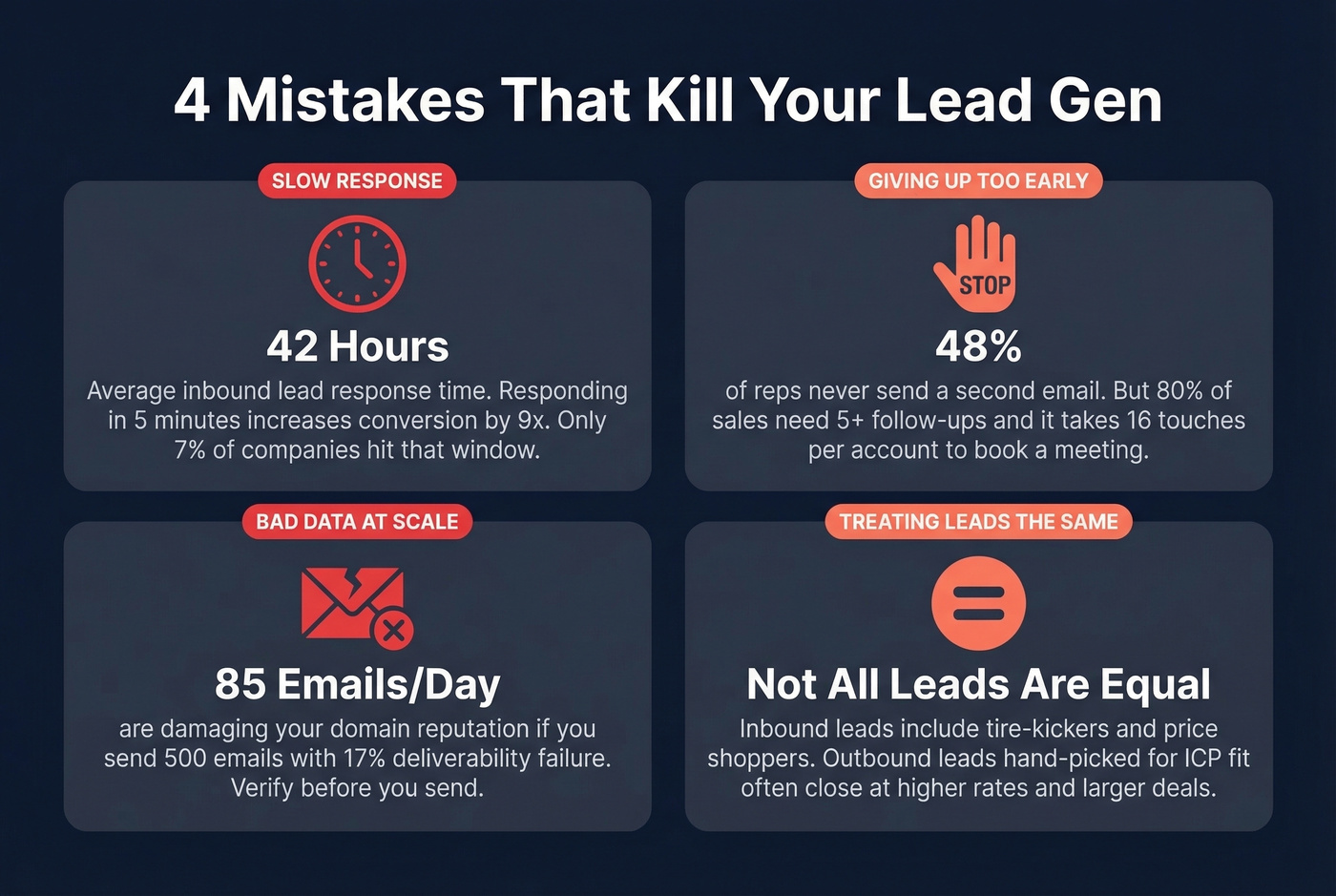
Giving up after one touch on outbound. 48% of reps never send a second email. Meanwhile, 80% of sales require 5+ follow-ups, and TOPO's research shows it takes 16 touches per account to generate a meeting. The math is brutal and obvious - yet nearly half of sales teams quit after one attempt.
Scaling volume before fixing data quality. Sending 500 cold emails a day with a 17% deliverability failure rate means 85 emails per day are actively damaging your domain reputation. That's not a volume problem. That's a data problem. Verify before you send. (If you need the mechanics, start with an email deliverability guide and then track your email bounce rate.)
Treating all leads the same regardless of source. The consensus on r/sales is that inbound leads aren't automatically better - many are price shoppers or tire-kickers who downloaded a free resource. Outbound leads you've hand-selected for ICP fit often close at higher rates and larger deal sizes. Route and qualify differently based on source.
Skip the "inbound vs outbound" debate entirely if your team is under 5 people. You don't have the bandwidth for both. Pick the motion that matches your ACV and go deep on it for 6 months before adding the second.
Building a Combined Lead Generation Strategy
Companies running both inbound and outbound see 2x faster revenue growth than those relying on a single motion. That's not a small edge - it's a structural advantage.
The practical connection points matter more than the strategy deck. Use outbound sequences to drive prospects toward gated inbound assets like a webinar, a benchmark report, or a free tool. Use inbound behavior signals to trigger outbound follow-up from reps. When a prospect visits your pricing page twice but doesn't request a demo, trigger an outbound sequence from the assigned rep. That's not cold outreach - it's warm follow-up with context.
Let's be honest about email-only outbound: it's slowly becoming a volume game with diminishing returns. Combining email, phone, and professional-network outreach boosts results by over 287% compared to email alone. The teams winning right now layer channels and use intent signals to time their outreach. A well-designed program treats both motions as a single revenue system rather than separate departments competing for budget.
Intent-triggered outbound converts 2-3x better than blind cold outreach. Prospeo tracks 15,000 buyer-intent topics and layers them with 30+ filters - headcount growth, funding, tech stack - so your outbound hits accounts already in-market. At $0.01 per email, the hybrid motion finally makes economic sense.
Stop choosing between inbound and outbound. Start choosing the right accounts.
FAQ
Which converts better - inbound or outbound leads?
Inbound leads convert at higher rates (2.9% qualified-lead average) because the buyer initiated contact. Outbound generates roughly 50% larger deals and gives you control over who enters your pipeline. "Better" depends on your deal size and growth stage - most teams past $3M ARR benefit from running both.
How much do inbound leads cost compared to outbound?
Inbound leads can cost up to 60% less over time but require 6-12 months of content investment upfront. Outbound costs $200-$500+ per lead for enterprise motions but produces revenue within days. Evaluate which produces revenue faster at your current stage before committing budget.
How do you improve outbound lead quality?
Start with verified contact data - 17% of cold emails never reach the inbox due to stale information. Verify emails before sending, follow up at least 5 times, and respond to any inbound interest within 5 minutes. Weekly-refreshed data with 98% accuracy eliminates the biggest outbound bottleneck before you touch your copy.
Should I run inbound and outbound together?
Yes, for most teams past $3M ARR. Companies running both motions see 2x faster revenue growth. Use outbound learnings - which pain points resonate, which titles respond - to sharpen inbound content, and use inbound signals like pricing page visits and content downloads to trigger timely outbound follow-up.