

Inbound vs Outbound Marketing: The 2026 Guide With Real Numbers
The inbound vs outbound marketing debate has wasted more executive meetings than any strategy argument in B2B. One side points at a content budget that "should've worked by now." The other side points at a pile of cold outreach activity that somehow turned into three meetings and a bruised domain reputation.
Here's the thing: neither inbound nor outbound "wins." The only question that matters is sequencing and mix: what you do first, what you fund second, and what you stop pretending will work for your deal size.
Let's break it down with numbers, not vibes.
Inbound marketing explained
Inbound marketing earns attention instead of buying it. You publish genuinely useful material and let prospects find you while they're already trying to solve something: guides, templates, calculators, webinars, product pages that actually answer questions. When it's working, it compounds. When it's not, it feels like you're feeding a furnace and getting polite traffic charts in return.
The mechanics haven't changed much. The bar has.
- SEO + content is still the backbone for most B2B inbound programs. HubSpot's "flywheel" framing (attract, engage, delight) is still a clean way to think about it: you build assets that keep pulling people in and keep paying you back.
- Email nurture is where a lot of inbound ROI quietly shows up. Campaign averages vary by list quality and offer, but the compounding effect is real once you have volume and a clear next step.
- Social + community can work, but organic reach is fickle. LinkedIn can convert well for some teams, yet it isn't a replacement for search-driven demand.
- Webinars and gated assets still punch above their weight in B2B, especially when you treat them like a series and not a one-off event.
One number that keeps showing up in channel ROI studies: SEO tends to outperform paid channels over time, but it takes months to feel it. If your leadership team expects inbound to behave like paid search, you're going to have a bad quarter and an even worse QBR.
We've tested this pattern across enough funnels to say it plainly: inbound is the efficient play, not the fast one.
Outbound marketing explained
Outbound marketing pushes messages to people who weren't looking for you. You're not capturing demand. You're creating it, or at least interrupting someone long enough to start a conversation.
Outbound gets caricatured as "spam." That's lazy. Good outbound is targeted, timed, and built on clean data. Bad outbound is what happens when someone exports 10,000 contacts, hits send, and then acts surprised when deliverability tanks.
Common outbound channels:
- Cold email (still the workhorse, now with better sequencing and tighter targeting)
- Cold calling (not dead, just less effective as a standalone channel)
- Paid ads (search, paid social, retargeting, sponsorships)
- Events and direct mail (expensive, but they can break through for enterprise)
If you spend time in communities like r/SaaSSales, the consensus is pretty consistent: outbound gives you control. You pick the accounts, you pick the timing, you pick the message, and you can build pipeline even when search demand is flat. That control is why serious B2B teams keep coming back to outbound, even after they've built a strong inbound engine.
Inbound vs outbound: side-by-side
| Dimension | Inbound | Outbound | Winner |
|---|---|---|---|
| Cost per lead | Lower over time (compounds) | Higher per lead (you pay for attention) | Inbound |
| Time to results | 3-6 months for traction; ~9 months to break even is common for SEO | 2-6 weeks to see pipeline movement | Outbound |
| Lead quality | High intent, but you can't fully control who shows up | Precise ICP targeting, but colder at first touch | Depends |
| Compounding | Yes | No (stops when you stop) | Inbound |
| Measurability | Harder (multi-touch attribution) | Easier (direct tracking) | Outbound |
| Best for | SMB, PLG, established categories | Enterprise, new markets, pipeline control | Depends |
| Biggest risk | Slow ramp, algorithm shifts | Bad data, low reply rates, compliance mistakes | Tie |
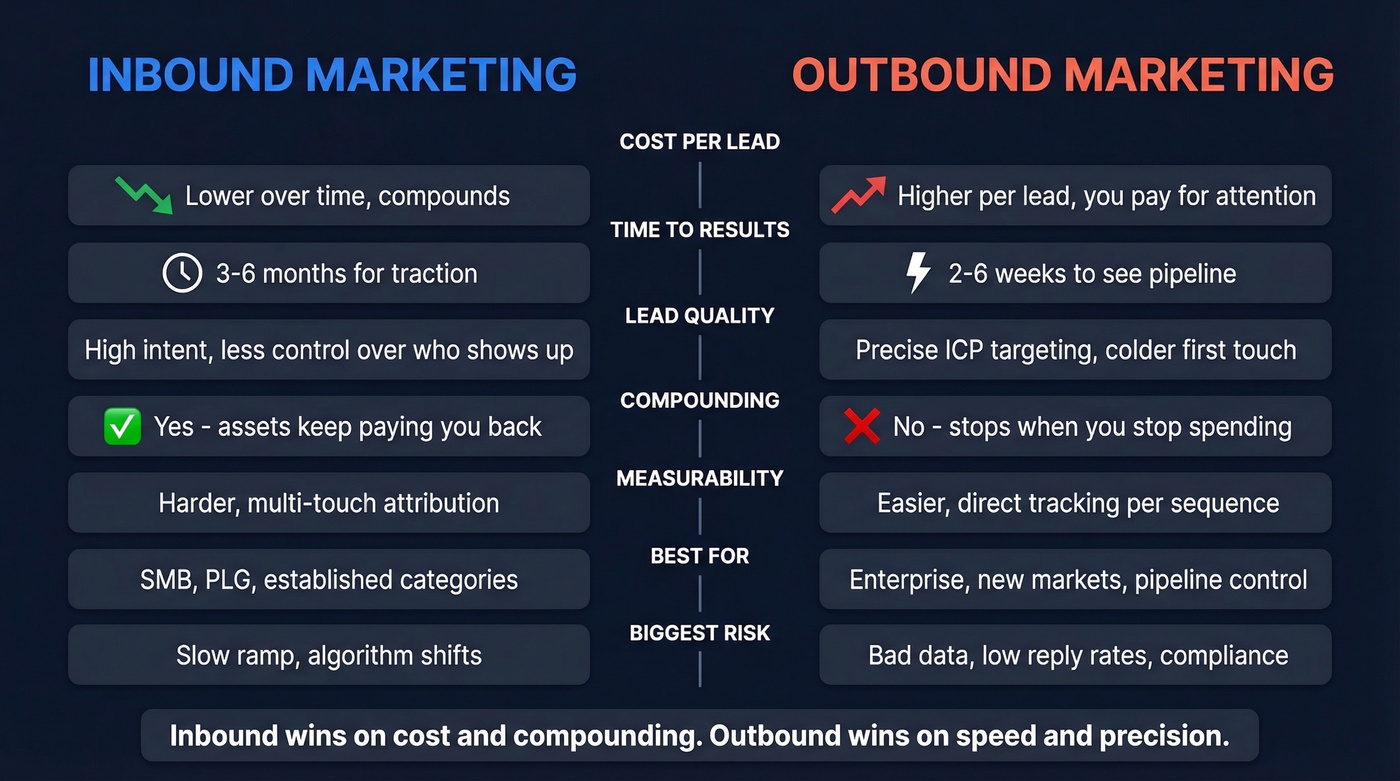
Inbound wins on cost and compounding. Outbound wins on speed and precision. That's the tradeoff, and pretending otherwise is how teams end up funding the wrong motion for two quarters straight.
Real cost benchmarks by industry
The "inbound is always cheaper" line falls apart once you look at industry benchmarks.
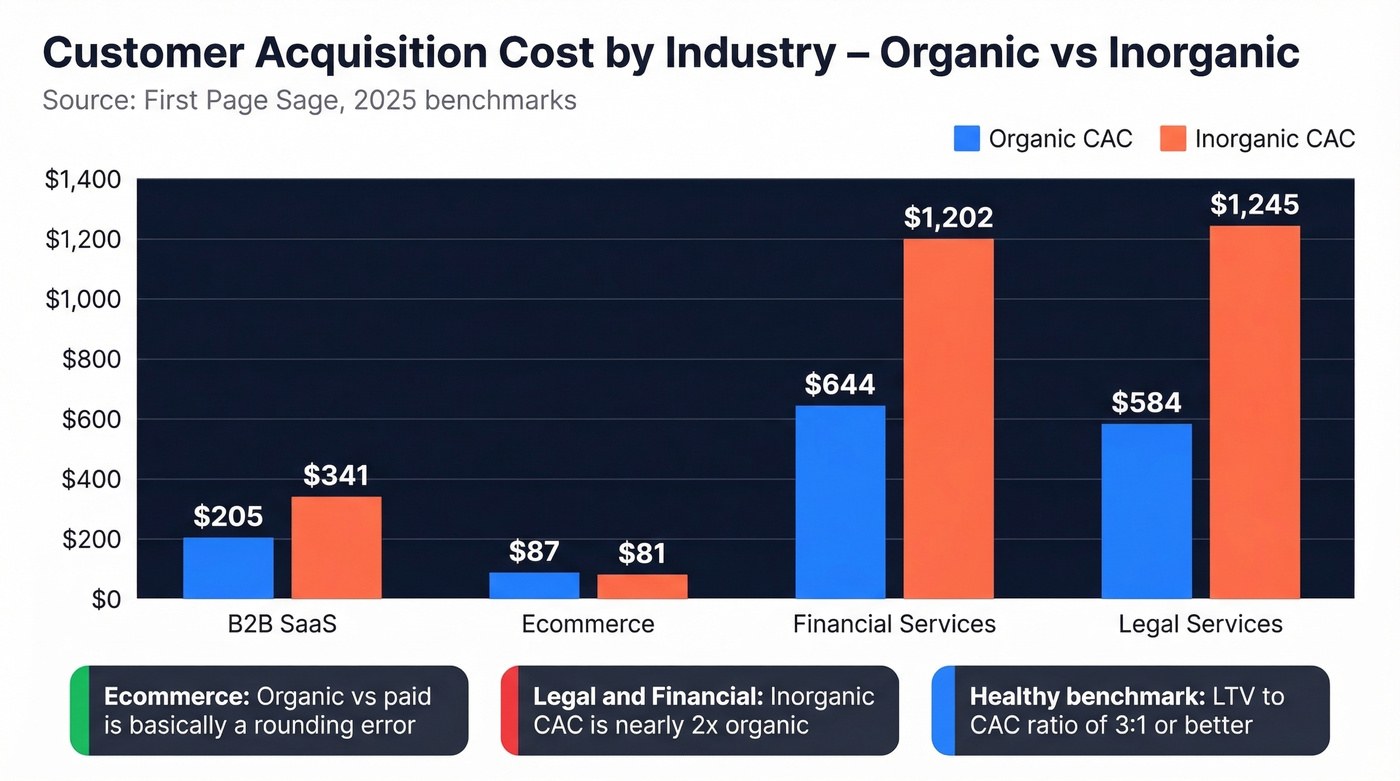
First Page Sage publishes CAC benchmarks by industry, including organic vs inorganic splits. Their latest dataset runs through 2025, and the spread is exactly what you'd expect: some markets barely differ, while others get punished for paid acquisition.
| Industry | Organic CAC | Inorganic CAC | Combined |
|---|---|---|---|
| B2B SaaS | $205 | $341 | $239 |
| Ecommerce | $87 | $81 | $86 |
| Financial Services | $644 | $1,202 | $784 |
| Legal Services | $584 | $1,245 | $749 |
A few takeaways:
Ecommerce is the weird one. Organic vs paid is basically a rounding error ($87 vs $81), which means the "inbound is cheaper" rule barely applies. If you're in that world, the real differentiator isn't inbound vs outbound, it's creative, offer, and conversion rate work.
Financial services and legal are the opposite. Inorganic CAC is nearly double organic, and that changes how you should plan your mix. In those industries, inbound isn't just "nice." It's how you keep CAC from eating your margins.
And yes, the investor-friendly sanity check still holds: LTV:CAC needs to land around 3:1 for most businesses. If you're below that, arguing about inbound vs outbound is just rearranging the deck chairs.
Outbound execution in 2026 (what actually breaks)
Look, most outbound "fails" for boring reasons: bad data, sloppy targeting, and teams trying to brute-force volume to compensate.
Here's a scenario we've seen too many times. An SDR team sends 5,000 emails. A huge chunk bounce. A few dozen reply. A handful book. Leadership concludes "outbound doesn't work anymore," and the team goes back to waiting for inbound leads that never arrive.
That's not an outbound problem. It's an inputs problem.
Some numbers worth keeping in your head:
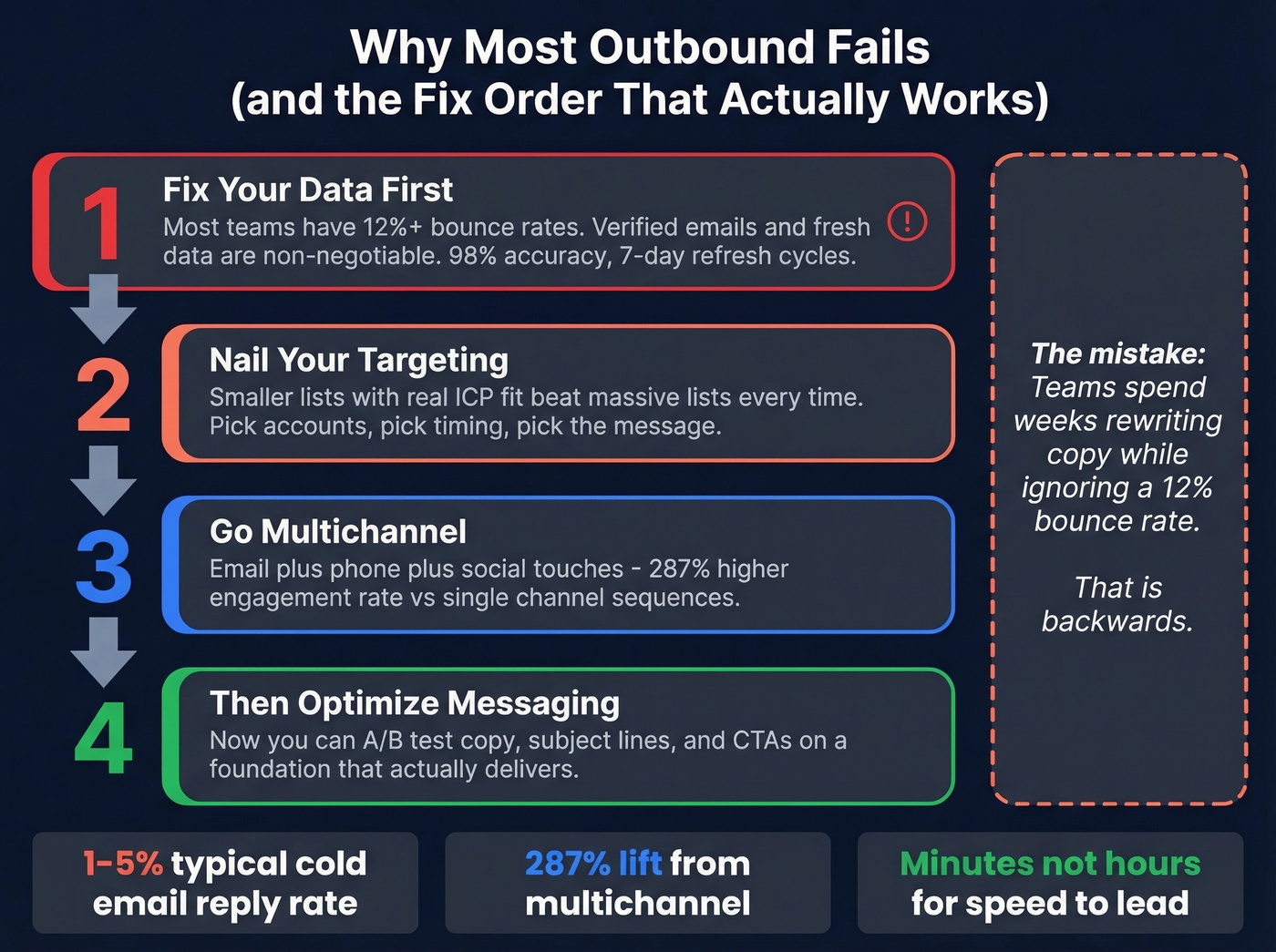
- Cold outreach response is brutal. Most cold emails get ignored, and 1-5% reply rates are common.
- Multichannel outreach (email + phone + social touches) consistently outperforms single-channel sequences. One widely cited stat puts the lift at 287% versus single-channel.
- Speed-to-lead matters more than most teams admit. The classic Harvard Business Review finding still gets repeated for a reason: responding within minutes dramatically increases your odds of connecting.
And here's the part that frustrates us: teams will spend weeks rewriting copy while ignoring a 12% bounce rate. That's backwards. Fix deliverability and list quality first, then optimize messaging.
This is where tools like Prospeo fit naturally in a modern outbound stack. If you're going to run outbound at scale, you need verified emails and direct dials you can trust, refreshed frequently enough that you aren't emailing people who left six months ago. Prospeo refreshes records every 7 days, verifies emails with 98% accuracy, and gives you access to 300M+ professional profiles, 143M+ verified emails, and 125M+ verified mobile numbers. That isn't "nice to have." It's the difference between a sequence that lands and a sequence that burns your domain.
A quick "skip this if..." moment: if you aren't willing to clean your targeting and data, skip outbound for now. You'll just create noise, annoy good prospects, and spend the next month trying to repair deliverability.

The article says it plainly: most outbound fails because of bad data, not bad messaging. Prospeo gives you 98% verified emails, 125M+ direct dials, and a 7-day refresh cycle so you're never emailing someone who left six months ago. At $0.01 per email, fixing your outbound inputs costs less than one bounced campaign.
Stop rewriting copy when your real problem is a 12% bounce rate.
Why inbound gets harder every year
Inbound still works. It's just less forgiving than it used to be.
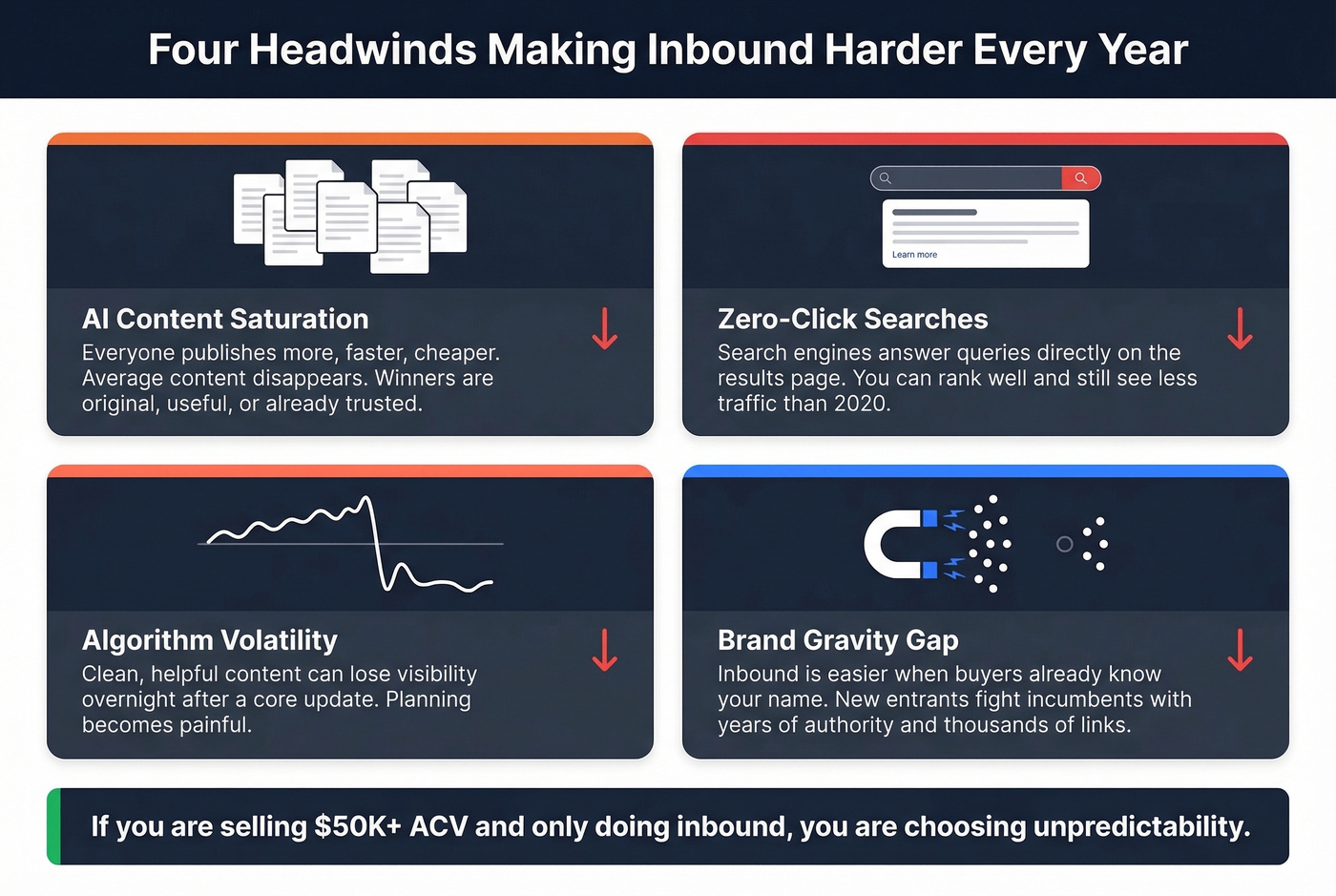
We've watched strong teams do everything "right" and still get clipped by forces they don't control. That's the reality of building on rented distribution.
Content saturation from AI is the obvious one. Everyone can publish more, faster, and cheaper, so average content disappears. The winners are either genuinely original, genuinely useful, or already trusted. Sometimes all three.
Zero-click searches are another headwind. Search engines answer more queries directly on the results page, which means you can rank well and still see less traffic than you would've in 2020.
Algorithm volatility makes planning painful. We've seen clean, helpful content lose visibility overnight after a core update, and the r/SEO threads after those updates read like group therapy.
Brand gravity matters more than people want to admit. Inbound is easier when buyers already recognize your name, because they click you, trust you, and convert faster. If you're a new entrant, you're fighting incumbents with years of authority and thousands of links, and no amount of "we published 12 blogs this month" changes that.
One opinion we hold pretty strongly: if you're selling $50K+ ACV and you're only doing inbound, you're choosing unpredictability. You'll get pipeline, but you won't control it, and you'll feel that lack of control every time organic traffic dips or a quarter gets tight.
Mistakes that kill both strategies
Inbound mistakes
Chasing high-volume keywords with unclear intent. Ranking for a broad term feels good until you realize the traffic doesn't buy. The best inbound programs mix informational content with commercial and decision-stage assets, then connect them with internal links and nurture.
If you want a tighter way to structure that journey, start with a B2B sales funnel that maps content to stages.
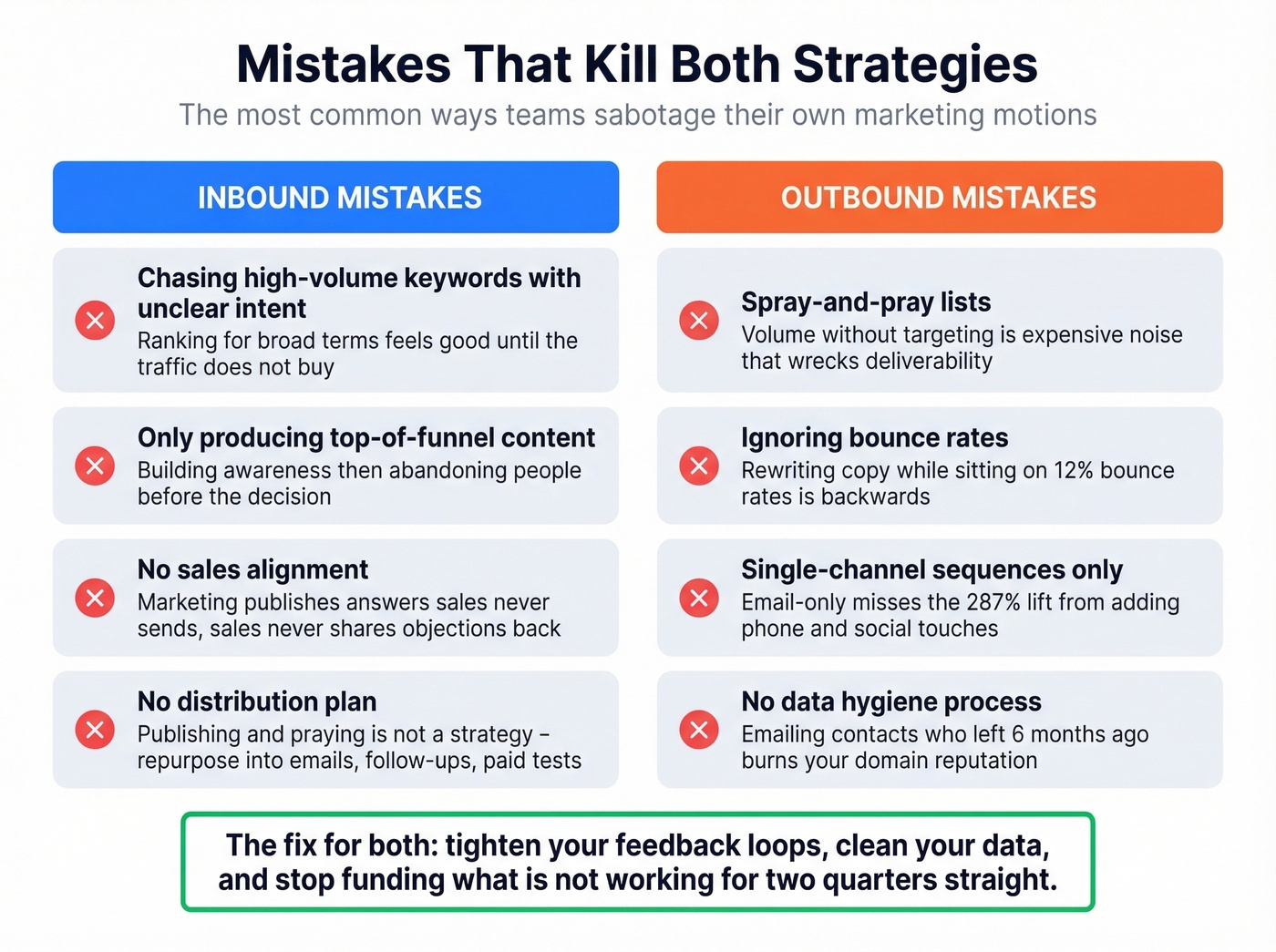
Only producing top-of-funnel content. If everything you publish is "what is X," you're building awareness and then abandoning people right before the decision. You need comparison pages, implementation guides, ROI proof, and objection-handling content that sales can actually use.
No sales alignment. This one is maddening. Marketing publishes answers to the exact questions prospects ask on calls, but sales never sends the content, and marketing never hears what objections are showing up this month. Fix the feedback loop and inbound conversion rates usually move without publishing a single new post.
No distribution plan. Publishing and praying isn't a strategy. Turn your best pieces into email sequences, sales follow-ups, partner co-marketing, and a few paid tests so you can learn faster - especially if you already have solid sales follow-up templates your team will actually use.

Outbound mistakes
Spray-and-pray lists. Volume without targeting is just expensive noise. Smaller lists with real ICP fit beat massive lists every time, and they do it without wrecking deliverability. If your ICP is still fuzzy, use an ideal customer profile template before you scale volume.
Single-channel outreach. Email-only sequences leave money on the table. Add calls, social touches, and retargeting where it makes sense. If calling is part of your mix, a repeatable cold calling system helps keep it from turning into random activity.
Fake personalization. "{first_name}" isn't personalization. A real trigger is a job change, a new office, a funding round, a tech stack shift, a hiring spike, or a clear intent signal. (More on doing this well: personalized outreach.)
Bad data. If your bounce rate is above 5%, stop. Fix the list. No copywriter on earth can write their way out of invalid addresses. Start with the basics: email bounce rate benchmarks and fixes.
Ignoring compliance. GDPR and CAN-SPAM aren't optional, and neither is basic respect for opt-outs. Read the rules and follow them.
- GDPR overview: https://gdpr.eu/
- CAN-SPAM compliance guide (FTC): https://www.ftc.gov/business-guidance/resources/can-spam-act-compliance-guide-business
How to combine inbound and outbound (the practical version)
"Do both" is true and also useless. The combined motion only works when you connect the systems.
Use inbound to earn attention, then use outbound to convert attention into conversations. If someone hits your pricing page twice and bounces, that's not a "nurture for 30 days" moment. That's an "AE reaches out with a specific offer" moment.
Turn outbound into a distribution channel for inbound assets. The best outbound teams don't just pitch. They send a relevant asset at the right time: a migration checklist, a benchmark report, a short teardown, a case study that matches the prospect's industry.
Retarget inbound visitors with paid and sales touches. Retargeting is the bridge. It keeps you present while outbound does the direct work.
Use intent signals to time outbound. When an account is actively researching a topic you solve, your outbound stops being an interruption and starts being help. That's the difference between "delete" and "sure, send it over." If you need a practical way to operationalize that, build around identifying buying signals.
A quick anecdote from a recent pipeline review: we watched a team spend weeks trying to "improve outbound copy" while their best-performing inbound asset was a simple ROI calculator that converted at 4%+ for the right traffic. The fix wasn't rewriting sequences. It was building a cadence that led with the calculator, then following up with a short, specific ask. Meetings went up. Replies got shorter. Everyone stopped arguing.
Prospeo is useful here in a very unglamorous way: it helps you reach the right people reliably once those inbound and intent signals tell you who to contact. Clean data makes the whole inbound-to-outbound handoff work, because you're not wasting your best timing on bounced emails.

Decision framework: which way should you lean?
The right mix comes down to five variables. Not your CEO's preference. Not what your last company did.
| Factor | Lean inbound | Lean outbound |
|---|---|---|
| Deal size | Under $10K | $50K+ |
| Sales cycle | Under 30 days | 3-12 months |
| Market maturity | Established category | New or emerging category |
| Team | Small team, no SDRs | SDR/AEs ready to prospect |
| Stage | Pre-PMF validation | Post-PMF pipeline scaling |
A simple starting point we use:
- No SDRs? Start inbound. Build the content engine, tighten conversion, and get your positioning right.
- SDRs + $50K+ ACV? Start outbound-heavy. You need pipeline control, and the unit economics can support it. (If you're building the stack, start with a shortlist of SDR tools.)
- Entering a new market? Outbound first, even if you love inbound. You can't capture demand that doesn't exist yet.
One more "skip this if..." call: if your product positioning is still fuzzy, don't scale outbound. You'll just amplify confusion. Inbound can tolerate fuzzy messaging for a while. Outbound punishes it immediately.
CTA
Running inbound and outbound together means you need precise ICP targeting without enterprise pricing. Prospeo's 30+ search filters - buyer intent, technographics, headcount growth, funding - let you build outbound lists as targeted as your best inbound leads, then verify every contact before it hits your sequence. Teams using Prospeo book 35% more meetings than Apollo users.
Combine inbound precision with outbound speed - starting free.
FAQ
Is inbound marketing cheaper than outbound?
On average, yes over the long run. For B2B SaaS, First Page Sage reports organic CAC around $205 versus $341 for inorganic. But the gap varies by industry; in ecommerce, the difference is negligible ($87 vs $81). For enterprise B2B, targeted outbound often produces pipeline faster than waiting on SEO.
What's the difference between inbound and outbound marketing?
Inbound attracts prospects already looking for answers through content, SEO, and nurture. Outbound reaches prospects directly through cold email, calling, paid ads, events, and direct outreach. Inbound captures existing demand. Outbound creates demand and gives you more control over who enters the funnel.
How long does inbound take to show results?
Expect 3-6 months for measurable traction and 6-12 months for meaningful scale in most B2B markets. SEO often takes around 9 months to break even, then it compounds if you keep publishing and updating what works.
What's the best way to start combining both approaches?
Start inbound to validate messaging and build assets that convert. Then layer outbound once your ICP is clear, using your best inbound assets as the "reason" for the outreach. The fastest wins usually come from outbound triggered by inbound signals: pricing page visits, webinar attendance, high-intent content consumption, and account-level intent.
How do you measure outbound success?
Track bounce rate, deliverability, reply rate, meeting-booked rate, cost per qualified meeting, and pipeline created per rep. If bounce rate is above 5%, fix data quality before you touch copy.