

Best Inside Sales Tracking Software for Every Layer of Your Stack
A RevOps lead we know ran a 3-tool bake-off last quarter. The "best" CRM created 4,000 duplicate contacts in Salesforce within five days. The cheapest tool had better phone connect rates. The lesson wasn't about which tool won - it was that tracking is a stack problem, not a single-tool problem.
63% of CRM initiatives fail due to poor training and adoption. Poor data quality costs $32,000 per sales rep per year in wasted effort. If you're not running enrichment alongside your CRM and engagement tools, your dashboards are lying to you.
Our Top Picks
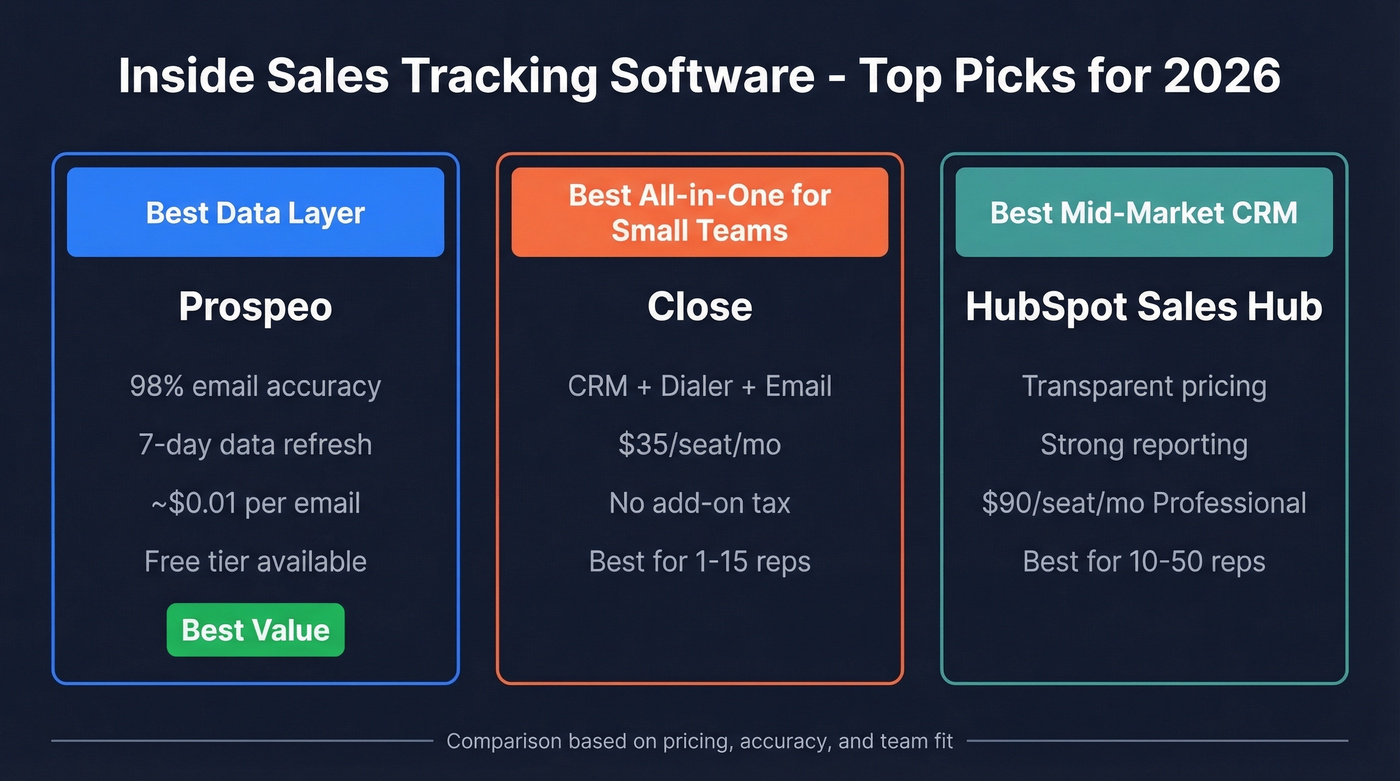
- Best data layer: Prospeo - 98% email accuracy, 7-day refresh, ~$0.01/email. Free tier available.
- Best all-in-one for small teams: Close - CRM + dialer + email from $35/seat/mo. No add-on tax.
- Best mid-market CRM: HubSpot Sales Hub - transparent pricing, strong reporting, $90/seat/mo at Professional.
Tool Comparison Table
| Tool | Category | Starting Price | Billing | Best For |
|---|---|---|---|---|
| Close | CRM + Dialer | $35/seat/mo | Monthly or annual | Small teams (1-15 reps) wanting CRM, dialer, and email in one tool |
| HubSpot Sales Hub | CRM | $90/seat/mo (Professional) | Annual | Mid-market teams (10-50 reps) needing strong reporting out of the box |
| Pipedrive | CRM | $14/user/mo | Monthly or annual | SMBs that only need visual pipeline tracking |
| Salesforce | CRM | $25/user/mo (+ implementation) | Monthly or annual | 50+ seat teams with a dedicated admin |
| Outreach | Sales Engagement | $100-140/user/mo base | Annual (5-seat min) | Enterprise teams running complex multi-step sequences |
| Salesloft | Sales Engagement | ~$125/user/mo (negotiated) | Annual | Mid-to-large teams wanting engagement + forecasting in one suite |
| Apollo | Sales Engagement + Data | $49/user/mo | Monthly or annual | Budget-conscious teams needing prospecting and sequencing together |
| ZoomInfo | Data + Intent | $15,000+/year | Annual (2-3 year contracts) | Enterprise teams that need bundled intent data and massive databases |
| Kixie | Dialer | $35/month | Monthly | Small teams needing a standalone power dialer |
| Gong | Conversation Intelligence | ~$30,000-80,000/year | Annual | Teams with enough call volume to generate coaching insights at scale |
Metrics Your Sales Tracking Must Capture
Before picking tools, know what you're measuring. These benchmarks separate high-performing inside sales teams from everyone else.
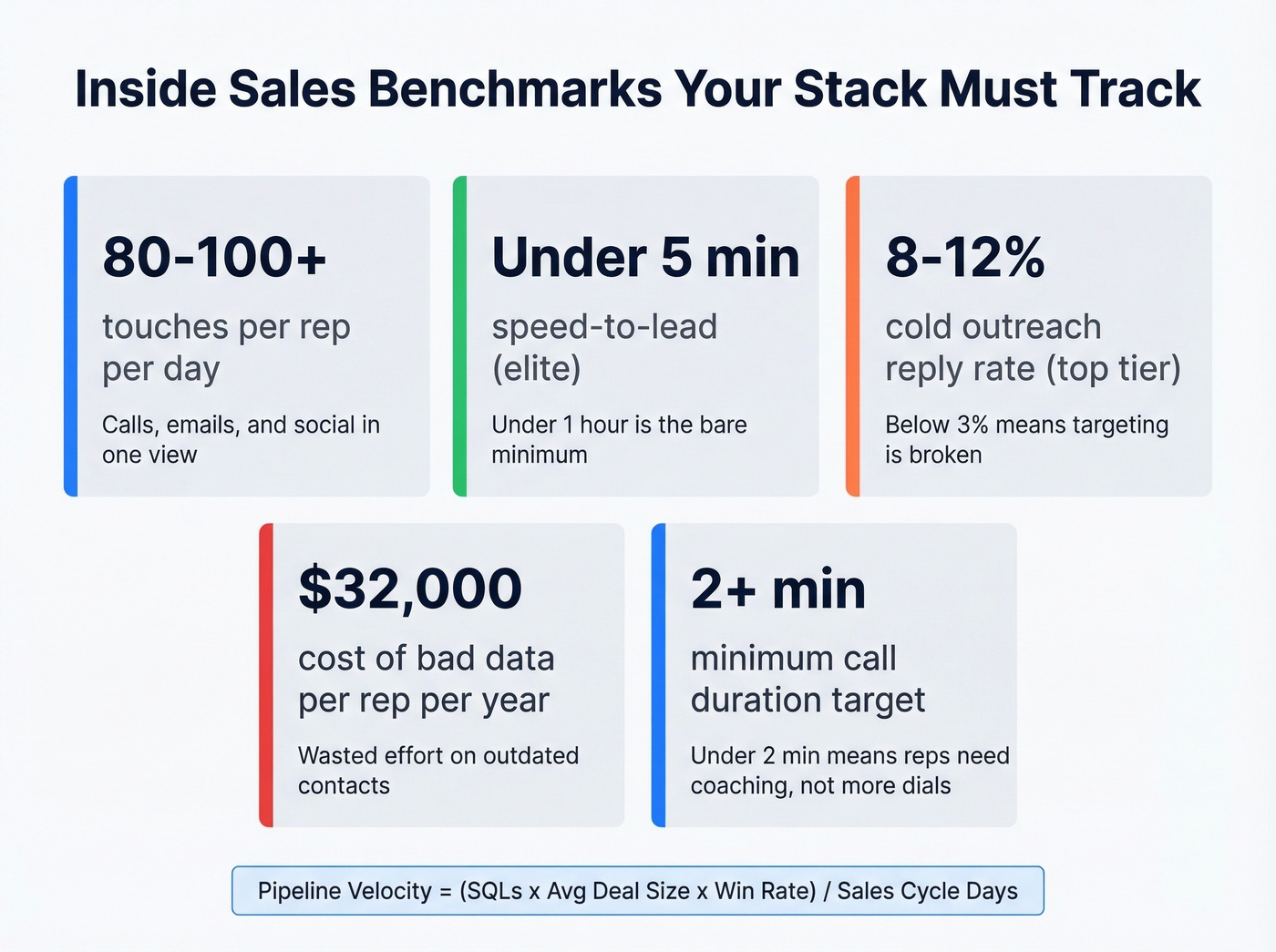
Activity volume. 80-100+ touches per rep per day is the standard. Your software needs to capture calls, emails, and social touches in one view - not scattered across three dashboards. If you need a clean definition of what counts, start with these sales activities.
Speed-to-lead. Under 5 minutes is elite. Under an hour is the minimum. If your CRM can't trigger alerts the moment a lead comes in, you're losing deals before reps even see them. This is also where lead status hygiene matters more than most teams admit.
Reply rate and lead-to-meeting rate. An 8-12% reply rate on cold outreach is top-tier; below 3% means your targeting or messaging is broken. For outbound prospecting, a 1-3% lead-to-meeting conversion rate is the benchmark. Track both at the sequence level, not just the campaign level - that's where the real signal lives. If you're rebuilding messaging, keep a set of proven sales follow-up templates handy.
Pipeline velocity. The formula: (SQLs x Avg Deal Size x Win Rate) / Sales Cycle Length in days. Every tool in your stack should feed data into this calculation. Strong CRM analytics surface this metric automatically rather than forcing managers to export spreadsheets and build formulas by hand. For a broader view of what predicts revenue, see pipeline health.
Call duration. Reps who can't keep prospects on the phone longer than two minutes need coaching, not more dials. Your dialer should surface this automatically.

Bad data costs $32,000 per rep per year in wasted effort. Every metric in your inside sales stack - reply rates, pipeline velocity, speed-to-lead - depends on reaching real people at verified addresses. Prospeo's 7-day data refresh and 98% email accuracy mean your CRM stays clean and your reps stop chasing ghosts.
Stop tracking vanity metrics on dirty data. Start with accuracy.
The Tools, by What They Track
CRM & Pipeline Tracking
Close - Use this if you're running a team of 1-15 inside sales reps and want calling, SMS, and email built into your CRM without bolting on three separate tools. Skip this if you need enterprise-grade reporting or complex multi-object data models. Starts at $35/seat/mo with the dialer included - that's the key differentiator.

HubSpot Sales Hub - The go-to for mid-market teams of 10-50 reps that want transparent pricing and strong out-of-the-box reporting. Skip this if your budget is tight. The Starter plan at $9/seat/mo is too limited to be useful, and you'll realistically need Professional at $90/seat/mo to unlock the reporting and automation that make HubSpot worth it. One compliance note: if you're selling into Europe, confirm SOC 2 and GDPR coverage with any CRM vendor before signing. If you're comparing options, this list of examples of a CRM can help frame the tradeoffs.
Pipedrive starts at $14/user/mo and does one thing well: visual pipeline tracking for SMBs. It's not an inside sales platform - you'll need to add a dialer and engagement tool on top. If you're building a lightweight stack, pair it with a dedicated SDR tool rather than forcing Pipedrive to do everything.
Salesforce starts at $25/user/mo on paper, but implementation is a major cost for smaller teams. It's the right choice at 50+ seats with a dedicated admin. Overkill for everyone else. If you're budgeting, it helps to understand the real-world gotchas in Salesforce pricing.
Engagement & Activity Tracking
Here's where pricing gets ugly. Let's break down what these tools actually cost.
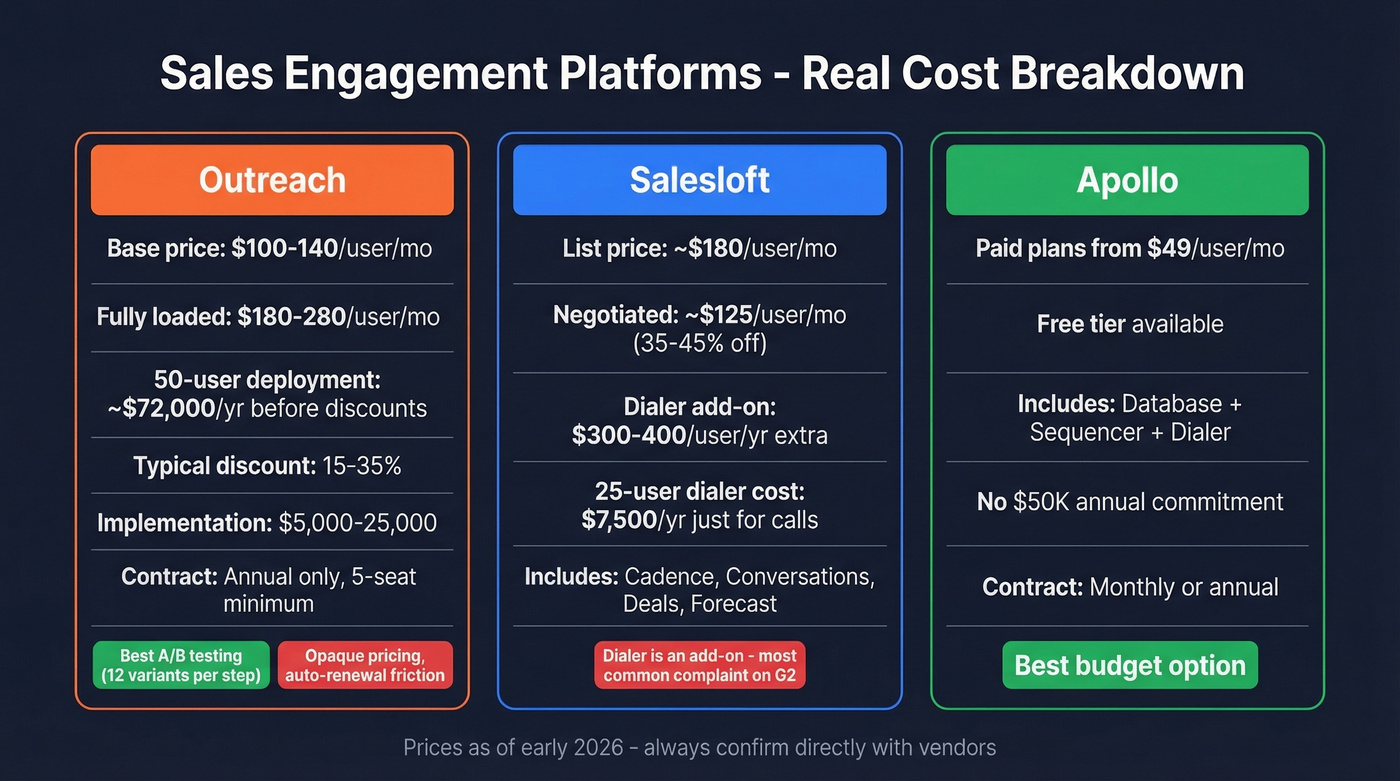
Outreach is the enterprise sequencing standard. The Engage module runs $100-140/user/mo, but fully loaded with Kaia, Deal management, and Forecast, expect $180-280/user/mo. A 50-user Engage deployment lists at roughly $72,000/year before discounts (typical discounts run 15-35%). Annual contracts only, 5-seat minimums, and implementation runs $5,000-25,000.
Best-in-class A/B testing with up to 12 variants per step and deep Salesforce integration make it worth the price for enterprise teams. The downsides: opaque pricing and auto-renewal friction are common complaints on G2 and TrustRadius. Outreach's HubSpot integration can also have sync delays, so test thoroughly if you're running that mid-market stack.
Salesloft positions itself as a "Revenue Orchestration Platform" - Cadence, Conversations, Deals, Forecast, and Rhythm in one suite. List price runs ~$180/user/mo, but negotiate hard and expect 35-45% off, landing around $125/user/mo. Here's the frustrating part: the dialer is an add-on for both plans, running ~$300-400/user/year extra. For a 25-user team, that's $7,500/year just to make phone calls from the platform you're already paying for. On G2, the dialer add-on cost is one of the most common Salesloft complaints, and honestly, we get why.
Apollo is the budget alternative that keeps getting better. Free tier available, paid plans from $49/user/mo with a built-in database, sequencer, and dialer. It won't match Outreach's enterprise workflow depth, but for teams that need prospecting and engagement in one tool without a $50K annual commitment, it's the obvious starting point. If you're tightening outbound, these sales prospecting techniques help you get more from the same toolset.
Data Quality & Enrichment
This is the layer most teams skip - and it's the one that makes or breaks everything else. 70.3% of contact data becomes outdated every year. Your activity metrics, pipeline reports, and forecasts are only as accurate as the contact data underneath them. If you're evaluating vendors, start with a shortlist of data enrichment services.
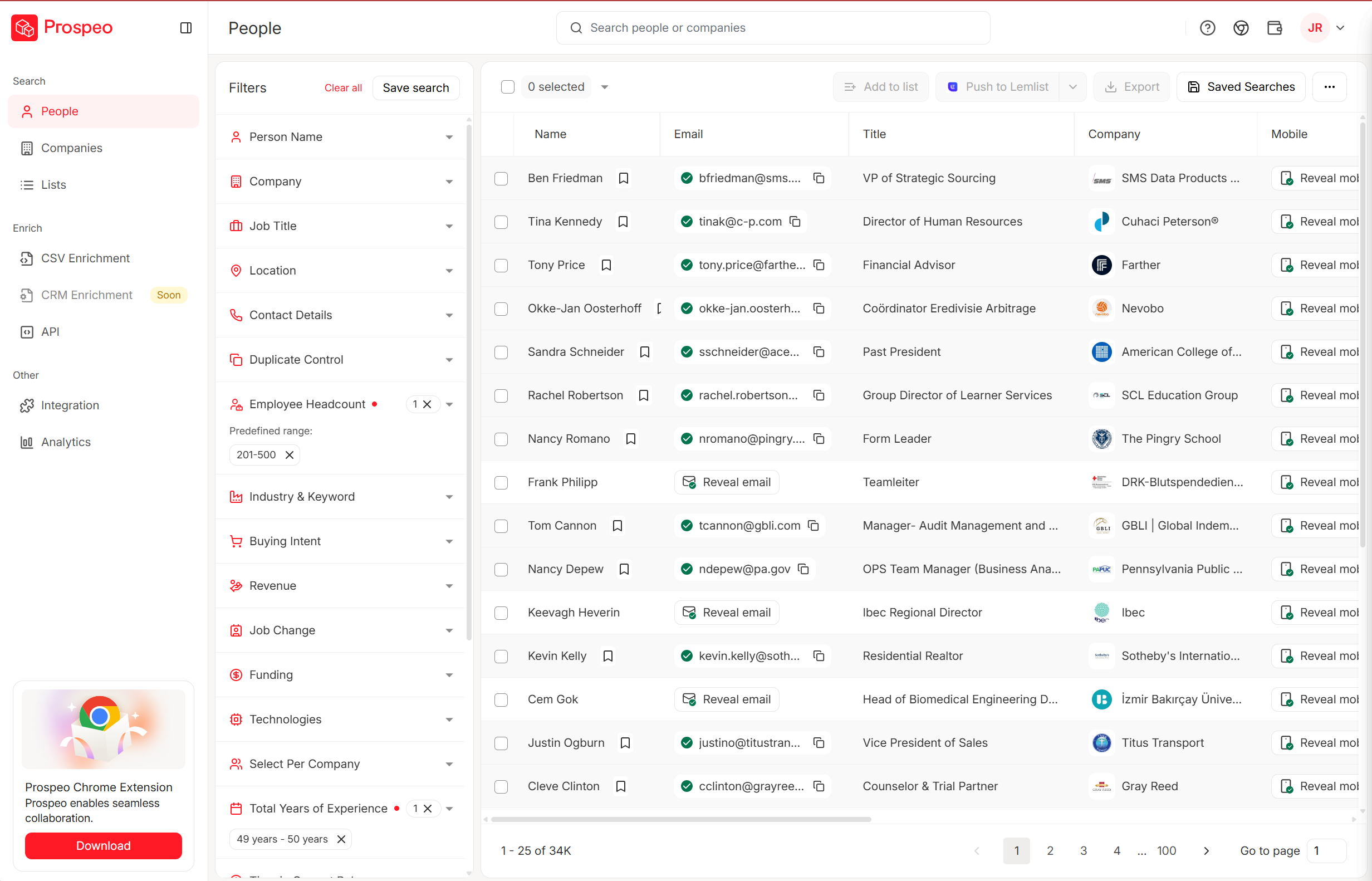
The platform runs on credits at roughly $0.01 per email, with a free tier (75 emails/month + 100 Chrome extension credits/month), no contracts, and full GDPR compliance. It integrates natively with Salesforce, HubSpot, Lemlist, Instantly, Smartlead, Outreach, Clay, Zapier, and Make - so enrichment flows directly into whatever CRM and engagement tools you're already using. If you're building lists in Clay, this Clay list building guide is a useful companion.
Compare that to ZoomInfo, where Professional starts at $15,000+/year with 5,000 annual credits. Some teams pay close to $50,000/year once you move up tiers and add modules. ZoomInfo pushes 2-3 year contracts with 60-90 day auto-renewal windows. For enterprise teams with massive data needs and budget to match, it works. For everyone else, you're paying 10x more for a contract that's harder to unwind.
Your CRM, dialer, and engagement platform are only as useful as the contact data flowing through them. Prospeo enriches your pipeline with 50+ data points per contact at a 92% match rate - for ~$0.01 per email. No annual contracts, no sales calls, no $15K minimums like ZoomInfo.
Feed your inside sales stack data that actually connects reps to buyers.
Dialers & Conversation Intelligence
If you picked Close, you already have a dialer. If you didn't, Kixie starts at $35/month and integrates with most CRMs - it's the simplest standalone power dialer for small teams. For parallel dialing at scale (20+ reps), Nooks and Orum offer custom-priced solutions (expect $100-200/user/mo) that let reps run multiple simultaneous calls. If you're comparing calling stacks, these Dialpad alternatives are a good starting point.
Gong is the conversation intelligence standard for coaching at scale. Pricing is custom and enterprise-oriented - expect $30,000-80,000/year depending on team size. It's worth it when you have enough call volume to generate statistically meaningful coaching insights. For smaller teams, Outreach's Kaia or Salesloft Conversations cover the basics without a separate contract.
What a Full Tracking Stack Costs
| Stack Tier | Tools | 5 Reps/Year | 20 Reps/Year |
|---|---|---|---|
| Enterprise | Salesforce + Salesloft + ZoomInfo + Gong | ~$60,000-80,000 | ~$200,000-300,000 |
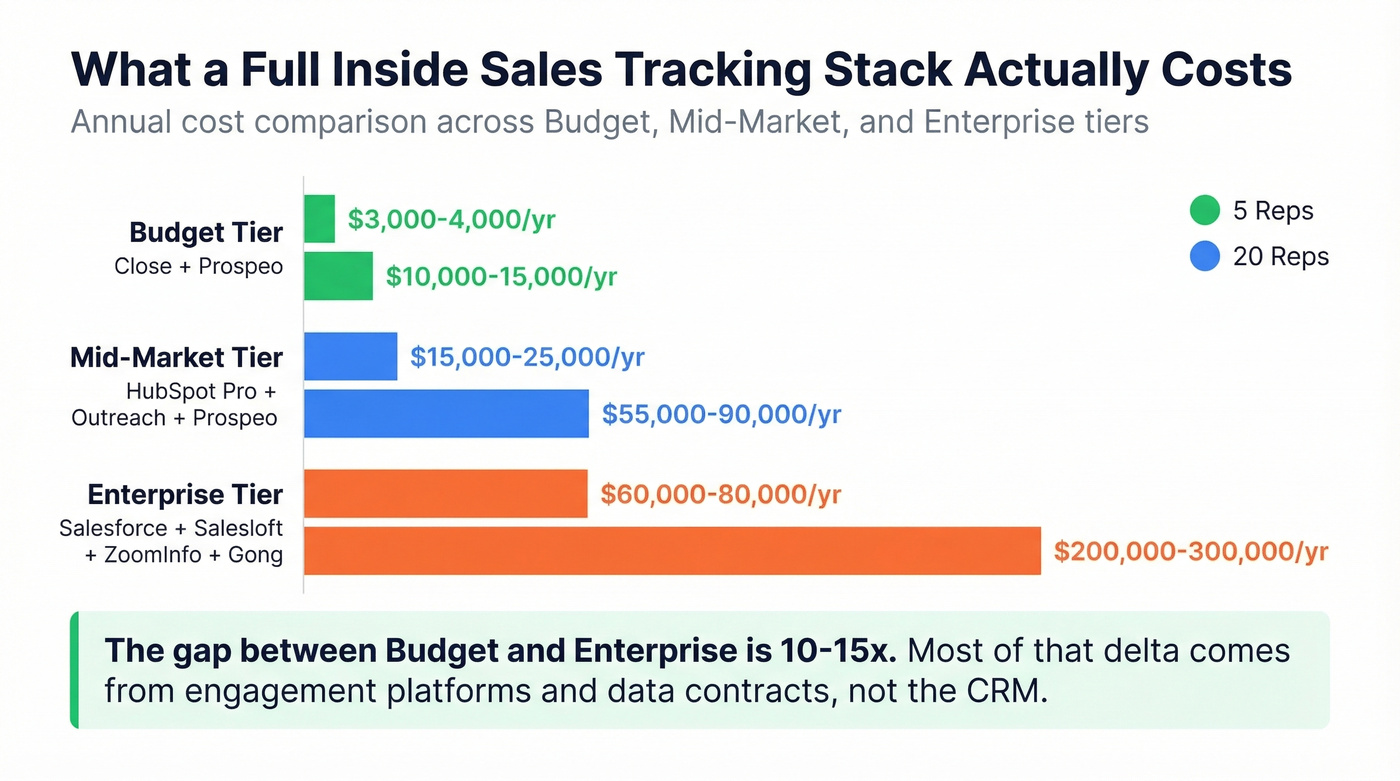
The gap between Budget and Enterprise is 10-15x. Most of that delta comes from engagement platform pricing and data contracts, not the CRM itself. We've seen teams run the Budget stack for two years, prove ROI, and then selectively upgrade individual layers rather than jumping straight to Enterprise.
Real talk: if your average contract value is under $15K, you almost certainly don't need an Enterprise-tier stack. The Budget tier with Close and clean data will outperform a bloated Enterprise stack with dirty data every single time. Spend the savings on hiring another rep.
Quick Picks by Team Size
5-20 reps: HubSpot Sales Hub Professional + Apollo (or Outreach if budget allows) for engagement, plus a dedicated enrichment layer. At this size, invest in proper CRM analytics so managers can spot rep-level bottlenecks before they tank the quarter.
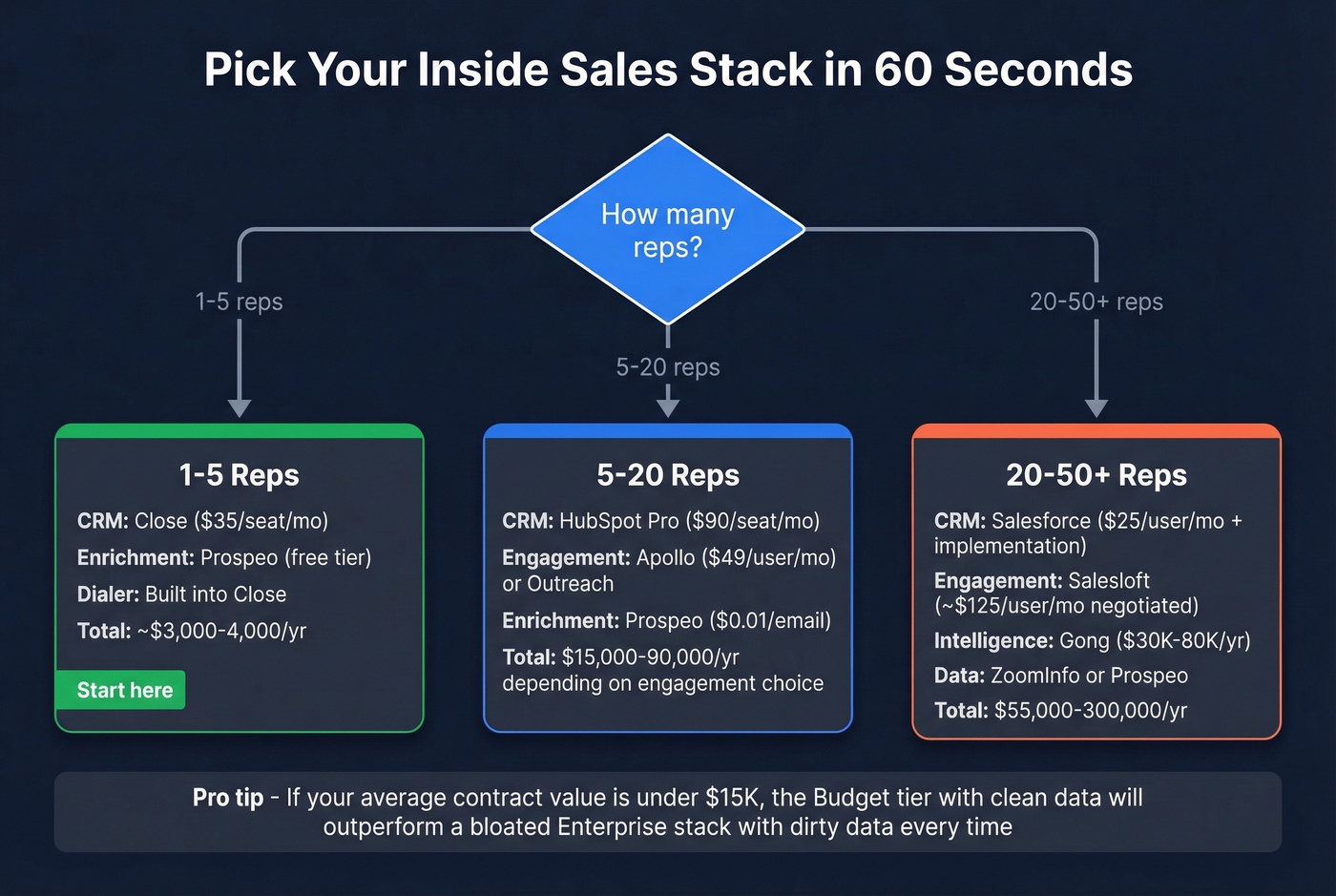
20-50+ reps: Salesforce + Salesloft + Gong, with ZoomInfo if you need bundled intent data at scale or Prospeo if you want higher accuracy at a fraction of the cost. At this scale, the data layer decision alone can save $30,000-40,000/year - the consensus on r/sales is that most teams overpay for data they don't fully use.
FAQ
What's the difference between a CRM and inside sales tracking software?
A CRM tracks deals and pipeline stages. Inside sales tracking software is broader - it covers activity metrics for calls, emails, and touches, plus data quality monitoring and engagement analytics. Most teams need a CRM plus 2-3 additional tools for engagement, enrichment, and conversation intelligence.
How much does an inside sales tracking stack cost?
Budget stacks run $4,500-6,000/year for 5 reps (Close + Prospeo). Mid-market stacks with HubSpot, Outreach, and enrichment hit $40,000-55,000/year. Enterprise stacks featuring Salesforce and ZoomInfo can exceed $200,000/year for 20 reps.
Why does data quality matter for sales tracking?
70.3% of contact data becomes outdated every year, costing $32,000 per rep annually in wasted effort. If reps dial dead numbers or email bounced addresses, activity metrics look healthy but pipeline suffers. A 7-day refresh cycle keeps CRM records current, while most competitors refresh every 4-6 weeks - a gap that compounds fast across a 20-person team.
What's a good free tool for inside sales data enrichment?
Prospeo offers 75 free email lookups and 100 Chrome extension credits per month with no contract - enough for a solo founder or small team running real outbound. Apollo also has a free tier with limited credits. ZoomInfo doesn't have a self-serve free option.