

Inside Sales vs Outside Sales: What the Data Actually Shows
The line between inside sales and outside sales used to be obvious. Inside reps worked the phones; field reps worked the road. That distinction is dissolving fast. B2B buyers now use an average of 10 interaction channels during their buying journey - up from 5 in 2016. McKinsey's "rule of thirds" holds across industries and geographies: roughly one-third of buyers prefer in-person, one-third prefer remote, and one-third prefer digital self-serve at any stage of the deal.
So the question isn't really "inside or outside?" anymore. It's about understanding where each model wins, where it doesn't, and how to blend them.
Here's the quick version. Inside sales covers 4x the prospects at half the cost. Outside sales still wins for complex, multi-stakeholder deals above $50K ACV. McKinsey found that 85% of companies expect hybrid sales to be the most common job role within three years. The real question is what percentage of your revenue motion should be remote vs. in-person.
What Is Inside Sales in 2026?
Inside sales means selling remotely - phone, email, video, social. No flights, no handshakes, no expense reports. It's the engine behind most SaaS, mid-market, and SMB sales motions, and it now accounts for the majority of the sales workforce. Per RepMove's guide citing Zippia, 53.7% of US sales reps work in inside sales roles, compared to 46.3% in outside sales.
The operational profile is straightforward. Inside reps typically engage 40-60 prospects per day, with high-activity teams pushing 50-80 calls daily for lead qualification. Deal sizes usually fall in the $5,000-$50,000 range, with sales cycles running 2-8 weeks. Ramp time for a new inside rep is roughly 4-6 weeks to productivity - significantly faster than field roles (use a 30-60-90 day plan to shorten it).
Where inside sales really shines is scalability. You can hire a team of five SDRs, seat them anywhere, arm them with a dialer and a verified contact database, and have them generating pipeline within a month. Try doing that with field reps who need territory plans, travel budgets, and months to build relationships.
Outside Sales in 2026
Outside sales - also called field sales - means meeting prospects face-to-face. These reps spend approximately 60-70% of their time in person with buyers, whether that's on-site demos, executive dinners, or multi-day workshops with procurement teams.
A common benchmark is about 5 in-person visits per day. That sounds low until you factor in travel, prep, and the depth of each interaction. These aren't cold calls. They're relationship-building sessions for deals that often exceed $50,000 and stretch across months of negotiation.
Outside sales earns its keep in environments where trust is the currency: enterprise software, medical devices, industrial equipment, financial services. When a deal involves six stakeholders, a custom implementation, and a board-level sign-off, a Zoom call isn't going to close it. The field rep's job is to navigate complexity that can't be compressed into a 30-minute demo.
That said, the pure field model is shrinking. In-person sales now generate just 17% of B2B revenue, down from 22% in 2022. E-commerce has become the top revenue-generating channel for B2B, accounting for more than one-third of total revenue. The reps who thrive in outside sales today are the ones who've learned to blend in-person moments with remote touchpoints.
In a lot of orgs, the inside/outside distinction is increasingly a title on a business card, not a description of how they actually sell. Many "outside" reps now run a big chunk of their deal cycle over video and email, saving in-person visits for the moments that genuinely move the needle.
Key Differences: The Real Numbers
Let's break down the numbers side by side.
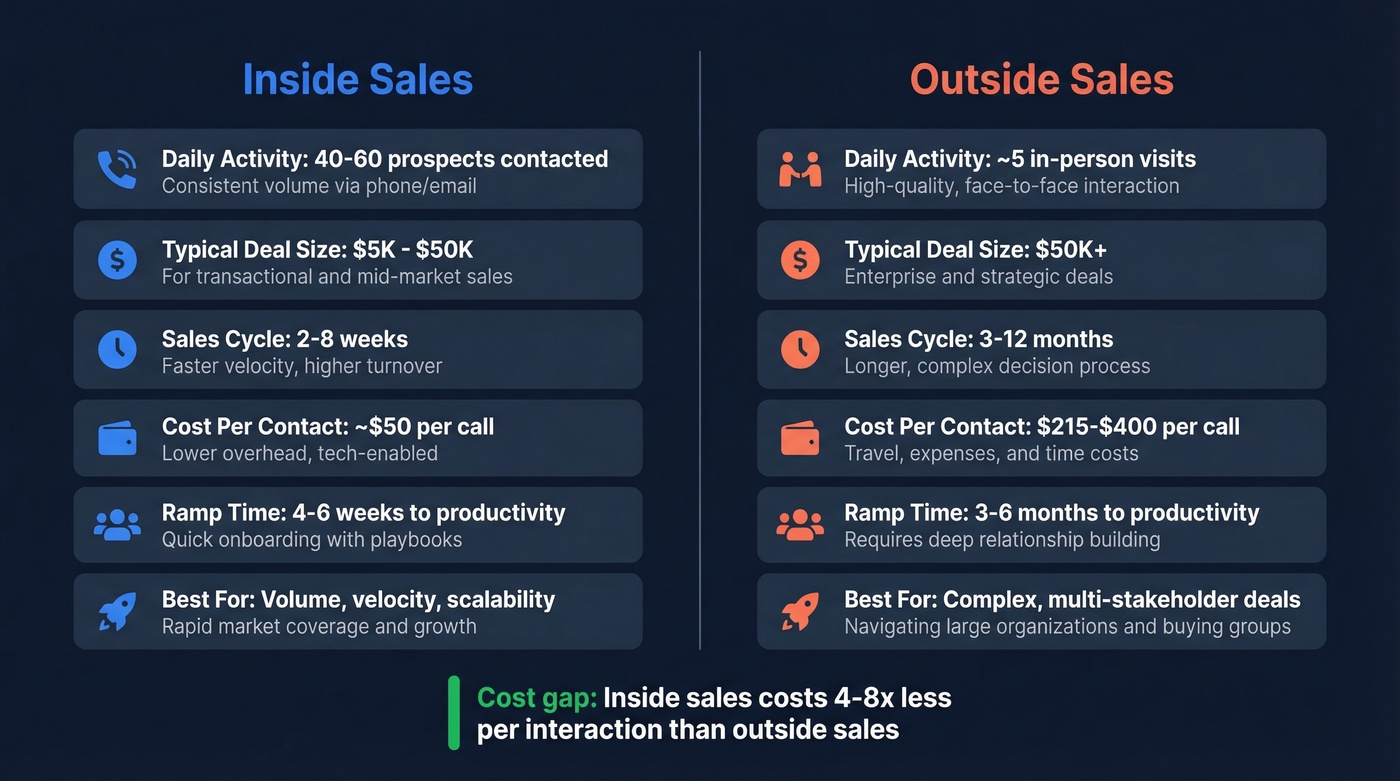
| Dimension | Inside Sales | Outside Sales |
|---|---|---|
| Daily activity | 40-60 prospects | ~5 in-person visits |
| Typical deal size | $5K-$50K | $50K+ |
| Sales cycle | 2-8 weeks | 3-12 months |
| Cost per contact | ~$50/call | $215-$400/call |
| Prospect coverage | 4x field capacity | ~5 accounts/day, high-touch |
| Ramp time | 4-6 weeks | 3-6 months |
| Industries | SaaS, fintech, SMB services | Pharma, industrial equipment, enterprise software |
| Best for | Volume, velocity, scalability | Complex, regulated, multi-stakeholder |
The cost gap is the number that should jump out. An inside sales call runs about $50 on average, while an outside sales call costs $215-$400 when you factor in travel, meals, and time. That's a 4-8x difference per interaction.
Does that mean inside sales is always more efficient? No. A $200K enterprise deal that requires three on-site visits and closes in six months has a very different ROI profile than a $15K SaaS deal closed over Zoom in three weeks. What matters is cost per dollar of revenue generated - and that's where the hybrid math gets interesting (especially when you track cost to acquire customer).
One data point worth flagging: Outreach's research found that deals closed within 50 days show a 47% win rate, compared to just 20% for deals extending beyond 50 days. Speed favors remote selling - but only when the deal complexity allows it.
What You Actually Earn
Compensation is where this debate gets personal.
| Role Type | Base Salary | Variable | Total OTE |
|---|---|---|---|
| Inside SDR/BDR | $50K-$60K | 25-35% of OTE | ~$85K |
| Inside AE (SaaS) | $65K-$80K | 40-50% of OTE | $110K-$140K |
| AE (mid-market/enterprise) | $77K-$100K | 50% of OTE | ~$154K |
| Sales Engineer | $90K-$110K | Varies | $121,520 median (BLS) |
Per Everstage's compensation data, the SDR OTE in SaaS sits around $85K with a 65-75% base split, while AEs average $154K OTE on a 50/50 base-to-variable structure. A commonly cited benchmark from RepMove's guide is that inside sales averages about ~$59K base plus $12K in commissions, while outside sales averages ~$87K base plus ~$23K in commissions.
Outside sales pays more on average, but the gap narrows fast at senior inside roles. A top-performing inside AE at a growth-stage SaaS company can clear $200K+ OTE without ever boarding a plane. The real compensation differentiator isn't your title - it's deal size and quota attainment (and how you define OTE in sales).

Inside reps hit 40-60 prospects a day - but only if every email and phone number actually connects. Prospeo delivers 98% email accuracy and 125M+ verified mobile numbers with a 30% pickup rate, so your inside team spends time selling, not bouncing.
Give your inside team the contacts that actually pick up.
The $500K Remote Deal
There's a persistent belief that large deals require in-person selling. The numbers tell a different story.
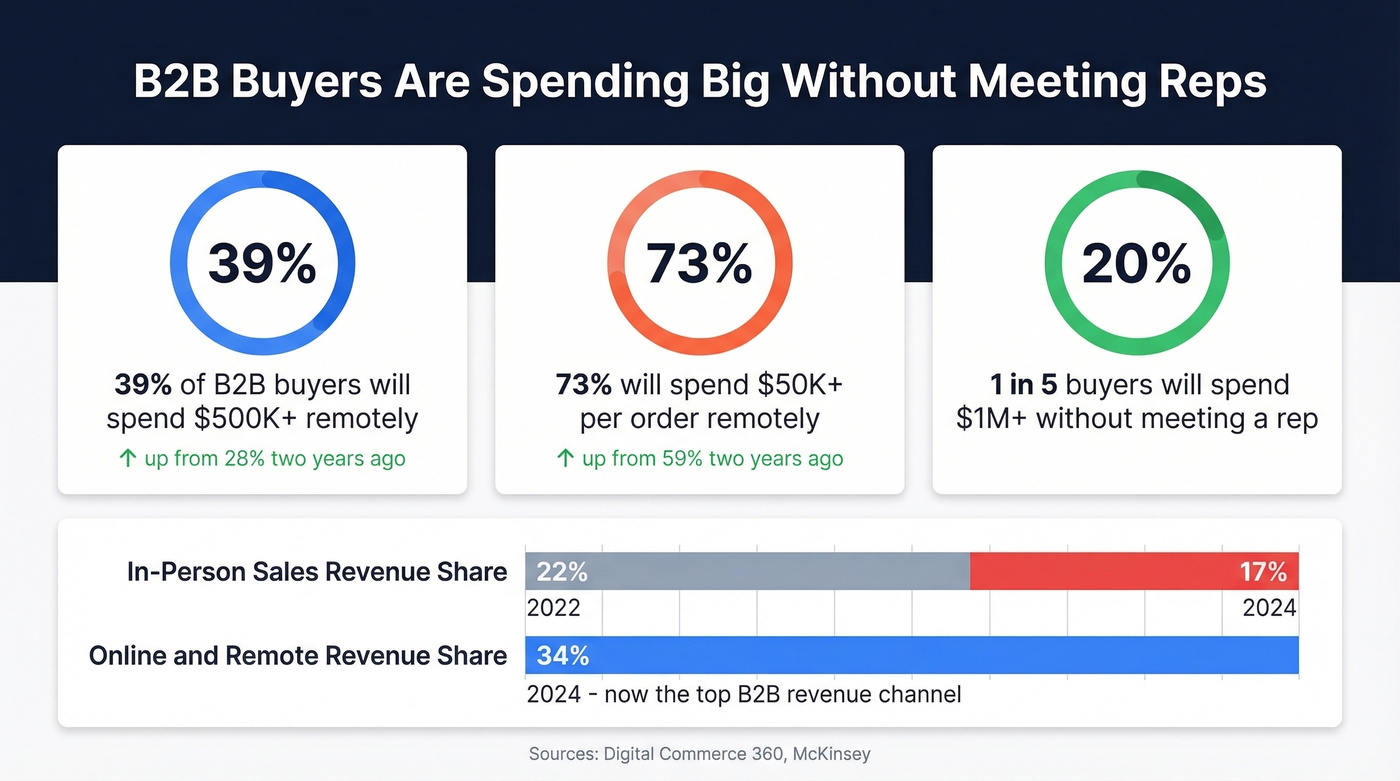
39% of B2B buyers are now willing to spend over $500,000 per order via remote channels or digital self-service - up from 28% just two years ago. One in five will spend over $1 million without meeting a rep face-to-face. And the trend isn't limited to the top end: 73% of B2B buyers will now spend over $50,000 per order remotely, up from 59% two years prior.
Meanwhile, in-person revenue's share dropped from 22% to 17% of total B2B revenue. Online sales via self-service and remote rep connections now account for 34%.
The $500K remote deal isn't a myth anymore. It's a trend line. The companies still insisting that every six-figure deal needs a steak dinner are leaving money on the table - and losing deals to competitors who let buyers purchase the way they want to.
Here's the thing: if your ACV is under $50K, you almost certainly don't need field reps. And for deals in the $50K-$150K range, you need fewer of them than you think. The buyer preference data is unambiguous - most decision-makers would rather skip the on-site visit if a video call gets the job done. This is the single biggest shift in how remote and field selling compare over the past five years.
How AI Is Changing Inside Sales
AI isn't replacing inside sales reps. It's making them dramatically more productive.
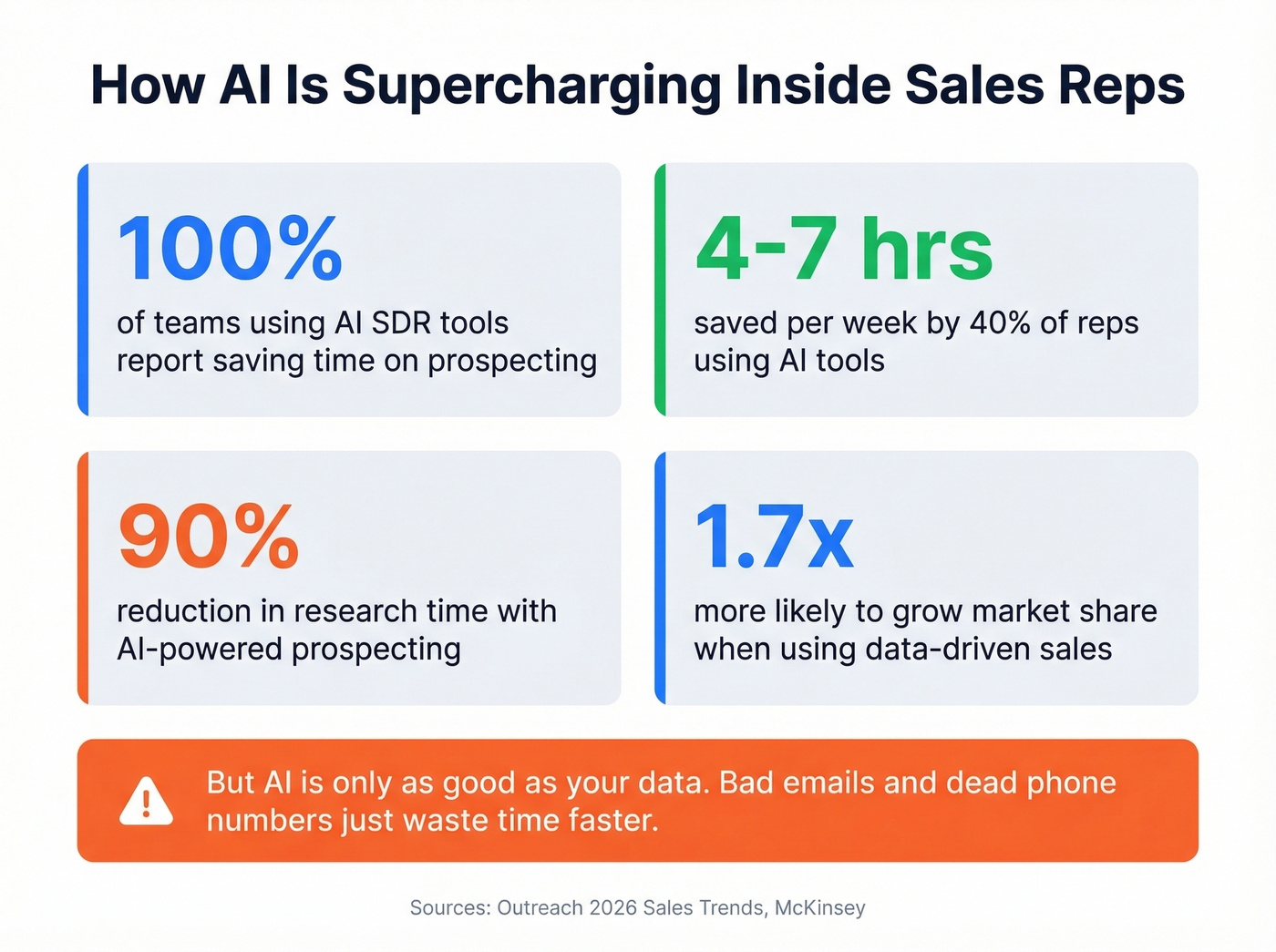
Outreach's 2026 sales trends report paints a clear picture: 100% of teams using AI SDR tools report saving time on prospecting. 40% save 4-7 hours per week. And 45% of high-performing teams have adopted hybrid human-AI SDR models where AI handles research, sequencing, and initial outreach while humans step in for conversations that require judgment.
Data-driven sales teams are 1.7x more likely to increase market share - a gap that widens as AI tooling matures (more on data-driven selling).
The productivity gains are stacking up. AI-powered prospecting delivers up to a 90% reduction in research time and a 35% improvement in engagement rates. That's not incremental. It's a step change in what a single inside rep can accomplish.
But here's what gets overlooked: AI tools are only as good as the data feeding them. We've watched teams burn through sequences on bounced emails and disconnected numbers, thinking they had an outreach problem when they actually had a data problem. An AI SDR torching your domain reputation on dead addresses isn't saving time - it's wasting it faster. That's why a 98% email accuracy baseline and a weekly data refresh cycle matter more than which AI sequencer you pick (see email bounce rate).
Hybrid Sales - The Model That's Winning
The hybrid model isn't a compromise. It's the evolution of both approaches.
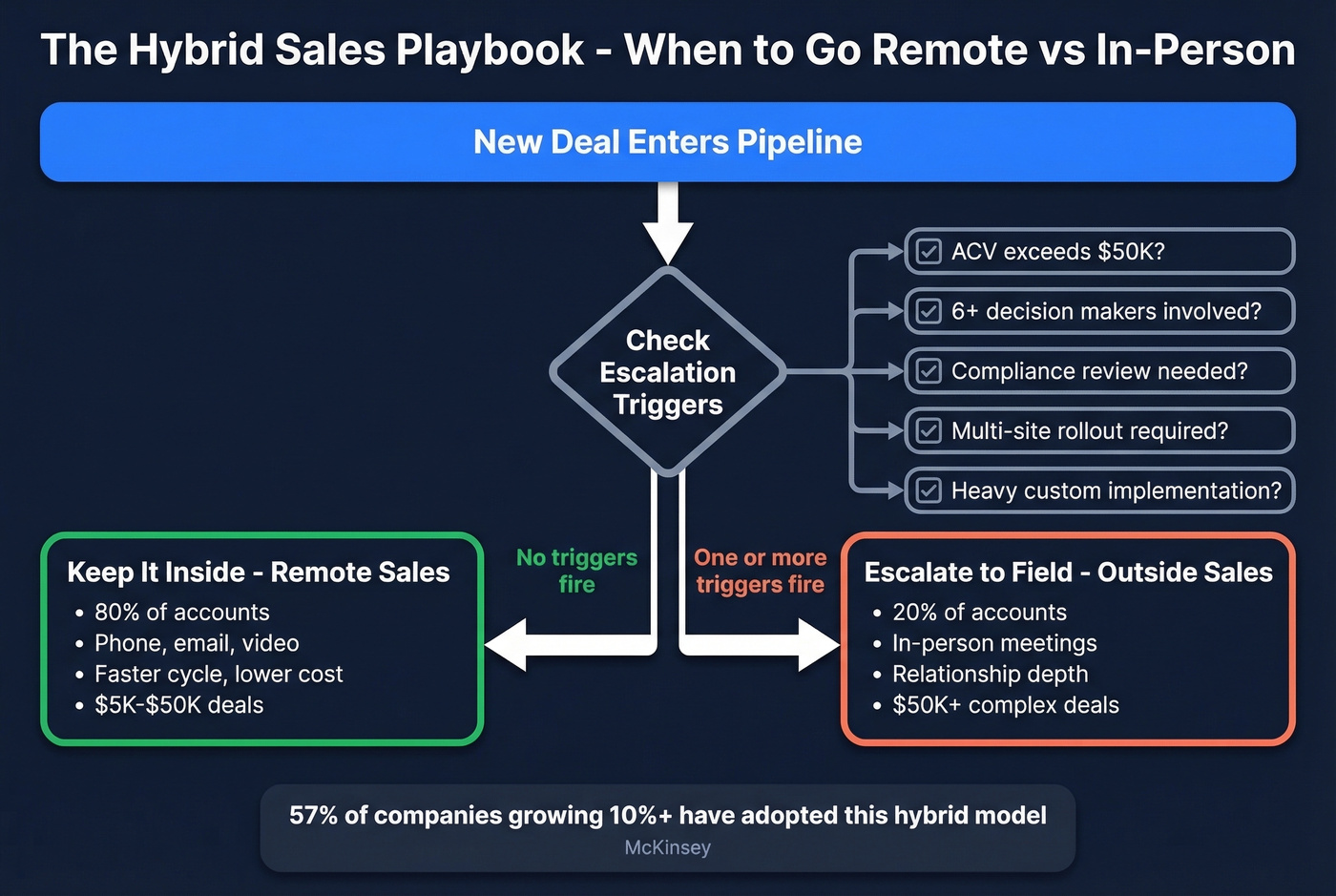
Among companies that grew more than 10% in 2022, 57% had adopted a hybrid sales model. McKinsey found that 85% of companies expect hybrid sales to be the most common job role within three years - and the shift is accelerating.
The practical framework is an 80/20 coverage model. Up to 80% of accounts - typically smaller and mid-sized, representing roughly half of revenue - can be covered remotely. The remaining 20% require in-person interactions for deal complexity, relationship depth, or regulatory requirements.
The question is when to escalate from remote to field. Here's a trigger framework we've seen work well:
| Trigger | Escalate to Field |
|---|---|
| Deal size | ACV exceeds $50K |
| Stakeholders | 6+ decision makers |
| Regulation | Compliance review needed |
| Deployment | Multi-site rollout |
| Customization | Heavy implementation |
If none of those triggers fire, keep the deal inside. Your field reps should be spending their time on the 20% of accounts that genuinely need them - not on deals that could close over video.
Skip the field investment entirely if you're a SaaS company selling sub-$30K deals to single-threaded buyers. We've seen teams add field reps at that ACV and watch their cost-per-acquisition double without any meaningful lift in win rate.
Your Inside Sales Stack Starts with Data
Look, we've seen inside teams making 50-80 calls a day lose more time hunting for accurate contact info than actually selling. That's a data problem, not a productivity problem. The consensus on r/sales is pretty consistent: bad data kills more pipeline than bad messaging.
Prospeo solves this at the foundation layer. The platform covers 300M+ professional profiles with 143M+ verified emails at 98% accuracy and 125M+ verified mobile numbers with a 30% pickup rate. Every record refreshes on a 7-day cycle - the industry average is six weeks, which means most databases are serving stale data by default.

For inside sales teams, the workflow is simple: use 30+ search filters - buyer intent, technographics, job changes, headcount growth, funding - to build a targeted list, export verified contacts, and push them directly into your sequencer via native integrations with Outreach, Salesloft, Lemlist, or HubSpot (compare options in best SDR tools).
Whether your reps close deals over Zoom or in the boardroom, bad data kills pipeline. Prospeo refreshes 300M+ profiles every 7 days - not every 6 weeks - so your hybrid team always reaches the right buyer at the right time.
Stop wasting $400 field visits on outdated contacts.
FAQ
What's the difference between inside and outside sales?
Inside sales is conducted remotely via phone, email, and video; outside sales involves face-to-face meetings with prospects. Inside reps handle 40-60 prospects daily at ~$50 per contact, while field reps average 5 visits at $215-$400 each. The core split comes down to cost structure, deal complexity, and buyer engagement preference.
Is outside sales dying?
No, but pure field roles are shrinking fast. In-person interactions now generate just 17% of B2B revenue, down from 22% in 2022. Most field positions are evolving into hybrid roles that blend on-site visits with remote selling for the majority of the deal cycle.
Which pays more, inside or outside sales?
Outside sales typically pays more - AEs average ~$154K OTE vs. ~$85K for inside SDRs. Senior inside AEs at growth-stage SaaS companies regularly clear $200K+ OTE, though. Deal size and quota attainment matter more than the role label.
Can inside sales close large deals?
Yes. 39% of B2B buyers now spend over $500K remotely, and one in five will spend over $1M without meeting a rep in person. Deal complexity and buyer preference drive the close, not the channel.
What tools do inside sales teams need most?
A CRM, a verified contact data platform for accurate emails and direct dials, a sales engagement tool like Outreach or Salesloft, and video conferencing. Bad data is the biggest silent killer of inside sales productivity - 98%+ email accuracy should be the baseline, not a nice-to-have.