

How to Write an Intro Email to a New Client (With 7 Templates)
A CSM we know sent a beautifully crafted intro email to new client accounts last quarter - role definition, value proposition, Calendly link, the works. Near-zero replies. The email wasn't bad. It was wrong for the audience: IT buyers who prefer transactional interactions and don't want a 30-minute "get to know you" call.
Cold email reply rates average 1-5%, and new client introductions aren't much better when you treat every recipient the same way. The fix isn't better copy - it's a better framework.
The Quick Version
If you're in a rush, here's the anatomy of an introduction email that actually gets replies:
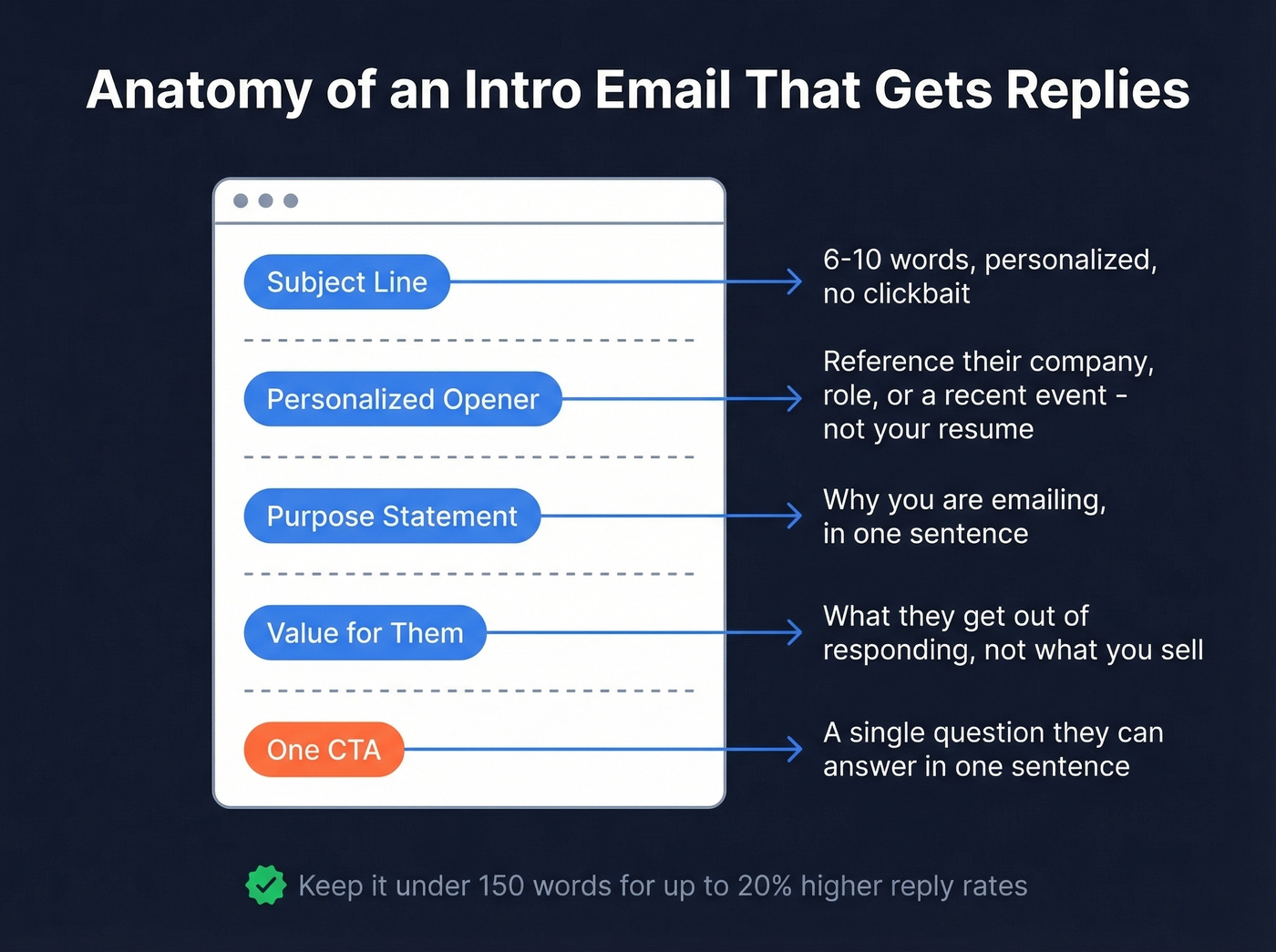
- Subject line: 6-10 words, personalized, no clickbait
- Personalized opener: Reference their company, role, or a recent event - not your resume
- Purpose statement: Why you're emailing, in one sentence
- Value for them: What they get out of responding, not what you sell
- One CTA: A single question they can answer in a sentence
Every template below follows this structure. Jump to the templates if you want to skip the reasoning.
What Makes a Great Introduction Email
Your intro email isn't about you. That's the single biggest mistake we see: people leading with credentials, company history, and role descriptions. Your new client doesn't care how long you've been at the company. They care about one thing - what happens next and how you make their life easier.
Lead with purpose, not background. Instead of "I've been a CSM for 6 years and I'm excited to work with you," try "I'm your point of contact for [project]. Here's what I need from you to get started." The first version is about you. The second is about them. Instead of "Our company was founded in 2012 and serves 500+ clients," try "We'll have your team onboarded by Friday." Same information hierarchy - you just flipped who benefits.
Personalized subject lines get 50% higher open rates. Subject lines between 6-10 words hit 21% open rates, which is the sweet spot for mobile screens where 47% of people check email on their phones. Keep the body under 150 words and you'll see up to 20% higher reply rates.
One CTA. Not two, not three. Every additional link or ask dilutes the response. And stop sending Calendly links in email one - a scheduling link feels presumptuous when someone hasn't even decided they want to talk to you. Ask a question they can reply to in one sentence. The meeting comes in email two or three.
The Numbers Behind Client Introductions
| Metric | Benchmark |
|---|---|
| Cold email reply rate (avg) | 1-5% |
| Top performer reply rate | 40-50% |
| Personalized subject lines | +50% opens |
| Numbers in subject lines | up to +113% opens |
| Welcome email open rate | 82% |
| First follow-up impact | +25% reply chance |
| 4-7 emails in sequence | 3x response rate |
| Best send time | 1 PM on weekdays |
| Mobile email checks | 47% of recipients |
| Salespeople who stop after 1 email | 70% |
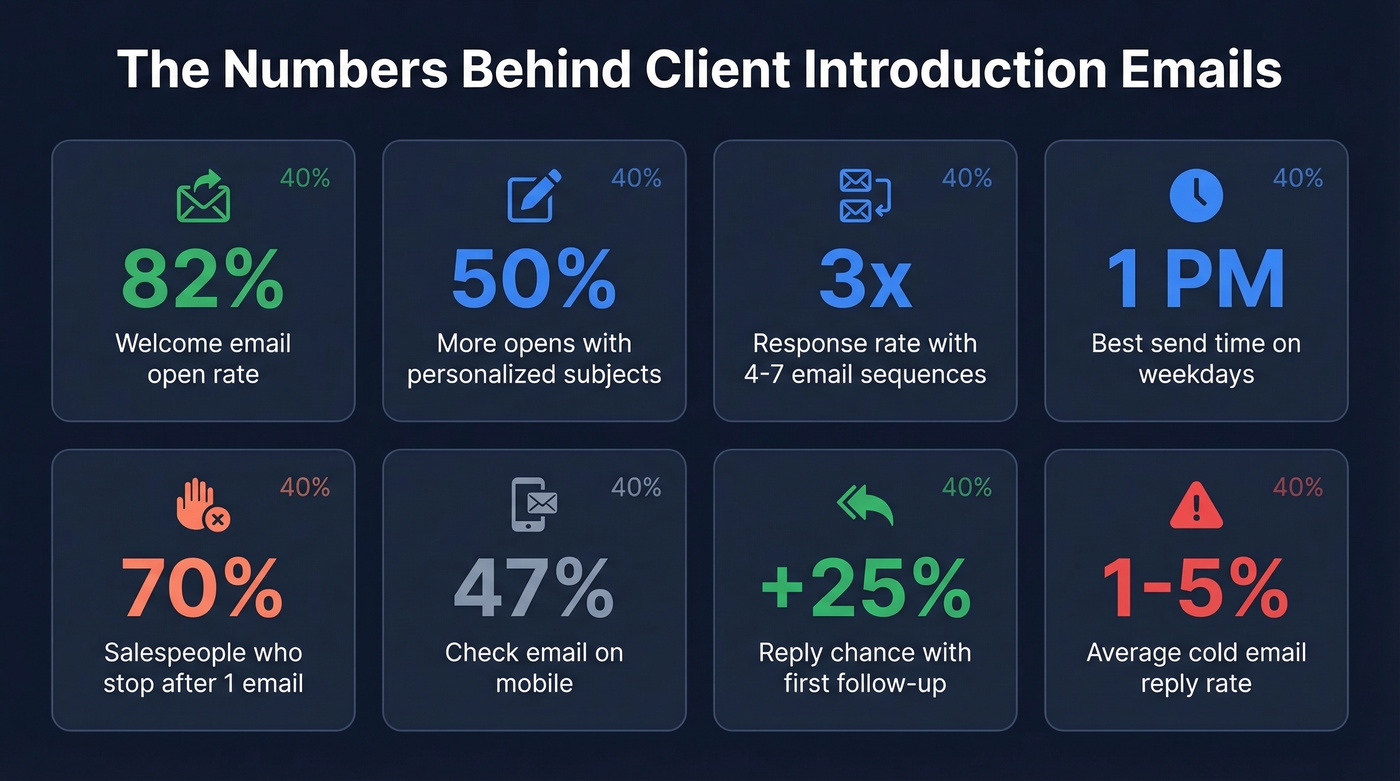
That last stat matters most. Seven out of ten salespeople send one email and give up. Most replies come after email two or three. If you're only sending the intro and moving on, you're leaving responses on the table.

A perfect intro email means nothing if it bounces. One bad address on a new domain tanks your sender reputation and kills your entire campaign. Prospeo verifies emails with 98% accuracy - so every intro you craft actually reaches the inbox.
Verify your prospect's email before you waste the perfect intro.
7 Intro Email Templates for Every Scenario
Templates without strategy are just Mad Libs. Each one below is built for a specific situation - use the one that matches your context, then adapt.
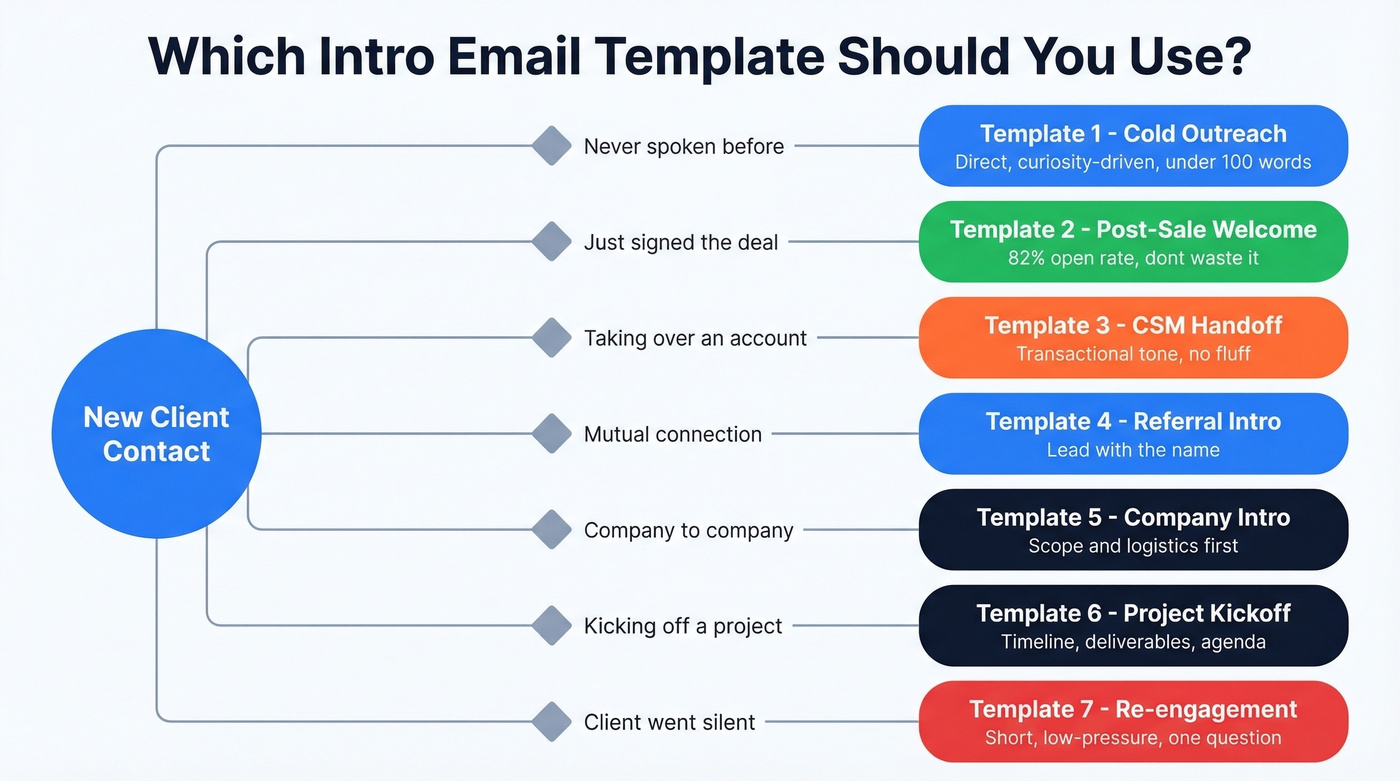
1. Cold Outreach to a Prospect
Before sending cold intros, verify the email address. A single bounce on a new domain hurts your sender reputation fast, and we've seen entire campaigns tank because someone skipped this step. Prospeo checks addresses in seconds with 98% accuracy, which is worth the 30 seconds it takes.
Tone: Direct and curiosity-driven. No warmth needed - earn it first.
Subject: Quick question about [specific initiative] at [Company]
Hi [First Name],
I noticed [Company] recently [specific trigger - new hire, funding round, product launch]. We help [similar companies] solve [specific problem] - typically cutting [metric] by [result].
Is [specific challenge] something your team is thinking about this quarter?
Best, [Your Name]
Keep this under 100 words. No attachments, no links, no pitch deck. This works best when you reference a real trigger event rather than a generic value prop. If you need more ideas, borrow from these sales prospecting techniques.
2. Post-Sale Welcome / Onboarding
Welcome emails hit an 82% open rate - the highest of any email type. Don't waste it.
Tone: Warm but structured. This is the one place where 150-200 words is fine.
Subject: Welcome aboard - here's what happens next
Hi [First Name],
Thanks for choosing [Company]. I'm [Your Name], your [role] and main point of contact going forward.
Here's what to expect this week:
- [Onboarding step 1]
- [Onboarding step 2]
- [Key resource or login link]
What's the best day/time for a 20-minute kickoff call?
Looking forward to working together, [Your Name]
Customize the onboarding steps for each account. A generic "we'll be in touch" wastes the highest-engagement email you'll ever send.
3. Account Manager or CSM Handoff
This is where the "zero replies" problem lives. The Reddit threads on r/CustomerSuccess are full of CSMs sending polished handoff emails and hearing crickets - especially from IT buyers who prefer transactional interactions.
Tone: Transactional. Match IT buyers' style. No fluff, no life story.
Subject: Your new point of contact at [Company]
Hi [First Name],
I'm [Your Name], taking over from [Previous Contact] as your [role]. My job is to make sure [specific outcome - renewals go smoothly / your team gets value from the platform / issues get resolved fast].
No need for a call unless you'd like one. If anything comes up, just reply here.
[Your Name]
Purpose-first. No personal background. No Calendly link. If you want a more casual version, swap the last line for "Hit me up anytime." For more variations, see these handoff email templates.
4. Referral-Based Introduction
Lead with the mutual connection's name - it's the highest-trust opener you have.
Tone: Warm and casual. The referral does the heavy lifting.
Subject: [Mutual Contact] suggested I reach out
Hi [First Name],
[Mutual Contact] mentioned you're [working on X / looking for Y] and thought we should connect. We helped [Mutual Contact's company] with [specific result].
Would a quick 15-minute call next week make sense?
Best, [Your Name]
5. Company Introduction to a New Customer
When you're reaching out on behalf of your organization rather than as an individual, lead with what the company delivers - not its history. This works well for agencies, consultancies, and service firms onboarding a new account.
Subject: [Your Company] + [Their Company] - getting started
Hi [First Name],
I'm [Your Name] from [Your Company]. We'll be handling [specific scope] for your team starting [date].
Here's what we need to kick things off:
- [Access / credentials / brief]
- [Key stakeholder intro]
Who on your side should I loop in?
[Your Name]
If you want more examples in this style, use these company introduction email examples.
6. Project Kickoff
Bulleted agendas keep longer emails scannable. This is a working document disguised as an email.
Subject: [Project Name] kickoff - timeline and next steps
Hi [First Name],
Excited to get [Project Name] moving. Here's where we stand:
Timeline: [Start date] → [Key milestone] → [Target completion] Your deliverables: [What you need from them] Our deliverables: [What they can expect from you] First meeting: [Proposed date/time] - I'll send a calendar invite.
Anything I'm missing? Reply and I'll adjust.
[Your Name]
7. Re-Engagement After Going Dark
When a client goes silent, keep it short and low-pressure. Remember: 70% of salespeople stop after one email. Don't be one of them.
Subject: Still interested in [project/topic]?
Hi [First Name],
I sent a note a couple weeks ago about [topic]. Totally understand if the timing's off.
Is this still on your radar, or should I check back in [timeframe]?
[Your Name]
One question. No guilt. No "just bumping this up." If you need more options, pull from these sales follow-up templates.
Bonus: Follow-Up After an Event or Meeting
Send this same-day or next-morning while the conversation is fresh.
Subject: Great meeting you at [Event] - [specific topic]
Hi [First Name],
Really enjoyed our conversation about [specific detail from the chat - not generic]. I mentioned [resource/idea] - here's the link: [one link].
Would it make sense to continue this over a call next week?
[Your Name]
The specific detail proves you were actually listening. Generic "great to meet you" emails get deleted.
Your 5-Email New Customer Sequence
Your intro email is email one of five. Here's the full arc:
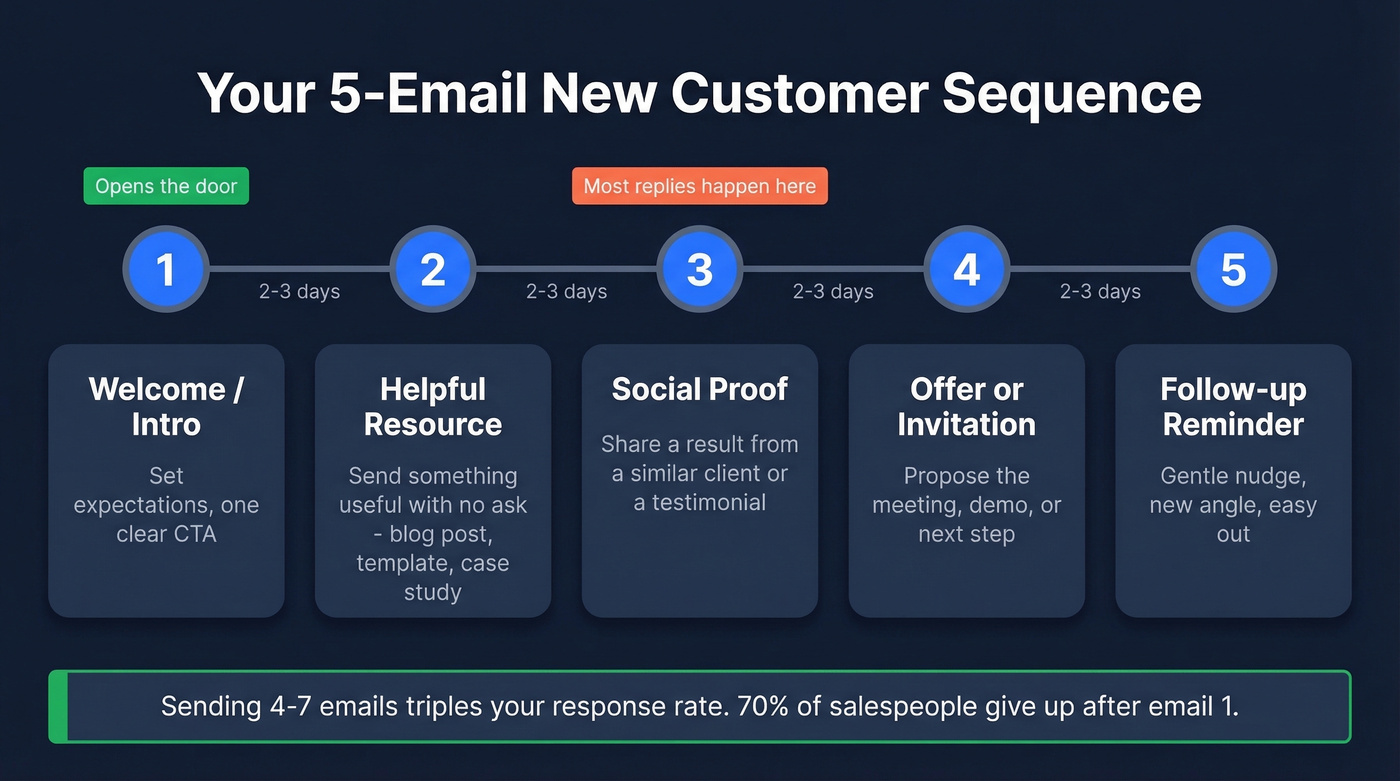
- Welcome / intro - set expectations, one CTA
- Helpful resource - send something useful with no ask (blog post, template, case study)
- Social proof - share a result from a similar client or a testimonial
- Offer or invitation - propose the meeting, demo, or next step
- Follow-up reminder - gentle nudge, new angle, easy out
Space these 2-3 days apart for cold outreach, and a few days to a week apart for post-sale onboarding. Use a real reply-to address - "no-reply@" kills engagement and signals to inbox providers that you don't want a conversation. If you're building a full sequence, this B2B cold email sequence guide helps.
Most replies come after email two or three. Sending 4-7 emails triples your response rate. The intro email opens the door - the sequence walks through it.
Make Sure Your Email Actually Arrives
Here's the thing: there's a step before "send" that most people skip entirely. Litmus reports that 70% of emails have at least one spam-related issue. Your perfectly crafted introduction doesn't matter if it lands in junk.
The basics: SPF tells receiving servers which IPs can send from your domain. DKIM adds a digital signature proving the email wasn't tampered with in transit. DMARC ties them together with a policy - start with p=none to monitor, then move to p=quarantine once your legitimate senders aren't getting flagged. If you want to go deeper, use this email deliverability guide and these SPF record examples.
Beyond authentication, avoid common triggers: no attachments in first emails, no ALL CAPS subject lines, and keep links to two max. Ask your new client to add you to their contacts - it's a small ask that dramatically improves inbox placement. Encourage a reply, even a short one, because replies signal to email providers that you're a trusted sender. If you're troubleshooting, an email spam checker can help pinpoint issues.
And before you hit send, verify the address. We can't stress this enough. A single bounce on a fresh domain can crater your sender reputation, and recovering from that takes weeks. Prospeo's email verification checks addresses in real time with 98% accuracy - paste a single email or upload your entire list. The free tier covers 75 verifications per month, enough to validate a new client roster before your first send. (If you're comparing tools, start with these Bouncer alternatives.)
Writing 7 intro emails is the easy part. Finding the right contact at 300M+ verified profiles - with real email addresses, direct dials, and intent signals - is where campaigns actually start. Prospeo gives you the data at $0.01 per email, no contracts.
Stop crafting intros for addresses that don't exist.
When Your Intro Email Gets Ignored
Three reasons your introduction to a new client isn't getting replies - and the fix for each.
Wrong format for the audience. That CSM sending polished relationship-building emails to IT buyers? The buyers wanted a two-line transactional message. Mirror your client's communication style. If they send three-word Slack messages, your intro should be five sentences, not five paragraphs.
Too much "about me." If your email spends more words on your background than on what the client gets, flip the ratio. Lead with their problem, their next step, their outcome. If you want a tighter structure, use this email copywriting framework.
No follow-up sent. The most common and most fixable problem. Send two to three follow-ups over two weeks, each adding a new angle or piece of value. Don't just "bump" the original thread - most people aren't ignoring you, they're busy. For timing, use this guide on when should you follow up on an email.
Let's be honest: if your average deal size is under five figures, you probably don't need a polished relationship-building intro at all. A three-sentence transactional email with clear next steps will outperform a five-paragraph warm handoff every single time. Save the relationship-building for the second email, after they've replied.
FAQ
How long should an intro email to a new client be?
For cold outreach, keep it under 100 words - shorter emails consistently get more replies. Post-sale welcome emails can run 150-200 words since the recipient already knows you. Project kickoff emails can stretch to 250 words with a bulleted agenda. Across the board, emails under 150 words see up to 20% higher reply rates.
What's the best template for new clients in B2B?
Use the short CSM handoff template for transactional IT buyers and the post-sale welcome template for relationship-driven buyers in consulting or services. The company introduction template works best when you're writing on behalf of your organization rather than yourself. Match the template to the buyer's communication style, not your internal process.
When's the best time to send an introduction email?
Weekdays between 10 AM and 1 PM in the recipient's time zone get the highest reply rates. Avoid Fridays and weekends - they perform worst. For post-sale welcome emails, send within 24 hours of the deal closing to capitalize on that 82% open rate while excitement is still high.
How many follow-ups should I send after no reply?
Three to five, spread over two to three weeks. Most replies come after the second or third email, and one follow-up alone increases reply chance by 25%. Each message should add new value - a relevant resource, a case study, a different angle - not just "circling back."
How do I make sure my intro email doesn't land in spam?
Set up SPF, DKIM, and DMARC authentication on your sending domain, keep links to two or fewer, and skip attachments in the first email. Verify every address before sending - a single bounce on a fresh domain can set you back weeks.