

How to Write an Introduction Email to a Client About Your Company
You spent 45 minutes crafting a 250-word introduction email to a client about your company's founding story, mission statement, and platform features. The prospect deleted it in under three seconds.
The average cold email reply rate sits between 1% and 5%. Top performers hit 8-12%. The difference isn't talent or luck - it's structure, brevity, and whether your email actually lands in the inbox instead of a spam folder.
What You Need (Quick Version)
Three rules that separate the 12% from the 2%:
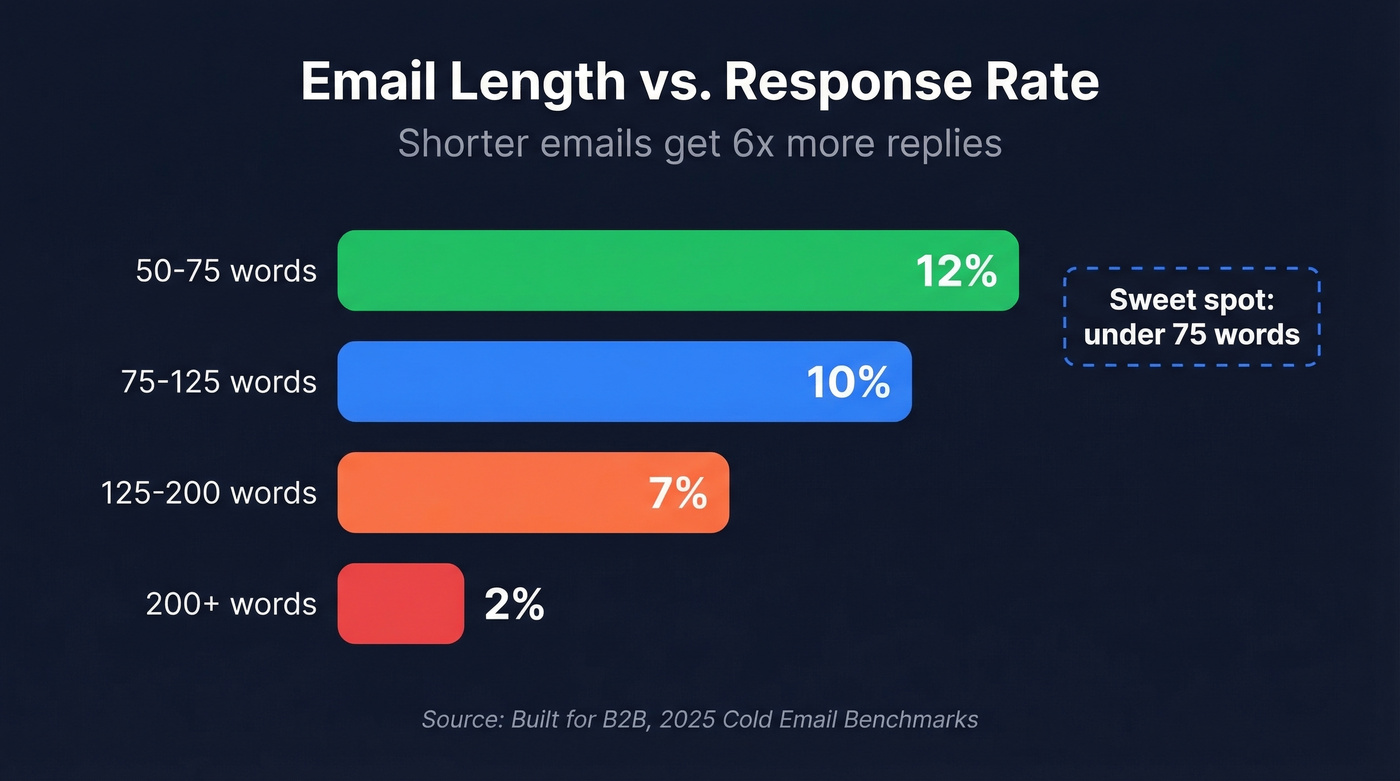
- Keep it under 75 words. Emails in the 50-75 word range pull a 12% response rate. Over 200 words? That drops to 2%.
- Use a 2-4 word personalized subject line. That combination hits a 46% open rate across 5.5 million emails.
- Verify every email address before sending. A email bounce rate above 5% risks provider blocks and serious domain reputation damage.
| Email Length | Response Rate |
|---|---|
| 50-75 words | 12% |
| 75-125 words | 10% |
| 125-200 words | 7% |
| 200+ words | 2% |
Every word past 75 costs you replies.
The Client Intro Email Framework
Every high-performing business introduction email follows the same skeleton: a greeting, a one-line hook tied to the recipient's world, a single value proposition, one clear CTA, and a sign-off. No company history. No feature list. No "I hope this email finds you well."
A practitioner on r/sales who books 6-7 meetings per week from cold outreach shared a rule worth stealing: under 90 words, two-sentence paragraphs max, one question, and zero links or attachments in the first email. Links from unknown senders trigger spam filters, and 80% of people scan rather than read. That last point is the one most people ignore - your email isn't being studied, it's being glanced at while someone waits for coffee.
Subject Lines That Get Opened
The Belkins study of 5.5 million emails is the best dataset we've found on this.
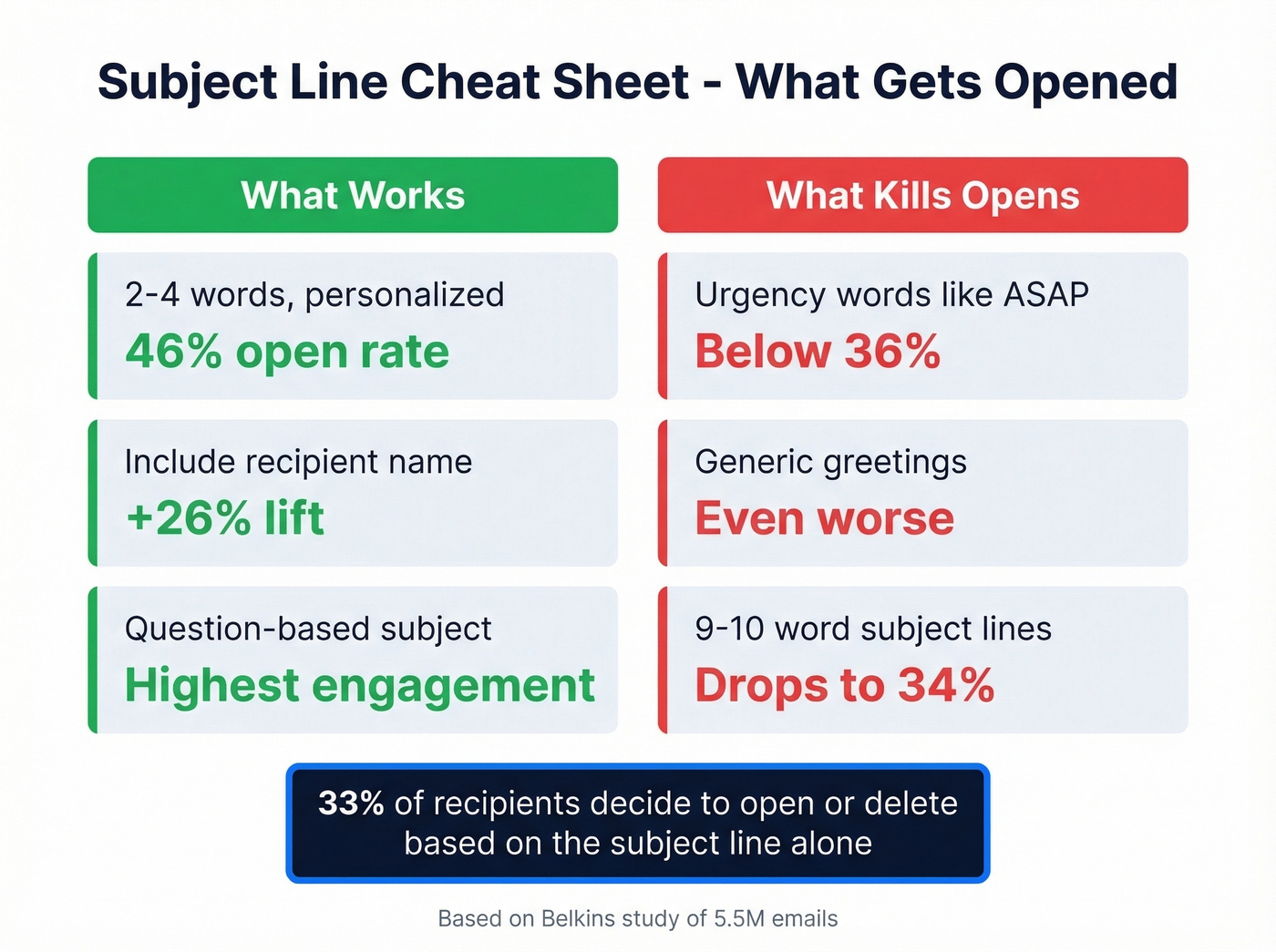
What works: Personalized, question-based subject lines at 2-4 words hit 46% open rates. Adding the recipient's name lifts opens by 26%. Since 46% of emails are opened on mobile, short subject lines aren't just better - they're the ones most likely to display fully on a small screen.
What kills opens: Urgency words like "ASAP" or "urgent" drag open rates below 36%. Generic greetings like "Hello, friend" perform even worse. Longer subject lines bleed fast - 9-10 words drop to 34%. Numbers in subject lines are neutral (27% vs. 28% without), so don't count on them for a lift.
Here's the thing: 33% of recipients decide to open or delete based on the subject line alone. Spend more time on those 3 words than on the body.
If you want more options, steal from these email subject line examples.

You just learned that emails over 75 words kill reply rates. But even a perfect 58-word intro email is worthless if it bounces. Prospeo verifies emails in real time with 98% accuracy - flagging catch-all domains, spam traps, and dead addresses before they torch your domain reputation.
One bounced intro email costs more than a thousand verified ones at $0.01 each.
4 Templates That Work
These four cover the most common B2B scenarios. For investor or partnership intros, the same structure applies - one hook, one value prop, one CTA.
Cold Prospect
Subject: [First name], quick thought
Hi [First name],
I noticed [Company] just [specific trigger - new hire, funding round, product launch]. When that happens, teams usually struggle with [specific pain point].
We helped [similar company] cut [metric] by [result] in [timeframe] using [one feature].
Worth a 10-minute call this week?
[Your name]
One trigger, one pain point, one proof point, one CTA. Under 65 words.
Referral / Warm Introduction
The mutual contact format borrows trust immediately. Lead with the name, offer specific days to reduce friction.
Subject: Introduction - [Your name] / [Prospect name]
Hi [Prospect name],
[Mutual contact] suggested I reach out. They mentioned you're working on [initiative], and that's exactly where we've been helping teams like [similar company].
I'd love 15 minutes to share what's worked for them. Would Tuesday or Thursday work?
Best, [Your name]
Before / After: The "We-We-We" Fix
Most company introductions fail because they talk about the sender. Here's the same email rewritten with the prospect at the center:
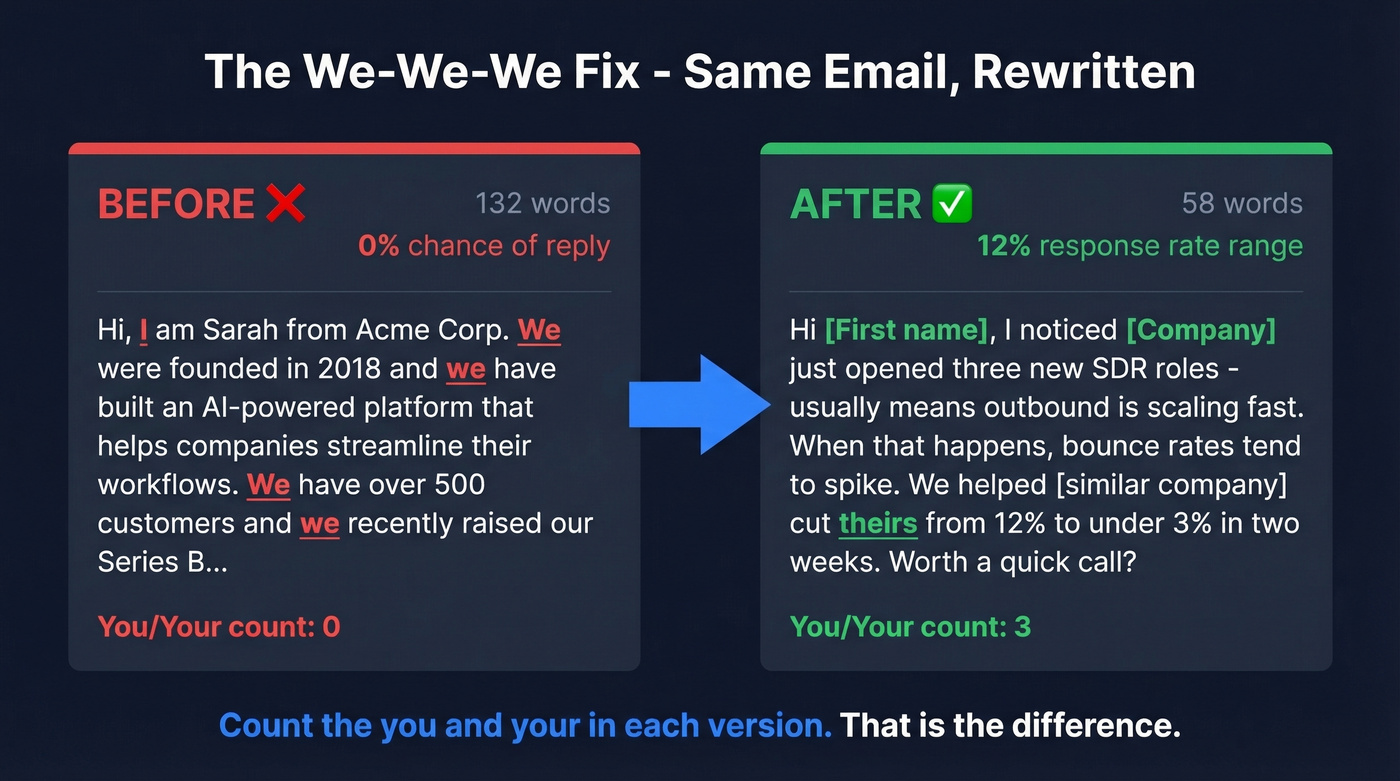
Before (132 words, 0% chance of reply): "Hi, I'm Sarah from Acme Corp. We were founded in 2018 and we've built an AI-powered platform that helps companies streamline their workflows. We have over 500 customers and we recently raised our Series B..."
After (58 words): "Hi [First name], I noticed [Company] just opened three new SDR roles - usually means outbound is scaling fast. When that happens, bounce rates tend to spike. We helped [similar company] cut theirs from 12% to under 3% in two weeks. Worth a quick call?"
Count the "you" and "your" in each version. That's the difference.
Post-Event Follow-Up
Subject: Good chat at [Event]
Hi [First name],
Great meeting you at [Event] - enjoyed our conversation about [specific topic]. You mentioned [specific challenge], and I think [one value prop] could help.
Happy to walk through it in 10 minutes. How's next week?
[Your name]
Referencing the specific conversation proves you're not blasting a list.
When to Send and Follow Up
A study of 2.1 million campaigns found Friday pulls the highest open rate at 49.72%, with Monday close behind at 49.44%. Opens peak between 8-11 AM local time.
If you want the full breakdown by day, time, and timezone, use this best time to send cold emails playbook.
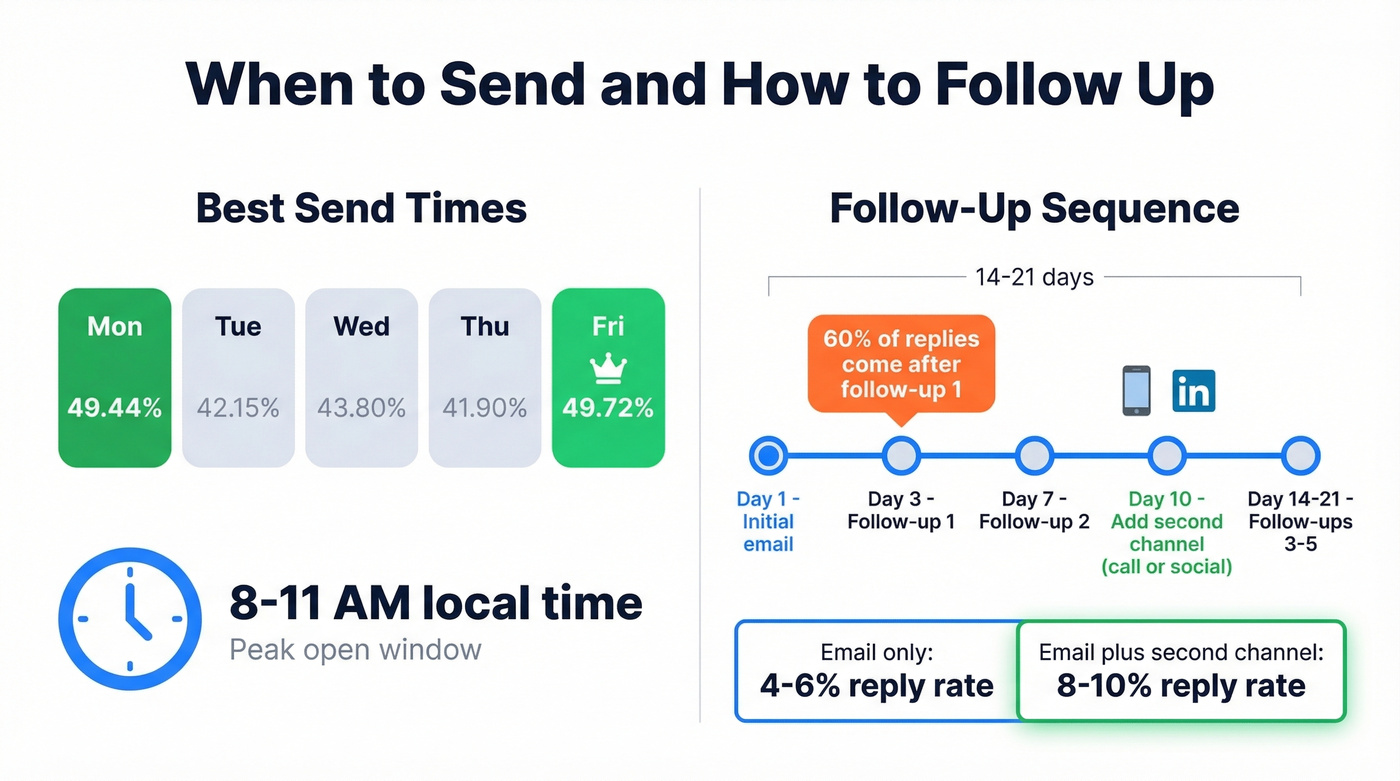
The real payoff is in follow-up. Roughly 60% of replies come after the first follow-up, not the initial email. Plan a sequence of 4-7 emails over 14-21 days. If you're only sending one email and moving on, you're leaving most of your replies on the table.
Email-only sequences cap out at 4-6% reply rates. Add a second channel - a phone call, a social touch - and that jumps to 8-10%. The best introduction email to a client about your company is one that's part of a B2B cold email sequence, not a standalone Hail Mary. We've seen this pattern over and over with outbound teams we work with: the email opens the door, but the second channel closes it.
Need more follow-up ideas? Use these sales follow-up templates.
Make Sure Your Email Actually Arrives
A perfect email sent to a dead address destroys your sender reputation. And once your domain gets flagged, every email you send - to prospects, customers, even colleagues - suffers.
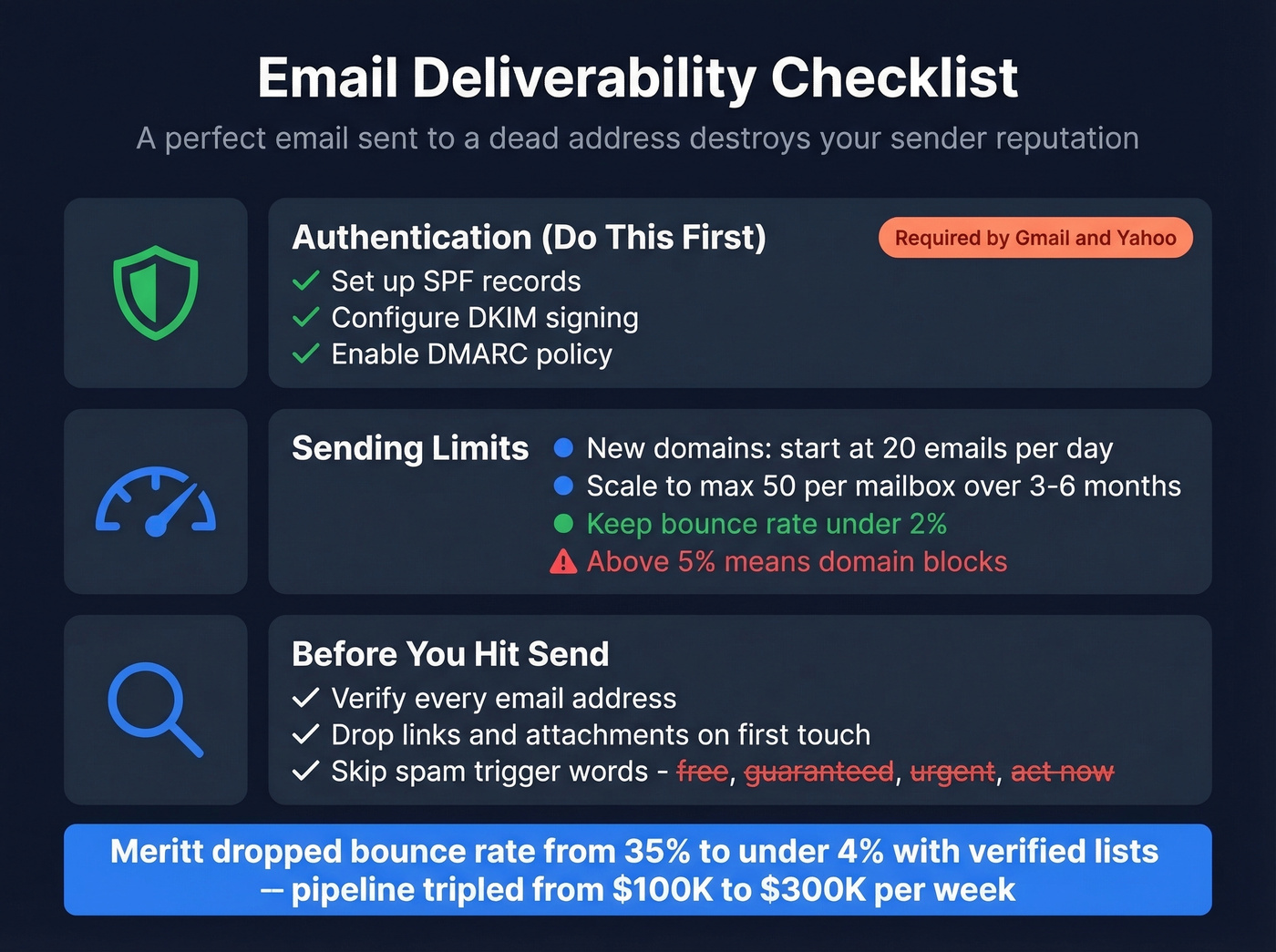
Start with authentication. SPF, DKIM, and DMARC are required by major inbox providers. If you haven't set these up, stop reading and do it now. Seriously. (If you want a deeper walkthrough, start with this email deliverability guide.)
Keep your bounce rate under 2%. Above bounce rate above 5%, inbox providers start blocking your domain entirely. Skip spam trigger words ("free," "guaranteed," "urgent," "act now") and drop links and attachments on the first touch. For new domains, start at 20 emails per day and scale to a max of 50 per mailbox over 3-6 months.
Verify every address before you send. Prospeo checks emails in real time with 98% accuracy and flags catch-all domains, spam traps, and dead addresses - the free tier covers 75 verifications per month. One customer, Meritt, dropped their bounce rate from 35% to under 4% after switching to verified lists, which tripled their pipeline from $100K to $300K per week.

The templates above work best when you nail the trigger - a new hire, a funding round, a product launch. Prospeo's 30+ search filters surface prospects by job change, headcount growth, and buyer intent across 15,000 topics, so every intro email opens with a trigger that's real and recent.
Stop guessing at triggers. Find prospects already showing buying signals.
Compliance in 30 Seconds
Don't skip this. The fines are real.
- CAN-SPAM: Include a physical address and unsubscribe option. Fines hit $53,088 per email. Honor opt-outs within 10 business days.
- GDPR: Consent required for EU recipients. Pre-ticked boxes don't count. Penalties reach EUR 10M.
- CASL (Canada): Express consent required. Fines up to $10M for businesses.
If someone asks to be removed, remove them. Immediately. No exceptions, no "we'll get to it next week."
FAQ
How long should a client introduction email be?
50-75 words gets a 12% response rate; over 200 words drops to 2%. If you can't say it in 90 words, you haven't identified your value prop yet. Cut the company backstory and lead with one specific result you've delivered.
What subject lines work best?
Personalized, question-based subject lines at 2-4 words hit 46% open rates. Include the recipient's name for a 26% lift. Avoid "ASAP" or "urgent" - they drag opens below 36%.
Should I include links in a first email?
No. Links and attachments from unknown senders trigger spam filters. Send plain text with a single question as your CTA. Save collateral for after they reply.
How do I keep my email out of spam?
Set up SPF, DKIM, and DMARC authentication first. Then verify every address before sending - tools like Prospeo's free tier handle 75/month with 98% accuracy. Start at 20 emails per day on new domains and scale slowly over several months.