

IP Warm Up Service: What Actually Works in 2026
You just got a shiny new dedicated IP, sent 10,000 emails on day one, and watched inbox placement crater to 40%. The ISP didn't know you, didn't trust you, and treated your mail like spam. That's the problem an IP warm up service claims to solve - and it's simpler than most vendors want you to believe.
What You Need (Quick Version)
If you send fewer than 50,000 emails per month, you don't need a dedicated IP - or IP warmup - at all. Shared IPs from reputable ESPs handle the reputation for you. If you do need warmup, follow the percentage-based schedule below. No paid service required.
The one thing you absolutely must pay for: verified contact data. Bounces during warmup destroy the reputation you're trying to build.
What Is IP Warmup?
IP warmup means gradually increasing send volume on a new or dormant IP address so mailbox providers learn to trust you. ISPs like Gmail and Microsoft track complaint rates, bounce rates, and engagement signals from the very first send. Rush the volume and you'll get throttled or blocked.
Warmy.io's State of Email Deliverability report puts average global inbox placement at 83.5%, with 64.6% of businesses saying deliverability issues directly hurt revenue and retention. During warmup, those numbers get far worse if you move too fast.
IP vs. Domain vs. Email Warmup
Most tools marketed as "IP warmup services" aren't doing IP warmup at all.
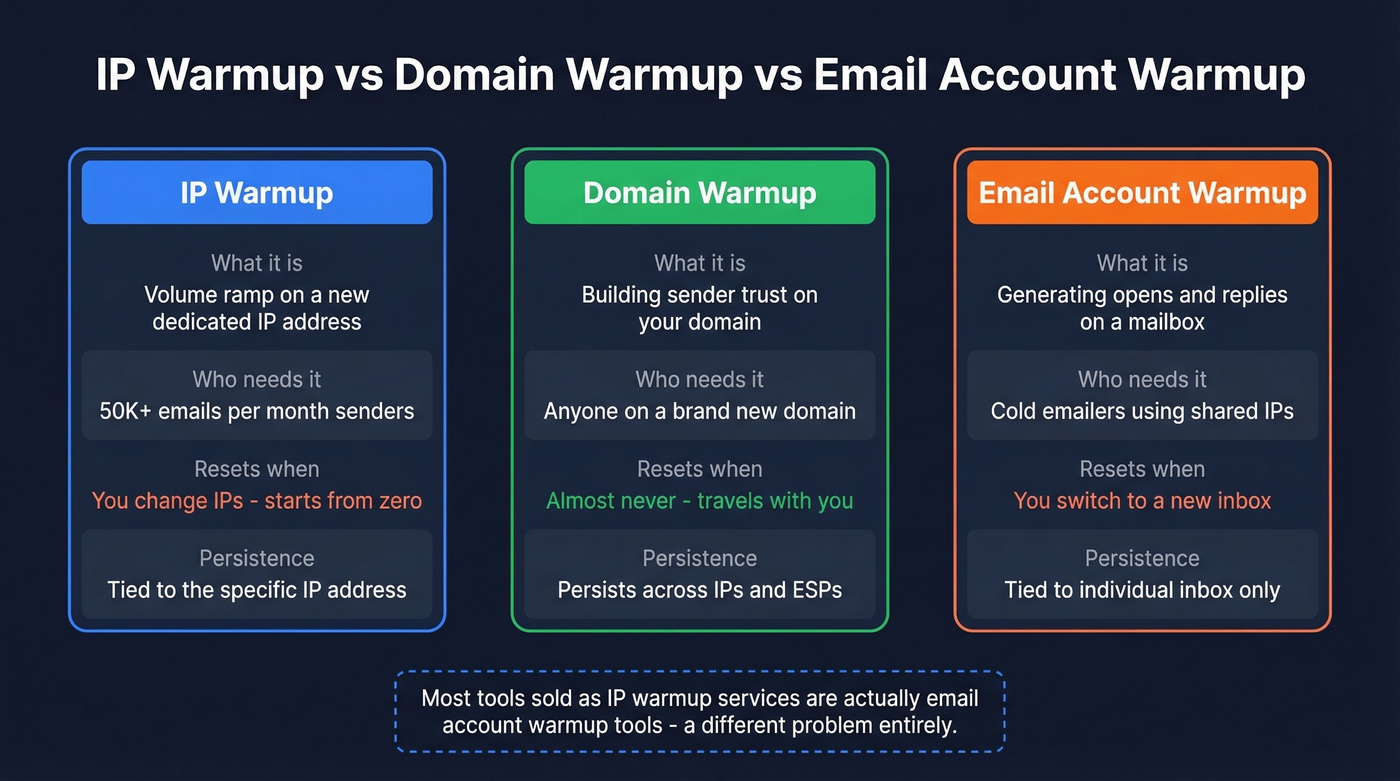
| IP Warmup | Domain Warmup | Email Account Warmup | |
|---|---|---|---|
| What it is | Volume ramp on a new IP | Building trust in your sending domain | Generating engagement on a mailbox |
| Who needs it | 50K+/mo senders on dedicated IPs | Anyone on a new domain | Cold emailers using shared IPs |
| Persistence | Resets if you change IPs | Persists across IPs and ESPs | Tied to individual inbox |
Here's the thing: domain reputation travels with you. Switch ESPs, change IPs - your domain reputation follows. That's why most "IP warming services" are actually email account warmup tools that simulate opens and replies on individual inboxes. Useful, but a different problem entirely.
If you're doing cold outreach, the bigger lever is usually email velocity and list quality, not "warming" tricks.
What Changed in 2026
The warmup playbook shifted meaningfully this cycle:
Gmail killed reputation dashboards. The old Postmaster Tools retired September 30, 2025. IP and domain reputation views are gone. Gmail now pushes a compliance-first model - focus on authentication health and complaint rates, not a reputation score.
Microsoft enforced authentication. In 2025, Microsoft began requiring SPF, DKIM, and DMARC for senders exceeding 5,000 emails/day to Outlook.com. No exceptions.
Continuous warmup became the norm. The consensus on r/smallbusiness is that warmup must run continuously - reputation decays without consistent positive engagement signals. You can't warm up once and coast.
If you want a deeper playbook on the underlying mechanics, start with our email deliverability guide.

Every bounce during IP warmup counts double against your reputation. Prospeo's 5-step verification catches spam traps, honeypots, and catch-all domains - delivering 98% email accuracy so your warmup ramp builds trust instead of destroying it.
Fix your data before you warm up. Most senders do it backwards.
Pre-Flight Checklist
Before you send a single warmup email:
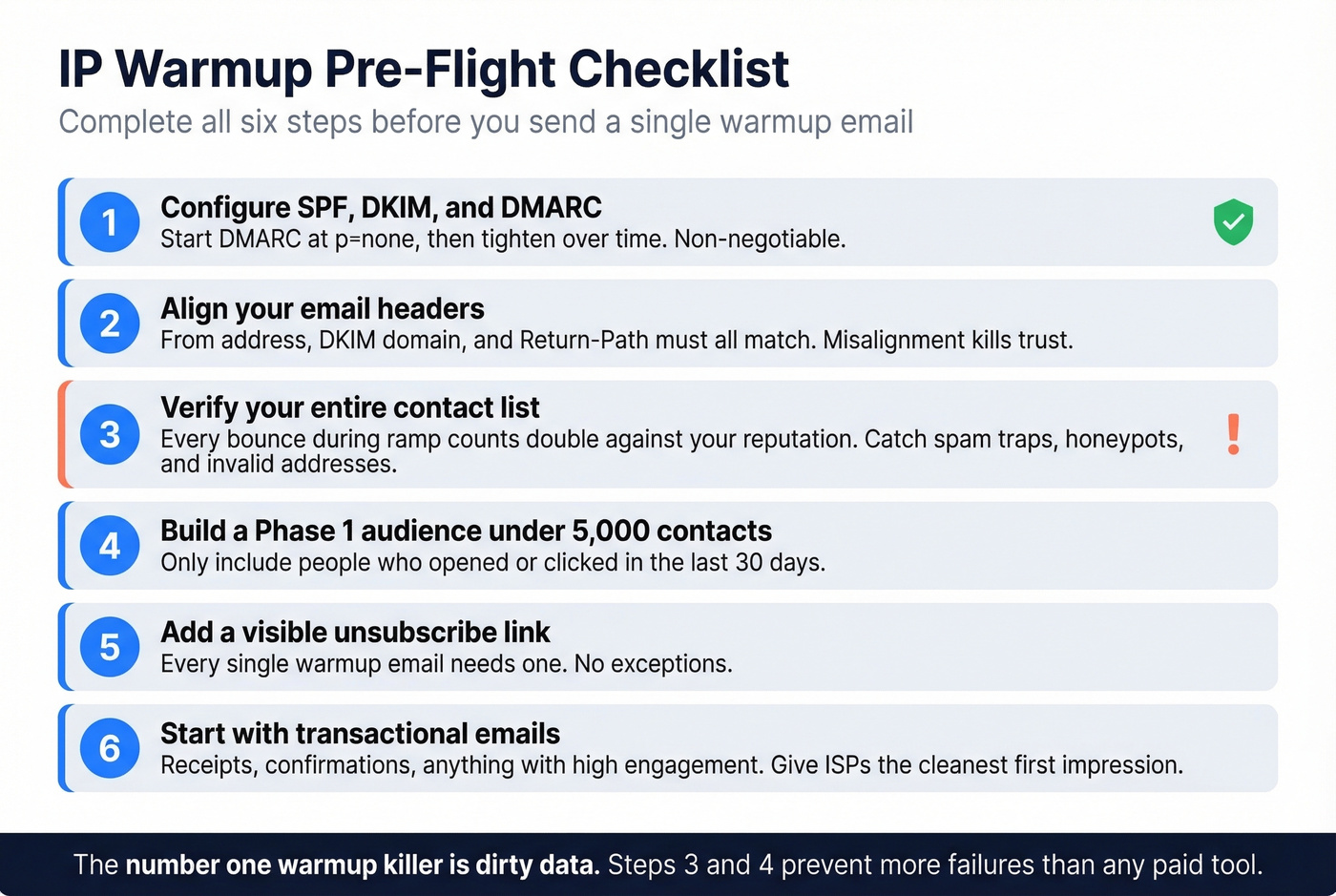
- SPF, DKIM, and DMARC configured. Start with
p=nonefor DMARC, then tighten. Non-negotiable. (If you keep failing auth, fix DMARC alignment first.) - Domain alignment across From, DKIM, and Return-Path. Misaligned headers are a trust killer that mailbox providers flag quickly. If you're unsure what Return-Path is doing, see Return Path Email.
- Verify your entire list. Every bounce during ramp counts double against your reputation. Run your contacts through a verification tool like Prospeo before the first send - 98% email accuracy with 5-step verification that catches spam traps, honeypots, and catch-all domains. (More on bounce impact: email bounce rate.)
- Build a Phase 1 audience of fewer than 5,000 contacts who've opened or clicked in the last 30 days.
- Include a visible unsubscribe link in every warmup email.
- Start with transactional emails for the first few days - receipts, confirmations, anything that generates high engagement signals and gives ISPs the cleanest initial read on your sending behavior.

The Warmup Schedule
Two approaches work. The classic absolute-number ramp is straightforward for predictable volume. The percentage-based schedule adapts better to high-volume senders.
Classic Daily Volume Ramp
| Day | Daily Sends | Day | Daily Sends |
|---|---|---|---|
| 1 | 200 | 8 | 25,000 |
| 2 | 500 | 9 | 50,000 |
| 3 | 1,000 | 10 | 75,000 |
| 4 | 2,000 | 11 | 100,000 |
| 5 | 5,000 | 12 | 150,000 |
| 6 | 10,000 | 13 | 200,000 |
| 7 | 20,000 | 14 | 250,000 |
This SparkPost schedule is one of the most widely reused published templates online. The full ramp continues to 10M/day by Day 29, but most senders hit their target volume within the first two weeks.
Percentage-Based Ramp
| Days | % of Ultimate Daily Volume |
|---|---|
| 1-3 | 0.5% |
| 4-7 | 1% |
| 8-14 | 5% |
| 15-21 | 25% |
| 22-28 | 50-100% |
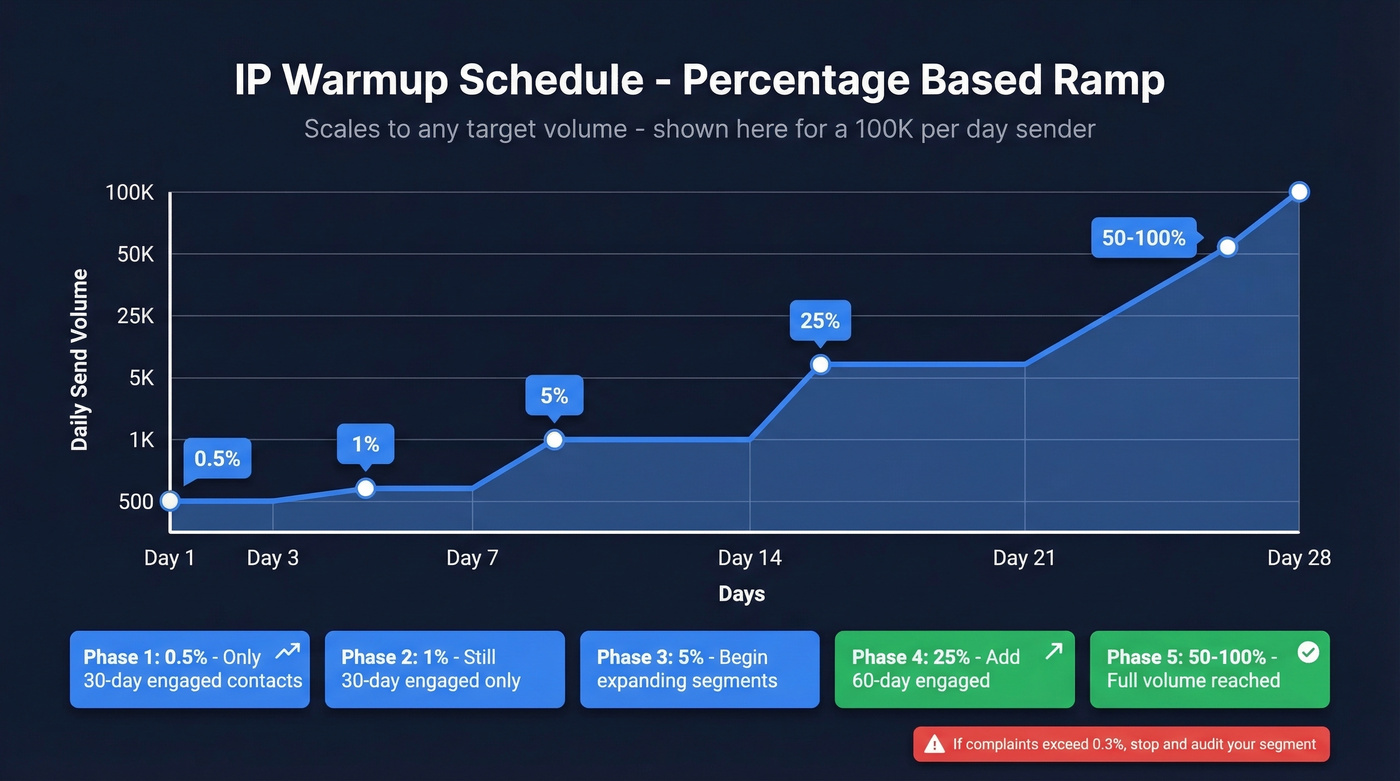
This Adobe framework scales to any target volume. We've found it works better because it respects proportional growth rather than fixed thresholds - a sender targeting 500K/day and one targeting 50K/day both get a sane ramp instead of hitting the same arbitrary daily numbers.
Segment by engagement recency throughout the ramp. Weeks 1-2: send only to contacts who engaged in the last 30 days. Weeks 3-4: expand to 60-day engaged. Never send to 90+ day inactive contacts during the first six weeks. This single rule prevents more warmup failures than any tool or service.
KPI thresholds: complaint rate ≤ 0.1%, hard bounce rate ≤ 2%, open rate ≥ 10%. If Yahoo throws a 421 temp failure, pause 24 hours and restart at the previous tier. If complaints exceed 0.3%, stop and audit your segment.
If you're trying to keep deliverability stable while scaling, pair warmup with a plan to improve sender reputation.
Do IP Warmup Services Actually Work?
Let's be honest - most don't deliver what they promise. Validity's detailed analysis warns against services offering pre-warmed IPs, manufactured seed engagement, or automation that "makes warmup look natural." Mailbox providers detect suspicious engagement patterns. A seed list that only opens and never deletes or reports spam looks nothing like real human behavior.
The bigger risk: automated warmup patterns rarely match your actual sending cadence, content, or audience. When you flip from warmup mode to real campaigns, ISPs see a sudden behavioral shift and get suspicious.
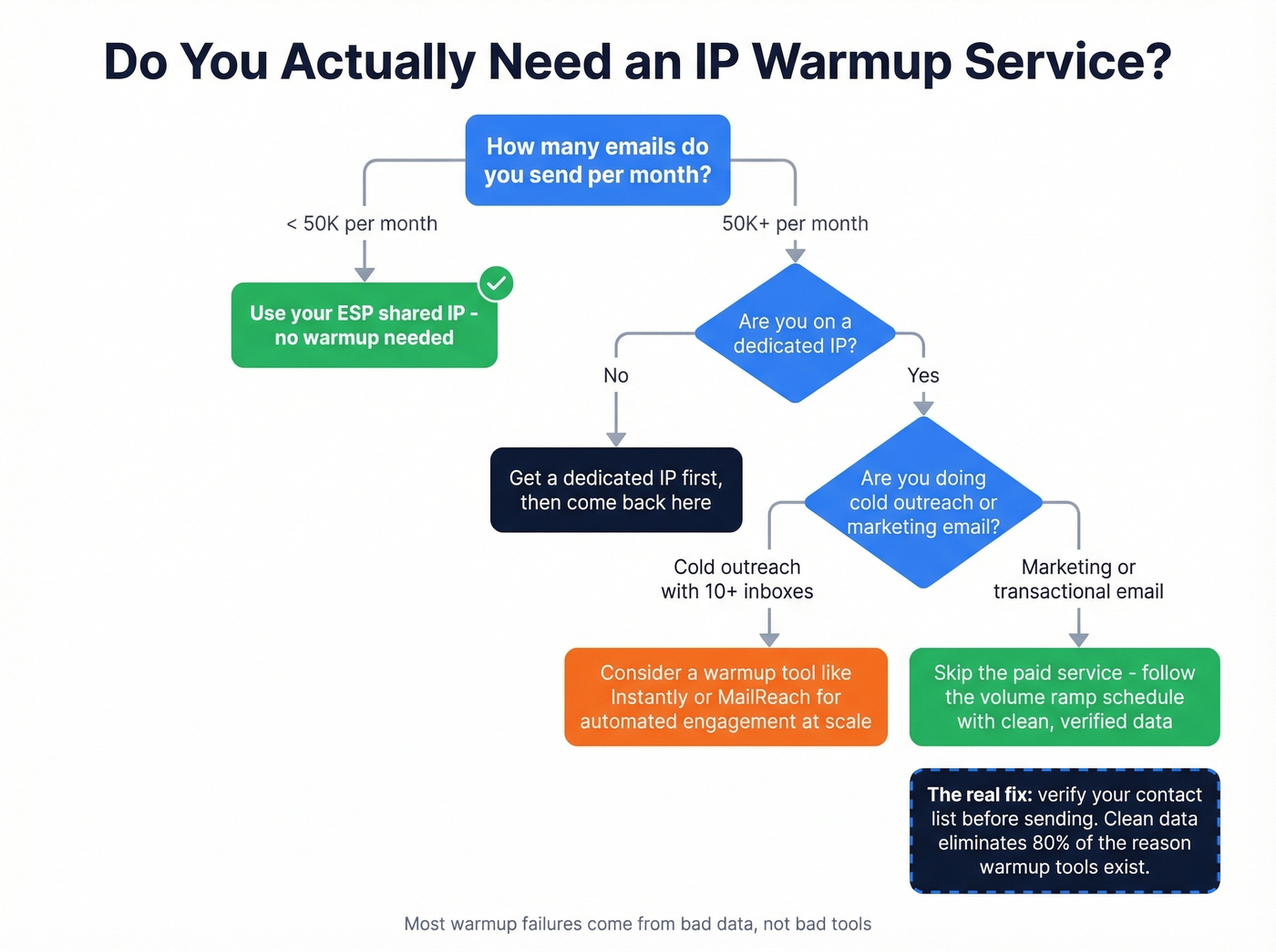
Use a warmup tool if you're running 10+ cold email inboxes and need automated engagement at scale. Skip it if you're warming a dedicated IP for marketing sends - you don't need manufactured engagement. You need a volume ramp, clean data, and real recipients.
Look, the entire IP warm up service category exists largely because senders skip list verification. We've seen this pattern dozens of times: a team spends $200/month on warmup tools while sending to a list full of invalid addresses. Fix your data quality and you eliminate 80% of the reason these tools exist in the first place. If you're cleaning lists, start with spam trap removal.
Tools and Pricing Compared
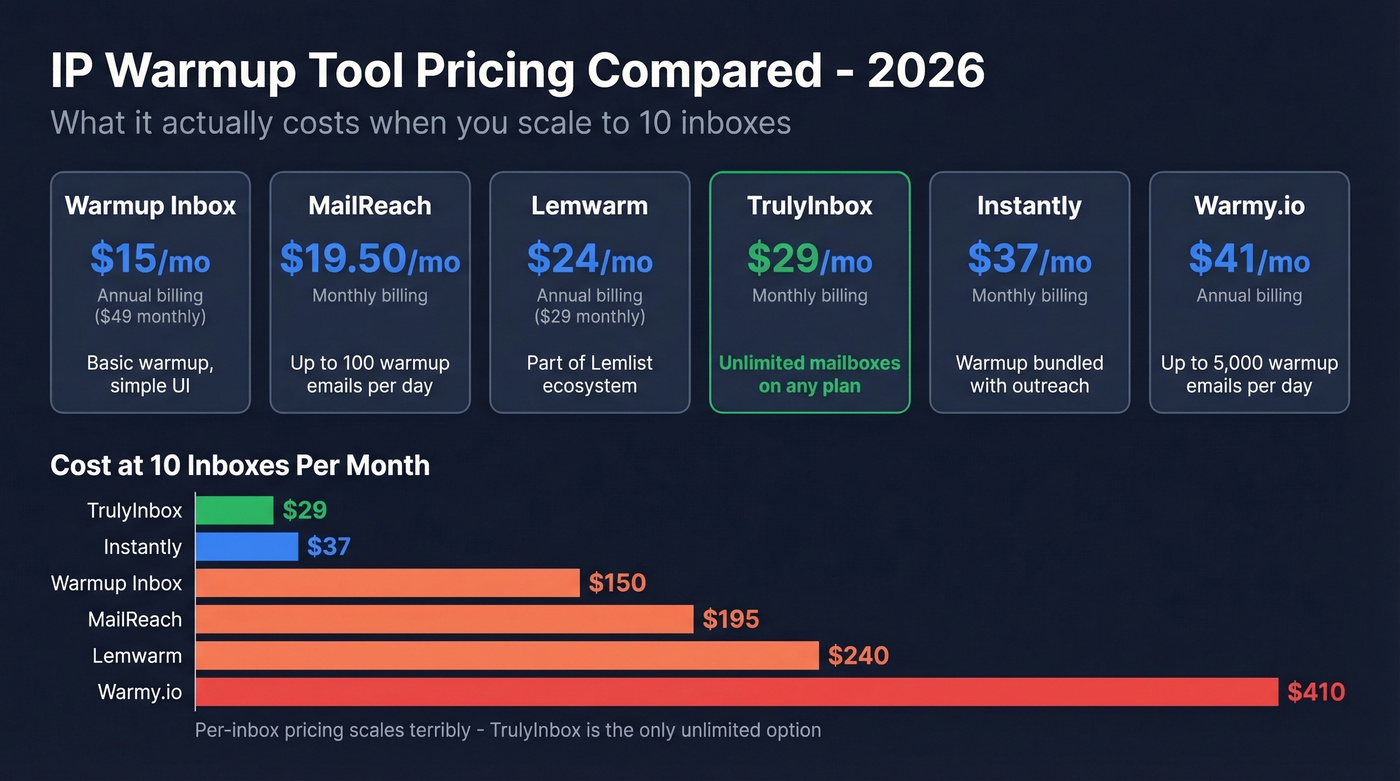
If you do want a tool, here's what they cost:
| Tool | Price | Billing | Notes |
|---|---|---|---|
| Instantly | ~$37/mo | Monthly | Warmup bundled with outreach platform |
| MailReach | $19.50/mailbox/mo | Monthly | Up to 100 warmup emails/day |
| Lemwarm | $24/mailbox/mo | Annual (~$29 monthly) | Part of Lemlist ecosystem |
| TrulyInbox | $29/mo | Monthly | Unlimited mailboxes on any plan |
| Warmy.io | $41/mailbox/mo | Annual | Up to 5,000 warmup emails/day per inbox |
| Warmup Inbox | $15/mailbox/mo | Annual ($49 monthly) | Basic warmup, simple UI |
Per-inbox pricing scales terribly. Ten inboxes at $20 each is $200/month just for warmup - before you've sent a single real email. TrulyInbox's unlimited-mailbox model is the exception worth noting. Instantly makes sense if you're already using it for outreach since warmup is included.
If you're evaluating options, compare against our roundup of unlimited email warmup tools.
After Warmup
Warmup isn't a one-time project. Reputation decays without consistent positive signals, and a sudden volume spike post-warmup can undo weeks of careful ramp. Keep volume increases under 30% week-over-week after reaching full capacity.
The ongoing discipline is list hygiene. Every new contact needs verification before it hits a sequence. In our experience, teams that verify continuously see bounce rates stay under 3% indefinitely, while teams that verify once and forget creep back above 10% within a quarter. Prospeo handles this at scale with CSV enrichment, a 92% API match rate, catch-all domain handling, and automatic spam-trap removal on a 7-day refresh cycle.
If you're building a bigger outbound engine, it helps to standardize your sequence management so volume changes stay predictable.
You're spending $200/month on warmup tools while sending to invalid addresses. At $0.01 per verified email, Prospeo eliminates the bounces that cause warmup failures in the first place - with a 7-day data refresh cycle so contacts stay valid throughout your ramp.
Stop warming dirty lists. Clean data is the only warmup hack that works.
FAQ
How long does IP warmup take?
Four to eight weeks depending on volume and engagement quality. The percentage-based schedule can compress this to four weeks for high-volume senders with clean lists. Rushing guarantees throttling.
Do I need a dedicated IP?
Only if you consistently send 50,000+ emails per month. Below that threshold, a shared IP from a reputable ESP works fine and requires zero warmup.
Can bad data ruin my warmup?
One bad batch can set you back weeks. ISPs evaluate you on a tiny sample during ramp, so bounces count disproportionately. Verify everything before the first send - catch invalid addresses, spam traps, and honeypots before they tank your reputation. No warmup tool can recover from a dirty list.
What's the cheapest way to warm up email inboxes?
Instantly at ~$37/month bundles warmup with its outreach platform - best value if you need both. For warmup-only, Warmup Inbox starts at $15/mailbox/month on annual billing. Pair either with verified data to avoid wasting credits on bounces.