

Is Cold Calling Dead? The Data Says No - But It's Changed
Your SDR just spent 90 minutes dialing and connected with two people. One hung up. The other said "send me an email" and will never reply. Meanwhile, the marketing team is forwarding you another article declaring the phone dead.
Here's the reality: cold calling isn't dead. Lazy cold calling is dead. And the gap between the two has never been wider.
The Short Answer
The 2026 industry cold-call success rate is 2.7% - conversations that turn into booked meetings. Top-performing teams hit 11.3%. That's a 4.2x gap, and it comes down to three things: data quality, timing, and channel mixing. If you're dialing office numbers from a list that's six months old, you're not prospecting - you're wasting electricity.
2026 Benchmarks That Matter
Let's start with what "success rate" actually means, because most people get this wrong. Cognism's WHAM dataset defines it as conversations that result in a booked meeting - not dials to meetings, not dials to conversations.
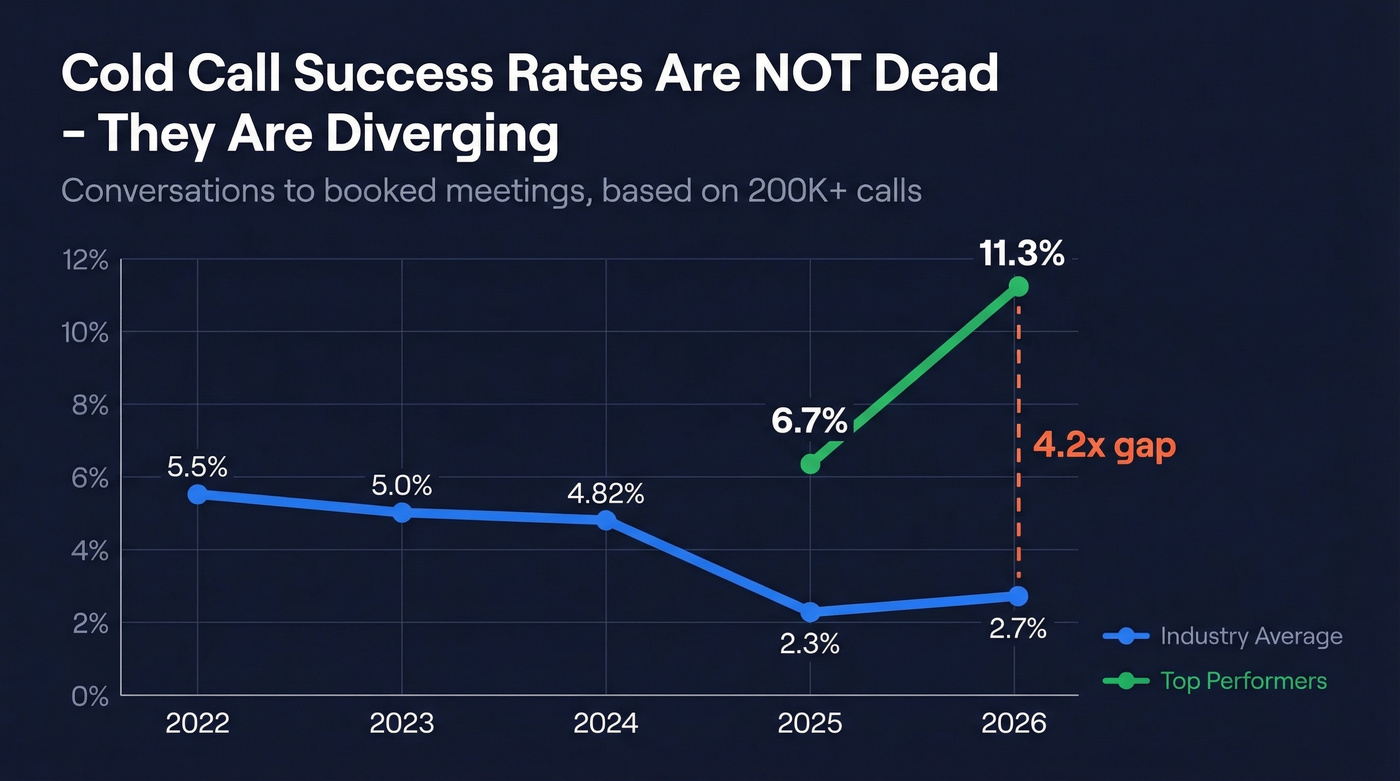
The trend line tells a clear story. Back in 2022, connect rates were higher because office lines still worked and spam filters were less aggressive. In 2024, the industry average sat at 4.82%. It cratered to 2.3% in 2025 as spam filters tightened and remote work scattered buyers across personal devices. Then 2026 brought a partial recovery to 2.7%, based on an analysis of 200K+ calls.
But the headline number buries the real story. Cognism's own internal SDR team hit 11.3% - up from 6.7% in their previous report. Same market, same buyers, wildly different results. Verified mobile numbers, tighter targeting, and fewer but better-timed dials made the difference.
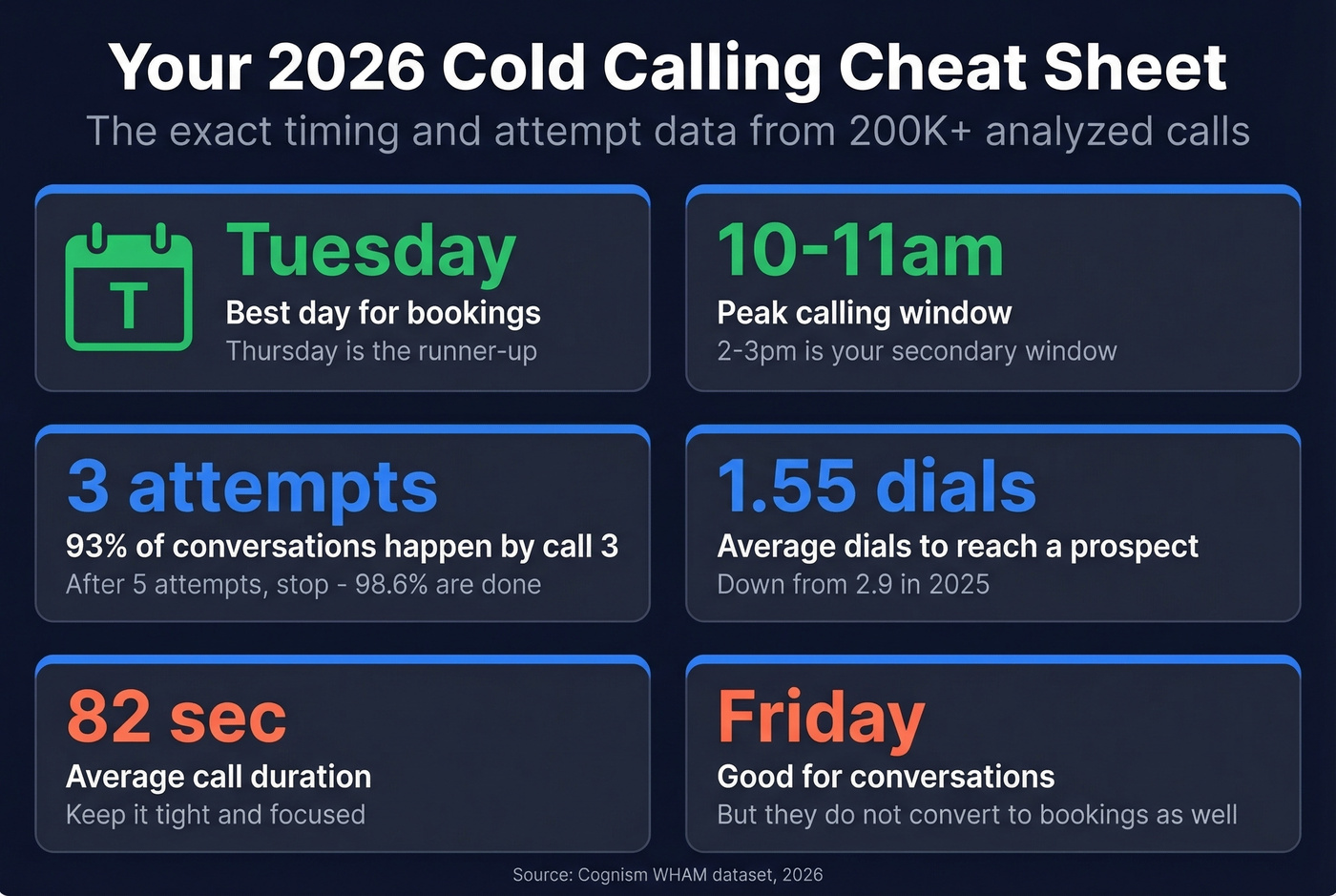
Average dials needed to reach a prospect dropped from 2.9 in 2025 to 1.55 in 2026. Average call duration runs about 82 seconds. And 93% of all conversations happen by the third call attempt, with 98.6% happening by the fifth - meaning anything past five calls is almost certainly wasted effort.
The numbers also vary dramatically by industry, and this is one of the most underused benchmarks in sales:
| Industry | Conversion Rate |
|---|---|
| Business Services | 2.61% |
| Consulting Services | 2.43% |
| Real Estate Services | 2.20% |
| Financial Services | 1.54% |
| Medical Devices | 1.12% |
| Tech/Software | 0.95% |
If you're a SaaS SDR comparing yourself to a 2.7% average, you're measuring against the wrong number. Your real benchmark is closer to 1%.
Why It Feels Dead (But Isn't)
Three forces make cold calling feel broken even when the data says otherwise. People have been declaring the phone dead since at least 2015, yet the channel keeps producing pipeline for teams that execute well.
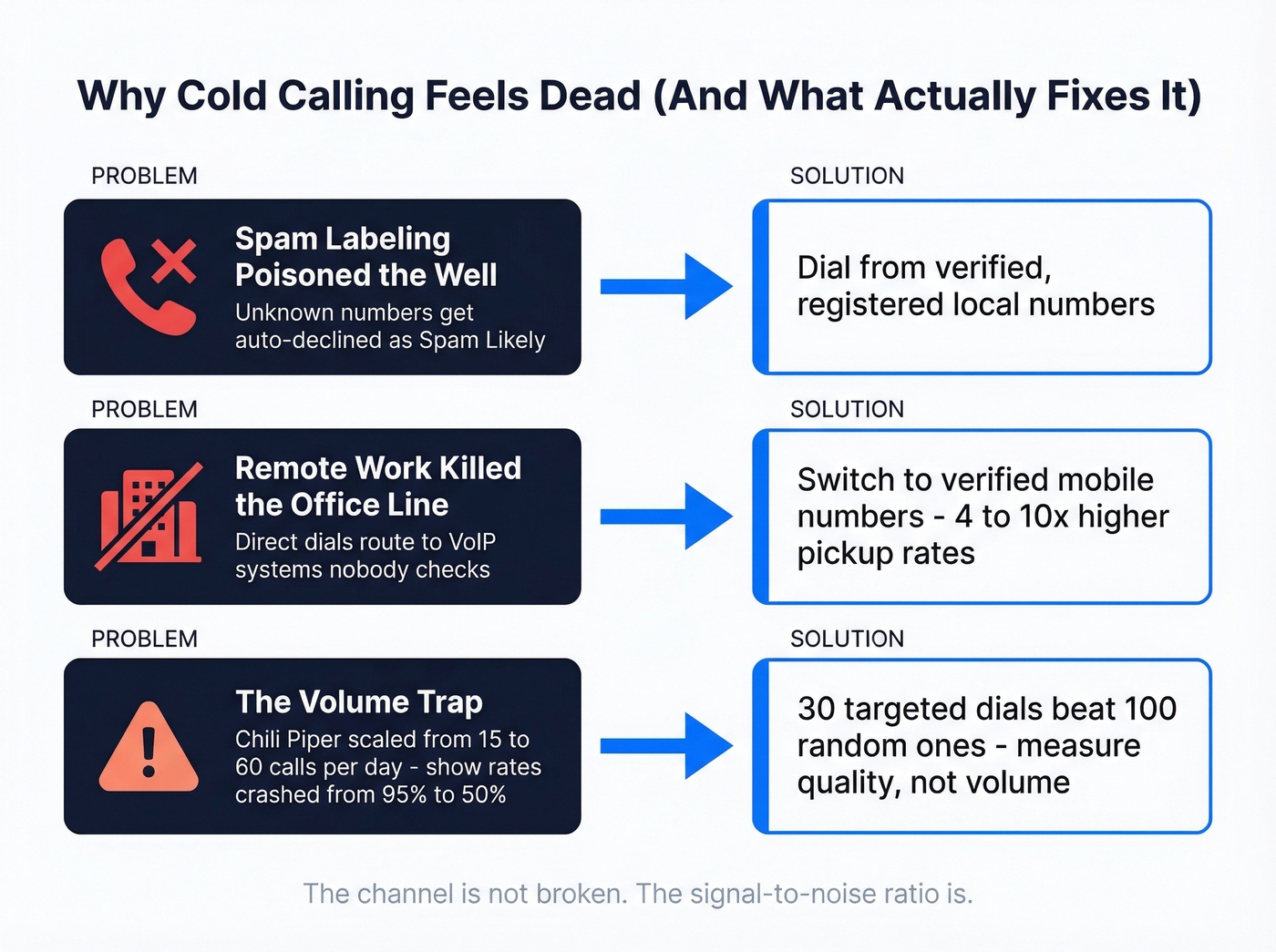
Caller ID and spam labeling have poisoned the well. When every unknown number gets flagged as "Spam Likely," even legitimate calls from real humans get declined. One r/sales thread put it bluntly: spam and scam calls have trained people to reject anything from an unknown number. On the flip side, another SaaS rep on the same subreddit claimed "the phone generates 95% of my business." The channel isn't broken - the signal-to-noise ratio is.
Remote work killed the office line. The direct dial that used to ring on someone's desk now routes to a VoIP system nobody checks. Mobile numbers are the new front door, but most databases haven't caught up.
Then there's the volume trap - the subtle killer. An internal experiment at Chili Piper scaled SDRs from 15 calls per day to 60 over two months. Phone-booked meetings went up ~50%, but total meetings per rep only rose ~20% because reps had less time for email and other channels. The connect rate dropped from ~8% to ~5%. Show rates crashed from 95% to roughly 50%. They were booking meetings with people who said yes just to get off the phone. Net pipeline barely moved. More dials didn't mean more revenue - it meant more no-shows.
Here's the thing: if you're selling deals under $20k, you probably don't need 100+ dials a day. You need 30 dials to the right people with the right data. Volume-based dialing is a coping mechanism for bad targeting.

The 4.2x gap between average and top-performing teams comes down to data. Bad numbers waste 27% of calling time. Prospeo's 125M+ verified mobile numbers refresh every 7 days - not 6 weeks - so your reps connect with real buyers instead of voicemail graveyards.
Stop dialing dead numbers. Start hitting 30% pickup rates.
The Hidden Variable: Data Quality
Most analyses stop at benchmarks and shrug. But the single biggest variable in cold-call performance isn't your script, your tonality, or your opener. It's whether you're dialing a number that actually rings on someone's phone.
Bad contact data wastes roughly 27% of calling time. B2B data decays at about 2.1% per month - that's 22.5% of your database going stale every year as people change jobs, get new numbers, and switch companies. If your data provider refreshes every six weeks, you're always behind.
We've seen teams double their connect rates just by switching to verified mobile data - no script changes, no new dialer, no coaching. Calling verified mobile numbers yields 4-10x higher pickup rates compared to office lines. That's the difference between connecting with two people in 90 minutes and connecting with ten. Prospeo carries 125M+ verified mobile numbers with a 30% pickup rate, refreshed on a 7-day cycle instead of the typical six weeks.
Cold Calling vs Cold Email
Cold calling and cold email aren't competitors - they're partners. But the economics are worth comparing side by side.
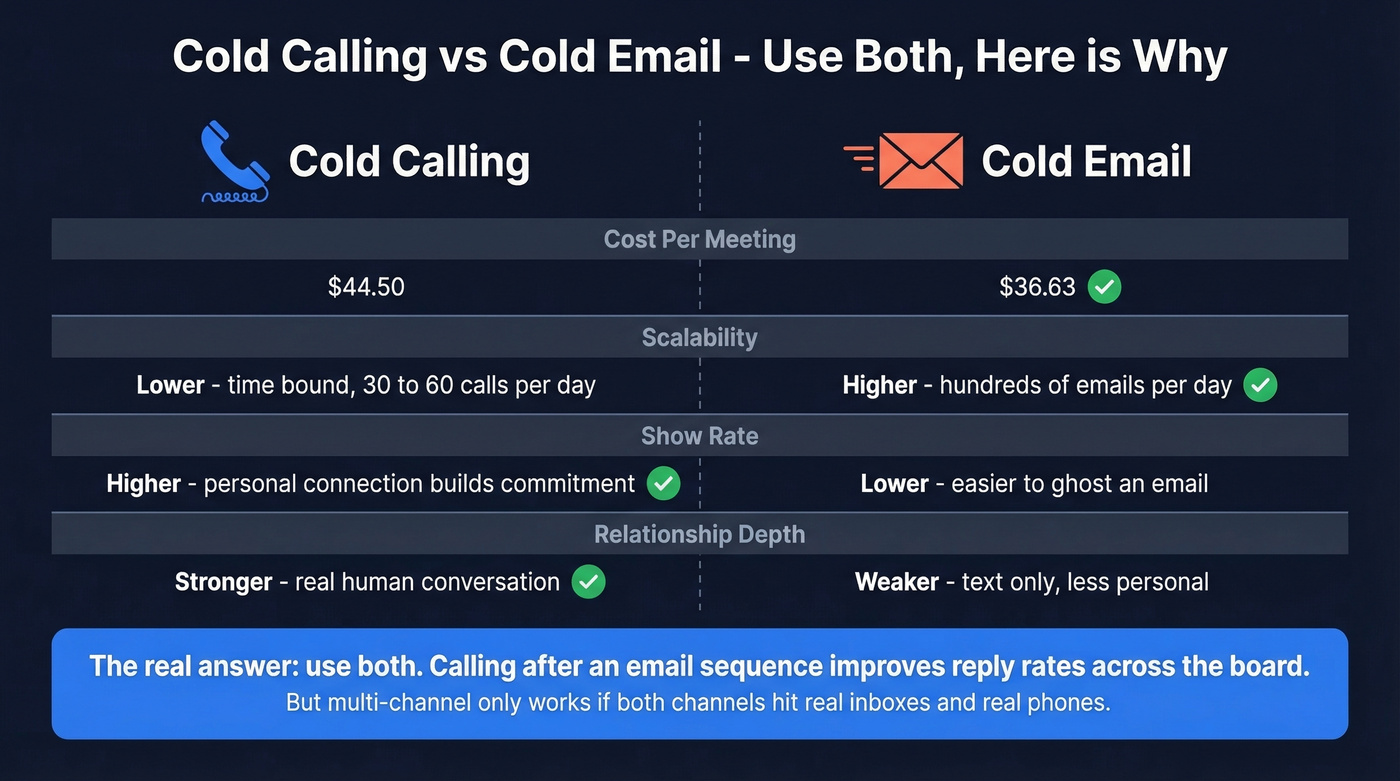
| Metric | Cold Calling | Cold Email | Edge |
|---|---|---|---|
| Cost per meeting | ~$44.50 | ~$36.63 | Cold email |
| Scalability | Lower (time-bound) | Higher | Cold email |
| Show rate | Higher (personal) | Lower | Cold calling |
| Relationship depth | Stronger | Weaker | Cold calling |
Cold email wins on cost and scale. Cold calling wins on show rates and relationship quality. The real answer is both - calling after an email sequence improves reply rates, and every top-performing team we've studied runs multi-channel sequences.
The catch is that multi-channel only works if both channels hit real inboxes and real phones. A bounced email tanks your domain reputation, and a disconnected number wastes your rep's time.
Compliance in 2026
Cold calling isn't illegal, but the rules have shifted fast enough that most SDR teams are operating on outdated assumptions.
TCPA litigation surged nearly 95% in 2025. The FCC's February 2024 ruling classified AI-generated voices as "artificial or prerecorded" under the TCPA, meaning any AI voice call now requires prior express written consent. If you're using an AI parallel dialer that plays a recorded intro before connecting a live rep, you're in a gray zone that's getting less gray by the month. Skip predictive dialers entirely - the abandoned-call rate creates direct TCPA exposure.
Consent revocation rules took effect April 11, 2025 - consumers can now revoke consent by any reasonable method, whether that's texting "STOP," sending an email, or telling a rep verbally. State mini-TCPAs are adding another layer: Texas SB 140 went live September 2025, Virginia SB 1339 kicked in January 2026, both stricter than federal law.
Your compliance checklist:
- Scrub every list against the National DNC registry before dialing
- Maintain an internal DNC list and honor opt-outs within 24 hours
- Respect 8am-8pm local time calling windows (some states are narrower)
- Register and post bonds in states that require it
- Treat ringless voicemail as a prerecorded message - it requires consent
- Never use AI-generated voices without prior express written consent
Real talk: most B2B teams aren't getting sued yet. But the litigation trend is steep enough that sloppy compliance is now a genuine business risk, not just a legal footnote.
How to Make It Work in 2026
The teams hitting 11.3% aren't doing anything magical. They're doing the basics better than everyone else. In our experience, the teams that obsess over data quality outperform the ones that obsess over scripts - every single time.
Dial verified mobiles, not office lines. This is the single highest-leverage change you can make. Mobile numbers connect 4-10x more often. If your data provider doesn't have mobile coverage, switch providers before you change anything else.
Timing matters more than most reps think. Tuesday is the best day for bookings, and Thursday is also a standout. In 2026, Tuesday overtook Wednesday after Wednesday performed better in prior years. The 10-11am window is the sweet spot, with 2-3pm as a secondary peak. Fridays are surprisingly good for conversations since fewer people are in meetings, but they don't convert to bookings as well.
Cap your attempts at three. 93% of conversations happen by the third call. After that, move the contact to email or a different channel. You're chasing diminishing returns.
The best teams don't treat phone outreach as a standalone activity. Calling after an email touch or a connection request isn't cheating - it's standard practice for top performers. The Chili Piper data showed warm calls outperformed pure cold calls on every key metric. Pair your calls with email sequences, and multithread your accounts - deals involving 10+ stakeholders close at 30% higher rates. One call to one contact at a target account is a lottery ticket. Five calls to five stakeholders is a strategy.
For international selling, use local numbers and local reps. Cross-border calling with foreign country codes tanks pickup rates - buyers screen unfamiliar prefixes the same way they screen spam.
Invest in the right dialer for your stage. A basic power dialer at $30-50/user/month is plenty for teams making 30-50 calls a day. Parallel dialers with AI features like Orum or Nooks make sense when you're scaling past 100 dials daily and need coaching analytics. Don't overspend on technology before your data is clean.
And finally, measure quality, not volume. Track conversations per hour, meeting show rate, and pipeline generated - not raw dials. The Chili Piper volume experiment proved that optimizing for dials destroys downstream metrics.
Multi-channel only works when both channels reach real people. Prospeo gives you 98% accurate emails and verified direct dials in one platform - at $0.01 per email. No stale data, no bounced emails torching your domain, no disconnected numbers burning rep hours.
Fix your data and your cold calls fix themselves.
FAQ
Is cold calling dead in 2026?
No. The industry average success rate is 2.7% and top teams hit 11.3%, based on 200K+ analyzed calls. The gap comes down to verified mobile numbers, call timing (10-11am on Tuesday/Thursday), and capping attempts at three per prospect. Anyone declaring the phone dead is looking at averages, not what the best teams are doing.
Does cold calling still work?
Yes. Effectiveness dipped in 2025 as spam filters tightened, but it recovered in 2026 for teams using verified mobile data. The channel works when the underlying contact data is fresh and accurate - stale lists are the real killer, not the medium itself.
Is cold calling illegal?
Cold calling is legal in most B2B contexts, but regulations are tightening fast. TCPA litigation surged 95% in 2025, and AI-generated voice calls now require prior express written consent. Always scrub against the National DNC registry, maintain internal opt-out lists, and respect 8am-8pm local calling windows.
Is cold email better than cold calling?
Cold email costs less per meeting (~$36.63 vs ~$44.50) and scales more easily. Phone-booked meetings show at higher rates because of the personal connection. The best-performing teams use both - calling after an email sequence improves conversions significantly. Multi-channel only works when both channels run on accurate, verified data.