

Is Email Dead? The Data Says No - But Your Strategy Might Be
In 2015, John Brandon wrote in Inc. that email would be dead by 2020. In 2009, Alex Berger called it an "endangered species" that millennials would finish off. Both were wrong. Email volume has grown from 306.4 billion messages per day in 2020 to around 376 billion per day, and the user base climbed from just over 4 billion to 4.6 billion over the same window. The obituary writers keep getting it wrong.
The predictions fail because they confuse channel fatigue with channel decline. People aren't tired of email - they're tired of bad email. That's a different problem, and it's worth about $36-40 in ROI for every dollar you spend getting it right.
The Short Answer
Email delivers $36-40 ROI per $1 spent. Global users sit in the mid-4 billions, with projections reaching 4.89B by 2027. Volume keeps rising year over year at about 4.3%. The real problem isn't the channel - it's execution. Roughly 17% of emails never reach the inbox. Fix your data quality, shift from broadcast campaigns to automated flows, and stop blasting unsegmented lists. Email isn't dying. Your email strategy might be.
Email by the Numbers in 2026
The scale is hard to overstate.
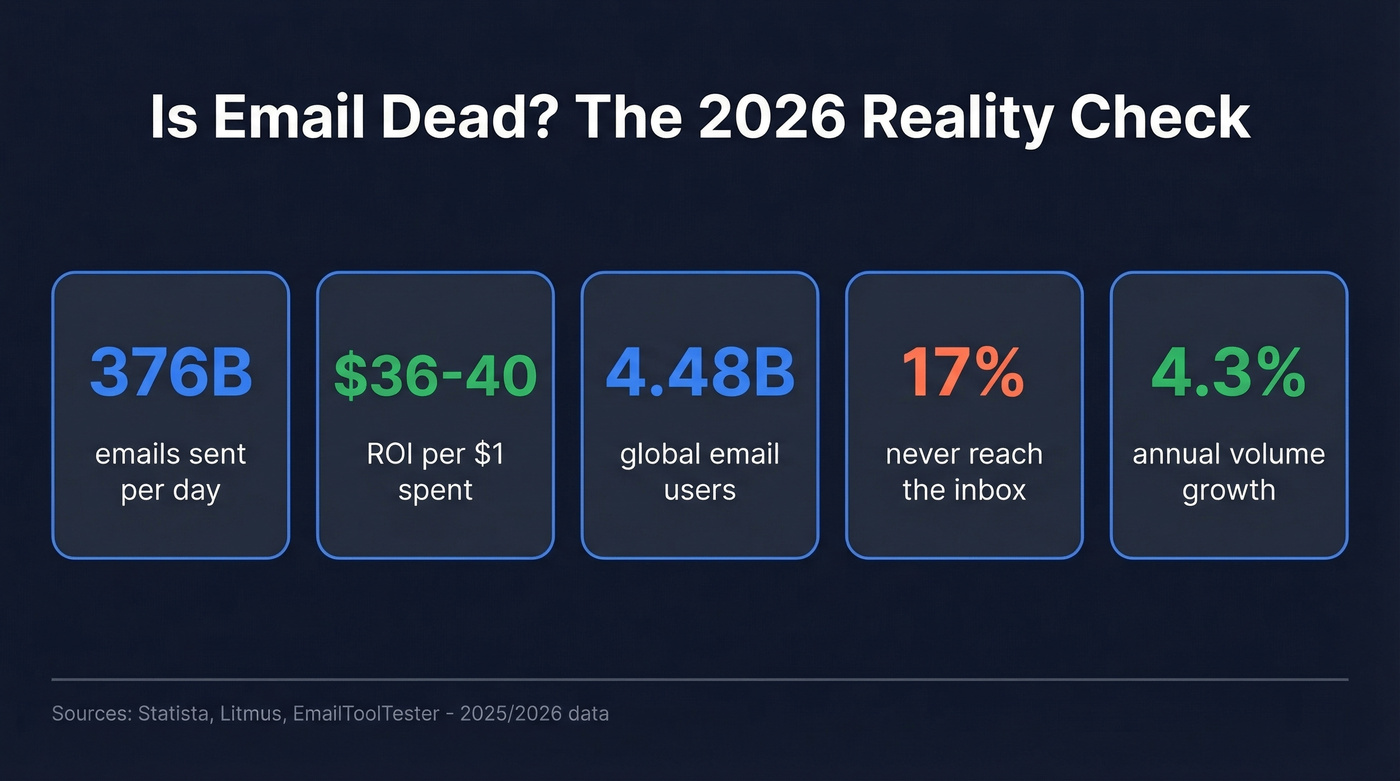
| Metric | Number |
|---|---|
| Emails sent/received daily | ~376B |
| Global email users | 4.48B |
| Projected users (2027) | 4.89B |
| Mobile email opens | 47% |
| Prefer smartphones for email | 81% |
That's not a dying channel. That's infrastructure.
The steady annual growth matters too - it's not explosive, it's the kind of growth you see in utilities, not fads. Email grows because it's the connective tissue of the internet, not because it's trendy. Retail and ecommerce brands see email marketing ROI as high as $45 per dollar spent; agencies hit $42. The general $36-40 figure is actually the conservative number.
The Deliverability Crisis Nobody Mentions
Here's the thing: email works, but a staggering amount of it never arrives.
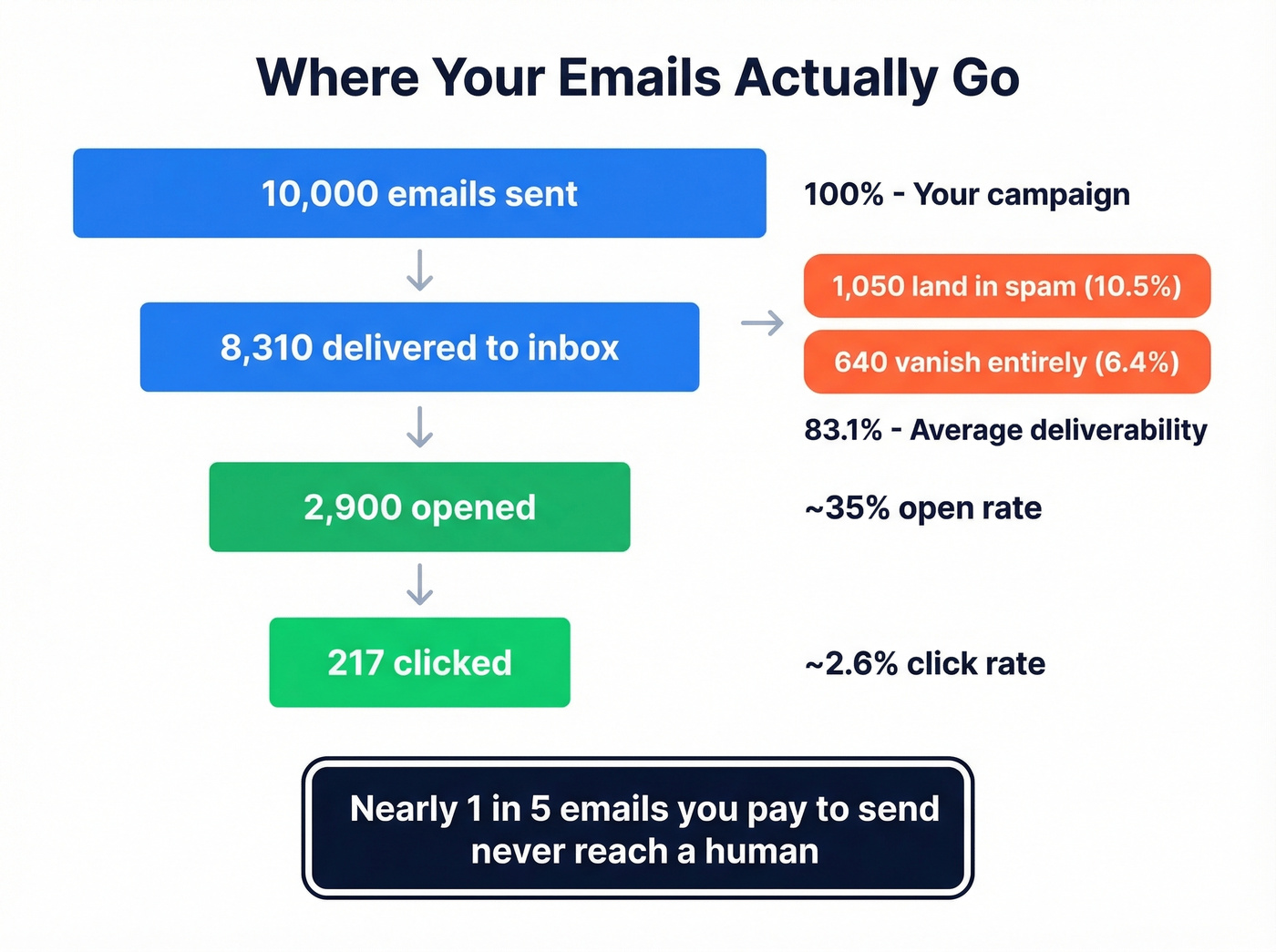
Roughly 46-47% of all email traffic is spam - approximately 176 billion spam messages per day. The sheer volume of junk has made inbox providers ruthless. Of the legitimate emails that do get sent, 10.5% land in spam folders and 6.4% vanish entirely, blocked or undelivered with no bounce notification. An EmailToolTester study across 15 providers found average deliverability sits at just 83.1%. For a 10,000-person campaign, that's 1,690 messages that disappear into the void while you're still paying to send them.
AI-powered phishing jumped 466% in Q1 2025, which has only made inbox providers more aggressive with filtering. Legitimate senders are collateral damage.
The fix isn't better subject lines or send-time optimization. It starts with list hygiene. We've watched teams cut bounce rates from 35%+ to under 4% just by verifying their lists before hitting send - tools like Prospeo run a 5-step verification process with catch-all handling, spam-trap removal, and honeypot filtering at 98% email accuracy. You can't optimize your way out of sending to addresses that don't exist.
If you want the deeper mechanics, start with an email deliverability audit and then work backward into your data.

2026 Benchmarks That Matter
Benchmarks are messy right now, and you need to understand why before comparing your numbers to anyone else's. Apple Mail Privacy Protection pre-loads tracking pixels, inflating open rates across the board. Click rates are the more reliable metric in 2026.
Here's how three major platforms stack up:
| Metric | Klaviyo (2026) | Mailchimp (Dec 2023) | ActiveCampaign (Jan 2026) |
|---|---|---|---|
| Dataset | 183K+ ecommerce brands | Billions of emails, 1K+ subs | Jan-Dec 2025 sends |
| Avg open rate | - | 35.63% (MPP-inflated) | 39.26% |
| Avg click rate | 1.69% (campaigns) / 5.58% (flows) | 2.62% | 6.21% |
If you’re pressure-testing performance, use a consistent click rates definition across platforms.
The ActiveCampaign numbers look unusually high on click rate - their dataset includes transactional and triggered emails alongside marketing campaigns. Mailchimp's benchmarks are the most widely cited but haven't been updated since December 2023.
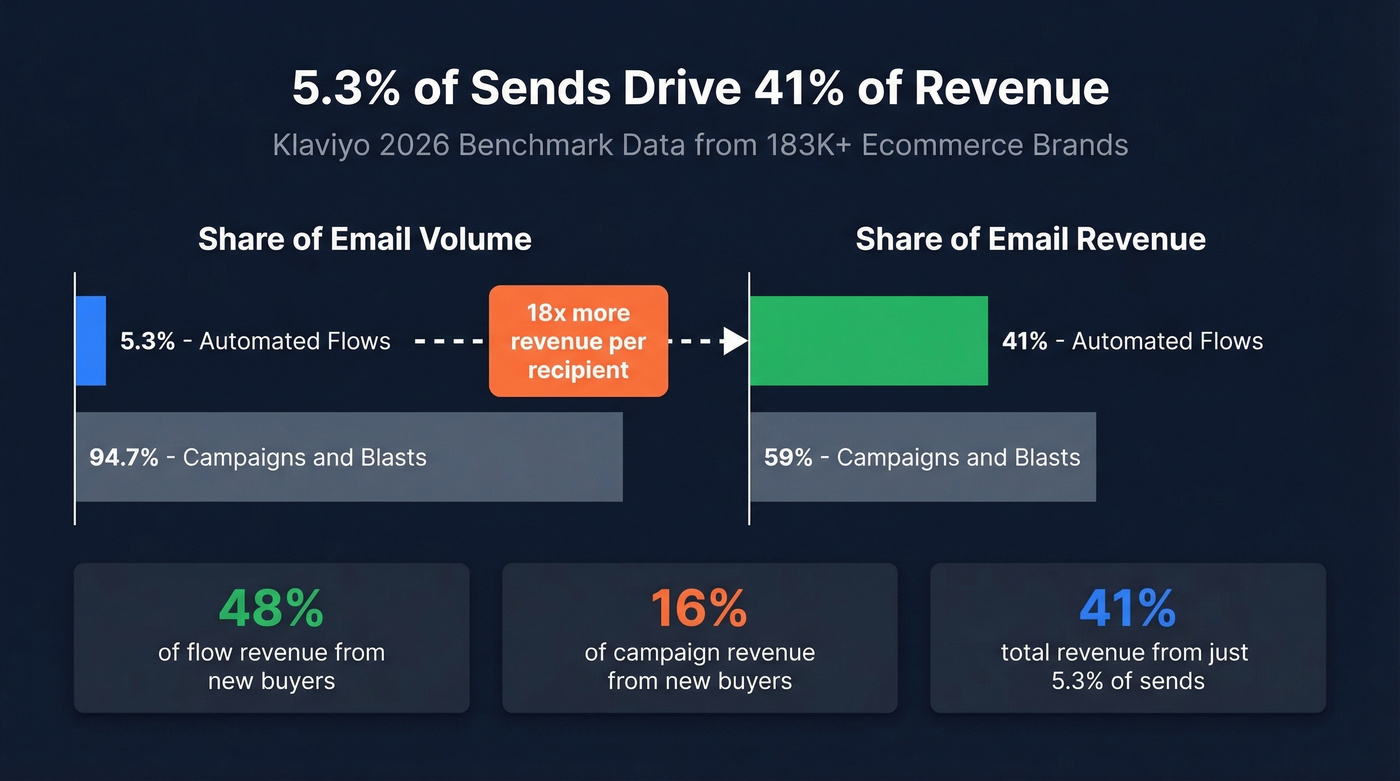
The most revealing data comes from Klaviyo's 2026 benchmarks. Their flows - automated sequences triggered by behavior - generate 41% of total email revenue from just 5.3% of sends. Revenue per recipient is 18x higher for flows than campaigns. And 48% of flow-driven revenue comes from new buyers, compared to just 16% for campaigns.
Let's be honest about what that means: 5.3% of email volume drives 41% of revenue. The other 94.7% - your newsletters, your blasts, your "just checking in" campaigns - are doing a fraction of the work. If you're still running a campaign-heavy strategy, you're leaving the majority of your email ROI on the table.

You just read that 16.9% of emails vanish before reaching the inbox. The fix starts with data quality, not better copy. Prospeo's 5-step verification with catch-all handling, spam-trap removal, and honeypot filtering delivers 98% email accuracy - cutting bounce rates from 35%+ to under 4%.
Stop paying to send emails that never arrive. Start at $0.01 per verified address.
Does Gen Z Still Use Email?
"Gen Z doesn't use email" is one of those things people repeat at conferences without checking.
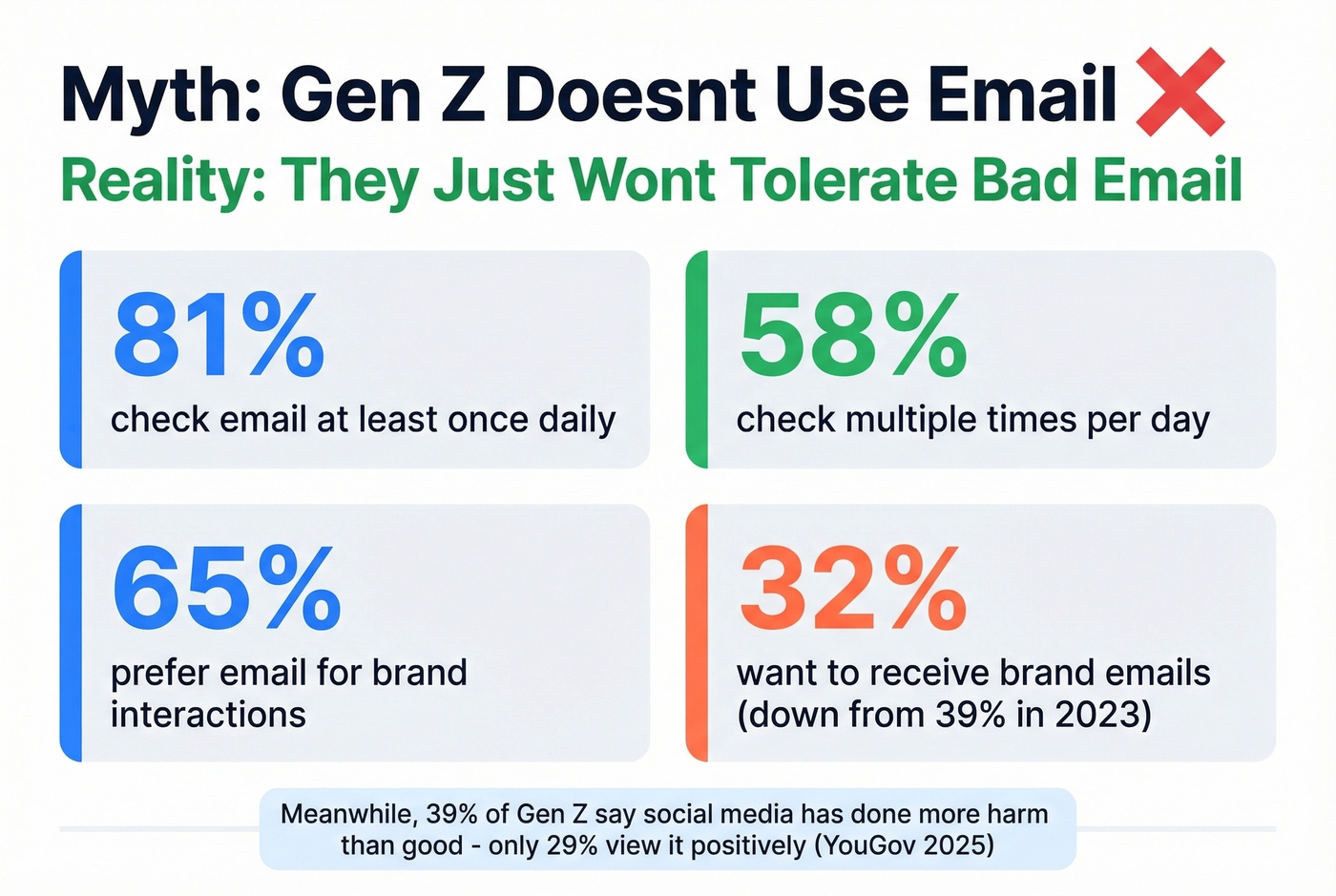
81% of Gen Z check email at least once daily. 58% check multiple times per day. 65% prefer email for brand interactions - higher than millennials at 62%. Gen Z's preference for receiving brand emails did drop from 39% to 32% between 2023 and 2025, per Braze's research. They're pickier, not absent. They'll engage with email that's relevant and ignore everything else, which is exactly what every generation does, just with less patience.
There's an interesting countertrend too. A YouGov survey found 39% of Gen Z Britons say social media has done more harm than good, compared to just 29% who view it positively. The "digital natives will abandon email for social" narrative is colliding with a generation that's increasingly skeptical of the platforms they grew up on.
Gen Z uses email. They just won't tolerate bad email.
Email Isn't the Problem - Noise Is
The average employee receives 117 emails and 153 Teams messages per day - 270 messages total. Microsoft's 2025 Work Trend Index found workers get interrupted every 2 minutes. Grammarly's research puts it at 88% of the workweek spent communicating.
The crowd declaring email obsolete loves to point at this overload as evidence. But chat tools didn't fix the problem - they added to it. Slack users send 92 messages per day and check the app 13 times daily. 40% of workers check email before 6 a.m. A third return to their inbox by 10 p.m.
Email isn't drowning people. Communication is drowning people. And when you look at which channel actually drives business outcomes - closed deals, completed purchases, signed contracts - email is still where the receipts live. Literally.
Email as Digital Identity
There's a dimension to email's durability that most articles on this topic miss entirely.
Every SaaS login, every ecommerce account, every password reset, every two-factor authentication flow runs through email. It's the unofficial system of record for business - where purchase orders, invoices, contracts, and RFPs live. In the post-cookie world, hashed email addresses are becoming the backbone of identity graphs that power ad targeting across channels. Email isn't just a communication tool. It's the first-party data asset that ties a person to their actions across the internet.
Part of what makes email unkillable is that it runs on open protocols. SMTP and IMAP are vendor-neutral - no single company owns them, no platform can lock you in or shut you out. Slack, Teams, WhatsApp - every alternative is a walled garden controlled by one corporation. Email is the only digital communication channel where you can switch providers without losing your address or your history. That interoperability is why email outlasts every "email killer" that launches.
What Actually Works in 2026
The data is clear: email works. But "email works" and "your emails work" are different statements.
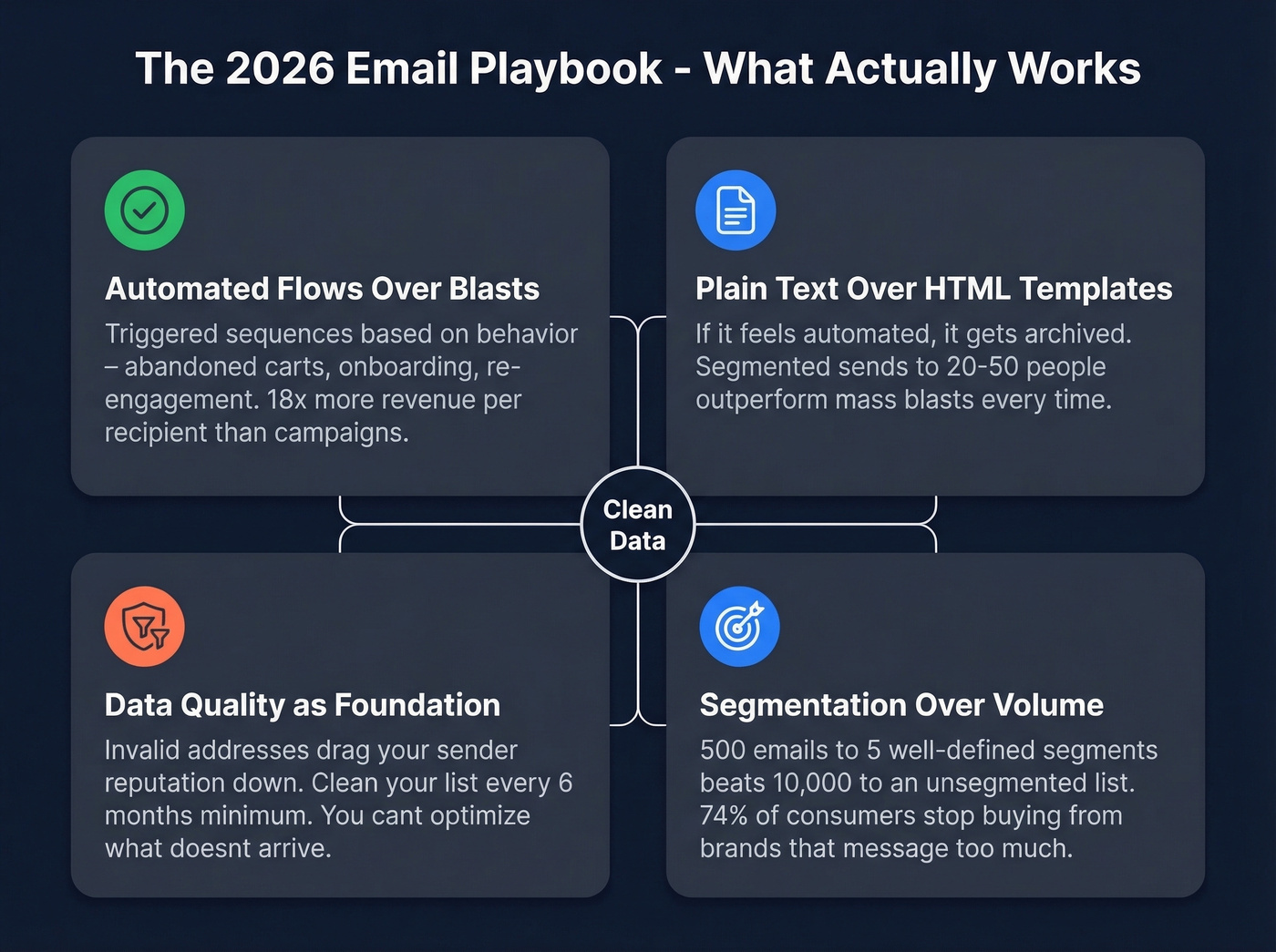
Automated Flows Over Blasts
Klaviyo's data is unambiguous - flows generate 18x more revenue per recipient than campaigns. If you're still building your email strategy around weekly newsletters and one-off blasts, you're optimizing the wrong thing. Build triggered sequences based on behavior: abandoned carts, onboarding, re-engagement, post-purchase. This is where the money is.
If you’re building outbound sequences too, a solid B2B cold email sequence structure helps keep volume from turning into noise.
Plain-Text Over Designed Templates
The consensus on r/b2bmarketing is blunt: "if it feels automated, it gets archived." The best-performing B2B emails in 2026 look like they were written by a human, not designed by a brand team. Segmented sends to 20-50 people, with tailored messaging, outperform mass blasts consistently. In our experience, the teams declaring email dead are almost always the ones still sending HTML-heavy blasts to unsegmented lists.
If you need ideas without going full “marketing template,” pull from these email subject lines and adapt them to your voice.
Data Quality as the Foundation
You can't optimize deliverability, personalization, or segmentation on a list full of invalid addresses. If you haven't cleaned your list in six months, a big chunk of it is dead weight dragging your sender reputation down with it. Clean data isn't a nice-to-have - it's the prerequisite for everything else working.
If you’re diagnosing performance, start with bounce rates and then fix the upstream data source.
Segmentation Over Volume
Sending 10,000 emails to an unsegmented list will always underperform sending 500 emails to five well-defined segments. Accenture found 74% of consumers who receive too many messages from a brand ultimately choose not to purchase. More isn't better. Relevant is better.
If you want a practical framework for this, build segments around intent instead of demographics alone.
Look - if your average deal size is under $5K, you almost certainly don't need a complex marketing automation platform. A clean list, three well-built flows, and a basic ESP will outperform a $50K/year Marketo instance that nobody on your team fully understands. The bottleneck is never the tool. It's the data going into it.
Check Who's Writing the Obituary
When a chat tool company tells you email is dead, notice who benefits. Plenty of collaboration-tool companies publish "email replacement" narratives while selling alternatives. That's not analysis - it's marketing.
If you’re doing outbound, it’s worth pairing this with a playbook on improving sender reputation so your “good email” actually lands.
Automated flows generate 41% of email revenue from just 5.3% of sends. But flows only work when they reach real inboxes. Prospeo gives you 143M+ verified emails refreshed every 7 days - not the stale data that's quietly destroying your deliverability and domain reputation.
Email isn't dead. Your list data might be. Replace it in minutes.
FAQ
Is email marketing dead in 2026?
No. Email delivers $36-40 per $1 spent, reaches 4.48 billion users worldwide, and volume grows roughly 4.3% year over year. Automated flows, clean lists, and tight segmentation separate the teams seeing results from the ones declaring the channel finished.
Will AI replace email?
AI is accelerating email usage, not replacing it. AI-powered phishing jumped 466% in Q1 2025, which ironically makes verified, trusted email communication more valuable than ever. AI tools help write and personalize emails - they don't eliminate the channel.
How do I fix low email deliverability?
Start with list hygiene - verify every address before sending. Then authenticate your domain with SPF, DKIM, and DMARC. Finally, segment your sends to keep engagement high, which signals to inbox providers that your emails are wanted.
What will replace email?
Nothing on the current horizon. Chat tools like Slack and Teams added communication volume without reducing email. Email's open-protocol architecture means no single company controls it, making it uniquely resilient. With 4.89B projected users by 2027, email functions more like internet infrastructure than a replaceable app.