

IT Demand Generation: What Actually Works When Sales Cycles Run 18 Months
You've read ten demand gen guides this quarter. They all say the same thing: create content, run ABM, nurture leads. None of them acknowledge that IT demand generation is a fundamentally different problem - selling a large enterprise infrastructure deal to a committee of eight people who won't return your calls isn't the same as selling a small self-serve SaaS subscription. 83% of the B2B buying process happens before a buyer contacts a vendor. For IT companies, that number is almost certainly higher - your buyers are technical, skeptical, and doing their own research long before your SDR sends a cold email.
Three things to internalize right now:
- IT buying committees have 6-10 people and your sales cycle runs 6-18 months. Generic B2B playbooks don't account for this.
- Stop optimizing for MQLs. Over 90% never convert. Measure pipeline and SQLs.
- Fix your data before you fix your content. Stale contacts kill ABM campaigns before they start.
What Demand Generation Actually Means for IT
Demand generation isn't lead generation with a fancier name. Lead gen is transactional - gated PDFs, form fills tossed to sales. Demand gen builds awareness, trust, and preference so that when your ICP starts evaluating solutions, you're already on the shortlist.
Think of it as two motions: demand creation (making people aware of a problem and your approach) and demand capture (intercepting active buyers). Most IT companies over-invest in capture and under-invest in creation - and it shows in their thin pipelines.
Why IT Buying Cycles Break Generic Playbooks
Demand gen for IT services operates under constraints that standard B2B frameworks ignore entirely.
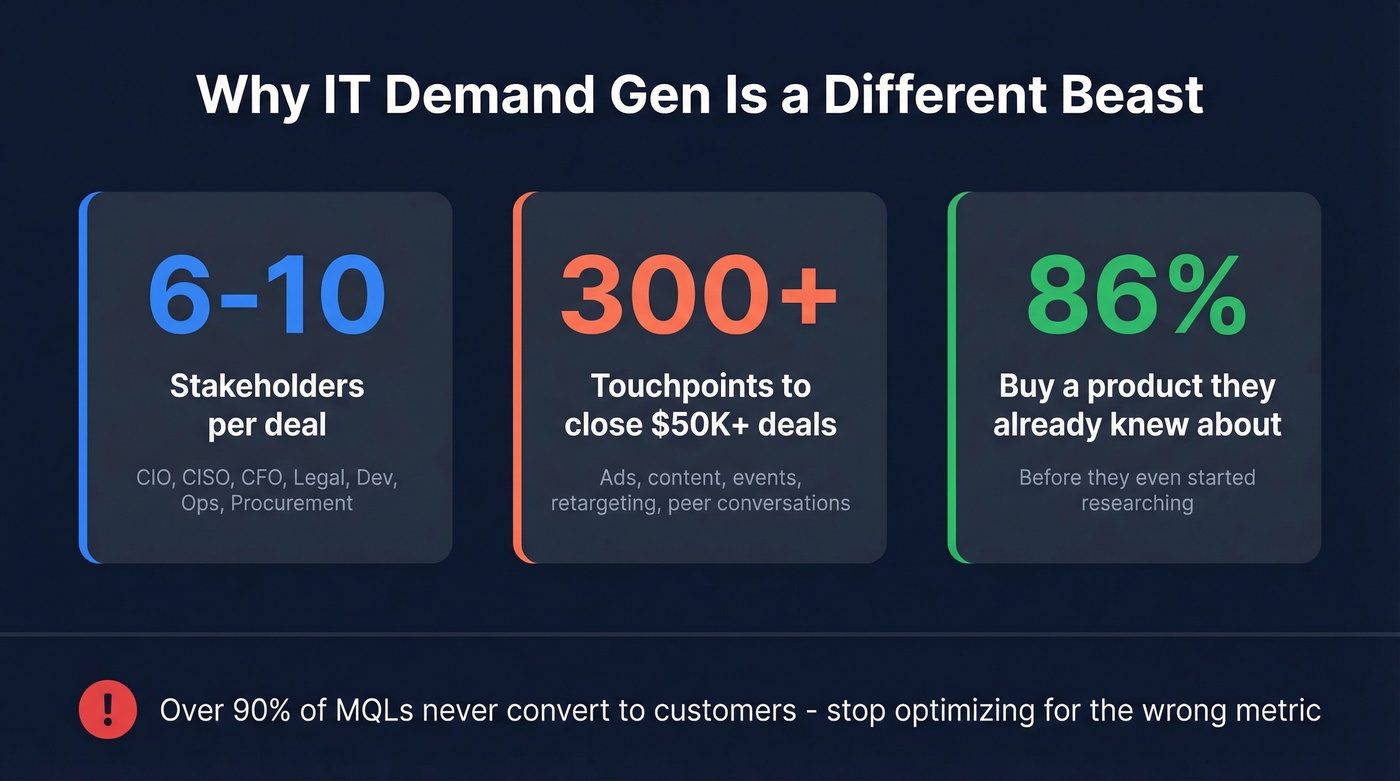
Massive buying committees. Enterprise IT purchases involve 6-10 stakeholders - CIO, CISO, CFO, legal, developers, ops, procurement. The CISO cares about security posture. The CFO cares about TCO. The developer cares about whether your API documentation is garbage. One piece of content won't reach all of them, and the internal politics between these roles can stall a deal for months even after everyone agrees the product is solid.
Brutally long sales cycles. Enterprise IT deals commonly run 6-18 months. That's not a nurture sequence - that's a relationship. And 86% of enterprise buyers purchase a product they'd heard of before they started researching. If you're not in the conversation early, you're not in the conversation at all.
Touchpoint volume most teams underestimate. A HockeyStack study found that $50K+ deals require 300+ touchpoints from SQL to closed-won. FullFunnel documented one deal that took 87 meaningful touchpoints over roughly a year before the prospect ever reached out. Not emails - ads, content views, event interactions, peer conversations, retargeting impressions.
Proof over promises. IT buyers demand technical depth: security certifications, SLAs, architecture diagrams, peer reviews on Gartner Peer Insights and G2. A polished landing page with stock photos won't cut it.
Strategies That Work for IT Companies
ABM for Enterprise Deals
If you're selling $50K+ IT solutions, account-based marketing is the default motion, not an experiment. Snowflake's ABM program drove a 300% increase in pipeline velocity. The key is building accurate, ICP-matched target account lists with verified buyer contact data - bad data means your personalized outreach hits nobody.
Use this if you're selling to named accounts with complex buying committees. Skip it if your average contract value is under five figures and you need volume.
Ungated Technical Content
Whitepapers behind forms are dying. Technical buyers won't fill out your form - they'll find the answer somewhere else. Publish architecture guides, security benchmarks, and comparison pages openly. The consensus on r/sales and r/b2bmarketing is pretty clear on this: gating commodity content just trains your best prospects to ignore you.
Use this if you want to build trust with engineers and technical evaluators. Skip it if your only goal is capturing emails - but seriously, reconsider that goal.
Referrals and Partnerships
For MSPs and IT services firms, referrals remain the highest-ROI channel. The catch: you need a professional web presence to convert passive referrals when someone Googles you after a recommendation. Use this if you're an MSP with happy customers. Skip it if your website looks like it was last updated in 2019.
Vertical-Specific Landing Pages
A generic "IT solutions" page converts poorly. A page targeting "cybersecurity compliance for healthcare organizations with 200-500 employees" converts 2-3x better because it speaks directly to the buyer's regulatory reality and technical environment. Use this if you serve distinct verticals with different compliance or technical requirements.
Intent Data for Demand Capture
Intent data tells you which accounts are actively researching topics related to your solution. Layer it on top of your ABM lists to prioritize outreach to accounts showing buying signals right now. Use this if you have a defined target account list and want to time your outreach. Skip it if you haven't nailed your ICP yet - intent data amplifies strategy, it doesn't replace it.

ABM only works when your contact data actually reaches the buying committee. Prospeo's 300M+ profiles with 98% email accuracy and 7-day refresh cycle mean your personalized outreach hits real people - not dead inboxes. Layer intent data across 15,000 Bombora topics to time outreach to accounts actively researching IT solutions.
Stop burning ABM budgets on stale data. Fix the foundation first.
What's Changed in 2026
Three shifts are reshaping demand gen for IT companies right now.
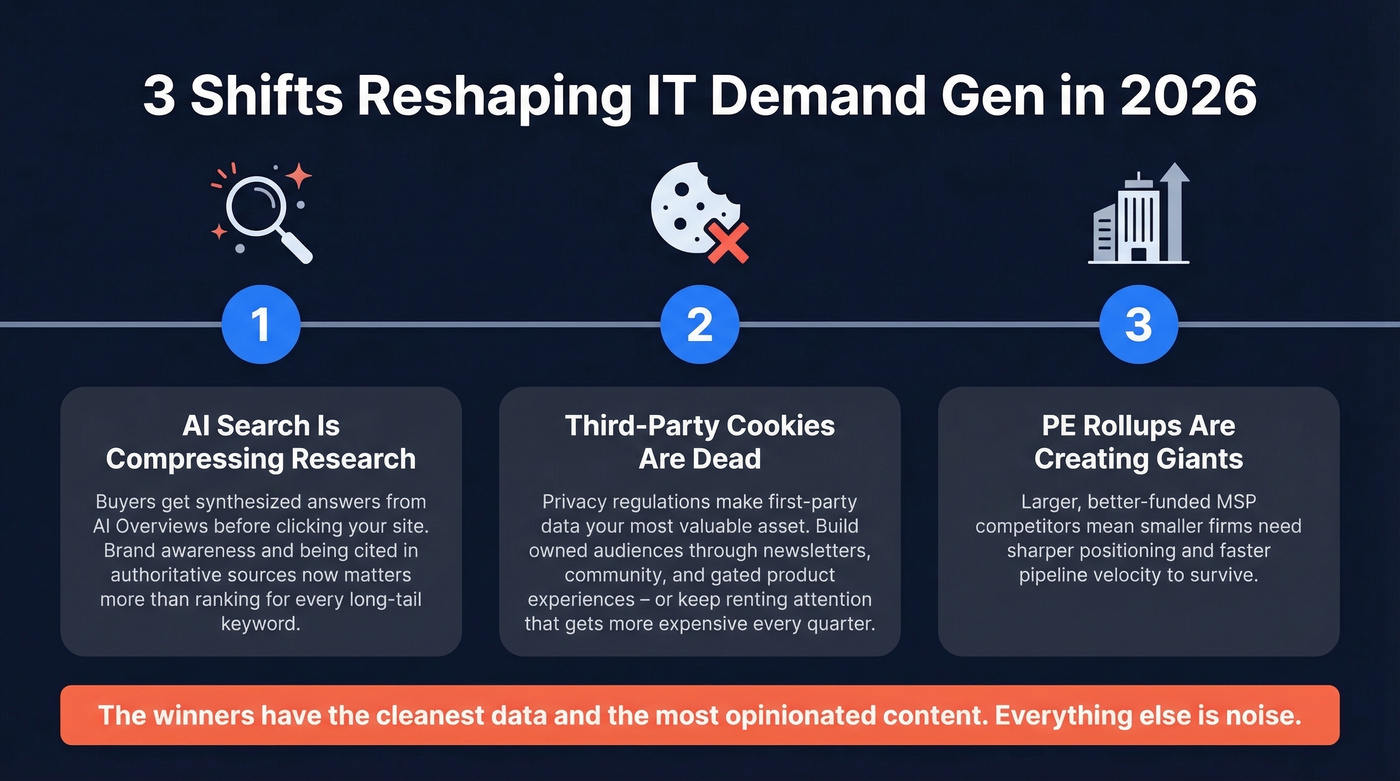
First, AI-generated search results are compressing the research phase. Your buyers are getting synthesized answers from AI Overviews before they ever click through to your site, which means brand awareness and being cited in authoritative sources matters more than ranking for every long-tail keyword.
Second, third-party cookie deprecation and tighter privacy regulations are making first-party data your most valuable asset. If you're not building an owned audience through newsletters, community, or gated product experiences, you're renting attention that gets more expensive every quarter.
Third, PE rollups in the MSP space are creating larger, better-funded competitors - smaller firms need sharper positioning and faster pipeline velocity to compete.
Here's the thing: the teams that'll win in 2026 aren't the ones with the biggest martech stack. They're the ones with the cleanest data and the most opinionated content. Everything else is noise.
Benchmarks Worth Knowing
| Metric | Benchmark | Context |
|---|---|---|
| IT & Managed Services conversion | 1.5% | Visitor to conversion |
| B2B SaaS conversion | 1.1% | Comparison point |
| Touchpoints for $50K+ deals | 300+ | SQL to closed-won |
| MQL-to-customer rate | Under 10% | 90%+ never convert |
| Sales cycle (enterprise IT) | 6-18 months | Varies by deal size |
That 1.5% conversion rate for IT & Managed Services is actually higher than B2B SaaS. The volume is lower, but the visitors are more qualified - they're further along in their research when they land on your site.
Mistakes IT Companies Keep Making
Obsessing over MQLs. Marketing reports 500 MQLs. Sales says they're junk. Both are right. A recurring complaint across B2B marketing communities captures it well: "Our MQLs are garbage but marketing keeps celebrating them." Track pipeline-sourced revenue and SQL conversion instead.
Writing generic content. "Top 10 Cybersecurity Tips" doesn't move the needle for a CISO evaluating a $300K platform investment. Write for the technical buyer who's already past the basics.
Sales and marketing misalignment. If marketing defines an MQL as "downloaded a PDF" and sales defines an SQL as "has budget and timeline," no tool can fix that gap. Align on lead definitions, share a CRM, and track from first touch to closed deal.
Running campaigns on stale data. B2B contact data decays at roughly 30% per year. We've watched teams pour budget into ABM sequences hitting last year's contacts - burning budget and domain reputation simultaneously. Fix the data first; everything else compounds from there.

Building Your Tech Stack
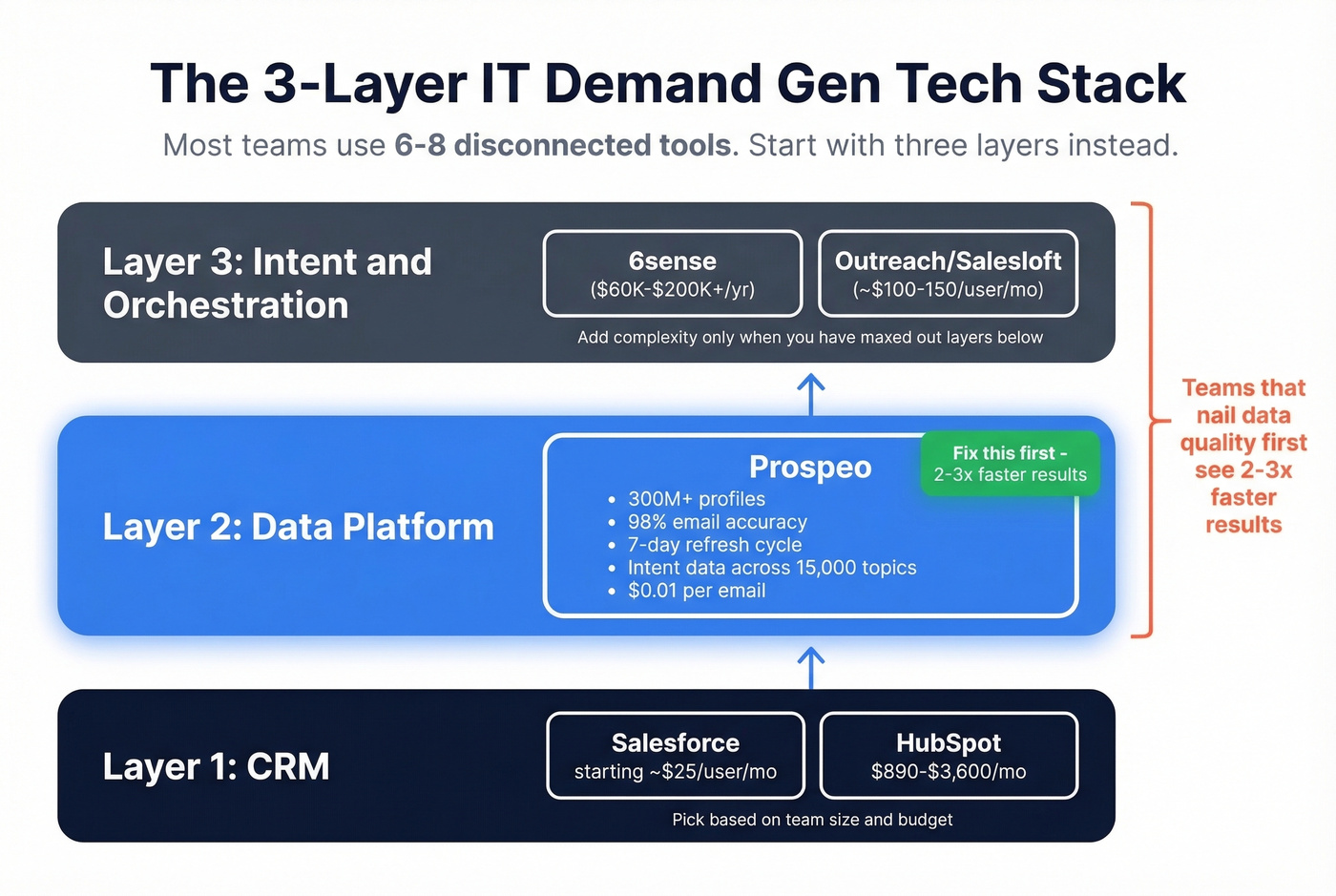
Most teams use 6-8 disconnected marketing tools. That's too many. Start with three layers and add complexity only when you've maxed out what they can do.
Layer 1: CRM
Salesforce or HubSpot - pick based on your team size and budget. HubSpot Marketing Hub runs $890/mo for Professional and $3,600/mo for Enterprise. Salesforce Sales Cloud starts around $25/user/month for entry tiers, scaling to $100+/user/month for higher editions.
If you're still deciding, start with a quick scan of examples of a CRM and then compare contact management software options.
Layer 2: Data Platform
This is where most IT demand generation programs quietly fail. Your ABM sequences, enrichment workflows, and intent-based outreach all depend on accurate contact data - and in our experience, bad data is the single most common reason ABM programs underperform. Prospeo gives you 300M+ professional profiles with 98% email accuracy on a 7-day refresh cycle, plus intent data across 15,000 Bombora topics so you can identify which accounts are actively in-market. Free tier starts at 75 verified emails per month, and paid plans run about $0.01 per email.
If you're evaluating vendors, start with data enrichment services and a practical lead enrichment workflow.

Layer 3: Intent and Orchestration
6sense is the heavyweight, running $60K-$150K+/year for mid-market and $200K+ for enterprise. If you're not ready for that investment, start with your data platform's intent signals and a sequencing tool like Outreach or Salesloft at ~$100-150/user/month.
You don't need the full stack on day one. Let's be honest - teams that nail data quality first see results 2-3x faster than those that start with content or orchestration tooling. We've seen this pattern enough times that it's basically a rule. If you want a broader shortlist, compare SDR tools and outbound lead generation tools.
300+ touchpoints to close a $50K+ IT deal - and every bounced email is a wasted one. Prospeo's 5-step verification and proprietary email infrastructure keep bounce rates under 4%, so your 18-month enterprise sales cycle doesn't stall on bad data. At $0.01 per email, cleaning your pipeline costs less than one failed send.
Enterprise IT deals are hard enough. Your data shouldn't make them harder.
FAQ
How is IT demand generation different from generic B2B demand gen?
IT buying committees are larger (6-10 stakeholders including CIO, CISO, CFO, legal, and developers), sales cycles run 6-18 months, and buyers demand technical proof - security certifications, SLAs, architecture documentation, and peer reviews - before they'll engage sales. Generic B2B playbooks underestimate all three factors.
What's the most important metric for IT demand gen?
Pipeline-sourced revenue, not MQLs. Over 90% of MQLs never convert to customers. Track SQLs, pipeline velocity, and CAC-to-CLV ratio instead - these metrics align sales and marketing around outcomes that actually drive revenue growth.
What tools do I need to get started?
Three layers: a CRM like Salesforce or HubSpot, a verified data platform for accurate contact data and intent signals, and a sequencing tool for outreach. Start there before adding complexity - most teams that buy everything at once end up using 20% of what they paid for.
How do I fix stale contact data in my ABM campaigns?
Run your existing CRM list through an enrichment tool with a short refresh cycle. Expect roughly 30% of year-old contacts to be outdated. Re-verify emails before launching any sequence to protect deliverability and domain reputation.