

How to Write the Perfect "It Was Great Speaking With You Today" Email
You just hung up the call. The conversation went well. Now you're staring at a blank compose window, trying to sound professional without sounding robotic.
Here's what the data says: the best-performing follow-ups are under 80 words, and an informal tone outperforms formal by 78%. The follow-up is the close. Keep it short, keep it human, and send it before the conversation fades.
Copy This Email Right Now
If you need to send something in the next two minutes, use this:
Subject: Great connecting - [one thing you discussed]
Hi [First Name],
It was great speaking with you today. [One specific thing from the conversation - a challenge they mentioned, an idea you explored, a mutual interest] really stuck with me.
I wanted to follow up with [resource/next step/specific value]. Would [specific day/time] work to continue the conversation?
Best, [Your Name]
That's roughly 50 words. Personalize the bracketed sections and hit send. If you need something more tailored, keep reading.
Templates for Every Scenario
Most guides give you 15 templates. You need five - one per scenario - and the discipline to personalize them.
If you want more options beyond these five, pull from proven sales follow-up templates and adapt them to your call notes.
After a Job Interview
Subject: Excited about the [Role Title] opportunity
Hi [Name],
It was great speaking with you today about the [Role Title] position. Your point about [specific challenge or team goal] resonated - it's exactly the kind of problem I tackled at [Previous Company] when we [brief, relevant result].
I'm genuinely excited about the opportunity. Don't hesitate to reach out if you need anything else.
Best, [Your Name]
After a Sales Call
This one lives or dies on specificity. Mention their exact pain point, not your product's feature list.
If you're building a repeatable system, pair this with a simple sequence management approach so your follow-ups stay consistent.
Subject: Quick thought on [prospect's pain point]
Hi [Name],
Great speaking with you today. You mentioned [specific pain point], and I wanted to share [resource, case study, or data point] that's relevant.
Based on our conversation, I think [one-sentence value prop tied to their situation]. Want to set up 20 minutes on [day] to dig into this?
Talk soon, [Your Name]
After a Networking Event
Keep this one short - you're not pitching, you're planting a seed. A simple "it was nice meeting you" email sent the same day outperforms a detailed pitch sent a week later every time.
Subject: Good meeting you at [Event Name]
Hi [Name],
Great connecting at [Event] - your take on [topic you discussed] was refreshing. I'd love to continue that conversation.
Coffee or a quick call next week?
Cheers, [Your Name]
After a Client Meeting
Less about selling, more about proving you listened.
Subject: Next steps from today's meeting
Hi [Name],
Thanks for making time today. Quick recap of what we aligned on:
- [Decision or action item 1]
- [Decision or action item 2]
- [Decision or action item 3]
I'll have [deliverable] ready by [date]. Let me know if I missed anything.
Best, [Your Name]
After a Virtual Call
Subject: Following up on our call - [topic]
Hi [Name],
It was nice talking to you today. Even over video, your enthusiasm for [project/initiative] came through. Here's [the resource/doc/link you mentioned].
Let's reconnect [specific timeframe]. Does [day] work?
Best, [Your Name]
Subject Lines That Get Opened
The subject line decides whether your follow-up gets read or buried. Here are five that work:
If you want a bigger swipe file, use these email subject line examples and keep the same “specific + human” structure.
- "Quick thought on [topic you discussed]" - Specificity signals effort.
- "The [resource] I mentioned on our call" - Delivers on a promise.
- "Re: [Their pain point] - here's a client example" - Feels like a reply, not a cold follow-up. Follow-ups that read like replies outperform by roughly 30%.
- "Following up on [Day] - here's the roadmap I'd build"
- "I forgot to mention..." - Creates an open loop. Hard not to click.
One hard rule: never put "Follow-up" in the subject line. It screams "I have nothing new to say."
If you're sending at scale, make sure your subject line and body align with modern email copywriting best practices (plain text, one idea, one ask).

You just nailed the call. Don't let a bad email address waste that momentum. Prospeo gives you 98% verified emails so your "great speaking with you" follow-up actually lands in their inbox - not a bounce folder.
One bounced follow-up undoes the entire conversation. Fix that.
What the Data Says
A few rules backed by actual numbers:
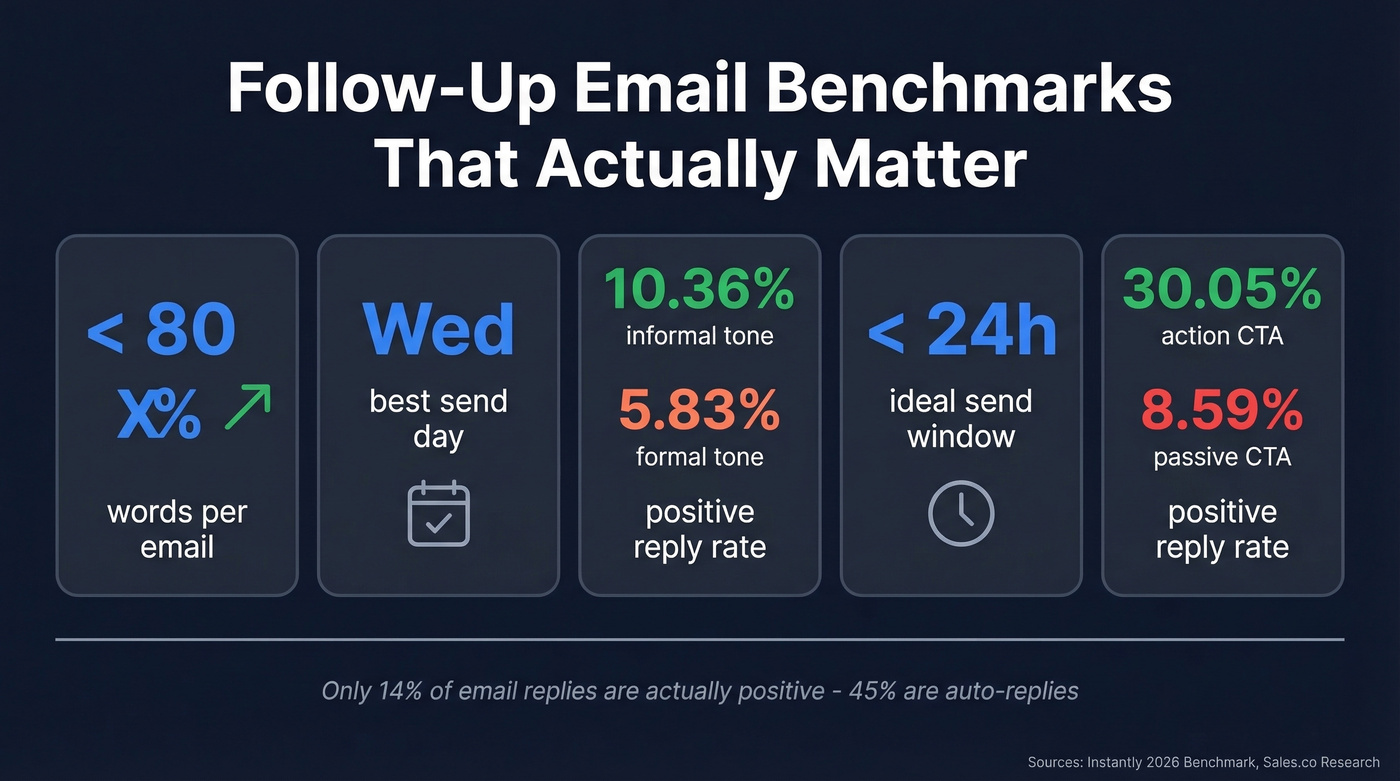
- Under 80 words. Best-performing campaigns in Instantly's 2026 benchmark consistently stayed under this threshold.
- Send on Wednesday. Tuesday and Wednesday are peak engagement days, with Wednesday edging ahead.
- Go informal. Informal tone drives a 10.36% positive reply rate vs 5.83% for formal - nearly double.
- Send within 24 hours - ideally the same day while the conversation's fresh.
- Use an action-oriented CTA. "Want to see it in action?" pulls a 30.05% positive rate vs 8.59% for "Mind if I send more info?"
And here's a sobering one: only 14% of email replies are actually positive. 45% are auto-replies. Quality of your follow-up matters far more than volume.
If you want to benchmark your own results, start with typical follow-up email reply rate ranges and work backward from there.
Mistakes That Kill Your Follow-Up
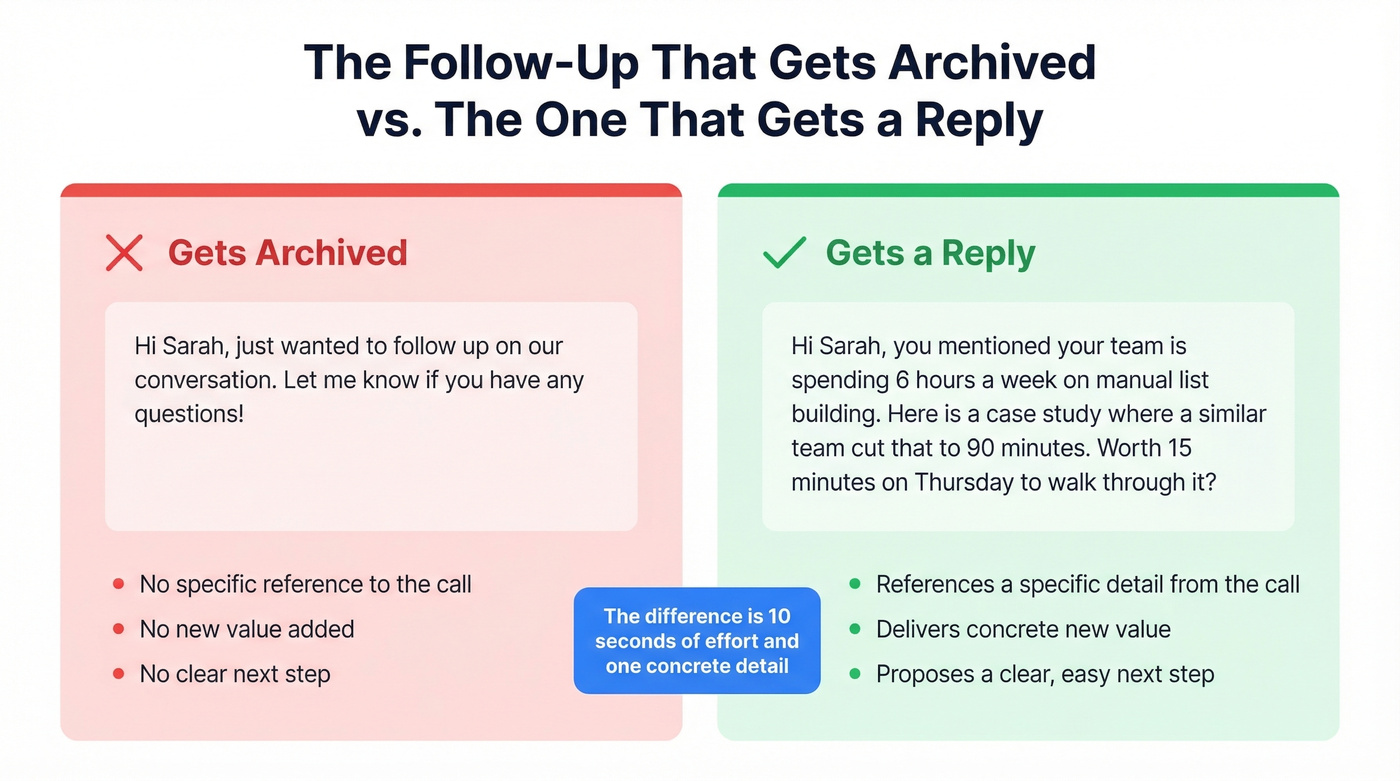
Don't bump without new information. "Just checking in!" is the fastest way to get archived. Do add something - a relevant article, a data point, a new angle. Every follow-up should earn its existence.
If you keep defaulting to “checking in,” use these alternatives on how to say just checking in professionally.
Don't over-format with HTML templates, images, and branded footers. Follow-ups that look like real emails get read. Fancy templates signal marketing, not conversation. Send plain text.
Skip empty phrases like "Just touching base," "Circling back," or "Hope you're doing well." Reference something specific from your conversation - specificity is the difference between opened and archived.
In our experience, the emails that get replies aren't the clever ones. They're the specific ones. Let's look at what that means in practice:
Bad:
"Hi Sarah, just wanted to follow up on our conversation. Let me know if you have any questions!"
Good:
"Hi Sarah, you mentioned your team's spending 6 hours a week on manual list building. Here's a case study where a similar team cut that to 90 minutes. Worth 15 minutes on Thursday to walk through it?"
The difference is 10 seconds of effort and one concrete detail. That's it.
Choosing the Right Phrase
| Phrase | Best For | Tone |
|---|---|---|
| Speaking with you | Phone/video calls | Professional |
| Meeting you | In-person meetings | Warm, formal |
| Talking to you | Casual, either format | Friendly |
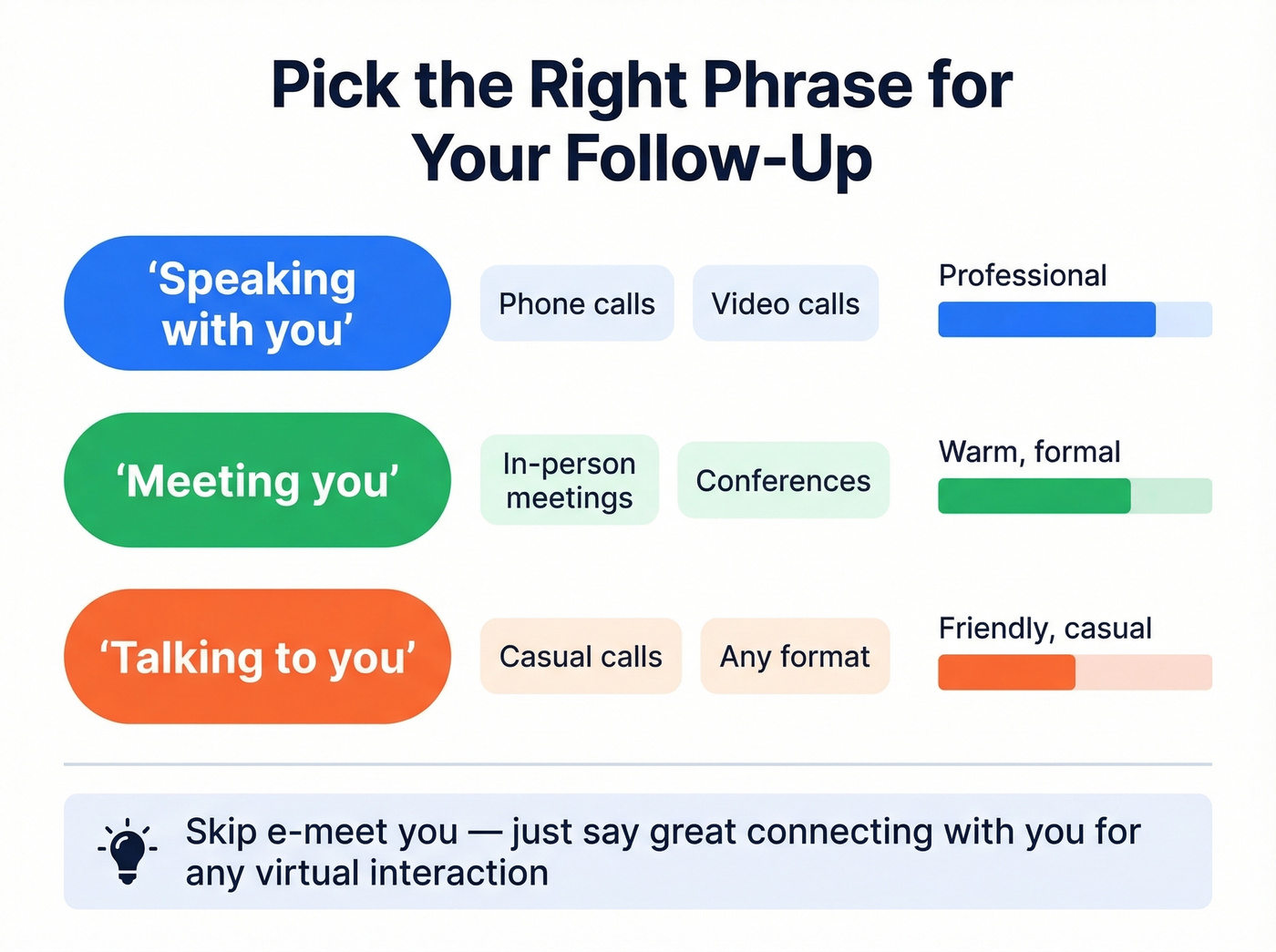
Pick one and move on - what matters is the rest of the email. If the interaction was in person, a "great meeting you" email should reference something you discussed face-to-face. If it was a call, "it was great speaking with you today" is the natural choice. And skip "nice to e-meet you." Just say "great connecting with you" regardless of whether the meeting was virtual or in-person.
What If They Don't Reply
Don't panic. Here's a simple three-step cadence:
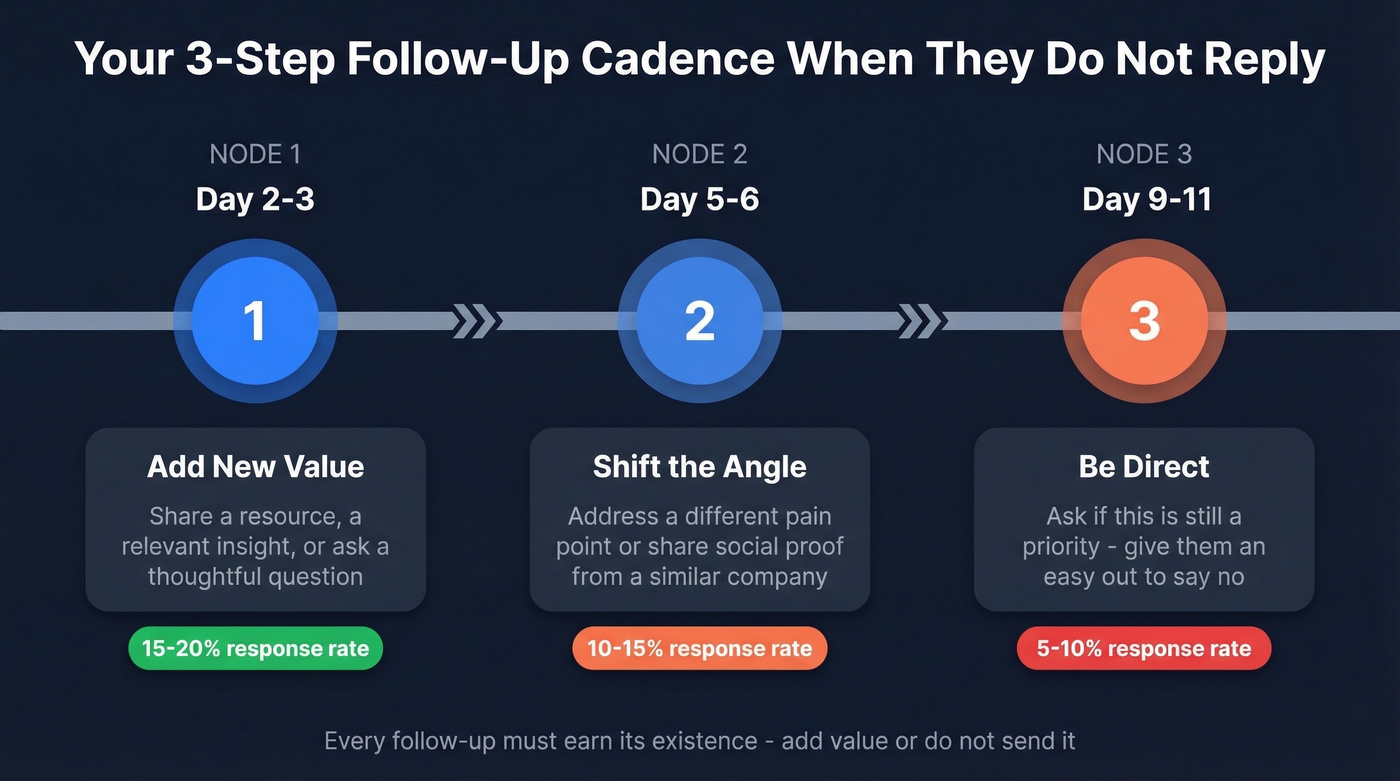
- Day 2-3: First follow-up. Add new value - a resource, a relevant insight, a question.
- Day 5-6: Second follow-up. Shift the angle. Address a different pain point or share social proof.
- Day 9-11: Final follow-up. Be direct - "Is this still a priority?" Give them an easy out.
Response rates drop from roughly 15-20% on the first follow-up to around 5-10% by the third. We've seen follow-ups with a single relevant data point outperform three-paragraph recaps every time.
If you’re unsure about timing, this guide on when should you follow up on an email breaks down practical windows by scenario.
Here's the thing: none of this matters if your email bounces. Email databases decay at roughly 30% per year, and a bounced follow-up is worse than no follow-up - it's invisible, and you'll never know it didn't land. Before you hit send, verify the address. Prospeo checks emails in real time with 98% accuracy, and the free tier covers 75 verifications a month with no credit card required.
To go deeper on preventing bounces, see email bounce rate benchmarks and the most common causes.
Writing the perfect follow-up means nothing if you're sending it to outdated contact data. Prospeo refreshes 300M+ profiles every 7 days - so the email you grabbed last week is still accurate today. At $0.01 per verified email, bad data is a choice.
Send your follow-up to an inbox that exists. Start free.
FAQ
Is "speaking with you" or "talking to you" more professional?
"Speaking with you" is slightly more formal and better suited for business contexts - client calls, interviews, vendor meetings. "Talking to you" is warmer and more casual. Both are grammatically correct; pick whichever matches the tone of your actual conversation.
How soon should I send a follow-up after a call?
Within 24 hours - ideally the same day while the conversation's still fresh. Wednesday is the highest-engagement day for email, so if your call lands on a Wednesday morning, send the follow-up that afternoon.
How long should a follow-up email be?
Under 80 words. The best-performing follow-ups are 3-4 sentences: reference the conversation, add one piece of value, and include a clear next step. If you need to share detailed information, attach it or link to it rather than pasting it into the body.
What if I don't have the right email address?
A bounced follow-up is worse than none - you'll never know it didn't land. Use a verification tool before sending. Prospeo's free tier lets you verify 75 emails per month at 98% accuracy with no credit card, which is enough for most professionals sending post-call follow-ups.
What should I put in the subject line?
Reference something specific from your conversation - never just write "Follow-up." Examples: "Quick thought on [topic you discussed]" or "The resource I mentioned on our call." Keep it under 8 words and tie it to value you're delivering.