

Jordan Belfort Sales Script: The Complete Straight Line Template You Can Actually Use
Every sales rep has seen the Aerotyne clip. Most have Googled the Jordan Belfort sales script hoping to find the actual framework behind it - what they get instead is a wall of podcast links, $299 upsells, and movie quotes stripped of context. Nobody gives you the template you can run on Monday morning.
We've watched reps memorize every Belfort line and still miss quota because their list was 40% dead numbers. The script matters, but so does everything around it. Dial-to-meeting rates have dropped to 2.3%, down from 4.82% a year prior. The margin for error on every call is razor-thin, which means your script and your data both need to be airtight.
What You Need (Quick Version)
- Belfort's Straight Line script has four parts: open, body (presentation), close, and rebuttal - delivered with looping patterns. The full template with example lines is below.
- Everything revolves around the "Three Tens" - raising your prospect's certainty in the product, in you, and in your company to 10 out of 10. Every line in the script serves one of those three.
- Delivery matters as much as words. Tonality - scarcity, mystery, reasonable - is the execution layer that separates a script-reader from a closer.
- The best script fails on bad numbers. If a third of your dials hit disconnected lines, even Belfort couldn't hit quota.
The Wolf of Wall Street Sales Pitch Everyone Remembers
Before the real framework, let's look at the script that put Belfort on the map - the Aerotyne cold call from Wolf of Wall Street. It's Hollywood, but every line maps to a real persuasion technique.
"The reason for the call today... If you have 60 seconds, I'd like to share the idea with you. You got a minute?"
Permission frame. He doesn't launch into a pitch. He asks for time, creating a micro-commitment. The prospect who says "sure" has already agreed to listen.
"Something just came across my desk... It is perhaps the best thing I've seen in the last six months."
Scarcity + mystery. "Just crossed my desk" implies timing matters. "Best thing I've seen" is a personal endorsement, not a corporate claim.
"Right now it trades at 10 cents a share... Your profit on a mere $6,000 investment would be upwards of $60,000!"
Price anchoring + ROI framing. The entry point sounds trivial. The upside sounds life-changing. The gap between the two does the selling.
"Let me lock in that trade right now... Sound good?"
Assumptive close. He doesn't ask "would you like to proceed?" He assumes the sale and asks for confirmation. The prospect has to actively object to stop the momentum.
The Aerotyne call was fraud - but the underlying techniques are legitimate tools used on every B2B sales floor today. The difference is what you're selling. That Wolf of Wall Street cold call scene remains the most-watched sales training clip on the internet for a reason: the structure is textbook.
The Psychology Behind the Script
Belfort's Straight Line System isn't really about scripts. It's about certainty management. Every prospect sits somewhere between 1 and 10 on three scales: how certain they are about your product, about you personally, and about your company. The script's job is to move all three to 10.
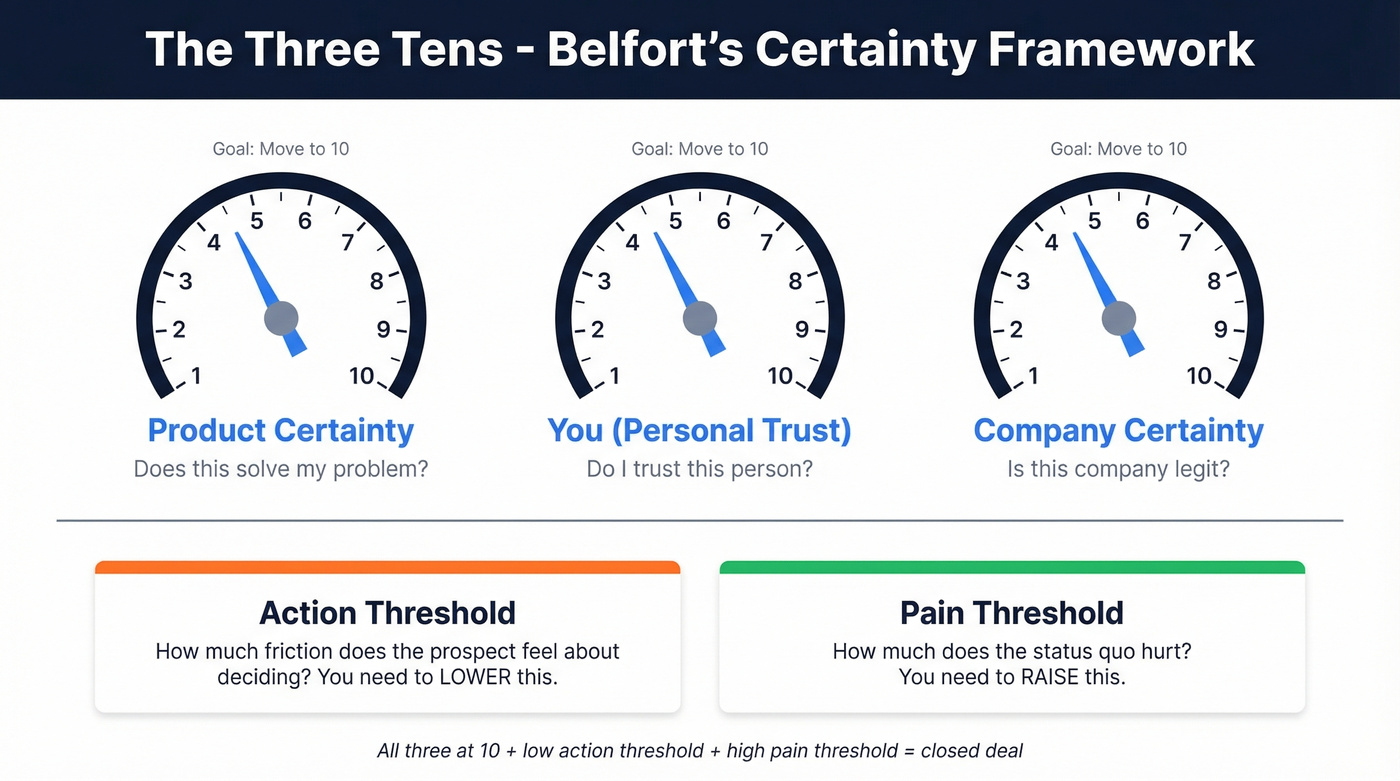
Certainty alone doesn't close deals, though. Belfort adds two thresholds. The action threshold measures how much friction the prospect feels about making a decision - you need to lower it. The pain threshold measures how much the status quo hurts - you need to raise it. A prospect sitting at 10/10/10 certainty who feels zero urgency still won't buy.
There are two types of certainty worth understanding here. Logical certainty covers facts, numbers, and ROI calculations - it gets you to "this makes sense." Emotional certainty covers gut feeling and a vision of the future - it gets you to "I want this." Belfort's primary tool for emotional certainty is future pacing: painting a vivid picture of what life looks like after the purchase.
All of this hinges on the first four seconds. In those opening moments, you must come across as sharp, enthusiastic, and an expert in your field. Sound like you're reading from a sheet and the prospect's certainty in you drops to a 2 before you've even started.

Belfort's Straight Line system only works when you're talking to real buyers. With dial-to-meeting rates at 2.3%, every dead number kills your momentum. Prospeo gives you 125M+ verified mobile numbers with a 30% pickup rate - so your script actually reaches decision-makers.
Stop perfecting your pitch on disconnected lines.
The Complete Straight Line Script Template
This template synthesizes Belfort's four-part structure - open, body, close, rebuttal - with practitioner-level detail. Adapt the language to your product, but keep the structure intact.
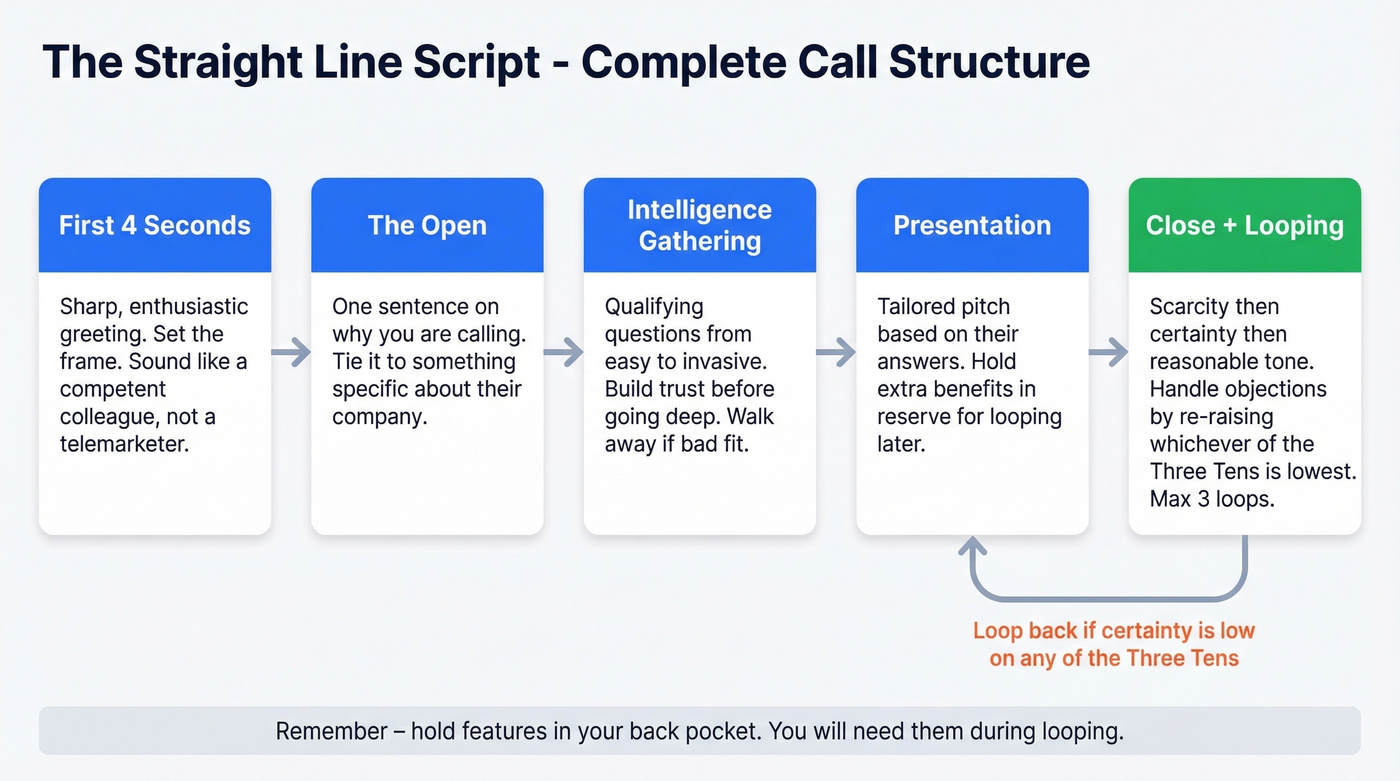
The First 4 Seconds
"Hey ___, my name's ___ with ___ - how's it going today! Great!"
Don't overthink this. The greeting sets the frame for the entire call. One practitioner on r/sales who broke down the full system noted that the real power is in systemizing each section - model your top performer's greeting, then make it repeatable across the team. The tone is everything: sharp, upbeat, confident. Think "competent colleague," not "telemarketer."
The Open
"Now the reason for the call today is..."
One sentence. What you do, and why it matters to them specifically. No rambling about your company's founding story. The best opens we've seen tie directly to something the prospect's company is doing right now - a hiring surge, a funding round, a tech stack change.
Intelligence Gathering
Before you pitch anything, understand whether this person is actually a fit. Map your qualifying questions in advance and order them from less invasive to more invasive as trust builds.
Start with easy ones: "How are you currently handling X?" Move toward harder ones: "What's your budget look like for this?" If the answers tell you they're not a fit, don't present. Walk away. Pushing a pitch on a bad-fit prospect doesn't just waste your time - it damages your credibility for any future conversation.
If you want a more structured approach here, borrow from modern discovery questions frameworks and keep your call tight.
The Presentation
"Based on everything you told me, what we do is a perfect fit."
That transition line matters. It signals that your pitch is tailored to what they just shared, not a canned deck. Then present your solution - but hold features in your back pocket. Don't dump everything upfront. You'll need those extra benefits later during looping when objections surface.
Structure the pitch around the Three Tens. Lead with product value for logical certainty, weave in your personal credibility ("we've done this for 40 companies like yours"), and anchor it to the company's reputation.
The Close
The closing pattern follows a specific tonal sequence: scarcity, then certainty, then reasonable.
"I don't know if we'll even have spots open next week... but based on everything you've told me, this is a no-brainer... sound fair enough?"
Scarcity creates urgency. Certainty reinforces the logic. "Sound fair enough?" is the reasonable tone - it gives the prospect an easy yes without feeling pressured.
If you want to compare closing frameworks, the 7 steps to close a sale breakdown is a useful complement.
Looping (Objections)
Here's the thing: Belfort treats every objection as a smokescreen. "I need to think about it," "send me some info," "let me talk to my partner" - these aren't real objections. They're signals that certainty is low on one of the three scales.
The deflection:
"I hear what you're saying, but let me ask you - does the idea make sense to you? Do you like the idea?"
If they say yes, the product isn't the problem. Re-pitch yourself or your company. If they hesitate on the idea itself, loop back to product certainty with a benefit you held in reserve. Each loop raises one of the Three Tens.
In our experience, three loops is the ceiling. After three, you're pushing, not selling. Know when to let go. For more on handling pushback without getting combative, see cold call rejection.
How to Deliver the Script
Words on paper are maybe 30% of the equation. Tonality carries the rest. Belfort identifies specific vocal patterns that trigger different psychological responses:
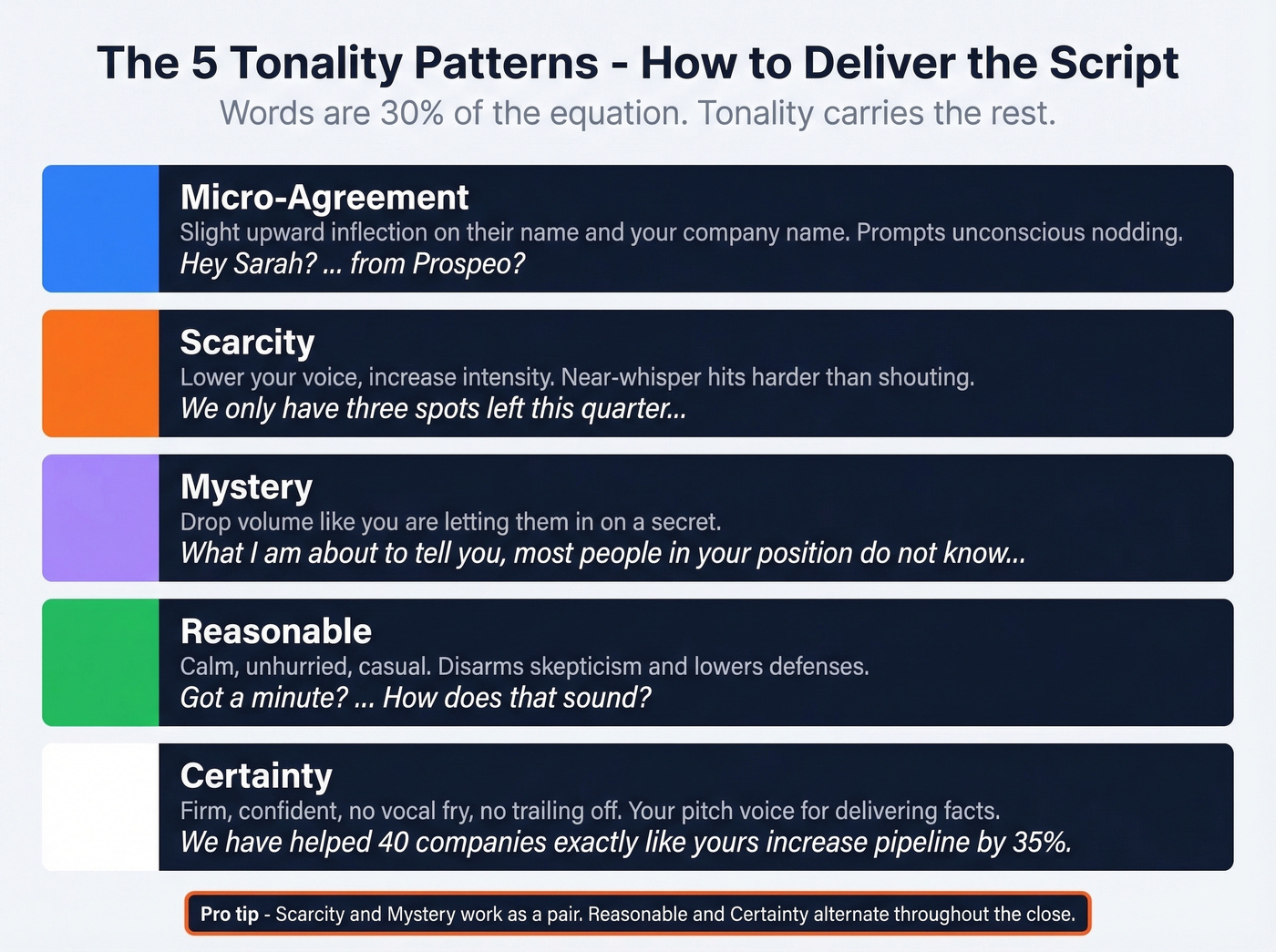
Micro-agreement inflection - say the prospect's name and your company name with a slight upward inflection. It unconsciously prompts them to nod along. Scarcity tone - lower your voice, increase intensity. "We only have three spots left this quarter" delivered in a near-whisper hits harder than shouted. Mystery tone - drop your volume like you're letting them in on a secret. "What I'm about to tell you, most people in your position don't know..."
The last two patterns work together. Reasonable tone is calm and unhurried - "Got a minute?" and "How's that sound?" delivered casually. This is the tone that disarms skepticism. Certainty tone is firm, confident, no vocal fry, no trailing off. This is your pitch voice. Facts delivered with zero hesitation.
Belfort claims applying these tonalities "with even minimal competency" yields "at least a 50% increase in sales." That's his number, not an independent study - but the principle that delivery matters as much as content is well-established in communication research. If you're building a repeatable team standard, it helps to treat this as part of your broader sales communication system.
Does Straight Line Selling Work in 2026?
Where It Shines
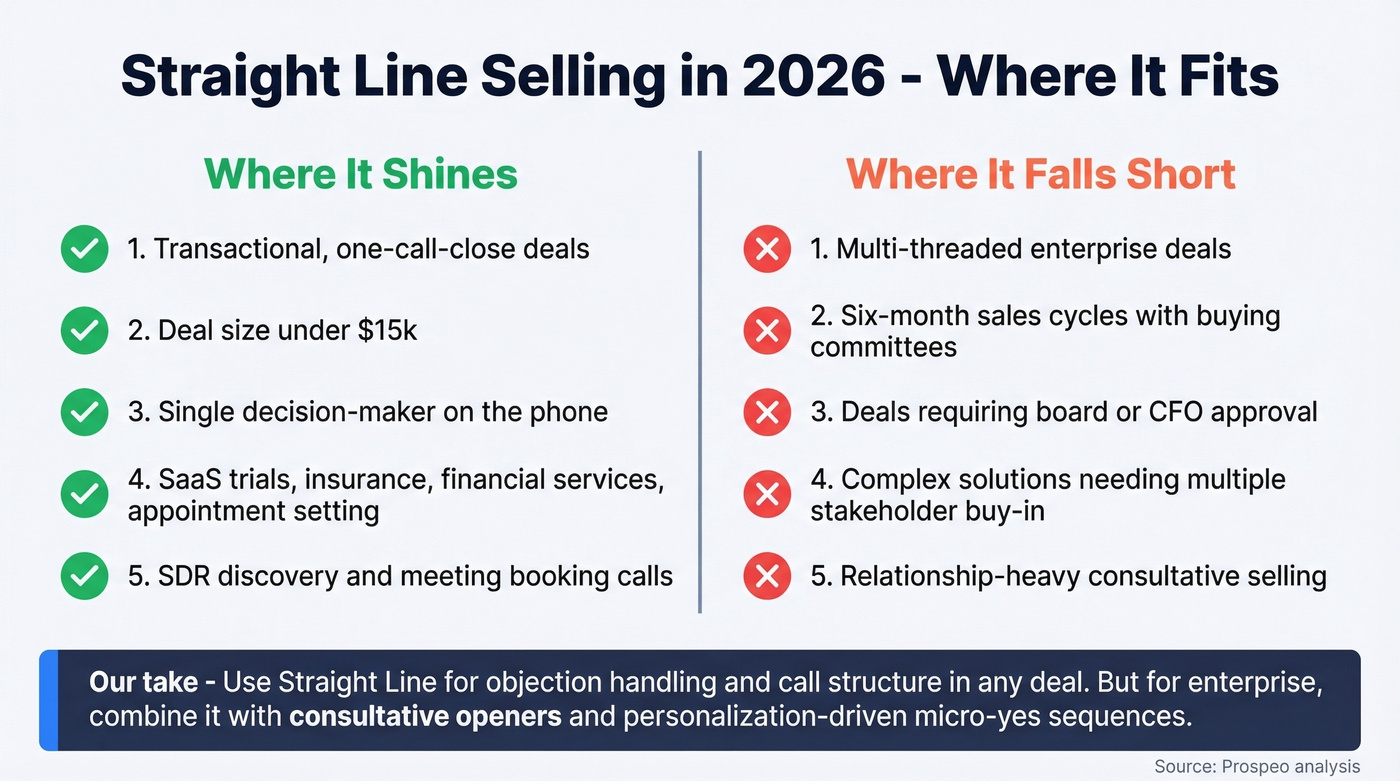
Straight Line is strongest in transactional, one-call-close environments. If you're selling a product where the decision-maker is on the phone and the deal can close in a single conversation - insurance, SaaS trials, financial services, appointment setting - this framework is genuinely powerful. The control structure keeps calls tight, and looping gives you a systematic way to handle objections instead of winging it.
We've seen teams adapt the framework for SDR-to-AE handoff calls too. The qualifying section maps cleanly to discovery, and looping works for booking meetings, not just closing deals. One team we worked with cut their average call time by 40% just by structuring their discovery around the intelligence gathering phase instead of freestyling every conversation. If you're building a repeatable outbound motion, a full cold calling system helps you operationalize this beyond a single script.
Where It Falls Short
For multi-threaded enterprise deals with six-month cycles and buying committees, Straight Line alone isn't enough. You can't "loop" a CFO who needs board approval. The framework assumes a single decision-maker with authority to act - that's increasingly rare in B2B. In those cases, you’ll want a more complete enterprise B2B sales approach layered on top.
The Reddit consensus on Belfort's actual training is mixed. Some users report the training feels like 90s-era video production, heavy on hype, light on instruction. That criticism is fair for the packaging, but the underlying framework is sound.
Our take: If your average deal size is under $15k and you're selling to a single decision-maker, Straight Line is the best cold call framework available. Full stop. For everything else, combine its looping structure with consultative openers and personalization-driven micro-yes sequences. Use Belfort for objection handling, but lead with genuine discovery instead of a hard pitch. (If you want more options to test, our roundup of sales prospecting techniques is a good starting point.)
Script Quality vs. Data Quality
Look - none of this matters if 35% of your numbers are dead before you start dialing. We've seen teams obsess over script optimization while ignoring the fact that a third of their list was garbage. Verify your call list with a tool like Prospeo before your next call block. Bad numbers kill connect rates faster than a weak script, and teams using verified mobile data see 30% pickup rates versus the roughly 12% industry average. If you’re auditing your pipeline inputs, start with data enrichment services and work backward from accuracy.

You can nail the Three Tens, master looping, and close like the Wolf - but a script is only as good as the list behind it. Prospeo's 300M+ profiles refresh every 7 days with 98% email accuracy, so your openers land on real prospects, not voicemails and bounces.
Your script is ready. Make sure your data is too.
Should You Buy the Script Builder?
The Script Builder runs $299 (marked down from $598). Lifetime access, 30-day money-back guarantee. Five modules: video training, done-for-you scripts, transcripts, guidelines, and a workshop where Belfort refines a real corporate client's script.
What you get: structured video walkthroughs of each script section, pre-built rebuttal templates, and a workshop module that's genuinely useful for seeing the framework applied to a real business. For visual learners, $299 is reasonable.
What you don't get: anything you can't build yourself with the framework above and two weeks of practice. The done-for-you scripts still need heavy customization. The broader training catalog ($497-$1,997 depending on the bundle) gets expensive fast for the same core methodology with more video hours.
Skip it if you're a self-starter who can take the template above and iterate on your own. Run it for two weeks first. If you want the video walkthroughs and pre-built rebuttals after that, the Script Builder is a fair purchase. If you just need the framework, this article covers it.
FAQ
What Is the Straight Line System?
It's Belfort's methodology built on moving every prospect from open to close by raising three certainties - product, you, and company - to 10 out of 10. The script is the vehicle; tonality and looping are the engine. It works best for transactional, single-call-close environments like insurance, SaaS trials, and appointment setting.
Is Belfort's Sales Training Worth $299?
For transactional sales where you close on a single call, the Script Builder at $299 is reasonable - you get video walkthroughs and done-for-you rebuttal templates that save setup time. For enterprise or consultative selling with long cycles and buying committees, pair the Straight Line framework with SPIN Selling or Sandler instead.
How Do I Adapt This Cold Call Script for My Industry?
Start with the four-part structure - open, intelligence gathering, presentation, close - and customize each section for your buyer persona. Write three to five looping rebuttals specific to your product's objections, then practice tonality shifts until they feel natural. The template above gives you the skeleton; your industry knowledge fills in the specifics.
How Do I Verify My Call List Before Dialing?
Upload your prospect CSV to an enrichment tool and get back verified emails and direct dials. Bad numbers kill connect rates faster than a weak script - teams using verified data see dramatically higher pickup rates on mobile dials versus the industry average.