

7 Journey Alternatives Worth Evaluating in 2026
Not the journaling app - this is about Journey the digital sales room platform. B2B buyers spend only 17% of their time talking to sales reps. The other 83% happens asynchronously: reading decks, reviewing case studies, looping in stakeholders over email. That's where digital sales rooms earn their keep, and why picking the right one matters.
Journey is good. But depending on your CRM stack, team size, or deal complexity, it might not be the right fit. Here are seven alternatives worth your time.
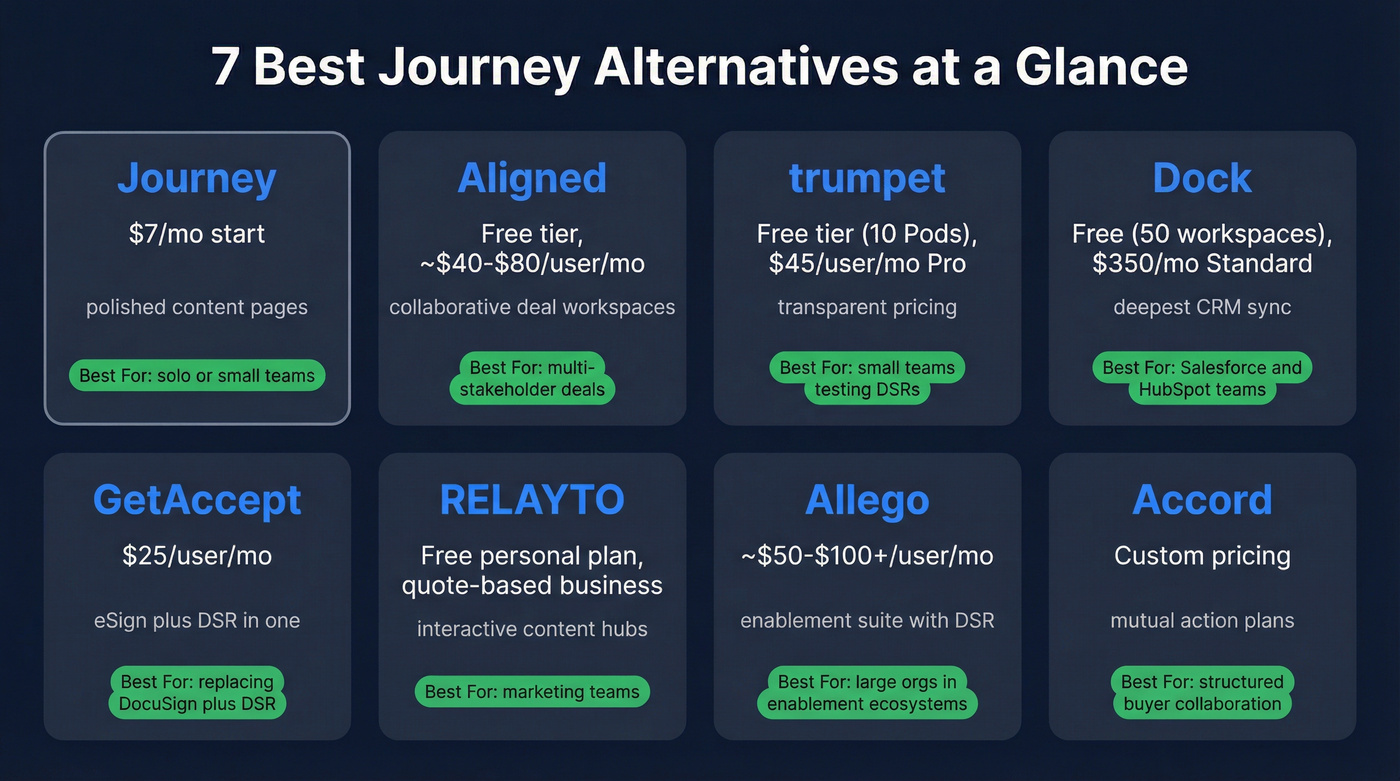
Quick Comparison
| Tool | Best For | Starting Price |
|---|---|---|
| Aligned | Collaborative deal workspaces | Free (paid ~$40-$80/user/mo) |
| trumpet | Transparent pricing + free tier | Free (Pro $45/user/mo) |
| Dock | Salesforce/HubSpot-centric teams | Free (Standard $350/mo) |
| GetAccept | eSign + DSR in one platform | $25/user/mo |
| RELAYTO | Interactive content hubs | Free (business plans custom) |
| Allego | Enablement suite with DSR features | ~$50-$100+/user/mo |
| Accord | Mutual action plans + buyer collaboration | Custom |
What Journey Does Well (and Where It Doesn't)
Journey lets you package pitch decks, case studies, recordings, and follow-up docs into a single branded page with engagement tracking. The AI-powered page generation and visual block editor make it fast to spin up a deal room, and the analytics show you exactly who viewed what. At 4.9/5 on G2, buyers love it - reviewers consistently praise the speed to first value over competitors that take longer to reach ROI.
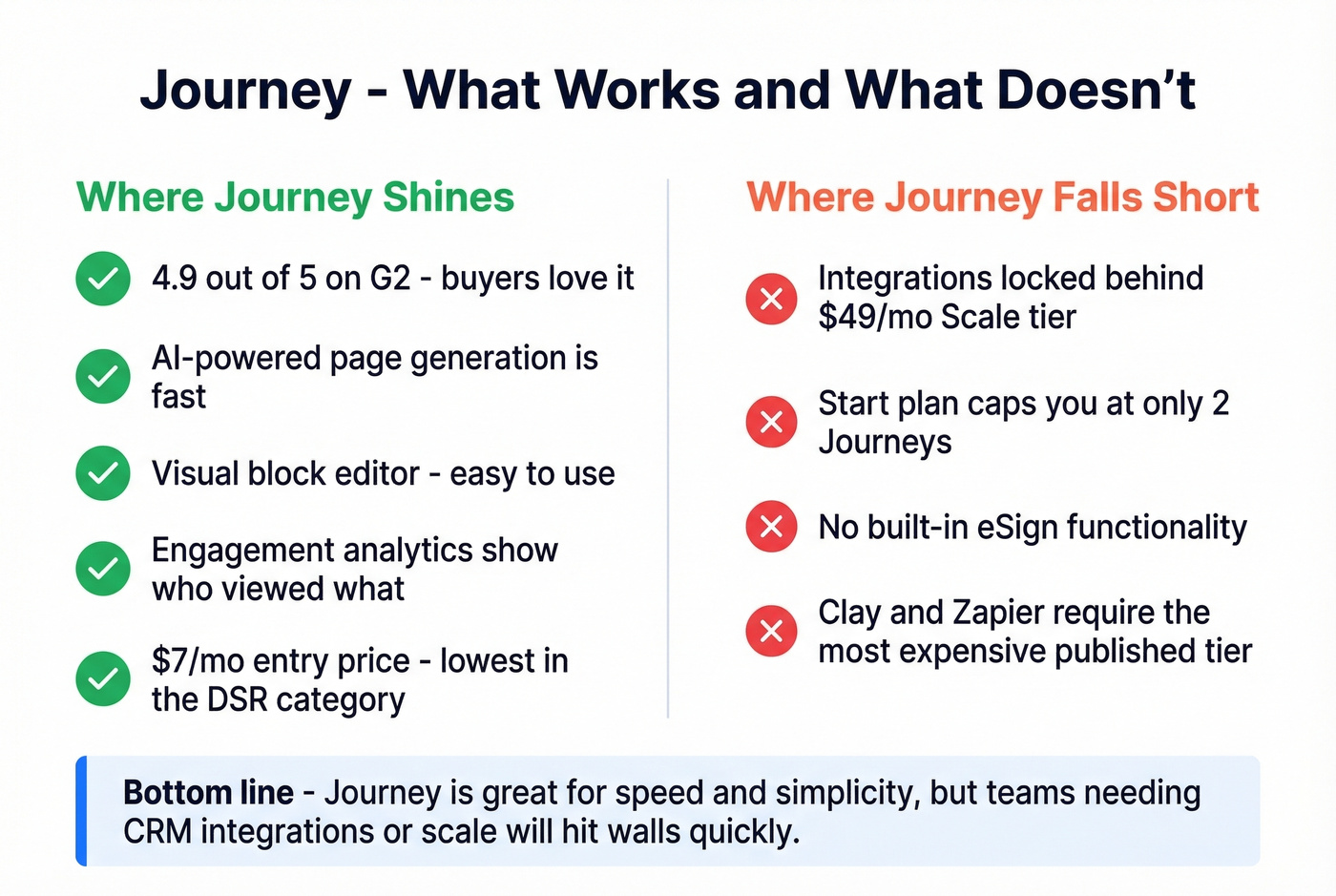
Pricing is aggressive: $7/mo (Start), $24/mo (Grow), $49/mo (Scale) billed annually, with enterprise custom. That's one of the lowest published entry prices in the DSR category.
Skip Journey if you need integrations on lower tiers - integrations including Clay and Zapier only start on Scale ($49/mo). The Start plan caps you at two Journeys. For a solo founder sending a few follow-ups, that's fine. For a 15-person sales team with CRM workflows, those gaps add up fast.

Digital sales rooms solve the last mile - but only if you're reaching the right buyers first. Prospeo gives you 300M+ profiles with 98% email accuracy and 125M+ verified mobiles, so every deal room you build starts with contacts that actually connect.
Fill your deal rooms with buyers who pick up the phone.
Best DSR Tools to Replace Journey
Aligned
G2 names Aligned the best overall alternative to Journey, and the product backs that up. Where Journey focuses on polished, shareable pages, Aligned builds full collaborative deal workspaces - mutual action plans, stakeholder mapping, and real-time buyer-seller communication in one place.
The free tier gets you started, and paid plans run ~$40-$80/user/mo. The fact that Aligned doesn't publish pricing prominently is frustrating - they're clearly optimizing for enterprise contracts, not your convenience. But for mid-market teams running complex, multi-stakeholder deals, the collaborative workspace model is genuinely more useful than a static content page. Journey gives you a polished page with tracking. Aligned gives you a living deal room where both sides work together in real time.
If you're standardizing your process around mutual action plans, it also helps to align on a consistent sales process optimization approach across the team.
trumpet
trumpet is the anti-opacity play in the DSR space. Fully transparent pricing, four clear tiers, and a generous free plan that includes 10 Pods per account with unlimited users.
Here's the breakdown: Free ($0, 10 Pods with mutual action plans and basic analytics), Pro ($45/user/mo, up to 5 users), Scale ($100/user/mo), and Elite ($160/user/mo with SSO, SCIM, and white labeling). With 800+ reviews, trumpet has one of the largest review footprints in the DSR category - though some G2 reviewers flag it as pricier than Journey at higher tiers.
The free tier is legitimately usable, not a crippled trial. If you're a small team that wants to test digital sales rooms without a budget conversation, trumpet is where you start. The tradeoff: SSO, SCIM only show up at Elite ($160/user/mo), which prices out mid-market teams who need enterprise security without enterprise budgets.
If you're pairing a DSR with outbound, make sure your sequence management is tight so buyers get the right follow-ups.
Dock
Dock is built for teams that live inside Salesforce or HubSpot. CRM integration is included at the $350/mo Standard tier (includes 5 users), and the workspace model supports complex enterprise deals with multiple stakeholders, order forms, and content management. The free plan covers 50 workspaces - enough to test the workflow thoroughly before committing budget. Premium runs $1,000/mo (billed annually) with 10 users, playbooks, and webhook support, and additional seats cost $50/user/mo.
Here's the thing: if your average deal size is under $15k, Dock is overkill. But if you're running six-figure enterprise deals through a CRM-centric workflow, it's the strongest option on this list. We've tested most of these tools with real deals, and Dock's CRM sync is the one that actually eliminates the "update Salesforce" tax that eats hours every week.
If CRM hygiene is a pain point, it’s worth reviewing what “good” looks like in contact management software before you pick a DSR.
GetAccept
| Feature | Journey | GetAccept |
|---|---|---|
| eSign built in | No | Yes |
| DSR features | Strong | Strong (Professional tier) |
| Starting price | $7/mo | $25/user/mo |
| CRM integrations | Scale tier only | Paid plans |
| Best for | Solo/small team content pages | Teams replacing DocuSign + DSR |
The eSign plan at $25/user/mo handles proposals and contracts. The Professional tier ($49/user/mo, minimum 5 users) unlocks the full DSR experience with mutual action plans, contextual commenting, and file sharing.
If your team currently juggles DocuSign plus a separate deal room tool, GetAccept collapses that into one line item. That consolidation alone justifies the price difference over Journey for most teams we've talked to.
To keep momentum after a proposal is viewed, use proven sales follow-up templates instead of ad-hoc nudges.
RELAYTO
RELAYTO turns static content into interactive experiences - more marketing content hub than deal-by-deal sales room. Free personal plan available; business pricing is quote-based. Best for marketing teams building interactive content portals, not AEs managing individual deals. Skip this if your primary use case is 1:1 deal rooms.
If you’re using these rooms as part of a broader content motion, it helps to ground the strategy in what is B2B content marketing.
Allego
Allego sits in the sales enablement category with DSR features bolted on. Enterprise pricing runs ~$50-$100+/user/mo with no public tiers. Worth evaluating only if you're a large org already invested in enablement suites and want DSR capabilities without adding another vendor. CRM integration and engagement analytics - the two criteria that usually top DSR evaluations - are both covered, but at a premium that's hard to justify unless you're already in their ecosystem.
If you’re evaluating enablement-heavy stacks, it’s useful to map responsibilities to a sales enablement manager operating model.
Accord
Accord is a strong pick when your "digital sales room" is really a mutual action plan plus buyer collaboration. It's built around aligning stakeholders, next steps, and timelines - which is often what actually moves deals forward once the content is already shared. Pricing is custom, so it fits best for mid-market and enterprise teams that want a structured mutual plan across every deal.
For complex deals, pairing a DSR with a consistent qualification framework like MEDDIC sales qualification can prevent “pretty room, weak deal” outcomes.
You're evaluating DSR tools to close deals faster. But bad contact data kills deals before any sales room opens. Prospeo's 7-day data refresh and 30+ filters - including buyer intent and job changes - ensure you're building rooms for decision-makers who are actually in-market.
Stop building deal rooms for stale contacts at $0.01 per email.
Full Pricing Comparison
| Tool | Free Tier | Starting Paid | Enterprise |
|---|---|---|---|
| Journey | 14-day trial | $7/mo (2 Journeys) | Custom |
| Aligned | Yes | ~$40-$80/user/mo | Custom |
| trumpet | Yes (10 Pods) | $45/user/mo | $160/user/mo |
| Dock | 50 workspaces | $350/mo (5 users) | Custom |
| GetAccept | No | $25/user/mo | Custom |
| RELAYTO | Yes (Personal) | Quote-based | Custom |
| Allego | No | ~$50-$100+/user/mo | Custom |
| Accord | No | Custom | Custom |
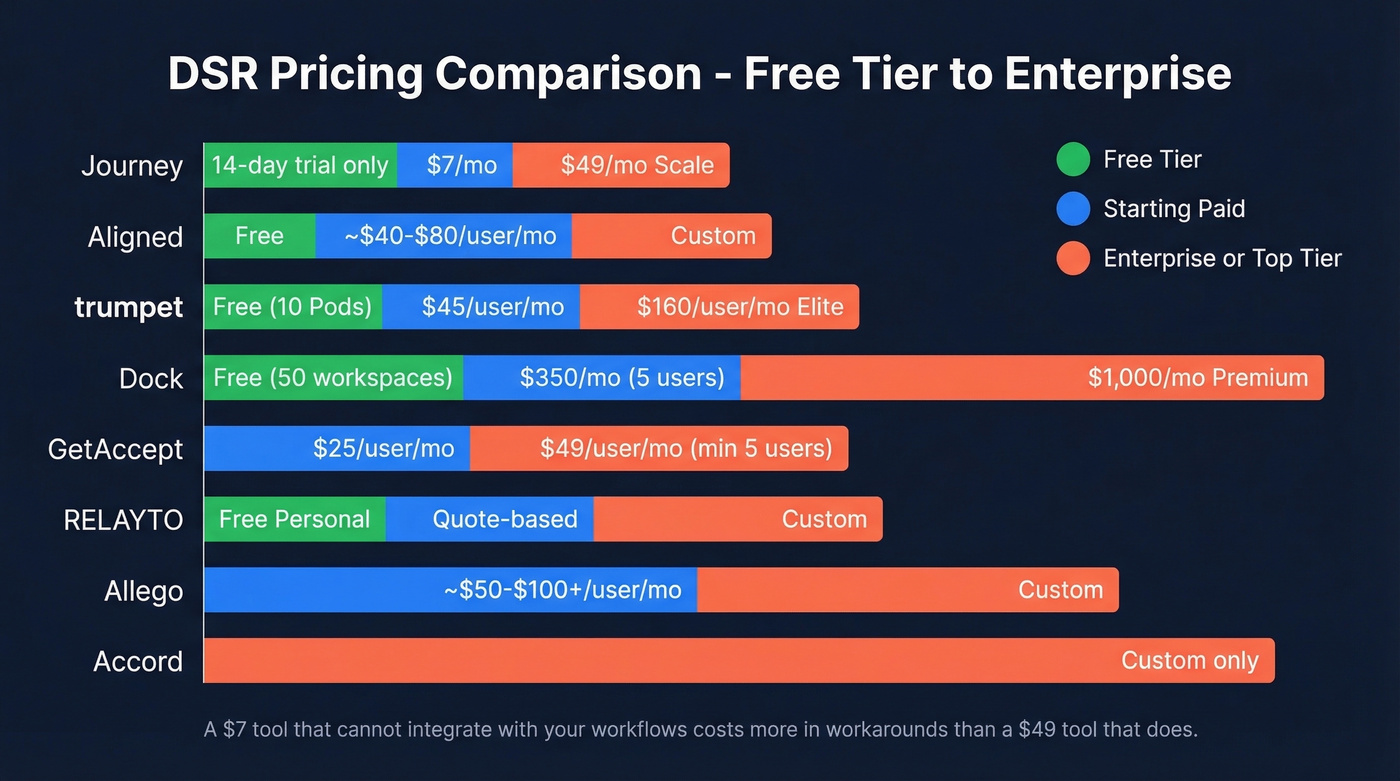
Journey's $7/mo entry point is one of the lowest published in the category. But pricing alone doesn't tell the story - a $7 tool that can't integrate with your workflows costs more in workarounds than a $49 tool that does.
How to Choose
Solo or small team on a budget: Journey's Start plan or trumpet's free tier. Both get you running in minutes.
Mid-market with multi-stakeholder deals: Aligned or GetAccept. Aligned for collaborative workspaces, GetAccept if you need eSign built in.
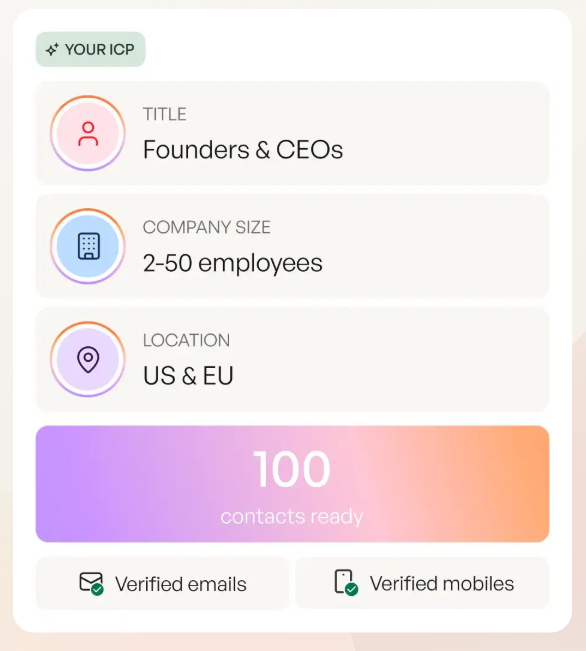
If you’re tightening targeting before you build rooms, start with an Ideal Customer Profile so the right stakeholders see the right content.
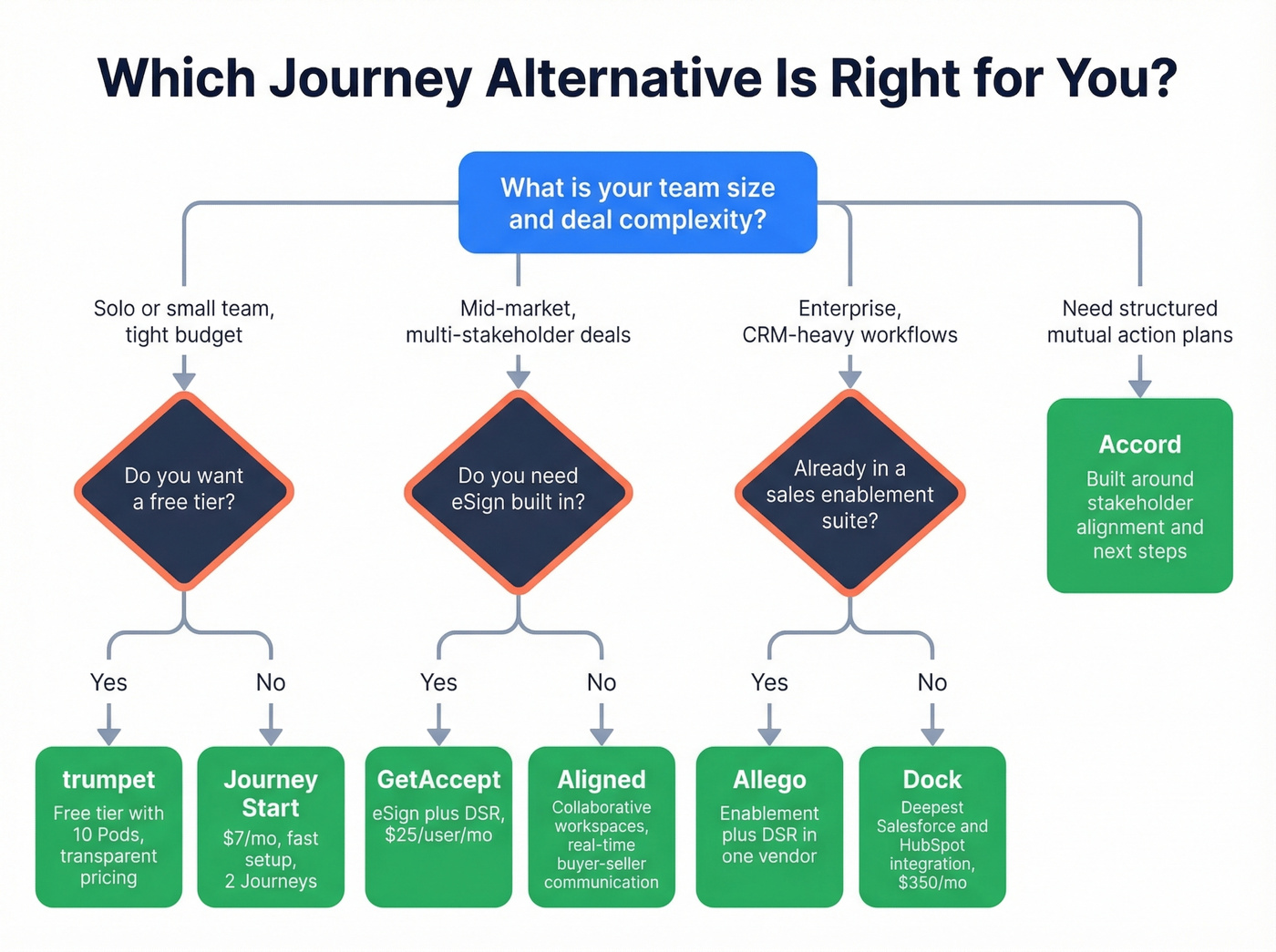
Enterprise with CRM-heavy workflows: Dock or Allego. Dock if you're Salesforce/HubSpot-centric, Allego if you're already in a sales enablement suite.
Integration-first teams: Dock's native CRM integration is the strongest here. GetAccept also supports HubSpot and Pipedrive on paid plans.
One thing that's easy to overlook: none of these tools fix bad contact data. A gorgeous deal room sent to a bounced email address generates exactly zero engagement. Before you go live with any DSR, run your prospect list through Prospeo's email verification - 98% accuracy, 7-day refresh cycle, and a free tier that lets you validate 75 emails a month without pulling out a credit card.
If bounces are a recurring issue, it’s worth benchmarking your email bounce rate and fixing the root causes before scaling outreach.
The DSR market is projected to hit $7.9B by 2031. Pick one of these Journey alternatives, test it for 30 days with real deals, and measure buyer engagement against your current email-attachment workflow. The difference is usually obvious within a week.
FAQ
What are the best Journey alternatives in 2026?
The top alternatives are Aligned (collaborative deal workspaces), trumpet (best free tier with transparent pricing), Dock (strongest Salesforce/HubSpot integration), and GetAccept (eSign plus DSR in one tool). Your best pick depends on CRM stack, deal complexity, and budget - see the comparison table above.
Is Journey free?
Journey offers a 14-day free trial but no permanent free plan. The Start tier costs $7/month billed annually and caps you at 2 Journeys. Grow ($24/mo) unlocks unlimited Journeys; Scale ($49/mo) adds integrations and session replays.
How do I improve engagement on digital sales room pages?
Start with verified contact data so your deal rooms reach real inboxes instead of bouncing silently. Beyond data quality, keep pages concise, lead with the most relevant content per stakeholder, and use engagement analytics to follow up with people who actually viewed the room.
Can I use a DSR with my existing CRM?
Yes - most modern digital sales rooms integrate with Salesforce and HubSpot. Dock offers the deepest native CRM sync starting at $350/mo. GetAccept supports HubSpot and Pipedrive on paid plans. Journey requires the $49/mo Scale tier for any integrations, including Zapier.