

Kaspr vs SphereScout: Different Tools for Different Jobs
You exported 50,000 local businesses from SphereScout and realized every email is info@ or contact@. No names, no decision-makers, no way to personalize outreach. Or you went the other direction - grabbed a Kaspr subscription, started pulling individual contacts, and watched your credits evaporate before you hit 500 enrichments.
Both tools work. They just don't solve the same problem, and comparing Kaspr vs SphereScout head-to-head is like comparing a phone book to a rolodex. Let's break down exactly which one fits your workflow and what to do when neither does.
30-Second Verdict
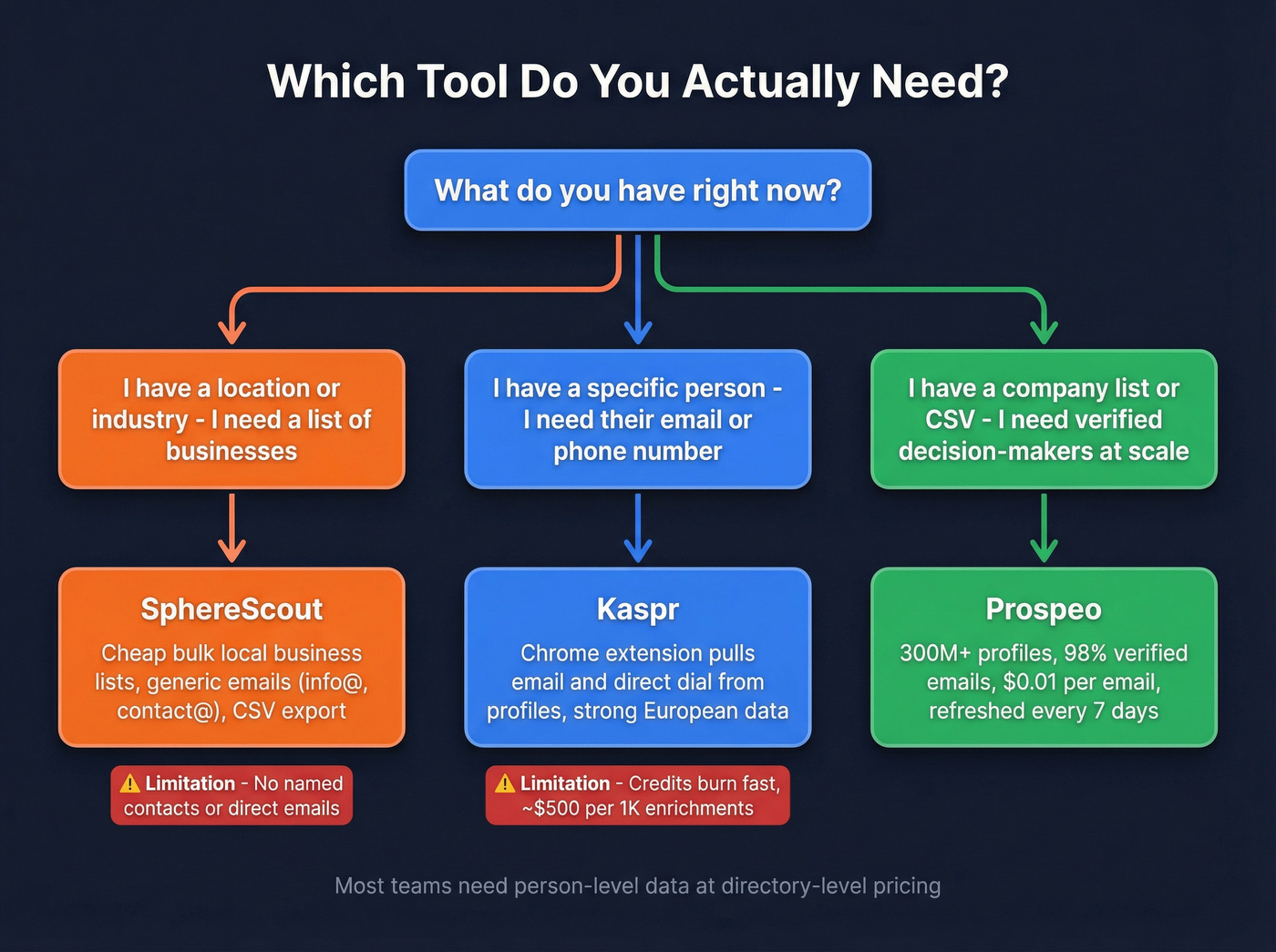
- SphereScout wins if you need cheap, bulk local business lists filtered by location, category, and Google rating. It's a directory, not an enrichment tool.
- Kaspr wins if you already have a specific person in mind and need their email or direct dial fast via a Chrome extension.
Feature Comparison at a Glance
These tools occupy different lanes entirely.
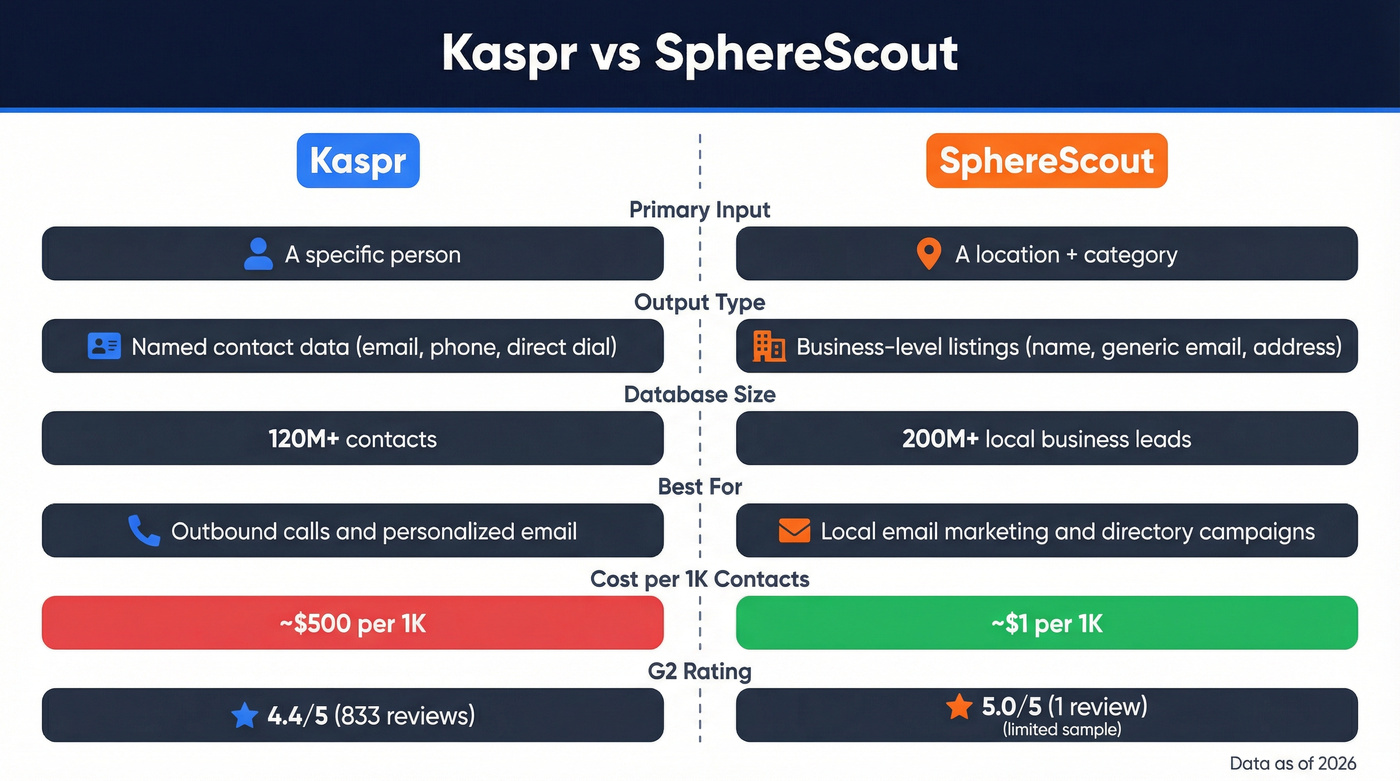
| Dimension | Kaspr | SphereScout |
|---|---|---|
| Primary input | A specific person | A location + category |
| Output type | Named contact data | Business-level listings |
| Database size | 120M+ contacts | 200M+ local business leads |
| Best channel | Outbound calls/email | Local email marketing |
| Pricing model | Per-user credits | Monthly subscription with contact credits (plus one-time list purchases) |
| G2 rating | 4.4/5 (833 reviews) | 5.0/5 (1 review) |
| Export/integration | Chrome ext + CRM integrations | CSV/Excel export |
The table tells the story. If you're agonizing over which to pick, you're probably asking the wrong question - they serve fundamentally different workflows.
What You Actually Get
SphereScout - Local Business Lists
SphereScout is a local business directory with 200M+ listings pulled from sources like Google Maps, Yelp, TripAdvisor, and YellowPages. You search by location and category, filter by Google rating, review count, and email/phone presence, then export to CSV or Excel.

It's clean and functional for local outreach campaigns. But here's the critical limitation, and SphereScout's own blog is upfront about it: the emails are mostly generic company inboxes - contact@, info@, hello@. If you're running personalized outbound, you'll need a second tool to get to actual people.
Kaspr - Person-Level Contact Discovery
Kaspr works the opposite direction. You start with a specific person - typically found while browsing professional profiles - and the Chrome extension pulls their email and direct dial. Owned by Cognism, Kaspr has a large European database with 120M+ contacts, and European numbers are notably more reliable than US ones. Phone accuracy runs around 50-65% and email accuracy around 75-80%.

The key limitation: Kaspr doesn't find people from company data alone. You need a name first. That's a dealbreaker for anyone starting with a company list and trying to work inward to decision-makers.
If you're trying to go from a company to a person, you’re really looking for lead enrichment (or a full data enrichment services workflow), not just a browser-based finder.

Kaspr burns credits before you hit 500 enrichments. SphereScout gives you 500K generic inboxes no one reads. Prospeo finds named decision-makers with 98% verified emails at $0.01 each - starting from a company, a person, or a CSV you already have.
Stop choosing between cheap company data and expensive person data.
Pricing Breakdown
SphereScout Pricing
| Plan | Monthly Cost | Contacts | Cost per 1K |
|---|---|---|---|
| Starter | $49/mo | 15,000 | $3.27 |
| Growth | $99/mo | 50,000 | $1.98 |
| Scale | $499/mo | 500,000 | $1.00 |
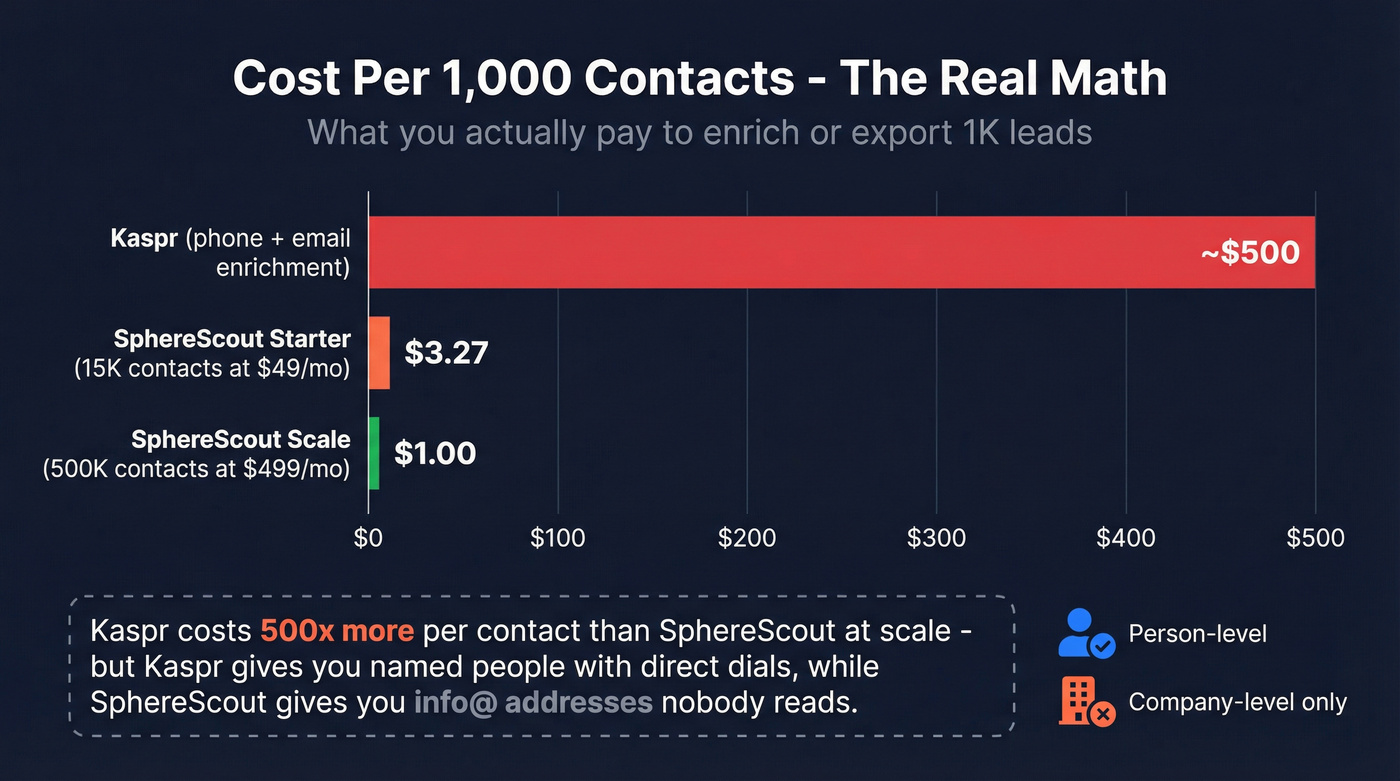
SphereScout also offers one-time purchases with dynamic pricing based on your filters - 7-day access, CSV/Excel download, unlimited usage rights. There's a "Get 100 Free Leads" trial to test the data before committing. At the Scale tier, you're paying a dollar per thousand contacts. That's remarkably cheap for business-level data, even if the emails are generic. Some Trustpilot reviewers have asked for more flexible credit purchasing instead of fixed monthly plans, which is worth watching if you have unpredictable volume.
If you're building lists like this regularly, it helps to have a repeatable lead generation workflow so you don't waste exports.
Kaspr Pricing
Kaspr pricing is per user/month with monthly or annual billing:
| Plan | Monthly Cost | What you get |
|---|---|---|
| Free | $0/user/mo | 15 B2B email credits, 5 phone credits, 5 direct email credits |
| Starter | $49/user/mo | Unlimited B2B email credits + 100 phone credits/mo |
| Business | $79/user/mo | Unlimited B2B email credits + 200 phone credits/mo + 200 direct email credits/mo |
| Enterprise | Custom | Higher limits and enterprise controls |
Here's where the math gets uncomfortable: enriching 1,000 contacts with both phone and email through Kaspr runs about $500 per 1K. Compare that to SphereScout's $1/1K at scale and you see why these tools attract different buyers.
We've seen this pattern with every credit-gated tool. It feels fine until you scale - then it becomes a tax on growth.
If your average deal size is under $5K, Kaspr's per-enrichment cost will eat your margins alive. The tool is built for high-ACV sales teams who need 50 perfect contacts, not 5,000 decent ones. (If you're scaling outbound, you may also want to sanity-check your sales prospecting techniques and stack against your ICP.)
What Real Users Say
Kaspr has 833 reviews on G2 at 4.4/5 (833 reviews). Users consistently praise the ease of use and the Chrome extension workflow. The recurring complaints? Credit limits and pricing at volume. A thread on r/LeadGeneration flags pricing frustration at high usage and disappointing customer service, with the OP describing slow responses to issues and questions.
SphereScout sits at 4.1/5 on Trustpilot with 5 reviews and 5.0/5 on G2 with a single review. Praise centers on responsive support and lead relevance.
Look - 833 reviews vs 6 total reviews is a massive confidence gap. SphereScout's scores look great, but the sample is too small to draw broad conclusions. Kaspr's sentiment is battle-tested. SphereScout's is still anecdotal.
When Neither Tool Is Enough
SphereScout gives you companies. Kaspr gives you individuals - if you already know who to look for. Neither delivers verified, named decision-maker contacts at scale without burning through credits or settling for generic inboxes. B2B contact data decays 30-70% annually, which makes freshness just as important as accuracy.
If you're trying to solve this systematically, you’ll want a real sales prospecting database (and often a dedicated email deliverability guide to protect sender reputation once you start sending).
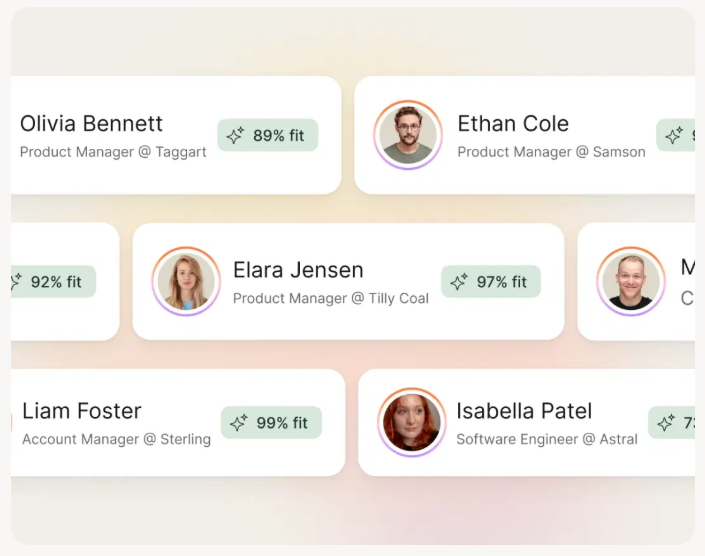
Kaspr charges ~$500 per 1K enrichments. SphereScout's $1/1K gets you info@ addresses. Prospeo delivers verified, named contacts with direct dials from 300M+ profiles - refreshed every 7 days, not 6 weeks. 75 free emails and 100 extension credits monthly, no contract.
Get person-level data at directory-level pricing.
FAQ
Can SphereScout find individual decision-makers at a company?
No. SphereScout provides company-level data - business name, generic email (info@, contact@), phone, and location. It doesn't resolve named individuals or direct email addresses. For decision-makers with verified direct emails and mobile numbers, you need a person-level enrichment tool.
Is Kaspr worth it for local business prospecting?
Not really. Kaspr requires a specific person as input - it doesn't generate company lists by location or industry category. For local business lead lists filtered by geography and Google rating, SphereScout is purpose-built. Kaspr's the right tool when you already know exactly who you want to reach.
What's the cheapest way to get verified B2B emails at scale?
SphereScout offers the lowest per-contact cost at $1/1K on the Scale plan, but those are mostly generic business inboxes. For verified person-level emails, Prospeo starts at roughly $0.01/email with 98% accuracy and a 7-day refresh cycle. Kaspr's per-enrichment cost is significantly higher at about $500/1K contacts, which only makes sense for small-batch, high-value prospecting.