

The Best Key Account Management Platforms in 2026
A RevOps lead we know spent six months rolling out a dedicated KAM platform. Three months after launch, adoption sat at 12%. The problem wasn't the tool - it was the stakeholder data inside it. Half the contacts were stale, two champions had changed roles, and nobody trusted the relationship maps.
That's the dirty secret of every key account management platform: the software is the easy part. The data is where teams actually fail. Below are the platforms worth shortlisting in 2026 - and the pricing signals vendors don't volunteer.
Our Picks
| Use Case | Pick |
|---|---|
| Enterprise KAM (50+ reps) | DemandFarm |
| Mid-market (10-50 KAMs) | Kapta |
| Keeping stakeholder data current | Prospeo |
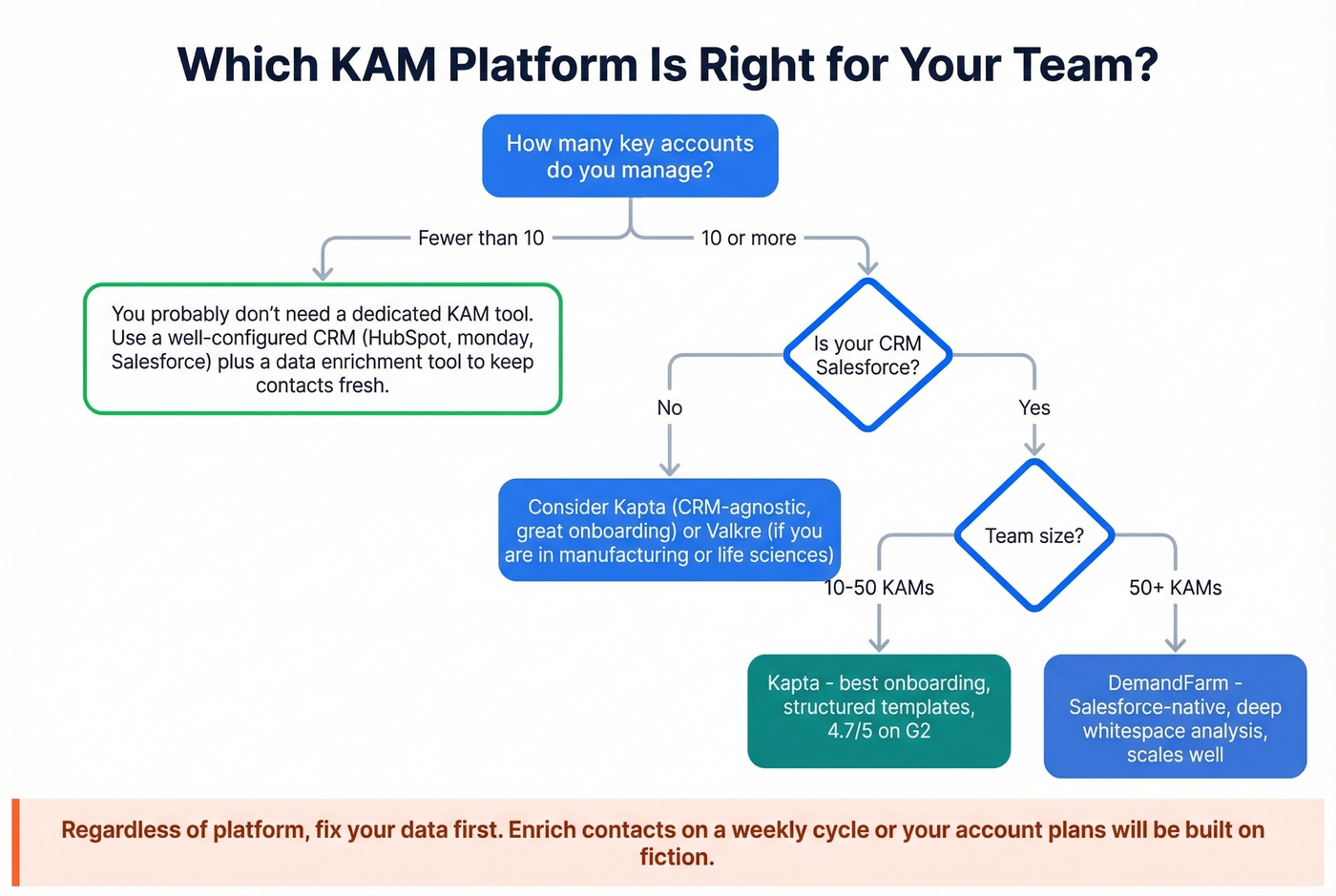
Here's the thing: if you have fewer than 10 key accounts, you probably don't need a dedicated KAM tool at all. Fix your process and your data first. A well-maintained spreadsheet with accurate contact info beats a $2,000/month platform full of stale records every single time.
What Is a KAM Platform?
Gartner defines account planning tools as software that improves seller precision and seller scale - synthesizing complex account info, prioritizing expansion, and flagging retention risk across a portfolio. In practice, a KAM platform sits on top of your CRM and adds the layers your CRM doesn't have: stakeholder mapping, whitespace analysis, account health scoring, and structured planning workflows. If your CRM could do this well, the category wouldn't exist.
What "2026-Ready" KAM Looks Like
The market has shifted. Static account plans updated quarterly don't cut it anymore. Here's what separates a modern key account management platform from a glorified spreadsheet:
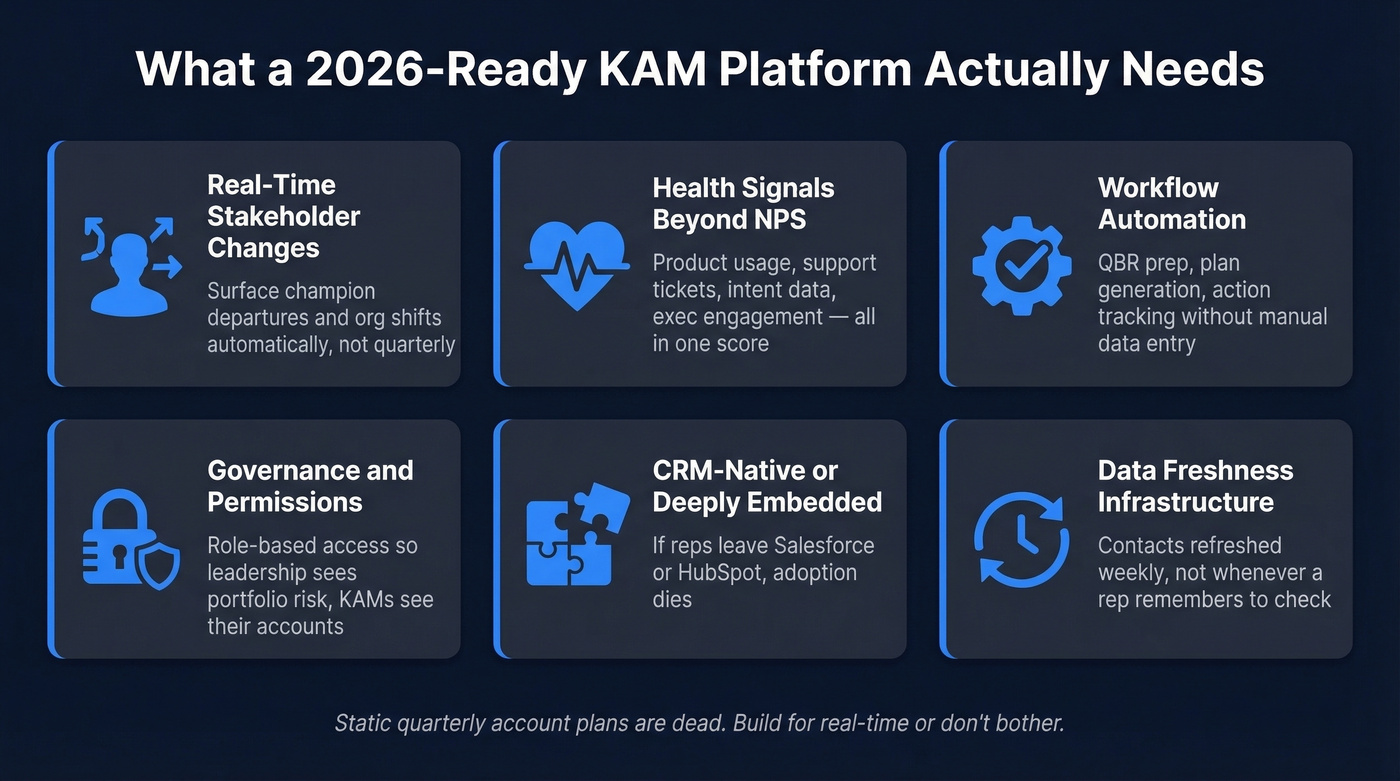
- Real-time stakeholder changes. Champions leave. Org charts shift. Your platform needs to surface these changes, not wait for a rep to notice.
- Health signals beyond NPS. Product usage, support ticket velocity, intent data, executive engagement frequency - all feeding a composite score.
- Workflow automation. QBR prep, account plan generation, and action item tracking that don't require manual data entry.
- Governance and permissions. Role-based access so leadership sees portfolio risk while KAMs see their accounts.
- CRM-native or deeply embedded. If reps have to leave Salesforce or HubSpot, adoption dies.
- Data freshness infrastructure. The platform either refreshes contact data itself or integrates tightly with a tool that does.
Pricing Comparison
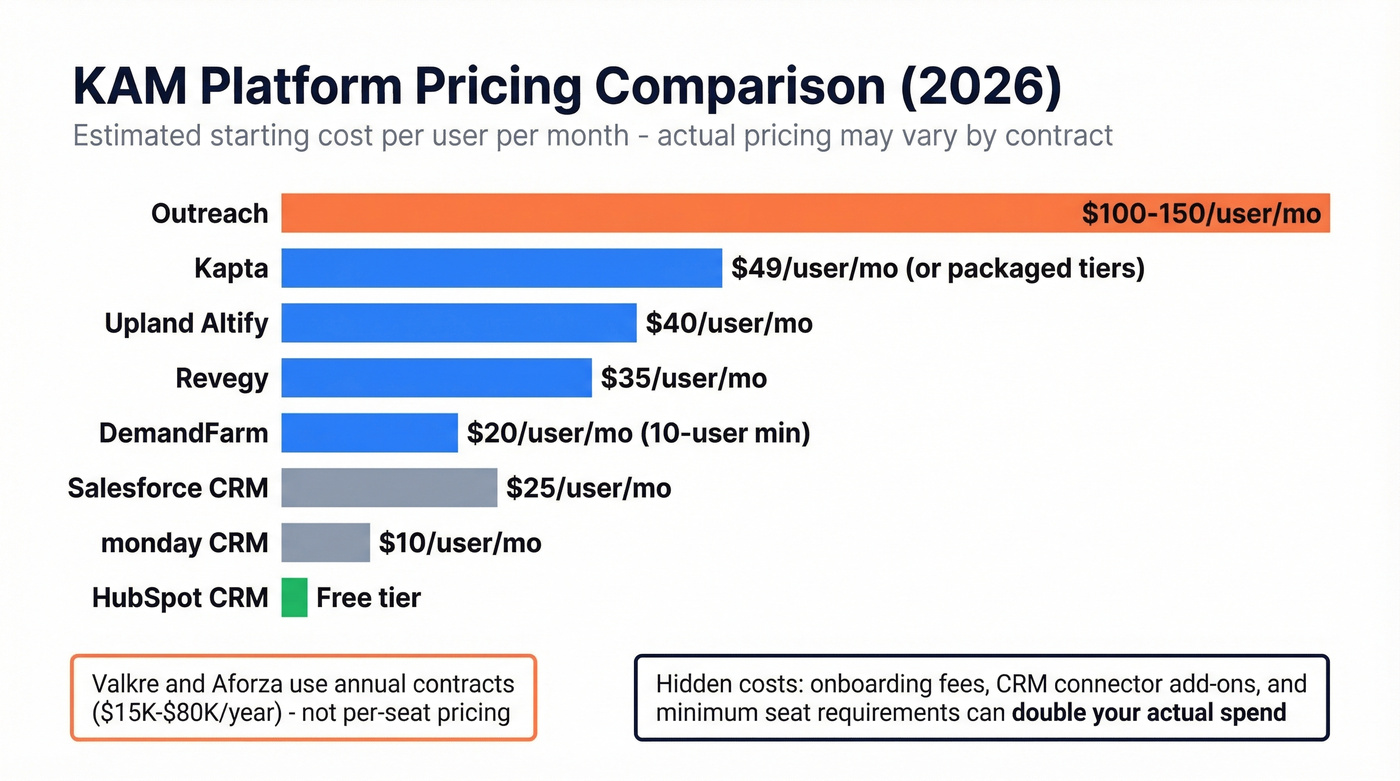
Most KAM vendors hide pricing behind "contact sales" forms. Here's what we've pieced together from G2, third-party listings, and vendor conversations.
| Platform | Starting Price | Model |
|---|---|---|
| DemandFarm | $20/user/mo | Per user, 10-user min |
| Kapta | ~$49/user/mo to ~$1,000+/mo packages | Varies by tier |
| Valkre | ~$30K-$80K/year | Annual contract |
| Aforza | ~$15K-$50K/year | Annual contract |
| Outreach | ~$100-150/user/mo | Per user |
| Revegy | ~$35/user/mo | Per user |
| Upland Altify | ~$40/user/mo | Per user |
| monday CRM | $10/user/mo | Per user |
| Salesforce | $25/user/mo | Per user |
| HubSpot | Free (paid upgrades) | Freemium |
DemandFarm's 10-user minimum means the floor is $200/month at the Org Chart tier. Starter is $500/month minimum, and Advanced is $700/month minimum. Kapta's pricing is harder to pin down - third-party listings show ~$49/user/month, while directories also list packaged programs starting around $1,000/month that scale with seats and support level. Expect the actual number to land somewhere in between depending on your team size.
If you're evaluating the data layer alongside your KAM rollout, compare vendors in our guide to data enrichment services.

Half the contacts in your key accounts are already stale. Prospeo's CRM enrichment returns 50+ data points per contact at a 92% match rate - refreshed every 7 days, not every quarter. At $0.01 per email, keeping your stakeholder maps current costs less than one missed QBR.
Stop building account plans on dead data. Enrich your CRM today.
The Best KAM Platforms Reviewed
DemandFarm
Use this if: You're a Salesforce shop with 50+ account managers who need visual account planning without leaving the CRM.
Skip this if: You have fewer than 10 KAMs - the minimum seat requirement will price you out.
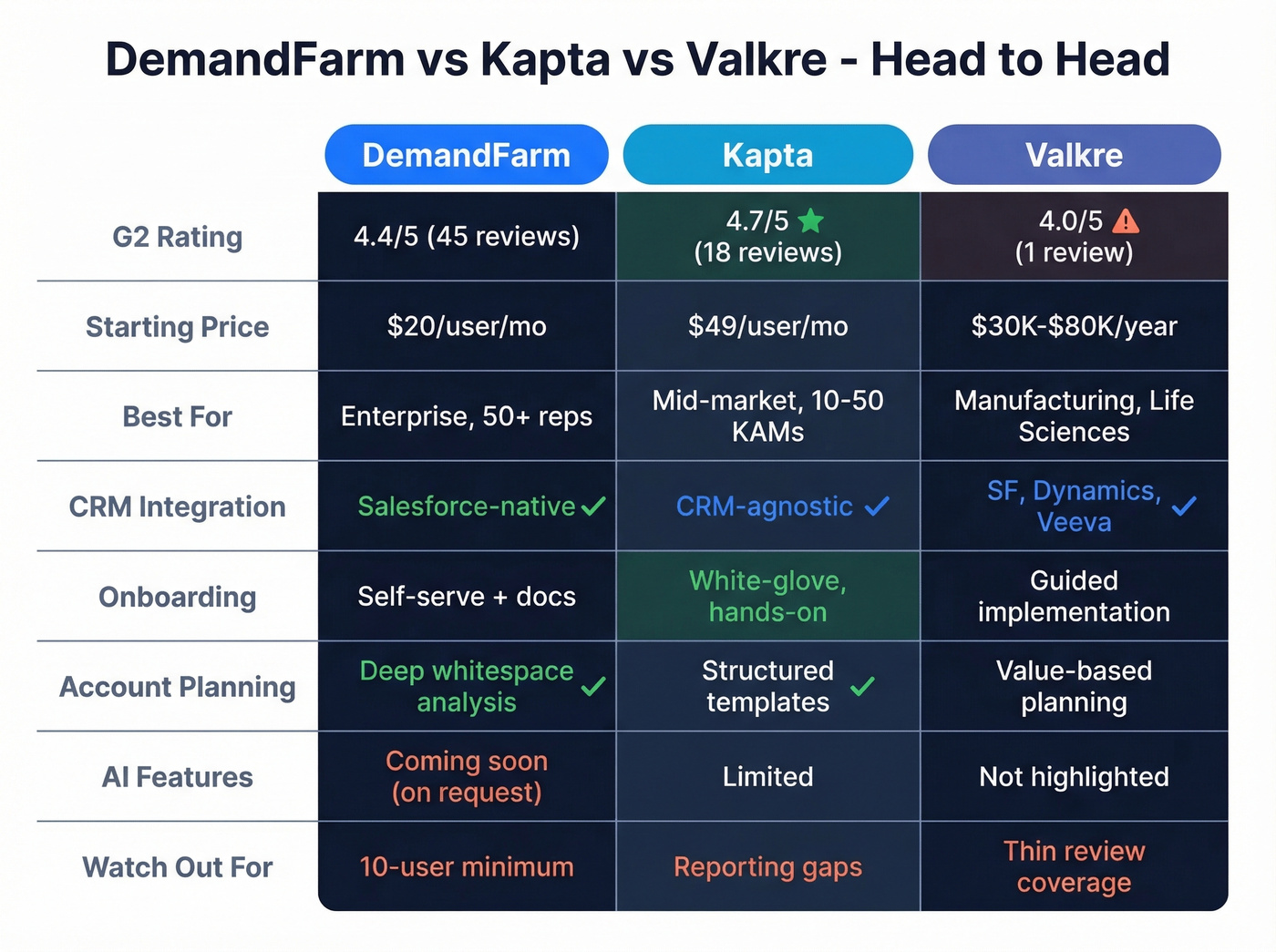
DemandFarm has a 4.4/5 rating on G2 across 45 reviews. It's Salesforce-native, so reps don't context-switch - whitespace planners, relationship maps, and opportunity planners all live inside the Salesforce UI.
Pricing runs $20/user/month for the Org Chart tier up to $70/user/month for Advanced, with a 10-user minimum across all plans. The vendor site is contact-sales only.
DemandFarm lists KAM AI as "on request" and highlights multiple AI capabilities as "coming soon," including 1-click account plan summaries, account health insights, and auto-generated action plans. Buy based on what's live today, not the roadmap. We've been burned by that before, and so have plenty of teams on r/sales who bought on promises that took 18 months to ship.
Kapta
Kapta carries the highest G2 rating among dedicated KAM tools in this shortlist: 4.7/5 across 18 reviews. Where DemandFarm wins on Salesforce depth, Kapta wins on onboarding. Their support team actually helps you build your first account plans - and in our experience, that hand-holding matters more than most buyers realize. We've seen teams get to "first useful account plan" in under two weeks with Kapta, versus six-plus weeks self-implementing other tools.

The trade-off is reporting. The most common ask on G2: more customized reporting and dashboards. If your leadership team wants bespoke analytics, push hard on this during the trial. Directory pricing lists packages starting around $1,000/month (KAM Basics), scaling to $2,000/month (KAM Plus) and $5,000/month (Enterprise), though other third-party listings show per-seat pricing around $49/user/month. Clarify the model before you commit.
If you're comparing options beyond Kapta, see our breakdown of Kapta alternatives.
Best for: Mid-market teams (10-50 KAMs) that value structured workflows and white-glove onboarding over deep customization.
Valkre
Valkre publishes impressive vendor case studies: Owens Corning reported +17% revenue growth and +31% EBIT margin growth in their composites business. The platform is CRM-agnostic - Salesforce, Dynamics, and Veeva - which makes it attractive for life sciences and manufacturing companies locked into non-Salesforce ecosystems.
Third-party review coverage is thin. The lone G2 review (dated 2018, 4.0/5) mentions an easy-to-use interface but flags excessive click-throughs to navigate the UI. Expect annual contracts in the $30K-$80K range depending on seats and modules. Get a pilot with clear success metrics before signing.
Outreach
Outreach is a sales execution platform first, with KAM capabilities layered on top. The account-level features include multi-threaded engagement tracking, stakeholder activity timelines, and automated sequence triggers based on account signals. It isn't as deep as DemandFarm or Kapta for whitespace analysis or structured account planning, but if your workflow already lives in Outreach, the consolidation argument is real. Expect $100-$150/user/month.
If you're rolling Outreach into your stack, this guide on how to connect Outreach tool to CRM can help avoid adoption friction.
Use this if: You already run Outreach for sequences and want lightweight KAM without adding another tool.
Skip this if: You need dedicated account planning templates and QBR workflows.
Other Tools Worth Knowing
Aforza - Built for consumer goods (trade promotion management, field sales). 4.5/5 on G2 with 1 review. Skip if you're B2B SaaS. Expect $15K-$50K/year.
Revegy - Starts at ~$35/user/month. Lightweight account planning worth evaluating if DemandFarm's minimum is too steep.
Upland Altify - ~$40/user/month, Salesforce-native, similar positioning to DemandFarm but with a smaller user community.
CRM alternatives - monday CRM ($10/user/mo), Salesforce ($25/user/mo), HubSpot (free tier). Not dedicated KAM tools, but for teams managing fewer than 10 key accounts, a well-configured CRM with good data might be all you need. If you need a broader shortlist, here are more examples of a CRM.
Adjacent Tools (Not KAM Platforms)
Don't confuse these with a dedicated account management platform, but they plug real gaps in a KAM stack:
- Org chart tools like OrgChartHub visualize buying committees. Useful when your KAM platform's native org charts feel thin.
- Data providers keep stakeholder contacts current. Prospeo enriches contacts with 50+ data points on a 7-day refresh cycle at ~$0.01/lead, delivering 98% email accuracy and an 83% enrichment match rate. That means your org charts don't go stale between QBRs. (If you're building a broader system, start with lead enrichment.)
- Conversation intelligence tools like Gong and Chorus surface relationship health signals from call recordings. They pair well with any KAM tool for sentiment analysis.
- CRMs with account features like Microsoft Dynamics, Pipedrive, and Zoho handle basic account management but lack dedicated KAM workflows. For teams that mainly need clean records, consider dedicated contact management software.
How to Choose the Right Platform
In our experience, governance beats features. These six criteria actually predict whether a KAM platform sticks:
- CRM integration depth. Native embed beats a separate tab. If reps have to log into another app, they won't.
- Account plan templates. Does the platform ship with structured templates, or are you building from scratch? Kapta excels here.
- Stakeholder mapping. Look for drag-and-drop org charts with influence scoring, not just a contact list.
- Reporting and QBR workflows. Can you generate a QBR deck from the platform? Can leadership see portfolio-level health without asking each KAM? If you're tightening your QBR process, start with these QBR questions to ask.
- Permissions and governance. Role-based access matters at scale. Without it, sensitive account data leaks across teams.
- Data freshness. The platform should either refresh contact data natively or integrate with an enrichment tool that does. Stale data kills adoption faster than bad UX.
Why KAM Platforms Fail
The #1 reason these tools fail has nothing to do with the software. Cranfield's research nails it: KAM is a business model change, not a tool purchase. Implementation takes years in complex organizations, and most teams underestimate the change management required.
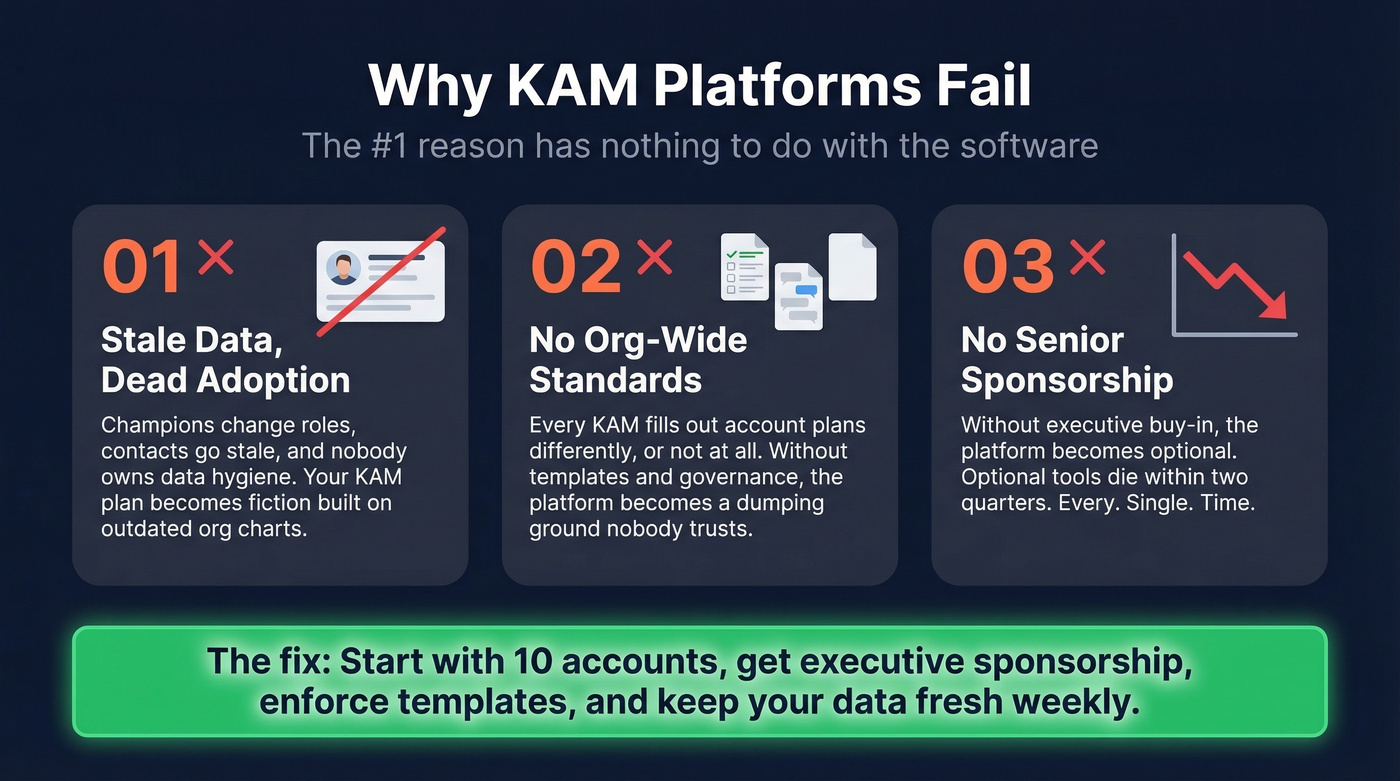
Look - if your CRM data is wrong, your KAM plan is fiction. We've seen adoption collapse when champions change roles and nobody owns data hygiene. The failure modes repeat themselves.
No org-wide standards. Every KAM fills out account plans differently - or not at all. Without templates and governance, the platform becomes a dumping ground.
No senior sponsorship. Without executive buy-in, the platform becomes optional. Optional tools die within two quarters. (If you're building the operating system around this, see our guide to sales leadership.)
Boiling the ocean. Teams try to roll out across 200 accounts instead of proving value with 10. Start small, show ROI, then expand.
Data decay. This is the silent killer. When stakeholder contacts go stale - wrong emails, outdated titles, departed champions - nobody trusts the platform. Trust erodes, adoption drops, and within six months you're back to spreadsheets. Job changes and org churn can break your org charts within a single quarter, which is why a weekly data refresh mechanism isn't a nice-to-have but a survival requirement for any KAM investment.

Kapta's own "Seven Deadly Sins" framework flags another pattern: teams treating KAM as tactical instead of strategic, using systems built for net-new pipeline to manage existing relationships. If your "KAM platform" is just your CRM with a renamed tab, you haven't actually changed anything.
Champion left and nobody noticed? Prospeo tracks job changes across 300M+ profiles so your KAM platform always reflects reality. With 98% email accuracy and 125M+ verified mobiles, your reps reach the new decision-maker - not the old one's voicemail.
Surface stakeholder changes before your competitor does.
What to Do Next
For enterprise Salesforce teams, start with DemandFarm. For mid-market teams that want structured onboarding, go with Kapta. And if adoption and data trust are already the problem - they usually are - fix the data layer first. No key account management platform survives stale contacts.
Whatever you pick, start with 10 accounts, not 200. Prove the workflow, get executive buy-in, then scale. The tool is the least important variable. Process and data quality determine whether your KAM investment pays off or becomes another line item nobody can justify at renewal.
FAQ
What's the difference between a CRM and a KAM platform?
A CRM tracks deals and pipeline across your entire customer base. A KAM platform adds account planning, stakeholder mapping, whitespace analysis, and health scoring - designed for managing existing strategic relationships, not closing net-new business. The CRM is the system of record; the KAM platform is the strategic layer on top.
How much does key account management software cost?
Dedicated KAM platforms range from $20/user/month (DemandFarm Org Chart) to $5,000/month (Kapta Enterprise). General CRMs with account features start at $10-$25/user/month. Budget $500-$2,000/month for a mid-market team of 10-30 KAMs, including data enrichment tools.
How do you keep stakeholder data accurate in a KAM platform?
Use a data enrichment tool alongside your platform. Job changes and org churn can break your org charts within a single quarter. A 7-day refresh cycle with high enrichment match rates keeps contacts current automatically - at a fraction of what legacy providers charge. Without a refresh mechanism, relationship maps become fiction fast enough to undermine any account plan.
Are sales account management tools the same as KAM platforms?
Sales account management tools is a broader category that includes CRMs, pipeline trackers, and lightweight account dashboards. A dedicated KAM platform is a subset - purpose-built for strategic account planning, stakeholder mapping, and retention workflows across your highest-value customers. Most teams start with general tools and graduate to a KAM platform once they have 10+ strategic accounts.