

How to Build a Key Account Program That Actually Gets Used
A RevOps lead we work with described their key account program perfectly: "We spent six weeks building beautiful account plans in January. By March, they were shelfware." Leadership asks for strategic account plans, gives vague guidance, and the plans sit in a shared drive collecting dust. The problem isn't the plan - it's everything around it.
You need three things: a weighted scoring model to pick the right accounts, a 90-day operating cadence so plans stay alive, and clean contact data so your stakeholder maps don't rot. Let's break down each one.
What Key Account Management Actually Is
Most guides confuse opportunity management with account management. Managing key deals means working pipeline. Managing key accounts means growing relationships across an entire organization over years - mapping stakeholders, finding whitespace, protecting renewals.
Only 5% of B2B accounts are actively looking to buy at any given time. A strategic account program exists for the other 95%: the accounts where you're building trust, expanding footprint, and positioning for the next budget cycle. If your "key account manager" is just chasing the next PO, that's a sales rep with a fancier title.
The Business Case
The numbers make the argument better than any strategy deck.
Key accounts are 60-70% more likely to close than new prospects and spend 31% more than new customers. Acquiring a new customer costs 6-7x more than retaining an existing one. Organizations with formal account planning report 75% better win rates, 58% shorter sales cycles, and 49% bigger deals.
Yet fewer than 20% of companies have fully embedded account planning into business operations. That gap between "everyone knows KAM matters" and "almost nobody does it well" is where the opportunity lives.
Select and Tier Your Accounts
You don't need 50 key accounts. You need 5-10 that get your full attention. We've found that teams stretching beyond 15 Tier 1 accounts always end up doing reactive maintenance instead of strategic management.
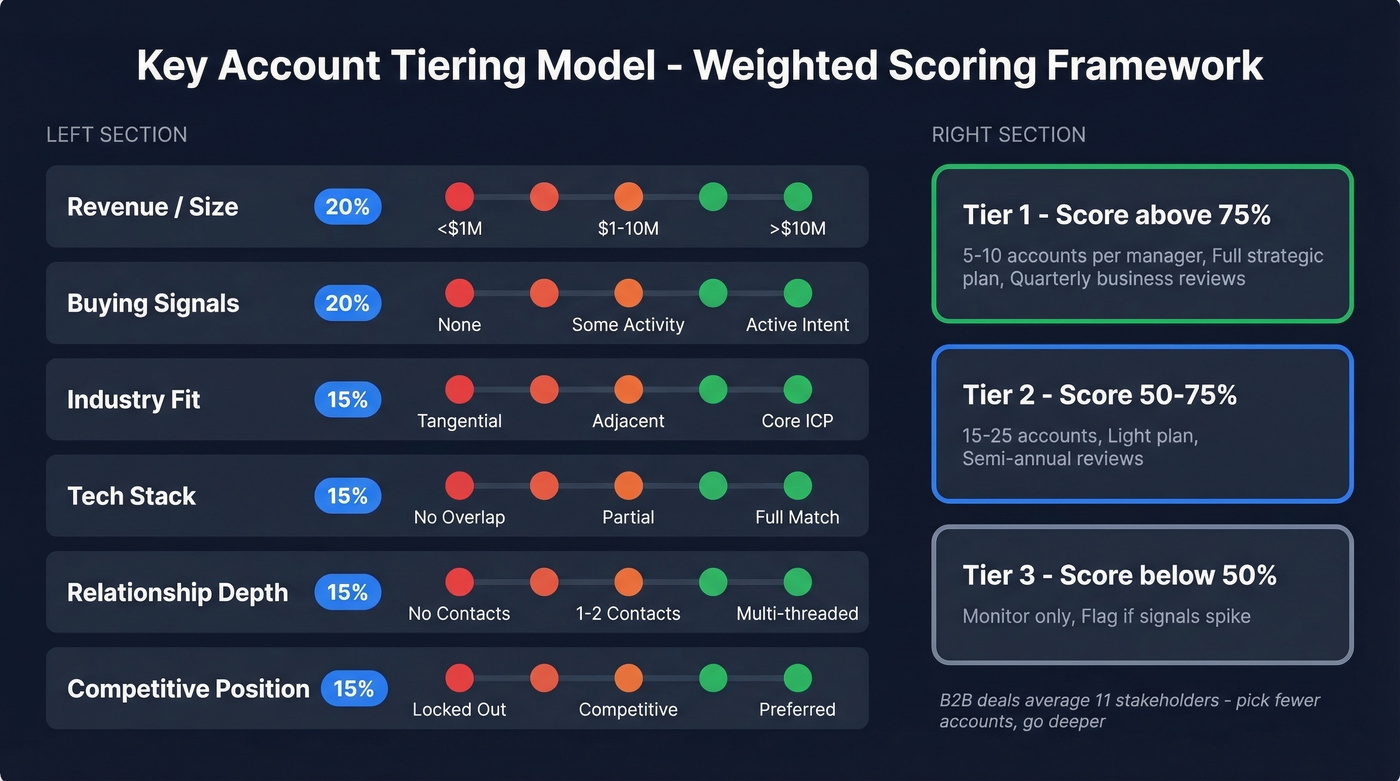
Weight each criterion below, score every account 1-5, and let the math decide who makes the cut.
| Criteria | Weight | Score 1 | Score 3 | Score 5 |
|---|---|---|---|---|
| Revenue / size | 20% | <$1M ARR | $1-10M | >$10M |
| Industry fit | 15% | Tangential | Adjacent | Core ICP |
| Tech stack | 15% | No overlap | Partial | Full match |
| Buying signals | 20% | None | Some activity | Active intent |
| Relationship depth | 15% | No contacts | 1-2 contacts | Multi-threaded |
| Competitive position | 15% | Locked out | Competitive | Preferred |
Tier cutoffs: >75% = Tier 1 (full strategic plan) | 50-75% = Tier 2 (light plan) | <50% = Deprioritize
Tier 1 gets 5-10 accounts per manager with full plans, quarterly reviews, and cross-functional involvement. Tier 2 gets 15-25 accounts with abbreviated plans and semi-annual reviews. Everything else is monitor-only.
This pairs well with the KAISM 2x2 matrix, which plots account attractiveness against your relative strength - high on both means "Invest," low on both means "Manage for cash." One stat that makes tiering non-negotiable: B2B deals now involve an average of 11 stakeholders. You can't multi-thread 50 accounts at that depth. Pick fewer, go deeper.
Build Your Account Plan
Stop writing 20-page account plans. A one-page plan with a scoring model and 90-day milestones outperforms a strategy deck nobody reads.
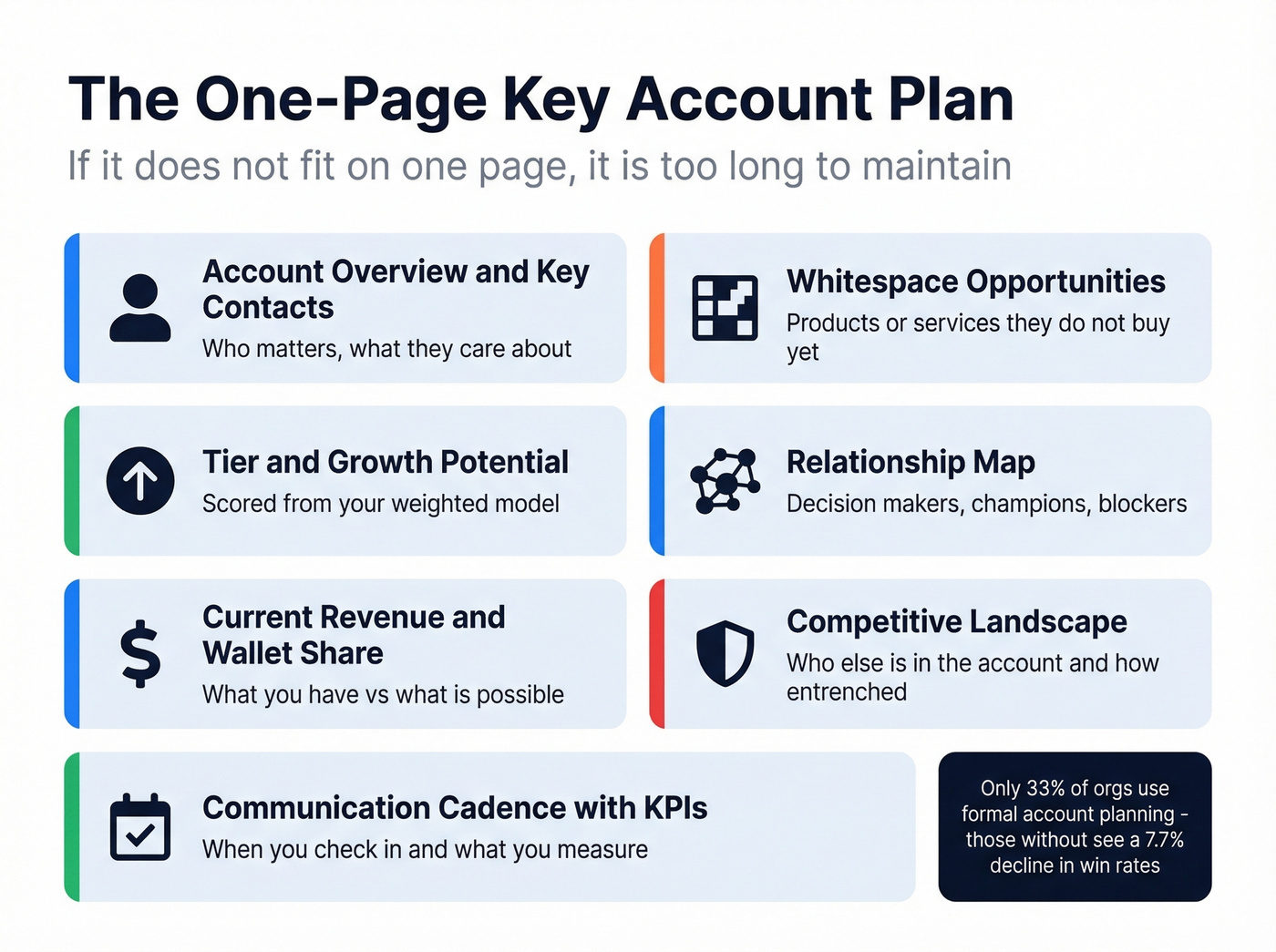
Only 33.1% of organizations use formal account planning, and those with random or informal planning see a 7.7% decline in win rates. So you need a plan. It just doesn't need to be a novel.
Cover seven areas, each in a few bullet points:
- Account overview and key contacts - who matters, what they care about
- Tier and growth potential - scored from your model above
- Current revenue and wallet share - what you have vs. what's possible
- Whitespace - products or services they don't buy yet
- Relationship map - decision makers, champions, blockers
- Competitive landscape - who else is in the account and how entrenched they are
- Communication cadence with KPIs - when you'll check in and what you're measuring
Keep each section actionable. If a bullet doesn't drive a next step, cut it. If the whole thing doesn't fit on one page or one dashboard view, it's too long to maintain.

Multi-threading 11 stakeholders per account means your relationship maps need verified emails and direct dials - not stale data from six weeks ago. Prospeo's 7-day refresh cycle and 98% email accuracy keep your key account plans actionable, not decorative.
Stop building stakeholder maps on data that's already dead.
Set Your Operating Cadence
Cadence is what keeps plans alive. Without it, even great plans die within a quarter.
Tier 1: Monthly check-ins with the account team, quarterly business reviews with the customer, annual strategic review with executive sponsors. These accounts justify the investment - treat them accordingly.
Tier 2: Quarterly internal check-ins, semi-annual customer review. Lighter touch, but still structured.
Tier 3: Monitor-only. Flag if buying signals spike, otherwise leave alone.
Put the reviews on the calendar now. Not "when we have time." That time never comes.
Measure What Matters
Four KPIs give you the core picture with Tier 1 accounts.
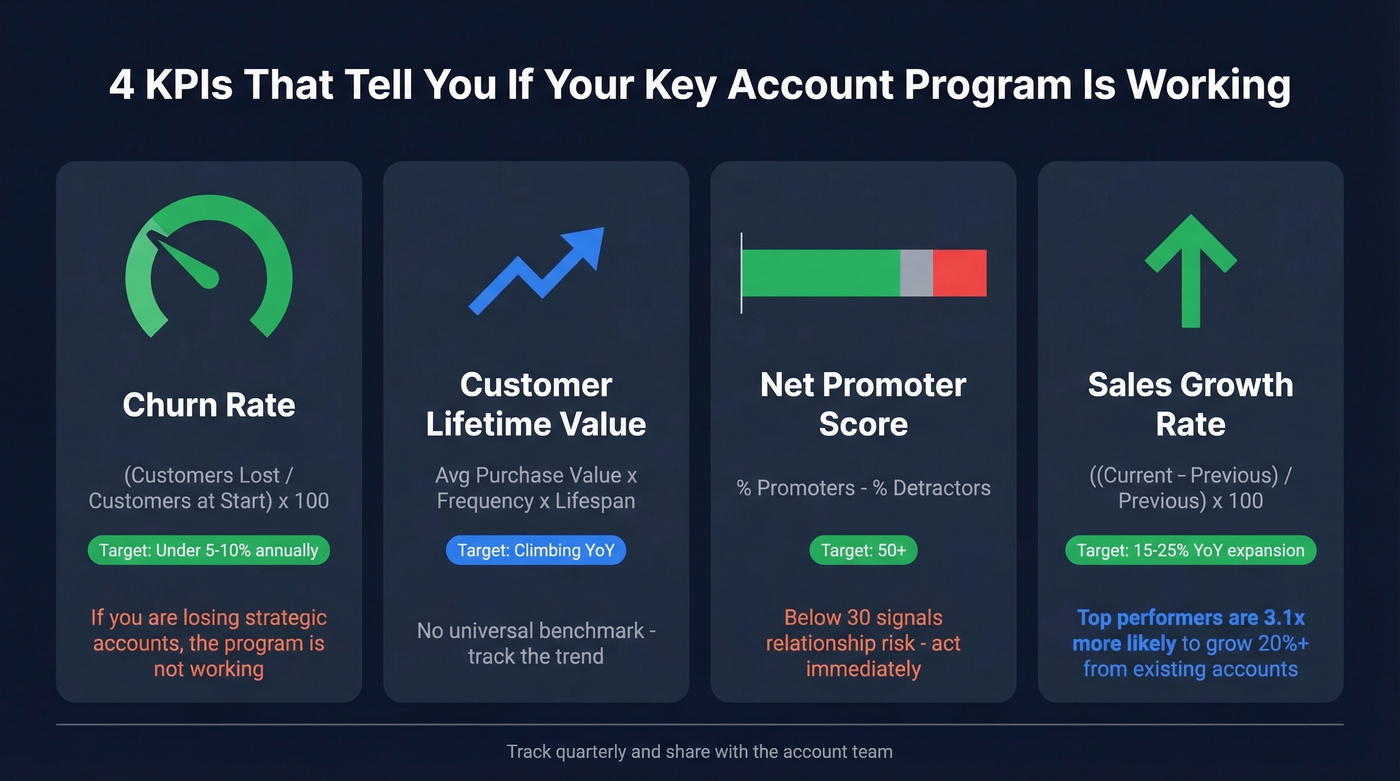
Churn rate = (customers lost / customers at start) x 100. Target: under 5-10% annually. If you're losing strategic accounts, the program isn't working - full stop. (If you want a deeper breakdown, see churn analysis.)
Customer lifetime value = avg purchase value x purchase frequency x avg lifespan. There's no universal benchmark here. Track the trend. CLV should climb year over year for key accounts.
NPS = % promoters - % detractors. Target: 50+. Anything below 30 signals relationship risk that needs immediate attention.
Sales growth rate = ((current period - previous) / previous) x 100. Target: 15-25% YoY expansion revenue. Top performers are 3.1x more likely to grow revenue 20%+ from existing accounts.
Track these quarterly and share them with the account team. If the numbers aren't moving, the plan needs to change - not just the effort level.
Why Key Account Programs Fail
Five failure modes kill most programs. I've seen all of them firsthand.
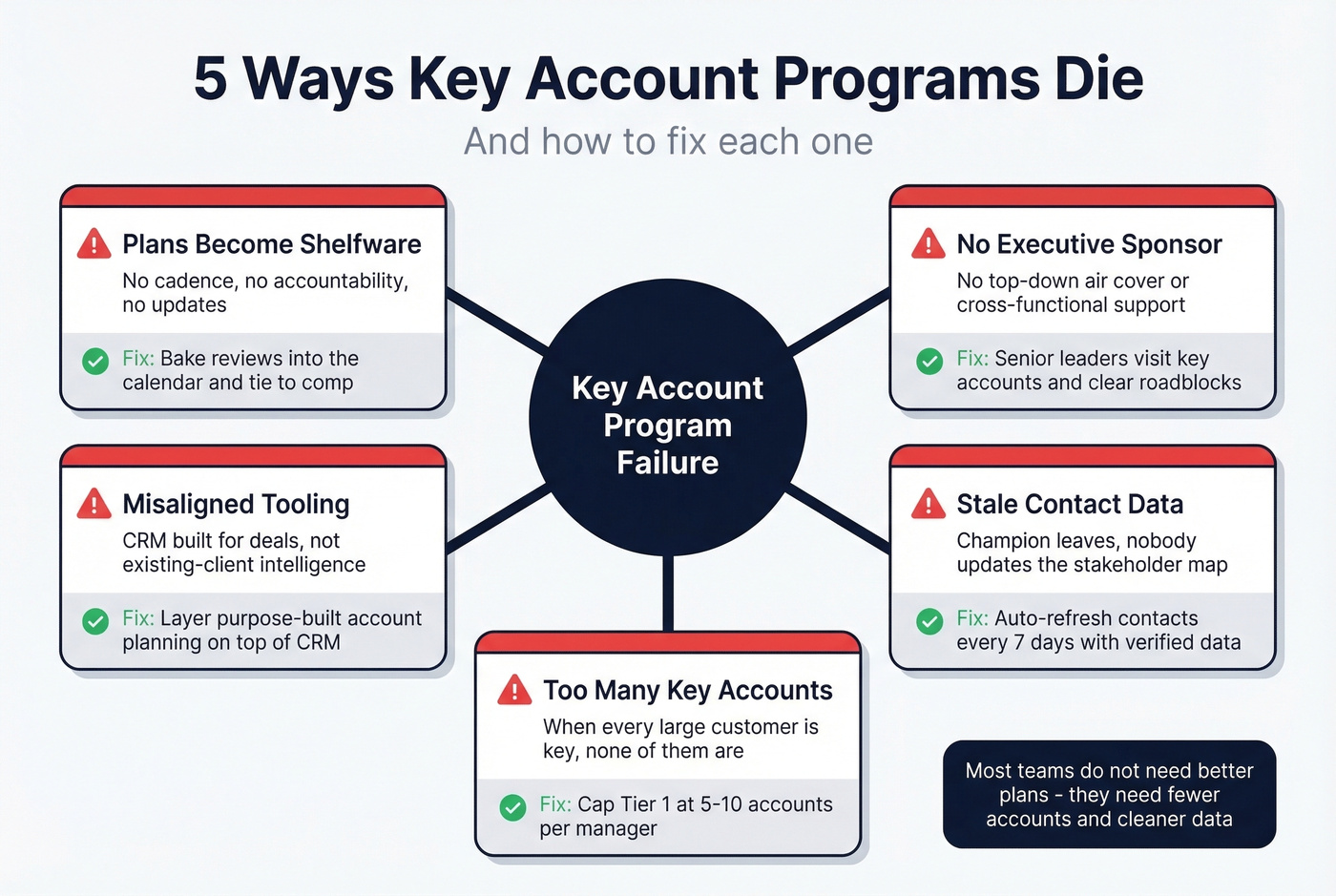
Plans become shelfware. No cadence, no accountability, no updates. Reddit threads on r/sales consistently flag this as the top reason KAM programs die. The fix is structural, not motivational - bake reviews into the calendar and tie them to comp.
No executive sponsor. These programs need top-down air cover. That means senior leaders visiting key accounts and clearing cross-functional roadblocks, not just signing off on a slide deck once a year.
Misaligned tooling. Most CRMs are built for tracking deals and new business, not organizing existing-client intelligence. Look for purpose-built account planning features - relationship mapping, whitespace analysis, automated updates - that layer on top of your CRM. (If you’re auditing your stack, start with a few examples of a CRM and what they’re actually good at.)
Stale contact data. Your champion leaves. Nobody updates the stakeholder map. The renewal conversation happens with the wrong person - or doesn't happen at all. This is the silent killer. Tools like Prospeo refresh contact records every 7 days at 98% email accuracy, so when a champion changes roles, your stakeholder map reflects it within days instead of months. That kind of automated hygiene is what separates programs that survive from ones that slowly decay.

Too many "key" accounts. When every large customer is "key," none of them actually are. The strongest programs also lean on cross-functional alignment - marketing, customer success, and product teams sharing account goals so the account manager isn't operating alone. (This is also where account-based selling practices can help.)
Here's the thing: most teams don't need better account plans. They need fewer accounts and cleaner data. The IRF case study on key distributor programs found the same pattern - don't launch programs until capacity, data hygiene, and training are fixed.
Key account programs fail when contact data rots. Prospeo gives you 125M+ verified mobiles with a 30% pickup rate and 300M+ profiles with 30+ filters - so your Tier 1 account plans stay connected to real decision-makers, not bounced emails.
Reach every stakeholder in your top accounts for $0.01 per email.
ROI: A Real Case Study
Company: U.S. hand-tool manufacturer | Duration: 9 months | Target: Top distributors
Goal: $1M in incremental net sales, margin lift from 30.4% to 32%
Results: Incremental net sales hit $1,440,164. Gross margins jumped from 30.4% to 35%. After subtracting $545,637 in program costs, total ROI landed at $1,059,178.
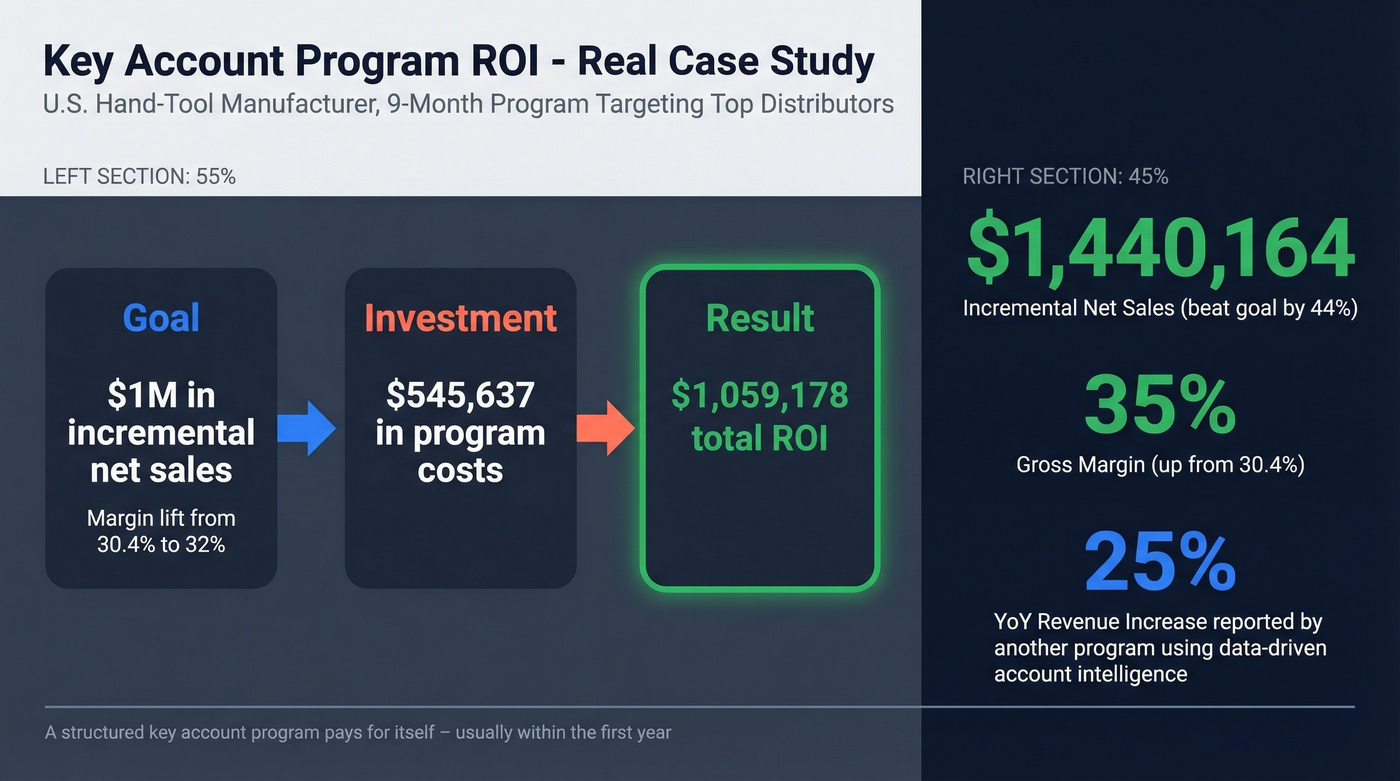
Other programs tell a similar story: one company reported a 25% YoY revenue increase from their top 10 accounts after adopting data-driven account intelligence. A structured key account program pays for itself - usually within the first year. Skip this approach if you don't have executive buy-in or the data infrastructure to support it; you'll burn budget and credibility simultaneously.
FAQ
How many key accounts should one manager own?
For Tier 1 accounts with full strategic plans: 5-10 per manager. Tier 2 with lighter plans: 15-25. More than that dilutes focus and turns strategic management into reactive account maintenance. If your managers are stretched across 30+ accounts, you don't have a key account program - you have a customer service queue.
What's the difference between KAM and sales?
Sales closes deals. Key account management grows relationships over years - mapping stakeholders, finding whitespace, protecting renewals, and expanding footprint across business units. If your KAM is measured purely on new bookings, you've got a sales rep with a fancier title.
How do I keep account plans from going stale?
Set a cadence: monthly check-ins for Tier 1, quarterly for Tier 2. Refresh contact data automatically so stakeholder maps stay current without manual research. Calendar the reviews now, not "when there's time." In our experience, embedding these rhythms into your operating cadence is the single biggest factor in whether plans survive past Q1.
What tools support a key account program?
Purpose-built platforms like DemandFarm, Kapta, and Revegy handle relationship mapping and whitespace analysis on top of your CRM. For contact data hygiene - the part most teams neglect - you need an enrichment tool that refreshes records automatically and returns enough data points per contact to rebuild a stakeholder map without manual research. (If you’re comparing vendors, start with data enrichment services and what “refresh” really means.)