

Lead Brokers: How They Work, What They Cost, and When to Cut the Middleman
You paid $2,500 for a list of 500 "exclusive" leads last month. Half the phone numbers were disconnected. The other half had already been pitched by three competitors. The broker's response? "All sales are final."
That's the lead broker experience for a disturbingly large number of buyers - and it doesn't have to be. Lead brokering is a slice of a broader data broker market projected to hit $332 billion, so real money flows through these pipes. But the 2025 TCPA one-to-one consent rules fundamentally changed the compliance picture, and most buyers haven't caught up. Here's how lead brokers actually work, what you should pay, and when to skip them entirely.
The Short Version
- B2C / high-volume verticals (insurance, solar, home services): Brokers still make sense, but vet ruthlessly using the checklist below. Ping-post works well for real-time form fills and call transfers at scale.
- B2B teams: Skip brokers. Self-serve data platforms cost roughly $0.01 per lead with 98% email accuracy - that's 100x cheaper than brokered B2B leads running $5-$50 each.
- Everyone: The 2025 TCPA one-to-one consent rule changed everything. If your broker can't show a documented consent chain, you're the one paying $500-$1,500 per violation.
Here's the thing: if your average deal size doesn't justify a $50 cost-per-lead, you almost certainly don't need brokered B2B sales leads. The margin math doesn't survive the markup.
What Is a Lead Broker?
A lead broker buys leads with the intention of reselling each one to their own network of buyers. They sit between the lead generator - the company running ads, landing pages, or comparison sites that capture consumer information - and the end-service provider who actually contacts the prospect. In the direct marketing world, this role evolved from the traditional list broker, who historically connected mailers with rented contact databases long before digital lead gen existed.
The economics are straightforward. A broker buys a lead for $10, sells it for $15-$25, and pockets the margin. Multiply that across thousands of leads per day, and you've got a real business.
The transaction happens in real-time via server-to-server communication: the consumer fills out a form, the lead hits the broker's system, and within milliseconds it's routed to a buyer. Any lead that goes unsold is a loss for the broker, which is why most modern brokers use ping-post distribution to gauge buyer demand before committing to a purchase. The broker's incentive is to maximize sell-through rate, not necessarily lead quality. Understanding that incentive structure is the first step to working with them effectively.
Broker vs. Aggregator vs. Marketplace
These terms get used interchangeably, but they describe meaningfully different business models.
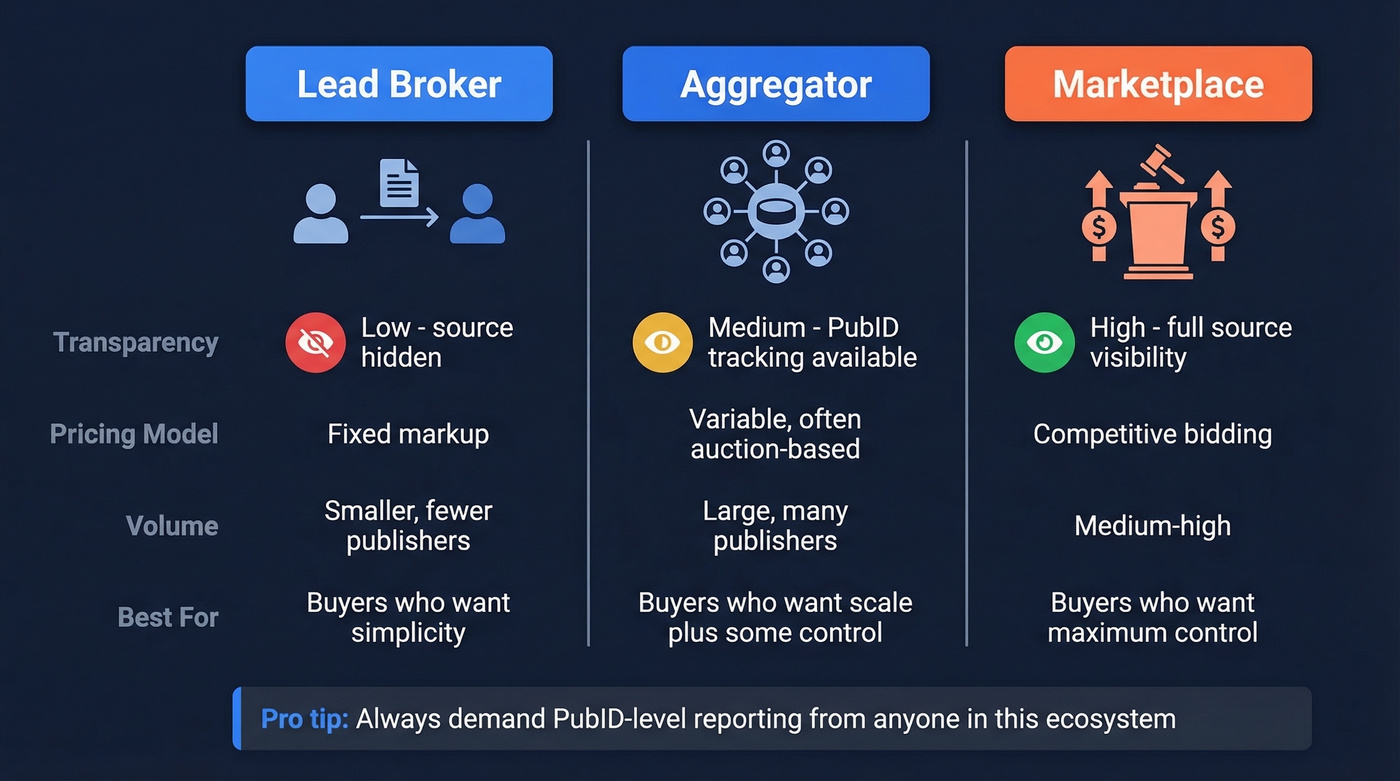
| Broker | Aggregator | Marketplace | |
|---|---|---|---|
| Model | Middleman, buys & resells | Platform connecting many publishers to buyers | Open exchange, buyers bid directly |
| Transparency | Low - source often hidden | Medium - PubID/SubID tracking available | High - full source visibility |
| Volume | Smaller, fewer publishers | Large, many publishers | Medium-high, category-dependent |
| Pricing | Fixed markup | Variable, often auction-based | Competitive bidding |
The practical difference for buyers comes down to visibility. With a lead broker, you often don't know where your leads originated. With an aggregator or marketplace, you can insist on PubID/SubID tracking and pull per-publisher conversion and refund rates. That data lets you kill underperforming sources fast instead of guessing why your close rate tanked this month.
Demand PubID-level reporting from anyone in this ecosystem. If they won't provide it, that tells you everything you need to know.
How Ping-Post Distribution Works
The Two-Stage Auction
Ping-post is the backbone of modern lead distribution - a two-stage process designed to maximize value for both sellers and buyers.
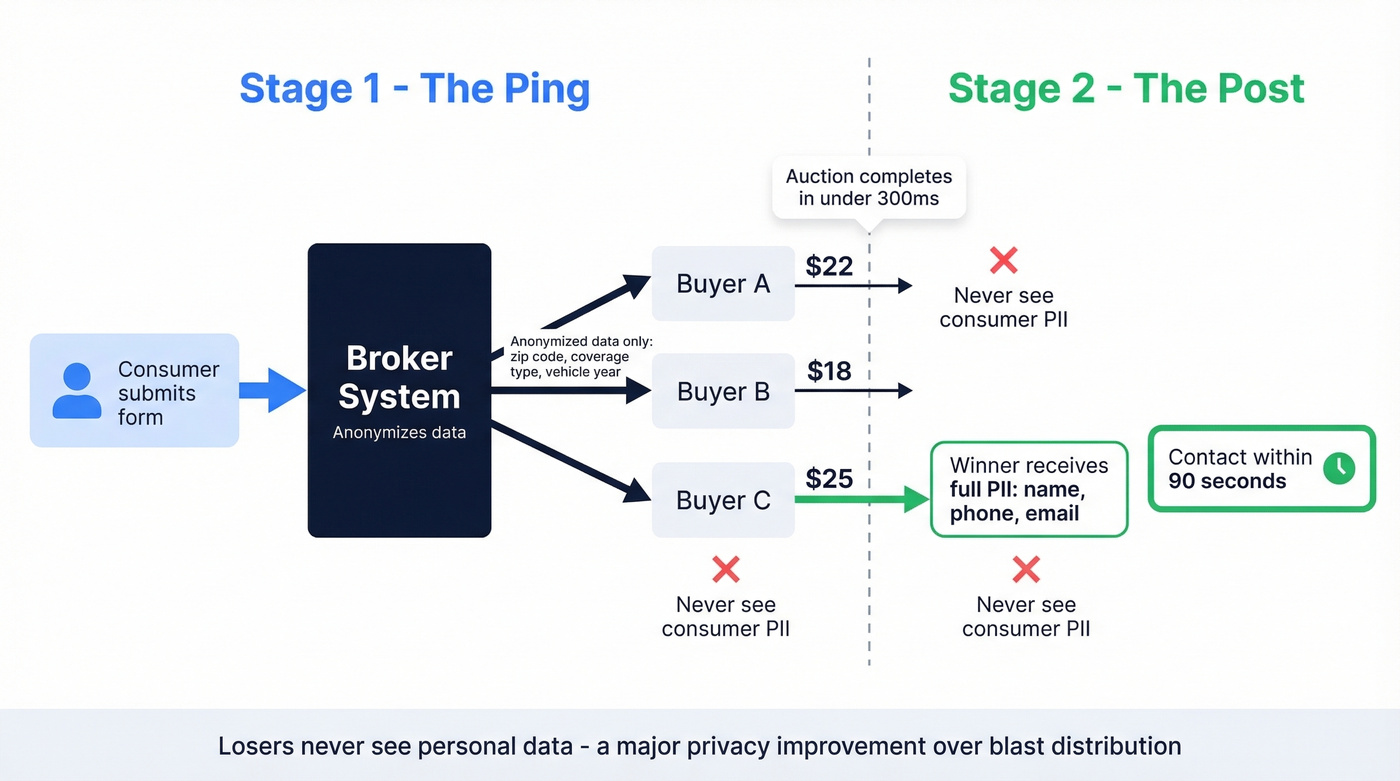
Stage 1 - The Ping: When a consumer submits a form, the broker sends anonymized data to multiple buyers simultaneously. This ping packet includes non-identifying fields like zip code, requested coverage type, and vehicle year - enough for buyers to decide if they want the lead, but nothing that reveals who the consumer is.
Stage 2 - The Post: Buyers return bids automatically. The auction completes in under 300 milliseconds. The winning bidder receives the full lead details - name, phone, email, everything. Losers never see the consumer's personal data. This is a meaningful privacy improvement over the old "blast the lead to everyone" model.
Ping-Post vs. Direct Post
| Ping-Post | Direct Post | |
|---|---|---|
| Bidding | Competitive auction | No competition |
| Pricing | Dynamic, market-driven | Fixed price |
| Buyer competition | Multiple bidders | Single buyer |
| Data exposure | PII only to winner | PII to buyer immediately |
| Best for | High-value verticals | Simple, low-volume ops |
What Happens When Nobody Bids
Not every lead finds a buyer at auction. Smart brokers build a fallback strategy: the lead cascades to a secondary network, then to a fixed-price buyer, and finally into an internal nurture queue. The worst outcome is a lead that dies in the system with no follow-up.
For buyers who win at auction, speed is everything. The benchmark is contact within 90 seconds. A lead that sits for even five minutes has already cooled off, and if you're paying auction prices for real-time sales leads, slow follow-up is burning money.
TCPA Rules That Reshaped Lead Brokering
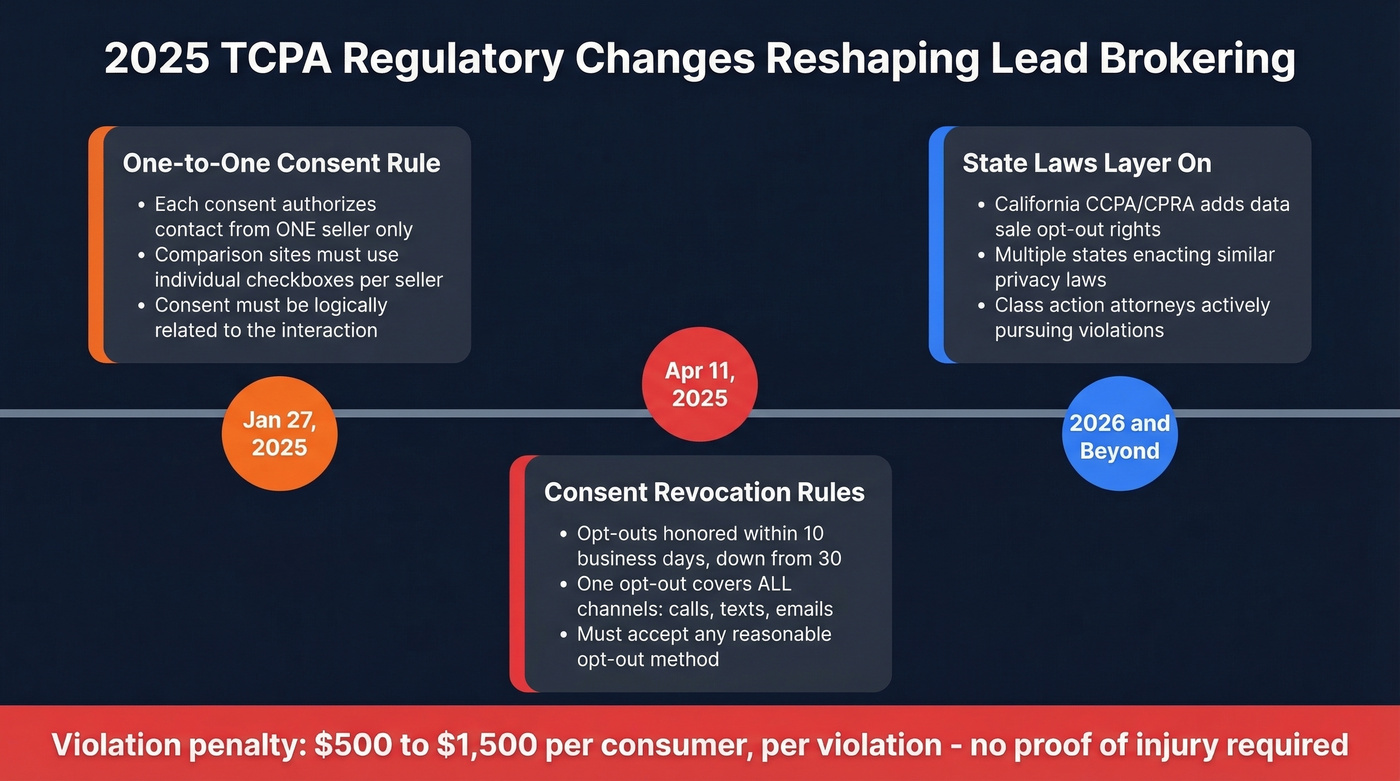
Two regulatory changes in 2025 fundamentally reshaped how lead brokers operate. If you're buying leads in 2026, you need to understand both.
One-to-One Consent (Jan 2025)
The FCC's one-to-one consent rule went into effect January 27, 2025. Each consent expression now authorizes calls or texts from only one identified seller. The old model - where a comparison site collected consent with blanket "by submitting this form, you agree to be contacted by our partners" language - is dead.
Comparison sites must now use individual checkboxes for each seller, or redirect consumers to the seller's own site for direct consent capture. The consent must also be "logically and topically" related to the interaction that produced it. You can't collect consent on a mortgage comparison site and use it to sell auto insurance.
Consent Revocation (Apr 2025)
Effective April 11, 2025, the FCC tightened opt-out rules significantly. Opt-outs must now be honored within 10 business days, down from 30. One opt-out covers all channels - calls, texts, and emails - and applies to marketing and informational communications. Businesses must accept "any reasonable method" of opting out, not just specific keywords or channels.
State Laws Add Another Layer
Federal TCPA rules aren't the whole picture. California's CCPA/CPRA imposes additional data-handling requirements, including the right to opt out of the "sale" of personal information - which directly applies to lead brokering. Several other states have enacted similar privacy laws. If you're buying leads that include California consumers, your broker needs to demonstrate CCPA compliance alongside TCPA compliance.
What This Means for Buyers
The exposure is real: $500-$1,500 per violation per consumer, with no need to show actual injury. Leads obtained before January 27, 2025 may no longer satisfy the new consent standard, and class action attorneys are actively looking for these cases.
This is also an opportunity. Buyers who demand compliance documentation will naturally filter toward higher-quality brokers.

You just read that brokered B2B leads run $5-$50 each - with no guarantee on accuracy. Prospeo delivers 300M+ verified contacts at roughly $0.01 per email, with 98% accuracy and a 7-day data refresh cycle. No middleman markup, no stale data, no compliance gray areas.
Skip the broker. Build your own pipeline in minutes.
What Do Leads Actually Cost?
Brokered Lead Pricing by Type
| Lead Type | Price Range | Notes |
|---|---|---|
| Aged insurance | $0.25-$2.00 | Typically 15-365 days old |
| Real-time exclusive insurance | $15-$75 | Single buyer |
| Shared insurance | $5-$25 | Sold to multiple buyers |
| Financial services (exclusive) | $50-$200 | High-value vertical |
| Real estate | $20-$80 | Varies by market |
| Solar | $15-$50 | Regional pricing |
| Home services | $10-$40 | Depends on trade |
| B2B brokered | $5-$50 | Wide range by quality |
Marketing CPL Benchmarks
For context, here's what companies pay to generate their own leads through marketing, per First Page Sage's 2026 report:
| Industry | Paid CPL | Organic CPL | Blended CPL |
|---|---|---|---|
| Financial Services | $761 | $555 | $653 |
| Real Estate | $480 | $416 | $448 |
| Business Insurance | $460 | $388 | $424 |
| B2B SaaS | $310 | $164 | $237 |
| Solar | $217 | $196 | $206 |
These are marketing CPLs - the cost to generate a lead through your own ads and content. Brokered leads look cheap by comparison, but the conversion math tells a different story. (If you want more benchmarks, see average cost per lead.)
Exclusive vs. Shared - The Real Math
Shared leads cost 50-80% less than exclusive leads. That looks great on a spreadsheet until you factor in conversion rates.
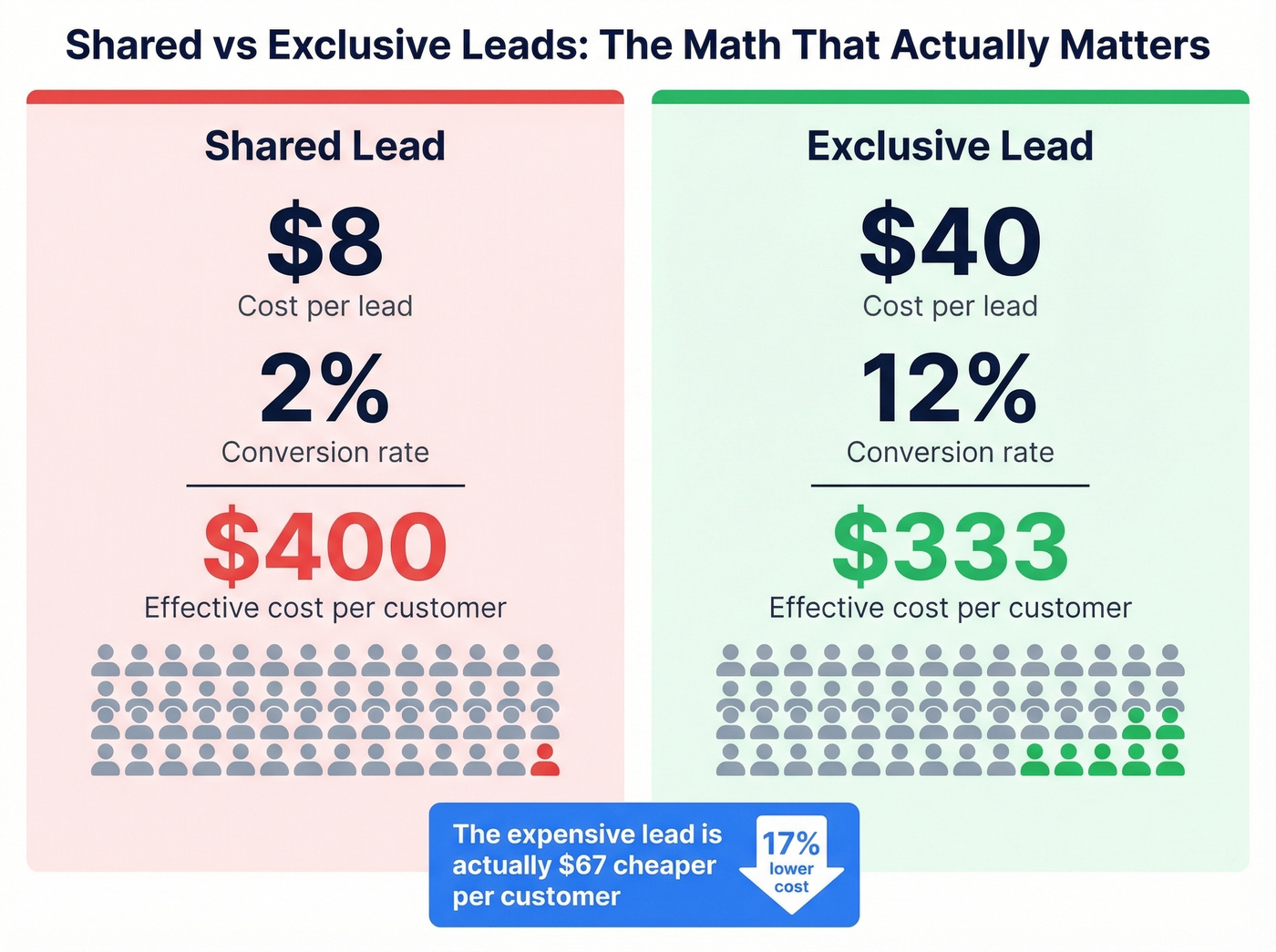
A shared insurance lead costs $8 and converts at 2%. Your effective cost per customer: $400. An exclusive lead at $40 that converts at 12% gives you an effective cost of $333. The "expensive" lead is actually cheaper. We've seen this math play out repeatedly across verticals, and it almost always favors exclusivity for high-value sales.
How to Vet Lead Brokers
We've evaluated dozens of broker relationships over the years, and the vetting process always comes back to the same checklist:
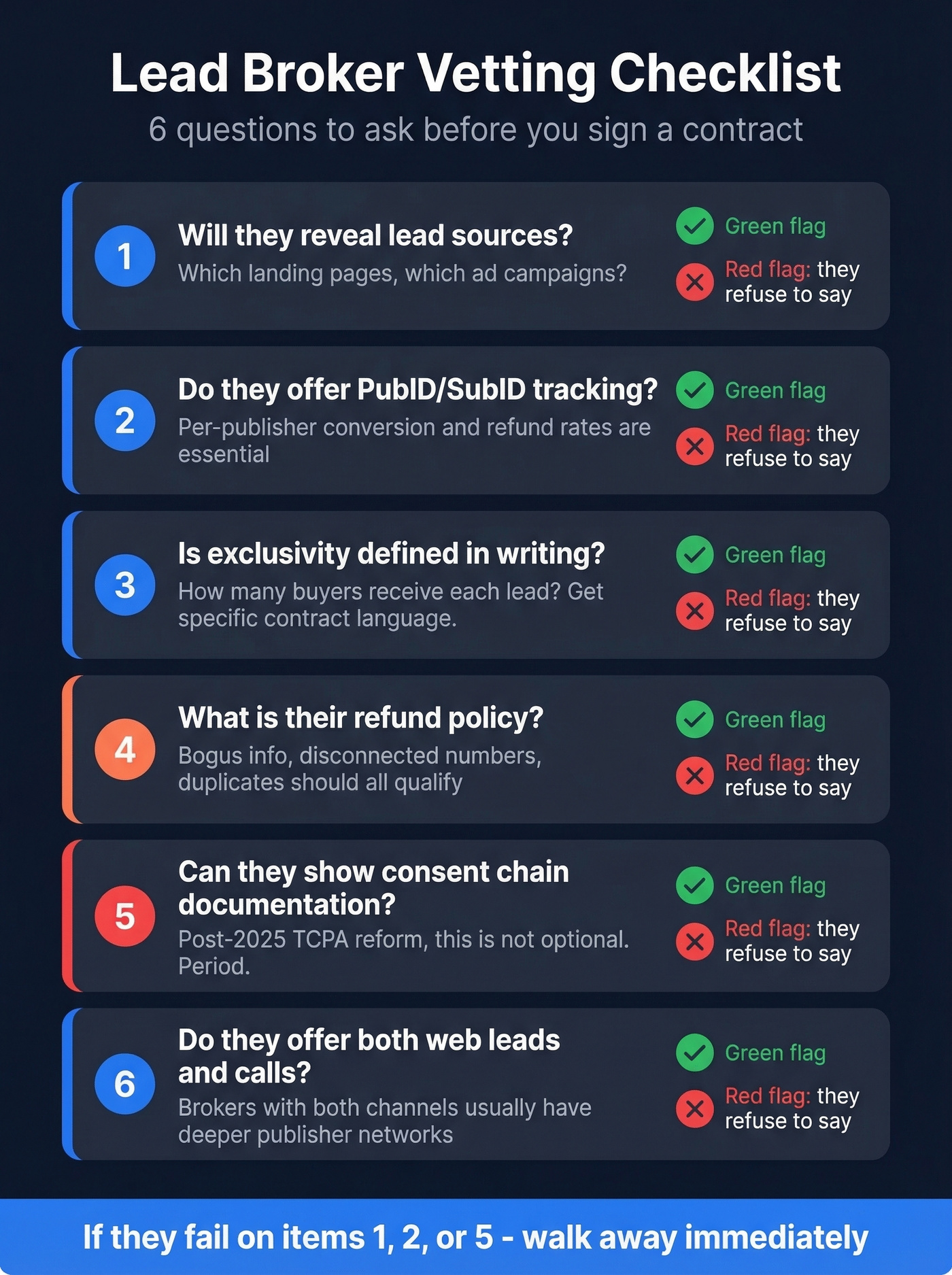
- Demand lead source transparency. Which landing pages, which ad campaigns? If the broker won't say, walk away.
- Ask for PubID/SubID tracking. Without per-publisher conversion and refund rates, you can't optimize spend.
- Clarify exclusive vs. non-exclusive - in writing. Get exclusivity terms in the contract with specific language about how many buyers receive each lead.
- Review their refund policy. Good brokers allow refund requests for bogus information, disconnected numbers, and duplicates. No refund policy means no accountability.
- Request consent chain documentation. Post-TCPA reform, this isn't optional.
- Check whether they provide both web leads and calls. Brokers offering both channels typically have deeper publisher relationships.
- Ask about lead scoring methodology. A broker with no scoring is just passing through raw form fills. (If you need a framework, start with lead generation metrics.)
- Run a seed test. Include your own phone number and email in the purchase criteria. Track when you receive the lead, whether it's actually exclusive, and how quickly it arrives.
- Verify data freshness. Ask for a timestamp on every lead. If they can't provide one, the leads are likely aged inventory sold as fresh.
- Check multi-vertical experience. Brokers operating across 5+ verticals tend to be more established with better infrastructure.
Red Flags Your Broker Is Wasting Money
Look, we've all been burned. But some warning signs are impossible to miss once you know what to look for:
- Resold lists with no exclusivity proof. The #1 complaint on Reddit about lead brokers? Paying premium prices and discovering the broker "sold that same list to 5 other customers."
- Vague "partner" consent language. If their forms still say "by submitting, you agree to be contacted by our partners," they're non-compliant with the January 2025 TCPA rule. That's your liability, not just theirs.
- No refund policy. Legitimate brokers stand behind their product. "All sales are final" is a red flag the size of a billboard.
- No source transparency. If they won't tell you where leads come from, it's because you wouldn't like the answer.
- "Real-time" leads that prospects say they've already been contacted. As one insurance agent on Reddit put it, vendors claim "real-time" and "exclusive," but prospects seem "already contacted multiple times."
- Goes quiet when you ask for consent documentation. This is the biggest red flag in 2026. If they can't produce it, they don't have it.
Lead Broker Platforms and Software
If you're operating as a list broker or evaluating a broker's tech stack, the capabilities that matter are real-time bidding, delivery limits, buyer filters, duplicate blocking, audit trails, and refund workflows. Any platform missing more than one of these is behind the curve.
boberdoo is the battle-tested routing engine most established brokers in insurance and home services have at least evaluated. They've been building lead distribution software since 2001. Expect around $500-$1,500/month depending on volume.
Lead Prosper and Phonexa serve different niches well. Lead Prosper offers lighter-weight routing at around $300-$800/month for smaller operations, while Phonexa bundles web lead and call tracking into an all-in-one platform at around $500-$2,000/month - a good fit for brokers handling both channels. For call-specific routing, Retreaver and TrackDrive are worth evaluating alongside Phonexa.
ActiveProspect deserves special attention. Their TrustedForm and LeadConduit products handle consent verification and data quality, and in the post-TCPA world, this tooling isn't optional. TrustedForm is commonly priced around $0.10-$0.50 per certificate. Pair it with Jornaya's LeadiD for an additional layer of consent verification - Jornaya tracks the consumer's journey across lead gen sites, giving you an independent audit trail that holds up under scrutiny. Some platforms like Standard Information market "FCC one-to-one compatibility," but treat that as a marketing claim, not a certification. Always verify independently.
For email and phone verification within the broker ecosystem, NeverBounce and ZeroBounce are the most common standalone tools. They handle list cleaning before delivery, though verification depth varies. (If you're comparing approaches, see email address verification.)
CAKE and PX Platform round out the ecosystem with performance marketing and exchange-style lead distribution, respectively. Both target larger operations with custom-quoted enterprise pricing, typically $1,000-$5,000/month depending on scale and modules.
When to Skip Lead Brokers Entirely
For B2B teams, the math just doesn't work in a broker's favor anymore.
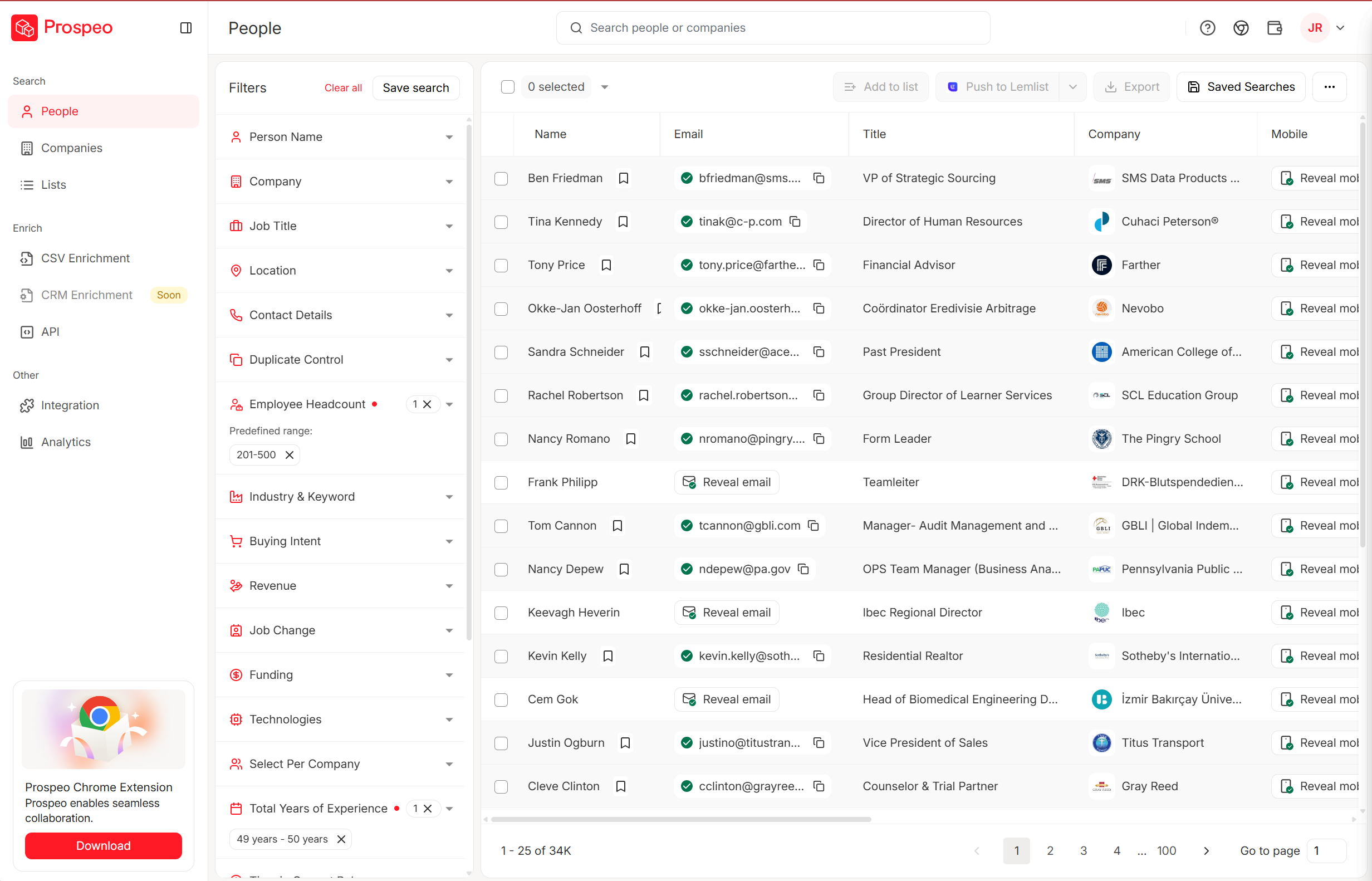
A brokered B2B lead runs $5-$50 depending on quality and exclusivity. You don't control the source, you can't verify freshness, and you're trusting someone else's consent chain. Compare that to self-sourcing with a platform like Prospeo, where you're pulling from 300M+ professional profiles at roughly $0.01 per lead. The quality gap matters even more than the price gap - 98% email accuracy, 125M+ verified mobile numbers with a 30% pickup rate, and data that refreshes every 7 days versus the industry average of 6 weeks.
The workflow is simple: set your ICP filters (30+ options including buyer intent powered by Bombora across 15,000 topics, technographics, job changes, headcount growth, and funding signals), pull a list, and push verified contacts directly into Salesforce, HubSpot, or your sequencing tool via native integrations. No middleman, no markup, no consent chain ambiguity because you're reaching out directly. (If you need help defining your ICP, use this ideal client profile guide.)
Skip brokers if you're selling B2B, your average deal size justifies personalized outreach, and you have reps who can work a targeted list. Self-sourced leads at $0.01 each will outperform brokered leads at $5-$50 every time. If you're still evaluating vendors, start with B2B lead finders and sales leads databases.
Keep using brokers if you're in a high-volume B2C vertical where real-time form fills and inbound call transfers at scale are the business model. Direct marketing list brokers add genuine value here - just vet them ruthlessly. (For adjacent models, see lead aggregators and lead generation marketplace.)
Lead brokers hide their sources. Prospeo gives you full control - 30+ filters including buyer intent, technographics, and headcount growth so you build exactly the list you need. 143M+ verified emails, 125M+ verified mobiles, and zero resale markup.
Own your data instead of renting someone else's leftovers.
FAQ
Are lead brokers legal?
Yes - lead brokering is legal in the United States. The 2025 TCPA one-to-one consent rule requires brokers to obtain separate consent for each buyer, though. Brokers still using blanket "partner" consent language are non-compliant, and buyers share liability at $500-$1,500 per violation.
How much do lead brokers charge?
It depends on vertical, exclusivity, and freshness. Aged insurance leads run $0.25-$2.00, while exclusive real-time finance leads cost $50-$200. B2B brokered leads range $5-$50. Shared leads cost 50-80% less but convert at significantly lower rates because multiple buyers receive the same contact.
What's the difference between exclusive and shared leads?
Exclusive leads go to one buyer only; shared leads go to multiple buyers. Exclusive leads cost 2-5x more but typically convert at 4-6x the rate. When you calculate effective cost-per-customer, exclusive usually wins - a $40 exclusive lead converting at 12% costs $333 per customer vs. $400 for an $8 shared lead at 2%.
Can I source B2B leads without a broker?
For B2B, self-serve data platforms are almost always better. You get access to hundreds of millions of profiles with verified emails at a fraction of the cost - compared to $5-$50 per brokered lead. You control filters, freshness, and compliance. For B2C verticals like insurance or solar, brokers still add value for real-time form fills and call transfers at scale.
What is ping-post in lead generation?
Ping-post is a two-stage auction for leads. The broker sends anonymized data - zip code, coverage type - to multiple buyers. Buyers bid in under 300 milliseconds. The winner receives full lead details including personal information. Losers never see the consumer's data, which reduces spam and improves privacy compared to older distribution methods.