

How to Build an Ideal Client Profile That Actually Drives Pipeline
Only 14% of sellers generate 80% of new logo revenue. That's not a talent problem - it's a targeting problem, and it starts with your ideal client profile. The top reps aren't better at selling; they're selling to the right accounts. Meanwhile, the other 86% burn cycles on companies that were never going to close, expand, or stick around.
We've watched teams burn six figures on accounts that never should have entered the pipeline. Picture this: 40% of your new accounts churn within six months. You wouldn't blame onboarding first. You'd ask who let those accounts into the pipeline. That's the job of an ICP, and most teams either don't have one or built theirs from a whiteboard brainstorm instead of actual data.
The Short Version
Your ICP isn't a persona. It's a scored profile of the companies most likely to buy, expand, and stay. Build it from your last 50 closed-won deals, not a brainstorm. Score accounts on a 100-point rubric across firmographics, technographics, and intent. Then use a B2B data platform to find matching accounts at scale.
What Is an Ideal Client Profile?
An ideal client profile is a detailed description of the type of company that gets the most value from your product or service - and delivers the most value back to you in revenue, retention, and expansion. It operates at the company level, not the individual level. You're describing organizations, not people.
This distinction matters operationally because company-level attributes are what your CRM can filter, score, and route on. You can't automate lead routing based on someone's personality - but you can automate it based on employee count, tech stack, and funding stage. That's why the ICP comes first.
"Ideal client profile" and "ideal customer profile" are interchangeable. The acronym ICP covers both. Some teams prefer "client" because it implies an ongoing relationship rather than a transaction, but the framework is identical. What matters is that your ICP describes firmographic, technographic, and behavioral attributes of companies - not the job titles or personalities of the humans inside them. Those come later, in your buyer personas.
Target Audience vs. ICP vs. Buyer Persona
These three concepts sit in a hierarchy, and getting the order wrong is one of the most common mistakes in B2B go-to-market. The Product Marketing Alliance frames it as a strategic funnel: target audience at the top, ICP in the middle, buyer persona at the bottom.
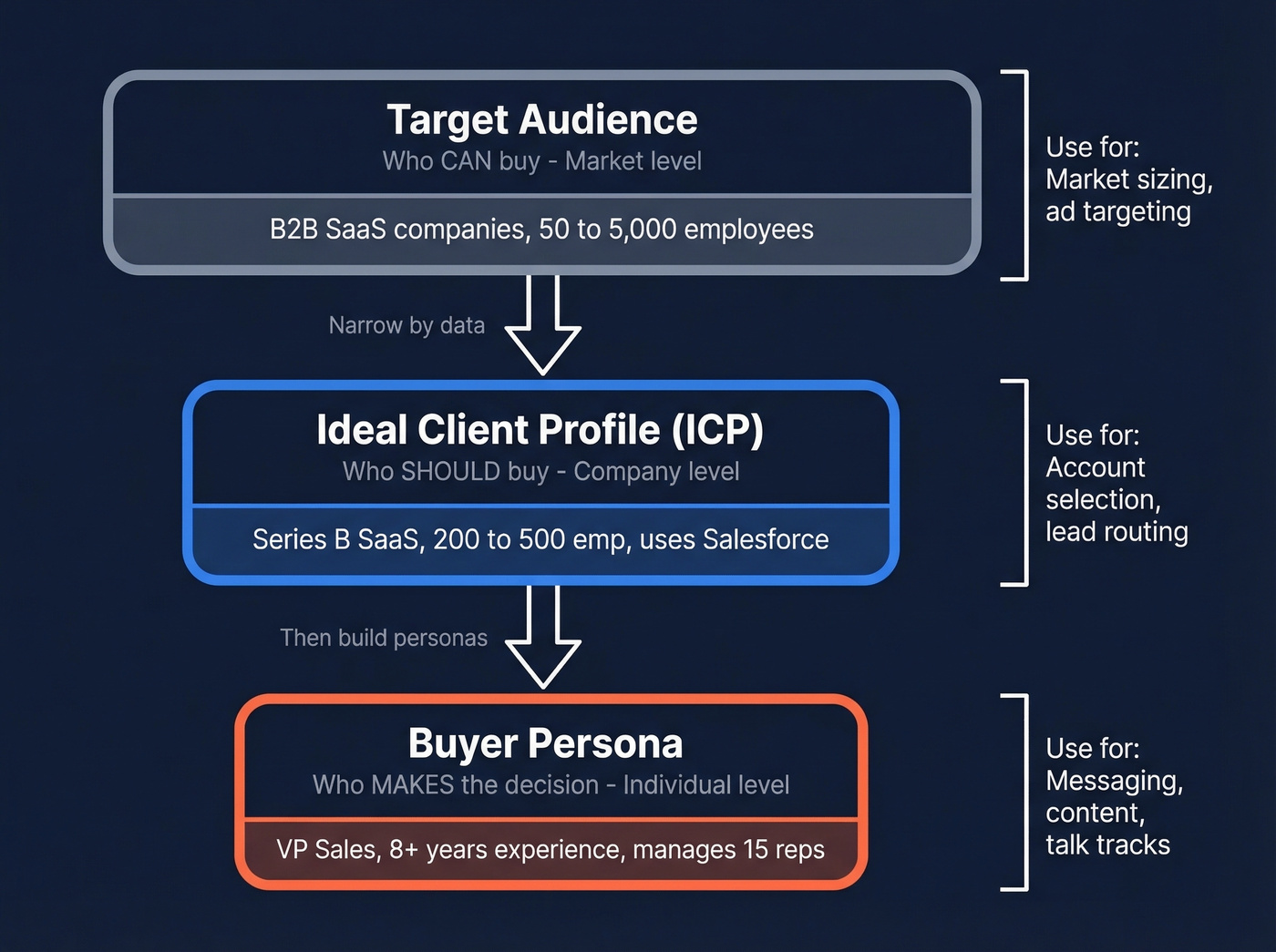
| Target Audience | Ideal Client Profile | Buyer Persona | |
|---|---|---|---|
| Definition | Who can buy | Who should buy | Who makes the decision |
| Level | Market | Company | Individual |
| Example | B2B SaaS, 50-5,000 emp | Series B SaaS, 200-500 emp, Salesforce | VP Sales, 8+ yrs, manages 15 reps |
| When to use | Market sizing, ad targeting | Account selection, lead routing | Messaging, content, talk tracks |
Here's the thing: building detailed buyer personas before you've nailed your ICP is backwards. You end up crafting beautiful messaging for people at companies that'll never convert. We've seen teams spend months on persona workshops only to realize they were targeting the wrong companies entirely. Start with the ICP. Personas follow.
Why Your ICP Matters
"We did not think about ICP... one of my biggest mistakes." - Mathilde Collin, CEO of Front
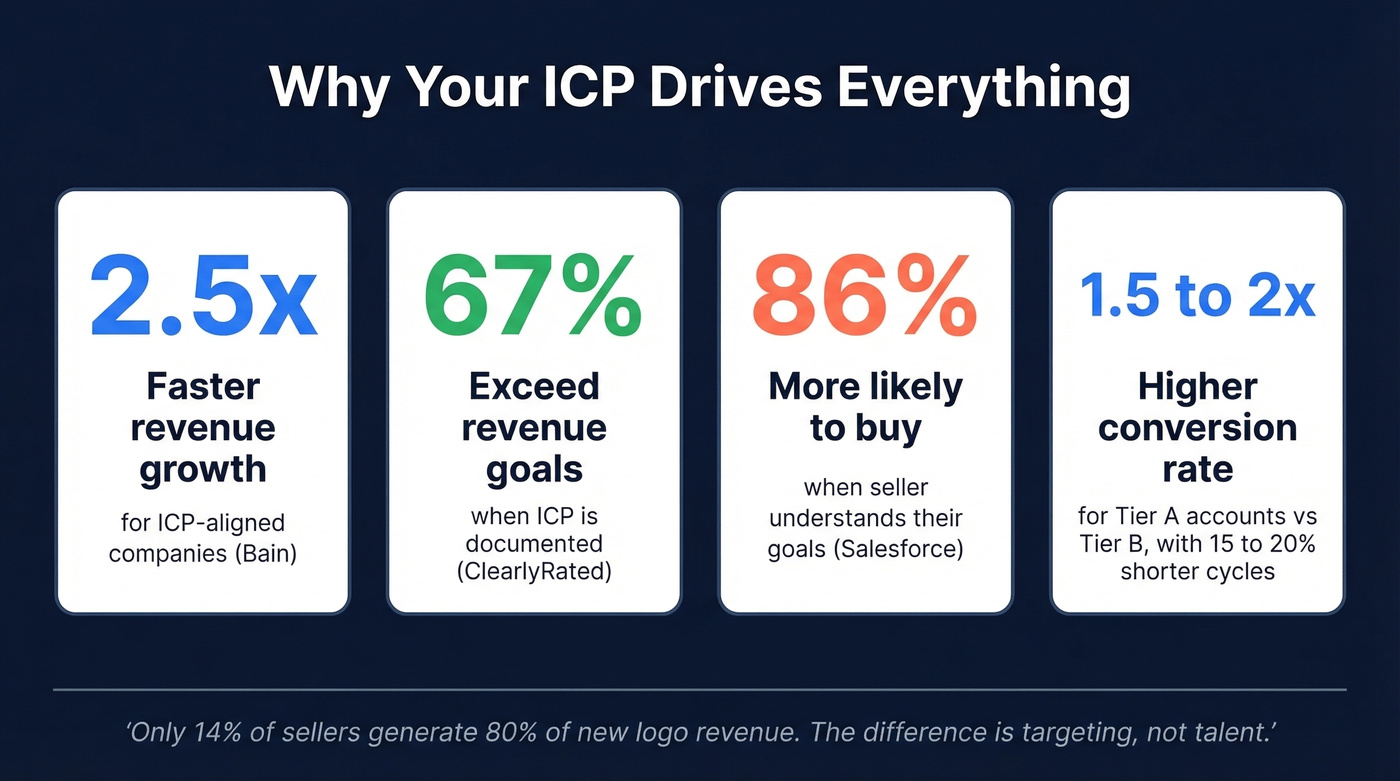
That quote should be taped to every founder's monitor. Bain research shows ICP-aligned companies can grow revenue up to 2.5x faster than teams without clear targeting. ClearlyRated found that 67% of high-performing companies exceed revenue goals when they have documented ICPs. And Salesforce reports that 86% of buyers are more likely to buy when the seller understands their goals - which is only possible when you've pre-selected accounts whose goals you actually understand.
The operational impact is just as real. Teams using tiered ICP scoring see Tier A accounts convert at 1.5-2x the rate of Tier B, with 15-20% shorter sales cycles. That's not marginal improvement - it's the difference between hitting quota and missing it.
Hot take: If your average deal size is below five figures, you probably don't need a six-dimension scoring model. A three-attribute ICP built from your last 30 closed-won deals will outperform no ICP at all. Don't let complexity become an excuse for inaction.
What Goes Into an ICP
A modern ICP draws from six data layers. Treating it as just "industry + company size" is how you end up with a target list of 50,000 accounts and no idea which ones to call first.
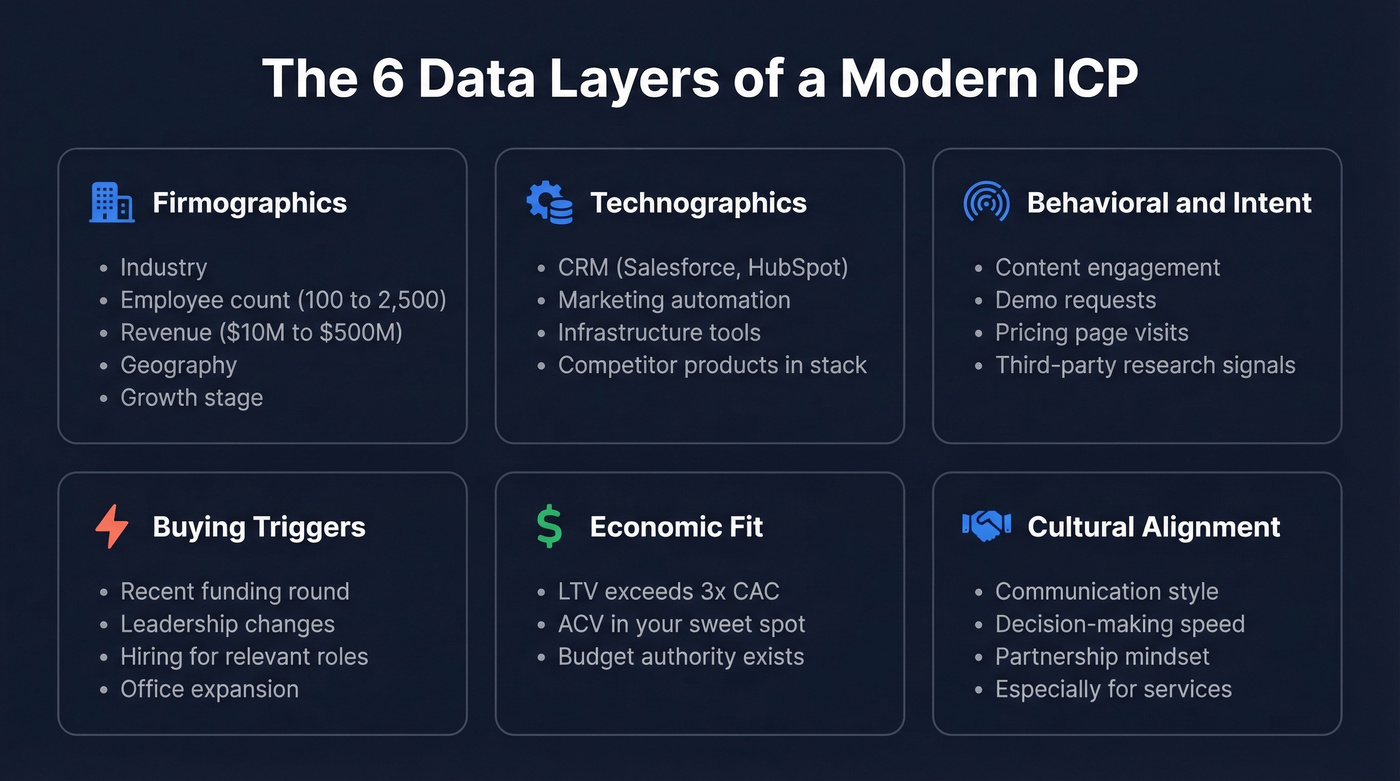
Firmographics form the foundation - industry, employee count, annual revenue, geography, and growth stage. A B2B SaaS company selling to mid-market might specify 100-2,500 employees, $10M-$500M revenue, North America. (If you want to operationalize this, start with firmographic filters.)
Technographics reveal what's in their stack. If you integrate with Salesforce and your product replaces a competitor, knowing they run Salesforce plus that competitor is gold. CRM, marketing automation, and infrastructure tools are the most common filters. (More on this in our guide to firmographic and technographic data.)
Behavioral signals and intent data separate passive fit from active interest. Behavioral signals include content engagement, demo requests, webinar attendance, and pricing page visits. Intent data adds third-party signals showing accounts actively researching topics related to your solution. An account that fits your firmographic profile and is researching your category is a fundamentally different prospect than one that just looks good on paper. (See intent based segmentation for a practical approach.)
Buying triggers - recent funding rounds, leadership changes, job postings for relevant roles, office expansions. A company that just raised a Series B and is hiring 10 SDRs has different buying intent than one that's been flat for two years. (Here’s how to systematize it: how to track sales triggers.)
Economic fit - does the math work? LTV should exceed 3x CAC. The account's expected ACV should fall within your sweet spot. Selling a $50K/year platform to a 10-person startup with $500K in revenue isn't a fit, no matter how well the firmographics match. (If you need a refresher, start with cost to acquire customer.)
For service businesses, add cultural alignment, communication style preferences, and historical satisfaction patterns. A consulting firm's ICP looks different from a SaaS company's - the relationship dimension carries more weight.
How to Build Your ICP in 5 Steps
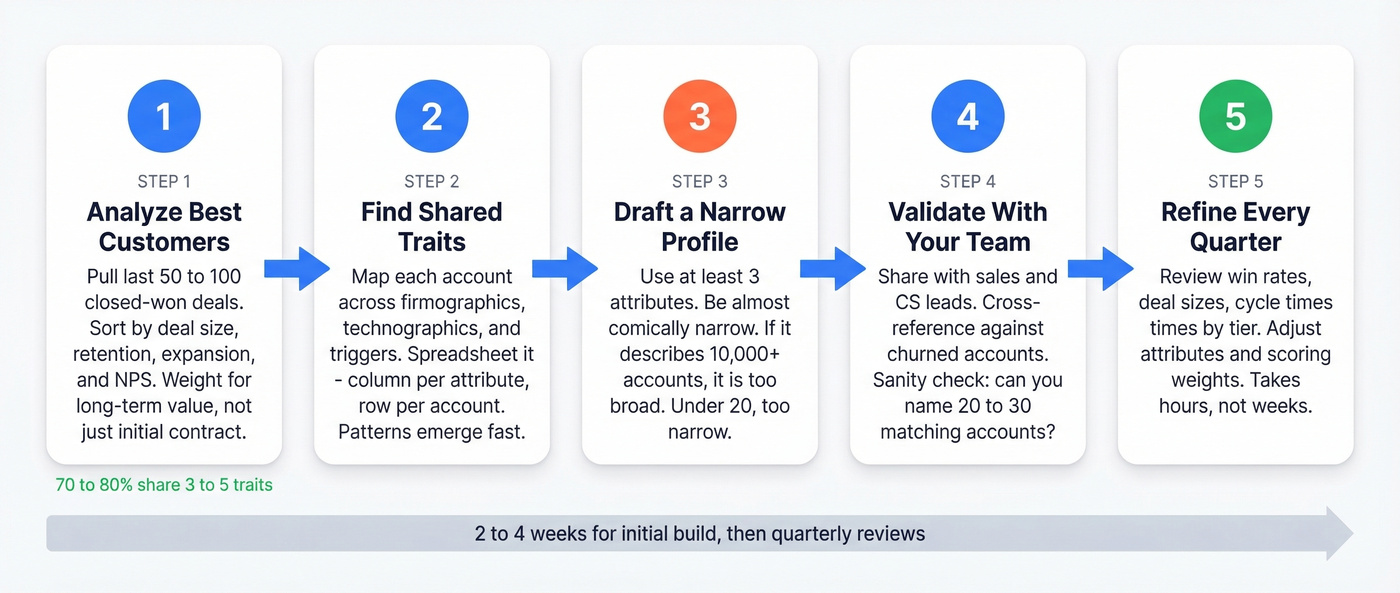
The initial build takes 2-4 weeks. After that, it's quarterly refinement. Don't overthink the timeline - a rough ICP built from real data beats a perfect one built from assumptions.
Step 1: Analyze Your Best Customers
Pull your last 50-100 closed-won deals from the past 12 months. Sort by deal size, retention, expansion revenue, and NPS. You're looking for the accounts that closed fastest, expanded most, and complained least. In our experience, 70-80% of your best deals share 3-5 traits. Those traits are your ICP's skeleton.
Don't just look at revenue. A $200K deal that churned in four months is worse than a $60K deal that expanded to $150K over two years. Weight for retention and expansion, not just initial contract value.
Step 2: Find the Shared Traits
Map each top account across firmographics, technographics, and buying triggers. Look for clusters. Maybe 80% of your best customers are Series B-C SaaS companies with 200-1,000 employees, using HubSpot, who came inbound after a funding round. That's not a coincidence - that's your ICP emerging from the data.
Spreadsheet this. Column for each attribute, row for each account. The patterns become obvious fast.
Step 3: Draft a Narrow Profile
Use at least three attributes. The best ICPs are, as Lenny Rachitsky documented in his ICP deep-dive, "almost comically narrow." Gong's initial ICP was software companies selling in the US in English, using video conferencing, with deal sizes between $1K-$100K. That narrowed their addressable market to roughly 5,000 companies worldwide. They dominated that segment before expanding.
Narrow feels scary. It's supposed to. A narrow ICP means you're saying no to accounts that could buy but probably shouldn't. That discipline is what separates high-growth teams from ones stuck on the revenue treadmill.
Step 4: Validate With Your Team
Share the draft ICP with your sales team and customer success leads. They'll spot blind spots the data misses. Cross-reference against your churned accounts too - if companies matching your ICP are churning at high rates, something's wrong with the profile.
Run a quick sanity check: does your ICP describe at least 20-30 accounts you could name today? If not, it's too narrow. Does it describe more than 10,000? Probably too broad.
Step 5: Refine Every Quarter
Your ICP isn't a tattoo. Markets shift, your product evolves, and new segments emerge. Review win rates, deal sizes, and cycle times by ICP tier every quarter. If Tier A performance drops or a new segment starts showing up in closed-won data, adjust your attributes and scoring weights. The quarterly review should take a few hours, not weeks.

You just defined your ICP across firmographics, technographics, and intent. Prospeo lets you activate it instantly - 30+ search filters including buyer intent (15,000 Bombora topics), tech stack, funding stage, headcount growth, and more across 300M+ profiles. Every email verified at 98% accuracy.
Stop building target lists manually. Let your ICP do the filtering.
Define Your Anti-ICP
Look, your anti-ICP is just as important as your ICP - and almost nobody builds one. It's the explicit definition of accounts you should not pursue: the ones likely to churn quickly, inflate your CAC, frustrate your team, and burn your reputation in the market.
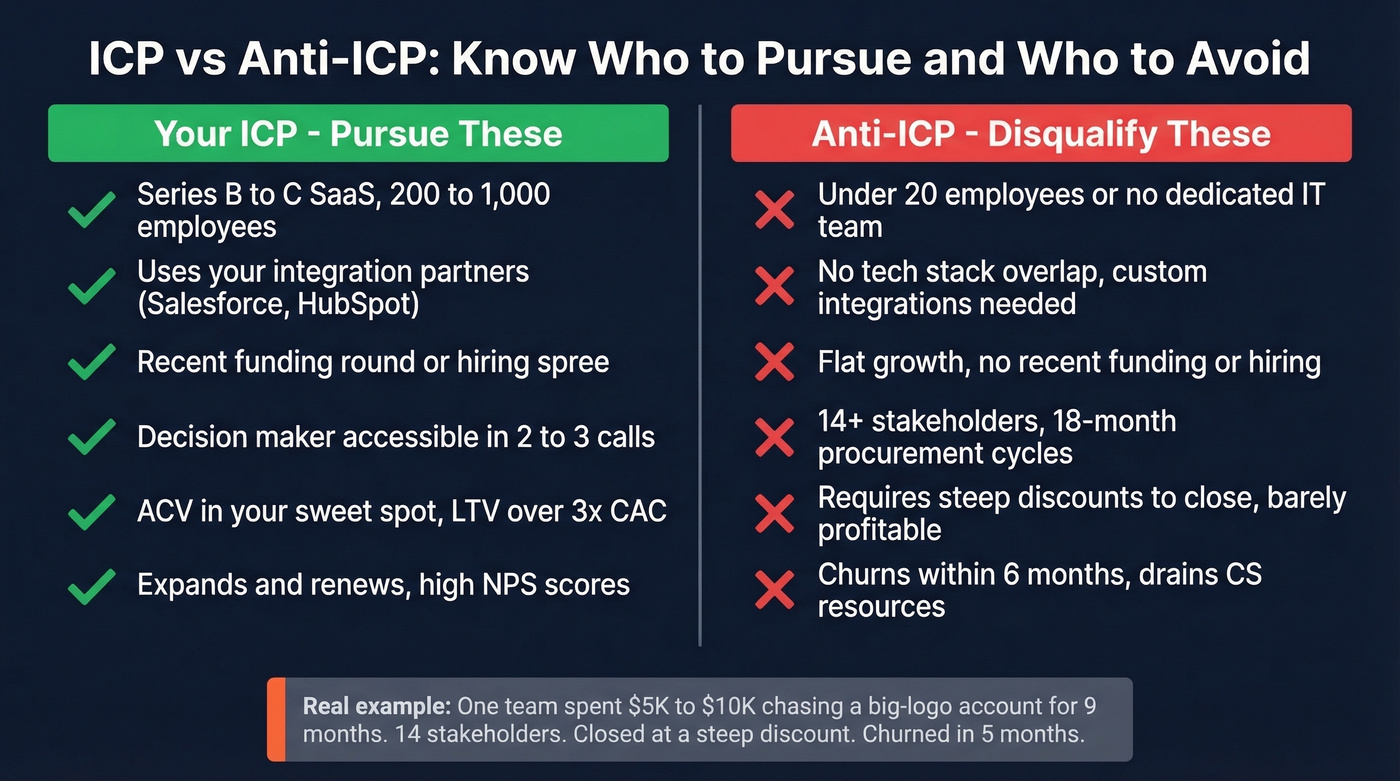
One team we know spent $5K-$10K chasing a big-logo enterprise account that was never a fit. The deal dragged for nine months, involved 14 stakeholders, and closed at a discount so steep it was barely profitable. Then they churned in five months. That's anti-ICP territory.
Build yours by analyzing your worst outcomes: highest churn, lowest ACV, longest sales cycles, worst NPS scores. Extract the shared traits. Maybe it's companies under 20 employees, or those without a dedicated IT team, or accounts in industries with 18-month procurement cycles. Write those down. Share them with your SDRs. Give them permission to disqualify.
The consensus on r/b2bmarketing is brutal on this point - reps chasing accounts for months only to discover the prospect had no budget authority, no technical fit, or a procurement process longer than the rep's tenure at the company. Skip this step at your own risk.
ICP Scoring: The 100-Point Model
A binary "fits / doesn't fit" ICP is better than nothing, but a scored model is what actually drives operational decisions. Here's a 100-point rubric based on six predictive dimensions. (If you want a plug-and-play version, use this ideal customer profile template.)
| Dimension | Weight | Example Criteria | Example Points |
|---|---|---|---|
| Firmographic | 30% | SaaS, 200-1,000 employees, N. America | 25/30 |
| Technographic | 20% | Uses Salesforce + Outreach | 18/20 |
| Intent | 15% | Researching "sales engagement" | 12/15 |
| Engagement | 15% | Visited pricing page, attended webinar | 10/15 |
| Triggers | 10% | Series B funding last 90 days | 8/10 |
| Economic Outcome | 10% | Expected ACV $40K+, LTV > 3x CAC | 9/10 |
That example account scores 82/100 - solidly Tier A.
Tier thresholds and routing SLAs:
- Tier A (80-100): Your best-fit accounts. SDR calls within 5 minutes. These get your senior reps, custom sequences, and executive sponsors.
- Tier B (60-79): Good fit with gaps. SDR outreach plus automated sequence within 24 hours. Worth pursuing but don't over-invest.
- Tier B- (50-59): Marginal fit. Automated sequence only - no dedicated SDR time unless they show strong engagement signals.
- Tier C (below 50): Nurture only. Marketing drip, no dedicated sales motion.
Two operational rules make this model work in practice. First, apply time decay: signals older than 30 days lose 50% of their value. A pricing page visit from last week is meaningful; one from two months ago isn't. Second, combine third-party intent with first-party engagement - count an intent spike only if a first-party touch occurs within 14 days. This prevents chasing phantom signals.
Real-World ICP Examples
The best ICPs in tech history all started absurdly narrow. The pattern is consistent enough to be a rule: start narrow, win decisively, then expand with data.
Gusto: Five Employees in California
Gusto didn't start as a payroll platform for all small businesses. Their initial ICP was companies with five or fewer employees, based in California, with specific payroll constraints. That's it. They expanded only after they'd built deep customer love within that segment and had the engineering bandwidth to serve adjacent ones.
Gong: 5,000 Companies Worldwide
Gong's founding team estimated that roughly 5,000 companies worldwide fit their initial ICP: software companies selling in the US in English, using video conferencing, with deal sizes between $1K and $100K. Five thousand. Not fifty thousand. They built their entire early go-to-market around that number and grew from there.
Snyk: Node.js Developers Only
Snyk launched focused exclusively on Node.js developers who cared about security. Not all developers. Not all languages. Just Node.js. They went depth-first, building credibility and product-market fit within that community before expanding to other languages and frameworks. By the time they broadened, they had the reputation and product maturity to compete.
The lesson across all three: earn the right to expand by dominating a niche first.
How to Activate Your ICP
An ICP that lives in a Google Doc nobody opens is worthless. Activation is where strategy becomes pipeline.
Lead routing by tier. Your CRM should automatically score and route inbound leads based on ICP tier. Tier A gets immediate human attention. Tier C gets a nurture sequence. No exceptions, no "but this one looks interesting" overrides from reps. (This is easiest when you’ve already implemented lead scoring.)
Outbound targeting with data tools. This is where most teams stall. They've built a detailed company profile and have no way to find 500 matching accounts. You need a platform that can filter by the exact attributes in your profile - industry, company size, tech stack, headcount growth, funding stage - and return verified contact data you can actually use. Prospeo's database lets you set those filters across 30+ dimensions, export a matched list with 98%-accurate emails and verified direct dials, and push it to your outreach tools in minutes rather than weeks of manual research. (If you’re building lists at scale, see how to automate target account lists.)
Content strategy aligned to ICP pain points. If your ICP is Series B SaaS companies with 200-500 employees, your content should address the specific challenges those companies face - not generic "sales tips" content. Every blog post, webinar, and case study should speak directly to your ICP's world.
Product feedback loops. Your ICP should inform product decisions. If Tier A accounts consistently request a specific integration, that's a roadmap signal. A widely cited Snowflake ABM example used intent and data-maturity scoring to close deals 34% faster - but the real win was feeding ICP data back into product and marketing strategy.
We've watched teams stare at 10,000 accounts and start calling alphabetically. That's what happens when the ICP stays theoretical. Activate it or it's just a document.
Your ICP scoring model is only as good as the data feeding it. Prospeo's CRM enrichment returns 50+ data points per contact at a 92% match rate - firmographics, technographics, and intent signals refreshed every 7 days. Enrich your existing accounts to score and tier them automatically.
Enrich your CRM, score every account, and prioritize Tier A prospects today.
ICP for Service Businesses
Product companies and service businesses need different ICP frameworks. For agencies, consultancies, and professional services firms, the relationship dimension carries as much weight as firmographics. A high-revenue client who's miserable to work with will drain your team and tank your margins.
If you're running a product-led SaaS company, skip this section - the five-step framework above covers you. For everyone else, use a four-dimension scorecard and rate every client from the last 2-3 years on each dimension.
| Dimension | Scale | What "5" Looks Like |
|---|---|---|
| Revenue | 1-5 | Top 20% of annual billings |
| Profitability | 1-5 | 40%+ margin after labor costs |
| Ease of Relationship | 1-5 | Responsive, trusts your expertise |
| Cross-Sell Potential | 1-5 | 3+ additional services needed |
Clients scoring 16 or higher represent your best-fit pattern. Extract their shared traits - industry, company size, decision-maker title, growth stage, and the pain points that brought them to you - and that's your service-business ICP.
Add fields that product companies often skip: cultural alignment, communication style preferences, and satisfaction patterns. As ClearlyRated's research frames it, the question for service businesses isn't just "who's profitable?" - it's "which organizations make us profitable, proud, and eager to renew?"
Common ICP Mistakes
Five mistakes kill most ICP efforts before they generate a single dollar of pipeline.
Fairytale personas built without customer input. The r/b2bmarketing community calls these out regularly - personas created in a conference room without talking to a single customer or reviewing a single deal. They collect dust.
Too broad, no disqualification criteria. If your ICP describes 50,000 companies, it's not an ICP - it's a TAM estimate. The whole point is to narrow. Include explicit "not a fit" criteria.
Over-indexing on demographics in B2B. B2C personas care about age, income, and lifestyle. B2B ICPs care about firmographics, tech stack, and buying committee structure. Don't import consumer frameworks into enterprise sales.
No operationalization. The ICP lives in a Google Doc that nobody opens. It's not embedded in your CRM, doesn't drive lead routing, and isn't referenced in pipeline reviews. A document nobody uses is a document that doesn't exist.
Set-and-forget. Markets change. Your product evolves. New segments emerge. An ICP that hasn't been updated in 12 months is probably wrong. Quarterly reviews aren't optional - they're the minimum.
FAQ
How often should I update my ideal client profile?
Quarterly. Review win rates, deal sizes, and cycle times by ICP tier each quarter. If Tier A performance drops or a new segment appears in closed-won data, adjust your attributes and scoring weights. The initial build takes 2-4 weeks; quarterly reviews take a few hours with the right CRM reports.
Can I have more than one ICP?
Yes, but start with one. Most B2B companies eventually maintain 2-3 ICPs - say, mid-market SaaS and enterprise manufacturing. Build and validate your primary profile before adding another. Multiple untested ICPs dilute focus and confuse your sales team about who to prioritize.
What if I'm a startup with no customer data?
Use your best hypotheses based on three attributes - industry, company size, and primary pain point - then validate aggressively with outbound. Gusto and Gong both started with narrow, assumption-based ICPs and refined from real data within months. Treat your initial profile as a hypothesis, not a conclusion.
How do I find companies that match my ICP?
Use a B2B data platform with advanced filtering. Define your attributes - industry, employee count, tech stack, funding stage, headcount growth - and export a matched list with verified contact data. Prospeo's 30+ search filters and 7-day data refresh cycle let you build a list of ICP-matched accounts with verified emails and direct dials, then push them to your outreach tools the same day.