

Lead Conversion: The Most Misunderstood Metric in B2B Sales
You ran a webinar last quarter. 500 registrants. Marketing called it a win. Sales looked at the pipeline two months later and saw three closed deals. Somewhere between "500 leads" and "3 customers," the entire funnel collapsed - and nobody can agree on where.
That's the lead conversion problem. Not a tactics problem. A definitions problem. Until your team agrees on what "conversion" actually means, every optimization you attempt is built on sand.
What Lead Conversion Actually Means
Lead conversion is the moment a prospect moves from one stage of your funnel to the next. Simple enough in theory. In practice, it's one of the most dangerously ambiguous terms in B2B.
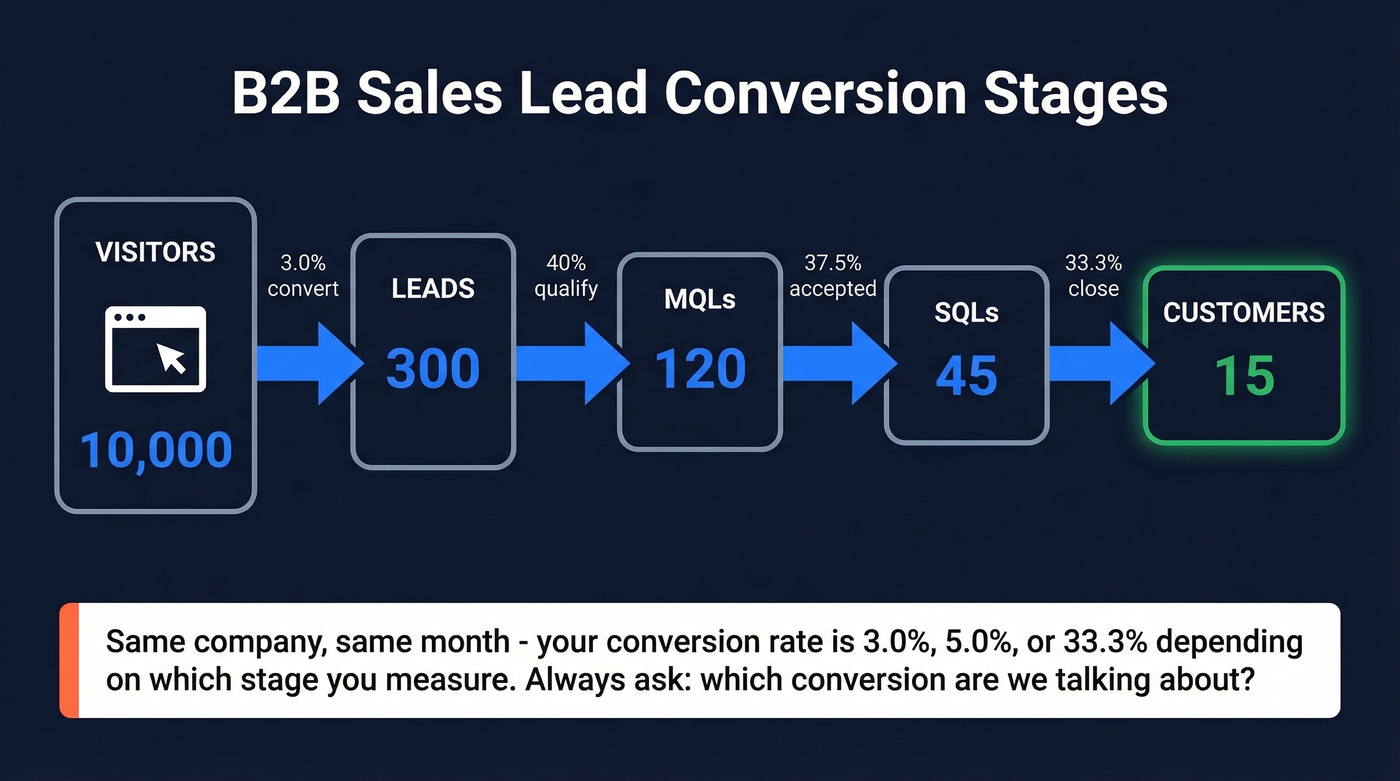
When your CMO says "we converted 500 leads," they probably mean 500 people filled out a form. When your VP of Sales says "we converted 12 leads," they mean 12 deals closed. Both are technically correct. Both are using the same word to describe completely different events.
There are at least four distinct conversions most B2B teams should track: visitor to lead, lead to MQL, MQL to SQL, and SQL to closed-won customer. Each has its own rate, its own benchmarks, and its own set of levers. Lumping them together under one umbrella rate is like measuring "speed" without specifying whether you're talking about a sprint or a marathon.
Here's the thesis that runs through everything below: getting your definitions right matters more than any tactic. A team that knows exactly where leads drop off will outperform a team running every growth hack in the book against a vague funnel.
The Quick Version
- Define which conversion you're measuring. Visitor-to-lead, MQL-to-SQL, and lead-to-customer are three completely different metrics with different benchmarks and different fixes.
- Fix speed-to-lead and data quality first. These two levers have the highest impact-to-effort ratio. Respond faster, make sure your contact data is actually valid, then worry about everything else.
- Use the benchmarks below to diagnose, not to celebrate. A "good" rate means nothing without industry and funnel-stage context.
How to Calculate Your Conversion Rate
The formula is straightforward:
(Converted Leads / Total Leads) x 100 = Lead Conversion Rate
The tricky part isn't the math. It's what you plug in.
Say your company generated 10,000 website visitors last month. Of those, 300 filled out a form - a 3.0% visitor-to-lead conversion. Marketing qualified 120 as MQLs, giving you a 40% lead-to-MQL rate. Sales accepted 45 of those MQLs as SQLs - a 37.5% MQL-to-SQL rate. And 15 became customers, for a 33.3% SQL-to-close rate.
So what's your overall rate? It's 3.0% if you're measuring top-of-funnel. It's 5.0% if you're measuring lead-to-customer (15 / 300). It's 33.3% if you're measuring SQL-to-close. Same company, same month, wildly different numbers. This is why every conversion conversation needs to start with: "Which conversion are we talking about?"

You just saw the numbers: 50% of sales time goes to unqualified prospects, and bad data costs 20-30% of revenue. Prospeo's 5-step verification delivers 98% email accuracy and 30% mobile pickup rates - so every lead your reps call actually connects.
Stop optimizing a funnel built on broken contact data.
Benchmarks by Industry, Stage, and Channel
Generic "2-5% average" benchmarks are useless. They don't tell you whether your 2.1% rate is excellent for B2B SaaS or terrible for legal services.
Industry Benchmarks
These are visitor-to-lead conversion rates from First Page Sage, based on client data collected Jan 2022 through Aug 2025:
| Industry | Visitor-to-Lead Rate |
|---|---|
| Legal Services | 7.4% |
| Higher Education | 2.8% |
| Real Estate | 2.7% |
| Manufacturing | 2.2% |
| Financial Services | 1.9% |
| IT & Managed Services | 1.5% |
| B2B SaaS | 1.1% |
Ruler Analytics' analysis of 100M+ datapoints across 14 industries puts the overall average at 2.9%. But that average hides enormous variance. A B2B SaaS company converting at 1.5% is actually outperforming its peers. A legal services firm at 3% is underperforming badly.
One detail the aggregate numbers miss: form-based conversions average 1.7% while phone call conversions average 1.2%, reflecting the broader trend that 67% of buyers prefer self-service over speaking to a rep. If your funnel still gates everything behind a "request a call" button, you're fighting your buyer's preferences.
Funnel Stage Benchmarks
This is where it gets genuinely useful. Stage-by-stage data breaks conversion rates across industries:
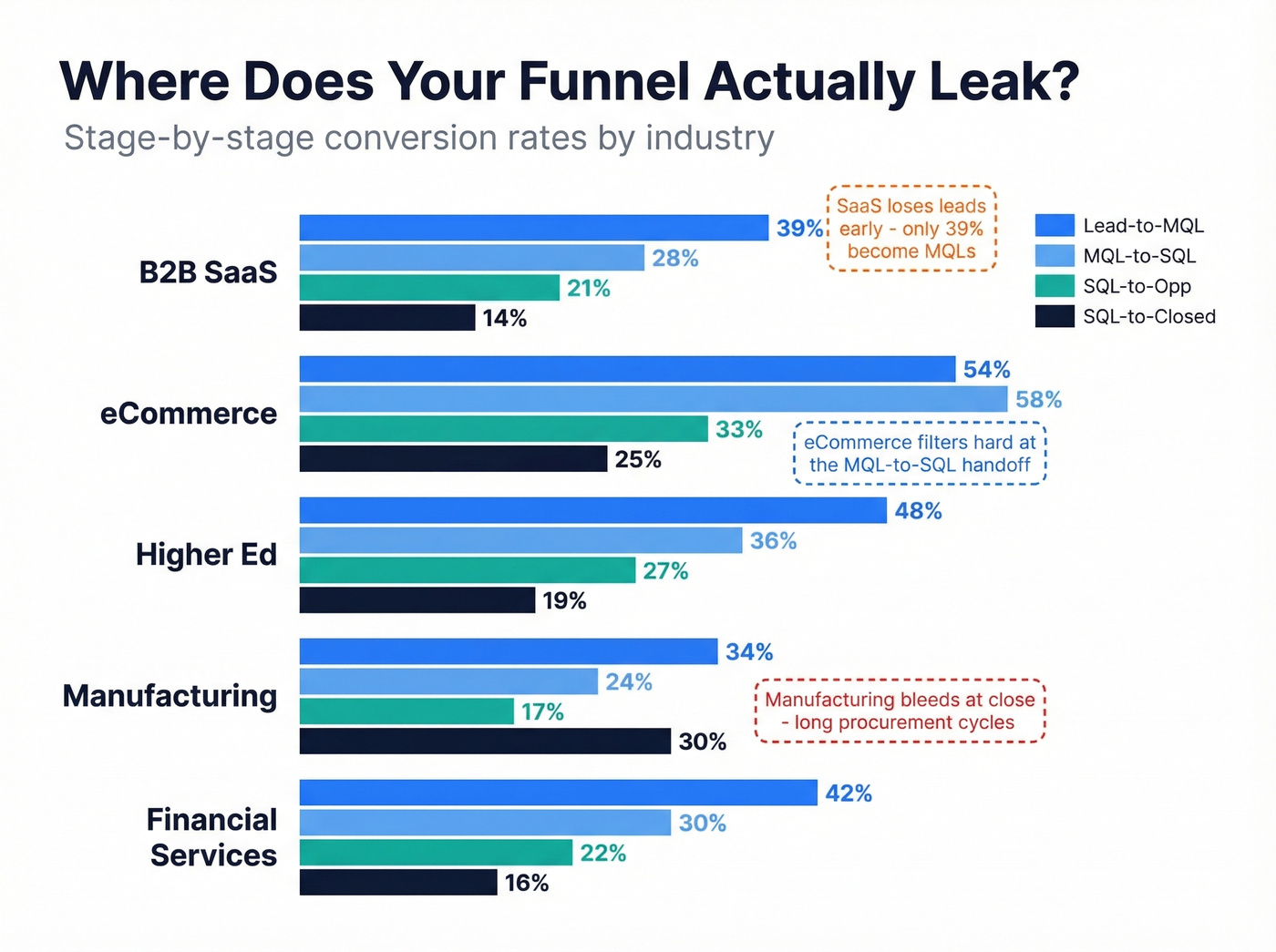
| Industry | Lead-to-MQL | MQL-to-SQL | SQL-to-Opp | SQL-to-Closed |
|---|---|---|---|---|
| B2B SaaS | 39% | 38% | 42% | 37% |
| eCommerce | 23% | 58% | 66% | 60% |
| Higher Ed | 45% | 46% | 61% | 66% |
| Manufacturing | 40% | 35% | 45% | 30% |
| Financial Services | 38% | 42% | 50% | 35% |
The pattern is revealing. B2B SaaS loses leads early - only 39% of leads become MQLs. eCommerce has the opposite problem: leads enter easily but the MQL-to-SQL handoff is where real filtering happens. Manufacturing bleeds at the close, often because of long procurement cycles and multi-stakeholder approvals.
Knowing where your funnel leaks matters infinitely more than knowing your overall rate. If 60% of your leads drop off between MQL and SQL, that's a lead handoff problem, not a "we need more leads" problem.
Channel Benchmarks
Not all traffic converts equally. B2B channel data tells a clear story:
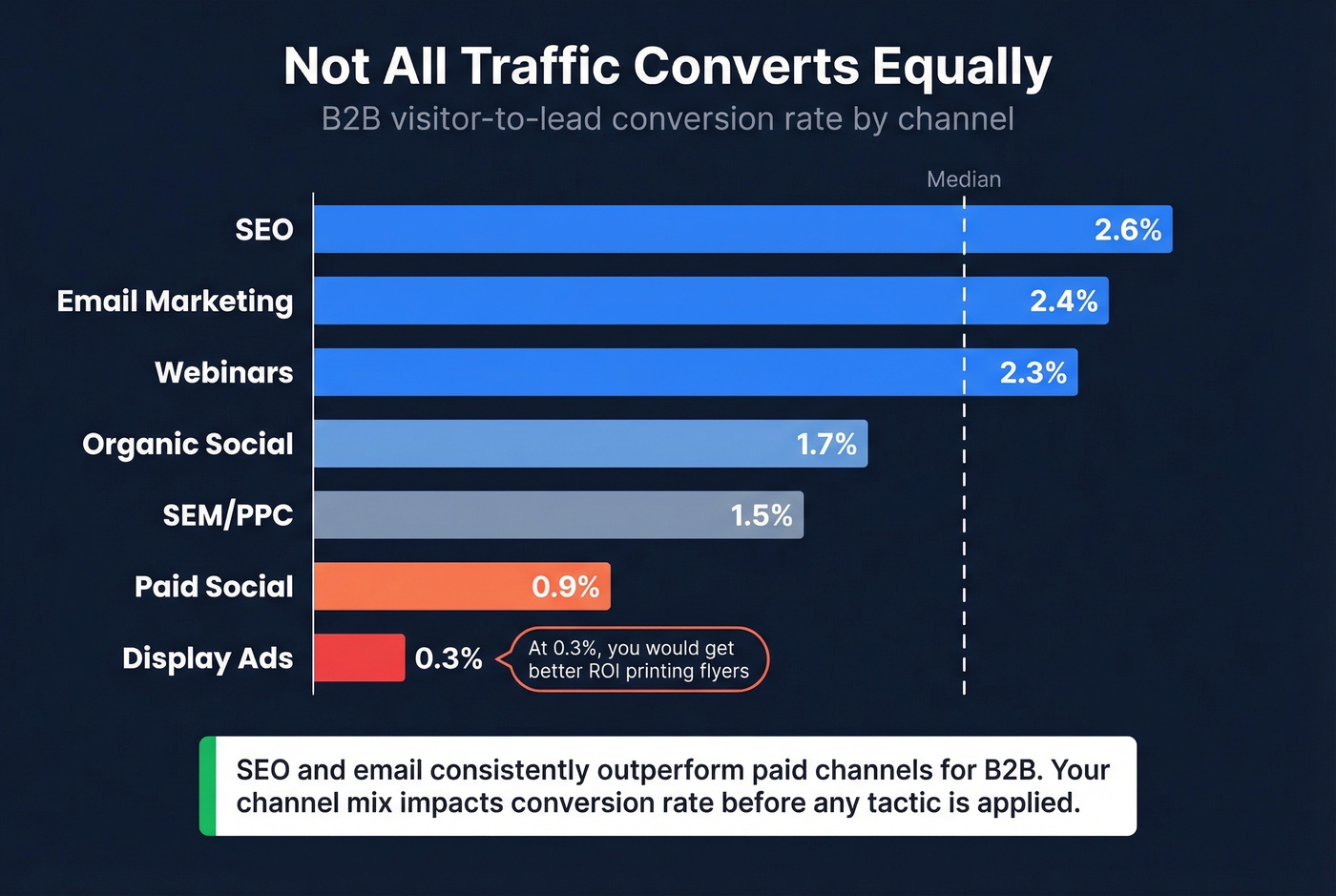
| Channel | Conversion Rate |
|---|---|
| SEO | 2.6% |
| Email Marketing | 2.4% |
| Webinars | 2.3% |
| Organic Social | 1.7% |
| SEM/PPC | 1.5% |
| Paid Social | 0.9% |
| Display Ads | 0.3% |
SEO and email consistently outperform paid channels for B2B. Display ads at 0.3% should make anyone question their display budget - you'd get better ROI printing flyers. The channel mix you choose directly impacts your conversion rate before any tactic is applied.
How to Improve Lead Conversion: 7 Proven Tactics
1. Respond Faster Than Everyone
The data on speed-to-lead is almost comically clear. Responding within 5 minutes makes you 21x more likely to qualify a lead compared to waiting 30 minutes. Only 7% of companies hit that 5-minute mark. Waiting 24+ hours drops qualification likelihood by 98%+.
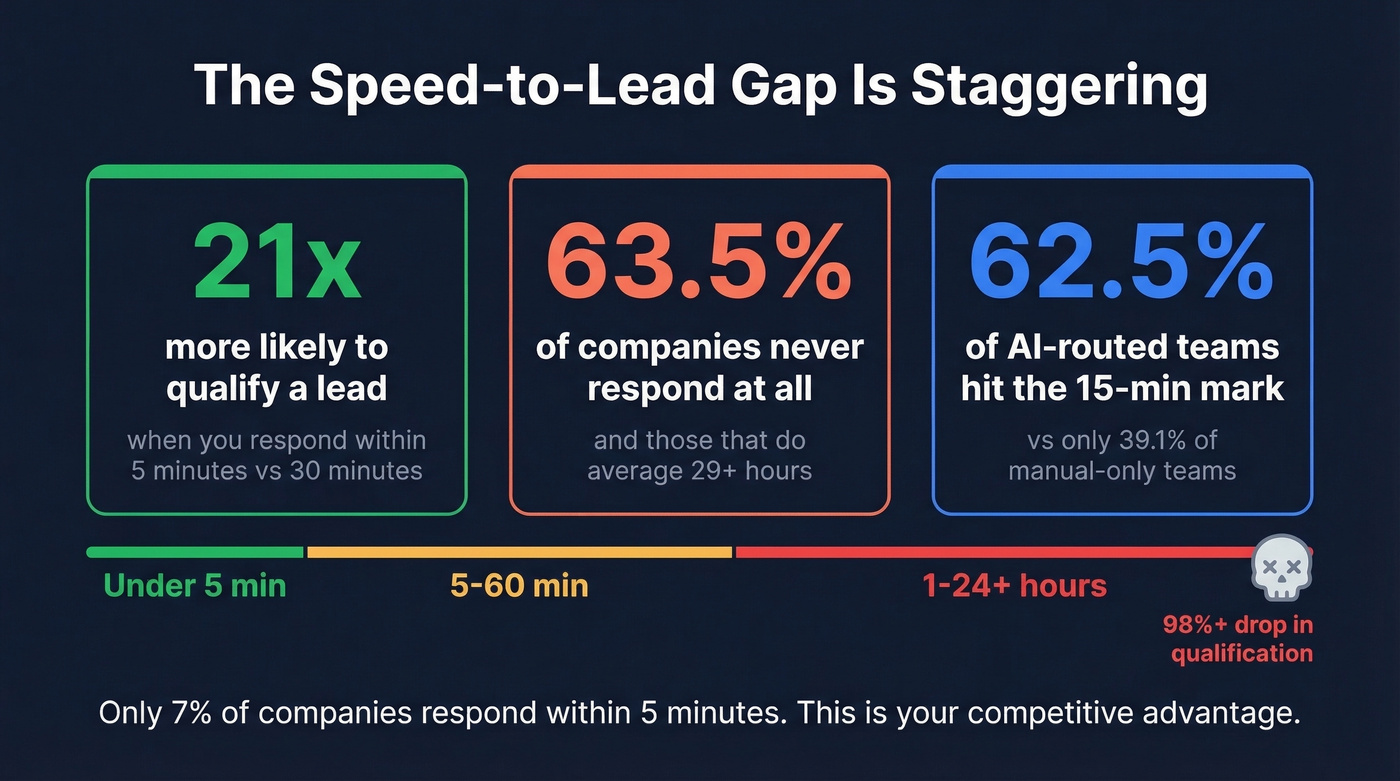
Yet a RevenueHero study of 1,000 companies found that 63.5% never responded at all. Among those that did, the average response time was 29+ hours. Let that sink in - 29 hours, while 81.2% of companies responding in over an hour report losing leads to faster competitors.
The Blazeo 2026 Speed-to-Lead Benchmark Report adds a useful layer: 62.5% of companies using AI-powered routing meet the under-15-minute response standard, compared to just 39.1% of manual-only teams. Companies with a formal response-time SLA hit the 15-minute mark 54.9% of the time versus 29.5% without one.
Implementing a 5-minute response SLA is one of the highest-ROI changes a team can make. It costs nothing and forces real process discipline.
But speed only works when the number is right. You can't call fast if the phone number is disconnected.
2. Fix Your Data First
Poor data quality costs companies 20-30% of annual revenue. Sales reps spend roughly 50% of their time on unqualified prospects. Only 27% of generated leads are ever contacted by sales. These aren't tactic problems - they're data problems.
If 35% of your emails bounce, no subject line optimization saves you. If your phone numbers are disconnected, no call script matters. We've seen teams blame messaging, timing, and offers for months before realizing the root cause was rotten contact data. Cleaning your database is the most overlooked form of conversion optimization.
Prospeo's 5-step verification process delivers 98% email accuracy, and its 125M+ verified mobile numbers carry a 30% pickup rate across all regions. The 7-day data refresh cycle means you're not calling someone who changed jobs six weeks ago.
When Snyk's 50-person AE team switched to verified contact data, their bounce rate dropped from 35-40% to under 5%. AE-sourced pipeline jumped 180%, generating 200+ new opportunities per month. That's not a marginal improvement - that's a fundamentally different business.
Here's the thing: if you haven't audited your contact data quality in the last 90 days, do that before you read another word of this article. Everything else is downstream.
3. Score and Prioritize Ruthlessly
Not all leads deserve the same attention. Gartner reports that AI-powered lead scoring reduces qualification time by up to 30%. But you don't need a fancy AI model to start - even a basic BANT framework applied consistently will separate the serious buyers from the tire-kickers.
The real win is layering intent data into your scoring model. When you know a prospect's company is actively researching your category - tracking thousands of intent topics via providers like Bombora - that signal should vault them to the top of the queue. A lead with intent is worth ten without it.
4. Align Sales and Marketing
Companies with strong sales-marketing alignment grow 27% faster year-over-year. Misaligned organizations see up to 10% revenue decline annually. The gap is enormous.
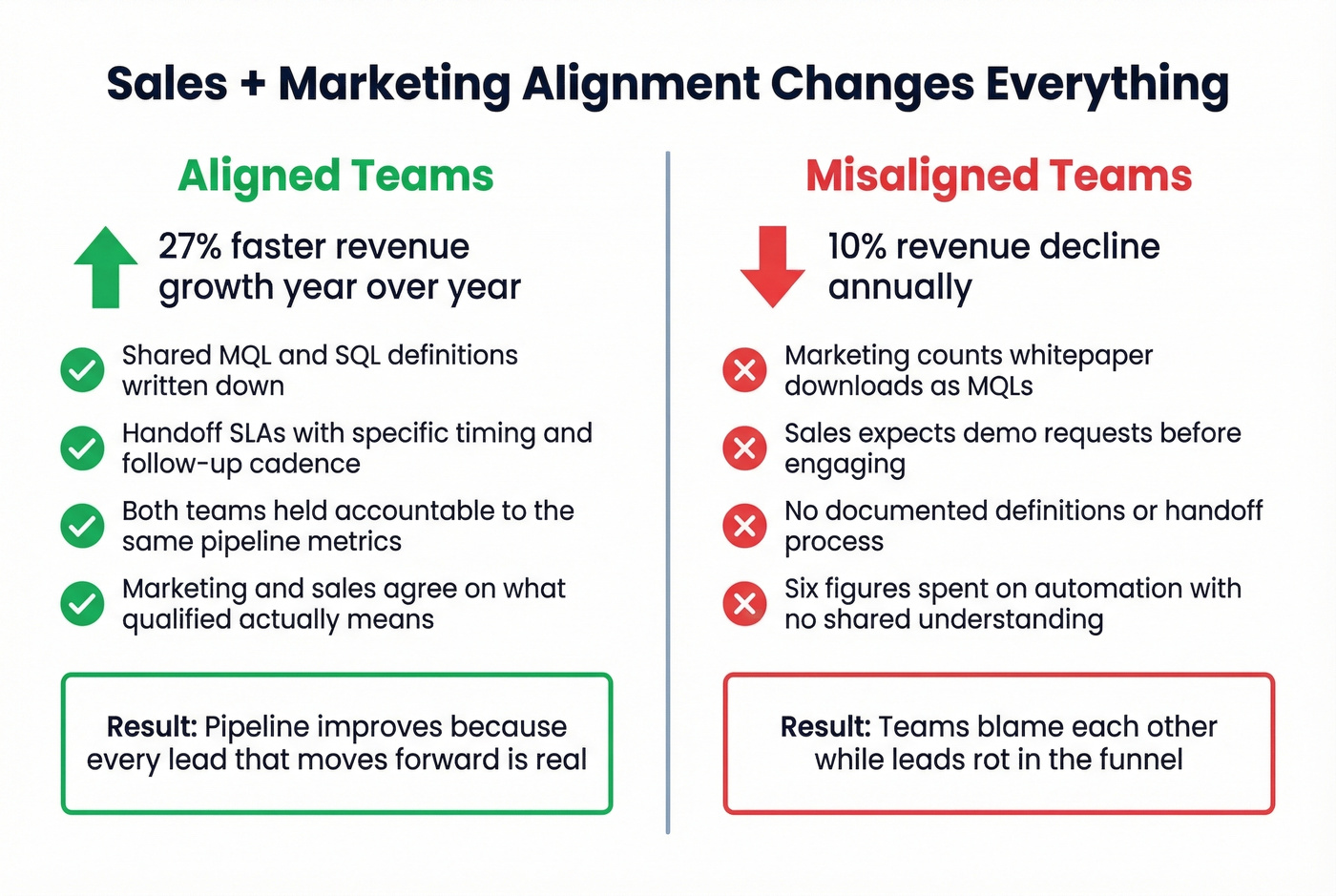
The fix isn't complicated: agree on shared MQL and SQL definitions, document them, and build SLAs around handoff timing and follow-up cadence. If marketing counts a whitepaper download as an MQL and sales expects a demo request, you'll never close the gap. Get in a room, define the terms, write them down, and hold both teams accountable. We've watched teams spend six figures on marketing automation platforms while their sales and marketing leaders couldn't even agree on what a qualified lead looked like - and then wonder why pipeline didn't improve.
5. Nurture With Relevance, Not Volume
Let's be honest: most B2B teams would be better off sending half the emails at twice the relevance. Automated nurturing is a tool, not a strategy.
A Journal of Marketing study summary found that automated nurturing can produce a 23 percentage point conversion lift - but only in specific contexts: new leads, shorter sales cycles, and lower-value deals. For complex, high-ticket B2B sales, the impact drops significantly.
Forrester's widely cited stat - nurturing generates 50% more sales-ready leads at 33% lower cost - is real, but it masks this nuance. Aberdeen Group puts the average at 10 marketing-driven touches to convert a lead into a sales-ready opportunity. If those 10 touches are all generic drip emails, you're wasting them. Nurturing works brilliantly for mid-funnel education and staying top-of-mind. It fails when it replaces genuine human engagement on high-stakes deals.
Skip this tactic entirely if your average deal size is above $50K and your sales cycle runs longer than 90 days - at that level, a well-timed phone call from a knowledgeable rep beats any drip sequence.
6. Personalize Beyond First Name
Nurtured leads make 47% larger purchases, per the Annuitas Group. But personalization that stops at "Hi {first_name}" isn't personalization - it's a mail merge.
Real personalization requires accurate, rich data. A VP of Sales who just joined a Series B company that uses Salesforce but doesn't have an outbound tool - that's a signal stack worth acting on immediately. Technographic signals, job-change alerts, and company growth indicators like recent funding rounds or headcount surges are the inputs that let you write an email that actually resonates. Without clean, current data feeding your personalization engine, you're just guessing with extra steps.
7. Use AI Where It Actually Helps
AI's biggest contribution to lead conversion isn't chatbots or generative email copy - it's speed and prioritization. The Blazeo data shows AI-using companies respond dramatically faster. Chatbots provide always-on qualification for after-hours leads. Predictive scoring surfaces the right leads before a human ever looks at the queue.
Where AI doesn't help: replacing the relationship-building that closes complex B2B deals. We've seen teams over-automate their follow-up sequences and watch reply rates crater. AI should handle the first 30 seconds of triage. Humans should handle everything after the prospect says "tell me more."
One lever most guides ignore: post-opportunity conversion. AI-powered CPQ tools that generate accurate proposals in minutes instead of days can meaningfully lift SQL-to-closed rates. If your bottleneck is below the SQL line, look there before adding more top-of-funnel volume.
7 Mistakes That Kill Your Rates

1. No follow-up process. 63.5% of companies never respond to inbound leads. That's not a conversion problem - it's an operational failure.
2. Bad contact data. High bounce rates wreck your sender reputation and waste rep time. If your list is bouncing at 35%+, every other optimization is irrelevant.
3. No shared definitions. Marketing reports a 40% MQL rate. Sales says conversion is 2%. They're both right - and both useless - because they're measuring different things.
4. Purchased lists. No intent, no opt-in, no relationship. The short-term volume isn't worth the long-term deliverability hit.
5. Vanity metrics. Measuring opens and clicks instead of meetings and revenue is like measuring how many people walked past your store instead of how many bought something.
6. No speed-to-lead SLA. Companies with a formal SLA respond within 15 minutes 54.9% of the time. Without one, that drops to 29.5%. An SLA costs nothing to implement.
7. Marketing-sales misalignment. Roughly 79% of marketing leads never convert to sales - not because the leads are bad, but because the handoff process is broken.
Best Tools for the Job
You don't need a 20-tool stack. You need three things working well: clean data, a CRM that tracks your funnel, and a routing system that gets leads to reps fast.
| Tool | Category | Starting Price | Best For |
|---|---|---|---|
| Prospeo | Data & Verification | Free / ~$0.01 per email | Verified emails & mobiles |
| HubSpot CRM | CRM | Free / paid from $45/mo | SMB full-funnel tracking |
| Salesforce | CRM | $25/user/mo | Mid-market & enterprise |
| Pipedrive | CRM | $14.90/user/mo | Sales-focused simplicity |
| Chili Piper | Lead Routing | ~$30-$100/user/mo | Instant meeting booking |
| monday CRM | CRM | $12/seat/mo (annual) | Visual pipeline management |
Clean data sits at the foundation of this stack. A 98% email accuracy rate and a 7-day refresh cycle mean your CRM stays clean and your reps reach real people. Native integrations with Salesforce, HubSpot, Lemlist, Instantly, and Clay keep data flowing without manual exports.
If you're building from scratch, start with a CRM lead management process, a data verification tool, and a lead routing tool. Everything else is optimization on top of that foundation.
Speed-to-lead means nothing if the phone number is dead. Prospeo refreshes 300M+ profiles every 7 days - not every 6 weeks like competitors - so your team reaches real buyers at real numbers, fast enough to win the deal.
Respond in 5 minutes with data that actually connects.
FAQ
What's a good lead conversion rate?
It depends entirely on your industry and which funnel stage you're measuring. B2B SaaS visitor-to-lead averages 1.1%, while Legal Services hits 7.4%. The cross-industry average is 2.9% according to Ruler Analytics' 100M+ datapoint analysis. Always benchmark against your specific vertical - a "good" number in one industry is underperformance in another.
What's the difference between MQL and SQL conversion?
MQL conversion measures how many leads meet marketing's qualification criteria - content engagement, firmographic fit, lead scores. SQL conversion measures how many of those MQLs sales accepts as worth pursuing. The gap between the two reveals alignment quality. B2B SaaS averages 39% lead-to-MQL and 38% MQL-to-SQL.
How fast should you follow up with a lead?
Within 5 minutes. You're 21x more likely to qualify a lead at that speed versus waiting 30 minutes, and only 7% of companies hit this benchmark. Set a formal SLA - companies with one respond within 15 minutes 54.9% of the time versus 29.5% without.
Does lead nurturing actually improve conversion?
Automated nurturing lifts conversion by up to 23 percentage points for shorter-cycle, lower-value deals. For complex, high-ticket B2B sales the impact drops significantly. The key is relevance - generic drip sequences underperform targeted, stage-appropriate content every time.
How does data quality affect conversion rates?
If 35% of your emails bounce, no tactic saves you - poor data costs companies 20-30% of annual revenue. Verification tools that deliver 98%+ email accuracy with frequent refresh cycles ensure outreach actually reaches the prospect. In our experience, teams that fix data quality first see the fastest improvement in pipeline outcomes.