

Speed to Lead: What the Data Actually Says (and How to Fix Yours)
It's Monday morning. Your CRM has 47 leads from the weekend sitting untouched - the oldest one is 61 hours cold. Your marketing team spent real money generating those form fills, and your reps are just now seeing them between sips of coffee. That gap between "lead raises hand" and "rep picks up the phone" is the most expensive silence in your pipeline.
Everyone cites the same speed to lead stats without linking the actual study. Here are the real sources, 2026 benchmarks, and a playbook that goes beyond "just call faster."
The Short Version
- The 5-minute benchmark is real. Qualification rates drop from 21% to 1% by the 30-minute mark.
- 63.5% of companies never respond at all. You're probably competing against silence, not speed.
- Fast response with bad contact data is theater. If a third of your phone numbers are wrong, your 3-minute response time is meaningless. Fix your data first.
- Set a formal SLA. Companies with documented response SLAs are nearly 2x more likely to respond within 15 minutes.
What Is Speed to Lead?
Speed to lead is the elapsed time between a prospect's action - a form fill, a chat message, a demo request - and the first meaningful human contact from your team. Not an autoresponder. Not a "thanks, we'll be in touch" email. Actual human engagement.
The concept was formalized in "[The Short Life of Online Sales Leads](https://hbr.org/2011/03/the-short-life-of-online-sales-leads)", published in Harvard Business Review in March 2011 by James B. Oldroyd, Kristina McElheran, and David Elkington. That research established the 5-minute response window that's been cited and misquoted ever since - most articles referencing "the HBR study" have never actually linked to it. Now you've got the real source.
The core finding hasn't aged. The faster you make meaningful contact, the more likely you are to qualify the lead. Everything else - the tools, the routing logic, the AI chatbots - is infrastructure built around that single insight.
Why Lead Response Time Matters
Here's the qualification drop-off curve, based on the original research and subsequent analysis:
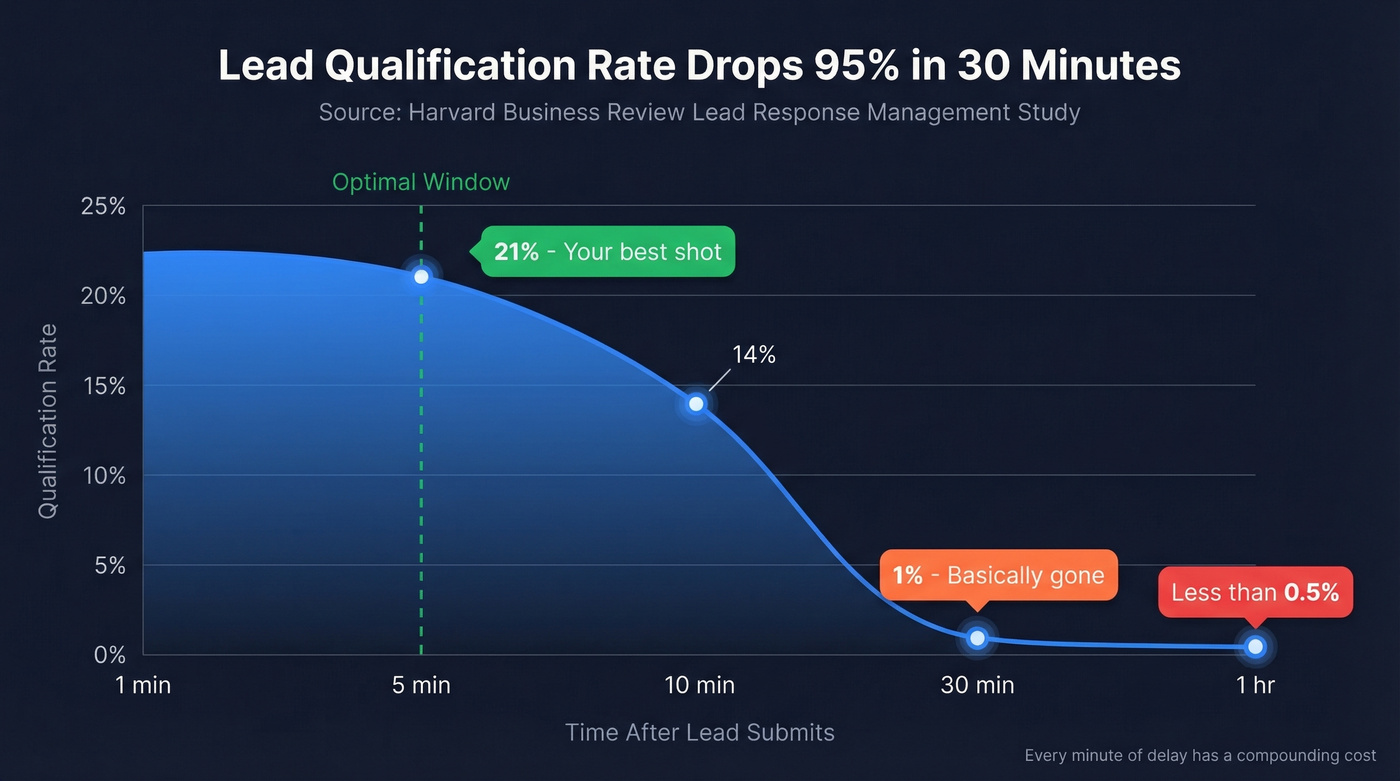
- Within 5 minutes: 21% qualification rate
- After 10 minutes: 14% qualification rate
- After 30 minutes: 1% qualification rate
- After 1 hour: less than 0.5% qualification rate
That's a 10x decrease after the first 5 minutes. Not a gentle decline - a steep slope that flattens into near-zero territory within half an hour.
Some practitioners push back on this. A real estate agent on r/realtors pointed out they've converted leads even when they didn't call within the first hour, and criticized gurus for citing studies without references. Fair enough - it's not a cliff where leads become worthless at 5:01.
But the math is brutal enough that even skeptics should care. Going from a 21% shot to a 1% shot in 25 minutes isn't a rounding error. That's the difference between a pipeline and a graveyard.
The practical takeaway isn't "respond in 4 minutes or lose everything." It's that every minute of delay has a compounding cost, and most teams are leaking value they never see because the delay is baked into their process.
2026 Benchmarks by Industry
| Industry | Avg Response Time | Best Practice Target |
|---|---|---|
| SaaS / Tech | 11.4 hrs | Under 5 min |
| Real Estate | 15 hrs | Under 5 min |
| Legal | 13 min (median) | Under 5 min |
| Financial Services | 8.2 hrs | Under 10 min |
| HVAC / Home Services | 1 day (most common, 37%) | Under 5 min |
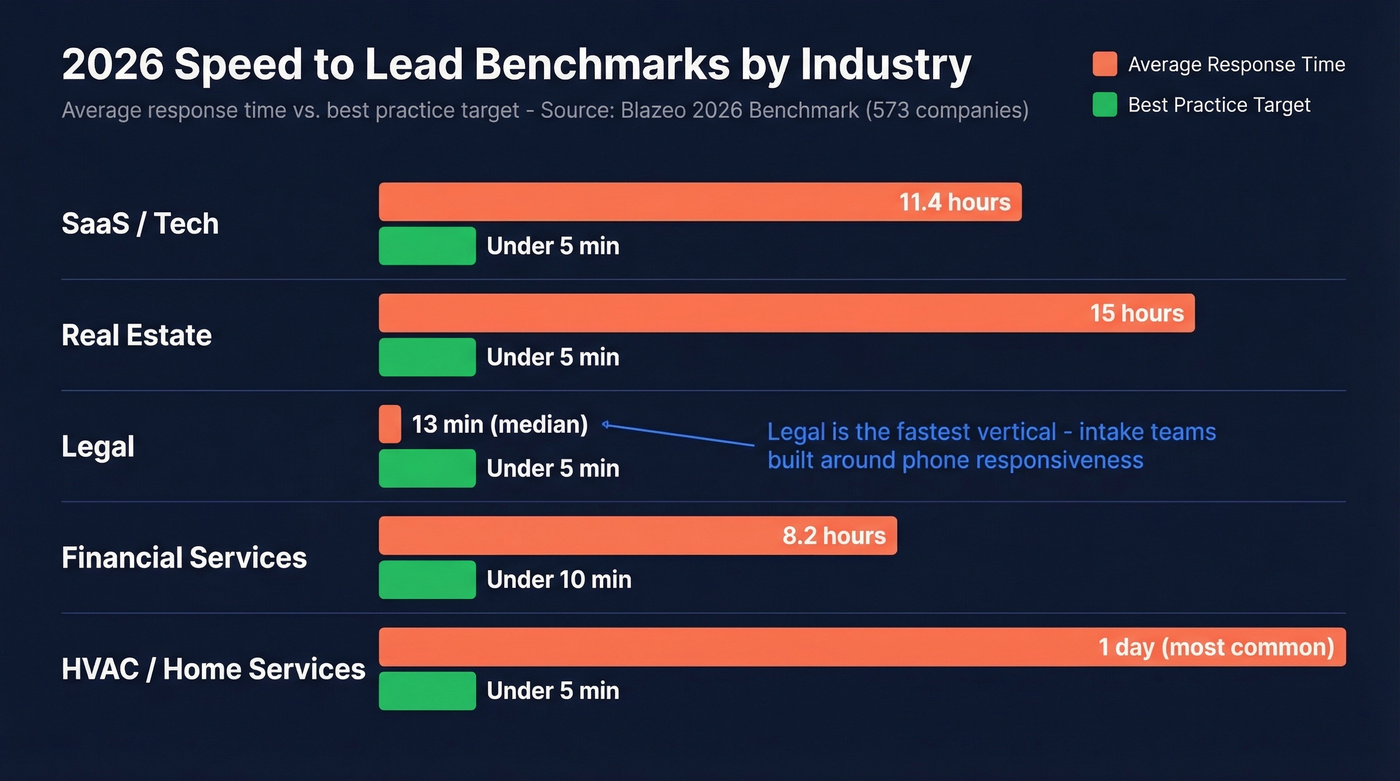
These numbers draw from a [Blazeo 2026 benchmark of 573 companies](https://www.prnewswire.com/news-releases/blazeo-unveils-2026-speed-to-lead-benchmark-report-revealing-businesses-are-failing-their-own-response-time-standards-302694994.html) plus vertical-specific research including a study of 1,333 law firms and an analysis of 132,188 home services campaigns.
Legal stands out as the fastest vertical - likely because intake teams are built around phone responsiveness. The legal data also reveals a stark split: 25% of firms respond within 5 minutes, while 26% never respond at all. Everyone else is measured in hours, not minutes.
Benchmarks by Company Size
| Company Size | Avg Response | Best-in-Class |
|---|---|---|
| Enterprise (1,000+) | 52 hrs | 8 min |
| Mid-Market (100-999) | 41 hrs | 12 min |
| SMB (10-99) | 38 hrs | 18 min |
| Small Business (<10) | 47 hrs | 32 min |
The gap between average and best-in-class ranges from roughly 88x to 390x depending on tier. Enterprise teams average just over two days. Small businesses - who you'd think would be scrappier - actually perform worse than SMBs, likely because they lack any routing infrastructure at all.
The Numbers That Should Alarm You
Let's be honest about how bad this is across the board. 63.5% of companies never respond at all. Among those that do respond, the average is 29 hours. Only 4.7% of companies hit the optimal 5-minute window. Over 30% of leads are never contacted - period.
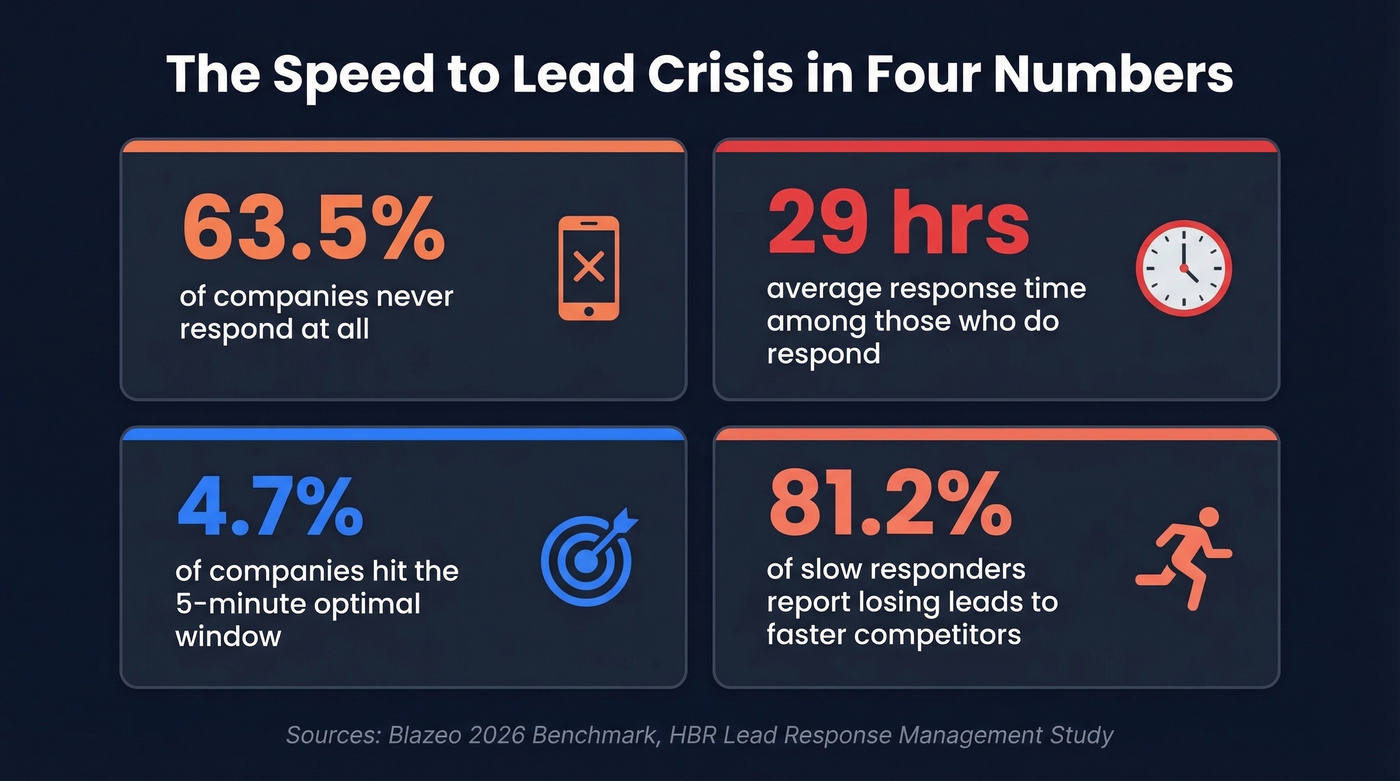
And 81.2% of companies responding in over an hour report losing leads to faster competitors. That's not a theory. That's 573 companies telling you what happened to their pipeline.
Here's the thing: if your average deal size is under $10K, you probably don't need a $50K routing platform. But you absolutely need a sub-5-minute SLA and clean contact data. The companies winning on response time aren't the ones with the fanciest tech stack - they're the ones who wrote down a target, assigned clear ownership, and verified their phone numbers before dialing.

You just read it - fast response with bad contact data is theater. If a third of your phone numbers bounce, your 3-minute SLA is worthless. Prospeo gives you 98% verified emails and 125M+ verified mobile numbers with a 30% pickup rate, refreshed every 7 days. Your reps dial real numbers on the first attempt.
Stop wasting your speed advantage on dead phone numbers.
Why Your Team Is Slow
It's rarely about lazy reps. The delay is systemic - a chain of small lags that compound into hours:
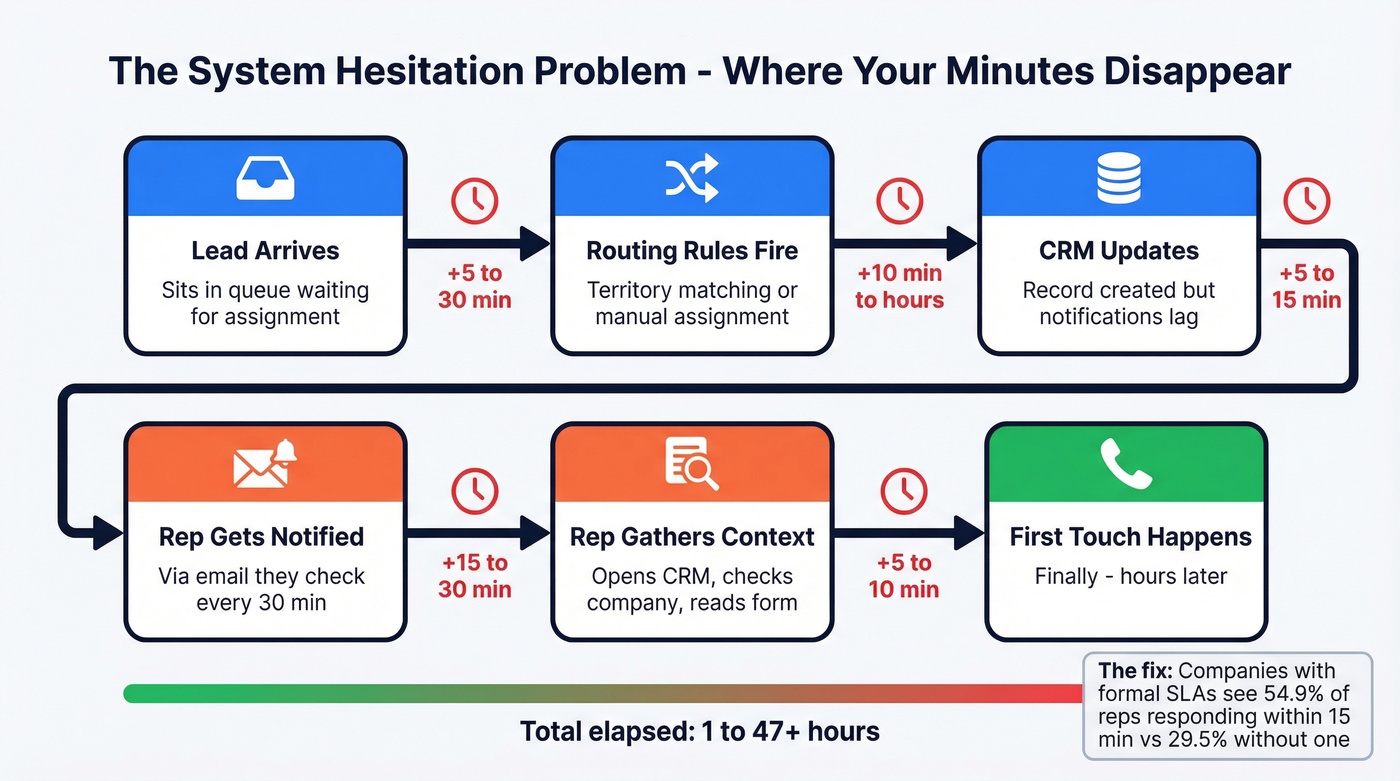
- Lead arrives - sits in a queue waiting for ownership assignment
- Routing rules fire - territory matching, round-robin logic, or manual assignment adds time (or hours if it requires a manager)
- CRM updates - the record gets created, but notification triggers lag behind
- Rep gets notified - via email, which they check every 30 minutes, not every 30 seconds
- Rep gathers context - opens the CRM record, checks the company, reads the form submission
- First touch happens - finally
This is the "system hesitation" problem - manual routing and unclear ownership are the top culprits.
Then there's the after-hours gap. Over 40% of high-intent inquiries arrive during evenings and weekends. A typical team goes 61 hours silent from Friday evening to Monday morning. That's not a gap. It's a canyon.
The SLA data makes the fix obvious: companies with formal response SLAs see 54.9% of reps responding within 15 minutes, versus 29.5% without one. Nearly double the speed, just from writing down the expectation and tracking it.
7-Step Playbook to Fix Response Time
Seven tactics, ordered by impact. The benefits compound as you stack them - each one shaves minutes off the clock, and minutes are where deals are won or lost.
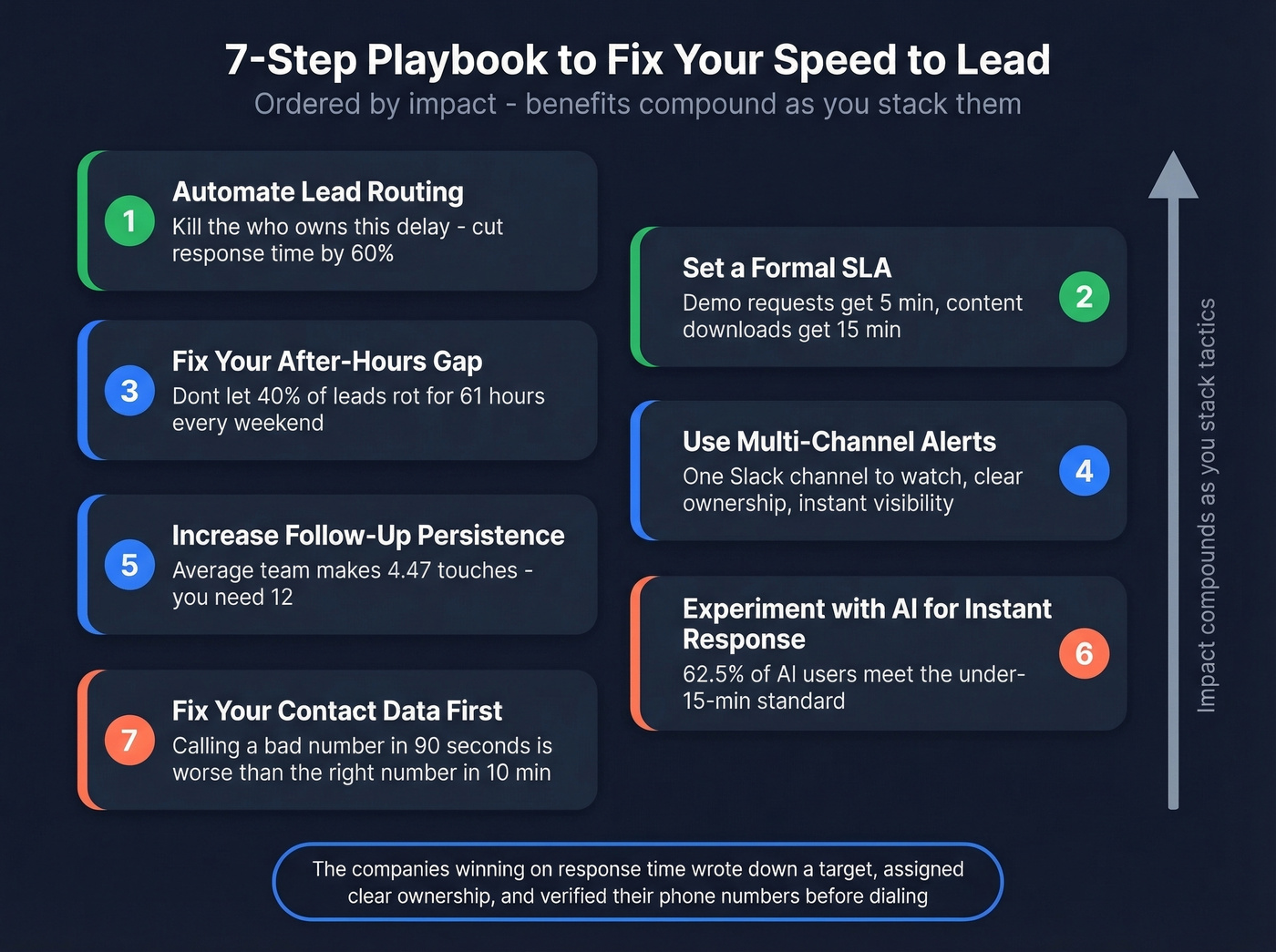
1. Automate Lead Routing
Kill the "who owns this?" delay. Set up round-robin, territory-based, or account-match routing so every lead has an owner the instant it arrives. SMB automation tools typically start at $50-$500/user/month, while enterprise routing platforms often run $10K-$50K+/year depending on seats and modules.
We've seen teams cut their average response time by 60% just by removing the manual assignment step. No new hires, no new tools - just a routing rule that fires before anyone has to think about it.
2. Set a Formal SLA
Define response windows by lead source and score. High-intent form fills like demo requests and pricing pages get a 5-minute SLA. Content downloads get 15 minutes. Track compliance weekly on a visible dashboard - "68% of leads contacted within SLA" creates accountability that verbal commitments never will.
3. Fix Your After-Hours Gap
Don't let 40%+ of your leads rot for 61 hours every weekend. Automate a first-touch acknowledgment - a text or email that says "Got your request, [Name]. Someone from our team will call you within [X]." Better yet, route after-hours high-intent leads to an on-call rep or a qualification chatbot that books a meeting for Monday morning.
4. Use Multi-Channel Alerts
If your reps are monitoring five different inboxes, they're monitoring none of them well. Centralize notifications in Slack or Teams with a dedicated channel. One place to watch, clear ownership, instant visibility. The pain of scattered notifications is one of the most common complaints we hear from ops teams.
5. Increase Follow-Up Persistence
The average team makes 4.47 touches before giving up. The recommended number is 12. Build a 10-14 day cadence mixing calls, emails, and social touches. Speed on the first attempt matters, but persistence across the sequence converts the leads who didn't pick up on attempt one. If you need a starting point, use proven follow-up templates and adapt them to your SLA.
6. Experiment with AI for Instant Response
Here's the strongest case for AI in your response workflow: 62.5% of companies using AI meet the under-15-minute standard, versus just 39.1% of manual-only teams. AI chatbots can handle immediate qualification - asking budget, timeline, and use case questions - while a human rep gets looped in for the real conversation. (If you're evaluating tooling, start with AI tools for automating sales follow-ups.)
The honest concern from practitioners on r/AI_Agents is that prospects hang up when they realize it's not human. Use AI to draft replies and pre-qualify, not to replace the human conversation entirely.
7. Fix Your Contact Data First
None of the above matters if your contact data is wrong. Calling a bad number in 90 seconds is worse than calling the right number in 10 minutes. If 30%+ of your phone numbers are outdated, your entire investment in faster response is theater.
This is where data quality becomes a speed problem, not just an accuracy problem. When Meritt switched to Prospeo, their bounce rate dropped from 35% to under 4% and their connect rate tripled to 20-25%. That's the difference between a fast response that reaches someone and one that hits a dead end - 98% email accuracy and 125M+ verified mobile numbers refreshed on a 7-day cycle mean your reps aren't wasting those critical first minutes dialing disconnected lines. If you're comparing vendors, start with data enrichment services and map them to your routing + SLA needs.
It's Not Just an Inbound Problem
Cold email reply handling is a lead response problem most teams ignore. When a prospect replies to your outbound sequence with interest, the same clock starts ticking. A practitioner on r/coldemail laid out the approach we've seen work best: centralize reply notifications in Slack, assign a single owner for first response, and maintain a sub-10-minute SLA during business hours. Treat positive replies like live chat.
The biggest leak in cold email isn't open rates or subject lines - it's the 3-hour gap between a warm reply and your follow-up. By then, the prospect has moved on to the next thing in their inbox. Skip this section if you're purely inbound, but for teams running outbound at scale, verifying your list upfront keeps bounce rates under 3% so warm replies actually reach you in the first place. (For the outbound side, see our AI cold email outreach playbook.)
How to Measure It
Speed to lead = Timestamp of first meaningful human contact - Timestamp of lead action
"Meaningful human contact" means a phone call, a personalized email, or a live chat response. Autoresponders and calendar booking confirmations don't count. The clock starts when the prospect takes action and stops when a human engages.
Track the median, not the average. Averages get destroyed by outliers - one lead that sat for a week skews your entire dataset. Three metrics to report weekly: median response time by source, SLA compliance rate, and after-hours vs. business-hours split. That last one reveals your weekend canyon. If you want a broader KPI set, align this with your lead generation metrics reporting.
Step 5 in the delay chain - 'rep gathers context' - kills your response time. Prospeo enriches every lead with 50+ data points instantly via CRM integration or API, so reps have company size, tech stack, and intent signals before they pick up the phone. No tab-switching. No research lag. Just dial.
Cut rep research time to zero and actually hit your 5-minute SLA.
FAQ
What is speed to lead?
Speed to lead is the elapsed time between a prospect's action and your first meaningful human response. Under 5 minutes is the gold standard per the original HBR research. Qualification rates drop from 21% to 1% within 30 minutes, making this one of the highest-leverage metrics a sales team can optimize.
How do you calculate it?
Subtract the timestamp of the lead's action from the timestamp of your first meaningful human contact - not an automated acknowledgment. Track the median across all leads, not the average, because a single lead sitting untouched for a week will skew your data.
Why do most companies respond so slowly?
Manual lead routing, unclear ownership rules, CRM notification delays, and after-hours gaps create systemic lag. The typical team goes 61 hours silent every weekend, and 63.5% of companies never respond at all.
Does response speed matter for outbound sales?
Yes. When a cold email prospect replies with interest, the same clock starts. Teams responding within 10 minutes during business hours convert at significantly higher rates than those who wait hours. Verifying your list before sending keeps bounce rates under 3% so warm replies actually land.
How does contact data quality affect response time?
Calling a wrong number in 90 seconds is worse than calling the right number in 10 minutes. If 30%+ of your phone numbers are outdated, every dollar spent on routing and automation is wasted. Verify before you dial - 98% email accuracy and weekly data refreshes eliminate the dead ends that make fast teams look slow.