

The 7 Best Lead Generation Chrome Extensions (Tested & Compared)
You exported 500 contacts last quarter, loaded them into your sequencer, and 180 bounced. Your domain reputation took a hit, reply rates cratered, and you spent the next two weeks warming up a backup domain. That lead generation Chrome extension that gave you those contacts? Still installed.
The difference between extensions that help and extensions that hurt comes down to three things: verification depth, data freshness, and credit economics. We've tested all seven of these tools across real outbound campaigns, and the gap between the best and worst is staggering.
Our Picks (TL;DR)
Best overall accuracy: Prospeo - 98% verified emails at ~$0.01 each.
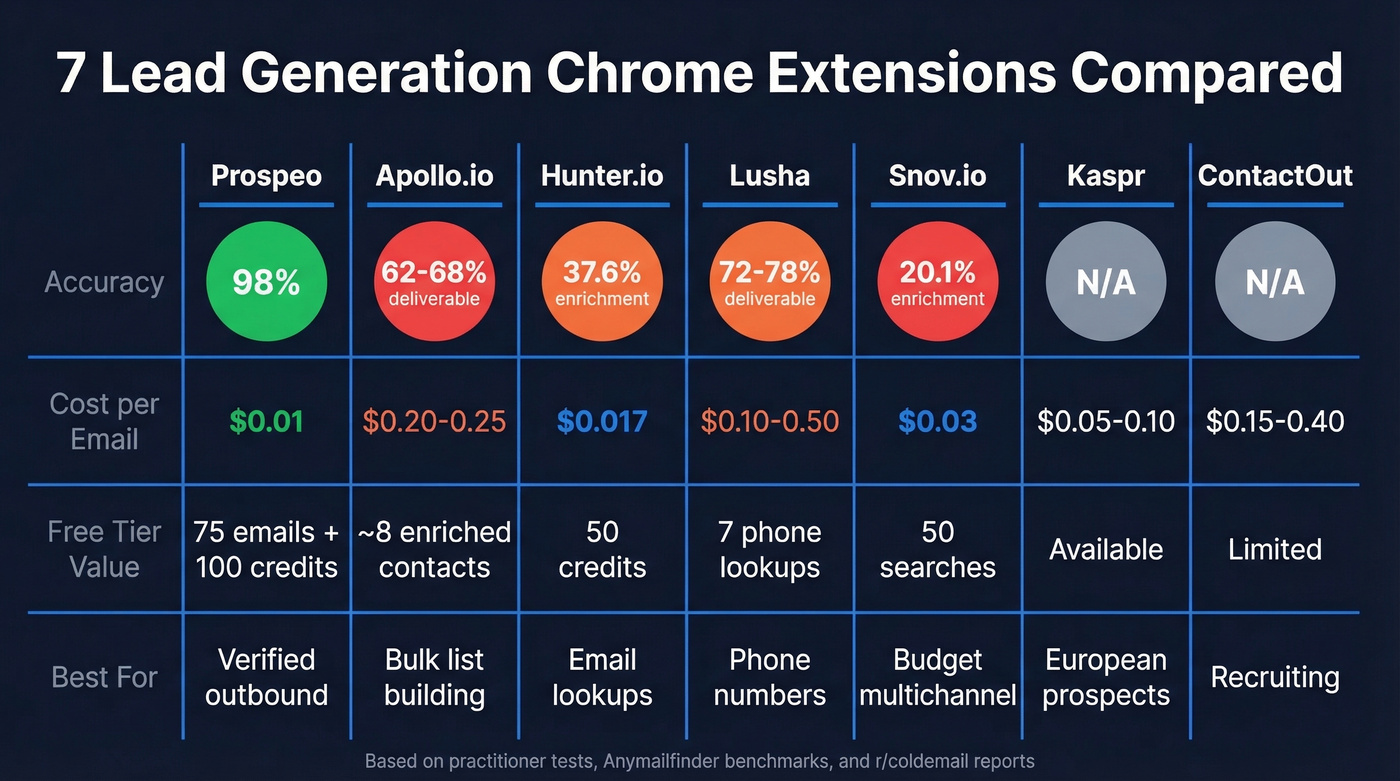
Best for bulk list-building: Apollo.io - massive database and filters, but re-verify everything before sending.
Best lightweight email finder: Hunter.io - clean, fast, predictable pricing. No bloat.
| Tool | Best For | Free Tier | Cost/Verified Email | Accuracy Signal |
|---|---|---|---|---|
| Prospeo | Verified emails + phones | 75 emails + 100 ext. credits/mo | ~$0.01 | 98% verified |
| Apollo.io | Bulk list-building | 50 credits/mo (~8 fully enriched) | ~$0.20-0.25 | 32-38% bounce reported |
| Hunter.io | Simple email lookups | 50 credits/mo | ~$0.017 | 37.6% enrichment rate |
| Lusha | Mobile numbers | 70 credits/mo (7 phones) | ~$0.10-0.50 | 22-28% bounce reported |
| Snov.io | Budget multichannel | 50 searches/mo | ~$0.03 | 20.1% enrichment rate |
| Kaspr | European prospects | Free tier available | ~$0.05-0.10 est. | N/A |
| ContactOut | Personal emails / recruiting | Limited free tier | ~$0.15-0.40 est. | N/A |
A cheap extension that bounces 35% of its emails isn't cheap. It's expensive in domain reputation.
The 7 Best Chrome Extensions for Lead Generation
Prospeo
Best for: Teams that can't afford bounces - agencies, founders scaling cold outbound, anyone who's been burned by bad data.
Prospeo's Chrome extension covers 300M+ professional profiles, 143M+ verified emails, and 125M+ verified mobile numbers. Every email runs through a 5-step verification process that includes catch-all handling, spam-trap removal, and honeypot filtering, delivering 98% email accuracy - the highest on this list by a wide margin. The extension works on professional profiles and company websites, surfacing verified emails and direct dials in one click.
What makes it genuinely different is the 7-day data refresh cycle. Most providers refresh around every 6 weeks, meaning you're often emailing people who changed jobs a month ago. Weekly refresh catches those changes before they become bounces. Data pushes directly into Salesforce, HubSpot, Smartlead, Instantly, Lemlist, Salesloft, Outreach, and Clay - no Zapier workaround needed for the core stack.
Free tier: 75 emails + 100 extension credits/month. No card required.
Apollo.io
Apollo is the default starting point for most teams - 275M+ contacts, a generous free tier, and a built-in sequencer. If you're building lists of 500+ contacts at a time, Apollo's filtering is hard to beat.
Here's the thing: Apollo's data quality has become a real problem. A practitioner test on r/coldemail found 32-38% bounce rates on exported lists verified through NeverBounce. Apollo's database is partially crowdsourced, so data freshness varies wildly by contact. Some records are solid. Others are two job changes behind.
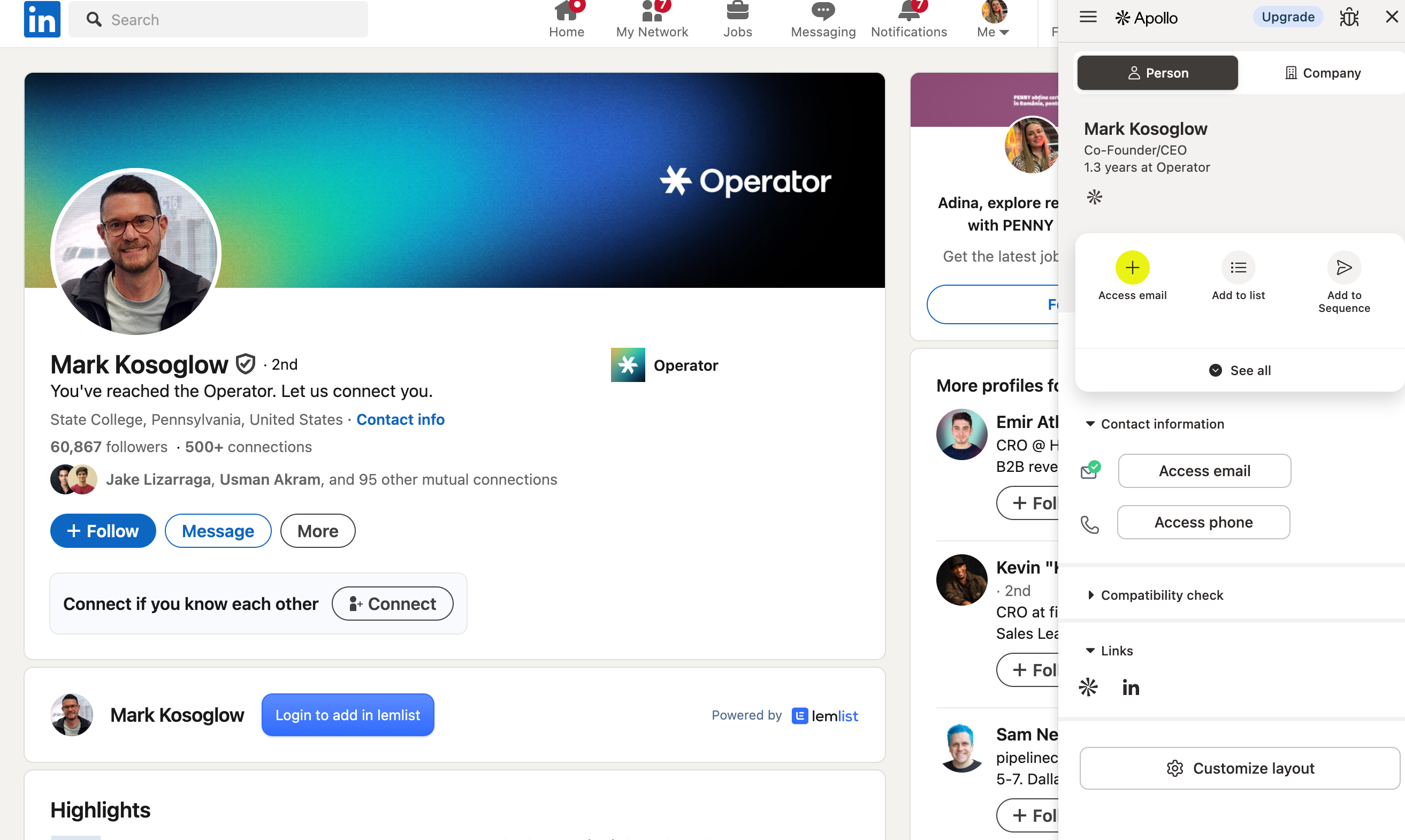
Pricing: Free gives you 50 credits/month, but exporting one contact with email + mobile costs 6 credits - roughly 8 fully enriched contacts. Paid plans start at $49/seat/month annually for 2,400 credits/year.
Use this if you need volume and have a separate verification step. Skip this if you're sending without re-verifying - your bounce rate will tank your domain.
Hunter.io
Hunter does one thing well: email lookups. Paste a domain, get the email pattern and verified addresses. The extension is clean, fast, and doesn't try to be a CRM or sequencer.

An Anymailfinder benchmark of 5,000 contacts put Hunter's verified enrichment rate at 37.6% - decent but not exceptional. Where Hunter wins is transparency: pricing starts at $34/month billed annually for 2,000 credits/month, and all plans include unlimited team members. No credit-per-seat games.
Skip this if you need phone numbers or bulk prospecting. Hunter isn't built for either.
Lusha
If your outbound motion is phone-first, Lusha's direct dial coverage beats most competitors. The extension surfaces phones and emails from professional profiles with a clean, fast UI.
The credit math is where it hurts. Lusha's free tier gives you 70 credits/month, but a single phone number costs 10 credits. That's 7 phone lookups per month on the free plan. Seven. Paid plans run $49-79/month per seat, and the credit drain continues at scale. For teams running primarily email outbound, you're overpaying for data you won't use.
Snov.io
Snov.io is the budget multichannel play. The Starter plan at $29.25/month billed annually includes 1,000 credits, a built-in email sequencer, and unlimited team members. For a bootstrapped team running email campaigns, the all-in-one value is real.
The catch: that same Anymailfinder benchmark showed Snov.io at just 20.1% verified enrichment rate. And automation add-ons run $69/month per slot, nearly doubling your bill. You'll almost certainly need a verification layer on top, which eats into the cost savings that made Snov.io attractive in the first place.
Kaspr
European-focused sales intelligence extension with solid EMEA coverage. Paid plans run ~$45-90/month. If your ICP is primarily in France, Germany, or the UK, Kaspr's data is fresher than US-centric tools for those regions. Limited value for North American prospecting.
ContactOut
Recruiter-oriented email finder specializing in personal email addresses - useful for talent acquisition, less so for B2B sales. Pricing runs ~$29-99/month depending on tier. If you're sourcing candidates rather than selling to prospects, ContactOut fills a niche the other tools don't cover.

You just read the bounce-rate data. 32-38% bounces from Apollo. 20% enrichment from Snov.io. Prospeo's Chrome extension delivers 98% email accuracy through 5-step verification - catch-all handling, spam-trap removal, honeypot filtering - on a 7-day refresh cycle.
75 free emails per month, no credit card. Install in 30 seconds.
What Separates Good from Bad Extensions
A Dropcontact benchmark tested 15 email finders across 20,000 real contacts and actually sent emails to measure hard bounces. Top performers hit roughly 40-55% effective enrichment with bounce rates between 0.9% and 3.6%. The bottom performers were dramatically worse - and still charge per credit. Four criteria that actually matter:
Verification depth. Does the tool verify in real time, or serve cached results from months ago? A 7-day data refresh catches job changes before they become bounces. A 6-week refresh doesn't. If you want a deeper breakdown of verification workflows, see data enrichment and lead enrichment.
Catch-all handling. Catch-all domains accept any email address, so unverified tools mark garbage addresses as "valid." Look for tools that flag catch-alls separately rather than lumping them in with verified results.
Credit economics. Lusha's 70 free credits is 7 phone lookups. Apollo's 50 credits is 8 enriched contacts. Always do the per-lead math - the headline number on the pricing page is designed to distract you from it.
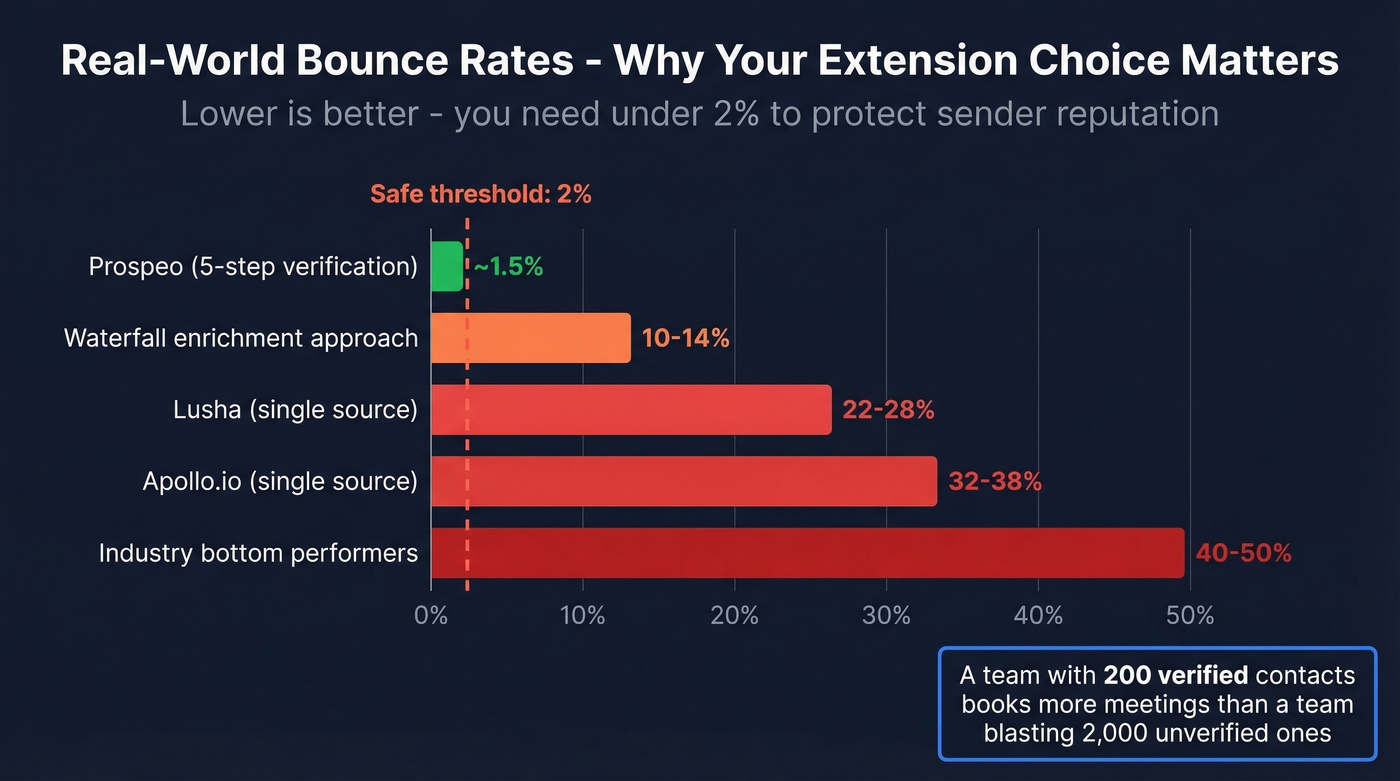
Bounce rate in practice. Real-world tests show massive variance, from 10-14% bounce with waterfall enrichment to 32-38% with single-source tools. Your sender reputation needs bounce rates under 2%. (If you want the benchmarks and fixes, read our guide to email bounce rate.)
Let's be honest about something the industry doesn't talk about enough: if your average deal size is under five figures and your list is under 1,000 contacts/month, you don't need Apollo-level volume. You need accuracy. We've run this comparison across dozens of client campaigns, and the team with 200 verified contacts consistently books more meetings than the team blasting 2,000 unverified ones. Meritt, for example, tripled their pipeline from $100K to $300K/week after switching to verified data and dropping their bounce rate from 35% to under 4%.
Extension Safety and Account Risks
Chrome extensions that interact with professional platforms fall into three architectures: JavaScript injection (runs inside the page), cloud-based requests (sends data remotely), and standalone modified browsers. Each carries a different detection profile, and roughly 23% of automation users face account restrictions within 90 days - though that stat skews heavily toward aggressive auto-scrapers, not manual-click tools.
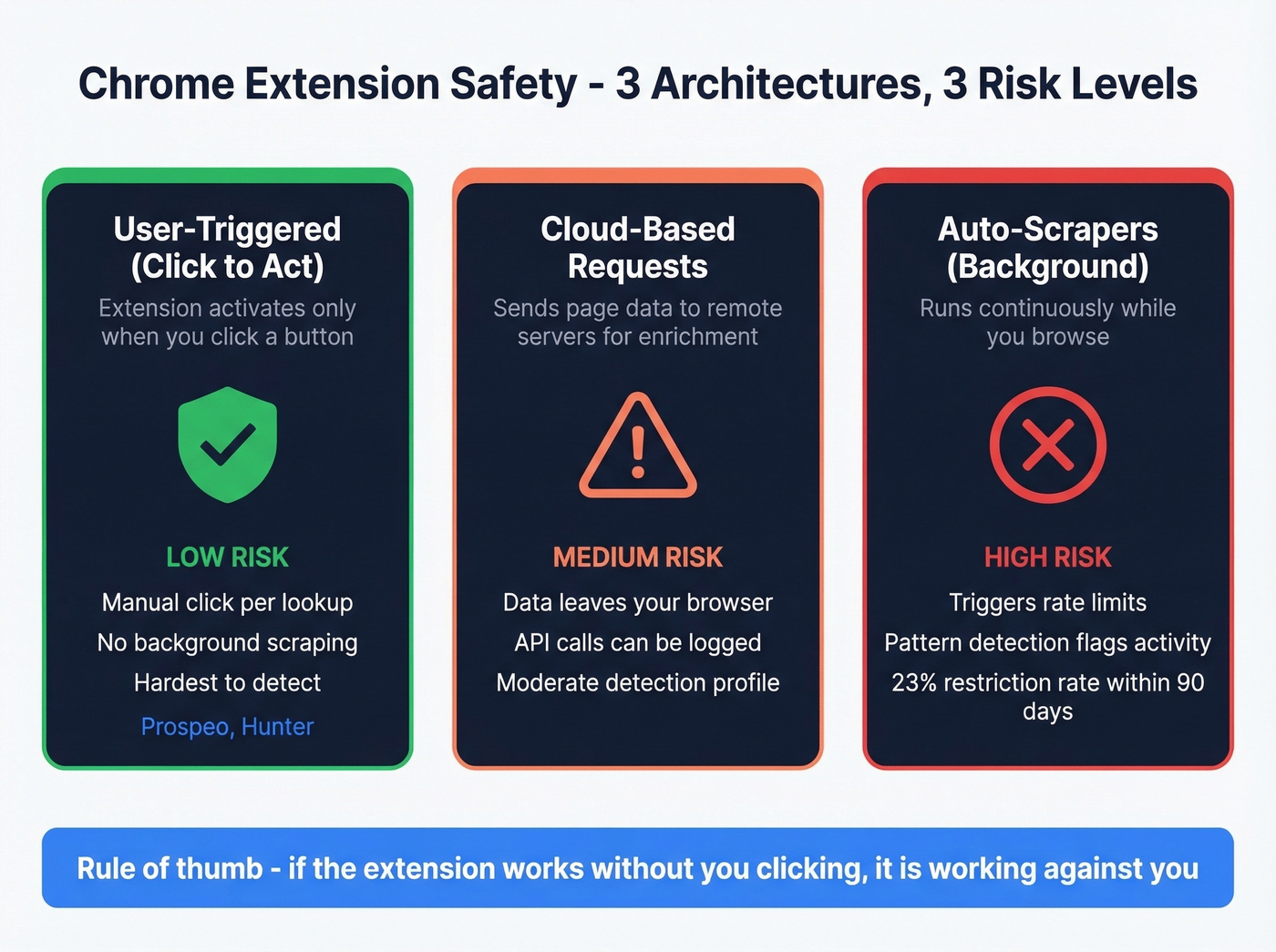
The safest prospecting extensions are user-triggered. They act only when you click, not when you browse. Auto-scrapers running in the background are the ones that get flagged. If you're building a safer outbound motion end-to-end, pair this with a deliverability checklist like email deliverability and improve sender reputation.
One compliance detail worth flagging: PhantomBuster's research notes Apollo doesn't currently apply GDPR safeguard controls to EU or UK contacts pulled through its extension. If you're prospecting in Europe, that's a real liability - GDPR fines run up to EUR20M or 4% of global annual revenue. Tools with built-in compliance controls save you from having to build that layer yourself.
Which Extensions to Install Together
You don't need 13 extensions. You need 2-3 that give you clean data and fit your workflow.
Solo founder stack: Prospeo plus Instantly or Smartlead. Contacts push directly into either sequencer. Total cost under $100/month with Prospeo's free tier. For more ways to build pipeline without bloated stacks, see free lead generation tools.
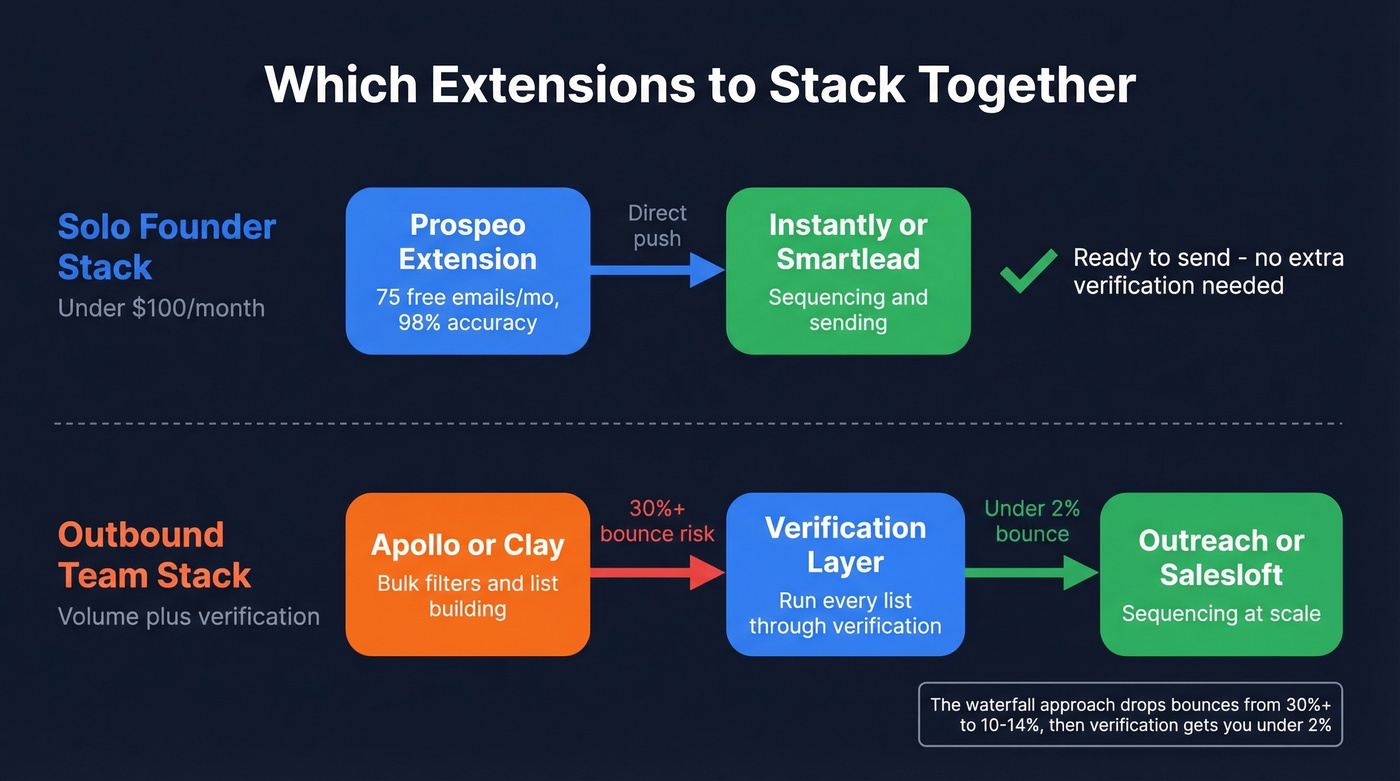
Outbound team stack: Apollo or Clay for bulk list building and waterfall enrichment, then a verification layer before sequencing through Outreach or Salesloft. Use Apollo for its filters and volume, then run every list through verification before sending. The waterfall approach drops bounce rates from 30%+ down to the 10-14% range practitioners report on r/coldemail, and a 98% accuracy verification layer gets you the rest of the way to under 2%. If you're standardizing the process, document it as a repeatable lead generation workflow and train reps on sales prospecting techniques.
FAQ
Are lead generation Chrome extensions safe?
User-triggered extensions are significantly safer than auto-scrapers. Stick to tools that act only when you click and use randomized delays. The 23% restriction rate skews toward aggressive background scraping, not manual-click extensions.
How much do lead gen extensions cost per lead?
From ~$0.01 per verified email to $0.20+ with Apollo. Phone numbers are the real cost driver - most platforms charge 5-10 credits per mobile reveal. Always calculate cost per verified contact, not cost per credit.
What's the best free lead generation Chrome extension?
Prospeo's free tier offers the most useful runway: 75 emails plus 100 extension credits per month at 98% accuracy. Hunter and Apollo also have free tiers, but Hunter's enrichment rate benchmarks lower and Apollo's bounce rates make "free" contacts expensive when they damage your sender reputation.
Can I use multiple prospecting extensions at once?
Yes - and you should. The most effective setup pairs a volume tool for filtering and list building with an accuracy tool for verification. Running contacts through a second verification layer before sequencing drops bounce rates from 30%+ to under 2%.