

Best Lead Generation Platforms for 2026 (12 Tested)
A RevOps lead we know ran a 3-tool bake-off last quarter. The "best" database created 4,000 duplicate contacts in Salesforce in five days. The cheapest one had better phone connect rates. The lead generation platform market is projected to hit $16.2B by 2034, up from $7.4B - and most of that growth comes from teams buying more tools, not better ones.
Here's the uncomfortable truth: 79% of marketing leads never convert into sales. Not because the leads are bad (though many are), but because teams stack the wrong tools, feed them stale data, and spray messages across channels without a coherent workflow. Email marketing converts at 6.5% with a $30-$45 CPL. LinkedIn ads? $120-$200 CPL. The channel math alone should dictate your stack, but most teams never run it.
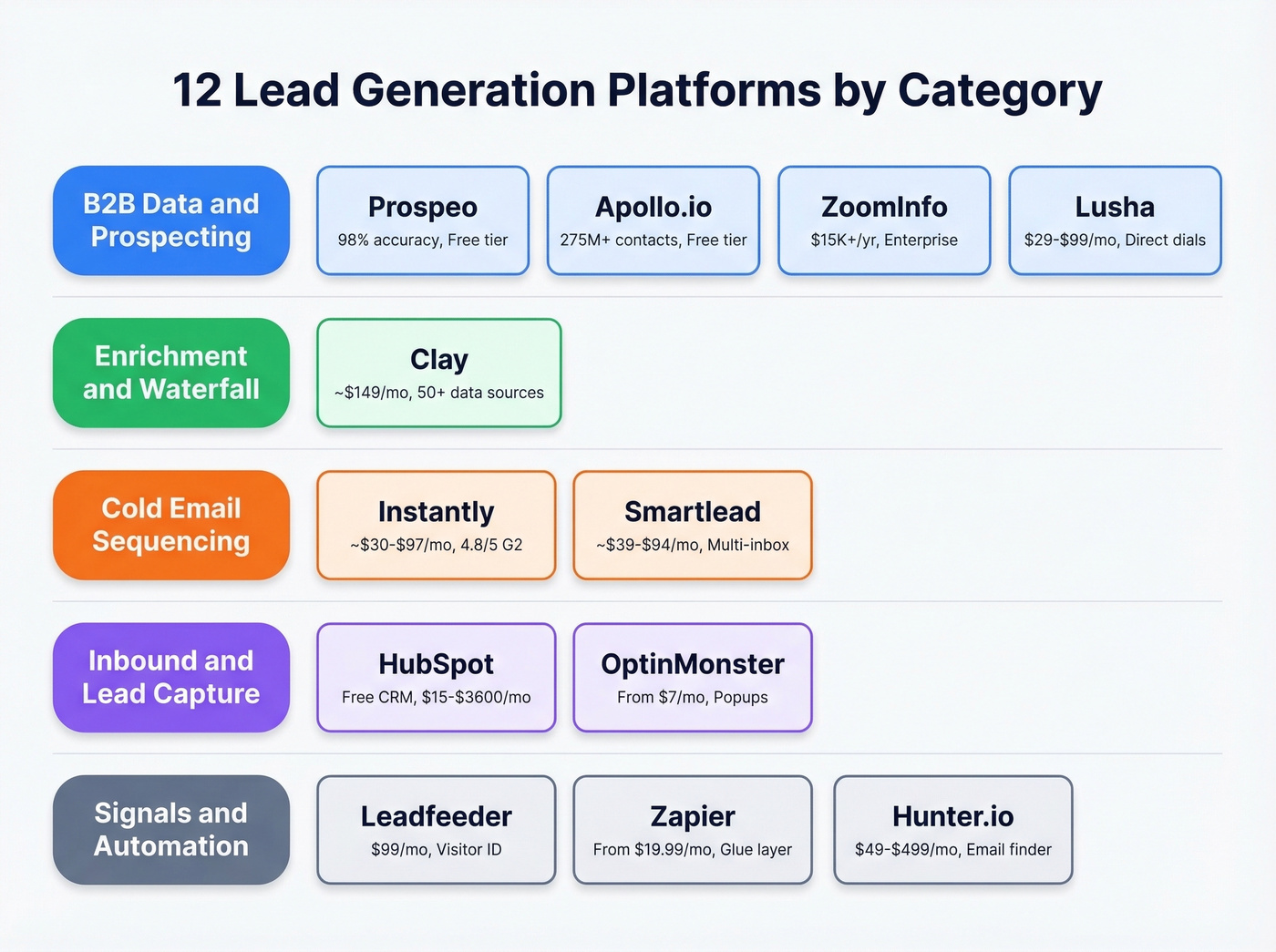
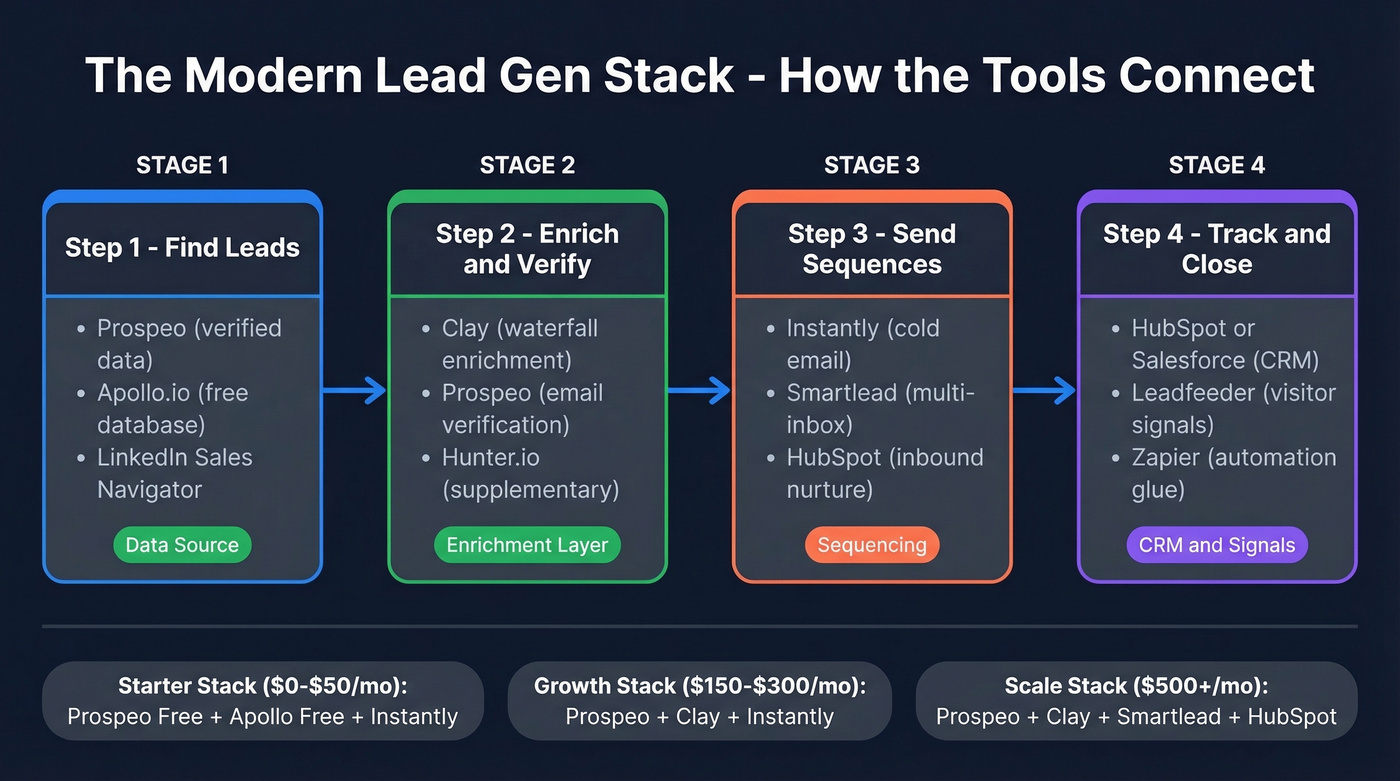
You don't need a single platform. You need a stack - two to four specialized tools that actually talk to each other. We've tested 12 lead gen platforms worth your budget in 2026, organized by function.
Our Picks (TL;DR)
| Pick | Best For | Starting Price |
|---|---|---|
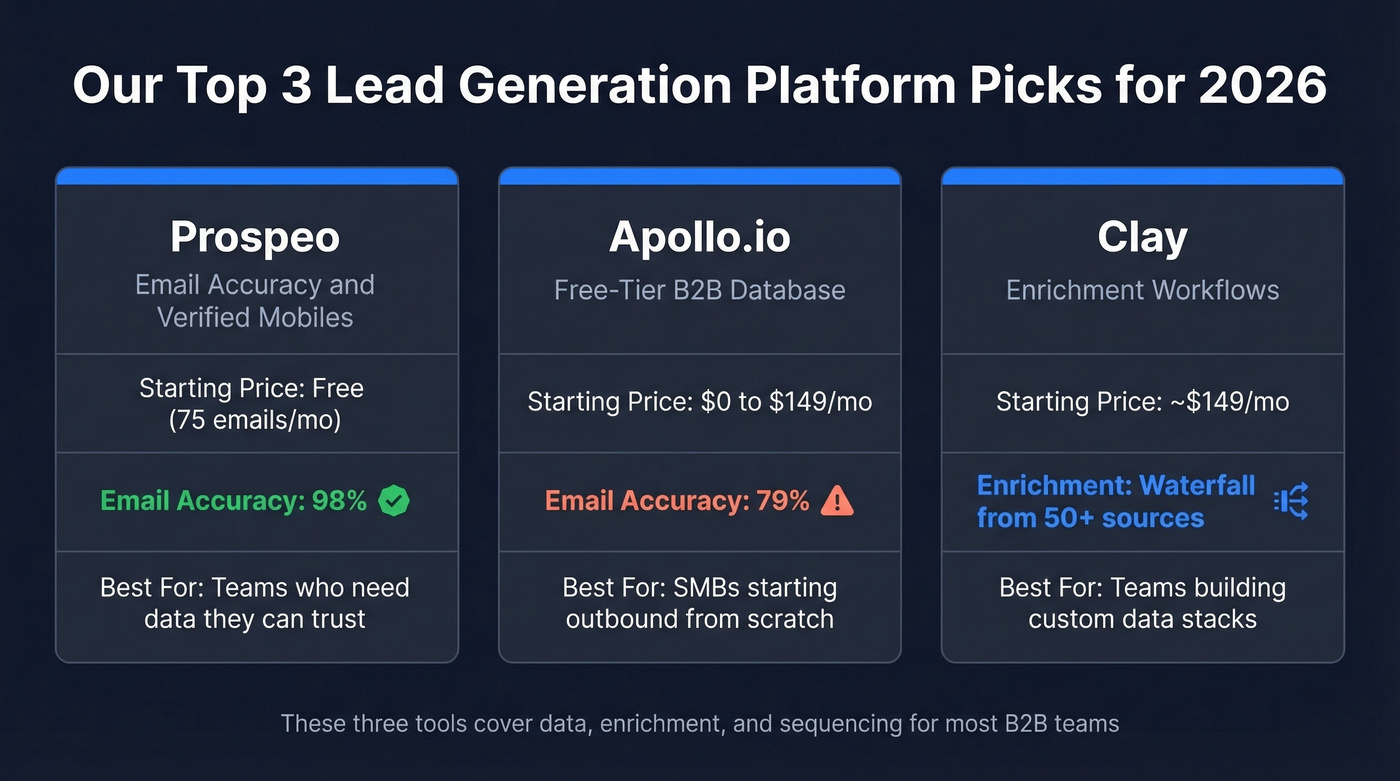
| Prospeo | Email accuracy & verified mobiles | Free (75 emails/mo) |
| Apollo.io | Free-tier B2B database | $0-$149/mo |
| Clay | Enrichment workflows | ~$149/mo |
Data Quality Beats Database Size
Every vendor brags about database size. "275 million contacts!" "300 million profiles!" The number that actually matters? Accuracy.
30% of B2B contact data becomes outdated annually. People change jobs, companies get acquired, email domains rotate. If your data provider refreshes every six weeks - the industry average - you're working with contacts already decaying by the time you hit send.

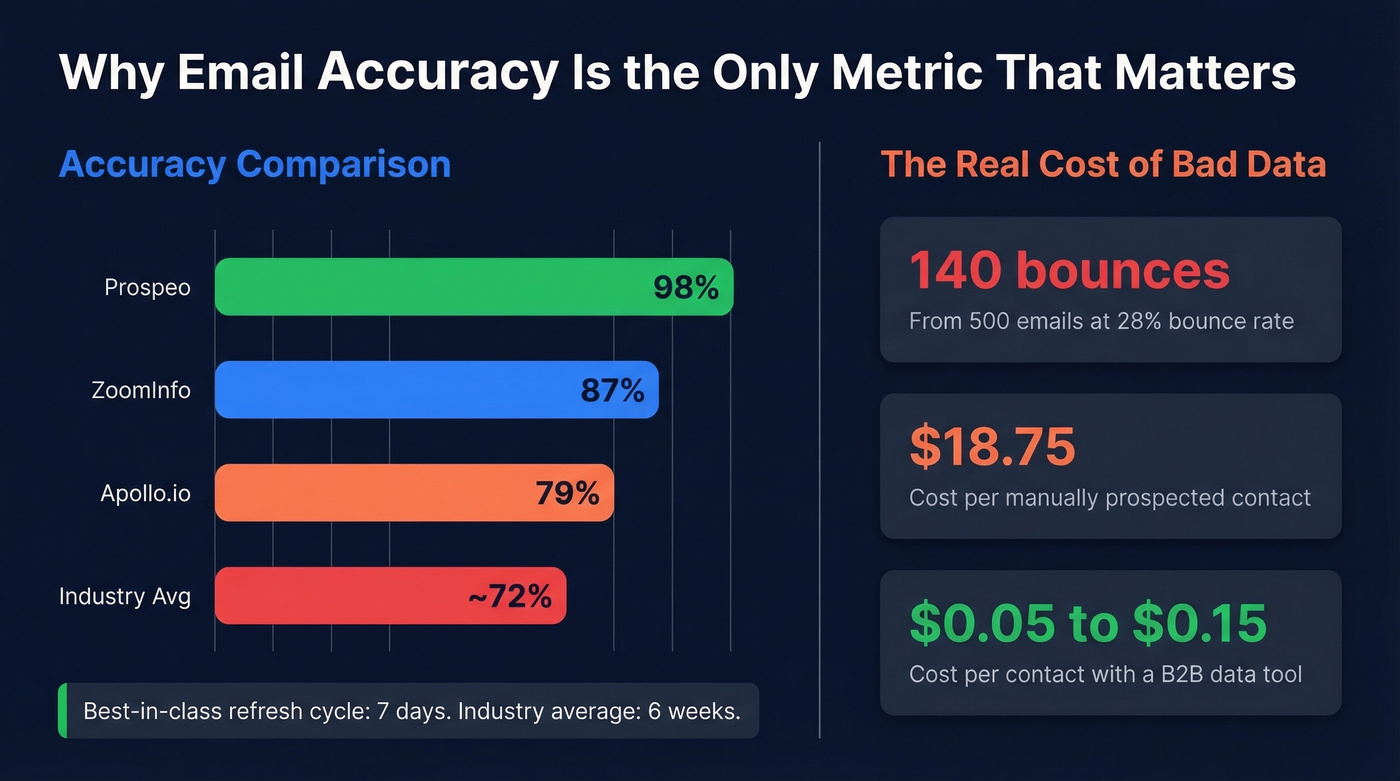
Let's run the math on bad data. You send 500 cold emails with a 28% bounce rate. That's 140 bounces hitting your sending domain in a single campaign. Your ESP flags you, deliverability tanks, and the 360 emails that did land get routed to spam. One bad batch can wreck months of domain warming.
There's a cost angle too. An SDR earning $60k/year costs roughly $37.50/hour. At two manually prospected contacts per hour, that's $18.75 per contact before you've sent a single message. A B2B data tool running at $0.05-$0.15 per contact is 100x cheaper - but only if the data is accurate enough to actually use. Best-in-class is a 7-day data refresh cycle. If a vendor can't tell you their refresh frequency, that's your answer.
The 12 Best Lead Gen Platforms
B2B Data & Prospecting
Prospeo
Use this if: You care more about data accuracy than database size, or you need verified mobile numbers that people actually pick up.
Prospeo covers 300M+ professional profiles, 143M+ verified emails, and 125M+ verified mobile numbers with a 30% pickup rate - all running through a proprietary 5-step verification process with catch-all handling, spam-trap removal, and honeypot filtering. The 98% email accuracy rate isn't a marketing number. Meritt saw bounce rates drop from 35% to under 4% and pipeline triple from $100K to $300K per week after switching. Snyk's 50 AEs cut bounce rates from 35-40% to under 5% and generated 200+ new opportunities per month, with AE-sourced pipeline up 180%.

The 30+ search filters go beyond standard firmographics - buyer intent powered by 15,000 Bombora topics, technographic data via Wappalyzer, job change signals, headcount growth, and funding events. The Chrome extension (40K+ users) works across company websites and professional profiles for one-click prospecting. Native integrations with Salesforce, HubSpot, Clay, Instantly, Smartlead, and Lemlist mean your data flows straight into whatever sequencer or CRM you're running.
Pricing is credit-based and transparent: roughly $0.01 per email, 10 credits per mobile number. Free tier gives you 75 emails and 100 Chrome extension credits per month. No contracts, no sales calls required.
Skip this if: You need a built-in email sequencer - pair with Instantly or Smartlead for that.
Apollo.io
Use this if: You're an SMB team that wants a free prospecting tool with built-in sequencing and doesn't want to pay for anything until you've outgrown the free tier.
Apollo's 275M+ contact database is the most generous free offering in B2B data. The 4.7/5 G2 rating across 9,476 reviews isn't an accident - for teams just starting outbound, it's the obvious first tool. You get search, sequencing, and a basic dialer in one platform, with paid plans running $0-$149/month.
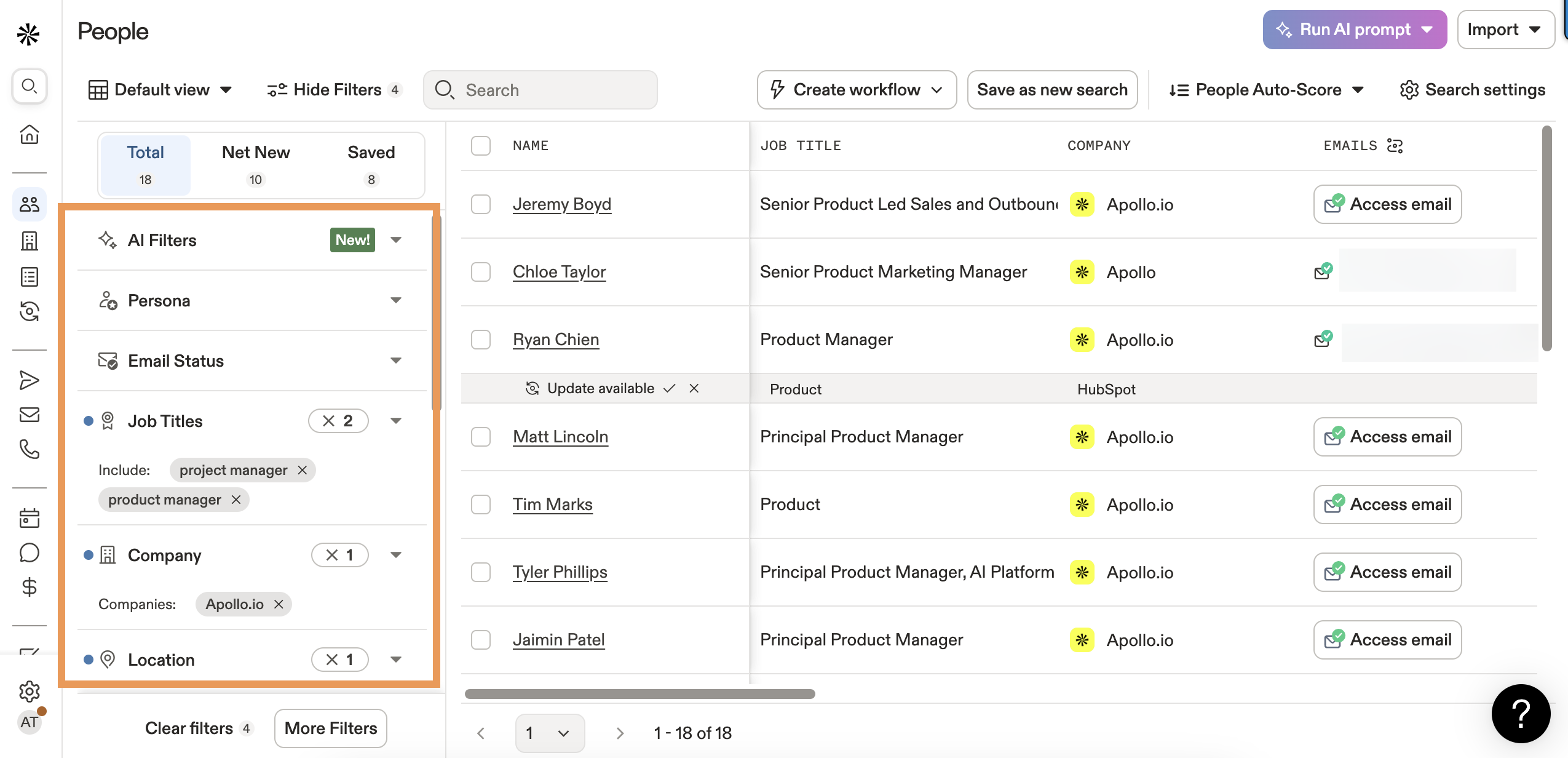
The tradeoff is data quality. Apollo's email accuracy runs around 79%, meaning roughly one in five emails bounces or hits a dead end. The bigger pain point, per Reddit threads from practitioners, is filter noise - search for "Growth" titles and you'll get real estate agents and healthcare clinics mixed in with the performance marketers you actually want. Seamless.AI ($0-$147/mo, 4.4/5 G2) occupies a similar space if Apollo's filters frustrate you.
Skip this if: You're targeting niche roles where filter accuracy matters more than database breadth, or your bounce rate tolerance is under 5%.
ZoomInfo
ZoomInfo is the incumbent for a reason. The 4.5/5 G2 rating (9,033 reviews) reflects a genuinely deep US database with strong intent signals, org charts, and workflow automation. If you're running a 50-person sales floor with Salesforce, Outreach, and a full ABM motion, ZoomInfo ties it all together.
Here's the thing: ZoomInfo is still the best all-in-one B2B lead generation software. But most teams don't need all-in-one. A typical annual contract runs $15K-$40K+/year with 2-3 seat minimums and annual commitments. Email accuracy sits around 87% - better than Apollo, but still below verification-first platforms. If your team has fewer than 20 reps, you're almost certainly overpaying for modules you'll never activate. And if your average deal size doesn't justify enterprise tooling, you definitely don't need ZoomInfo-level infrastructure.
Skip this if: You're a team under 20 reps or you can't commit to an annual contract north of $15K.
Lusha
Lusha does one thing better than anything else: instant direct dials on individual prospects.
The 45M+ contact database is smaller than Apollo or ZoomInfo, but the Chrome extension is fast and the data quality on direct dials is solid for quick, one-off lookups. Plans run $29-$99/month. It's the tool you keep around for the moments when your primary database comes up empty on a specific contact. Don't try to use it for scale prospecting - 45M contacts won't cover niche industries, and the per-credit cost adds up fast when you're pulling hundreds of leads daily.
Enrichment & Waterfall
Clay
Clay is the practitioner favorite heading into 2026. On r/sales, it's the tool that keeps getting named alongside "what actually works" - and newer tools like Trigify are riding the same enrichment wave. The key insight: Clay isn't a database. It's an orchestration layer that waterfalls data from multiple sources to build the most complete record possible for each lead.
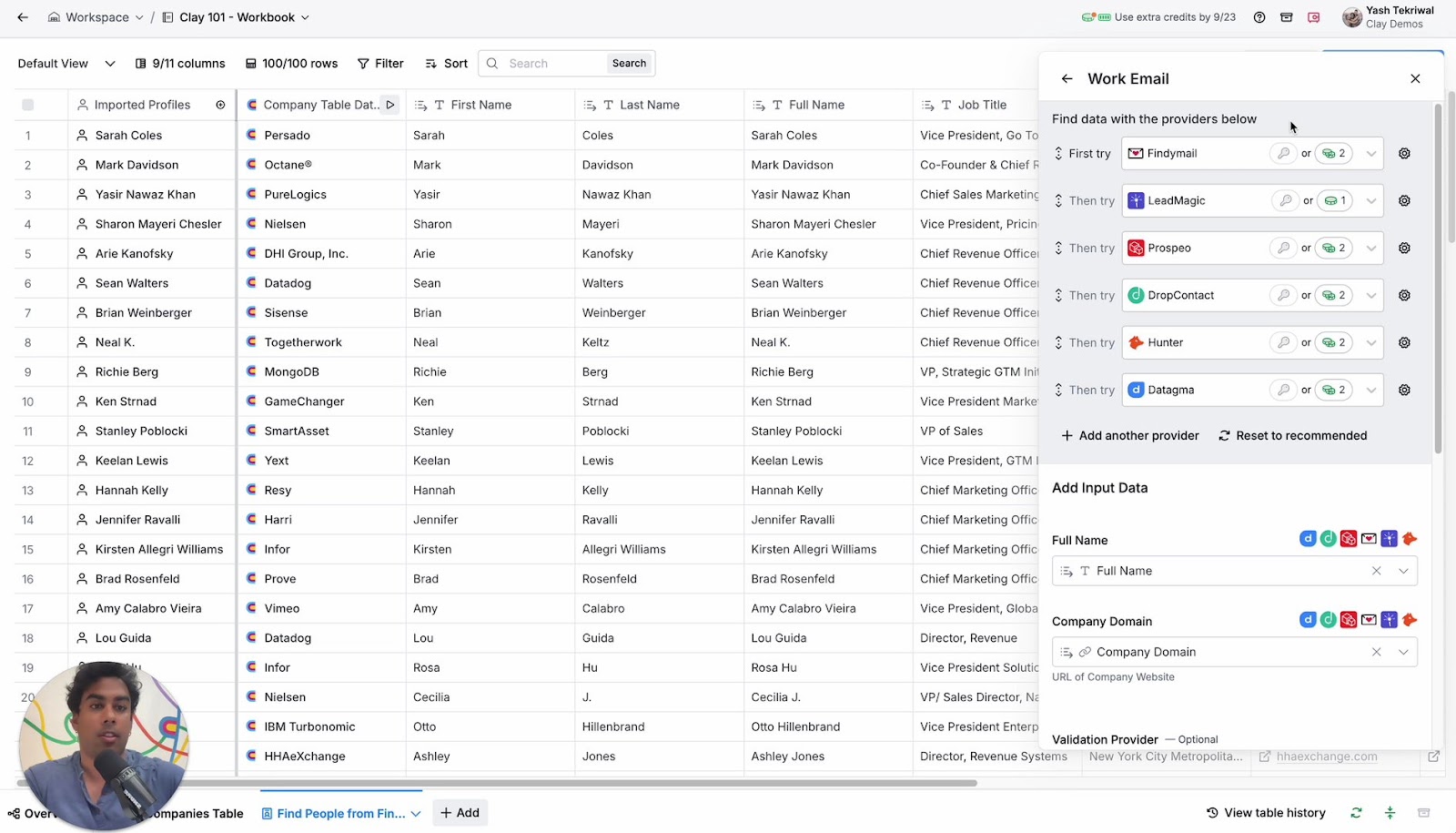
The workflow flexibility is what makes it special. Pull company data from one source, enrich emails from another, verify mobiles from a third, and score everything with AI - all in a single table. Pricing starts around ~$149/month and scales with credits. We've seen teams cut their enrichment costs by 40-60% by waterfalling through cheaper sources first and only hitting premium providers for gaps.
Clay is the most exciting tool in lead gen right now, but it's an enrichment layer, not a standalone database. You still need a data source feeding it and a sequencer sending the output. The teams getting the best results pair Clay with a verified data provider and Instantly or Smartlead for sequencing.
Skip this if: You want an all-in-one tool with a built-in database and sequencer - Clay requires you to build a stack around it.
Cold Email Sequencing
Instantly
Instantly's 4.8/5 G2 rating (4,040 reviews) makes it the highest-rated tool on this list. Plans run ~$30-$97/month depending on sending volume and features. The Clay + Instantly stack is becoming the default outbound setup for agencies and SMB teams. No built-in database - pair it with a data provider for contacts.
Smartlead
Smartlead handles multi-inbox management and cold email sequencing at ~$39-$94/month. It's the main Instantly alternative, popular with agencies running campaigns across multiple client domains. If you're managing more than five sending accounts, Smartlead's inbox rotation is worth evaluating.
Inbound & Lead Capture
HubSpot
Best moment to use this: when your first inbound leads start arriving and you need somewhere to put them that isn't a spreadsheet.
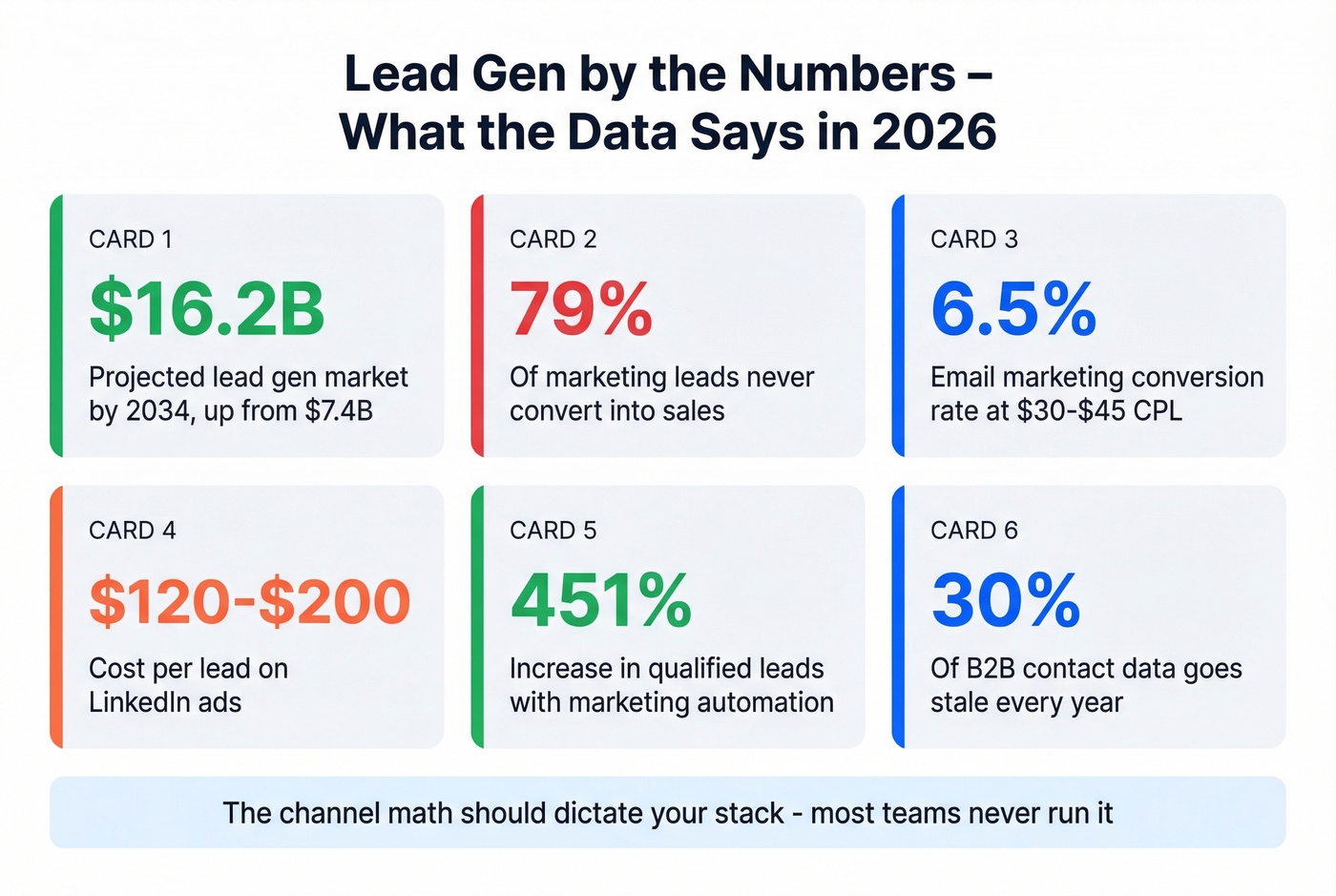
HubSpot's free CRM is genuinely useful - it's how most SMB teams start managing contacts before they can justify a paid tool. While Salesforce dominates enterprise with 25,480 G2 reviews, HubSpot is the go-to SMB CRM with a free tier that actually works. Marketing Hub pricing ranges from $15-$3,600/month depending on tier. The free tier plus forms is enough for early-stage teams. The $800+/month Professional tier is where marketing automation gets serious - and marketing automation is linked to a 451% increase in qualified leads.
Skip this if: You're purely outbound. HubSpot's strength is inbound capture and nurture, not prospecting.
OptinMonster
OptinMonster builds lead capture forms, popups, and exit-intent overlays for content-heavy websites. Starting around $7/month, it's the cheapest tool on this list. Best for teams with existing blog traffic that need to convert readers into leads. Under ~5,000 monthly visitors, ROI is usually limited.
Website Visitor Identification
Leadfeeder (Dealfront)
Leadfeeder identifies anonymous website visitors at the company level and pushes them into your CRM. The free plan gives you 7 days of data and up to 100 identified companies. Paid plans start at $99/month when paid annually. It's not a prospecting tool - it's a signal tool that tells your outbound team which accounts are already showing interest. Under ~1,000 monthly visitors, signal is usually thin.
Automation & Integration
Zapier
Zapier connects your lead gen stack - pushing data between tools that don't have native integrations. Free plan available, paid from $19.99/month. It's not a lead generation platform itself, but it's the glue that makes a multi-tool stack work without manual CSV exports.
Hunter.io
Hunter covers 200M+ emails with a simple find-and-verify workflow. Free tier available, paid plans run $49-$499/month. No sequencing, no database browsing - just email finding. Useful as a supplementary source, not a primary tool.

You saw the math: 28% bounce rates wreck domains and waste SDR hours. Prospeo's 5-step verification delivers 98% email accuracy on a 7-day refresh cycle - not the 6-week industry average. At $0.01/email, one bad batch from a cheaper tool costs more than a year of accurate data.
Stop paying for leads that bounce. Get 75 free verified emails today.
Pricing Comparison
The fact that half the industry still hides pricing behind "talk to sales" in 2026 tells you everything about how vendors treat buyers. Here's what you'll actually pay:
| Tool | Starting Price | Free Tier? | Contract? | Best For |
|---|---|---|---|---|
| Prospeo | ~$0.01/email | Yes | No | Data accuracy |
| Apollo.io | $0/mo | Yes | No | Free B2B database |
| ZoomInfo | ~$15K/yr | No | Annual | Enterprise GTM |
| Lusha | $29/mo | Yes | No | Quick lookups |
| Clay | ~$149/mo | Yes | No | Enrichment |
| Instantly | ~$30/mo | No | No | Cold email |
| Smartlead | ~$39/mo | No | No | Multi-inbox |
| HubSpot | $0/mo (CRM) | Yes | No | Inbound/CRM |
| OptinMonster | ~$7/mo | No | No | Lead capture |
| Leadfeeder | $0/mo | Yes | No | Visitor ID |
| Zapier | $0/mo | Yes | No | Integrations |
| Hunter.io | $0/mo | Yes | No | Email finding |
Build Your Stack by Budget
No single platform handles everything. The consensus on r/sales is that practitioners use three to four tools because no one product covers the full workflow. Four templates based on what you can spend:
$0/month - Bootstrap Stack Apollo free tier for database and basic sequencing, HubSpot free CRM for contact management and forms. This gets you searching, sequencing, and tracking without a credit card. Limited by volume, not capability.
$100-$300/month - Growth Stack Start with a verified data provider + a sequencer, then add enrichment as needed (see free lead generation tools if you're piecing this together on $0-$100).
$500-$1,500/month - Scale Stack Add HubSpot Marketing Hub for inbound capture and nurture on top of the Growth Stack. HubSpot handles the leads that come to you; the outbound chain handles the ones you go find.
$15K+/year - Enterprise Stack ZoomInfo for database, intent, and workflows. Salesforce for CRM and reporting. Even enterprise teams benefit from a verification layer - ZoomInfo's 87% email accuracy means 13% of your outbound hits dead ends. Running contacts through a verification step before they enter sequences catches bad data before it damages your domain.
Building your lead gen stack? Prospeo gives you 300M+ profiles, 30+ filters including buyer intent and technographics, and native integrations with Clay, Instantly, Smartlead, and HubSpot. No contracts, no sales calls - just data that actually connects you to buyers.
The lead generation platform your stack is missing. See it in 60 seconds.
How to Evaluate Any Lead Gen Tool
Before you commit to any tool, run through these five checks:
Data accuracy. "Our data is high quality" means nothing. Ask for a specific email accuracy percentage and a bounce rate guarantee. If they can't give you one, that's a red flag. The benchmark is 95%+. (If you want the benchmarks and fixes, see email bounce rate.)
Refresh frequency. How often does the database update records? Seven days is best-in-class. Six weeks is the industry average. Anything longer and you're prospecting with stale data.
Pricing transparency. If you can't see pricing on the website, you're about to enter a multi-week sales cycle for a tool you don't even want yet. Transparent pricing should be table stakes.
Integration depth. The tool needs to connect to your CRM and your sequencer natively - not through a CSV export you run manually every Tuesday. Check for Salesforce, HubSpot, and whatever outbound tool you're using. (If you're wiring tools together, use a checklist like connect outreach tool to CRM.)
Compliance. GDPR isn't optional if you're selling into Europe. Ask about opt-out enforcement, data processing agreements, and where the data is sourced. A cheap database that gets you fined isn't cheap. (For list sourcing risk, see Is It Illegal to Buy Email Lists?.)
FAQ
What's the difference between inbound and outbound lead generation?
Inbound tools capture demand that already exists - HubSpot forms, Leadfeeder visitor identification, OptinMonster popups. Outbound platforms find and reach new prospects who haven't raised their hand yet, like Apollo and Prospeo. Most B2B teams need both working together for full-funnel coverage.
How much does a lead generation platform cost?
Most SMB teams spend $100-$500/month on a two-to-three tool stack covering data, sequencing, and CRM. Enterprise teams running ZoomInfo plus Salesforce can easily spend $50K+ annually. Free tiers from Apollo, HubSpot, and Prospeo let you start at $0 and scale spending as pipeline grows.
Can one platform handle all my lead generation?
No. B2B buyers require 70+ touchpoints across six channels before purchasing. No single tool covers prospecting, enrichment, sequencing, inbound capture, and CRM well. Build a stack of two to four specialized tools that integrate cleanly - the teams trying to do everything in one place are the ones with the worst data quality.
What's a good email bounce rate for outbound campaigns?
Under 5% is the target. Above 10%, your data provider is the problem, not your copy or targeting. Real-time email verification brings bounce rates from the 15-30% range down to 2-5%. Meritt dropped from 35% to under 4% after switching providers - above 10% and you risk permanent domain reputation damage.
Do I need intent data for lead generation?
Intent data helps you prioritize, not prospect. It shows which companies are actively researching your category so you contact them first. Tools tracking thousands of topics let you layer buying signals on top of firmographic and role-based filters. It's not essential for every team, but it dramatically improves conversion rates in competitive markets where timing is everything.