

The Lead Generation Specialist: What the Role Actually Looks Like in 2026
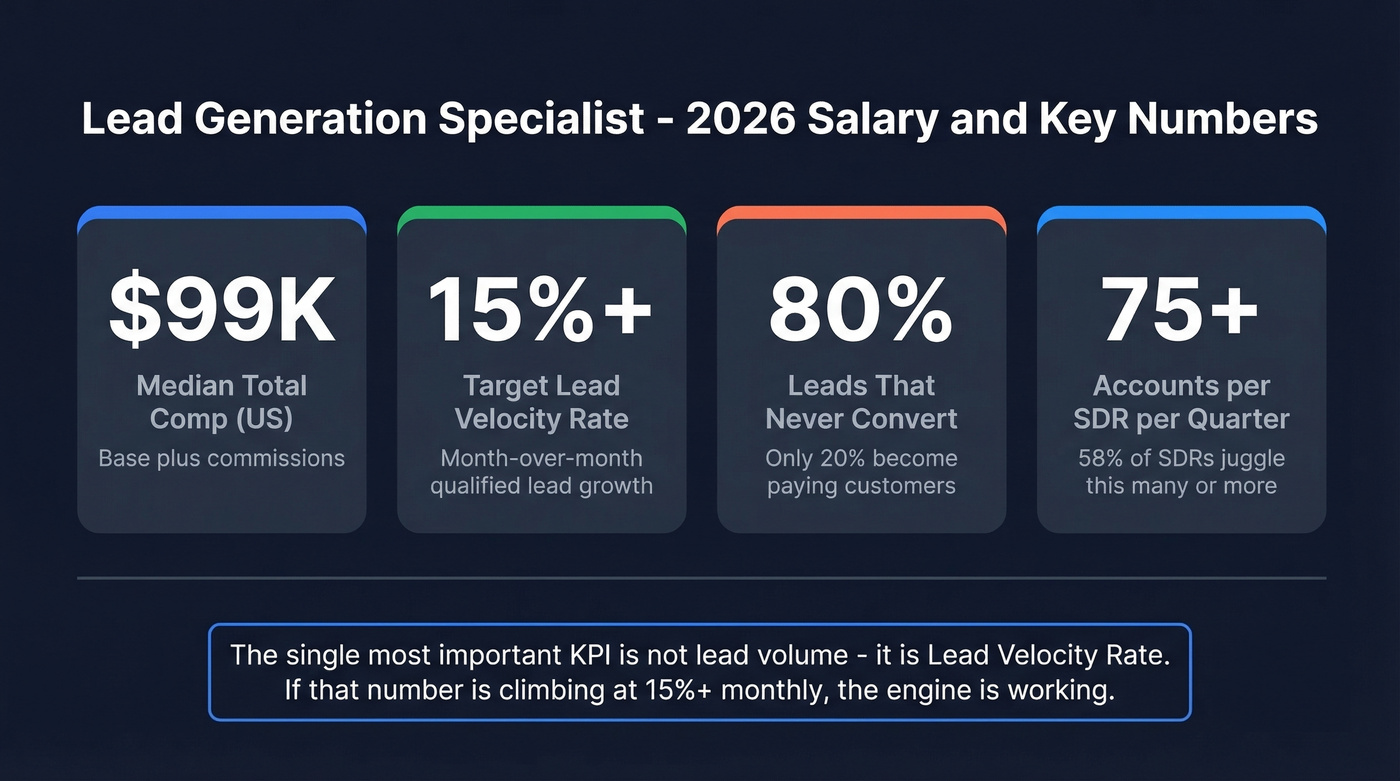
On average, only 20% of leads convert to paying customers. That means 80% of the pipeline your team builds goes nowhere - and someone has to fix that ratio. The lead generation specialist is the person who owns that problem, sitting between marketing's demand engine and the sales floor's quota pressure. When the role works, pipeline flows. When it doesn't, reps spend hours prospecting instead of closing - at Snyk, for example, 50 AEs were burning 4-6 hours per week on research before they fixed their data stack.
This role builds, qualifies, and hands off pipeline. Median total comp in the US sits at $99K/year (base plus commissions). On day one, every specialist needs three tools: a CRM, a data platform for verified contacts, and a sequencing tool. And the single most important KPI to track isn't lead volume - it's Lead Velocity Rate, the month-over-month growth in qualified leads. If that number's climbing at 15%+, the engine's working.
What Is a Lead Generation Specialist?
A lead generation specialist fills the top of the funnel with qualified prospects. They don't close deals. They don't run marketing campaigns. They sit in the gap between the two - identifying ideal buyers, building targeted lists, executing outreach, and qualifying responses before handing warm leads to account executives or SDRs.
In most orgs, the role reports to either the VP of Sales or the Head of Marketing. The reporting line often tells you more about the company's GTM philosophy than the specialist's actual work.
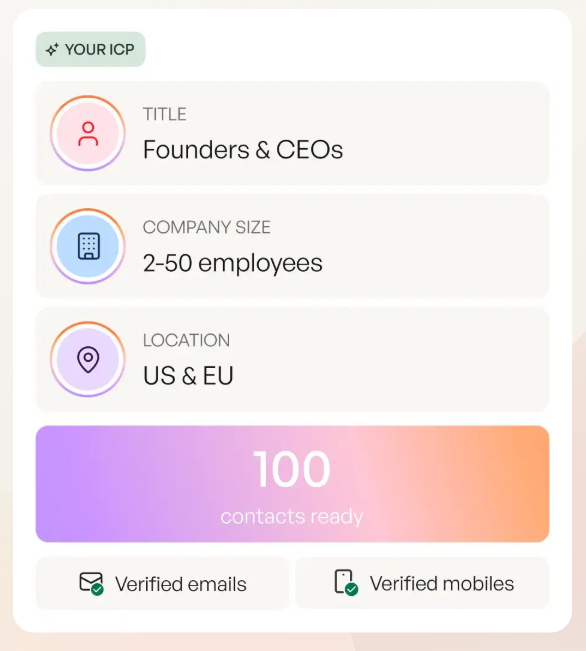
The distinction from demand generation matters. Demand gen creates awareness and inbound interest at scale - content, ads, events, SEO. A lead gen specialist works the other direction: identifying specific accounts and contacts, then reaching out directly. Think of demand gen as pulling; lead gen as pushing. The specialist is the push.
Lead Gen Specialist vs SDR vs BDR
The salary data online is confusing enough. The title confusion is worse.
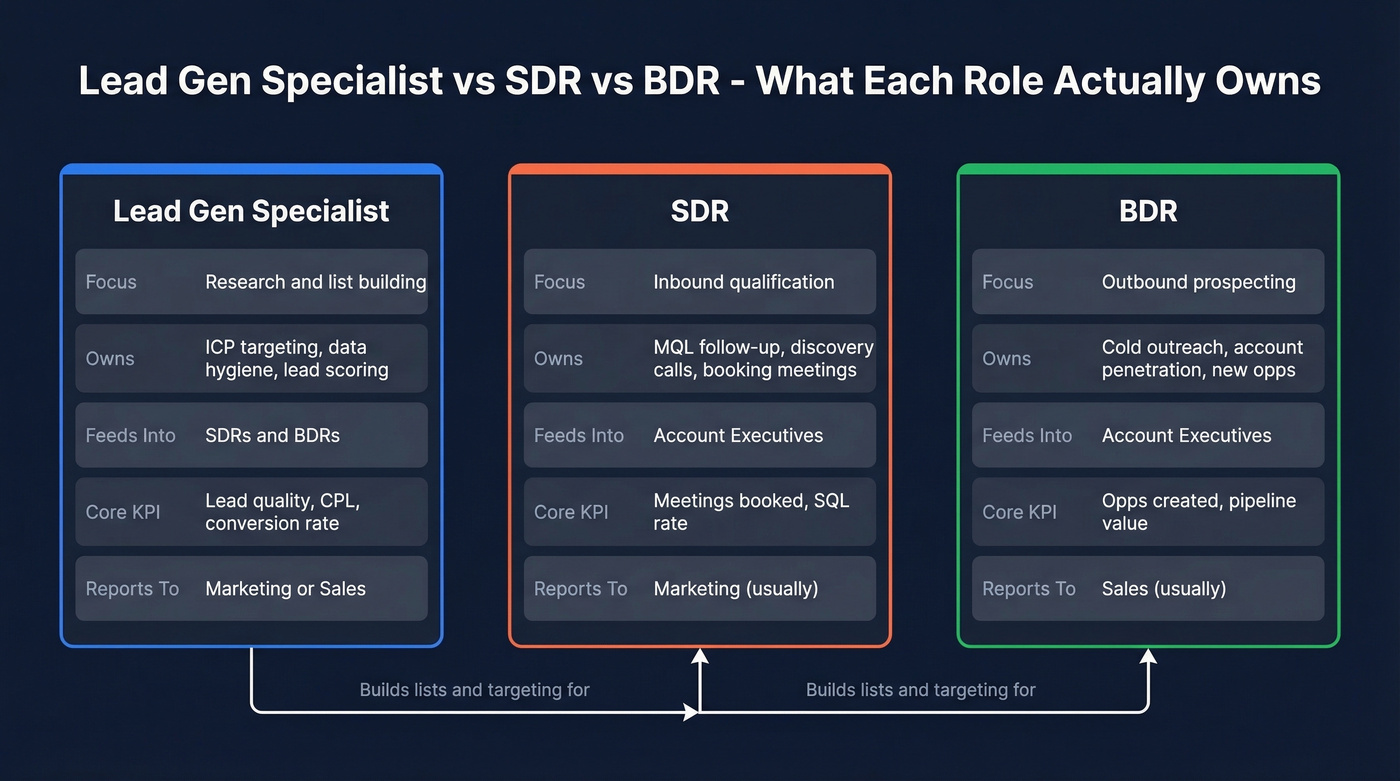
| Role | Primary Focus | Responsibilities | Core KPIs | Reports To |
|---|---|---|---|---|
| Lead Gen Specialist | List building & qualification | Research, lists, campaigns, scoring | Volume, quality, CPL, CVR | Marketing or Sales |
| SDR | Qualifying inbound leads | MQL follow-up, qualify, book meetings | Meetings booked, SQL rate | Marketing (often) |
| BDR | Outbound prospecting | Cold outreach, account penetration | Opps created, pipeline value | Sales (often) |
The specialist owns the research and list-building layer that feeds both SDRs and BDRs. SDRs typically work inbound leads generated by marketing. BDRs go outbound, creating opportunities from scratch. The specialist builds the targeting, the lists, and the scoring framework that makes both roles more effective.
Here's the thing: 58% of SDRs juggle more than 75 accounts every quarter. That's too many to research properly. A dedicated specialist takes the research burden off reps so they can focus on conversations instead of spreadsheets.
Many orgs blur these lines entirely. A 20-person startup might call the same person an SDR, a BDR, and a lead gen specialist depending on the week. The titles matter less than the function: who's building the list, who's working it, and who's closing it.
Day-to-Day Responsibilities
The day-to-day breaks into seven areas. A practical split: roughly 60% on prospecting and outreach execution, 20% on data work and CRM management, 20% on reporting, analysis, and team syncs.
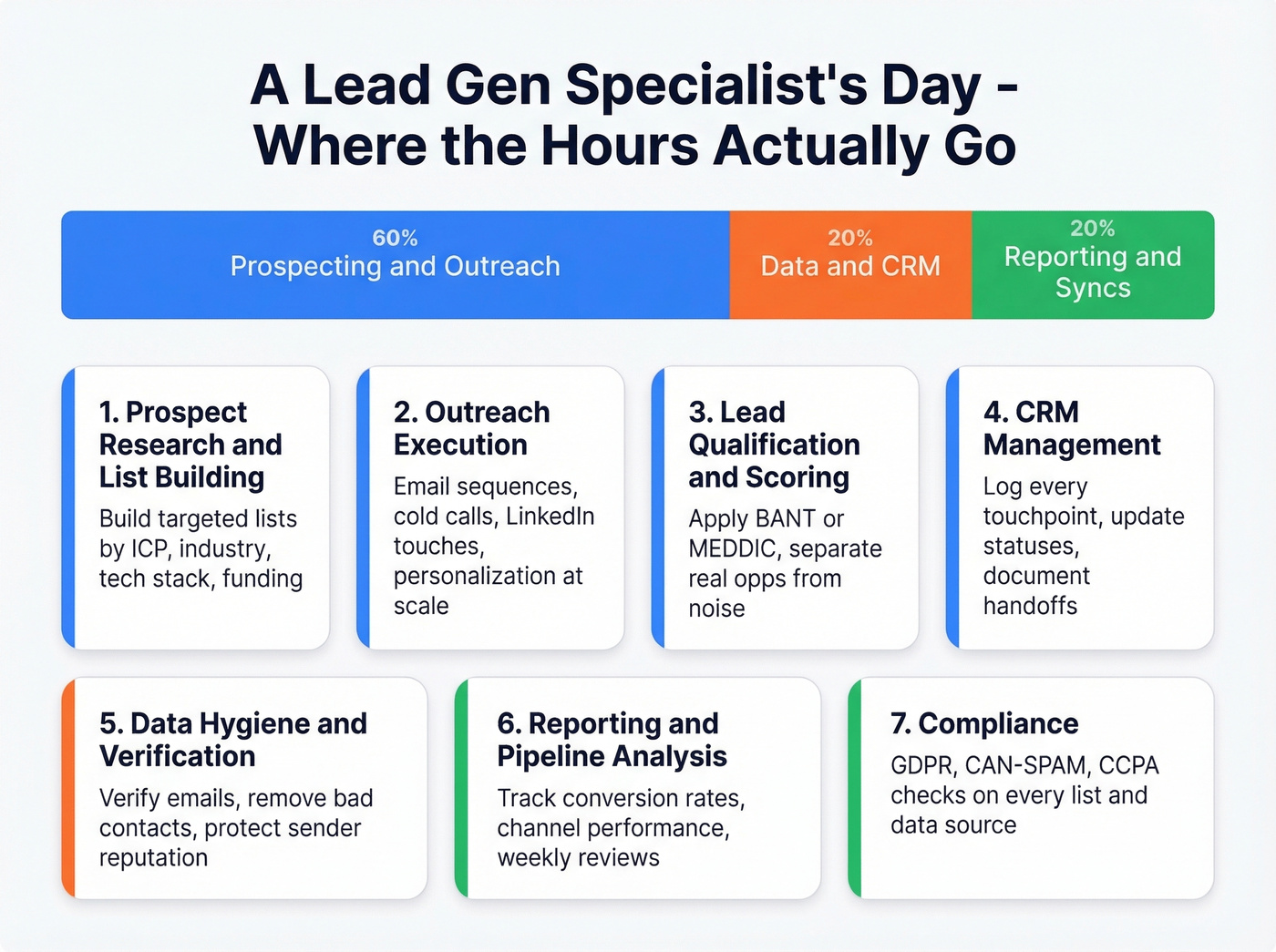
Prospect research and list building is the foundation. You're building targeted lists based on ICP criteria - industry, company size, tech stack, funding stage, job title. The quality of the list determines everything downstream. Garbage in, garbage out.
Outreach execution is always multi-channel. Email sequences, cold calls, social touches. The specialist either runs these directly or builds the campaigns that SDRs execute. Personalization at scale is the skill that separates good from great here.
Lead qualification and scoring separates real opportunities from noise. The specialist applies frameworks like BANT or MEDDIC to determine which prospects are worth an AE's time. Lead scoring models - whether manual or automated - are their responsibility to build and maintain.
Two responsibilities get overlooked but eat significant time. CRM management means every touchpoint logged, every status updated, every handoff documented. It's the difference between a pipeline you can forecast and one you're guessing at. Data hygiene and verification is the silent killer of outbound campaigns - bad emails burn sender reputation and waste sequencing credits on dead addresses. We've seen teams learn this the expensive way, launching sequences without verification and torching their domain reputation in a single week.
Reporting and pipeline analysis rounds out the analytical side. Weekly pipeline reviews, conversion rate tracking, campaign performance analysis. The specialist should know which channels, messages, and segments are converting - and adjust accordingly.
Compliance is increasingly a core competency, not an afterthought. GDPR, CAN-SPAM, CCPA - every list, every email, every data source needs to pass compliance checks. In the EU, that means documented consent trails and the ability to honor deletion requests within required timelines. In practice, this shapes which data sources you can use and how you build lists.
Essential Skills
The skills cluster into three groups, and the best specialists are strong in all three.
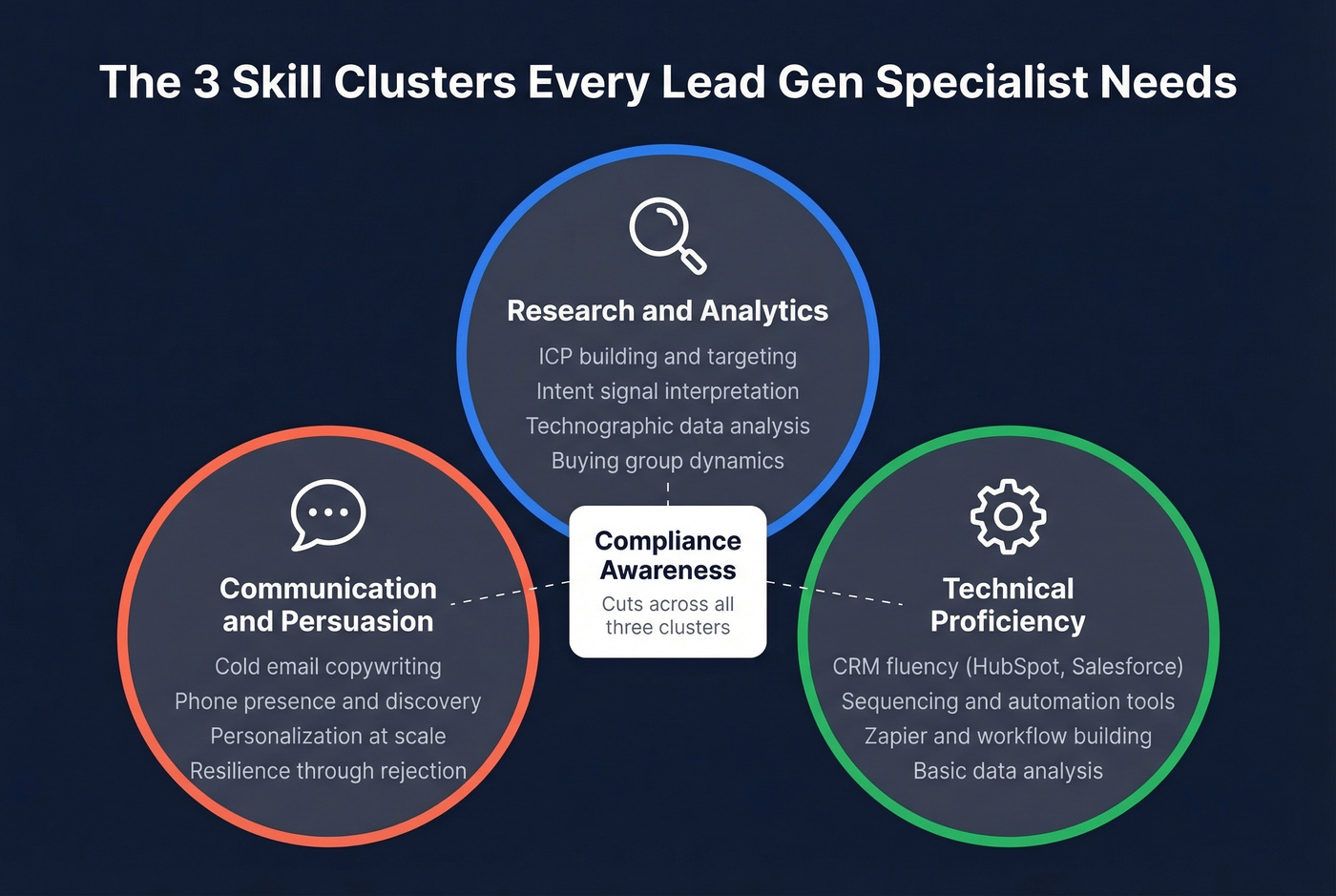
Research and analytics. ICP building is the starting point - knowing which companies and contacts to target, and why. But the 2026 specialist also needs to interpret intent signals, read technographic data, and understand buying group dynamics. Data interpretation isn't a nice-to-have anymore; it's the core of the role.
Communication and persuasion. Cold email copywriting, phone presence, and the ability to personalize at scale without sounding like a template. The best specialists write outreach that reads like it came from a human who did their homework - because it did. Resilience matters too. Ignore rates in outbound are brutal, and the role requires someone who doesn't internalize constant rejection.
Technical proficiency. CRM fluency in HubSpot or Salesforce (usually both), sequencing tools, data platforms, and basic automation. The specialist who can build a Zapier workflow to route leads from enrichment to sequencing without asking for help is worth twice what they're paid. Compliance awareness - understanding what you can and can't do with prospect data across jurisdictions - cuts across all three clusters.
The Tool Stack
If we were building a specialist's stack from scratch, we'd think in three layers: data platform, CRM, and sequencer. Everything else is optional until you've nailed those three.

Layer 1: Data platform. The data platform is the foundation because nothing else works if your contacts are wrong. Prospeo covers 300M+ professional profiles with 98% email accuracy, 143M+ verified emails, and 125M+ verified mobile numbers. The 7-day data refresh cycle stands out - the industry average is 6 weeks, which means most platforms are emailing people who changed jobs a month ago. The 30+ search filters let specialists build hyper-targeted lists by buyer intent, technographics, job changes, headcount growth, funding, and revenue. Native integrations with HubSpot, Salesforce, Instantly, Lemlist, and Clay mean leads flow directly into whatever CRM and sequencer you're running. Pricing starts at roughly $0.01 per email with a free tier of 75 verified emails per month. One proof point: Meritt dropped their bounce rate from 35% to under 4% after switching, and their pipeline tripled from $100K to $300K per week.
Layer 2: CRM. HubSpot's free CRM is the obvious starting point for teams under 20 reps. It's intuitive, the reporting is solid, and the Starter plan at $15/user/month is a common entry point for teams that want more automation. Salesforce is the enterprise standard - more powerful, more customizable, and significantly more complex. Starter runs $25/user/month, with higher tiers commonly landing in the $75-$175/user/month range once teams need real workflow automation.
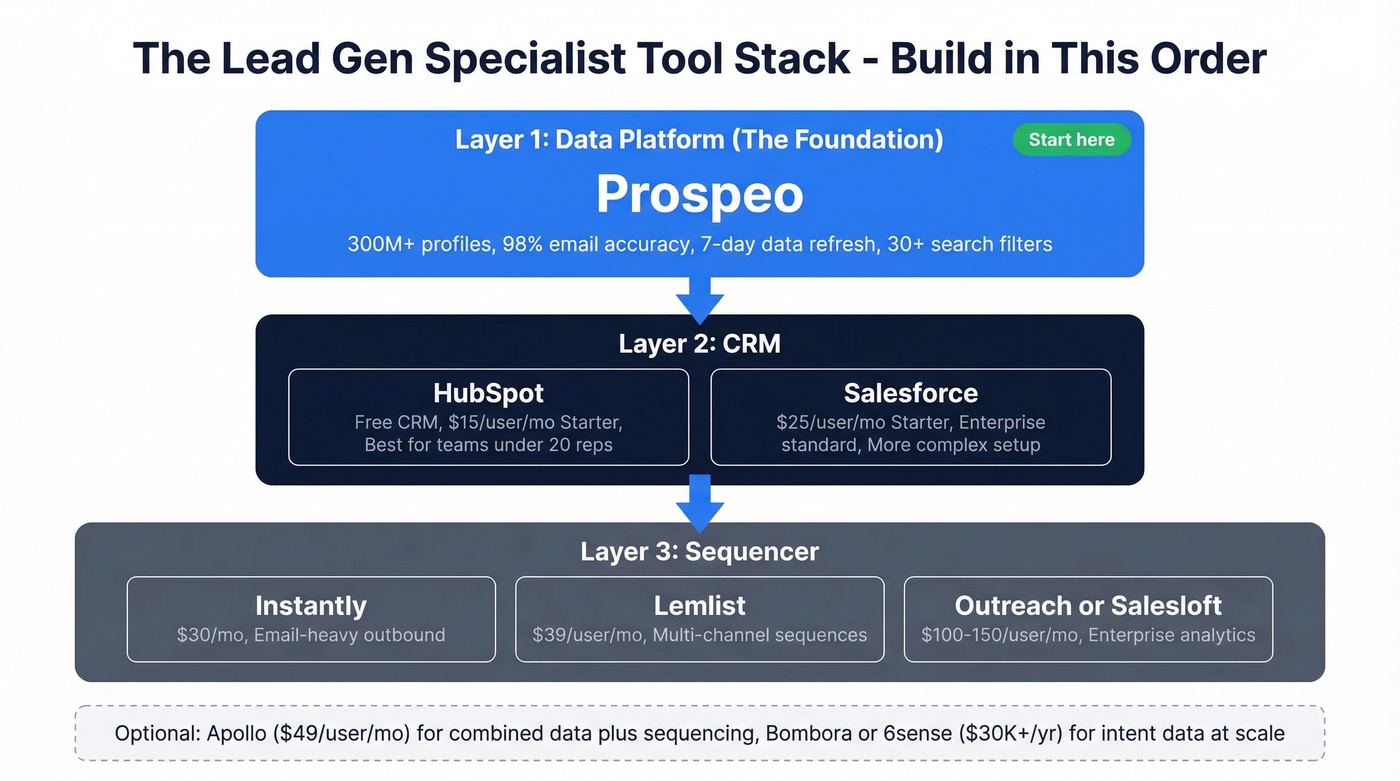
Layer 3: Sequencer. Instantly at ~$30/month is the budget pick for email-heavy outbound. Lemlist at ~$39/user/month adds multi-channel capabilities - email, calls, and social touches in one sequence. For enterprise teams, Outreach or Salesloft at $100-$150/user/month offer deeper analytics and coaching features, but they're overkill for most specialist-level workflows.
Optional additions. Apollo at ~$49/user/month combines a decent database with built-in sequencing - useful if you want one tool instead of two, though the data accuracy doesn't match dedicated platforms. For intent data beyond what's built into your data platform, Bombora or 6sense at $30K-$100K+/year layer buying signals onto your targeting - worth it at scale, expensive to justify for small teams. Skip these until you're running outbound across 500+ accounts per quarter.
| Tool | Category | Starting Price | Free Tier? |
|---|---|---|---|
| Prospeo | Data platform | ~$0.01/email | Yes (75 emails/mo) |
| HubSpot | CRM | $15/user/mo | Yes (free CRM) |
| Salesforce | CRM | $25/user/mo | No |
| Instantly | Email sequencing | ~$30/mo | No |
| Lemlist | Multi-channel sequencing | ~$39/user/mo | No |
| Apollo | Data + sequencing | ~$49/user/mo | Yes (limited) |
| Outreach / Salesloft | Enterprise sequencing | ~$100-150/user/mo | No |

The article mentions Snyk's 50 AEs burning 4-6 hours a week on research. After switching to Prospeo, their bounce rate dropped from 35-40% to under 5% and AE-sourced pipeline jumped 180%. That's what happens when your lead gen specialist has 300M+ profiles with 98% verified emails and 30+ search filters - including intent data, technographics, and headcount growth.
Give your specialist the data stack that actually converts.
You just read that data hygiene is the silent killer of outbound. Prospeo's 5-step verification, catch-all handling, and spam-trap removal exist to solve exactly that. Every record refreshes every 7 days - not the 6-week industry average. At $0.01 per email with 98% accuracy, bad data stops being a line item your lead gen team has to worry about.
Stop torching your domain reputation with unverified contacts.
Salary Breakdown in 2026
The salary data online is a mess. Indeed says $19.33/hour (~$40K annualized). Glassdoor says $99K/year. The difference? One is base-only from job postings; the other includes commissions and bonuses across 800 reported salaries. Context matters.
| Metric | Amount | Source |
|---|---|---|
| Median total pay | $99K/yr | Glassdoor (800 salaries) |
| Base pay range | $48K-$80K/yr | Glassdoor |
| Additional pay | $28K-$52K/yr | Glassdoor |
| Avg hourly (postings) | $19.33/hr | Indeed (3.1K salaries) |
| 75th percentile total | $131K/yr | Glassdoor |
| Freelance/contract | $25-$60/hr | Market estimate |
The base-plus-variable structure is standard. Most orgs tie the variable component to qualified leads accepted by sales - not raw lead volume - which is the right incentive structure. Tying comp to volume just incentivizes list dumps.
Geography swings the numbers significantly. Las Vegas tops Indeed's city list at $35.23/hour, Fort Lauderdale comes in at $31.82/hour, and Austin sits around $21.07/hour. Remote roles tend to peg compensation to the company's HQ market or a national median.
Industry matters even more than location.
| Industry | Median Total Pay |
|---|---|
| Pharma & Biotech | $106K |
| Financial Services | $75K |
| Media & Communication | $72K |
| Real Estate | $65K |
| Telecommunications | $63K |
Pharma and biotech pay a premium because the sales cycles are long, the buyers are specialized, and the compliance requirements are steep. If you're a specialist choosing between industries, the comp gap between pharma and telecom is $43K. That's not trivial.
For freelancers and contractors, expect $25-$60/hour depending on experience, niche expertise, and whether you're doing strategy or execution. Specialists with proven playbooks in a specific vertical command the top of that range.
KPIs and Performance Benchmarks
Lead Velocity Rate is the metric that matters most. LVR measures month-over-month growth in qualified leads, and for B2B SaaS companies, 15%+ is the benchmark that signals healthy pipeline momentum. If LVR is flat or declining, no amount of closing skill downstream will save the quarter.
| Metric | Benchmark | Why It Matters |
|---|---|---|
| Lead Velocity Rate (LVR) | 15%+ MoM growth | Predicts future revenue better than pipeline size |
| Cost Per Lead (CPL) | $30-$150 (B2B SaaS) | Ties specialist output to budget efficiency |
| SAL Velocity | Under 48 hours | Measures handoff speed and lead quality |
| In-Market Coverage | 60%+ of active accounts | Shows whether you're finding buyers, not just contacts |
| Buying Group Depth | 3-5 contacts per account | Multi-threading reduces single-thread risk |
Beyond LVR, the standard funnel metrics still apply: visitor-to-lead conversion, lead-to-MQL, MQL-to-SQL, and lead-to-customer rate. Cost per lead and customer acquisition cost tie the specialist's work to revenue.
What's changed in 2026 is the measurement layer on top. Buyers complete nearly 70% of their journey anonymously before ever talking to sales. Traditional funnel metrics miss most of the buying process. Modern specialists track SAL velocity, cost-per-opportunity, buying group depth, and in-market coverage - the percentage of actively researching accounts you're actually reaching.
The shift from "how many leads did we generate?" to "how many in-market accounts did we reach, and how fast did sales accept them?" is the defining KPI evolution of the role. Specialists who only report on lead volume are already behind.
How AI Is Changing the Role
Daily AI usage among knowledge workers jumped 233% through 2025 per the Slack Workforce Index, and daily users report 64% higher productivity. Automated customer interactions via AI agents are projected to grow from 3.3 billion in 2025 to 34 billion by 2027. The lead gen specialist's job isn't disappearing - but the job description is being rewritten in real time.
The manual tasks that used to fill a specialist's day - researching companies, finding contact info, writing first-draft outreach, logging CRM updates - are increasingly handled by AI agents. The role is shifting from "managing tools" to "designing agent workflows." The specialist who can architect a system where AI handles research, enrichment, and initial outreach while they focus on qualification strategy and edge cases is worth three specialists who do everything by hand.
Look, stop hiring people to do manual prospecting. The 2026 specialist is a systems thinker who designs workflows, QAs outputs, and optimizes the machine. The new skill requirements reflect this - prompt engineering, workflow design, data quality auditing, and the judgment to know when AI output needs a human touch. Teams aren't going to solve lead gen by hiring more hands. They'll solve it by hiring smarter architects.
One strong opinion from our team: if your average deal size is under $10K, you probably don't need a full-time specialist at all. A founder or marketing generalist armed with AI workflows and a solid data platform can handle the volume. The role becomes essential when deal complexity, account volume, or compliance requirements exceed what a generalist can manage alongside their other responsibilities.
How to Hire the Right Specialist
You posted on three job boards and got 200 applicants. Half list "lead generation guru" in their bio. Here's how to separate signal from noise.
The evaluation framework. Give candidates three tasks. First, an ICP exercise: hand them your product and ask them to define the ideal customer profile, target accounts, and contact personas. Second, a sample outreach sequence: three-touch email sequence for a specific persona, written from scratch. Third, a data quality audit: give them a messy CSV of 100 contacts and see how they clean it. These three tasks test research thinking, communication skill, and technical rigor - the three skill clusters that matter.
Red flags. Candidates who recommend buying lists as a primary strategy. Anyone without a follow-up cadence philosophy. Generic templates that could apply to any product. No lead scoring methodology or qualification framework. If they can't explain how they'd determine whether a lead is worth an AE's time, they're not ready.
Comp structure. Base plus variable, always. Tie the variable to qualified leads accepted by sales - not raw volume, not meetings booked by the specialist themselves unless they're also doing SDR work. A 60/40 or 70/30 base-to-variable split is standard.
Equipping the new hire. Give your new specialist access to a self-serve data platform on day one - no procurement cycle, no annual contract, no "talk to sales" gate. The faster they can build their first list and launch their first sequence, the faster you'll know if the hire was right. We've seen teams lose weeks waiting for tool access while a new specialist sits idle, and it's one of the most avoidable mistakes in onboarding.
Outsource or hire in-house? The answer depends on your stage. Outsourcing to an agency makes sense when you need pipeline fast but don't have the management bandwidth to train and ramp a specialist - expect $3K-$8K/month for a dedicated resource. Hire in-house when lead gen is a core, ongoing function and you need someone embedded in your ICP, product, and sales process. The in-house specialist builds institutional knowledge that no agency can replicate. Most companies that start outsourced eventually bring the role in-house once they've validated their ICP and outbound playbook.
How to Become One
There's no single degree or certification that unlocks this role. Most specialists come from one of three backgrounds: sales (SDR or retail), marketing (content or digital), or customer support. The common thread is comfort with outreach and a willingness to learn data tools quickly.
The most practical path is to start with free or low-cost tools and build a portfolio of real results. Sign up for a free CRM tier, grab a data platform with a free plan, and run a small outbound campaign - even for a side project or a friend's business. Hiring managers care far more about demonstrated work than certifications.
For candidates entering the field with no experience, three moves accelerate the ramp. First, learn a CRM inside and out - HubSpot's free academy is the fastest path. Second, practice cold email copywriting by writing and A/B testing real sequences. Third, get comfortable with data hygiene: deduplication, verification, and enrichment workflows. These three skills cover 80% of what you'll do in the first six months.
The specialists who advance fastest treat the role as a systems problem, not a task list. They document what works, build repeatable playbooks, and measure everything - which is exactly the mindset that opens doors to AE, RevOps, or demand gen roles down the line.
Career Path and Progression
Most specialists should plan on 12-18 months in the role before advancing. The promotion trigger in most orgs is hitting 90%+ of quota for two straight quarters - that's the signal you've mastered the fundamentals and you're ready for more complexity.
Five paths open up from here, and they're not equally obvious.
| Path | Typical Timeline | Comp Range |
|---|---|---|
| Account Executive | 12-18 months | $120K-$180K OTE |
| Customer Success Manager | 15-20 months | $80K-$110K total |
| Revenue Operations | 18-24 months | $90K-$130K total |
| Marketing / Demand Gen | 18-24 months | Varies by org |
| Freelance / Fractional | 24+ months | $25-$60/hr ($80K-$150K+) |
The AE path is the default, and for good reason - it's the highest-ceiling comp track for individual contributors. High performers can make the jump in 10-12 months. CSM is the natural fit for specialists who are better at relationship-building than cold outreach.
RevOps is the most underrated path. Fewer people compete for it, the ceiling is higher long-term, and the skills transfer perfectly - a specialist who understands data quality, CRM architecture, and pipeline metrics already thinks like a RevOps analyst. The $90K-$130K range is just the starting point; senior RevOps roles at growth-stage companies regularly clear $150K+.
A fifth option - freelance or fractional lead gen consulting - is increasingly viable, especially for specialists with proven playbooks in a specific vertical. If you can demonstrate a repeatable system for a niche industry, you can command $60+/hour and build a calendar through referrals. The consensus on r/sales is that vertical specialization is what separates $30/hour freelancers from $80/hour ones.
FAQ
What is a lead generation specialist?
A lead generation specialist fills the top of the sales funnel by researching target accounts, building contact lists, executing outreach campaigns, scoring responses, and handing qualified leads to AEs or SDRs. The role sits between marketing and sales, ensuring pipeline flows consistently so reps spend time closing instead of researching.
How much does a lead generation specialist earn in 2026?
Median total compensation is $99K/year in the US, per Glassdoor (800 salaries). Base pay ranges $48K-$80K, with commissions adding $28K-$52K. Pharma and biotech specialists earn a median of $106K, while telecom averages closer to $63K.
What's the difference between a lead gen specialist and an SDR?
Lead gen specialists focus on top-of-funnel list building, campaign execution, and lead scoring. SDRs qualify and convert those leads into booked meetings. The specialist builds the targeting and lists; the SDR works them. Many orgs combine both functions, but the core responsibilities are distinct.
What tools do lead generation specialists need?
The core stack has three layers: a data platform for verified contacts, a CRM like HubSpot or Salesforce, and a sequencing tool like Instantly or Lemlist. Larger teams add intent data platforms and enterprise sequencers like Outreach or Salesloft. Budget the stack at $80-$200/month per specialist for mid-market teams.
Is lead generation a good career path?
Yes - demand is strong, comp is competitive at $99K median, and the role opens clear paths to account executive ($120K-$180K OTE), revenue operations ($90K-$130K), or freelance consulting ($60+/hour). As AI automates manual tasks, the role is becoming more strategic, which increases both job security and earning potential.