

Lead Scraping in 2026: The Workflow, Tools, and Rules That Actually Work
Your agency just landed a new client who wants 500 qualified leads per week. You pull a list from a database, send the first campaign, and 60 emails bounce. The client's domain takes a reputation hit before the second sequence even fires.
60% of marketing leads originate from outbound efforts - and the quality of your scraped data determines whether those efforts convert or crater. Lead scraping is the easy part. Verification is the hard part.
What Is Lead Scraping?
It's the automated extraction of contact data from web sources - business directories, Google Maps, company websites, professional profiles - structured into usable lists for outbound campaigns. The data points you're pulling typically include names, email addresses, phone numbers, job titles, company names, and addresses.
A roofing contractor in Phoenix needs local homeowner leads. A SaaS SDR needs VP-level contacts at Series B companies. A recruiting firm needs hiring managers in healthcare. The use case varies, but the mechanic is the same: find the source, extract the data, clean it, use it.
The sources matter more than most people realize. Google Maps gives you fresh local business data. Company websites give you current team pages. Professional profile databases give you job titles and career history. Each source has different freshness, accuracy, and compliance implications - and combining them with verification is what separates a productive workflow from a spam cannon. Understanding how to match the right source to the right extraction method is the skill that separates productive teams from those burning through domains.
Quick Picks
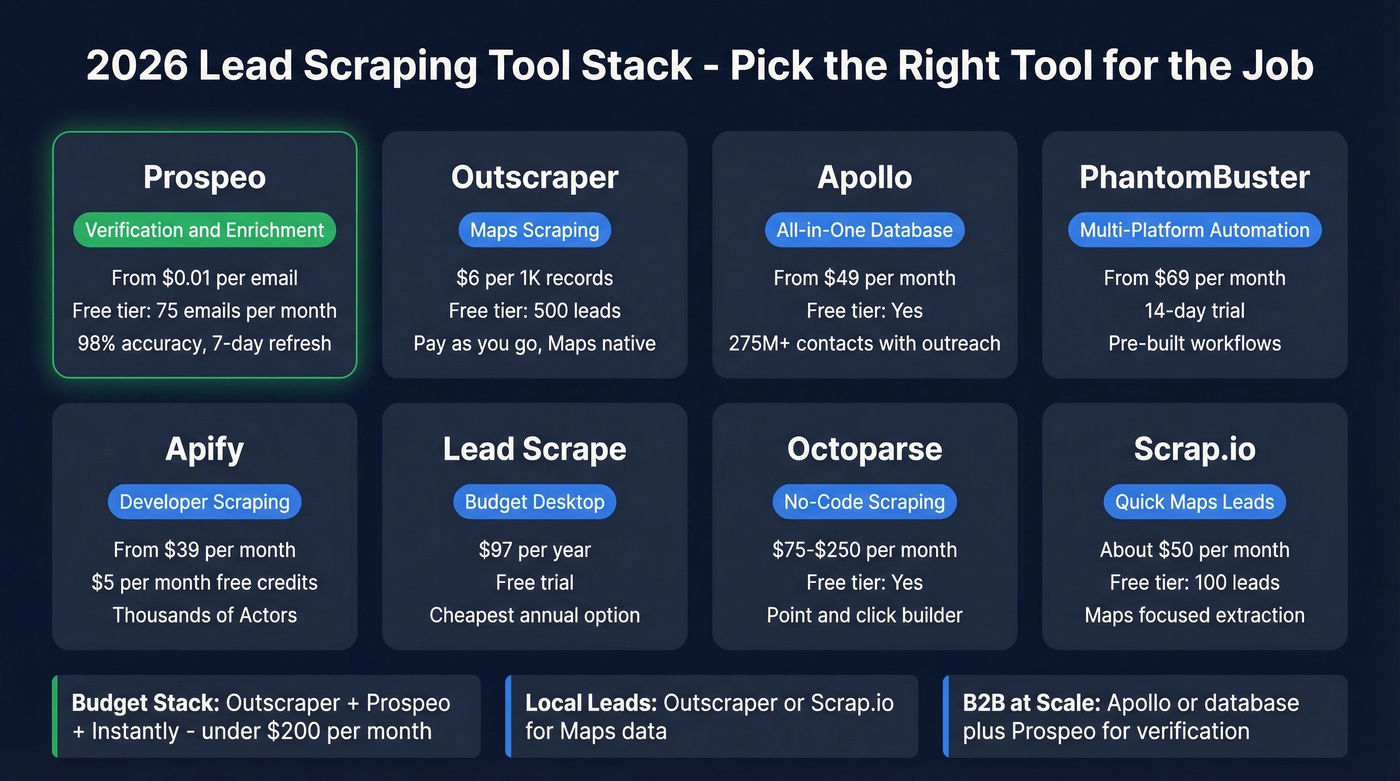
- For local/Maps leads: Outscraper or Scrap.io, then scrape, verify, enrich, and send.
- For B2B at scale: Apollo or a dedicated B2B database - filter by ICP, verify, outreach.
- Budget stack from scratch: Outscraper ($6/1K) + Prospeo (free tier, 75 emails/mo) + Instantly. Under $200/month total.
If you're scraping without verifying, you're gambling with your domain reputation. The verification step isn't optional - it's the whole point.
Scraping vs. Lists vs. Databases
Three ways to get contact data. Each has a different cost-quality profile, and most teams pick wrong.
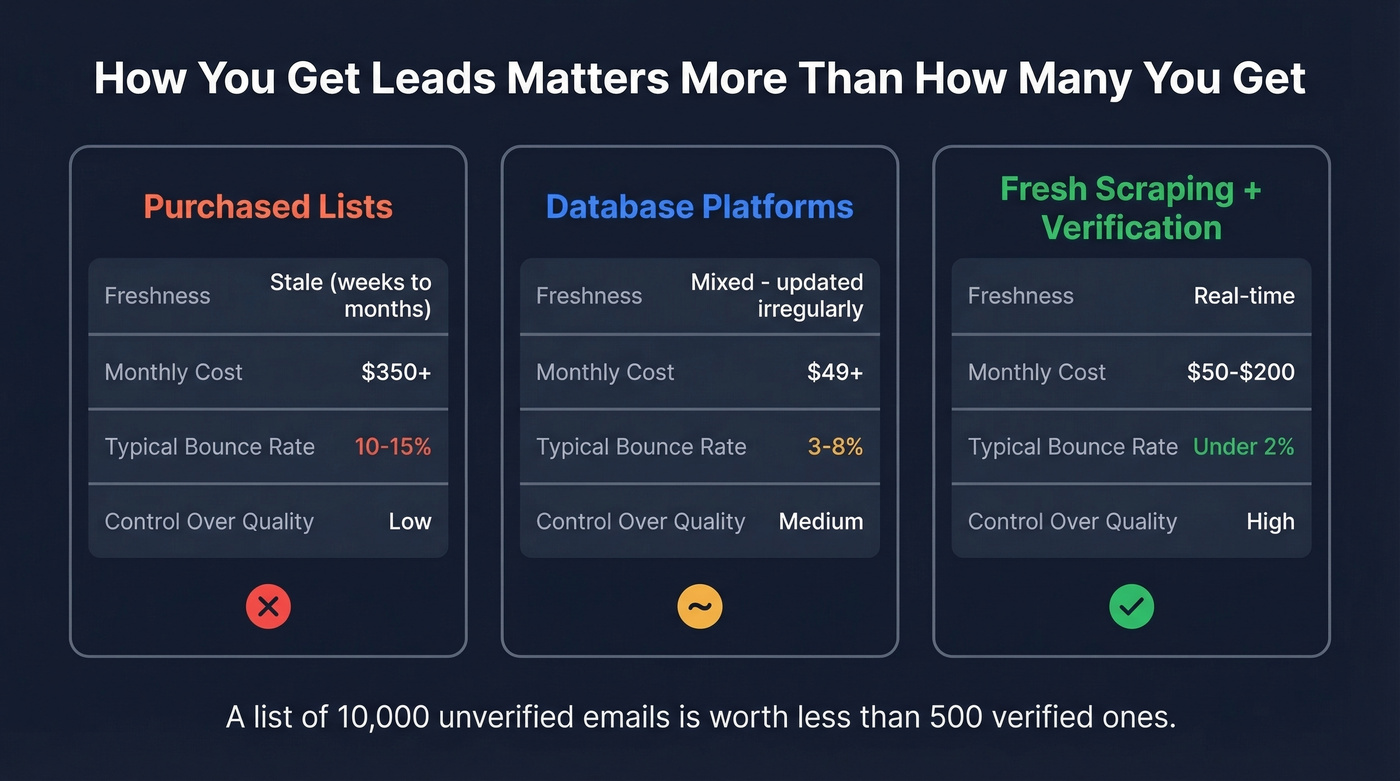
| Approach | Freshness | Cost | Typical Bounce Rate | Control |
|---|---|---|---|---|
| Purchased lists | Stale (weeks-months) | ~$350/mo+ | 10-15% | Low |
| Database platforms | Mixed | $49/mo+ | 3-8% | Medium |
| Fresh scraping + verification | Real-time | $50-$200/mo | <2% | High |
Here's a pattern we've seen repeatedly. A team was paying ~$350/month for purchased lead lists and eating a 12% bounce rate. Many contacts were closed businesses, people who'd moved on, or generic info@ inboxes that never convert. They switched to scraping leads from Google Maps directly, pulled 80 emails for a roofing contractor campaign in Phoenix, and got 2 bounces. Bounce rate dropped under 2% once they started verifying decision-maker info.
The big databases aren't immune either. Platforms like Apollo and ZoomInfo regularly serve outdated contacts, generic emails, and overused lists where your competitors are emailing the same people. One practitioner found 70% of phone numbers were wrong. ZoomInfo processes 1.5B data points per day and users still complain about stale data. Scale doesn't equal quality.
Let's be honest: a list of 10,000 unverified emails is worth less than 500 verified ones. The math isn't close when you factor in domain reputation damage, wasted sequences, and the opportunity cost of chasing dead leads.
The Workflow That Actually Converts
Six steps. Skip any of them and your conversion rate craters.
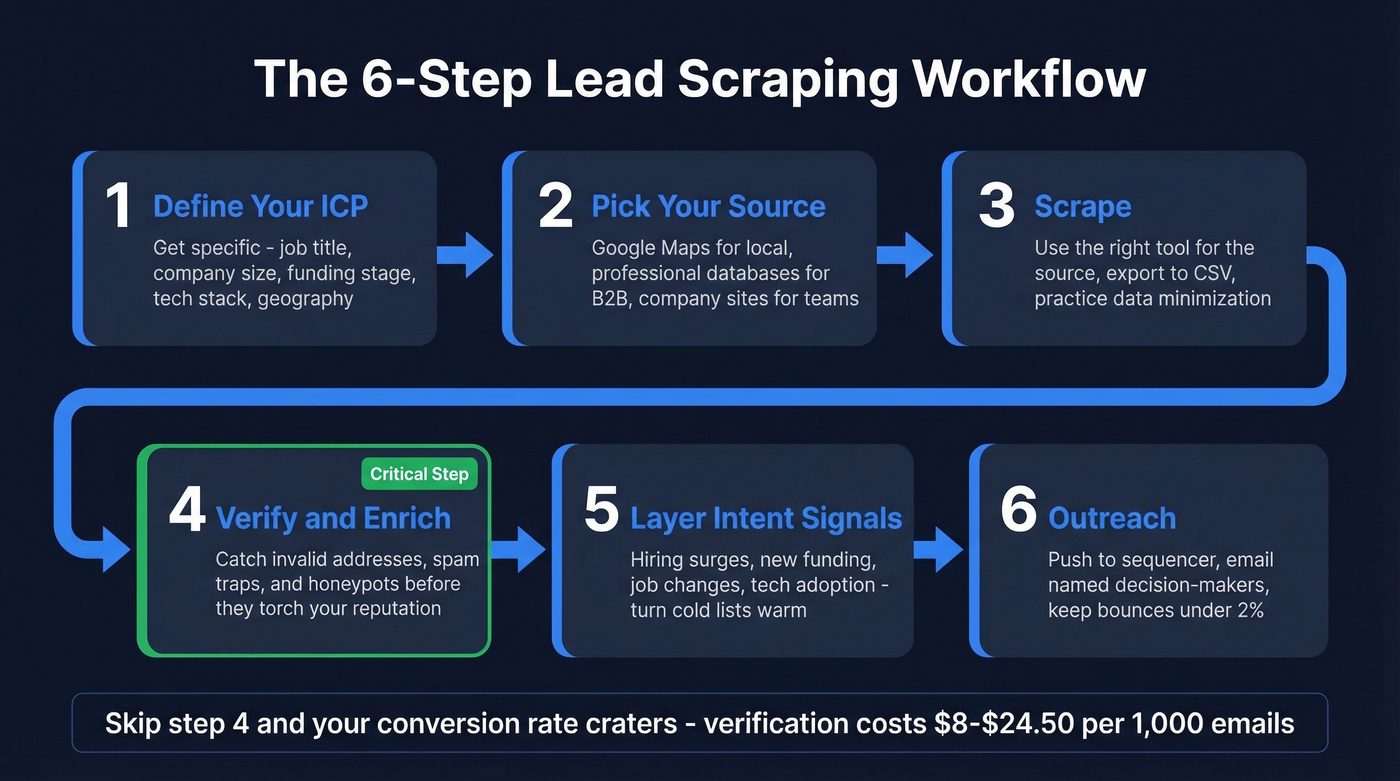
1. Define your ICP. Not "companies with 50+ employees." Specific: VP of Marketing at B2B SaaS companies, Series A-B, 50-200 employees, using HubSpot, based in North America. The tighter your ICP, the less you scrape and the more you convert. (If you need a framework, start with an Ideal Customer Profile template.)
2. Pick your source. Google Maps for local businesses. Professional databases for B2B contacts. Company websites for specific teams. Match the source to the lead type.
3. Scrape. Use the right tool for the source. Export to CSV. Don't scrape everything - data minimization isn't just a GDPR requirement, it's a quality filter.
4. Verify and enrich. This is where most workflows fail. Run your scraped list through a verification tool that catches invalid addresses, spam traps, and honeypots before they torch your sender reputation. Upload a CSV or connect via API. (More on lead enrichment if you're building this step out.)
5. Layer intent signals. Don't just scrape and blast. Layer buying signals - hiring surges, new funding rounds, job changes, technology adoption - on top of your scraped data. This turns a cold list into a warm one. (See a practical approach to identifying buying signals.)
6. Outreach. Push verified contacts to your sequencer (Instantly, Lemlist, Outreach) and send. In our experience, emails to named decision-makers convert at 5-10x the rate of generic inboxes. Keep total bounces under 2% and hard bounces under 1%. (If you're troubleshooting, use an email deliverability guide before you scale volume.)
B2B data decays 22.5-30% per year, and some fast-moving industries hit 70%. Verification costs run $8-$24.50 per 1,000 emails depending on the tool - a rounding error compared to the cost of a burned domain. And consider this: global inbox placement averages just 84%, with Microsoft inboxes the worst offenders at only 75.6% versus 87.2% for Gmail. Bad data makes those numbers much worse.

You just read why scraping without verification is a domain killer. Prospeo's 5-step verification catches spam traps, honeypots, and catch-all domains before they wreck your sender reputation - at $0.01 per email. 143M+ verified emails, refreshed every 7 days, not every 6 weeks.
Stop gambling your domain on unverified scraped data.
Why Scraped Data Stops Converting
You scraped 2,000 contacts from Google Maps last quarter. You're still emailing the same list. Here's the problem: 25% of those contacts have changed. People left companies. Businesses closed. Phone numbers got reassigned.
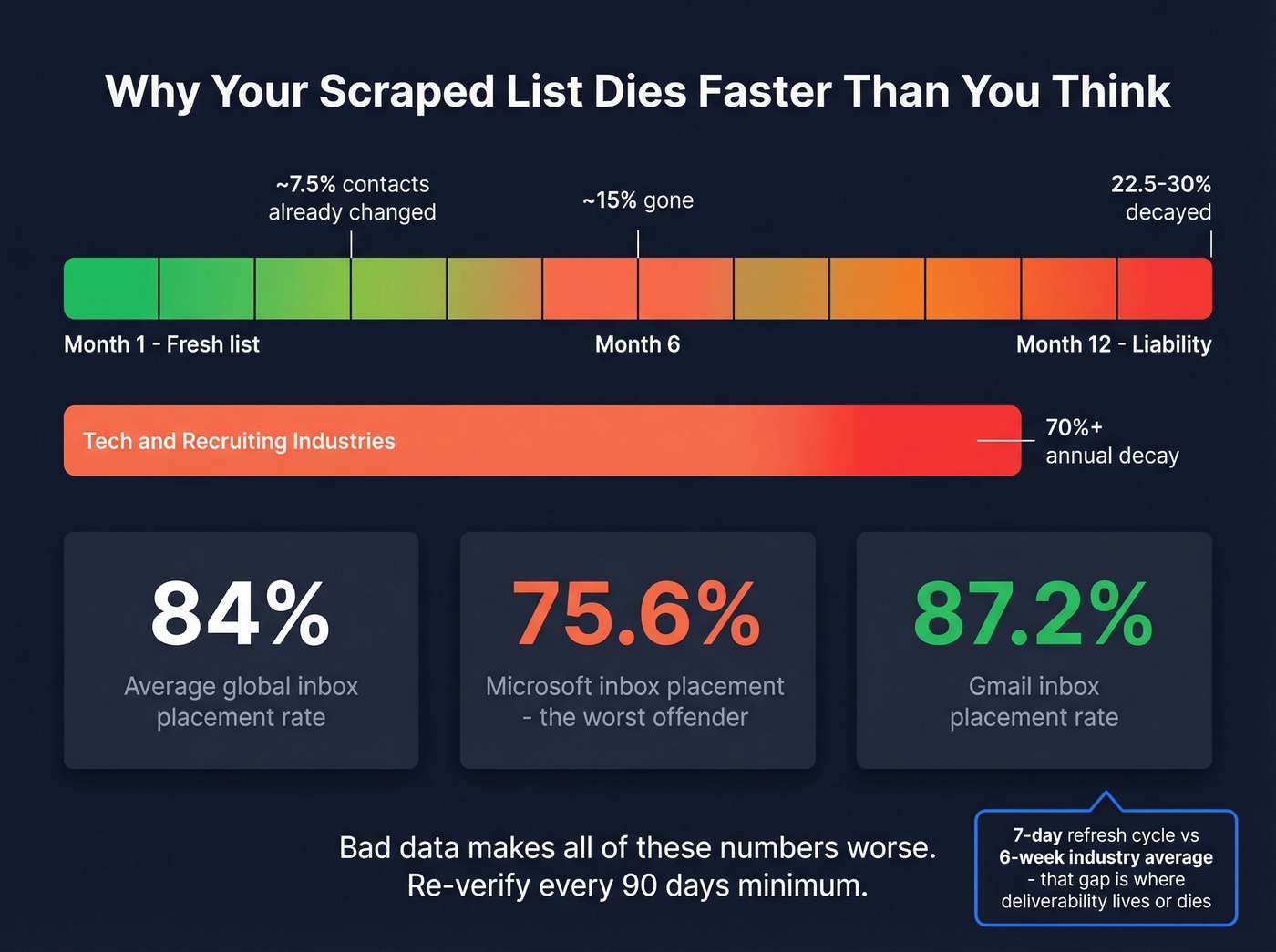
That 30% annual decay rate? In tech and recruiting, it's more than double. A list that performed well in January is a liability by June.
Then there's the info@ problem. Generic inboxes almost never convert in outbound - they route to shared mailboxes that nobody monitors for cold email. If your extraction workflow doesn't filter these out and find the actual decision-maker's address, you're burning sends on dead ends.
The compounding effect is what kills you. Bad data leads to bounces. Bounces damage your sender reputation. Damaged reputation means even your good emails land in spam. One bad list can tank deliverability for months. The benchmark to look for in any data tool is a 7-day refresh cycle versus the roughly 6-week industry average. If you're managing lists manually, re-verify every 90 days at minimum.
Is Lead Scraping Legal?
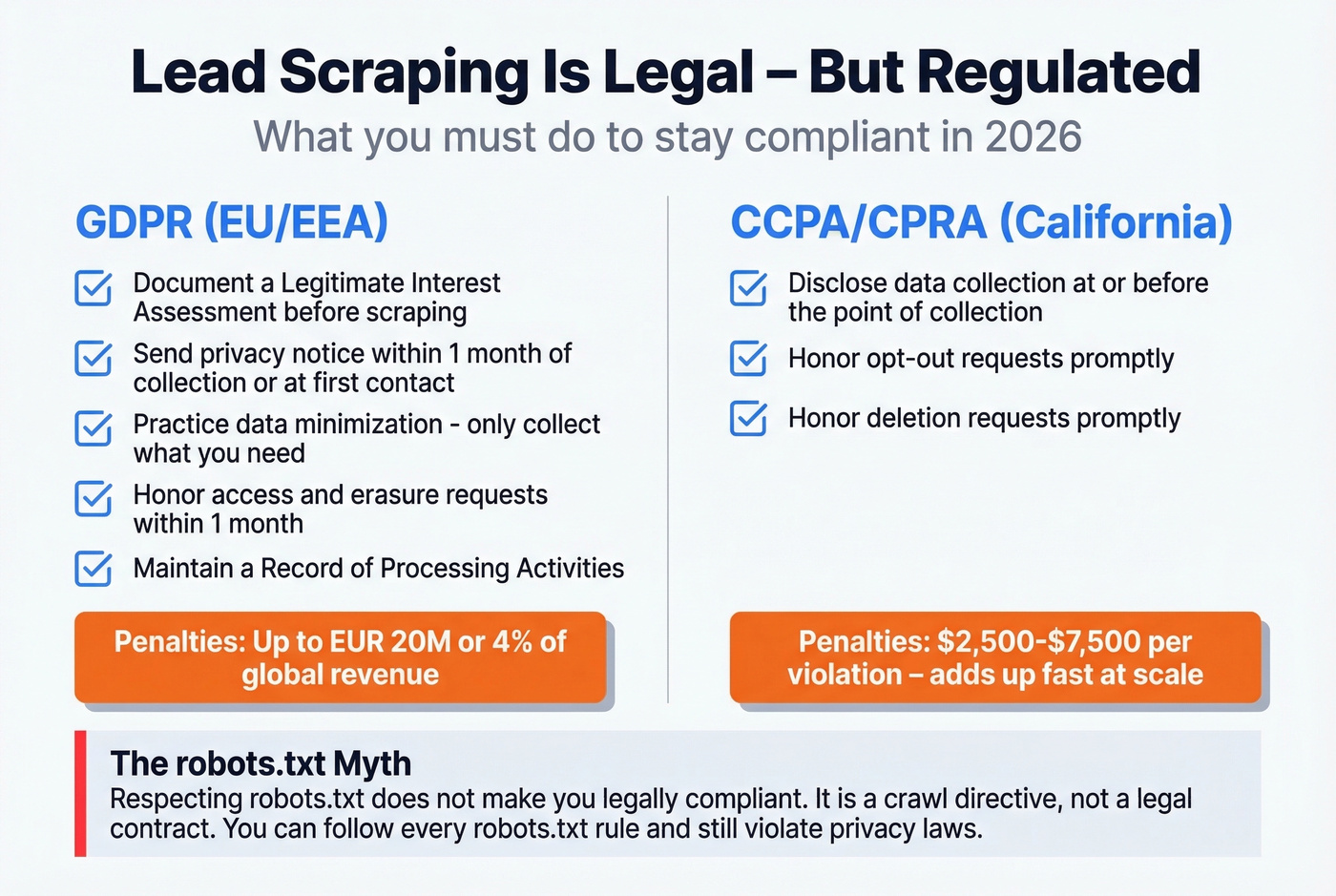
Yes, but regulated. Privacy laws don't ban scraping - they regulate how you collect, store, and use the data.
GDPR (EU/EEA)
GDPR applies to processing EU/EEA individuals' personal data regardless of where you're based. The most viable lawful basis for B2B scraping is Legitimate Interest. That means you need to document a Legitimate Interest Assessment before you scrape, provide a privacy notice within one month of collection or at first contact, practice data minimization, honor access and erasure requests within one month, and maintain a Record of Processing Activities.
Penalties: up to EUR 20M or 4% of global revenue, whichever is higher.
CCPA/CPRA (California)
CCPA doesn't require a "lawful basis" like GDPR, but it does require disclosure at or before collection and honoring opt-out and deletion requests. Penalties: $2,500-$7,500 per violation. That adds up fast at scale.
The robots.txt Myth
Here's the thing: respecting robots.txt doesn't make you legally compliant. Robots.txt is a crawl directive, not a legal contract. You can follow every robots.txt instruction perfectly and still violate privacy laws, copyright, or terms of service. Compliance failures tend to surface when scale meets scrutiny - audits, partnerships, acquisitions - not when the scraping first "works."
Scrape responsibly, document your legal basis, honor opt-outs, and don't confuse "publicly available" with "free to use however you want."
Best Tools for Scraping Leads in 2026
| Tool | Best For | Starting Price | Free Tier | Key Strength |
|---|---|---|---|---|
| Prospeo | Verified emails + dials | ~$0.01/email | 75 emails/mo | 98% email accuracy, 7-day refresh |
| Outscraper | Maps scraping | $6/1K records | 500 leads | Pay-as-you-go, Maps-native |
| Apollo | All-in-one + outreach | $49/mo | Yes | 275M+ contacts |
| PhantomBuster | Multi-platform automation | $69/mo | 14-day trial | Pre-built workflows |
| Apify | Developer scraping | $39/mo | $5/mo credits | Thousands of Actors |
| Lead Scrape | Budget desktop | $97/year | Free trial | Cheapest annual |
| Octoparse | No-code scraping | ~$75-$250/mo | Yes | Point-and-click |
| Scrap.io | Quick Maps leads | ~$50/mo | 100 leads | Maps-focused |
Prospeo
Prospeo isn't a scraper - it's the layer that makes scraped data worth sending. The platform covers 300M+ professional profiles with 143M+ verified emails at 98% accuracy and 125M+ verified mobile numbers that hit a 30% pickup rate. Every record refreshes on a 7-day cycle, compared to the 6-week industry average.
The 5-step verification process catches invalid addresses, spam traps, catch-all domains, and honeypots before they torch your sender reputation. You get 50+ data points per enriched contact, including direct dials, job titles, and company firmographics.

The 30+ search filters include buyer intent powered by 15,000 Bombora topics, so you can layer scraping with in-market signals. Integrations cover the full outbound stack: Salesforce, HubSpot, Instantly, Lemlist, Clay, and Zapier. Stack Optimize, an outbound agency, built from $0 to $1M ARR using the platform with 94%+ deliverability and zero domain flags across all clients. Pricing starts free at 75 emails + 100 Chrome extension credits per month, and paid plans run about $0.01 per email. No contracts, no sales calls.
Outscraper
Use this if: you need local business leads from Google Maps at scale and want to pay only for what you pull.
Skip this if: you need B2B contact data with emails and direct dials - Outscraper gives you business listings, not individual contacts.
Outscraper is purpose-built for Google Maps data extraction. Define a search query, set your parameters, and it returns structured data: business names, addresses, phone numbers, websites, and other listing fields. The first 500 leads are free, then $6 per 1,000 records dropping to $2/1K at 100K+ volume.
The sweet spot is pairing Outscraper with an enrichment tool. Scrape the businesses, then find the decision-maker emails and verify them separately. That two-step workflow consistently outperforms buying pre-built lists.
Apollo
Apollo's 275M+ contact database with built-in CRM and email sequencing is the closest thing to an all-in-one prospecting platform at an accessible price. Free plan available, paid tiers run $49-$119/mo per user. Search, filter, build a list, and launch a sequence without leaving the platform.
The tradeoff is data quality. Practitioners consistently report accuracy issues - outdated titles, wrong emails, and lists that every other Apollo user is also hitting. We've seen teams get solid results from Apollo for initial prospecting, then move verification to a dedicated tool once bounce rates creep up. Compared to ZoomInfo, Apollo wins on price and accessibility but loses on data depth for enterprise accounts.
PhantomBuster
PhantomBuster runs pre-built automation workflows ("Phantoms") that scrape and extract data across multiple web platforms. Plans run $69-$439/mo with a 14-day free trial. The learning curve is moderate - you're configuring automations, not writing code, but it isn't point-and-click simple either. Best for growth teams that need multi-step workflows combining scraping, enrichment, and outreach prep.
Apify
Developer-friendly platform with a marketplace of pre-built scrapers ("Actors") covering everything from Google Maps to e-commerce sites to job boards. If you have a developer on staff, Apify gives you more flexibility than any other tool on this list.

Free tier includes $5/mo in credits. Paid plans run $29-$999/mo depending on compute needs. API-first architecture means you can pipe scraped data directly into your enrichment and outreach stack. Non-technical users will struggle without the pre-built Actors.
Lead Scrape
Budget desktop software for solo operators who need business directory leads without a monthly subscription. Lead Scrape runs $97/year (Standard) or $247/year (Business) with a free trial. It won't scale to enterprise volumes, but for a freelancer pulling a few hundred leads per week, the price-to-value ratio is hard to beat. Also includes basic competitive intelligence features like tech stack detection.
Octoparse
No-code visual scraper with a point-and-click interface. Free plan available, paid plans run ~$75-$250/mo. Good for non-technical users who need to scrape structured data from websites without writing code. Add-ons for proxies ($3/GB) and CAPTCHA solving help control costs. The main limitation: anti-bot handling is basic, so heavily protected sites will give you trouble.
Scrap.io
Lightweight Google Maps lead generator with a 7-day free trial and 100 free leads. Paid plans run ~$50-$150/mo. If you only need Maps data and want the simplest possible interface, Scrap.io gets you there faster than Outscraper. The tradeoff is no enrichment - you get Maps data only, no emails or direct dials - so you'll need a second tool for that.
Layer intent signals on top of your scraped leads without duct-taping five tools together. Prospeo combines 30+ ICP filters, Bombora intent data across 15,000 topics, and real-time verification in one platform - so you skip the scrape-clean-enrich-verify dance entirely.
Get verified decision-maker emails in one step, not six.
How to Pick the Right Tool
Match these five criteria to your situation, in order of importance.
Data accuracy is non-negotiable. The cheapest tool is worthless if 15% of emails bounce. Verify before you send, always. Integrations matter next - your scraping tool needs to connect to your enrichment tool, which connects to your sequencer, which connects to your CRM. Check the chain before you buy. (If you're building a stack, start with a shortlist of SDR tools.)
Ease of use determines adoption. A tool your team won't use is a tool you wasted money on. Compliance features like opt-out handling and data deletion matter more every year. And pricing model depends on your volume: pay-per-lead beats flat-rate subscriptions if your volume fluctuates, while subscriptions win at consistent high volume.
The best stack for most teams in 2026: a scraping source (Outscraper for local, Apollo for B2B) feeding into a verification and enrichment layer, pushing clean data to a sequencer like Instantly or Lemlist. Under $200/month for a budget stack, or under $300/month with Apollo's paid tier for higher B2B volume. (If you're scaling safely, set guardrails around email velocity and monitor your email bounce rate.)
FAQ
Is lead scraping legal?
Yes, but regulated. GDPR and CCPA require a lawful basis, privacy notices, and honoring opt-out and deletion requests. Scraping publicly available data is legal; how you store, use, and contact those people creates the liability. Document your legal basis before you start.
What's the difference between scraping and enrichment?
Scraping extracts raw contact data from web sources like Google Maps or directories. Enrichment adds missing fields - verified emails, direct dials, job titles - to existing records. Most high-performing workflows combine both sequentially for the cleanest output.
How often should I refresh scraped lists?
Re-verify every 90 days at minimum. B2B data decays 22.5-30% per year, and fast-moving industries like tech and recruiting lose integrity even faster. Tools with a 7-day refresh cycle handle this automatically.
What's a safe bounce rate for cold email?
Keep total bounces under 2% and hard bounces under 1%. Anything above 5% risks domain reputation damage that can take months to recover from. Verification at $8-$25 per thousand emails is trivial compared to rebuilding a burned sending domain.
Can I scrape leads for free?
Yes, with volume limits. Outscraper offers 500 free leads, Apollo has a free plan, and Prospeo's free tier includes 75 verified emails per month. For serious outbound volume, expect $50-$200/month on a scraping + verification stack - still a fraction of what purchased lists cost.