


LeadRocks vs Pubrio: Which B2B Data Tool Is Worth Your Money?
Two lifetime deals, both sold on AppSumo, both starting at $79, both promising B2B contact data. If you're weighing LeadRocks vs Pubrio, the headline numbers look straightforward: LeadRocks gives you 5,000 contacts per month while Pubrio gives you 750 credits and burns 3 per search. The math alone tells you these are different tools. But the real gap is data quality, and neither handles it well.
30-Second Verdict
- Pick LeadRocks if you want raw volume on a budget and sell into Western markets. Verify everything externally.
- Pick Pubrio if you need APAC coverage and intent signals, and you're comfortable with a platform founded in 2024 that has almost no review history.
- Skip both if deliverability matters most. In our testing, verification-first tools consistently outperform large databases on actual bounce rates (see email bounce rates and the full email deliverability guide).
LeadRocks at a Glance
LeadRocks runs a 100M+ record database with emails, phone numbers, and built-in email sequences (more on sequence management). The AppSumo listing sits at 4.5/5 across 365 reviews - solid. Trustpilot tells a different story: 2.4/5 with billing complaints and deliverability horror stories.
The volume is generous - 5,000 contacts per month on the LTD, plus a Chrome extension and unlimited users on monthly plans. The problem is what happens after export. One AppSumo user ran their list through MailVerify and got 53% valid emails. Another downloaded 17,775 contacts targeting a specific state and found just 56 matches. Reddit threads echo the skepticism, with users questioning whether LeadRocks data holds up under any external verification at all.
Subscription plans start at $29/mo and scale to $580/mo for higher volumes. If you can still grab the $79 lifetime deal, that's the best-value entry point.
Pubrio at a Glance
Pubrio pulls from 50+ localized sources to build a global business graph. The database claims are ambitious: 275M contacts, 1B+ company profiles, 156M emails, and 120M direct dials. It also bundles intent analytics, automated sequences, and managed services - packing more features than LeadRocks into a single platform.
The execution, though, is unproven.
What makes Pubrio genuinely interesting is its APAC depth. One G2 reviewer called it "the only one focused specifically on the APAC market." Pubrio also surfaces company-level website intent, showing which organizations are actively exploring your site, and it supports ROI attribution for partner campaigns. That's a real differentiator if you sell into Asia-Pacific (for a deeper framework, see intent based segmentation). The downsides: just 2 G2 reviews (5.0/5) and 8 AppSumo reviews (3.5/5). The 3-credits-per-search model drains allocations fast, and multiple reviewers describe the UI as clunky. Top-up credits run $0.015-$0.025 each depending on your tier.
Pubrio offers a free tier at 100 credits/month, worth testing before committing. The AppSumo LTD ($79-$599, scaling up to 3,500 credits/month) is sold out. Subscription pricing starts at $125/mo for 6,000 credits.

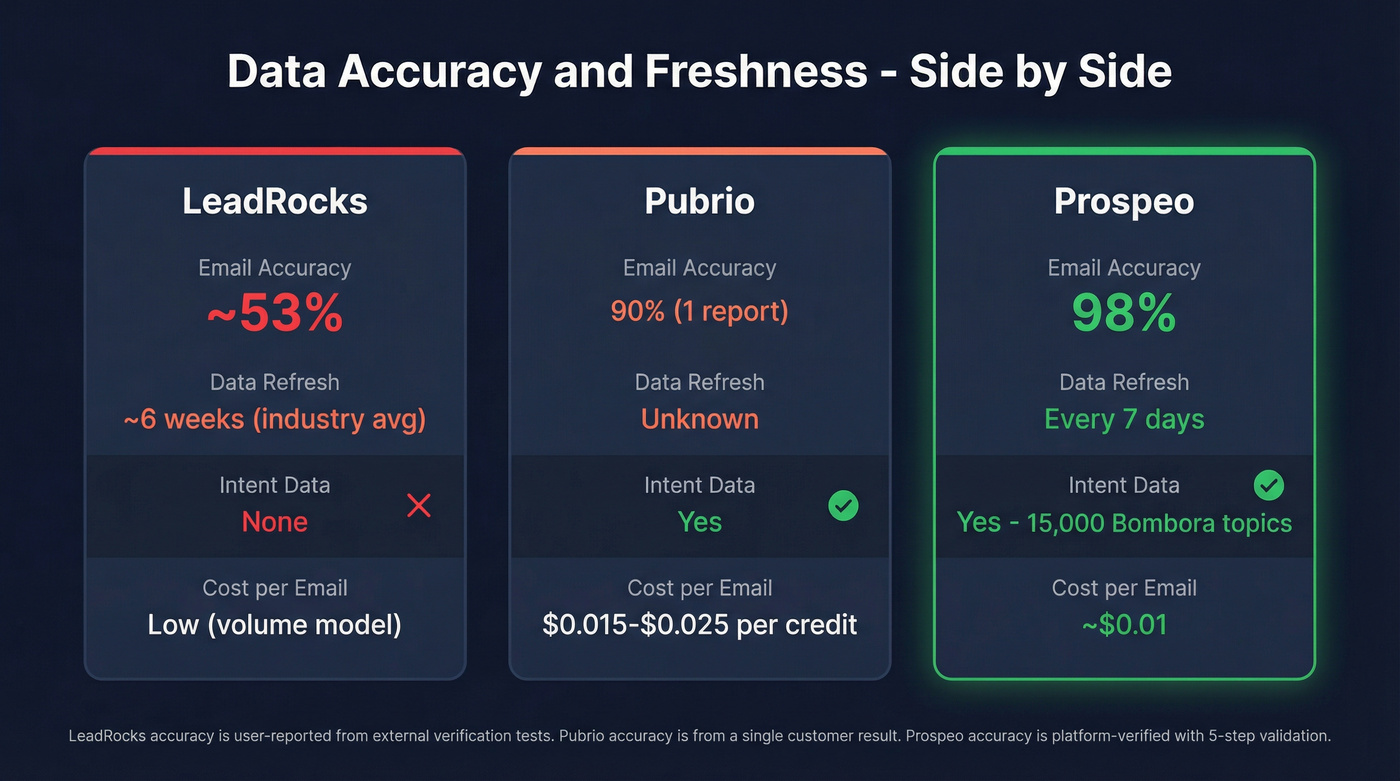
LeadRocks users report 53% email accuracy. Pubrio has 8 reviews and no independent validation. Prospeo's 5-step verification delivers 98% email accuracy across 300M+ profiles - refreshed every 7 days, not every 6 weeks. Stop cleaning bad data and start sending.
75 free emails per month. Test the accuracy difference yourself.
Head-to-Head Comparison
| Feature | LeadRocks | Pubrio | Edge |
|---|---|---|---|
| Database size | 100M+ | 275M (claimed) | Pubrio |
| Email accuracy | ~53% (user-reported) | 90% (single customer result) | Neither proven |
| Intent data | No | Yes | Pubrio |
| APAC focus | No | Yes | Pubrio |
| Built-in outreach | Yes | Yes | Tie |
| Credit model | 5,000 contacts/mo (LTD) | 750 credits/mo (3 per search) | LeadRocks |
| Free tier | Yes (50 credits/mo) | Yes (100 credits/mo) | Pubrio |
| LTD price | $79 (if available) | $79 (sold out) | LeadRocks |
| Subscription entry | $29/mo | $125/mo | LeadRocks |
| Reviews | AppSumo 4.5 (365) / Trustpilot 2.4 | AppSumo 3.5 (8) / G2 5.0 (2) | LeadRocks (volume) |
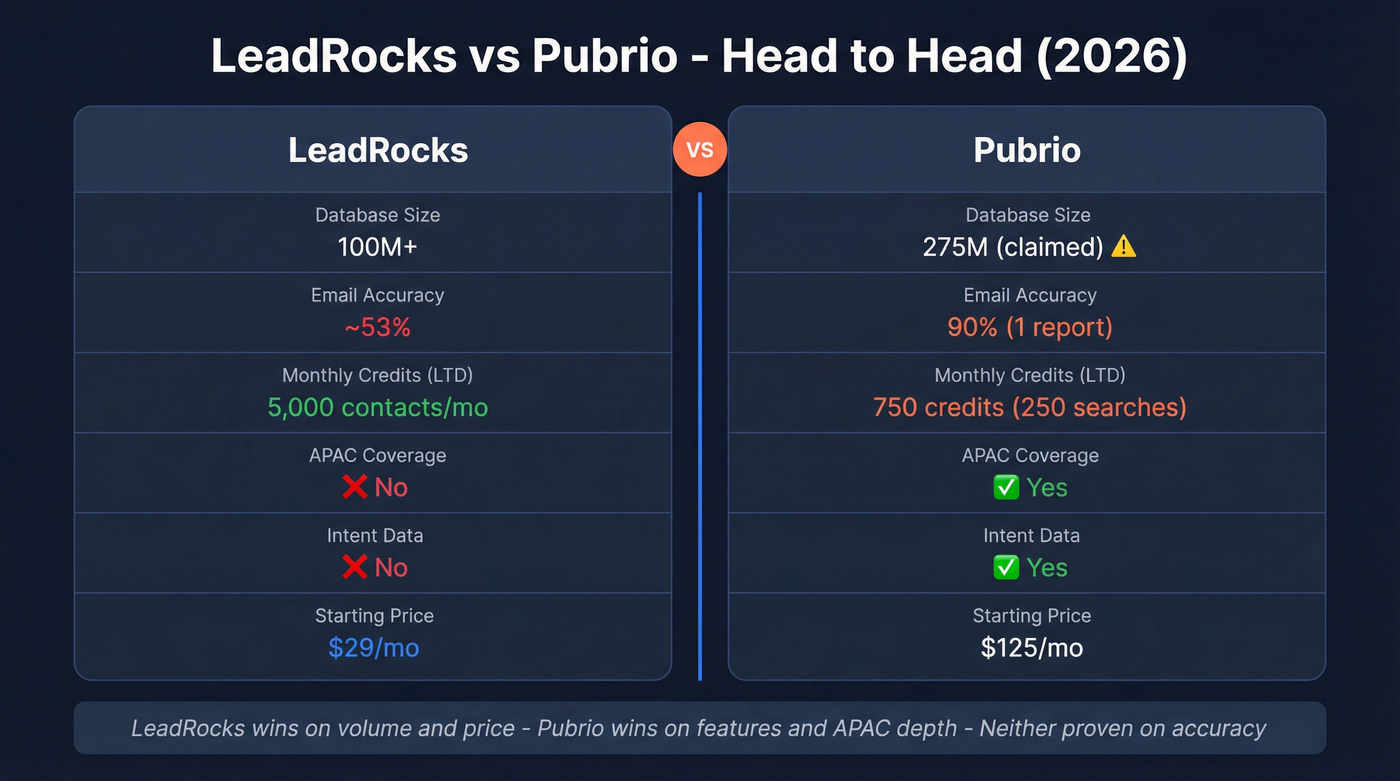
LeadRocks wins on volume and price. Pubrio wins on features and APAC depth. Neither inspires confidence on accuracy - LeadRocks has documented problems, and Pubrio's accuracy number has almost no independent validation.
Here's the thing: if your average deal size is under five figures, you probably can't afford the time cost of cleaning bad data from either tool. The hours spent verifying, deduplicating, and re-targeting eat your margin faster than the subscription saves it (especially if you’re doing lead enrichment after the fact).
What Users Actually Say
LeadRocks has the larger review footprint, and the complaints are specific. One Trustpilot reviewer exported 5,000 emails and found only 145 usable. That's a 2.9% usability rate.
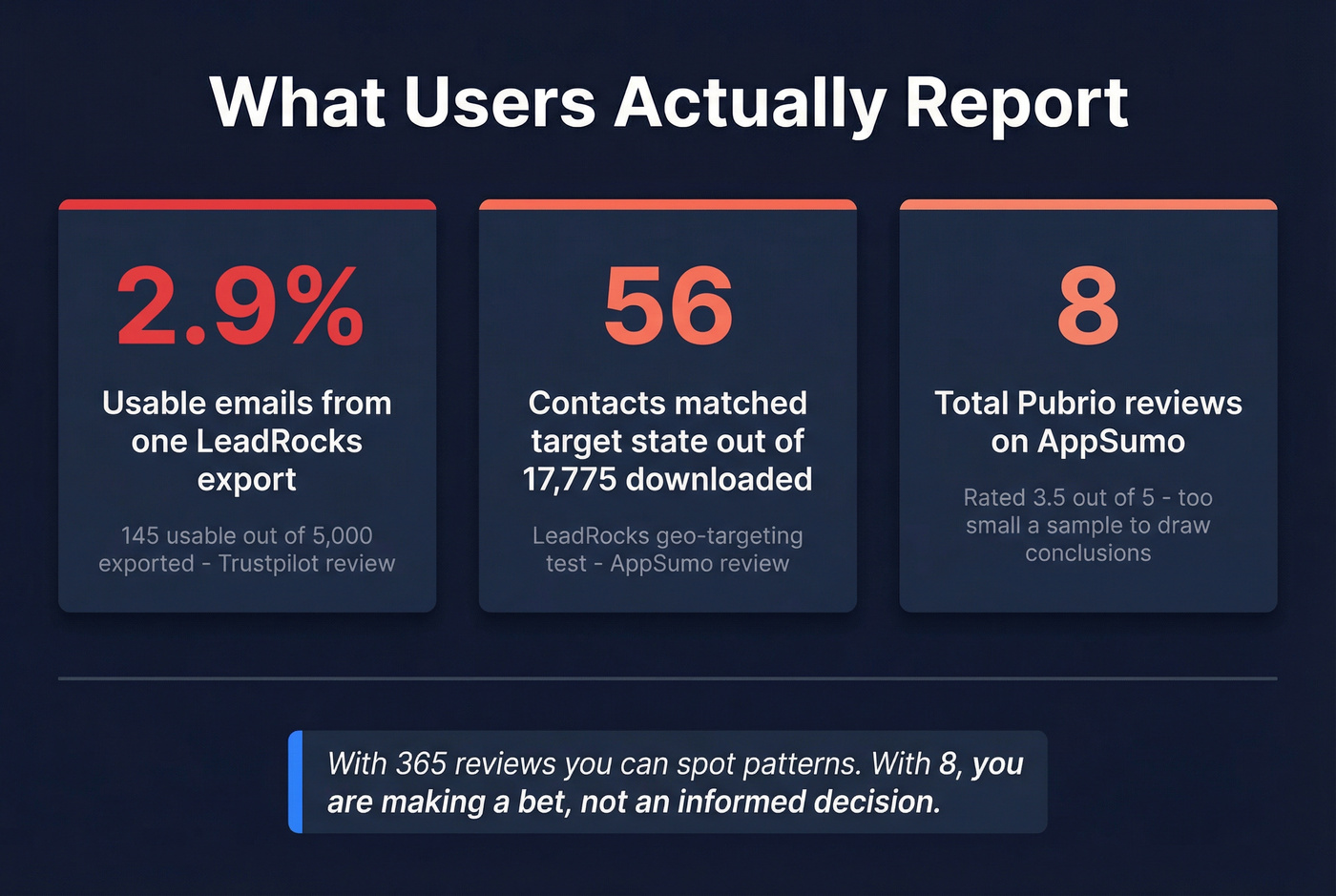
Separately, an AppSumo user discovered that LeadRocks' geo-targeting is essentially broken - 56 contacts in their target state out of 17,775 downloaded. That's not a data quality issue. That's a data quality crisis. We've seen teams burn through entire sending domains because they trusted unverified exports like these, and rebuilding domain reputation takes months (see how to improve sender reputation).
Pubrio's review pool is tiny but telling. The most-upvoted AppSumo review (9 helpful votes) flags the credit system directly: "3 credits for every single search query... credits drain incredibly fast." At least one reviewer reported unresponsive support. On the positive side, users praise the data quality and the ability to run research, segmentation, and outreach from one platform.
Let's be honest: with 365 reviews you can spot patterns. With 8, you're making a bet, not an informed decision.
Who Should Pick Which
LeadRocks makes sense for teams that need maximum volume at minimum cost, sell into Western markets, and accept they'll verify every list externally before sending (if you need options, compare B2B data providers).
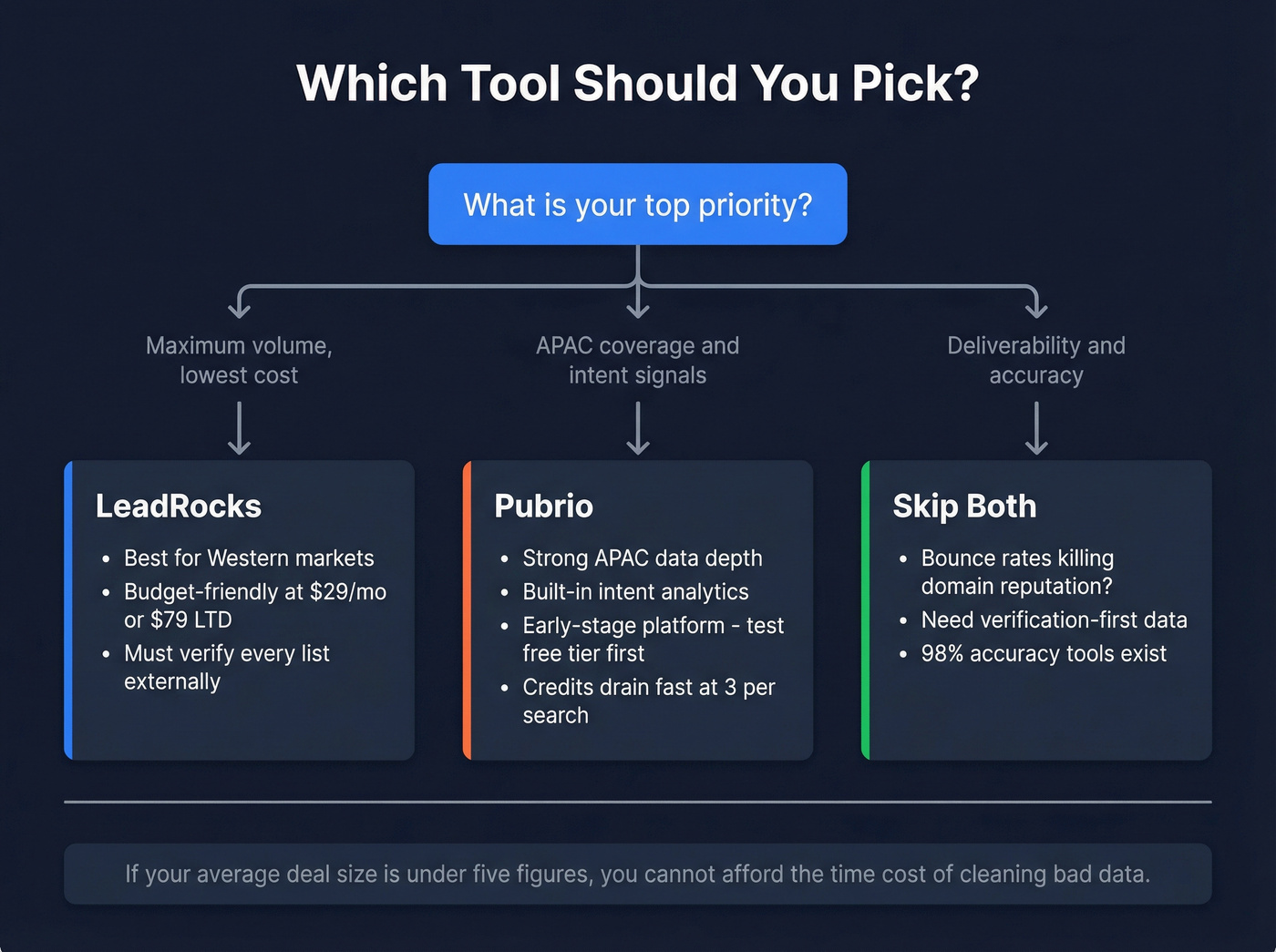
Pubrio makes sense for teams targeting APAC markets specifically, wanting integrated intent signals, and willing to adopt an early-stage platform. Start with the free tier to test data quality before committing to $125/mo.
Skip both if deliverability is your top priority. When bounce rates are killing your domain reputation, the problem isn't database size - it's verification.
When Data Accuracy Is the Real Problem
Both LeadRocks and Pubrio give you volume. If your real problem is bounce rates and dead numbers, you need verification-first data. Prospeo covers 300M+ professional profiles with 98% email accuracy on a 7-day refresh cycle - weekly data freshness versus the industry average of six weeks. It also tracks 15,000 intent topics via Bombora, matching Pubrio's intent capability with far more proven accuracy. The free tier includes 75 emails and 100 Chrome extension credits per month, enough to validate the accuracy difference before spending a dollar. Paid plans start at roughly $0.01 per email with no contracts.

Pubrio charges 3 credits per search and caps you at 250 lookups a month. LeadRocks gives you volume but 2.9% usability rates. Prospeo gives you 30+ filters, Bombora intent data on 15,000 topics, and emails at $0.01 each - with accuracy that won't torch your domain.
Intent data plus verified contacts. No LTD gamble required.
FAQ
Is LeadRocks data accurate?
User-reported accuracy hovers around 53% after external verification, and one Trustpilot reviewer found just 145 usable contacts from 5,000 exported. Always run LeadRocks exports through a third-party verifier before loading them into any outreach sequence.
How fast do Pubrio credits run out?
At 3 credits per search, a 750-credit monthly plan gives you roughly 250 lookups - about 12 per business day. Teams running active outbound campaigns typically exhaust that within the first two weeks.
Is there a more accurate alternative to both tools?
Prospeo delivers 98% verified email accuracy with a 7-day data refresh cycle, 30+ search filters including intent data, and a free tier of 75 emails per month. It's the strongest option when deliverability is the priority.