


LeadRocks vs QuickEnrich: Which B2B Data Tool Is Worth Your Money?
You grabbed the LeadRocks lifetime deal on AppSumo, ran your first export, and half the emails bounced. Now you're eyeing QuickEnrich's $29/mo plan wondering if the grass is greener. Bad data costs the US economy an estimated $3.1 trillion a year according to IBM, and at the rep level it means burned domains, wasted sequences, and pipeline that never materializes.
We reviewed all 365 AppSumo reviews, dug through QuickEnrich's docs and pricing pages, and checked Reddit's r/LeadGeneration and r/coldemail for independent discussion. Here's what we found.
30-Second Verdict
LeadRocks - keep it if you already own the lifetime deal, but verify every email externally before sending.
QuickEnrich - better per-contact economics, but a tiny public review footprint makes it a gamble.
Feature Comparison
Here's how the two stack up on what actually matters.
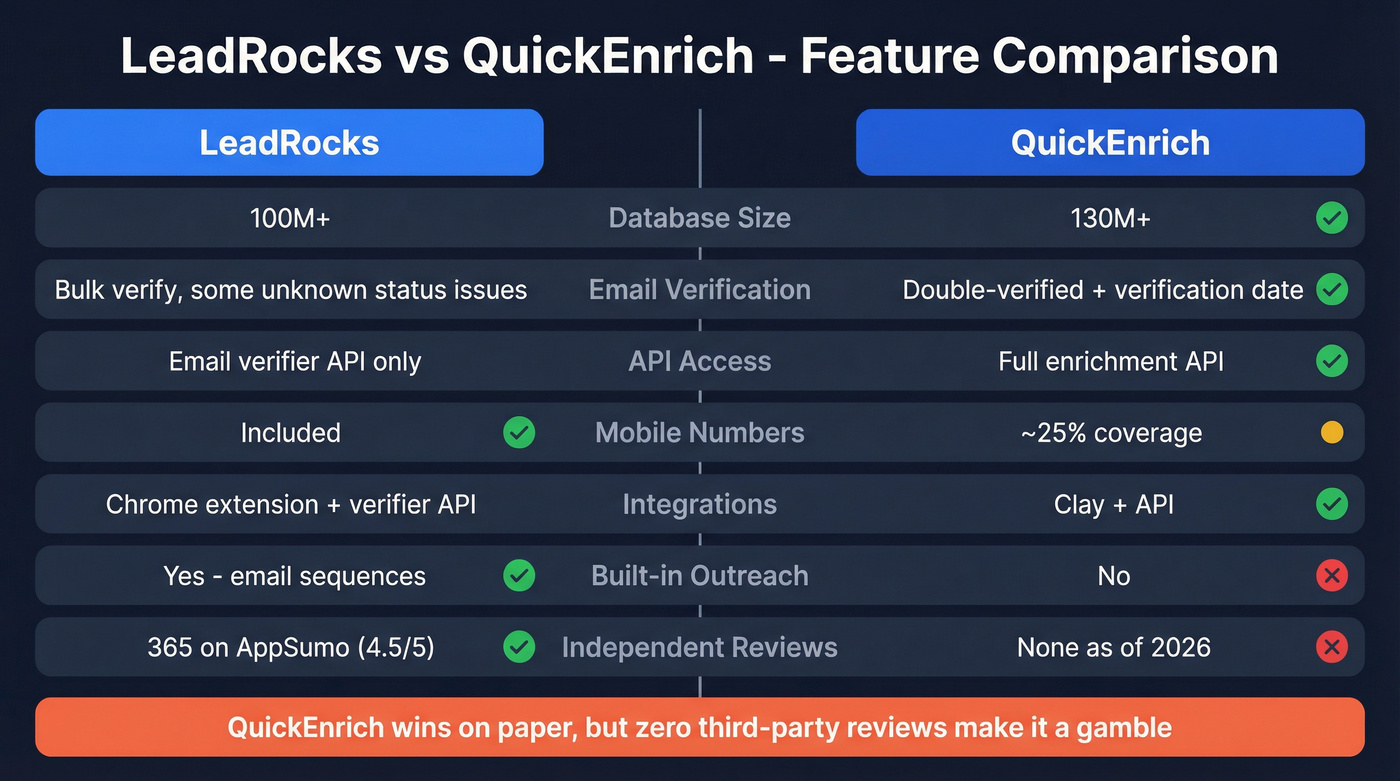
| Feature | LeadRocks | QuickEnrich | Winner |
|---|---|---|---|
| Database size | 100M+ | 130M+ | QuickEnrich |
| Email verification | Bulk verification; one documented case returned "unknown status" for every email | Double-verified + verification date | QuickEnrich |
| API | Email verifier API only | Full enrichment API | QuickEnrich |
| Mobile coverage | Mobile numbers included | ~25% | Tie |
| Integrations | Chrome extension + verifier API | Clay + API | QuickEnrich |
| Built-in outreach | Yes | No | LeadRocks |
| Independent reviews | 365 on AppSumo | None | LeadRocks |
QuickEnrich wins on paper. But "on paper" is doing a lot of heavy lifting when there's zero third-party validation.
LeadRocks - What Real Users Say
LeadRocks holds a 4.5/5 rating across 365 AppSumo reviews, and the aggregate sentiment is genuinely positive - people like the big database and the UI. But the complaints are brutal when they surface.
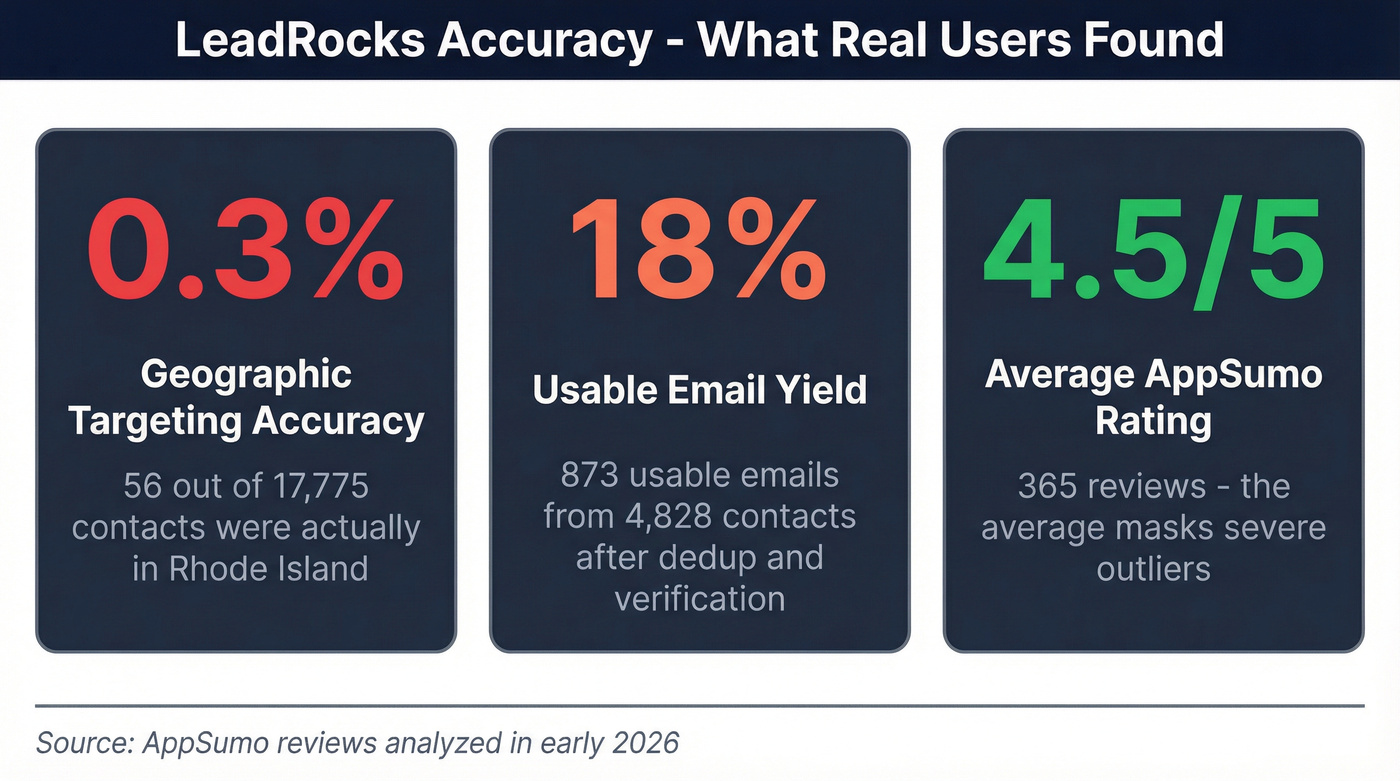
One reviewer exported 17,775 "Rhode Island business owners" and found only 56 actually in Rhode Island - a 0.3% geographic targeting accuracy. Of those verified, just 53% had valid emails. Another ran 4,828 contacts through deduplication and external verification and ended up with 873 usable emails - an 18% yield. A September 2025 reviewer put it bluntly: "search is useless" and "data is so out of date."
What works: Large database, decent UI, built-in email sequences, responsive support. If you bought the lifetime deal (around $79 one-time on AppSumo), the sunk cost is low enough to keep it as a supplementary source.
What doesn't: A January 2026 review says only the Email Verifier tool is available via API - not the database itself. In that same review, the verifier returned "unknown status" for every email in a documented test. UK education leads were flagged as outdated in early 2026. Duplicates are common. The r/coldemail consensus is that AppSumo data tools are fine for supplementary prospecting but shouldn't be your primary source.
A 4.5/5 average masks the severity of the worst experiences. When targeting accuracy drops below 1%, the average doesn't matter.

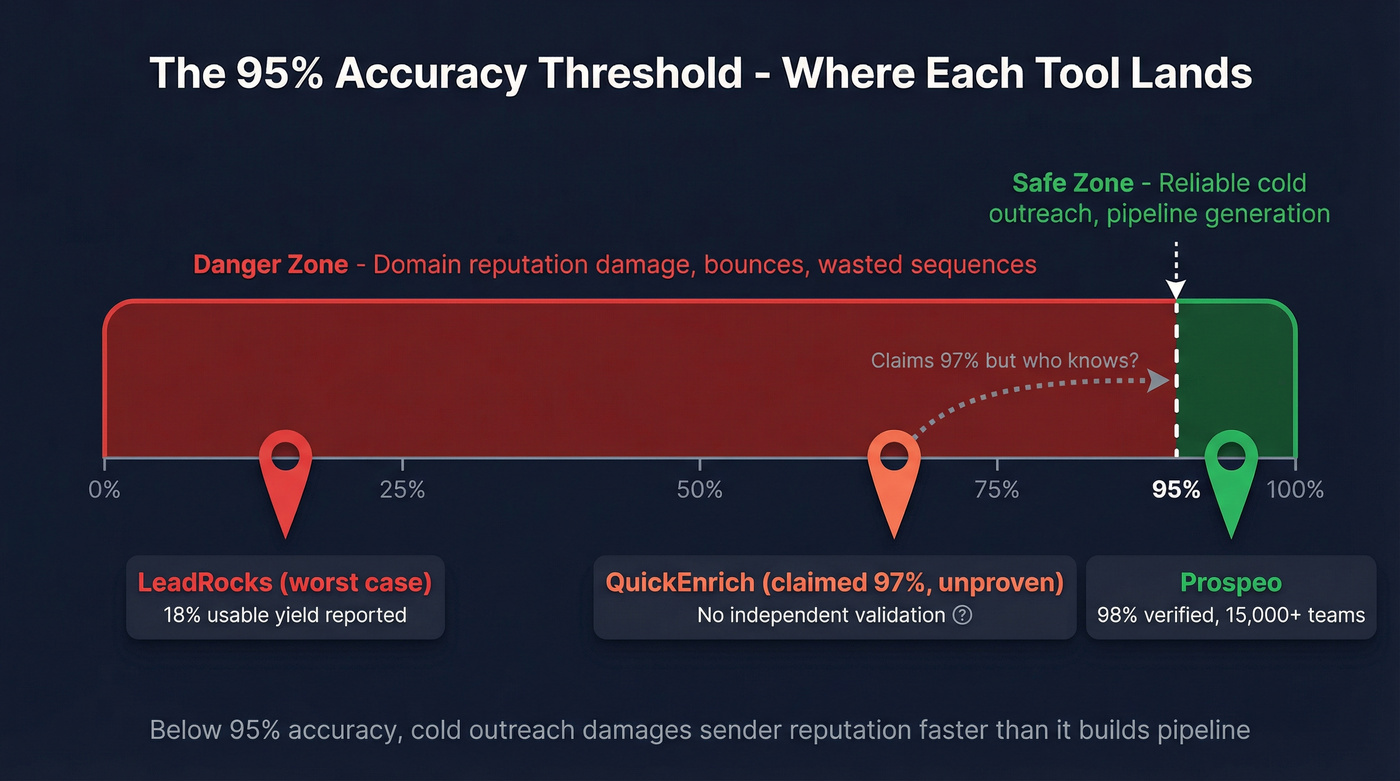
LeadRocks users report 18% usable emails after verification. QuickEnrich has zero independent reviews to back its 97% claim. Prospeo delivers 98% email accuracy with a 5-step verification process - no external verifier needed. At $0.01/email with a 7-day data refresh, you stop gambling with your domain reputation.
Start with 75 free emails and see the accuracy difference yourself.
QuickEnrich - Promising but Unproven
QuickEnrich positions itself as a B2B email finder and API with 130M+ contacts and a 97% accuracy claim. It markets "double verified emails" using multiple verification tools including catch-all and SMTP verification, and says it never includes risky emails. Every enriched email includes a verification date - a recency signal most competitors skip.
The Clay integration makes it easy to slot into waterfall enrichment stacks, and QuickEnrich highlights data "not found on social media," going beyond providers that just rely on professional-profile sources. They also claim to find 250% more email domains than competitors by identifying true email domains rather than just obvious company website domains.
What's missing: No meaningful third-party review footprint as of early 2026. No independent benchmarks. We've seen plenty of tools claim 97% accuracy; the ones that actually deliver it have third-party validation to prove it. You're betting entirely on vendor positioning, and that's a real risk when your domain reputation is on the line.
Here's the thing: if your average deal size sits below $5k, an unproven enrichment tool can quietly destroy more pipeline value through bounces than it saves you in subscription costs. The math just doesn't work.
Pricing Breakdown
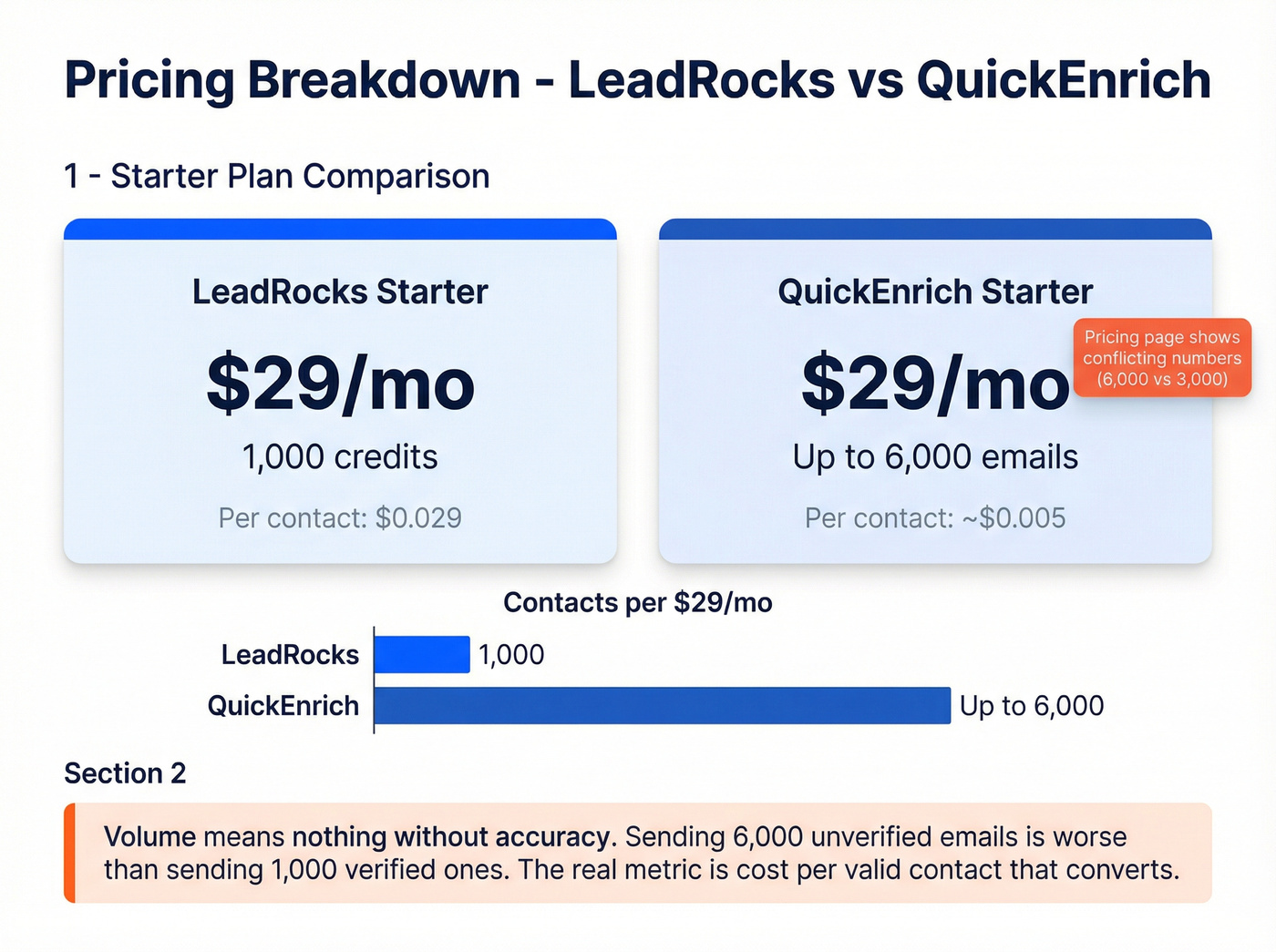
QuickEnrich delivers roughly 6x the volume of LeadRocks at the same price point - but volume means nothing if accuracy is unproven. Sending 6,000 unverified emails is worse than sending 1,000 verified ones.
| Plan | LeadRocks | QuickEnrich |
|---|---|---|
| Starter (monthly) | $29/mo - 1,000 credits | $29/mo - up to 6,000 emails |
| Starter (annual) | N/A | ~$24/mo billed annually |
| Growth (monthly) | $145/mo - 5,000 credits | $99/mo - up to 25,000 emails |
| Growth (annual) | N/A | ~$83/mo billed annually |
| Per-contact cost | ~$0.029 | ~$0.005 |
One wrinkle we noticed: QuickEnrich's own pricing page shows conflicting quota numbers - 6,000 and 3,000 on the same plan depending on where you look (and 25,000 vs 11,000 on Growth). We used the higher figure with "up to" framing, but that inconsistency doesn't inspire confidence for a tool with no external reviews.
The real question isn't cost per contact. It's cost per valid contact that converts.
Why Neither Tool Solves the Core Problem
Both LeadRocks and QuickEnrich share a fundamental weakness: neither has proven, independently validated email accuracy above 95% - the threshold where cold outreach stops damaging your sender reputation and starts generating pipeline.
If you want a broader view of what “good” looks like across vendors, compare against other sales prospecting databases and data enrichment services before you commit budget.
Final Verdict
LeadRocks works if you already own the lifetime deal and treat it as a rough prospecting layer - never send from it without external verification. The built-in sequences are a nice bonus for solo operators who want everything in one tab.
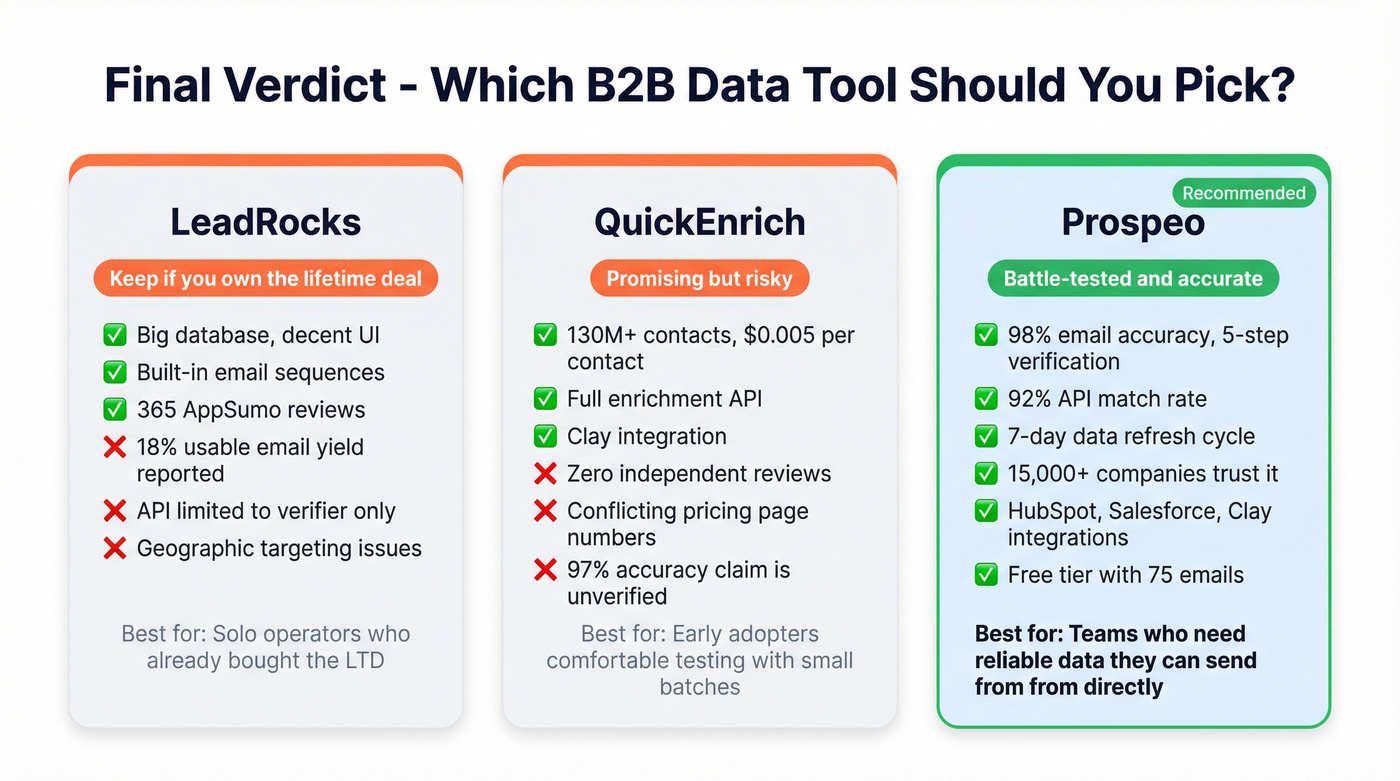
QuickEnrich wins on per-contact economics and API flexibility. If you're comfortable being an early adopter with no safety net of reviews, run a small test batch of 100-200 contacts and verify independently before committing. Skip it if your team can't afford a bounce rate spike while you figure out whether the accuracy claims hold up.
Prospeo is the pick when you need data you can build campaigns on - 98% email accuracy, a 92% API match rate, a 7-day refresh cycle, and transparent pricing starting free. When your domain reputation depends on data quality, saving $20/mo on an unproven tool is a false economy. We've watched teams at companies like Snyk cut bounce rates from 35-40% to under 5% after switching, and that kind of improvement pays for itself in the first week.
If you're tightening the rest of your outbound system too, pair better data with stronger cold email sequences, cleaner email deliverability, and a clear view of your email bounce rate.
QuickEnrich's API looks promising but unproven. Prospeo's enrichment API returns 50+ data points per contact at a 92% match rate - battle-tested by 15,000+ companies. Native integrations with Clay, HubSpot, Salesforce, and every major sequencer mean you plug it in and go.
Stop beta-testing your pipeline. Use data that 15,000+ teams already trust.
FAQ
Is LeadRocks data accurate?
Inconsistent. One AppSumo reviewer found 0.3% geographic targeting accuracy; another reported just 18% usable emails after deduplication and external verification. The 4.5/5 aggregate rating masks severe outliers. Always verify LeadRocks exports with a dedicated tool before sending.
Does QuickEnrich have independent reviews?
No meaningful third-party review footprint exists as of early 2026. The tool claims 97% accuracy and double verification, but no independent benchmark confirms it. Run a test batch of 100-200 contacts and verify results with a separate tool before committing to volume.
Which is better for cold email - LeadRocks or QuickEnrich?
Neither is reliable enough as a sole data source for cold email. LeadRocks has documented accuracy problems; QuickEnrich has no independent validation. Cold outreach requires 95%+ email accuracy to protect your sending domain. Prospeo's 98% accuracy and 5-step verification make it a safer foundation, and its free tier lets you compare results directly against either tool.