

LeadsForge vs Apollo.io: Which Wins in 2026?
Apollo's database covers 275M+ contacts. It's also been called "burned" by cold email practitioners on Reddit - thousands of reps pulling from the same pool, hammering the same inboxes. If you're weighing LeadsForge vs Apollo.io, the distinction matters: LeadsForge takes a different approach with multi-source waterfall enrichment through a chat interface. Two architectures, same goal.
Let's figure out which one actually delivers.
30-Second Verdict
Pick Apollo if you want sequencing, data, and a dialer in one platform and your ICP is US-based. Budget for external email verification - you'll need it.
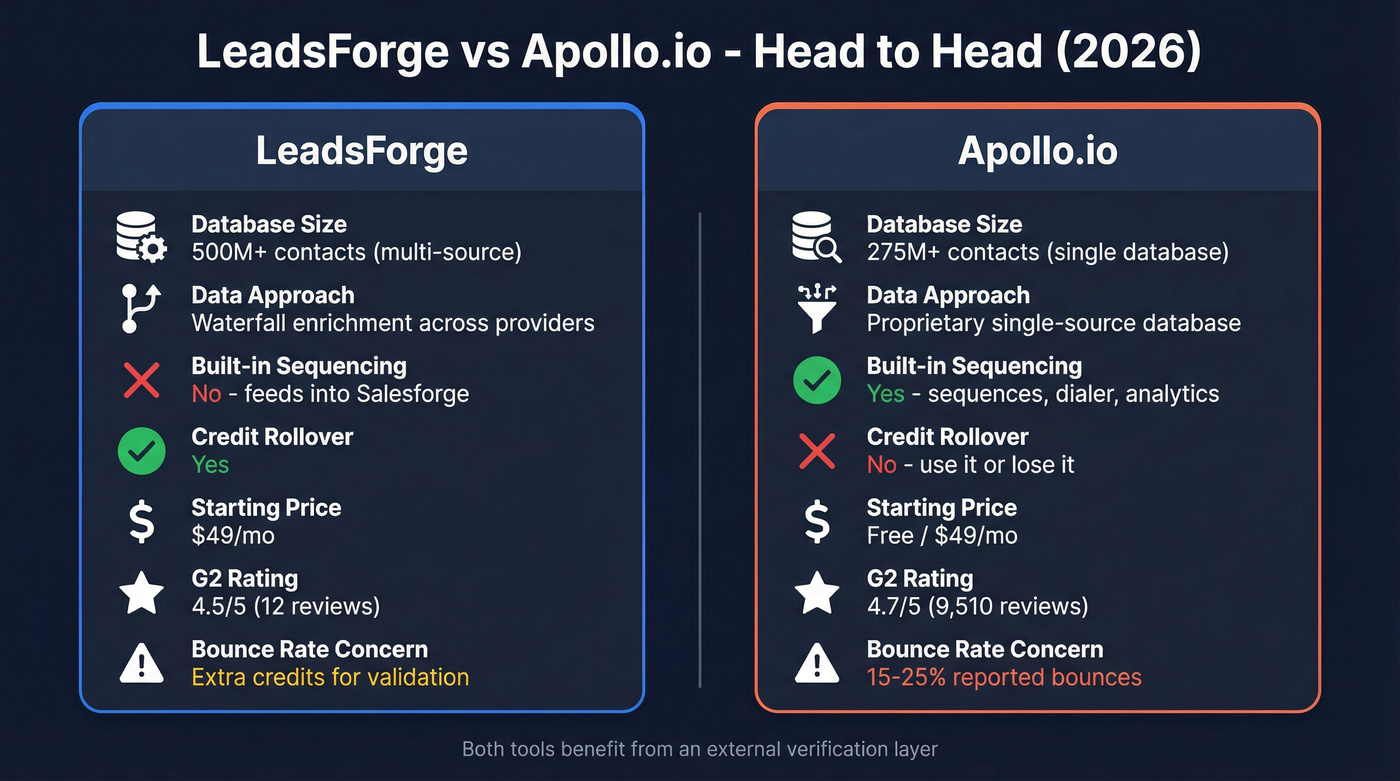
Pick LeadsForge if you want multi-source enrichment, credit rollover, and you're already using Salesforge for outreach.
What Each Tool Does
Apollo.io at a Glance
Apollo is the all-in-one play: 275M+ contact database, built-in email sequences, a dialer, and CRM sync from one UI. It's the default starting point for most outbound teams, and the G2 rating reflects that - 4.7/5 across 9,510 reviews. The problem isn't the feature set. It's the data underneath it.
LeadsForge at a Glance
LeadsForge positions itself as a chat-based lead search engine. You describe your ICP in natural language, then it runs waterfall enrichment across multiple sources, claiming coverage of 500M+ contacts. It also offers lookalike company discovery, intent signals, and lead qualification via custom prompts.
G2 rates it 4.5/5 from 12 reviews; Trustpilot sits at 4.0/5 from 11 reviews. Reviewers report saving 10+ hours per week on manual research. Think of it less as a traditional database and more as a search engine powered by multi-source enrichment - you're not stuck with a single data provider's stale records.
Data Quality Compared
This is where the comparison gets interesting, and honestly, where most teams should spend 80% of their evaluation time.
Use Apollo if you're running high-volume US outbound and you've already budgeted for a separate verification tool. Apollo's sheer database size means you'll find someone at almost any company, and the workflow speed is hard to beat.
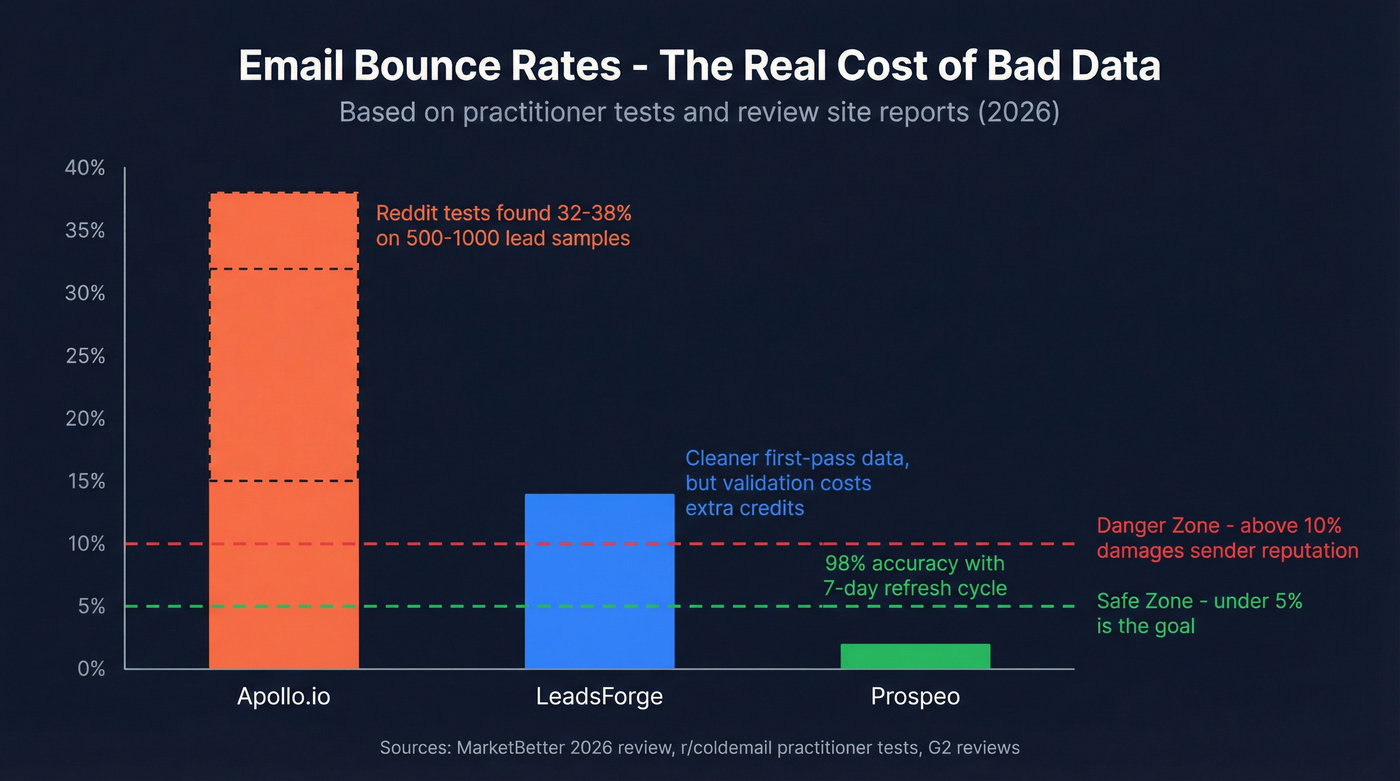
Skip Apollo if you can't tolerate bounce rates above 5%. MarketBetter's 2026 review reports email bounce rates of 15-25% on Apollo-sourced contacts. A practitioner test on r/coldemail using NeverBounce found even worse: 32-38% bounces on a 500-1,000 lead sample. Apollo's own G2 profile flags 503 "Inaccurate Data" complaints. Reddit users consistently report Apollo showing contacts at companies they left months ago, with reps spending more time cleaning lists than doing outreach. That's not just a data problem - it's a deliverability problem. Every bounce chips away at your sender reputation.
Use LeadsForge if you want cleaner initial data. Multi-source waterfall enrichment often produces better first-pass lists than pulling from one source alone.
Skip LeadsForge if you need consistent, clean exports or strong LatAm coverage. Trustpilot reviewers flag inconsistent field formatting on exports, and one verified reviewer called out weak Mexico/LatAm B2B data. The Salesforge ecosystem also has a learning curve - multiple reviewers note "too many service names that all sound the same." Email validation costs extra credits, which eats into your budget fast.
In our experience, any tool reporting bounce rates above 10% needs a verification layer on top - or you're burning domains for no reason. If you want benchmarks and fixes, see our guide to email bounce rate.

Apollo users report 15-25% bounce rates. LeadsForge charges extra credits for validation. Prospeo's proprietary email infrastructure delivers 98% accuracy with no cleanup step - every record refreshes every 7 days, not every 6 weeks.
Stop paying twice - once for data, again to verify it.
Pricing Breakdown
| LeadsForge | Apollo.io | Prospeo | |
|---|---|---|---|
| Starting price | $49/mo | Free / from $49/mo | Free / ~$39/mo |
| Credits included | 2,000 export credits (Essential) | 1,200/yr (Free) | 75 emails + 100 ext/mo |
| Credit rollover | Yes | No | N/A (pay-as-you-go) |
| Phone credit cost | 10 credits | 5 credits | 10 credits per mobile |
| Free tier | 100 free credits on signup | Yes (limited) | Yes (75 emails/mo) |
| Contract required | No | No (Org = 3 seats min) | No |
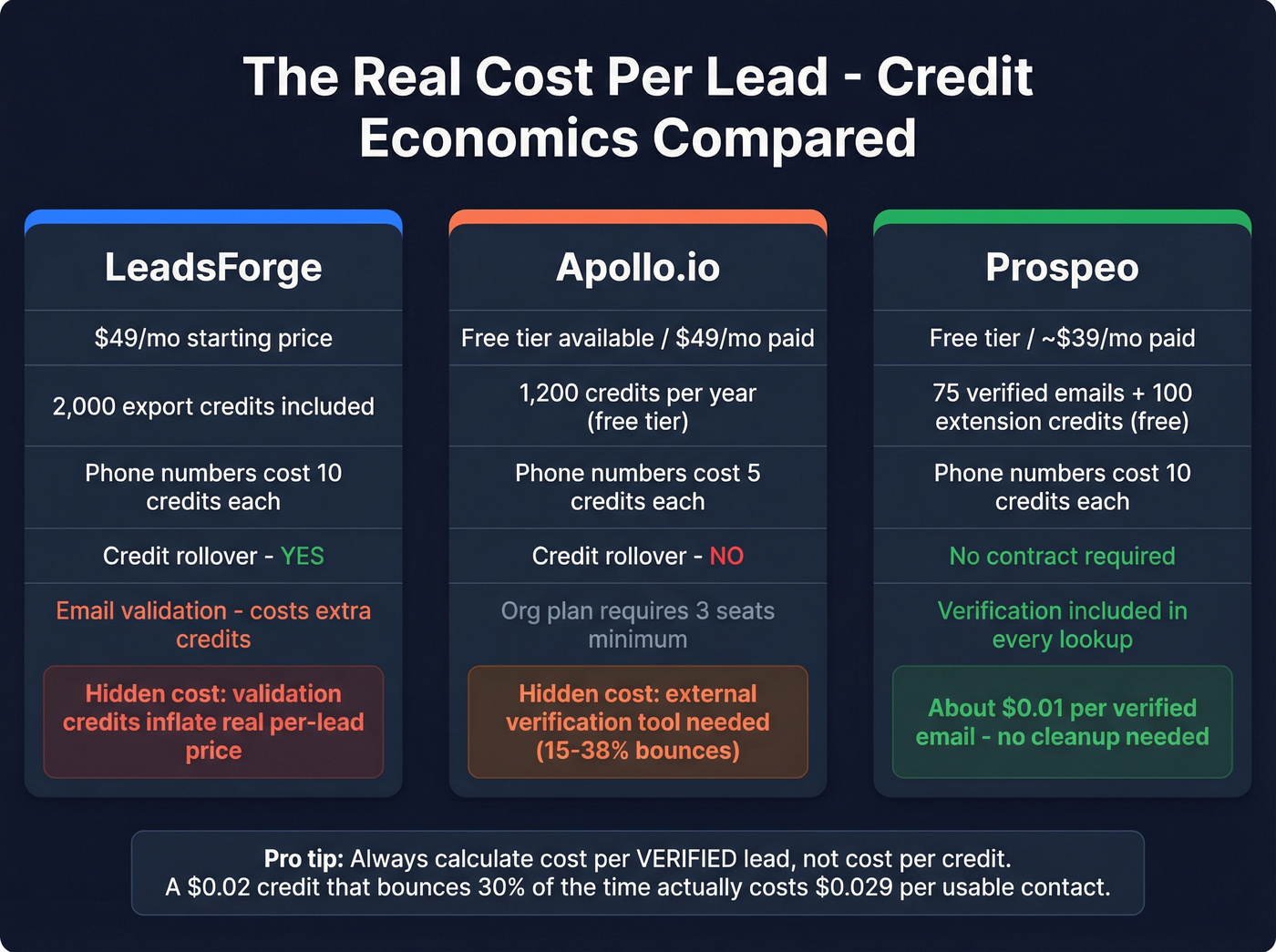
The credit mechanics matter more than the sticker price. Apollo's monthly credits don't roll over - use them or lose them. Phone number reveals cost 5 credits each, typically 5x an email reveal, and at the Organization tier ($119/mo), you're locked into a minimum of three seats. LeadsForge's rollover policy is genuinely useful for teams with uneven prospecting volume, but at least three G2 and Trustpilot reviewers call out validation credit costs as an unexpected add-on that inflates the real per-lead price.
Workflow and Integrations
Apollo's strength is consolidation. Data, sequences, dialer, and analytics live in one platform. You find a lead, add them to a sequence, and start calling - no tab-switching. For teams that want a single login for everything outbound, it's hard to argue against that simplicity.
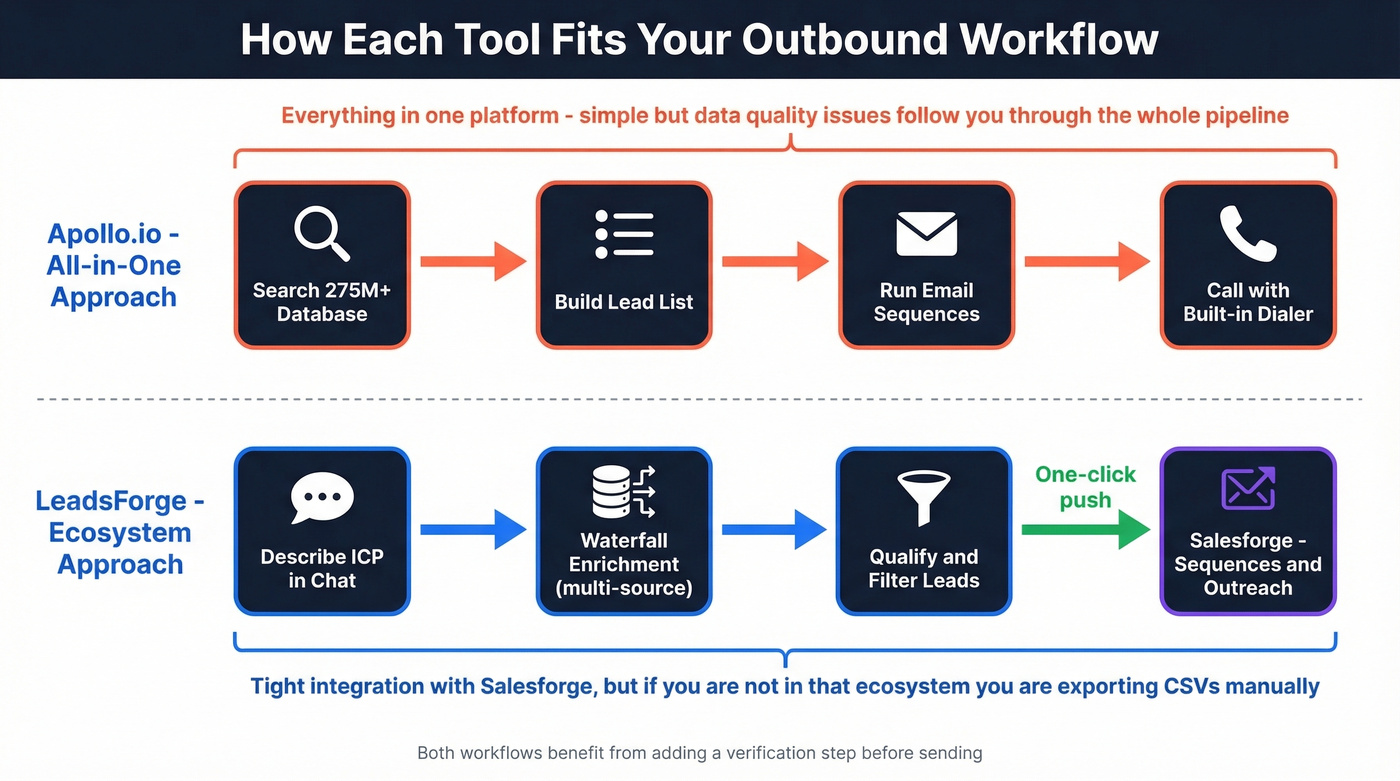
LeadsForge takes the opposite approach: it's purpose-built to feed the Salesforge stack. You build a list in LeadsForge, push it to Salesforge with one click - no CSV exports, no manual imports. If you're already in the Salesforge ecosystem, the integration works out of the box. If you're not, it's less compelling, and you'll probably end up exporting CSVs anyway.
When to Pick Which
For US-focused teams that want everything in one UI, Apollo is the right starting point - just run a separate verification pass before launching sequences. The free tier is a legitimate way to test the waters. If you're building a broader stack, compare options in our roundup of SDR tools.
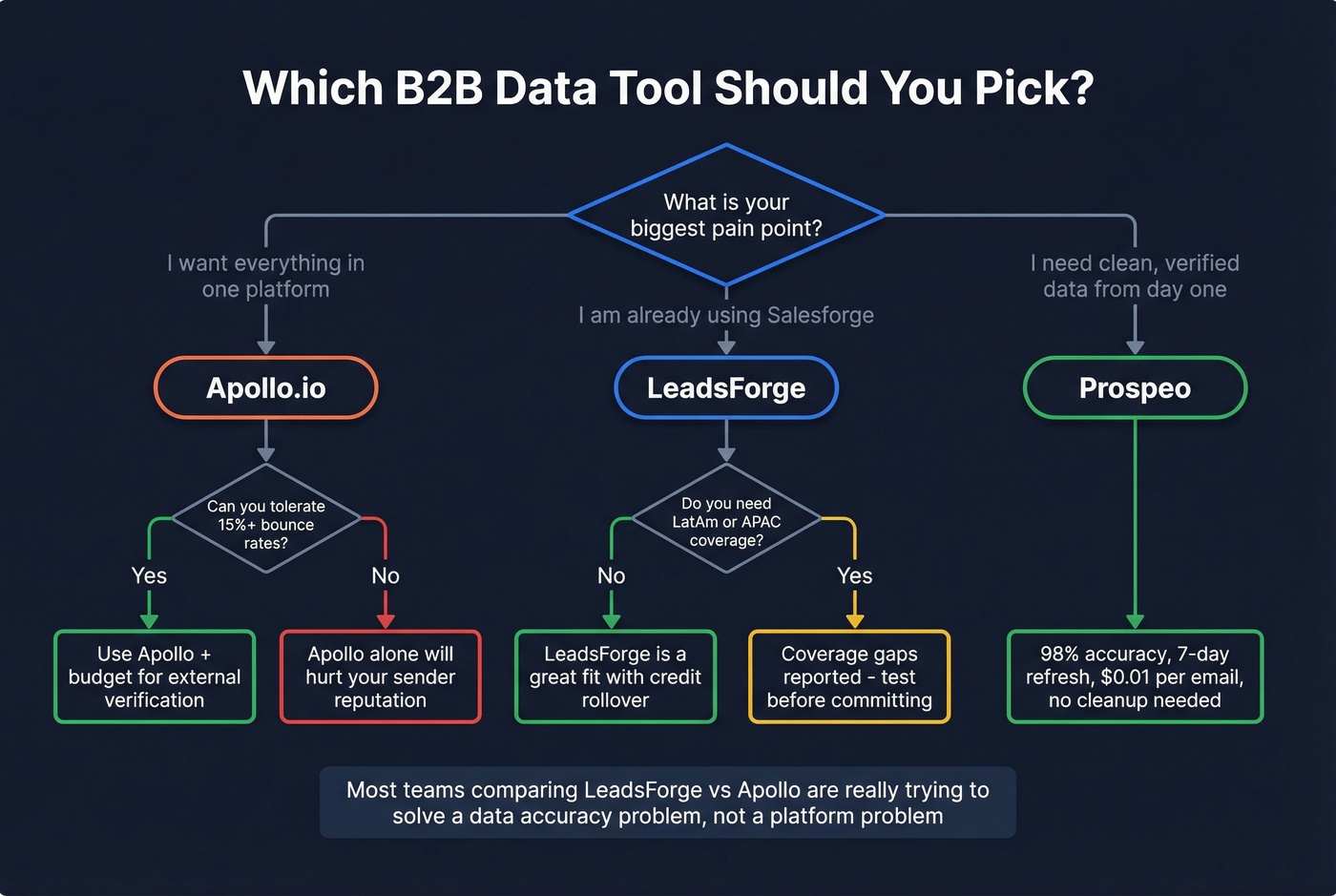
For teams already inside the Salesforge ecosystem, LeadsForge makes more sense. Credit rollover, multi-source enrichment, and a tight one-click integration with Salesforge outweigh the smaller review footprint.
Here's the thing: most teams comparing these two tools are actually trying to solve a data accuracy problem, not a platform problem. If your bounce rate is above 10%, switching between them won't fix it. You need a verification-first tool. (If you want the deeper playbook, start with our email deliverability guide.)
When Data Accuracy Is the Real Problem
Both Apollo and LeadsForge users end up spending time and money cleaning data after export. We've tested this workflow ourselves, and the cleanup tax is real - it can eat 30-40% of the time you thought you were saving with automation.
Prospeo eliminates that step. Its database covers 300M+ professional profiles with 98% email accuracy, built on proprietary email-finding infrastructure that doesn't rely on third-party providers. Every record refreshes on a 7-day cycle, compared to the 6-week industry average. The platform is fully GDPR compliant with no contracts required. If you're evaluating vendors beyond these two, see our list of data enrichment services and sales prospecting databases.

The free tier gives you 75 verified emails and 100 Chrome extension credits per month. No contract, no credit card. Paid plans start around $39/mo with transparent, credit-based pricing at roughly $0.01 per email.
Both LeadsForge and Apollo force you to budget for external verification. Prospeo's 5-step verification, spam-trap removal, and 7-day refresh cycle mean your lists are clean before they hit your sequencer. At $0.01/email, it's 90% cheaper than ZoomInfo too.
Teams using Prospeo book 35% more meetings than Apollo users.
FAQ
Is LeadsForge's data better than Apollo's?
LeadsForge's waterfall enrichment pulls from multiple sources, which often produces cleaner initial lists than Apollo's single-database approach. That said, users report inconsistent exports and extra credit costs for email validation. Neither tool guarantees sub-5% bounce rates without an additional verification layer.
Does Apollo.io charge for phone numbers?
Yes. Apollo charges 5 credits per phone number reveal - typically 5x an email reveal. LeadsForge charges 10 credits per phone number. Prospeo also charges 10 credits per mobile but includes verification in the lookup, so you only pay for valid numbers.
What's the cheapest way to get verified B2B emails?
Prospeo's free tier gives you 75 verified emails per month at 98% accuracy - the strongest no-cost option for small teams. Apollo's free plan includes 1,200 credits per year but with significantly higher bounce rates. LeadsForge offers 100 free credits on signup with no monthly free tier.