


Leadspace Pricing, Reviews, Pros and Cons: Is a $60K/Year CDP Worth It?
You go to Leadspace's website looking for pricing. Nothing. You check G2 - no cost breakdown. Three searches deep and you still don't know if this is a $25K or $250K decision.
We pulled together everything we could find on Leadspace's actual costs, consolidated 130+ reviews across G2, Gartner Peer Insights, and TrustRadius, and built the breakdown that Leadspace's sales team would rather you didn't see before hopping on a demo.
What Is Leadspace?
Leadspace isn't a contact database. It's a B2B customer data platform that unifies buyer and account data from 30+ embedded sources, then activates that intelligence across your GTM stack - Salesforce, Marketo, HubSpot, Oracle. It includes Bombora-powered intent data, AI-driven scoring, identity resolution, and close to 120 enrichment fields per record.
Think of it as the data layer underneath your entire revenue operation, not a tool your SDRs log into to find emails. CDPs are a $4.58B market in 2026, projected to hit $13.14B by 2031, and Leadspace targets the enterprise segment of that growth.
Pricing Breakdown
Leadspace doesn't publish pricing. Here's what companies actually pay.
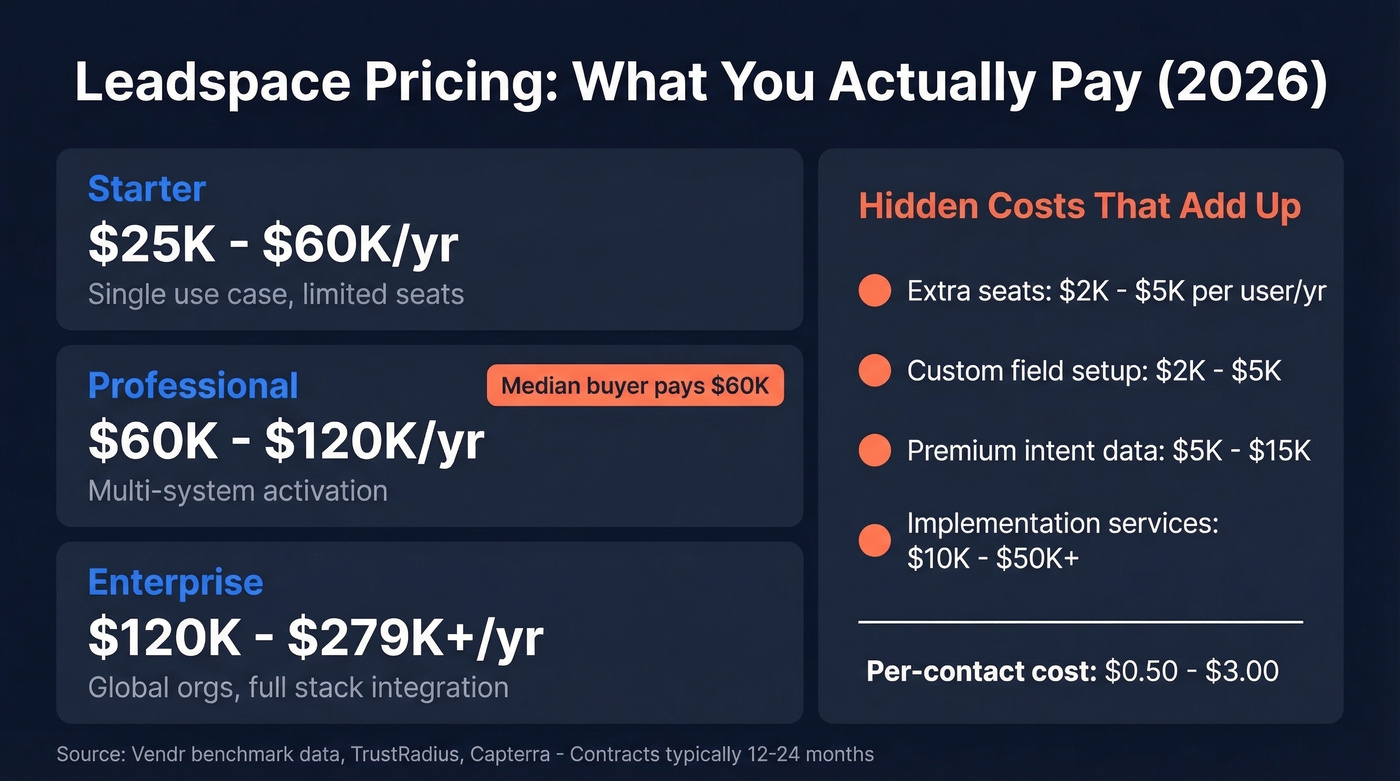
The best anchor comes from Vendr's benchmark data: the median buyer pays $60,000/year, with an observed range spanning $42,000 to $279,000. TrustRadius and Capterra list a starting price of $25,000/year, which functions as the floor for smaller deployments.
| Tier | Annual Cost | Typical Fit |
|---|---|---|
| Starter | $25K-$60K | Single use case, limited seats |
| Professional | $60K-$120K | Multi-system activation |
| Enterprise | $120K-$279K+ | Global orgs, full stack |
But the sticker price isn't the whole story. Extra seats run $2,000-$5,000 per user annually. Custom field setup fees land in the $2,000-$5,000 range. Premium intent categories add $5,000-$15,000. Professional services are typically required for implementation - budget another $10,000-$50,000+ on top of your license.
Per-contact cost works out to roughly $0.50-$3.00 depending on tier and data types. Contracts are typically 12-24 months. We've seen teams get surprised by the add-ons more than the base price, so push hard on total cost of ownership during negotiations (and know your walk away point).
Reviews Across Platforms
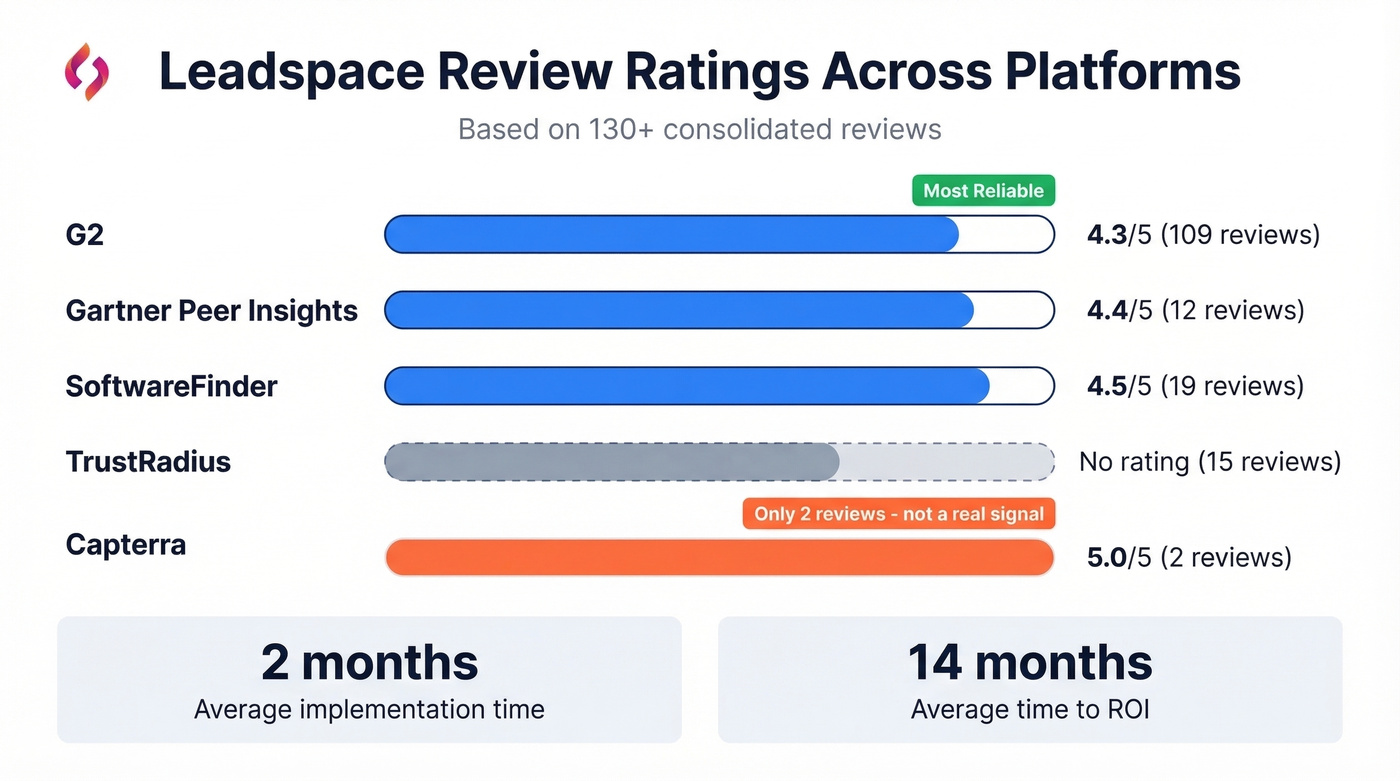
We consolidated ratings from every major review platform we could find:
| Platform | Rating | Reviews |
|---|---|---|
| G2 | 4.3/5 | 109 |
| Gartner Peer Insights | 4.4/5 | 12 |
| TrustRadius | - | 15 |
| SoftwareFinder | 4.5/5 | 19 |
| Capterra | 5.0/5 | 2 |
That Capterra 5.0? Based on exactly two reviews. A placeholder, not a signal. G2's 109 reviews provide the most reliable dataset, with benchmarks showing an average implementation time of 2 months and a 14-month timeline to ROI.
There isn't much Leadspace-specific discussion on Reddit - typical for enterprise CDPs sold through direct sales rather than public forums.

Leadspace charges $0.50-$3.00 per contact and takes 2 months to implement. Prospeo enriches contacts at $0.01 each with 98% email accuracy, 92% API match rate, and 50+ data points per record - live in minutes, not months.
Skip the $60K commitment. Get enterprise-grade data at self-serve pricing.
Pros and Cons
What Users Like
Reviewers consistently praise Leadspace's data accuracy and responsive customer support. The Marketo integration gets specific love:
"The integration with Marketo via webhook is incredibly smooth, and the lead enrichment happens almost in real-time."
The breadth of the dataset is another highlight - strong global and SMB company coverage, plus technographics, mobile numbers, funding data, and corporate hierarchy mapping across close to 120 enrichment fields. For enterprise teams that already have a complex stack, the depth of enrichment is genuinely impressive (especially if you're already investing in lead enrichment).
What Users Dislike
Lead-to-account matching - the core promise of a CDP - draws repeated complaints. One reviewer noted:
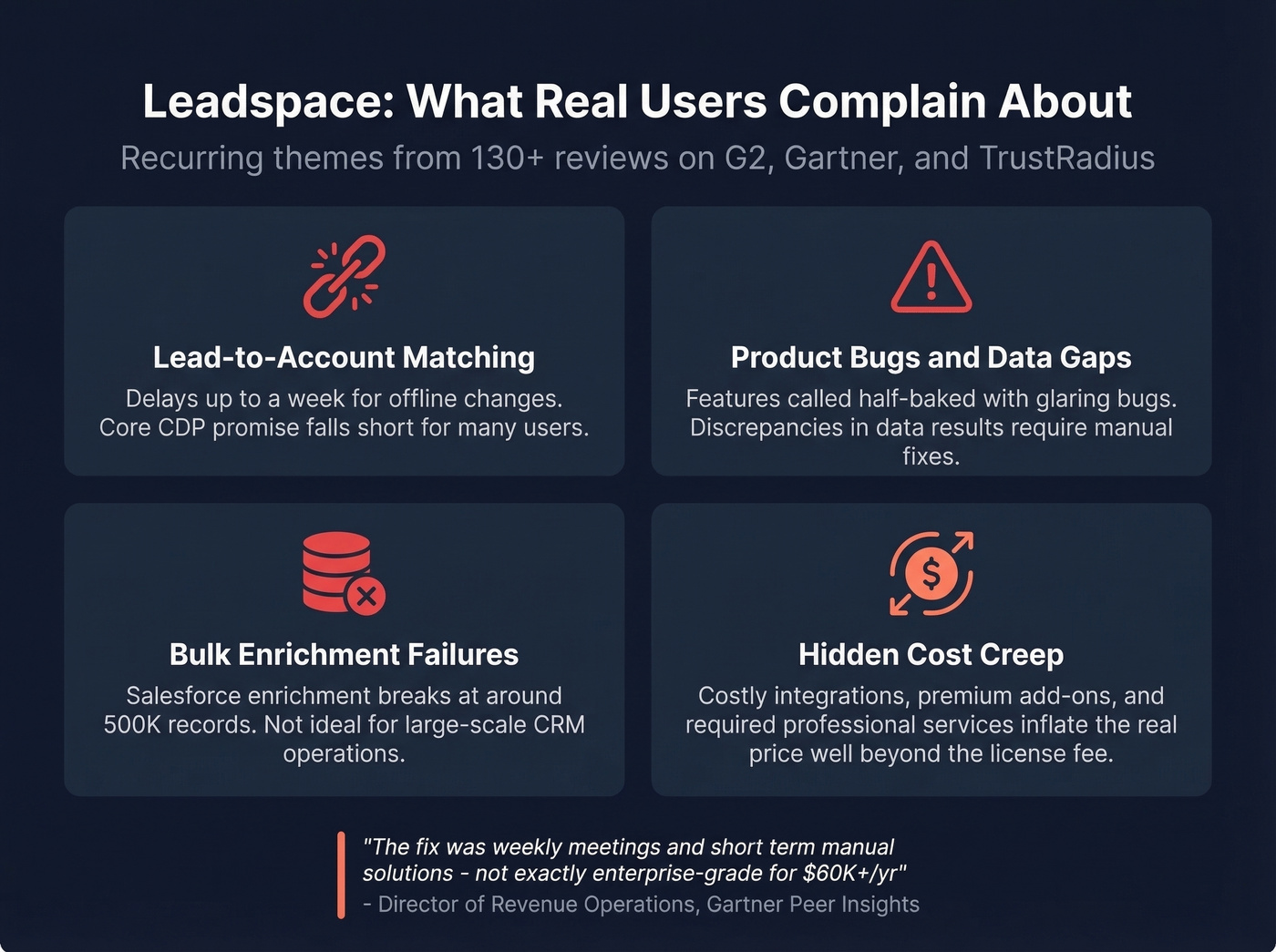
"The lead-to-account matching isn't perfect. I've noticed delays - sometimes up to a week - when changes need to be made offline."
A Director of Revenue Operations on Gartner Peer Insights was blunter, calling features "half-baked" with "glaring product bugs" and "discrepancies in the data results." The fix? Weekly meetings and "short term manual solutions." Not exactly enterprise-grade reliability for a $60K+ annual commitment.
Salesforce bulk enrichment also struggles at scale, with failures reported when processing around 500K records. Data freshness issues and costly integrations round out the recurring pain points (common sales pipeline challenges when data quality slips).
Who Is Leadspace For?
Use Leadspace if you're a 500+ employee enterprise with a dedicated RevOps team, a $100K+ annual GTM data budget, and an existing Salesforce/Marketo stack that needs a unification layer.
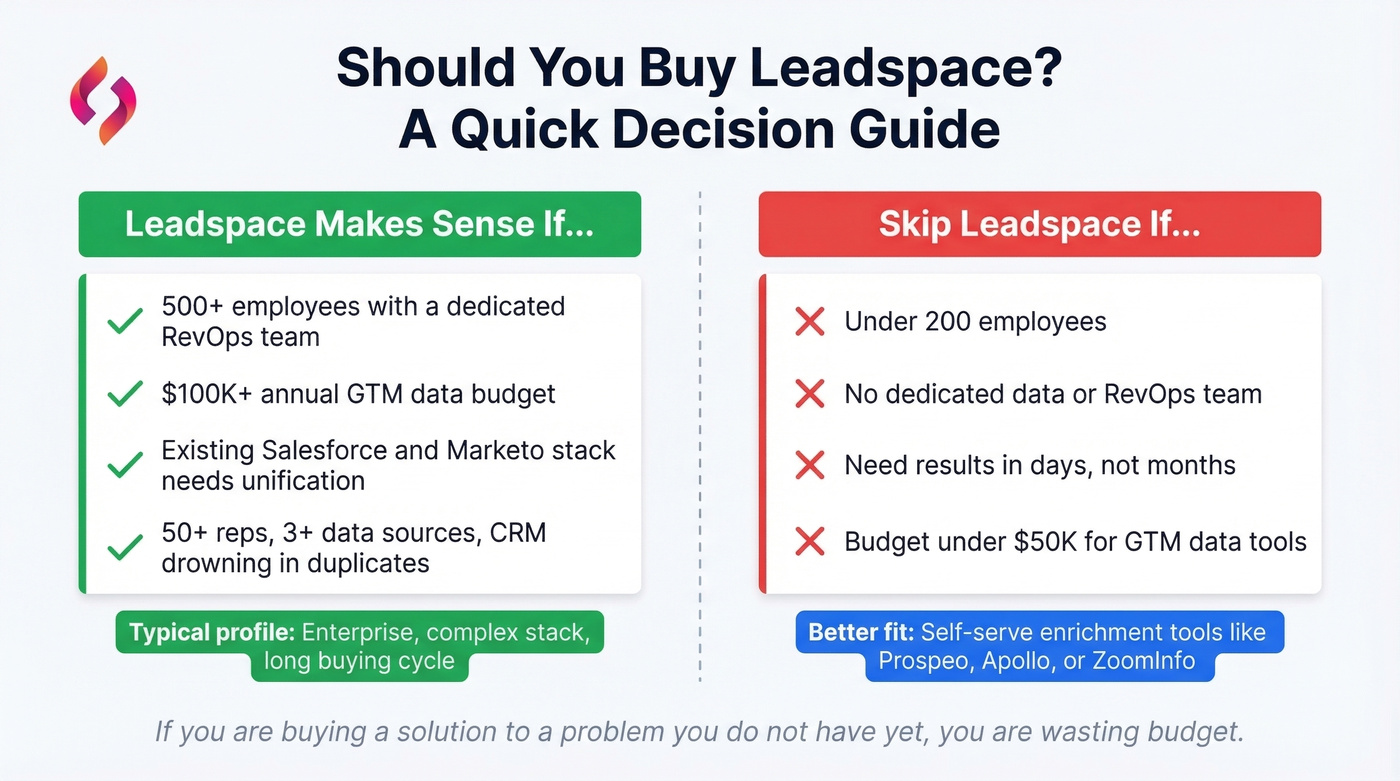
Skip Leadspace if you're under 200 employees, don't have a data team, or need results in days rather than months. We've watched teams under 200 employees waste months trying to implement enterprise CDPs when a self-serve tool would have had them prospecting the same afternoon (see practical sales prospecting techniques instead).
Let's be honest about the real calculus here: Leadspace solves a genuine problem, but it's a problem that only matters once you have 50+ reps, 3+ data sources, and a CRM that's already drowning in duplicate records. If that's not you, you're buying a solution to a problem you don't have yet.
Alternatives Worth Considering
| Tool | Pricing | Best For |
|---|---|---|
| ZoomInfo | $15K-$40K+/yr | Large database + intent |
| Apollo | $59-$149/user/mo | Self-serve outreach + enrichment |
| 6sense | Free tier; paid $30K-$100K+ | Predictive ABM + intent |
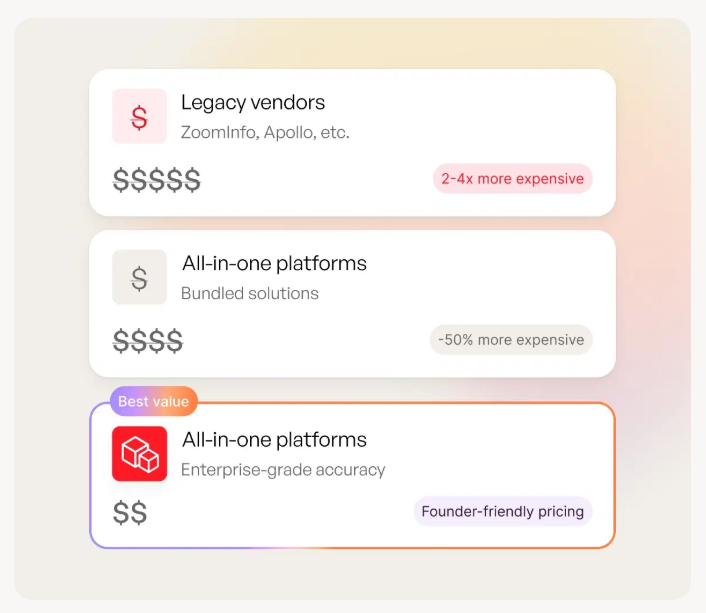
ZoomInfo sits closer to Leadspace in both price and complexity at $15K-$40K+/year for a large contact database with intent modules. It's the default enterprise pick, but you're paying for a lot of platform you won't touch (compare with other sales prospecting databases if you're shopping).
Apollo combines outreach tooling with enrichment at $59-$149/user/month - the strongest option if you want prospecting and sequencing in one tool without an enterprise contract.
6sense competes directly with Leadspace's intent and scoring layer. It offers a free tier for basic account identification and paid plans at $30K-$100K+ for the full predictive ABM suite (more on account-based selling best practices if you're building ABM).
The Verdict
Leadspace is worth evaluating only if you're a 500+ employee enterprise with a dedicated data team and a six-figure GTM data budget. The platform does what it promises - unifying buyer data across 30+ sources and activating it across your stack - but the cost, implementation timeline, and recurring bug reports mean it's not a casual purchase.
For everyone else, simpler tools deliver faster results at a fraction of the cost. And don't trust the vanity scores: most Leadspace review pages online are aggregator templates with 2 reviews and a perfect rating. Make your decision based on the 109 reviews on G2 and the Gartner Peer Insights feedback, not the placeholder scores.
Leadspace users report week-long delays and bulk enrichment failures at 500K records. Prospeo refreshes all 300M+ profiles every 7 days, handles CRM enrichment at scale, and includes Bombora intent data across 15,000 topics - starting at $0.
Same intent data. Fresher contacts. No six-figure contract.
FAQ
Does Leadspace offer a free trial?
No. Capterra confirms Leadspace doesn't offer a free trial, and the minimum contract starts at $25,000/year with 12-24 month terms.
How long does Leadspace take to implement?
Average implementation takes 2 months with professional services typically required, costing an additional $10,000-$50,000+. G2 data shows full ROI takes approximately 14 months from deployment.
What's the cheapest way to get verified B2B contact data?
Self-serve enrichment tools offer verified emails at a fraction of CDP pricing. Prospeo, for example, charges roughly $0.01 per email with a free tier available - no contracts, and you can start pulling contacts in minutes rather than months.