

Lean Sales: Eliminate Waste and Build a Repeatable Sales System
A rep on r/sales described being handed a blank slate - no CRM, no scripts, no lead source - and told to "create all processes and be the entire sales department." That's not a sales role. That's chaos dressed up as autonomy. And it's exactly where lean sales thinking delivers the most dramatic results, because 96% of buyers have already researched your product before they'll talk to a rep. Every minute your team spends on non-selling activity is a minute the buyer spends getting closer to a competitor.
This approach applies Toyota's waste-elimination principles to your pipeline. The payoff is shorter cycles, higher win rates, and reps who actually sell instead of drowning in admin. If you implement one thing today, start with OQC - it eliminates more waste at the top of the funnel than any other single change.
What Is Lean Sales?
This isn't a productivity hack. It's a system rooted in the Toyota Production System that obsessively identifies and removes anything that doesn't create value for the buyer. The distinction matters: "sales efficiency" usually means doing the same things faster. Lean means stopping the things that shouldn't be done at all.
Here's the thing - the Lean Enterprise Institute makes a critical point that lean has to be taught in sales language, not manufacturing jargon. Telling a rep about "kanban boards" gets blank stares. Telling them "we're going to cut the steps that keep you from selling" gets buy-in in five minutes. This is also why lean pairs well with an agile sales methodology. Both frameworks prioritize rapid iteration and customer feedback over rigid, top-down playbooks.
5 Core Principles for Sales
These five principles translate directly from manufacturing to how a sales org should operate. Think of them as a cycle, not a checklist.
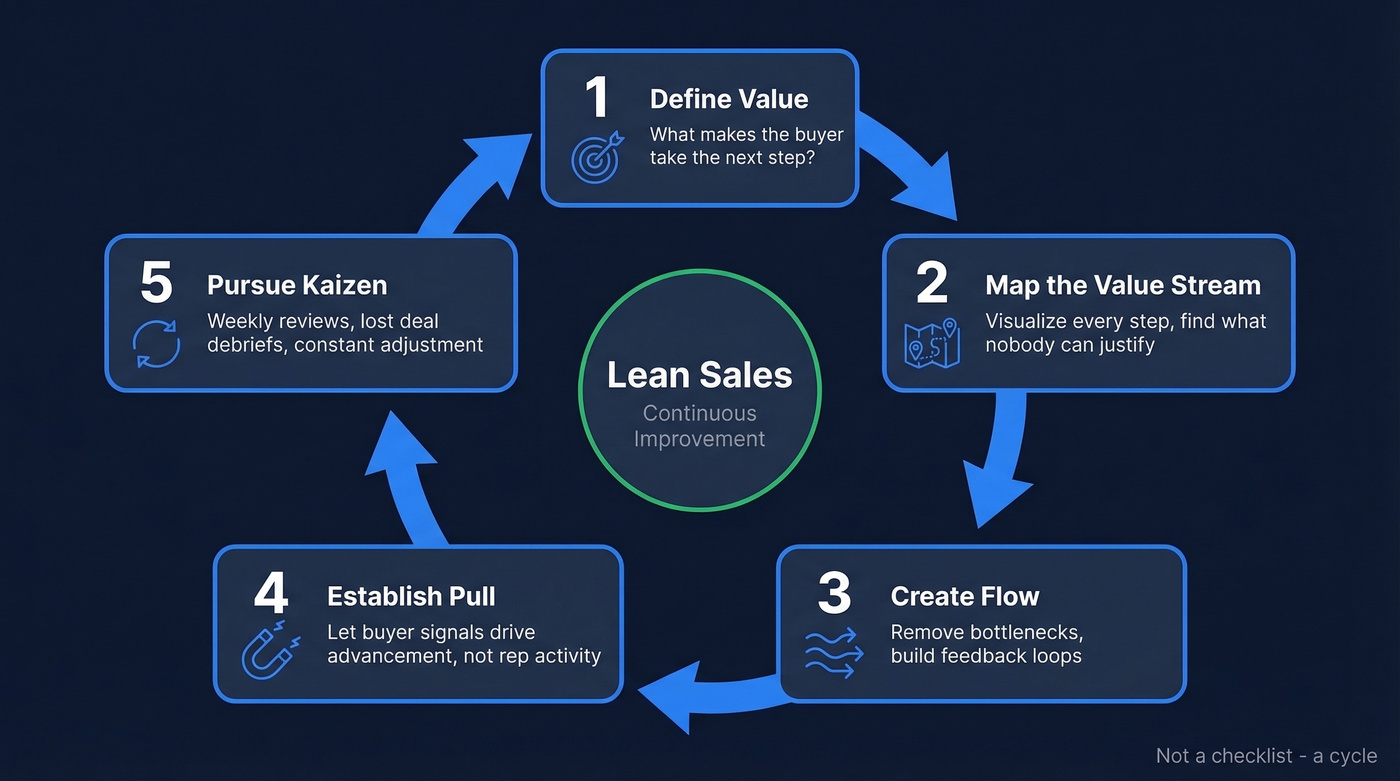
1. Define Value. Value is whatever makes the buyer take the next step. A discovery call that surfaces real pain? Value. A follow-up email restating what your website already says? Waste.
2. Map the Value Stream. Lay out every step from first touch to closed deal. Use Lucidchart or Miro to visualize it, annotate cycle times and handoff delays. You'll find steps nobody can justify.
3. Create Flow. Remove bottlenecks so deals move continuously. Nissila's research highlights a real tension here - optimizing for flow can create rigidity. The fix is building feedback loops into every stage so the system adapts rather than calcifies.
4. Establish Pull. Don't push leads through stages they aren't ready for. Let buyer signals - engagement, intent data, explicit requests - pull opportunities forward. This is the antidote to reps force-advancing deals just to hit activity metrics.
5. Pursue Kaizen. No process is ever finished. Run weekly pipeline reviews, debrief lost deals, and adjust. The feedback loops from Principle 3 make kaizen sustainable rather than aspirational.
The 8 Wastes Killing Your Pipeline
This is the anchor concept. Studies suggest up to 90% of office work is waste. That number sounds extreme until you watch a rep spend 40 minutes toggling between a CRM, a quoting tool, and a spreadsheet just to send a proposal.
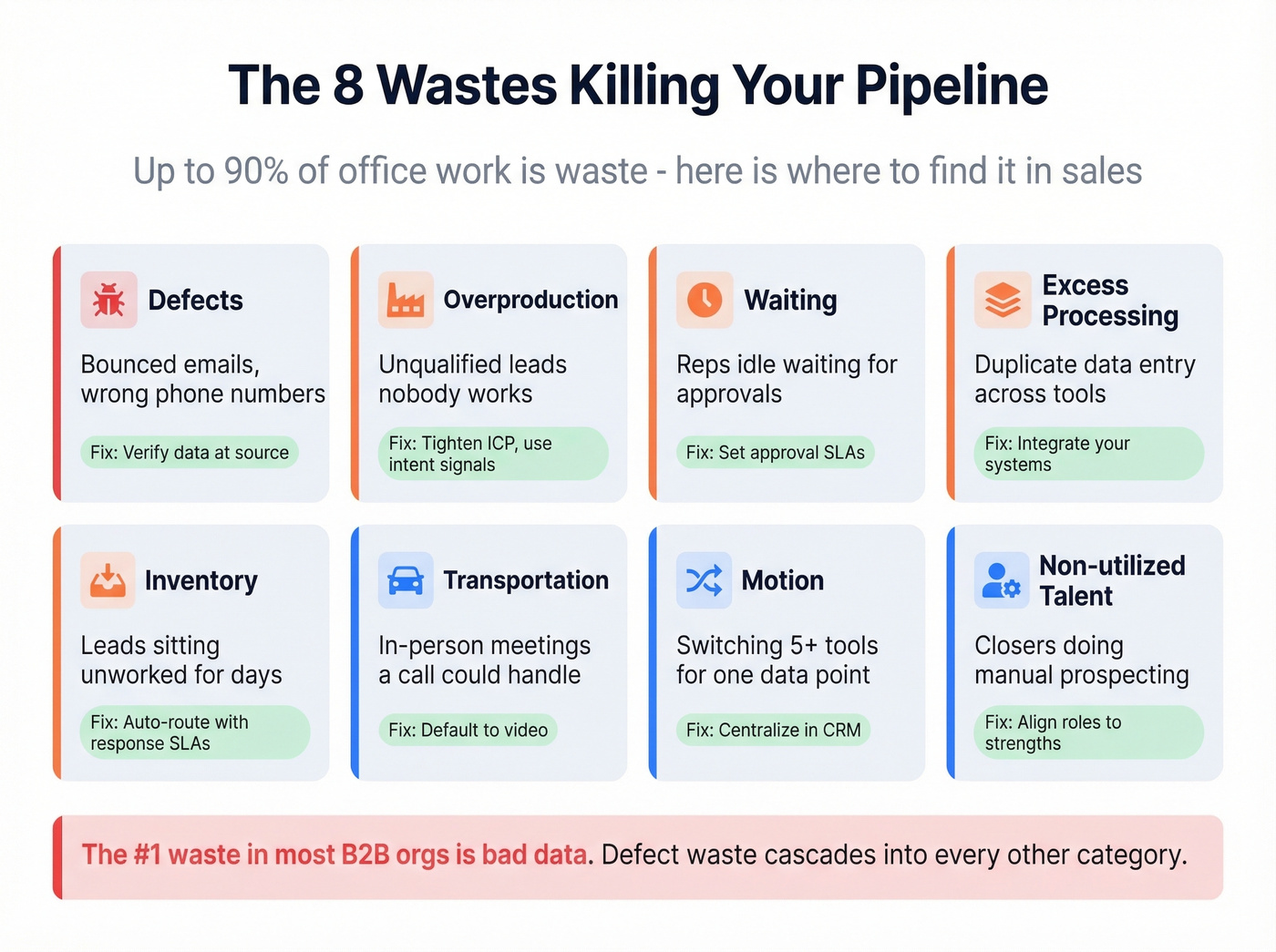
Cincom uses a memorable analogy: the cotton stuffed into pill bottles used to prevent breakage during shipping. It doesn't anymore - but it's still there. Your sales process is full of cotton.
| Waste Type | Sales Example | Countermeasure |
|---|---|---|
| Defects | Bounced emails, wrong numbers | Verify data at source |
| Overproduction | Unqualified leads nobody works | Tighten ICP; use intent signals |
| Waiting | Reps idle for approvals | Set approval SLAs |
| Excess Processing | Duplicate data entry | Integrate systems |
| Inventory | Leads sitting unworked | Auto-route; set response SLAs |
| Transportation | In-person meetings a call handles | Default to video |
| Motion | Switching 5+ tools for one data point | Centralize in CRM |
| Non-utilized Talent | Closers doing manual prospecting | Align roles to strengths |
Let's be honest: the single biggest waste in most B2B sales orgs isn't bad process - it's bad data. Defect waste cascades. When contact data is wrong, every downstream activity burns time and money for zero return. We've seen teams cut bounce rates from 35% to under 4% just by verifying emails before they hit the CRM, using tools like Prospeo's real-time verification and 7-day data refresh cycle.
Muri and Mura - The Wastes Nobody Names
Toyota's framework goes beyond muda to include two other inefficiencies. Muri is overburden - the rep carrying 200 accounts while also prospecting, running demos, and closing. That r/sales thread about a rep promoted to Sales Executive but still expected to set their own appointments? Textbook muri. Burnout follows, then attrition, then you're hiring again.
Mura is unevenness - the feast-or-famine pipeline where reps crush quota one month and miss by 40% the next. If your pipeline swings wildly month over month, you have a mura problem, not a prospecting problem. Mura makes forecasting nearly impossible and increases the risk of muri as reps scramble during famine periods, creating a vicious cycle that's hard to break without structural changes.
The Hidden 9th Waste - Bad Strategy
The Lean Enterprise Institute adds a waste that doesn't appear in the original eight: bad strategy. A company that optimizes its sales process to perfection but targets the wrong market generates waste for the entire organization.
I've watched teams spend quarters refining their outbound motion only to discover the ICP was wrong. All that optimization? Wasted. Strategy sits upstream of process, and it has to be right first. Teams that embrace lean startup thinking in sales - validating market assumptions through small, fast experiments before scaling - avoid this trap entirely.
The OQC Qualification Framework
If you implement one lean selling practice this quarter, make it OQC - Opportunity Qualification Criteria. It's a four-question framework that kills bad opportunities before they consume rep time and forecasting accuracy.
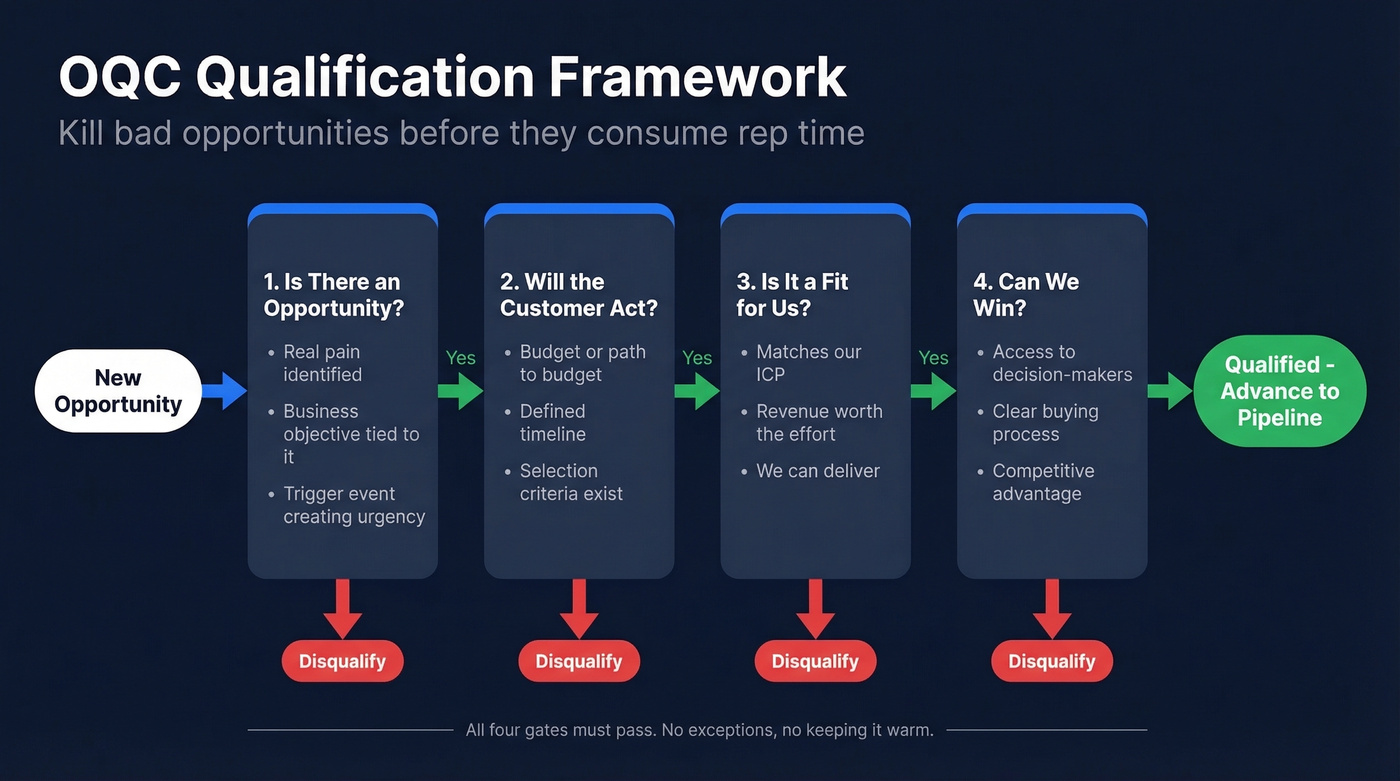
1. Is there an opportunity? Does the prospect have a real pain, a business objective tied to it, and a trigger event creating urgency?
2. Will the customer act? Is there budget or a path to it, a timeline, and defined selection criteria - or are they "just exploring"?
3. Is it a fit for us? Does this prospect match your ICP? Is the revenue worth the effort?
4. Can we win? Do you have relationships with decision-makers? Is the buying process clear?
Implementation is straightforward: define your ICP, workshop the four themes with your team, test on real pipeline, embed criteria in your CRM as stage-gate fields, and train for consistency. The Lean Sales Method site has detailed question templates for each theme.

Bad data is the #1 waste in your pipeline. Every bounced email triggers a cascade - wasted rep time, burned sender reputation, broken forecasts. Prospeo's 5-step verification and 7-day data refresh cut bounce rates from 35% to under 4%.
Eliminate defect waste at the source for $0.01 per verified email.
7-Stage Lean Sales Process
A lean sales process isn't CRM stages with fancy names. It's a system with logic, accountability, and measurable outcomes at every step.
Stage 1: Prospecting. Standard work for prospecting means defining your data source and verification process before reps start dialing. Exit criteria: lead matches ICP with verified contact data. (If you need a repeatable motion, start with these sales prospecting techniques.)

Stage 2: Qualification. Apply OQC. If the opportunity doesn't score "yes" on all four themes, disqualify it. No exceptions, no "let's keep it warm."
Stage 3: Discovery. This is where most deals are won or lost. Cincom's principle applies - "sell it once, sell it right." In our experience, inadequate discovery regularly resets deals to day one, reintroduces competition, and wastes all prior progress. Exit criteria: documented pain, stakeholder map, and success metrics. (Use a consistent set of discovery questions to reduce variance.)
Stages 4-7 compress into a tight sequence once discovery is solid:
| Stage | Core Action | Exit Criteria |
|---|---|---|
| 4. Pitch | Tailored to discovery findings | Buyer confirms solution fit |
| 5. Objection Handling | Pull from team objection library | All objections addressed |
| 6. Close | Define next step explicitly | Signed contract or clear "no" |
| 7. Post-Sale | Fast onboarding, referral triggers | Feeds back into Stage 1 |
71% of teams with structured workflows hit or beat their revenue targets. Structure creates repeatability, and repeatability creates predictability. Companies with formalized sales plans and CRM integration are 33% more likely to predict quarterly revenue accurately. (If forecasting is still noisy, consider dedicated sales forecasting solutions.)
KPIs That Actually Matter
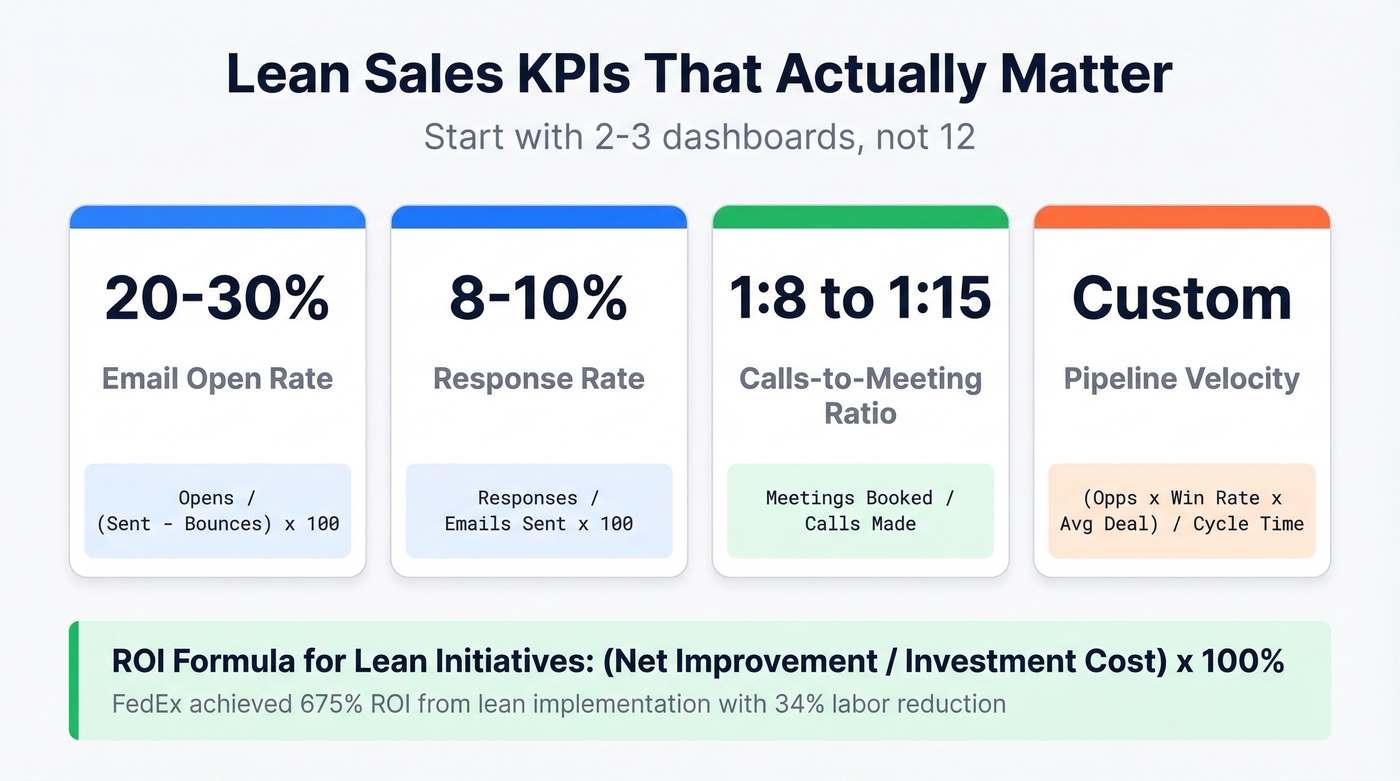
Start with 2-3 dashboards, not 12. These are the KPIs that matter for a waste-free system.
| KPI | Formula | Benchmark |
|---|---|---|
| Email open rate | Opens / (sent - bounces) x 100 | 20-30% |
| Response rate | Responses / emails sent x 100 | 8-10% |
| Calls-to-meeting | Meetings / calls made | 1:8 to 1:15 |
| Pipeline velocity | (Opps x win rate x avg deal) / cycle time | Company-specific |
ROI formula for lean initiatives: (Net Improvement / Investment Cost) x 100%. For context, FedEx's lean implementation in aircraft maintenance delivered a 675% ROI with a 34% labor reduction. That's operations, not sales - but the measurement rigor transfers directly. Track your cycle time, win rate, and cost-per-opportunity before and after changes. (To pressure-test your baseline, use funnel metrics that map to each stage.)
Lean vs. Traditional Selling
| Dimension | Lean Approach | Traditional Approach |
|---|---|---|
| Approach | Collaborative, team-built | Canned programs, top-down |
| Decision basis | Data and evidence | Opinion and anecdotes |
| Leadership role | Hands-on, in the process | Reviewing reports from above |
| System design | Team-based, sustainable | Relies on "superhero" reps |
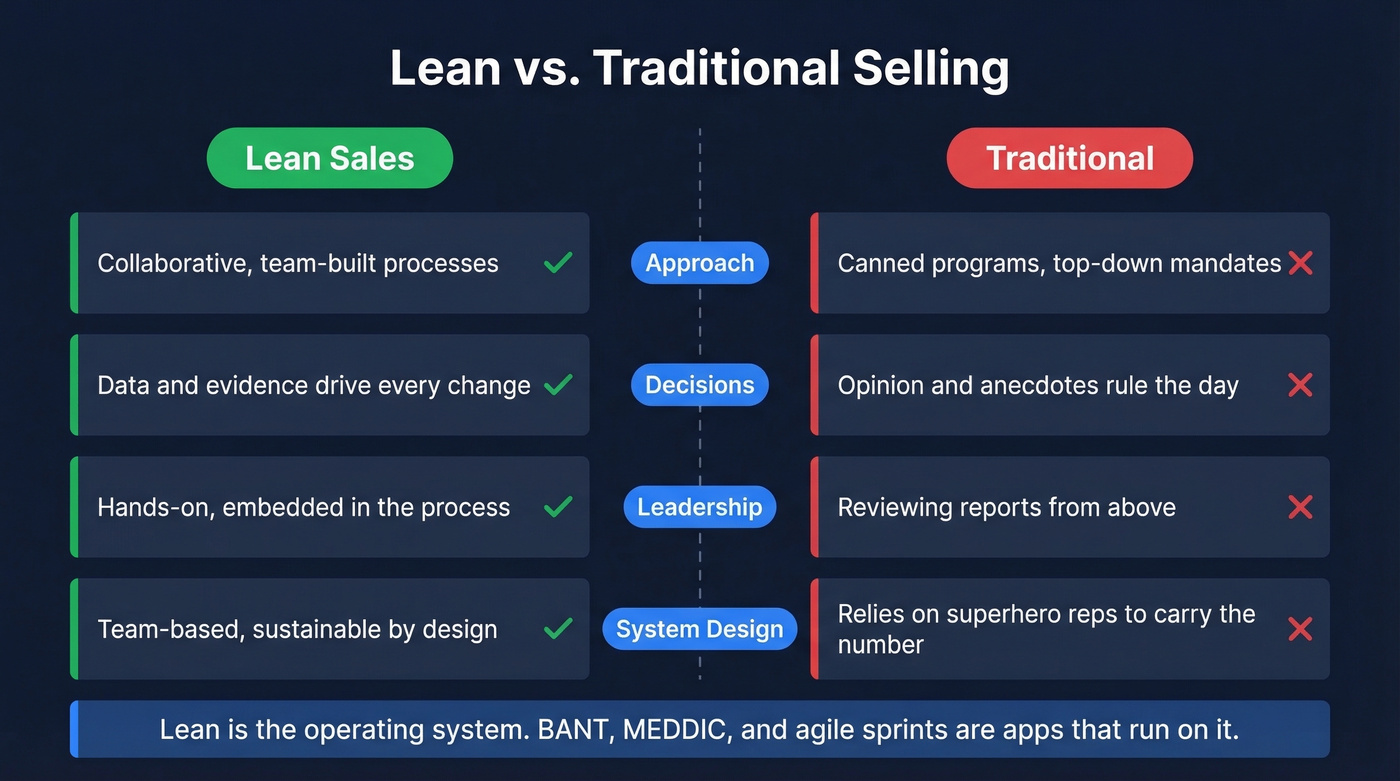
Skip the lean-vs-agile debates. Lean is the operating system; everything else - BANT, MEDDIC, agile sprints - is an app that runs on it. The key differentiator is that lean changes the system so good behavior is sustainable, rather than relying on individual heroics. Many high-performing teams adopt a hybrid approach, layering agile selling sprints on top of a lean foundation so reps can adapt to deal-specific complexity without abandoning the waste-elimination framework. (If you're formalizing the system, this is classic sales process optimization.)
Common Mistakes to Avoid
Using manufacturing jargon with sales teams. The Lean Enterprise Institute warns against this explicitly. Talk about "removing steps that keep you from selling," not "eliminating muda through jidoka."
Random experimentation without market prioritization. Lean experimentation isn't launching darts at a dartboard. Prioritize your markets and channels first, then optimize the process for each. (If you're rethinking top-of-funnel, start with lead generation trends.)
Ignoring frontline reps. Start with one question: "What's keeping you from selling more?" We've found the answers surface more waste than any consultant's audit. Threads on r/sales about what people would change in their sales process consistently point back to admin work and process friction, not selling technique.
Optimizing a process that targets the wrong buyers. This is the 9th waste in action. Get strategy right before you optimize tactics. If your team hasn't validated ICP assumptions with real data in the last two quarters, that's your first move - not process refinement. (A quick diagnostic: review your pipeline health before changing tactics.)
Lean says stop doing things that shouldn't be done at all. That includes closers manually hunting for contact info across five tools. Prospeo gives your team 300M+ verified profiles with 30+ filters - intent, technographics, job changes - so reps sell instead of search.
Free your reps from non-selling activity. Start with 75 free emails.
FAQ
Where should I start with lean sales?
Start with OQC - it eliminates waste at the top of the funnel before bad opportunities consume rep time and forecasting accuracy. A single workshop can align your team on all four qualification themes in under two hours.
How long until results are measurable?
Most teams see cycle-time reduction within one quarter. Full cultural adoption - where continuous improvement becomes habitual - typically takes 6-12 months of consistent practice and weekly pipeline reviews.
Does this work for small teams?
Small teams benefit the most because waste is more visible and changes propagate faster. A 3-person team can implement OQC and value stream mapping in a single afternoon.