

How to Write a Meeting Invitation Letter That Actually Gets Confirmed
It's 4:47 PM on a Friday. A calendar notification pops up: "Quick Chat - Monday 9 AM." No agenda, no context, no attendees listed. Your stomach drops. One Reddit user described exactly this scenario - a random 1:1, late in the day, not recurring. Their update? "I was laid off."
A vague meeting invite isn't just sloppy. It's cruel. Whether you're sending a formal letter for a meeting invitation or a quick calendar ping, the way you write it determines whether people show up prepared or show up anxious. Most templates floating around are useless: one generic letter with [BRACKET PLACEHOLDERS] and zero guidance on when to go formal vs. informal. With most teams now hybrid and scattered across time zones, your invitation has to do more work than ever before.
What Every Meeting Invitation Needs
Every meeting invitation - letter, email, or calendar invite - needs four things:
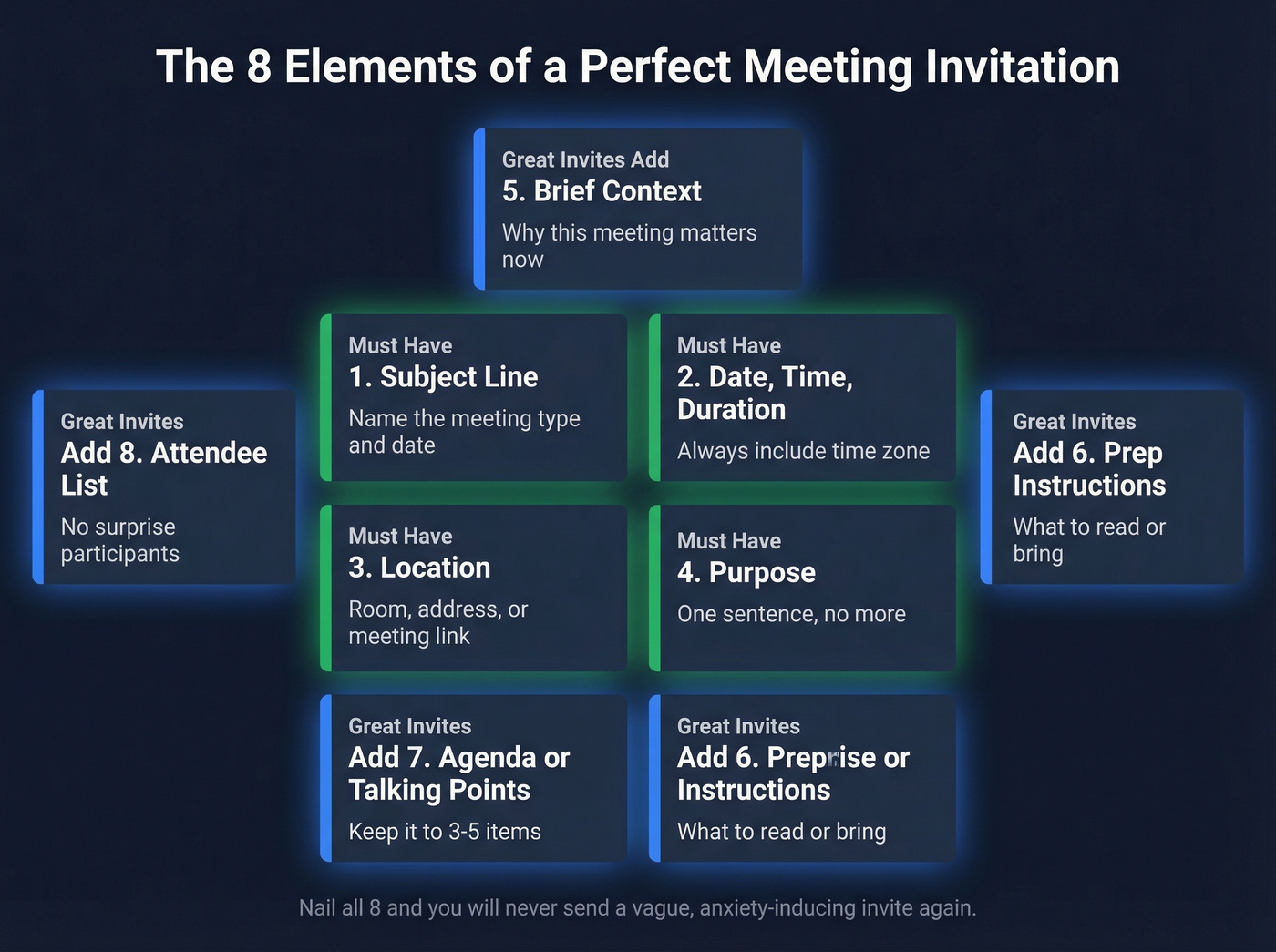
- Subject line that names the meeting type and date
- Date, time, and duration with time zone
- Location - room, address, or meeting link
- Purpose in one sentence
Four more elements separate good invites from great ones: brief context, preparation instructions, an agenda or talking points, and an attendee list. That last one is especially important for sensitive meetings where surprise participants erode trust. Nail those eight and you'll never send a vague, anxiety-inducing invite again.
Why Your Invitation Letter Matters
There are somewhere between 36 and 56 million meetings every day in the US alone. Most start with an invitation that's either too vague or too long. Neither gets confirmed reliably.
Think of an accepted meeting invite as a mini contract. Once someone clicks "Accept," there's mutual accountability - they've committed their time, and you've committed to making that time worthwhile. A clear invitation creates that commitment. A vague one creates resentment.
Here's the thing: 47% of recipients decide whether to open an email based on the subject line alone. If your invitation doesn't get opened, it doesn't get confirmed.
Subject Lines That Get Opened
That 47% stat cuts both ways. 69% of recipients report emails as spam based solely on the subject line. Your meeting invite is competing with newsletters, cold pitches, and actual spam. It needs to earn the open.
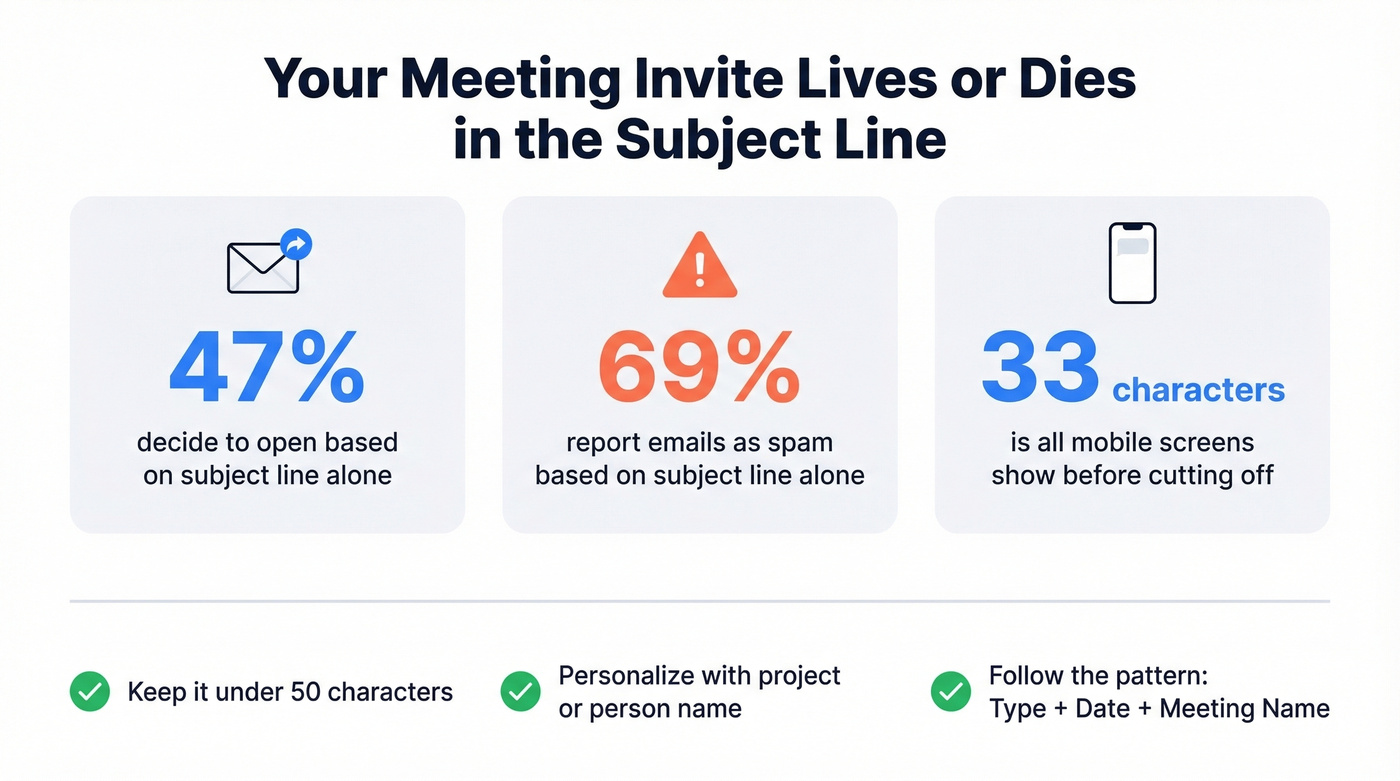
Three rules backed by data:
Keep it short. Mobile devices show roughly 33 characters before truncating, and 81% of emails are now opened on mobile. Never exceed 50 characters. Front-load the important words. If you need more inspiration, borrow from proven subject line patterns.
Personalize when possible. Personalized subject lines can deliver 26-50% higher open rates. For meeting invites, that means naming the project, the person, or the decision at stake - not just "Meeting." (More swipeable options: Email Subject Line Examples.)
Follow the pattern: Type + Date + Meeting Name. This answers the three questions every recipient has: what is this, when is it, and why should I care?
| Scenario | Subject Line Example | Characters |
|---|---|---|
| Quarterly review | Q2 Review - June 12, 2 PM | 26 |
| Client kickoff | Kickoff: Acme Project - Mar 5 | 30 |
| Team standup | Standup 3/10: Sprint 4 Updates | 30 |
| Performance review | 1:1 Review w/ Kate - Apr 8, 30 min | 35 |
| Board meeting | Board Meeting - May 15, 10 AM ET | 33 |
| Rescheduled | Rescheduled: Budget Review - Jun 3 | 36 |
| Canceled | Canceled: Budget Review - Jun 3 | 33 |
Avoid abbreviations that make sense internally but confuse external recipients. "QBR w/ Mktg Re: FY26 OKRs" means nothing to a client.
Formal vs. Informal Invitations
The distinction matters more than most people think. A post on r/AskHRUK captured the problem perfectly: a manager's email described a "formal letter" inviting someone to a meeting, but the attached letter called it an "informal meeting." The recipient had already been blindsided by HR appearing unannounced at a prior meeting. The mixed signals made everything worse.
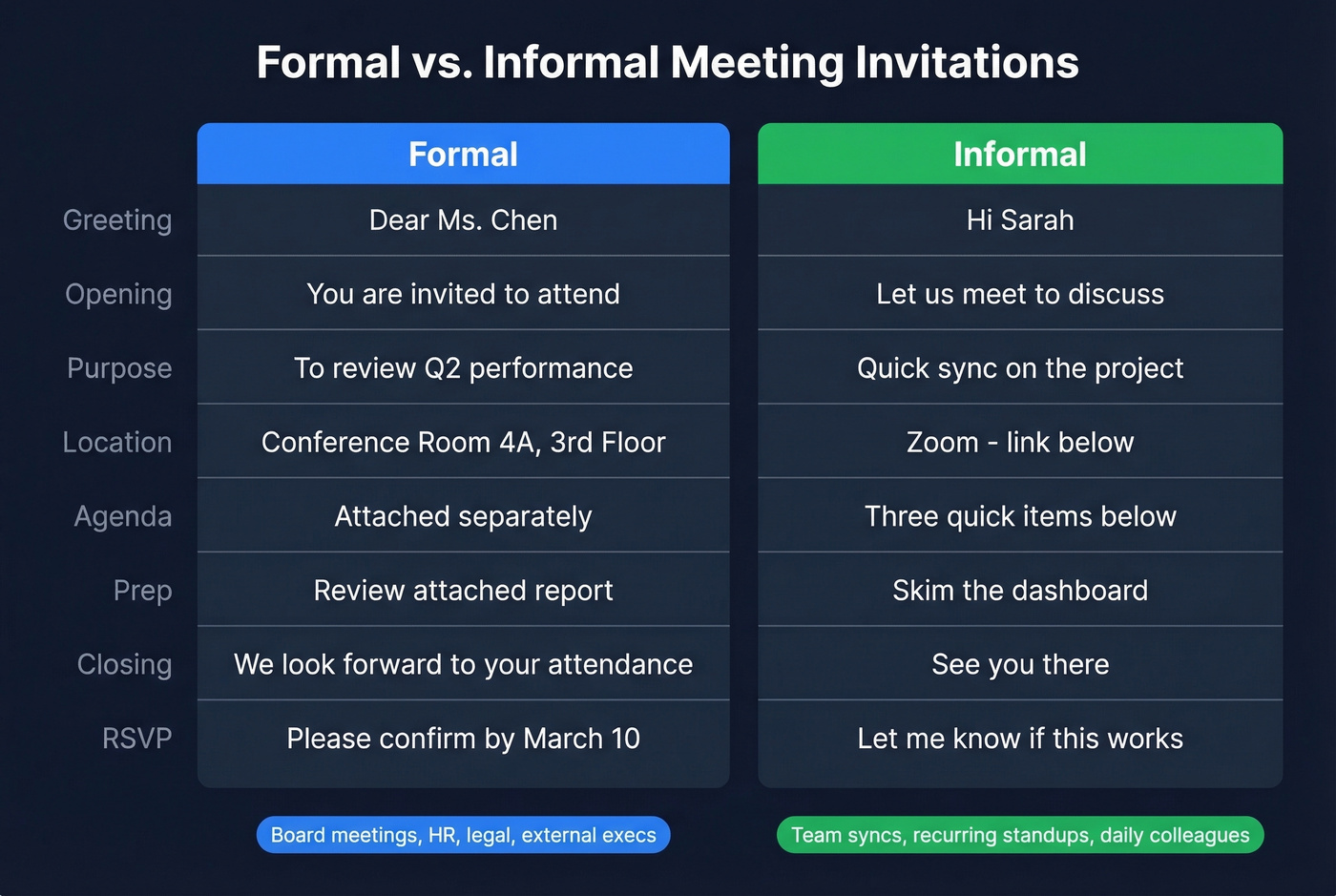
Consistency between your email, your letter, and the actual meeting experience isn't optional.
| Component | Formal | Informal |
|---|---|---|
| Greeting | Dear Ms. Chen | Hi Sarah |
| Opening | You are invited to attend | Let's meet to discuss |
| Purpose | To review Q2 performance | Quick sync on the project |
| Location | Conference Room 4A, 3rd Floor | Zoom - link below |
| Agenda | Attached separately | Three quick items below |
| Prep | Review attached report | Skim the dashboard |
| Attendees | Listed with titles | @-mentioned or implied |
| Closing | We look forward to your attendance | See you there |
| RSVP | Please confirm by March 10 | Let me know if this works |
Use formal for board meetings, legal or HR proceedings, external stakeholders you haven't met, and any meeting where printed letters or PDFs are expected. A formal email invitation is also appropriate when reaching out to executives or government officials for the first time.
Use informal for internal syncs, recurring team meetings, and colleagues you work with daily. If you're booking meetings as part of outbound, these sales prospecting techniques can help you get the yes faster.

A great meeting invitation letter gets confirmed. But first, you need the right email address. Prospeo's 98% verified emails mean your invitation actually lands in the inbox - not a dead address or spam folder.
Stop crafting perfect invites for broken email addresses.
Email, Calendar Invite, or Printed Letter?
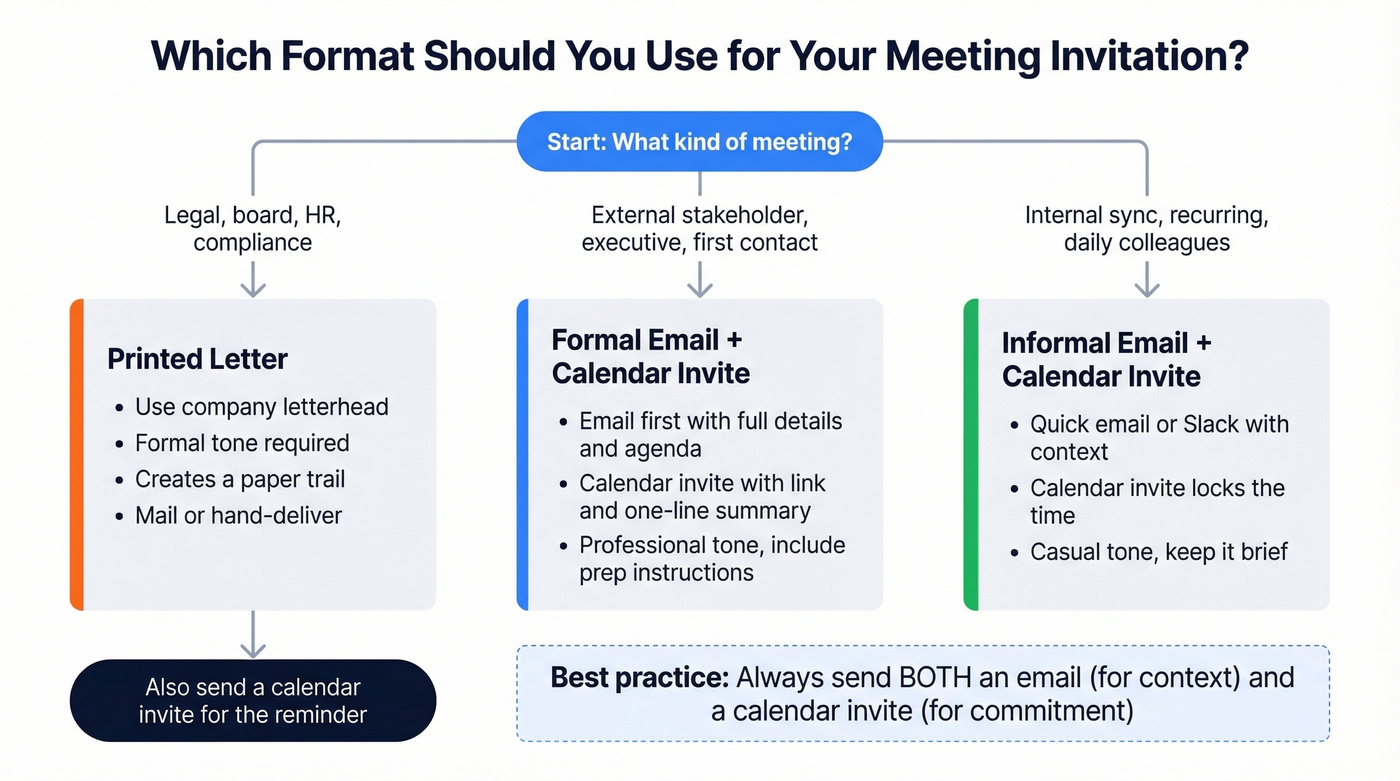
Send both an email and a calendar invite. The email provides context. The calendar invite creates commitment.
| Feature | Calendar Invite | Printed Letter | |
|---|---|---|---|
| Best for | Context & detail | Attendance & reminders | Formal/legal record |
| Auto-reminders | No | Yes | No |
| Time zone handling | Manual | Automatic | N/A |
| Detail capacity | High | Limited | High |
| Formality level | Medium | Low | High |
Calendar invites drive attendance because they sit on the recipient's calendar with auto-reminders and automatic time zone alignment. They feel like a commitment, not a suggestion. But calendar invites have limited space for context, agendas, and prep instructions.
Our recommendation: email first with full details, then send the calendar invite with the meeting link and a one-line summary. Printed letters are reserved for board meetings, legal proceedings, and HR matters requiring a paper trail. When a business letter for a meeting invitation is required - for regulatory or compliance purposes, say - use company letterhead and keep the tone appropriately formal. If you're sending at scale, make sure your email deliverability fundamentals are solid.
9 Meeting Invitation Templates
1. Formal Printed Letter
This works for board meetings, legal proceedings, and any situation requiring a printed record.
[Your Company Letterhead]
[Date]
[Recipient Name & Title] [Company Name] [Address]
Dear [Title] [Last Name],
You are cordially invited to attend [Meeting Name] on [Day, Month Date, Year] from [Start Time] to [End Time] at [Full Address, Room Number].
The purpose of this meeting is to [one-sentence purpose]. An agenda is enclosed for your review. Please confirm your attendance by [RSVP Date] by contacting [Name] at [Email/Phone].
Sincerely, [Your Name, Title]
2. Formal Email Invitation
Subject: Q2 Strategy Review - April 15, 10 AM ET
Dear Ms. Rodriguez,
I'm writing to invite you to our Q2 Strategy Review on Tuesday, April 15, 2026, from 10:00 AM to 11:30 AM ET in Conference Room 3B (or via Zoom - link below).
We'll review regional performance, discuss resource allocation for H2, and align on Q3 priorities. Please review the attached deck before the meeting. Kindly confirm by April 10.
3. Informal Team Meeting Email
Subject: Standup 3/12: Sprint 5 Priorities
Hey team - quick standup Wednesday at 10 AM, wrapping by 10:20. Usual Zoom room. Three items:
- Sprint 4 retro (5 min)
- Sprint 5 priorities and blockers
- Design review update from Jake
No prep needed. See you there.
4. Client / External Stakeholder
Subject: Kickoff: Acme Integration - March 20, 2 PM ET
Hi David,
I'd like to schedule our project kickoff for Thursday, March 20, from 2:00 to 2:30 PM ET. We'll cover the integration timeline, your team's access requirements, and next steps.
Could you review the scope document (attached) beforehand? That'll help us move faster in the meeting. Please confirm by March 17 or suggest an alternative time.
5. Board Meeting Invitation
Subject: Board Meeting - May 15, 2026, 9 AM PT
Dear Board Members,
The next quarterly board meeting is scheduled for Thursday, May 15, 2026, from 9:00 AM to 12:00 PM PT at [Address]. A detailed agenda and supporting materials will be circulated by May 1.
Please confirm your attendance by April 25. Remote dial-in details will follow separately.
6. Interview Invitation
Subject: Interview: Marketing Manager - March 25, 11 AM ET
Hi Alex,
We'd like to invite you to interview for the Marketing Manager position on Tuesday, March 25, from 11:00 to 11:45 AM ET via Zoom (link below).
You'll meet with [Name, Title] and [Name, Title]. Please bring a brief portfolio or campaign example you're proud of. Let us know if you need any accommodations.
7. Virtual / Hybrid Meeting
Subject: Product Sync - Apr 3, 3 PM ET / 8 PM GMT
Hi everyone - our monthly product sync is Thursday, April 3, from 3:00 to 4:00 PM ET / 8:00 to 9:00 PM GMT.
Zoom link: [link] Dial-in: +1-555-123-4567, PIN 9876#
If joining by video, please update Zoom to the latest version. Agenda is pinned in the #product Slack channel. In-office folks: Room 2C with the conference mic.
8. Sensitive Meeting (Performance Review, Restructuring)
This is where clarity isn't just professional - it's humane. A vague invite to a meeting with HR creates the exact anxiety that makes people spiral for days. We've seen teams eliminate that anxiety entirely just by naming the purpose and attendees upfront.
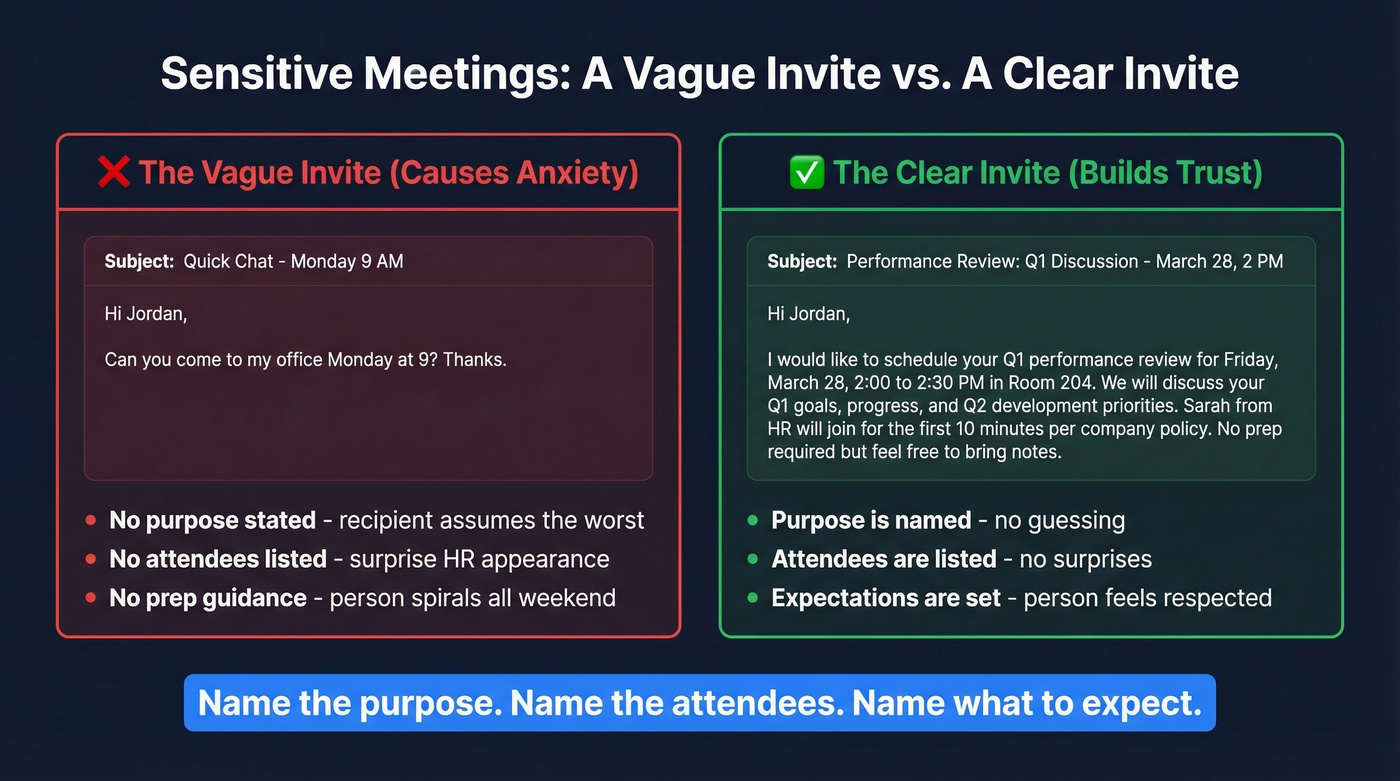
Subject: Performance Review: Q1 Discussion - March 28, 2 PM
Hi Jordan,
I'd like to schedule your Q1 performance review for Friday, March 28, from 2:00 to 2:30 PM in my office (Room 204). This is a standard quarterly review - we'll discuss your Q1 goals, progress, and development priorities for Q2.
[Name] from HR will join for the first 10 minutes per company policy. No preparation is required, but feel free to bring notes or questions. Please confirm by March 25.
Name the purpose. Name the attendees. Name what to expect. That's it.
9. Follow-Up / Reminder Email
Send this 24-48 hours before the meeting.
Subject: Reminder: Q2 Strategy Review - Tomorrow, 10 AM ET
Quick reminder that our Q2 Strategy Review is tomorrow (April 15) at 10:00 AM ET in Conference Room 3B. Zoom link: [link].
Deck is attached again if you haven't reviewed it. Let me know if you can no longer attend so we can adjust.
Let's be honest - stop overthinking the template. The format matters less than three things: purpose, logistics, and who's in the room. Nail those and even a two-sentence invite works. One of the biggest predictors of meeting attendance is whether the invite includes an agenda, even a rough one. If you need a post-meeting note, use these sales meeting follow-up email frameworks.
How Far in Advance to Send
Timing depends on the meeting's complexity and who's involved:
- Internal sync or standup: 24-72 hours
- Cross-functional planning meeting: 1-2 weeks
- External stakeholder meeting: 2-4 weeks
- Board meeting or executive dinner: 4-8 weeks
- Major event requiring travel: 4-6 months
For recurring meetings, set the series once and let the calendar do the work. For one-off meetings with senior stakeholders, err on the side of more notice - their calendars fill up fast, and a two-week lead time that feels generous to you is already tight for a VP juggling 30 hours of meetings a week.
Mistakes That Kill Your Invite
Vague or missing subject lines. "Quick Chat" with no context is how you make someone assume they're getting fired. Name the meeting type and purpose.
Formal/informal mismatch. If your email says "formal review" but the meeting is a casual check-in, you've created unnecessary stress. Pick a tone and stay consistent.
Missing meeting link or time zone. The link belongs in the invite - not in a follow-up email someone has to dig for. Always include the time zone for distributed teams.
No RSVP deadline. Without one, people treat the invite as optional. Give a specific date. If you're not getting replies, these sales follow-up templates can help.
Sending large attachments. Large attachments can hurt deliverability - some servers block oversized messages entirely. Link to the document instead. If you're troubleshooting bounces, start with email bounce rate.
Not listing attendees. If HR or legal will be in the room, say so upfront. Surprise attendees erode trust instantly.
Sending formal meeting invitations to executives and external stakeholders? Prospeo gives you direct emails and verified mobile numbers for 300M+ professionals - so your invitation reaches the decision-maker, not a gatekeeper.
Find any executive's direct email in seconds for $0.01.
FAQ
How long should a meeting invitation letter be?
Aim for 80-150 words - enough for purpose, logistics, and an RSVP request. Board meeting letters with enclosed agendas can run longer, but the invitation itself should stay concise. If it takes more than 30 seconds to read, you've lost people.
Should I send a calendar invite or an email?
Send both. The email carries context, prep instructions, and the agenda. The calendar invite locks the time slot with auto-reminders and automatic time zone conversion. Together they maximize confirmation rates.
What's the difference between a printed letter and an email invitation?
A printed letter uses formal structure - letterhead, address blocks, PDF or physical format - for board, legal, or external contexts. Email works for everything else. Use the formal email template above when you need structure without the overhead of print.
How do I invite someone if I don't have their email?
Use an email finder tool to locate and verify their professional address before sending. Prospeo's free tier includes 75 verified lookups per month, which is plenty for most meeting coordination. A bounced email signals disorganization before the meeting even happens.
Is it rude to decline a meeting invitation?
No - a polite decline beats accepting and not showing up. If the invite says "Regrets only," reply only if you can't attend. Otherwise you're expected to be there. A brief reason ("conflict with client call") is courteous but not required.