

How to Write a Company Introduction Letter That Actually Gets a Reply
The average cold email reply rate in 2026 is 3.43%. That means roughly 97 out of 100 company introduction letters go unanswered. And here's what stings: 58% of replies come from the first email, not the follow-ups. Your opening message does the heavy lifting, so you can't afford to waste it on a forgettable wall of text about your company's founding story.
The Short Version
Before you spend an hour drafting, three things actually make the difference:
- Keep it under 80 words. Lead with value for the recipient, not your origin story. End with a soft CTA - "Worth a conversation?" beats "Book a 15-minute call."
- Use a subject line under 50 characters. In one documented case study, "Quick question" beat "Partnership opportunity" by roughly 2x. Short subjects also avoid getting truncated on mobile, where 46% of opens happen.
- Verify every email address before sending. The best introductory mail gets 0% replies if it bounces. One team saw bounce rates drop from 11% to under 2% after switching to manual verification.
What Is a Company Introduction Letter?
A company introduction letter is a formal first touchpoint between your business and a potential client, partner, supplier, or investor. As PandaDoc frames it, it's your chance to introduce your company before a business proposal - to establish credibility and open a door.
The B2B version tends to be more formal and value-driven than a B2C version, which can lean on brand personality and promotions. But regardless of audience, the goal is the same: get a reply, not close a deal.
Introduction letters, cover letters, and cold emails overlap but serve different purposes:
| Introduction Letter | Cover Letter | Cold Email | |
|---|---|---|---|
| Purpose | Open a relationship | Apply for a role | Generate a reply/meeting |
| Audience | Partners, clients, vendors | Hiring managers | Prospects |
| Tone | Professional, warm | Formal, qualifications-led | Conversational, brief |
| Length | One page (email versions much shorter) | ~300-400 words | ~40-80 words |
| When to use | New company, new product, new partnership | Job application | Outbound prospecting |
Structure That Works
The best business introduction letters follow a framework the military calls BLUF - Bottom Line Up Front). Carnegie Mellon promotes this approach for reader-friendly business writing, and it works perfectly here. Don't make the recipient dig for your point. Lead with it.
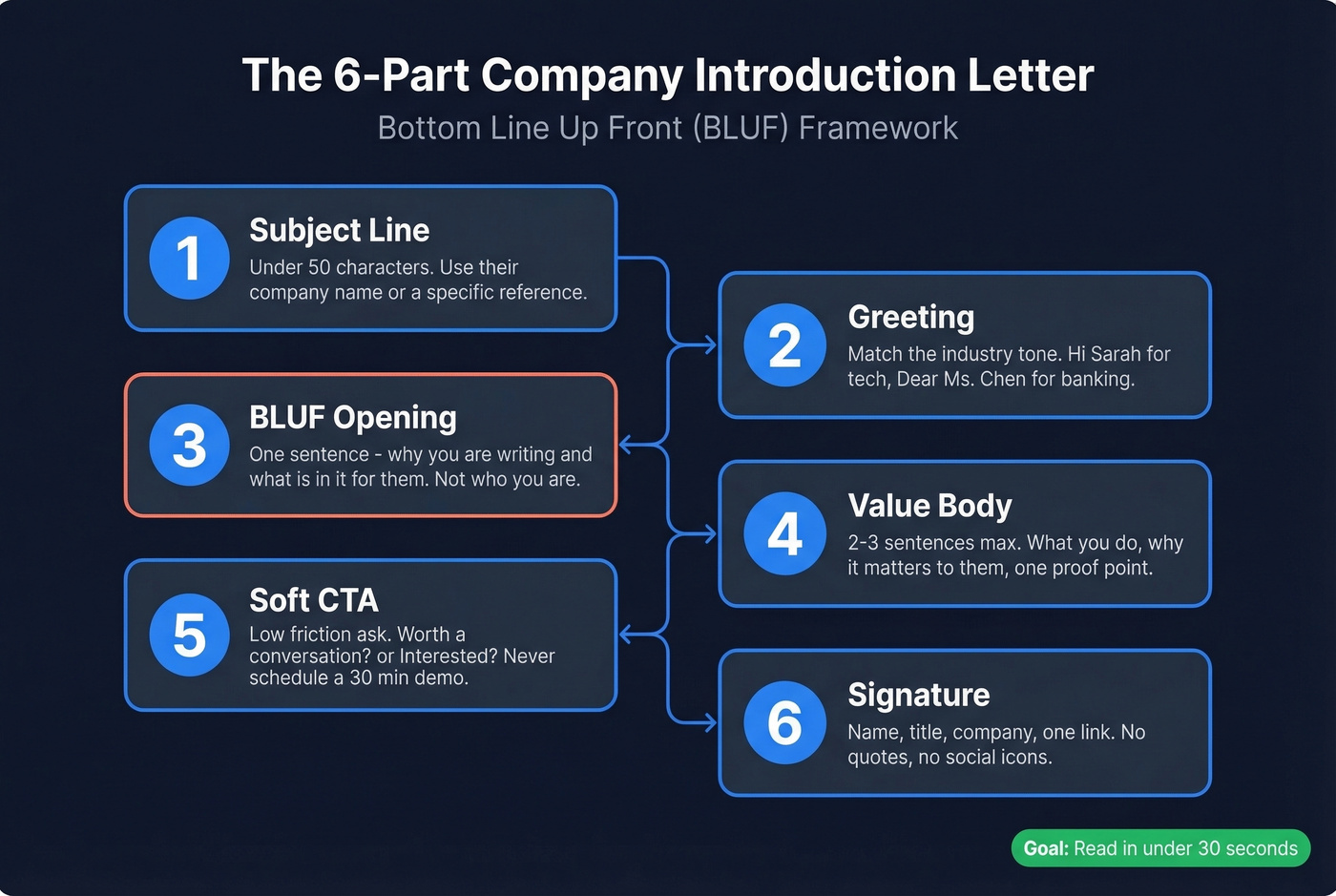
Here's the six-part structure:
- Subject line - Under 50 characters. Personalized subject lines boost open rates by +26%. Use the recipient's company name or a specific reference.
- Greeting - Match the industry. "Hi Sarah" works for tech. "Dear Ms. Chen" works for banking, government, or academia.
- BLUF opening - One sentence that tells the reader why you're writing and what's in it for them. Not who you are.
- Value body - Two to three sentences max. What you do, why it matters to them specifically, and one proof point.
- Soft CTA - A low-friction ask. "Worth a quick conversation?" or "Interested?" Not "Let's schedule a 30-minute demo."
- Signature - Name, title, company, one link. No inspirational quotes. No five social media icons.
The whole thing should read in under 30 seconds. If it doesn't, cut.
How to Write One That Gets Replies
Structure alone won't save a mediocre letter. Let's talk about what actually drives replies.
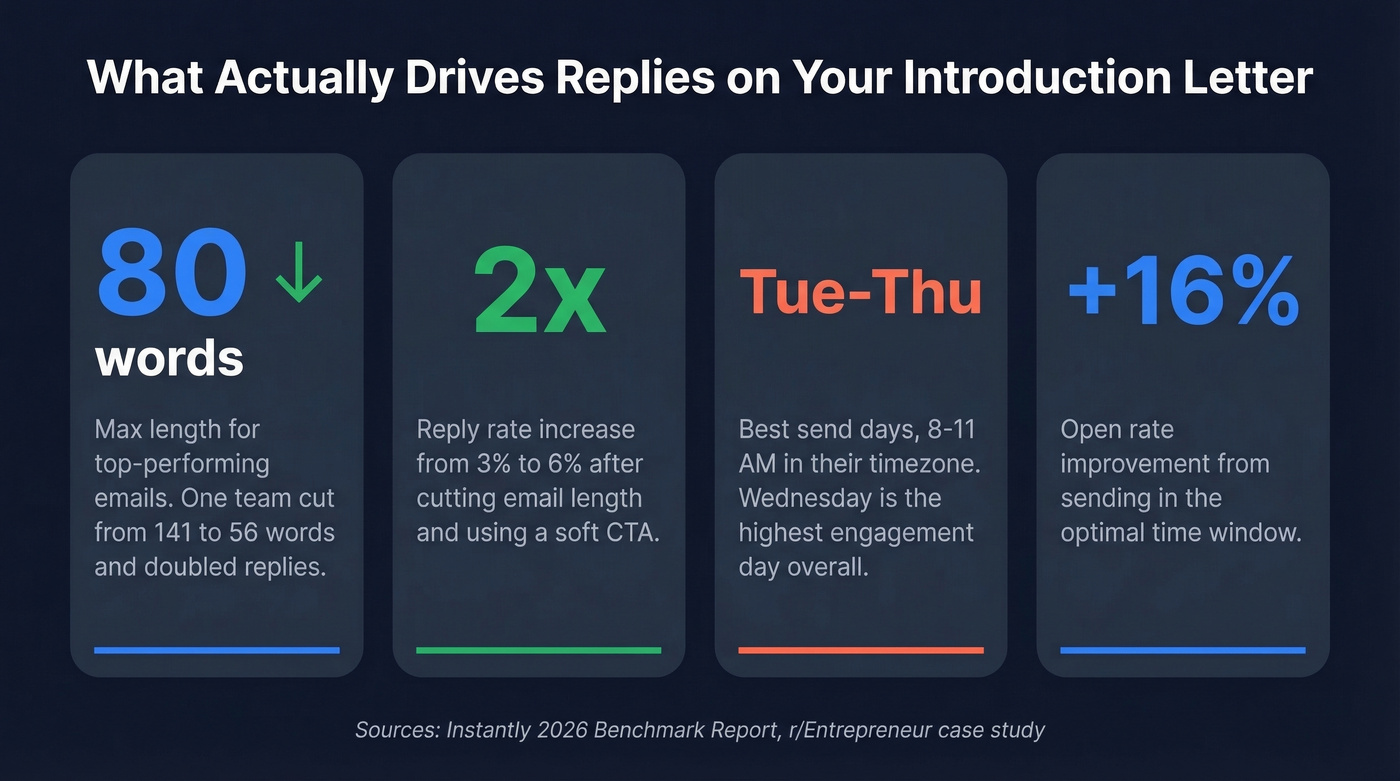
The single biggest lever is length. Best-performing campaigns keep emails under 80 words. One practitioner on r/Entrepreneur documented cutting their emails from 141 words down to 56 - and watched reply rates double from 3% to 6%. Every extra sentence is a reason to delete.
The second lever is your CTA. A soft CTA like "Worth a conversation?" or simply "Interested?" consistently outperforms hard asks like "Schedule a 15-min call." You haven't earned calendar time yet. Don't ask for it. (If you want more options, see our email call to action guide.)
Third, lead with value, not credentials. The consensus on r/copywriting is blunt: "I'll audit your top 3 landing pages and send you a Loom with fixes" beats "We're a leading provider of..." every single time. Give the recipient something before you ask for anything.
Timing matters more than most people think. Send Tuesday through Thursday, 8-11 AM in the recipient's timezone. That window improved opens by 16% in one documented case. Wednesday is the highest-engagement day overall. (For a deeper breakdown, see best time to send cold emails.)
Here's the thing: if your average deal size is under $5k, you don't need a polished introduction letter. You need a 40-word email that sounds like a text from a friend. Save the formality for enterprise deals where the recipient expects it.

You just learned that 58% of replies come from the first email - which means a bounce on that first touch kills the entire sequence. Prospeo's 5-step email verification delivers 98% accuracy, so your company introduction letter actually lands in the inbox it was written for.
Stop crafting perfect intro emails that bounce. Verify first.
Subject Lines That Get Opened
33% of recipients decide to open or delete based on the subject line alone. And with 46% of opens happening on phones, anything over 50 characters gets truncated.
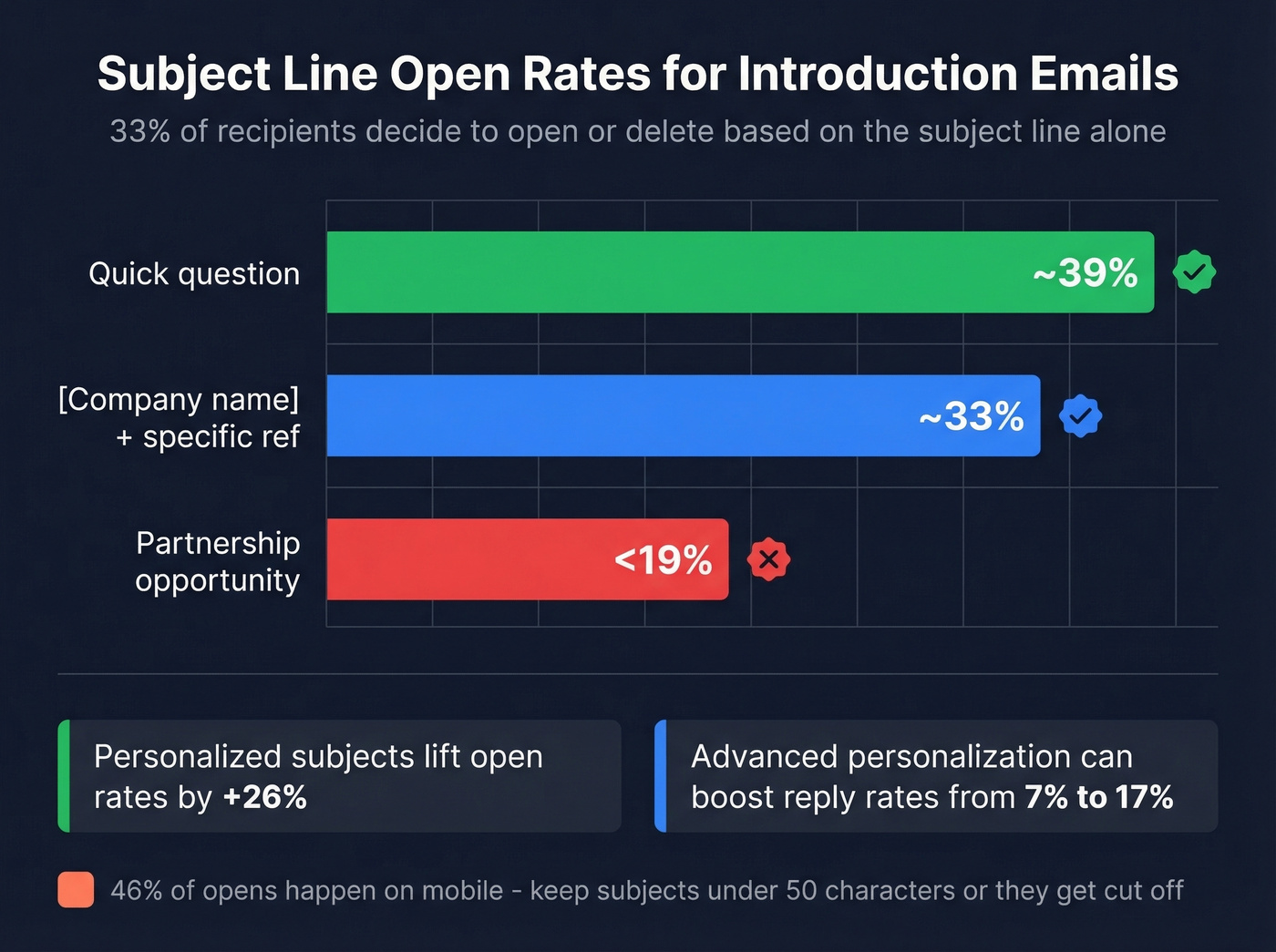
The data speaks for itself:
| Subject Line | Open Rate |
|---|---|
| "Quick question" | ~39% |
| "[Company name] + specific ref" | ~33% |
| "Partnership opportunity" | <19% |
Simple, curiosity-driven subjects win. Salesy, formal subjects lose. "Quick question about [their company]" works because it feels like a real email from a real person - not a mass blast. If you want more tested ideas, browse these cold email subject line examples.
Personalized subject lines lift open rates by +26%, and advanced personalization can more than double reply rates - from 7% to 17%. But personalization doesn't mean "Dear {First_Name}." It means referencing something specific: their company, a recent hire, a product launch. That's what makes the recipient think "this person actually knows who I am." (More on this in our personalized outreach playbook.)
5 Introduction Letter Templates
Each template follows the BLUF structure, stays under 80 words, and uses a soft CTA. Copy, customize, send.
New Company to Potential Clients
Subject: Quick question about [Company]'s [specific area]
Hi [Name],
We just launched [Your Company] to help [industry] teams [specific outcome - e.g., "cut onboarding time by 40%"]. I noticed [Company] is scaling its [department/function] - we built [product] specifically for that stage.
Happy to share how [similar company] used it to [result]. Worth a quick look?
[Your name], [Title] at [Company]
Why this works: It opens with their situation, not your story. The proof point creates curiosity without overselling.
New Product or Service Announcement
Subject: New from [Your Company] - built for [their pain]
Hi [Name],
We just shipped [Product Name], which [one-sentence value prop - e.g., "automates invoice reconciliation for finance teams doing 500+ transactions/month"].
Given [Company]'s growth, this might save your team [specific time/cost]. I put together a 2-minute walkthrough if you're curious.
Interested?
[Your name]
Partnership or Supplier Outreach
Subject: [Your Company] + [Their Company]
Hi [Name],
[Your Company] works with [type of companies] to [outcome]. We're looking for a [supplier/partner] who handles [their specialty], and [Their Company] keeps coming up.
Would it make sense to explore a fit? Happy to share what we're working on.
[Your name], [Title]
The "[Your Company] + [Their Company]" subject line signals mutual benefit, not a sales pitch.
B2B Referral Introduction
Subject: [Mutual contact] suggested I reach out
Hi [Name],
[Mutual contact] mentioned you're working on [specific initiative] at [Their Company]. We helped [similar company] with [related outcome] - [one proof point].
[Mutual contact] thought it'd be worth connecting. Open to a quick chat?
[Your name], [Title] at [Company]
Skip this template if you don't have a genuine mutual connection. Fabricating one is the fastest way to destroy trust.
New Hire Introduction (Internal)
Subject: The new [Title] - a few things about me
Hi team,
I'm [Name], your new [Title]. Quick version: I'm based in [City], I've spent the last [X] years in [field], and I'm unreasonably enthusiastic about [work-related interest].
Outside work, I [one personal detail - pet, hobby, recent trip]. Looking forward to meeting everyone. Feel free to grab me on Slack or stop by my desk.
[Name]
Mistakes That Kill Your Outreach
Writing for yourself, not the reader. Your company history doesn't matter to someone who's never heard of you. The Ariel Group calls this the #1 business writing mistake: failing to write for your audience. Open with their problem, not your story.
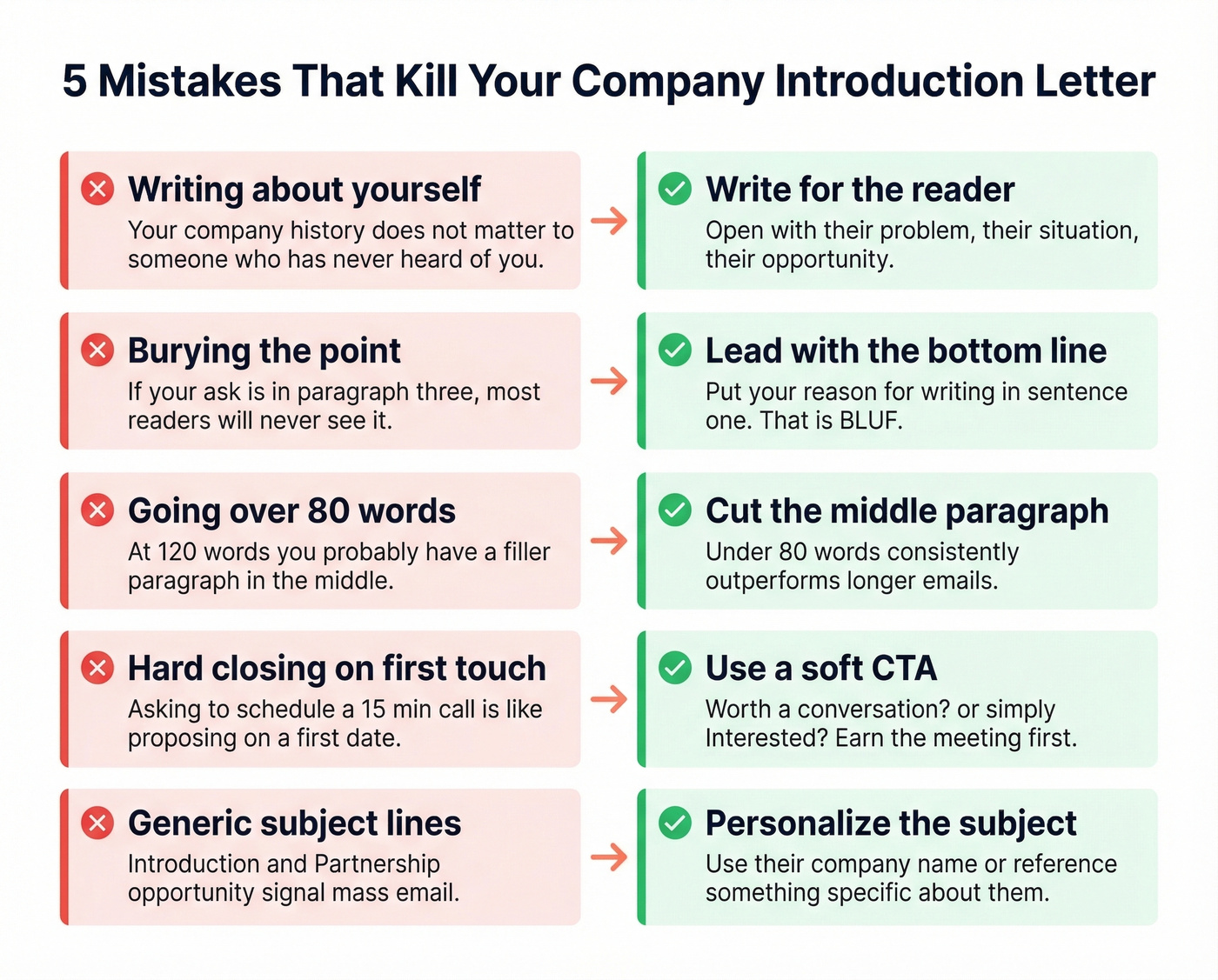
Burying the point. If your ask is in paragraph three, most readers won't see it. Put the bottom line in sentence one. That's BLUF.
Going over 80 words. Campaigns under 80 words consistently outperform longer ones. If you're at 120, cut the middle paragraph. It's probably filler.
Hard-closing on the first touch. The classic "New CSM" email - subject line "New CSM," body that's a self-introduction ending with "let's schedule a quick 15-minute meeting" - is the template equivalent of asking someone to marry you on the first date. Soft CTA first. Earn the meeting.
Using a generic subject line. "Introduction" and "Partnership opportunity" are inbox poison. Both signal mass email. Both get deleted. (If you need more inspiration, see subject lines that get opened.)
Pre-Send Checklist
We've seen teams nail the copy and still get terrible results because they skipped the basics. Before you send a single introductory message:
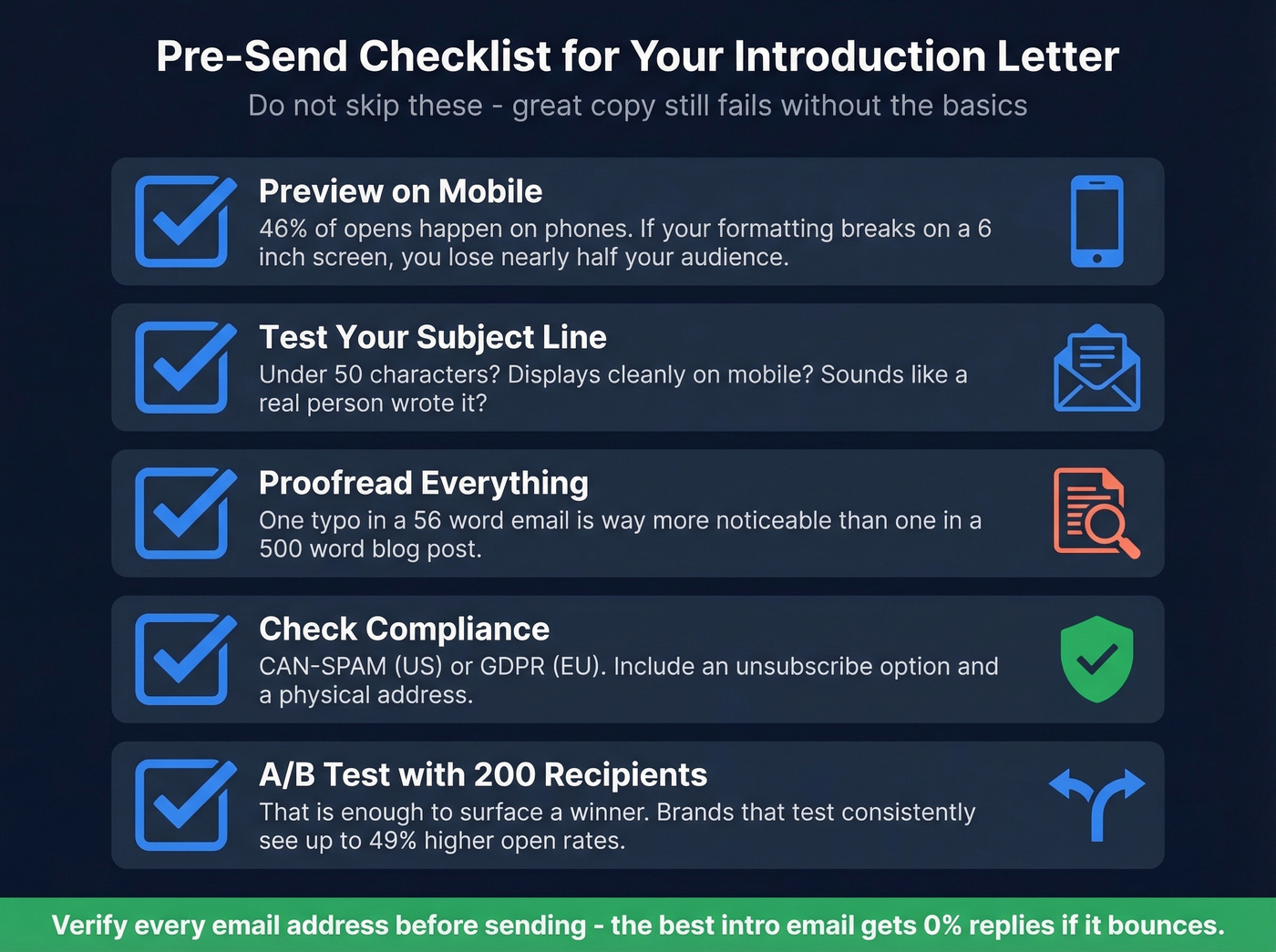
- Preview on mobile. 46% of opens happen on phones. If your formatting breaks on a 6-inch screen, you've lost nearly half your audience.
- Test your subject line. Under 50 characters? Displays cleanly on mobile? Sounds like a real person wrote it?
- Proofread. One typo in a 56-word email is far more noticeable than one in a 500-word blog post.
- Check compliance. CAN-SPAM (US) or GDPR (EU). Include an unsubscribe option and a physical address.
- A/B test with a 200-recipient split. That's enough to surface a winner. Brands that test consistently see up to 49% higher open rates over time.
If you're also troubleshooting bounces and inboxing, use this email deliverability guide and our email bounce rate benchmarks to diagnose the root cause.
Case Study: 3% to 6% in 62 Days
A founder on r/Entrepreneur documented their entire cold email rebuild over 62 days. The results are worth studying because they mirror what we've seen across dozens of outreach campaigns our team has analyzed.
They started at a 3% reply rate with 141-word emails, 3 sending domains, and an 11% bounce rate. What they changed: cut emails to under 56 words, scaled to 7 domains sending 26 emails/day max, stopped buying lists and switched to manual verification (bounces dropped to under 2%), and sent only Tuesday through Thursday, 8-11 AM in the recipient's timezone.
The result: reply rate doubled to 6%. "Quick question" subject lines hit 39% opens. The entire stack cost $420/month and generated 16 qualified leads per month - roughly $26 per qualified lead.
Verification was the biggest single lever. Bad data doesn't just waste sends - it damages your domain reputation, which hurts deliverability for every email you send after. In our experience, teams that skip verification end up spending months rebuilding sender reputation they could've protected from day one. (If you're in that situation, see how to improve sender reputation.)
Personalized subject lines boost opens by 26%, but personalization requires real data - job titles, company signals, recent changes. Prospeo gives you 50+ data points per contact across 300M+ profiles, so every introduction letter references something specific enough to get opened.
Write intro emails that feel personal because the data behind them is real.
FAQ
How long should a company introduction letter be?
Under 80 words for email - under 56 is even better, since campaigns at that length saw reply rates double from 3% to 6%. For printed letters, stick to one page max with block format, 10-12pt font, and ~1-inch margins.
Should I send a letter or email?
Email, unless your industry demands print. Government, banking, and academia sometimes still expect formal letters, but email is the standard delivery method for business introductions in 2026. Format for mobile first, since 46% of recipients read on their phone.
When should I follow up?
Send a follow-up three to four days after the initial message. Reference something specific from the original or add new value - don't just "check in." 42% of replies come from follow-ups, and the sweet spot is 4-7 touchpoints in a sequence.
What should a letter for introduction of company include?
Six elements: a short subject line, a greeting matched to the industry, a BLUF opening with the recipient's benefit, a two-to-three sentence value body with proof, a soft CTA, and a clean signature. Keep the whole thing under 80 words.
What's the best free tool for verifying emails before sending?
Prospeo's free tier gives you 75 email verifications per month plus 100 Chrome extension credits - enough for small outreach campaigns. It runs 5-step verification with catch-all handling and spam-trap removal, delivering 98% accuracy. Hunter offers 25 free searches/month but caps enrichment features.