


Lusha Reviews 2026: What 2,900+ User Reviews Actually Tell You
Lusha reviews tell wildly different stories depending on where you look. A 4.3 on G2 and a 1.3 on Trustpilot - same product, same year. That gap reveals more about Lusha than any feature list ever could, and it's why most review roundups get this tool wrong.
30-Second Verdict
Lusha is a solid mid-tier prospecting tool with one of the best Chrome extensions in the category. Email data for US contacts is decent, but practitioner-tested accuracy commonly lands around 60-70% for emails, while phone accuracy is often closer to ~50%. That doesn't match Lusha's 95%+ accuracy marketing claim. The credit model punishes phone-heavy teams, and there's an active Italian regulatory investigation. Best for: small teams of 1-3 reps doing light, US-focused email prospecting who value simplicity. Skip Lusha if: you need phones at scale, prospect outside the US/Western Europe, or run 5+ SDRs.
Here's the thing most reviews won't tell you: Lusha's biggest problem isn't accuracy. It's that the credit model makes reps afraid to prospect. When revealing a single phone number costs 10 credits, people start rationing instead of reaching out. That behavioral tax is harder to measure than bounce rates, but it's just as damaging to pipeline.
What Lusha Does Well
Credit where it's due - Lusha's Chrome extension is genuinely excellent. It's fast, clean, and works across professional profiles, company websites, and inside your CRM. For a rep who lives in the browser, the workflow friction is close to zero.
Key strengths:
- Integrations: Salesforce, HubSpot, Pipedrive, Outreach, Dynamics, Salesloft, Zoho, and Bullhorn - covers most common sales stacks (and most SDR tools need these basics)
- Onboarding: A new SDR can pull contacts within an hour of signing up, a real advantage over platforms like ZoomInfo that often take weeks to roll out
- Expanding platform: Bombora-powered intent data and a Novacy acquisition signal a move toward a fuller GTM tool
- Bulk reveals: Paid plans support batch reveals of up to 25 contacts at a time
One caveat the marketing site won't mention: HubSpot integration bugs around deal ownership overrides are a recurring complaint in user forums. Worth testing before full rollout.
Pricing Breakdown
Lusha's pricing looks straightforward until you do the credit math:
| Plan | Monthly Price | Annual Price | Credits/Mo |
|---|---|---|---|
| Free | $0 | $0 | 70 |
| Pro | $39.90/user | $29.90/user | 250 |
| Premium | $69.90/user | $52.45/user | 600 |
| Scale | Custom | Custom | Custom |
Lusha uses dynamic, region-based pricing, so what you see may differ from what someone in another country sees. The Scale plan is marketed as "unlimited," but user reports suggest a fair-use cap around 2,000 contacts per month.
The credit mechanics are where the real cost lives:
- Email reveal: 1 credit
- Phone reveal: 10 credits
- CSV export (up to 25 rows): 1 credit
- CRM export: 1 credit
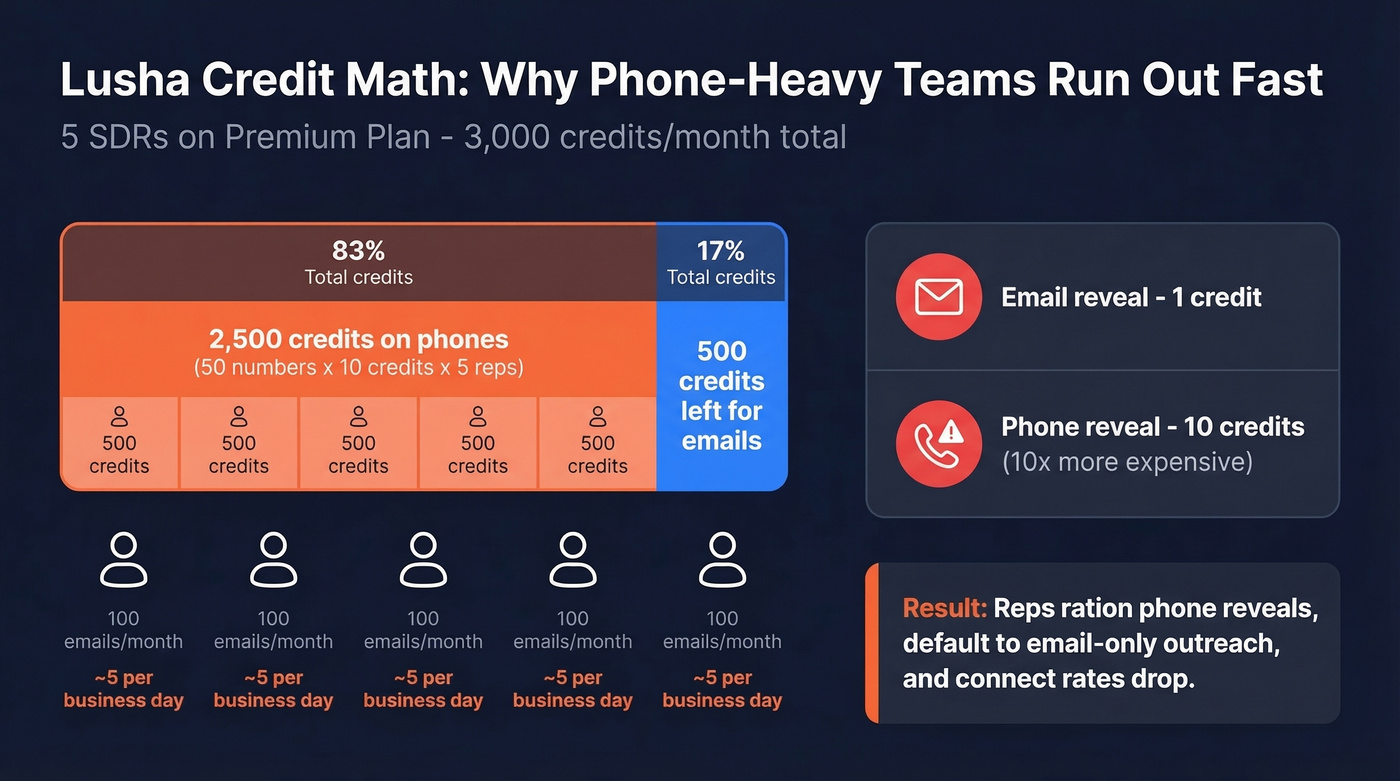
Let's run a real scenario. You're on Premium with 5 SDRs - 3,000 credits per month total. Each rep needs 50 phone numbers, which is reasonable for outbound. That's 2,500 credits on phones alone, leaving 500 for emails. Split across 5 reps, that's 100 emails each per month, roughly 5 per business day. For serious outbound, that's nowhere near enough. We've run the credit math for dozens of teams, and the pattern is always the same: reps avoid revealing phones because they're expensive, default to email-only outreach, and connect rates drop as a result. (If you're trying to fix the downstream impact, start with sales pipeline challenges and where activity gets throttled.)

Lusha charges 10 credits per phone reveal and still delivers ~50% accuracy. Prospeo gives you 125M+ verified mobile numbers with a 30% pickup rate - 3x the industry average - on a 7-day data refresh cycle that keeps bounce rates under 4%.
Stop paying premium credits for disconnected numbers.
Data Accuracy: Claims vs. Reality
B2B contact records decay at roughly 30% per year. Every data provider fights this battle. The question is how hard they fight. (This is also why teams pair data tools with data enrichment services and verification.)
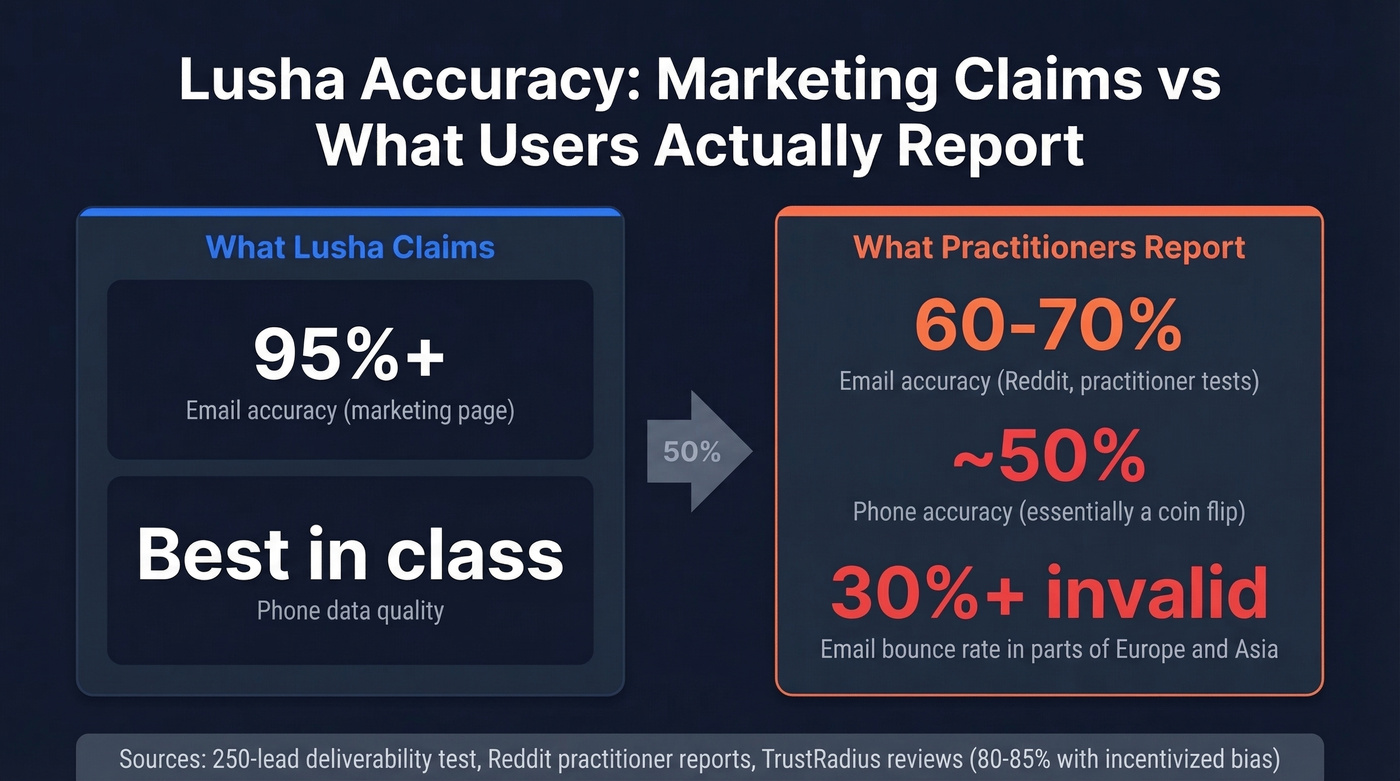
A 250-lead deliverability test showed a 3% bounce rate, 54% open rate, and 0.4% reply rate. That bounce rate looks solid on paper. But practitioner reports from Reddit paint a less rosy picture: after a few thousand enrichments, users peg Apollo and Lusha at ~60-70% valid emails and phone accuracy that's essentially a coin flip at ~50%. If you're benchmarking, compare against typical email bounce rate targets for cold outbound.

The gap between Lusha's claimed 95%+ accuracy and what practitioners experience is significant. TrustRadius reviewers - many of whom submitted incentivized reviews - peg accuracy at 80-85%. Regional coverage makes things worse: review quotes cite 30% invalid emails in parts of Europe and Asia. In our testing, those regional drops are even more pronounced than the aggregate numbers suggest.
The frustration of revealing a phone number for 10 credits and hearing a disconnected tone is real. Platforms with faster data refresh cycles cut this problem significantly - a 7-day refresh cycle, for example, cuts bounce rates to under 4% in practice, compared to the industry average of roughly six weeks between updates. If you're building a safer outbound motion, align this with an email deliverability guide and list hygiene.
Why Scores Are All Over the Map
| Platform | Score | Reviews |
|---|---|---|
| G2 | 4.3/5 | ~1,610 |
| Capterra | 4.0/5 | ~365 |
| TrustRadius | 8.1/10 | ~248 |
| Trustpilot | 1.3/5 | ~728 |
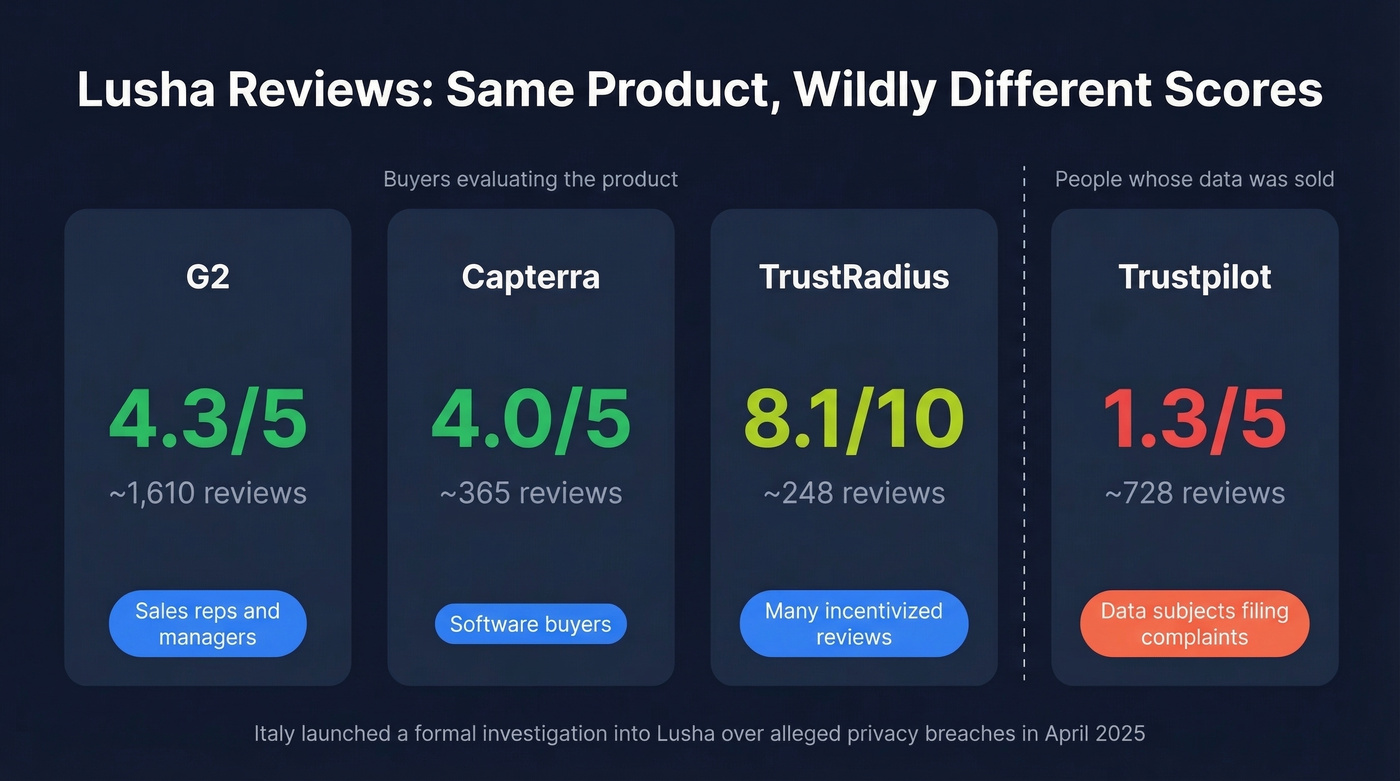
These numbers look contradictory, but they make perfect sense once you understand who's reviewing where.
G2, Capterra, and TrustRadius capture the buyer experience - sales reps and managers who chose Lusha and use it daily. These users generally like the Chrome extension, appreciate the simplicity, and tolerate the accuracy gaps. Many TrustRadius reviews are labeled "Incentivized," which skews scores upward. Trustpilot captures something entirely different: data subjects. People who discovered their personal phone number or email was being sold through Lusha without their knowledge. They aren't evaluating a product - they're filing a complaint.
This isn't just a review-score curiosity. In April 2025, Italy's data protection authority (Garante) launched a formal investigation into Lusha over alleged privacy breaches. On Reddit, a UK-based user described submitting a deletion request, receiving confirmation their data was removed, and then learning from a cold caller that their information was still accessible in the platform. If you're in a compliance-sensitive industry, the Trustpilot pattern should give you more than pause.
Who Lusha Is Best For
Use Lusha if:
- You're a small team of 1-3 reps doing US-focused email prospecting
- You value Chrome extension UX and fast onboarding over database depth
- Your prospecting volume stays under 500 contacts per rep per month (see sales prospecting techniques if volume is your bottleneck)
- You want a simple, self-serve tool without enterprise complexity
Skip Lusha if:
- Your outbound is phone-heavy - the 10-credit phone reveal will drain your budget
- You prospect into EMEA or APAC regularly and can't afford 30%+ invalid data
- You're running 5+ SDRs and the credit math breaks at scale
- You're in a compliance-sensitive industry and can't afford regulatory risk (read up on ethics in sales if you're setting policy)
If your average deal size is under $10K, Lusha's free tier is probably enough. But if deals regularly exceed $50K, you can't afford these accuracy gaps - a single missed opportunity from a bounced email costs more than a year of better tooling.
Alternatives Worth Considering
| Feature | Lusha | Prospeo | Apollo | ZoomInfo | Cognism |
|---|---|---|---|---|---|
| Starting Price | Free (70 cr) | Free (75 emails) | Free tier | ~$15-40K/yr | ~$1-3K/mo |
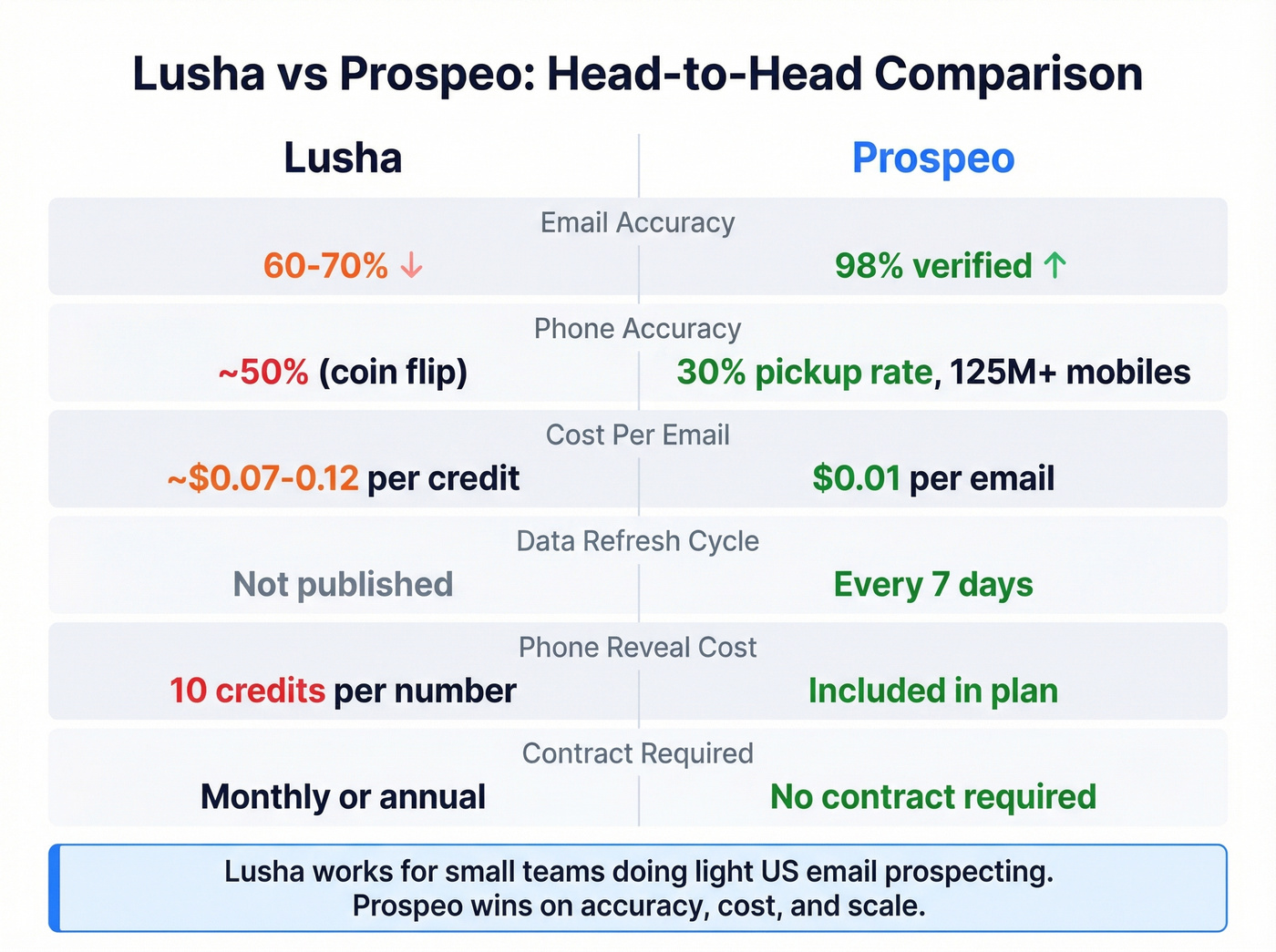
| Email Accuracy | 60-70% real | 98% verified | 60-70% real | 87% | Not published |
| Phone Data | 10 cr/reveal | 125M+ mobiles | Included | Deep US | Diamond verified |
| Data Refresh | Not published | 7 days | Not published | ~Monthly | Not published |
| Contract | Monthly/annual | No contract | Monthly/annual | Annual | Annual |
| Best For | Small teams, US email | Accuracy-first teams | All-in-one workflow | Enterprise budget | EMEA prospecting |
Prospeo
Prospeo directly solves Lusha's two biggest problems: accuracy and credit economics. The platform covers 300M+ professional profiles with 98% verified email accuracy, built on proprietary email-finding infrastructure with 5-step verification, catch-all handling, spam-trap removal, and honeypot filtering. The 125M+ verified mobile numbers come with a 30% pickup rate across all regions - compared to Lusha's coin-flip phone accuracy, that's the difference between a pipeline and a waste of time.
Pricing runs ~$0.01 per email with a free tier of 75 emails and 100 Chrome extension credits per month. No contracts, no annual commitments. The 7-day data refresh cycle means you're working with current information, not records that decayed three months ago. Native integrations with Salesforce, HubSpot, Smartlead, Instantly, Lemlist, and Clay cover most outbound stacks. Real results back this up: Meritt tripled pipeline from $100K to $300K/week after switching, while Snyk's 50-person AE team cut bounce rates from 35-40% to under 5% and grew AE-sourced pipeline by 180%. (If you're building lists in Clay, see Clay list building.)
The credit math doesn't work at scale with Lusha. Prospeo gives your team 300M+ profiles, 98% email accuracy, and verified direct dials at $0.01 per email - no annual contracts, no fair-use caps, no behavioral tax on your reps.
Give your SDRs data they won't ration.
Apollo.io
Apollo occupies a similar price tier but takes a completely different approach. Where Lusha is a data tool, Apollo is an all-in-one platform - prospecting, sequencing, analytics, and dialer in one package. Paid plans run ~$49-99/mo per user with a generous free tier. The catch: email accuracy in practice is similar to Lusha's 60-70% range. Apollo wins on workflow consolidation; Lusha wins on simplicity. If Apollo's feature sprawl overwhelms your team, you'll end up paying for a sequencer nobody uses. If you're evaluating the broader category, start with best outbound lead generation tools.
ZoomInfo
Worth it if you've got $15-40K/year and a team that'll actually use the platform. Skip it if you're under 10 seats. ZoomInfo has the deepest US coverage in the market, the most integrations, and a genuine intent data engine. But it takes time to configure, requires annual contracts, and most mid-market teams use maybe 20% of what they're paying for. For everyone else, it's expensive shelf-ware.
Cognism
The pick for teams prospecting heavily into Europe. Diamond-verified mobile data and genuine GDPR-focused positioning - not just a compliance badge on the website. Custom pricing typically lands at ~$1,000-3,000/mo for small teams. Skip it if you're US-only.
FAQ
Is Lusha's data accurate?
Practitioner reports suggest 60-70% valid emails and roughly 50% phone accuracy. A 250-lead test showed a 3% bounce rate, but regional coverage - especially EMEA and APAC - is notably weaker. Lusha's claimed 95%+ accuracy doesn't match real-world experience for most teams.
Is Lusha GDPR compliant?
Lusha claims GDPR compliance, but Italy's data protection authority opened a formal investigation in April 2025 over alleged privacy breaches. Users have reported difficulty getting their data fully deleted even after receiving confirmation of removal.
How much does Lusha actually cost?
Plans range from free (70 credits/month) to ~$52.45/user/month on annual Premium. Phone reveals cost 10 credits each, so the real cost depends on how many direct dials your team needs. A 5-SDR team on Premium burns through credits fast.
What's a good free alternative to Lusha?
Prospeo's free tier includes 75 verified emails and 100 Chrome extension credits monthly - more usable volume than Lusha's 70 credits, especially since Lusha charges 10 credits per phone reveal. Apollo also offers a free tier, though email accuracy sits in the same 60-70% range as Lusha.
Can you trust Lusha's review scores?
G2's 4.3/5 reflects the buyer experience. Trustpilot's 1.3/5 captures data subjects - people whose information appeared without consent. Neither score tells the full story. Weight G2 for product quality and Trustpilot for compliance risk signals.