


Lusha vs NinjaPear: Different Tools for Different Problems
The Lusha vs NinjaPear question keeps surfacing in B2B data conversations, but here's the thing - these tools barely overlap. Lusha is a Chrome extension that hands sales reps emails and phone numbers. NinjaPear is an API that feeds developers company intelligence: customer lists, competitor maps, funding data. Comparing them is like comparing a hammer to a blueprint. Both part of building, but you'd never swap one for the other.
30-Second Verdict
Pick Lusha if you're a sales rep who needs emails and direct dials from a browser extension, no dev work required.
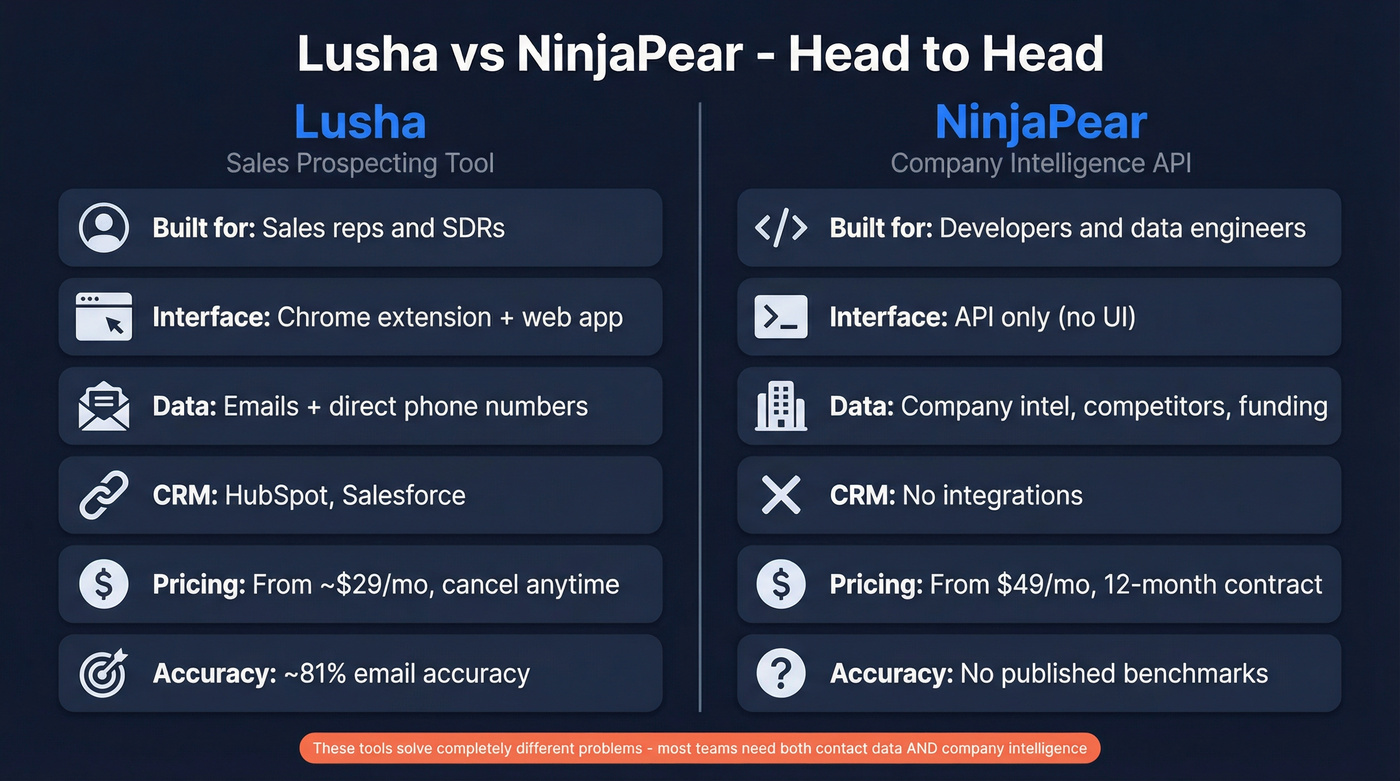
Pick NinjaPear if you're a developer building enrichment pipelines who needs company intelligence via API - and can stomach a 12-month contract.
What Is NinjaPear?
NinjaPear is the successor to Proxycurl, built by the same team at Nubela. LinkedIn filed a lawsuit against Proxycurl in January 2025, and the product shut down in July 2025. NinjaPear repositioned as a "Competitive Intelligence Data company," and it's API-only. Endpoints cover Customer Listing, Competitor Listing, Company Details, Company Funding (funding history plus investors), Person Profile lookup, and a Monitor API that tracks company blog and social updates via RSS. Client libraries ship for Node.js and Python, and rate limits scale by plan up to 300 requests per minute.
What NinjaPear doesn't sell is prospecting-style contact data. There's no email or phone database for finding and exporting leads. It sells company-level intelligence for developers who want to build on top of it - more aligned with a broader competitive intelligence strategy than outbound prospecting.
What Is Lusha?
Lusha is a sales intelligence platform built around a Chrome extension. Reps browse professional profiles or company websites, click the extension, and get verified emails and phone numbers. The free tier gives you 70 credits per month - enough for 70 email reveals or 7 phone reveals, since emails cost 1 credit and phones cost 10. It plugs into HubSpot and Salesforce, though Reddit users have flagged the HubSpot integration as buggy, with duplicate contacts and deal ownership getting overwritten.
We've seen this pattern ourselves: multiple users report strong results in the first couple months, followed by declining hit rates on emails and phones. The consensus on r/sales threads tends to be that Lusha works great until it doesn't, and by then you're already relying on it - often as part of a bigger sales prospecting stack.

Lusha gives you the extension but not the API. NinjaPear gives you the API but not the contacts. Prospeo gives you both - 300M+ profiles at 98% email accuracy, a Chrome extension with 40K+ users, and an enrichment API with a 92% match rate. All refreshed every 7 days, no 12-month contracts.
Stop stitching two tools together. Get contacts and API access in one platform.
Feature Comparison
| Lusha | NinjaPear | |
|---|---|---|
| Data type | Emails + phones | Company intelligence |
| Interface | Chrome extension + web UI | API only |
| Direct phones | Yes | No |
| CRM integrations | HubSpot, Salesforce | None |
| Client libraries | N/A | Node.js, Python |
| Rate limit | N/A | Scales by plan up to 300 req/min |
| Target user | Sales reps, SDRs | Developers, data engineers |
These tools don't compete because they serve different workflows entirely. Lusha is point-and-click prospecting. NinjaPear is programmatic company research. If you need both contact data and company intelligence, you're looking at two separate tools - or a platform that bundles them (see our roundup of data enrichment services).
Pricing Breakdown
| Free tier | 70 credits/mo | 3-day trial, 10 credits | 75 emails + 100 Chrome extension credits |
| Paid from | ~$29/mo | $49/mo | ~$0.01/email |
| Top tier | Custom | $1,899/mo | Custom |
| Phone credits | 10 credits/reveal | No phone data | 10 credits/number |
| Contract | Cancel anytime | 12-month minimum | Cancel anytime |
| Credit expiry | Rollover up to 2x | End of billing cycle | No expiry on active plan |
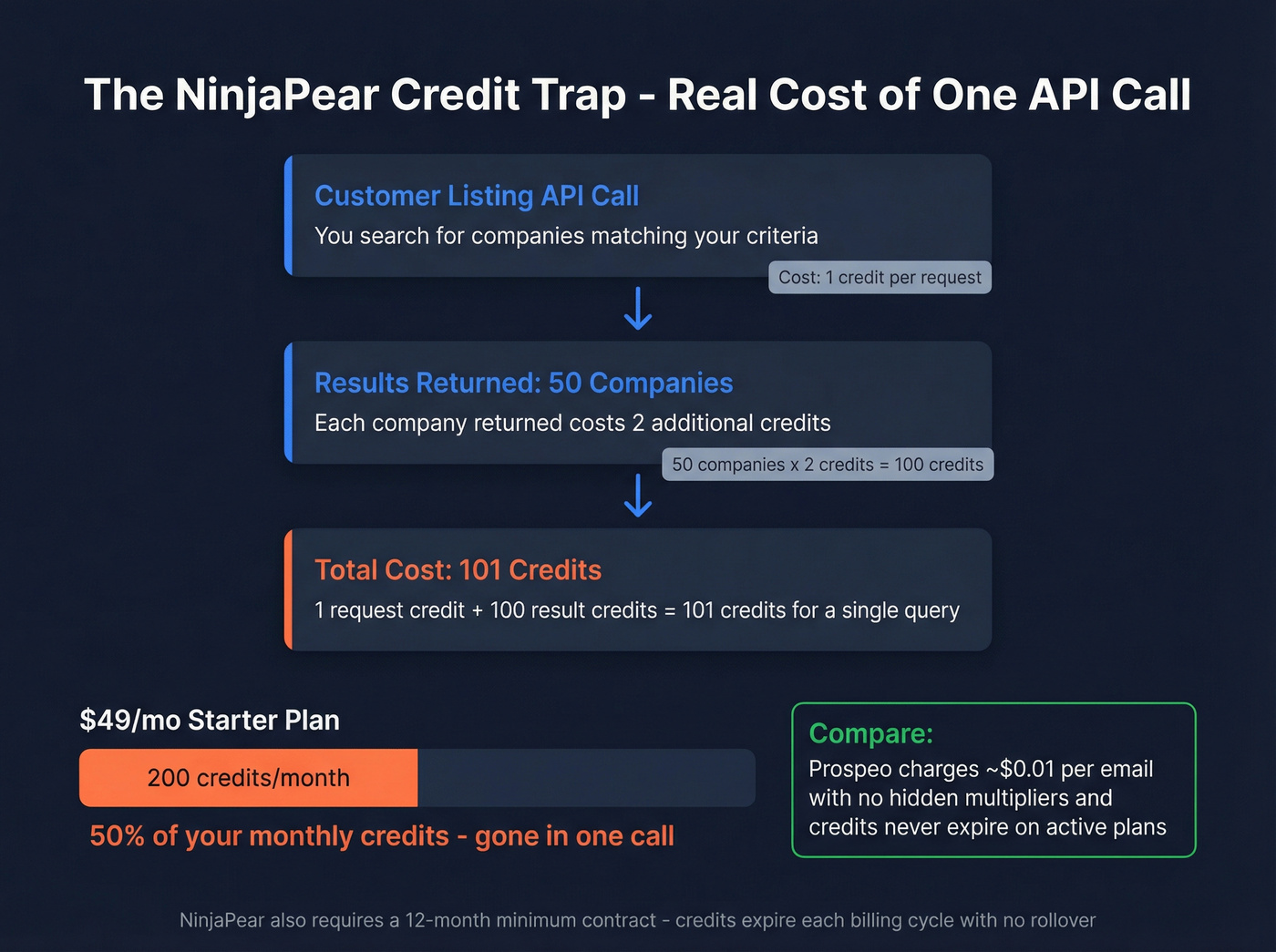
NinjaPear's 12-month commitment applies even to "monthly" plans. Cancel early and you owe the remaining months. Credits expire at the end of each billing cycle with no rollover. PAYG credits last 18 months, but the real cost trap is the Customer Listing endpoint: it charges 1 credit per request plus 2 credits per company returned. In our testing, a single query returning 50 companies costs 101 credits. On the $49/mo tier, that's nearly your entire monthly allotment in one API call. Overage credits on the top tier run $0.009 each.
Lusha's credit model is more forgiving. Monthly plans roll over unused credits up to twice your limit, and cancellation just means your credits last until the billing period ends.
Data Quality
Lusha is often cited at 81% email accuracy. An independent test of 100 profiles found Proxycurl (NinjaPear's predecessor) hit 89% accuracy on current job title and 86% on current company, with most errors tied to recent job changes. Proxycurl's freshness claim was 29 days.
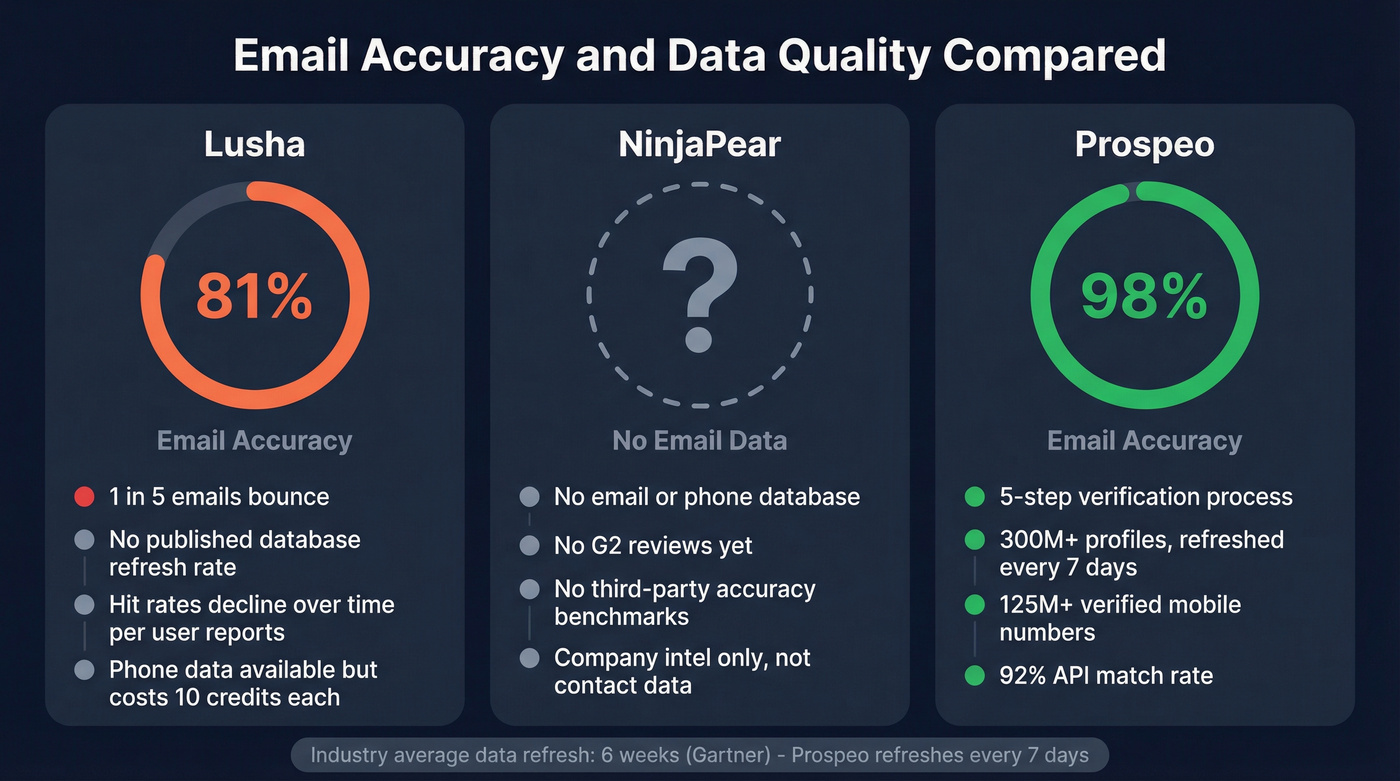
NinjaPear has no published database size, no G2 reviews, and no third-party accuracy benchmarks yet. We've monitored the product since launch and the API works, but there's not enough independent data to vouch for accuracy at scale. If your enrichment pipeline needs verified contact data rather than company intelligence, NinjaPear isn't the right tool regardless.
For comparison, Prospeo's 5-step verification process delivers 98% email accuracy across 300M+ profiles, with data refreshed every 7 days - well ahead of the 6-week industry average (and if you're trying to reduce bounces, see email bounce rate benchmarks and fixes).
Who Should Use Which
Use Lusha if you're a sales rep who needs emails and phone numbers fast, prefers a Chrome extension over writing code, and wants to cancel anytime.
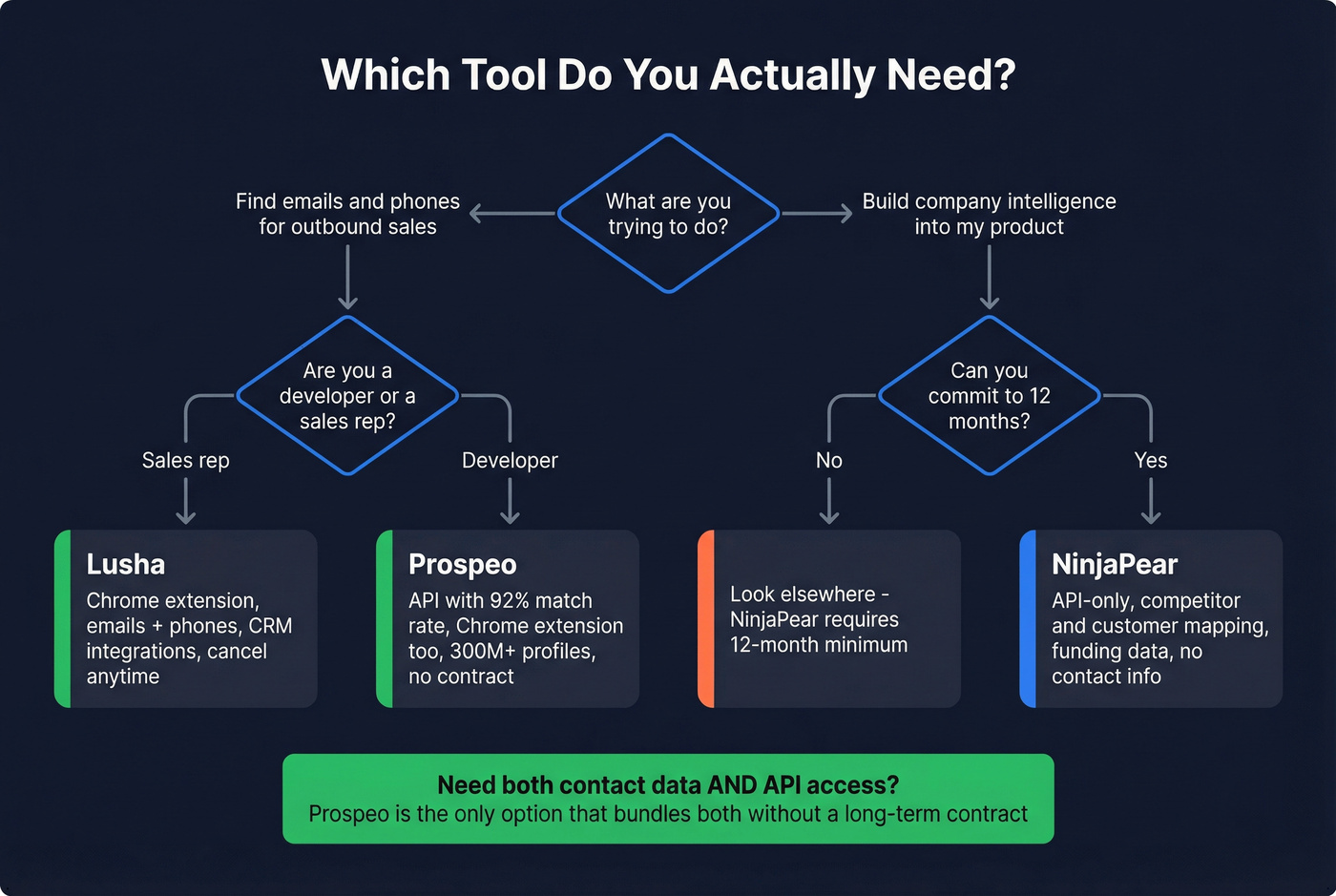
Use NinjaPear if you're a developer building competitive intelligence into a product, need customer and competitor mapping via API, and can commit to 12 months. Skip it if you just need contact data for outbound - it won't help you there.
For teams that need both verified contact data and programmatic access, Prospeo bundles a Chrome extension with 40,000+ users and an API delivering a 92% match rate. 300M+ profiles, 125M+ verified mobiles, all refreshed every 7 days. No contracts, cancel anytime, and the free tier includes 75 verified emails per month. If you're evaluating broader options, compare against best sales prospecting databases and best B2B company data providers.
At 81% email accuracy, Lusha means 1 in 5 emails bounce. NinjaPear doesn't even sell email data. Prospeo's 5-step verification delivers 98% accuracy across 143M+ verified emails and 125M+ verified mobiles - starting at $0.01 per email with no credit card required.
Get the data accuracy neither Lusha nor NinjaPear can match.
FAQ
Is NinjaPear the same as Proxycurl?
Same team at Nubela, different product. Proxycurl shut down in July 2025 after a LinkedIn lawsuit. NinjaPear focuses on company intelligence via API rather than profile scraping, with different endpoints and pricing.
Can NinjaPear find emails and phone numbers?
No. NinjaPear doesn't provide a phone number database, and it isn't built as a sales prospecting email finder. Its Person Profile endpoint looks up job history and education from a work email - it won't reveal direct dials or personal emails the way Lusha or Prospeo do.
What if I need both contact data and API access?
Prospeo bundles both: a Chrome extension for manual prospecting and an enrichment API with a 92% match rate for programmatic workflows. The free tier includes 75 verified emails per month, no contract required. Running NinjaPear plus Lusha together would cost more and still leave gaps in verification.