


Lusha vs No2Bounce: You're Comparing Two Different Categories
If you're searching Lusha vs No2Bounce, you're probably trying to solve one problem - "I need better outbound data" - with two tools that do completely different jobs. One is a sales intelligence database. The other is an email verification service. That's like comparing a fishing rod to a cooler. Both useful, different purposes entirely.
B2B contact data decays roughly 30% per year, which means you likely need both sourcing and verification. The real question isn't which tool is better - it's whether you want two separate tools or one workflow that covers both.
30-Second Verdict
- Need contacts from scratch? Lusha. It's a prospecting database with 100M+ business profiles.
- Need to clean a list before sending? No2Bounce. Dedicated email verifier with strong catch-all detection.
- Want both in one platform? Prospeo handles sourcing and verification in a single step - 143M+ verified emails at 98% accuracy on a 7-day refresh cycle.
Lusha vs No2Bounce: Side-by-Side
| Lusha | No2Bounce | |
|---|---|---|
| Category | Sales intelligence | Email verification |
| Best for | Finding new contacts | Cleaning existing lists |
| Starting price | ~$29.90/user/mo | $17/mo (10k credits) |
| Free tier | Up to 70 credits/mo | 100 free credits |
| Accuracy | ~81% | 98-99% |
| G2 rating | 4.3/5 (1,400+ reviews) | 4.0/5 (3 reviews) |
| CRM integrations | HubSpot, Salesforce | Salesforce, HubSpot, API |
| Credits expire? | Rollover (2x cap) | Never expire |
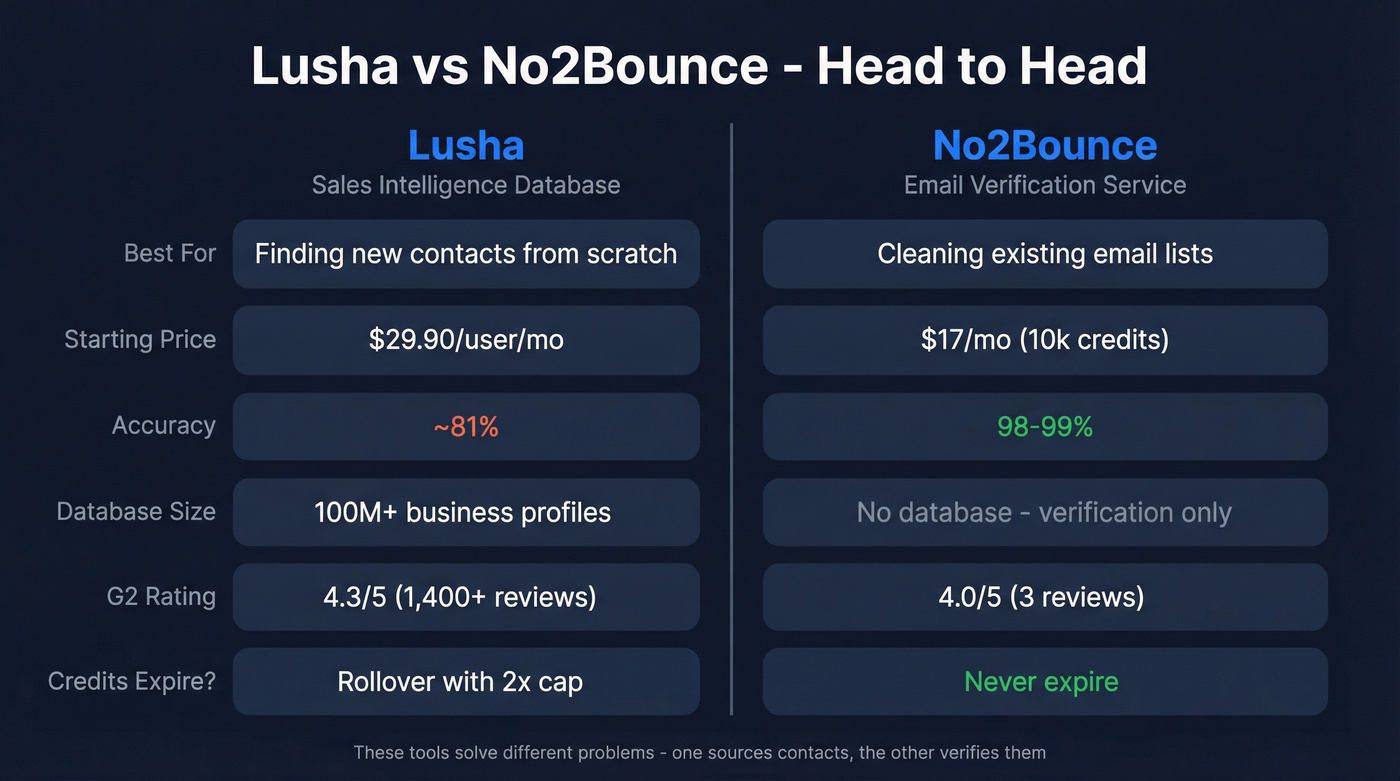
That review volume gap matters. Lusha is mature and widely adopted. No2Bounce is newer and niche - strong at what it does, but with a much smaller user base. Its Trustpilot score sits at 4.5/5 across 26 reviews, which adds more signal but still isn't a huge sample.
Pricing: What You Actually Pay For
These tools serve different budgets because they solve different problems.
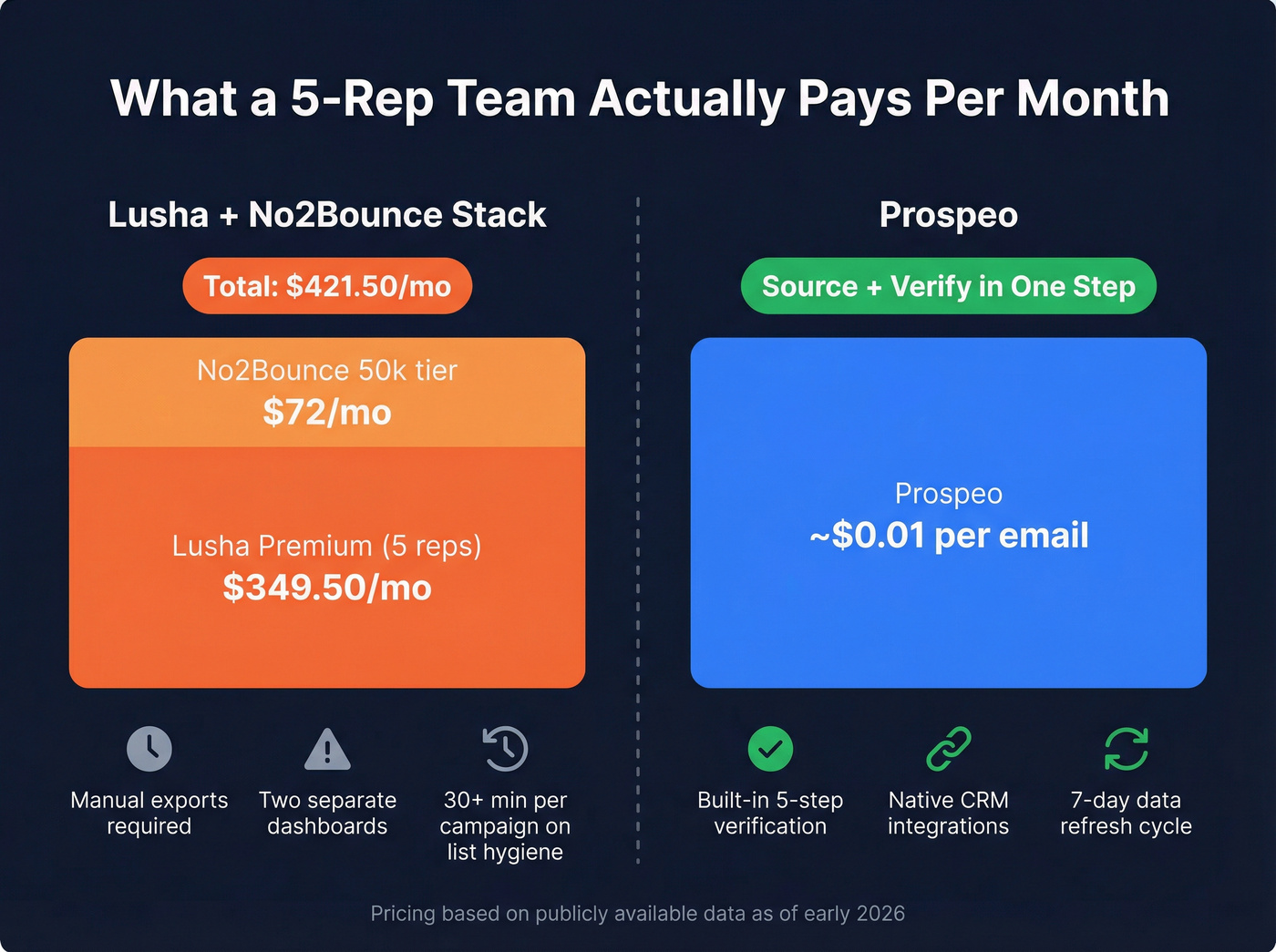
Lusha gives you up to 70 free credits per month - enough for up to 70 email reveals or just 7 phone numbers, since phones cost 10 credits each. Pro runs ~$29.90/user/mo for 250 credits, Premium ~$69.90 for 600. A five-rep team on Premium hits ~$349.50/mo before you even think about verification.
No2Bounce charges purely for verification. The monthly 10k tier costs $17, which works out to $1.70 per thousand emails. Scale to 100k and it drops to $1.26 per thousand. Pay-as-you-go credits never expire - genuinely useful for teams with inconsistent volume.
Here's the thing: skip Lusha if your main problem is list hygiene, not list building. Skip No2Bounce if you don't have a list yet. It verifies emails; it doesn't find them.

Running Lusha for sourcing and No2Bounce for verification means juggling exports, uploads, and extra spend. Prospeo gives you 143M+ verified emails at 98% accuracy - already cleaned through a 5-step verification process - for roughly $0.01 per email.
Source and verify in one step. No exports, no extra tools.
When Lusha Wins
Lusha's strength is sourcing. Its database covers 100M+ business profiles and 60M+ decision-maker emails, with HubSpot and Salesforce integrations baked in. If your reps need to build a list from scratch - filtered by title, industry, company size - Lusha gets them moving fast.
The caveats are real, though. Coverage outside North America gets thin. The consensus on r/sales and related Reddit threads flags data gaps and a buggy HubSpot integration that messes with contact ownership after merges. And credits vanish fast once reps start pulling phone numbers at 10 credits a pop. We've seen teams burn through a month's allocation in a single afternoon of heavy prospecting.
If you're building lists from scratch, it also helps to have a repeatable set of sales prospecting techniques so reps don't waste credits on the wrong segments.
When No2Bounce Wins
No2Bounce wins when you've already got a list and need to protect your sender reputation. Email bounces can reduce deliverability by up to 20%, and No2Bounce's catch-all and accept-all verification is one of the features users praise most on both G2 and Trustpilot. The platform has processed 500M+ validations, and bulk uploads handle CSVs up to 50k rows.
The weak spot is workflow automation. G2 reviewers specifically call out the need for more CRM integrations - if you need verified results flowing straight into Salesforce without manual exports, you'll be leaning hard on the API.
If bounces are a recurring issue, it's worth tracking your email bounce rate and tightening your email deliverability basics before scaling volume.
The Simpler Stack
Let's be honest: most outbound teams shouldn't be running two tools for what's fundamentally one workflow. A Reddit thread breaking down a full prospecting stack lists "MillionVerifier ou No2Bounce" as the cleaning step after sourcing contacts from tools like Lusha. Source, clean, enrich, send. That's three or four tools before a single email goes out.
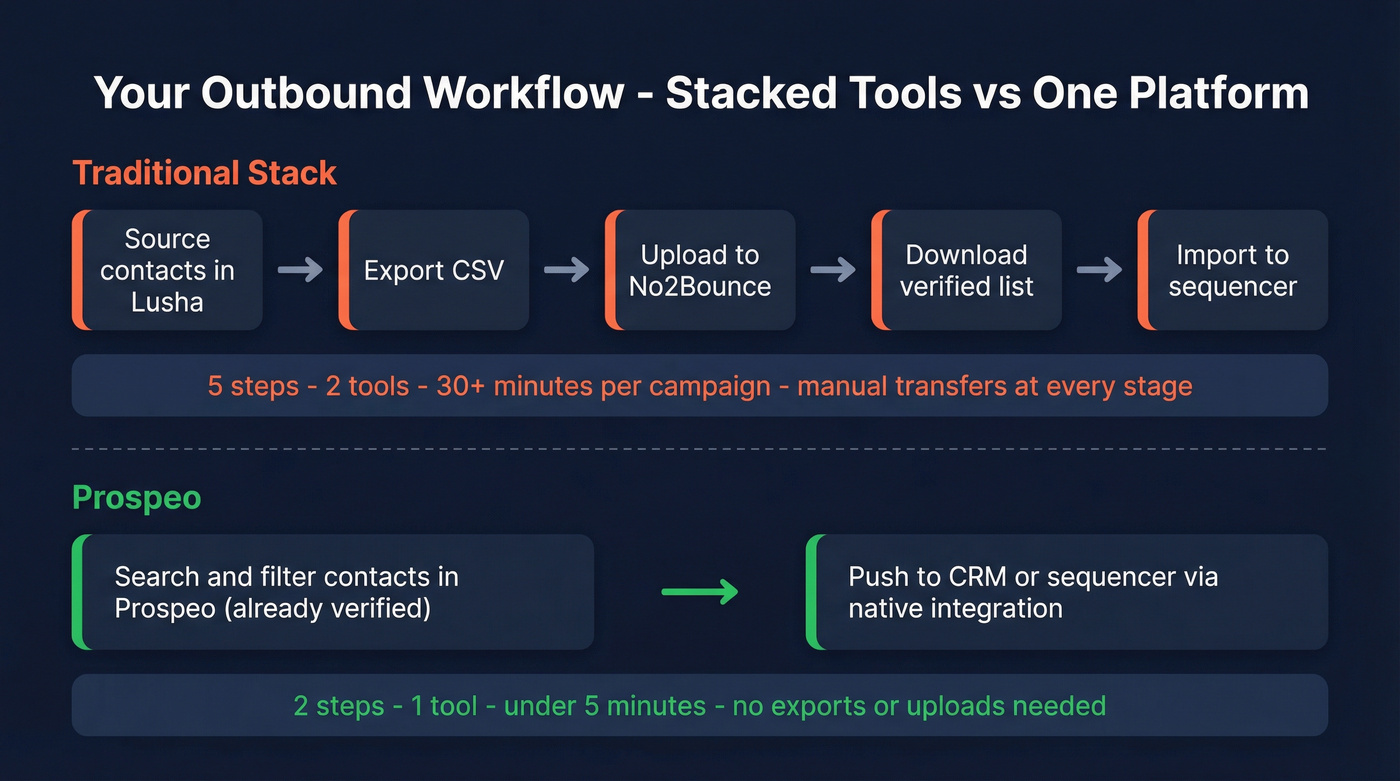
In our experience, teams running that stacked workflow often spend 30+ minutes per campaign just on list hygiene. The math backs this up: 5 reps on Lusha Premium (~$349.50/mo) plus No2Bounce's 50k tier ($72/mo) equals ~$421.50/mo - and you're still juggling exports between platforms.
Prospeo collapses that into one step:
- 300M+ professional profiles with 143M+ verified emails and 125M+ verified mobile numbers
- 98% email accuracy via a 5-step verification process (catch-all handling, spam-trap removal, honeypot filtering)
- 7-day data refresh cycle vs. the 6-week industry average
- 30+ search filters including intent, technographics, job changes, headcount growth, funding, and revenue
- Native integrations with Salesforce, HubSpot, Smartlead, Instantly, Lemlist, Clay, Zapier, and Make
Instead of exporting from a database, uploading to a verifier, then re-importing into your sequencer, you pull already-verified data and push it where it needs to go. Pricing stays self-serve and transparent at roughly $0.01 per email, with no annual contracts.
If you're evaluating broader options, compare stacks across data enrichment services and outbound lead generation tools to see where consolidation actually saves time.

A five-rep team on Lusha Premium plus No2Bounce runs $421+/mo and still requires manual list transfers. Prospeo delivers 300M+ profiles with built-in verification, 7-day data refresh, and native CRM integrations - no stitching required.
Replace two tools and save 30 minutes per campaign.
FAQ
Can I use Lusha and No2Bounce together?
Yes. A common workflow is: export contacts from Lusha, verify them in No2Bounce, then import the clean list into your sequencer. Expect an extra 10-30 minutes per campaign for exports and uploads, but it's worth it if you're protecting deliverability - especially when a database averages ~81% accuracy. For teams that don't mind the extra steps, this combo works fine.
Do No2Bounce credits expire?
They don't, on either monthly plans or pay-as-you-go. You can buy capacity and use it whenever you run a campaign. That's a practical advantage for teams that send in bursts - launch weeks, events, seasonal pushes - instead of steady daily volume.
What's a good alternative that does both?
Prospeo is a strong single-tool option because it combines sourcing and verification with 98% email accuracy, 143M+ verified emails, and a 7-day refresh cycle. The free tier includes 75 emails/month plus 100 Chrome extension credits, so you can test data quality before committing anything.
Picking the Right Tool
If your decision really is Lusha vs No2Bounce, pick based on where you are in the workflow. Lusha builds lists. No2Bounce cleans them. They aren't competitors - they're different stages of the same pipeline.
If you're tired of stitching together exports, verifications, and re-imports across multiple platforms, a unified tool with verified emails, weekly refresh, and native integrations keeps the whole source-to-send flow in one place. That's the approach we'd recommend for any team sending more than a few hundred emails a month.