

Lusha vs Xverum: Honest Comparison (2026)
Comparing Lusha vs Xverum is like comparing a screwdriver to a pallet of lumber. One's a Chrome extension that reveals individual contacts for SDRs. The other sells bulk datasets to data teams via API. We've tested both approaches, and here's the thing - most people weighing this comparison don't actually need either tool. They need a self-serve prospecting platform with verified emails and direct dials that doesn't burn through credits in a week.
30-Second Verdict
Lusha is for individual SDRs who want quick contact reveals from a Chrome extension. Xverum is for data engineers buying bulk datasets via API. Different buyers, different workflows, barely any overlap.
What Is Lusha?
Use this if you're a solo SDR or small team that needs quick email and phone reveals while browsing professional profiles. Lusha's Chrome extension is genuinely fast for one-off lookups, and the 280M+ contact database covers enough ground for many prospecting teams.

Skip this if you're running any kind of volume. Lusha's credit model is the core problem: 1 credit per email, 10 credits per phone number. The free plan gives you 70 credits/month - that's 7 phone numbers. Pro runs about $22.45/user/mo on annual billing, Premium about $52.45/user/mo, and credits still burn fast.
Accuracy is the bigger issue. Lusha claims 95% deliverability, but user-reported accuracy lands around 60-65%. An independent test of 500-1,000 leads showed bounce rates of 22-28%, which is brutal if you're trying to protect domain reputation (see our email deliverability guide). A separate 250-lead test showed a 3% bounce rate - better, but with a tiny 0.4% reply rate. The HubSpot integration is buggy too; users report deal ownership getting overridden on merged contacts.
What Is Xverum?
Use this if you're a data engineer, ML team, or SaaS platform that needs bulk B2B datasets delivered via API in JSON or Parquet. Xverum's scope is large: 750M+ professional profiles, 54M company profiles (though their own site also lists 42M+ elsewhere, which isn't a great look), and they claim 97-98% accuracy with 300M+ records updated monthly.
Skip this if you're a salesperson who wants a rep-first prospecting workflow. Xverum isn't built for one-off contact reveals inside a browser extension. It's built around datasets and APIs. Pricing starts at $500/month, with typical dataset subscriptions running $900-$1,800/month on Datarade. API-based datasets go as low as $2.50/1,000 calls for specific signals like job changes (more on how to track sales triggers). Enterprise contracts can hit $100K/year.
Now, the trust problem. Xverum has zero G2 reviews and a single 5.0 rating on Datarade from one verified buyer. There's literally no Reddit discussion about this company. The 97-98% accuracy claim? Unverifiable.

Lusha burns credits on 60-65% accurate data. Xverum requires a data team to operationalize. Prospeo gives SDRs 98% email accuracy, 125M+ verified mobiles with 30% pickup rates, and 30+ filters - all refreshed every 7 days. No dataset subscriptions, no per-phone-number gouging.
Stop choosing between bad accuracy and tools built for data engineers.
Head-to-Head Comparison
| Dimension | Lusha | Xverum |
|---|---|---|
| Database | 280M+ contacts | 750M+ profiles, 54M companies |
| Pricing model | Per-credit (1/email, 10/phone) | Dataset subscriptions + API calls |
| Starting price | Free (70 credits/mo) | ~$500/mo |
| Accuracy (claimed) | 95% | 97-98% |
| Accuracy (real-world) | ~60-65% | Unverifiable |
| Delivery | Chrome extension, CRM | API (JSON, Parquet) |
| Data freshness | Not disclosed | 24-hour refresh cycles (claimed) |
| Compliance | GDPR, CCPA | GDPR, CCPA |
| G2 reviews | 1,400+ (4.3/5) | 0 reviews |
| Best for | SDR quick lookups | Data teams, ML pipelines |
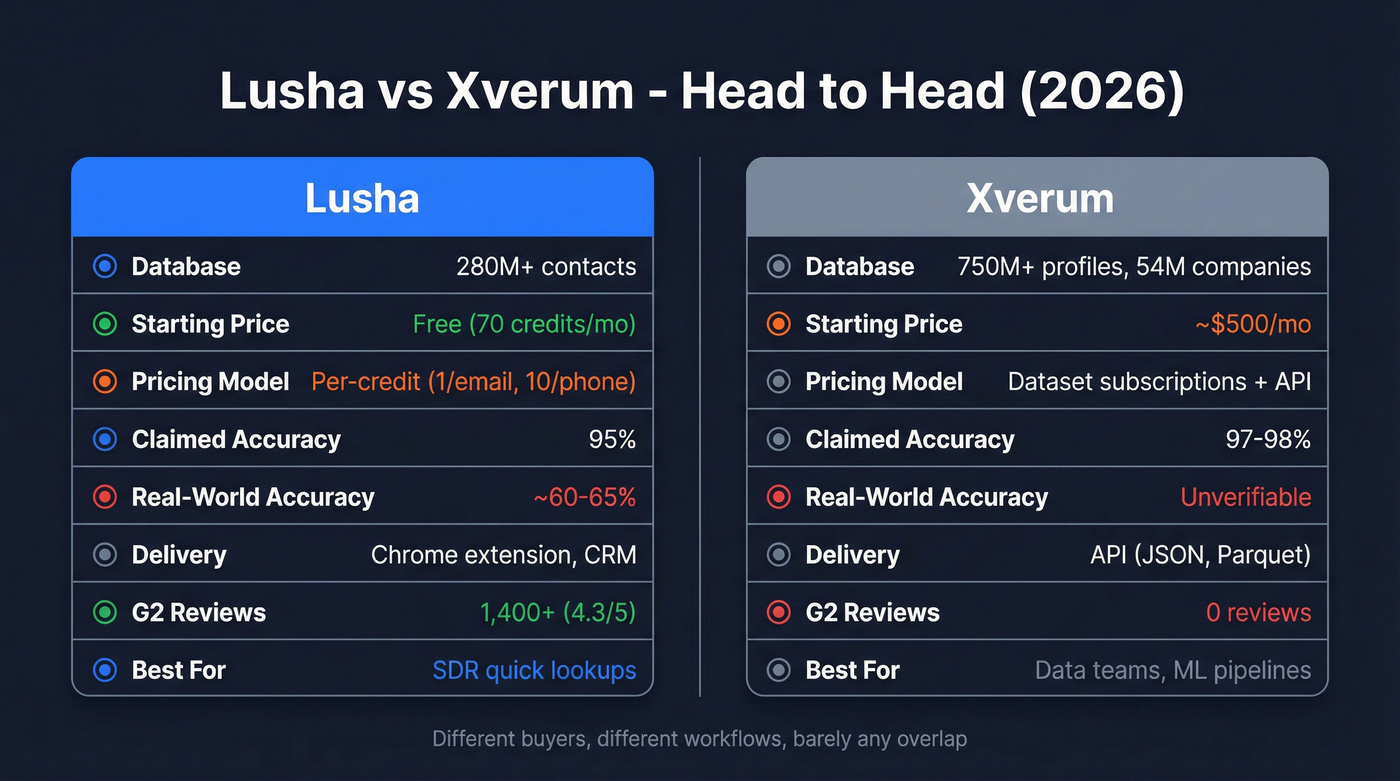
These tools don't share a single delivery method, pricing model, or target buyer. Lusha sells individual reveals to salespeople. Xverum sells bulk data to developers. Comparing them on the same axis is like comparing Salesforce to Snowflake - technically both "data platforms," practically nothing alike.
Why Most Reps Need Neither
Let's be honest about why someone searches Lusha vs Xverum. You probably saw both mentioned as B2B data providers and want to know which one to buy. The answer: probably neither, because they solve fundamentally different problems (and most teams are better served by sales prospecting techniques plus a rep-first database).
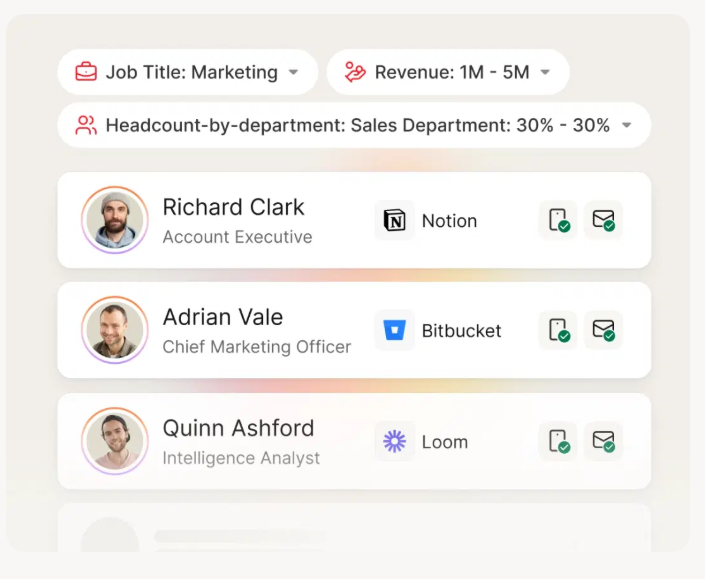
Lusha's strength is speed-to-contact for individual reps. Its weakness is that credits evaporate and accuracy degrades at scale. Xverum's strength is raw dataset volume for technical teams. Its weakness is that it's not designed as a day-to-day SDR prospecting interface - there's no Chrome extension, no CRM sidebar, no rep-facing UI at all.
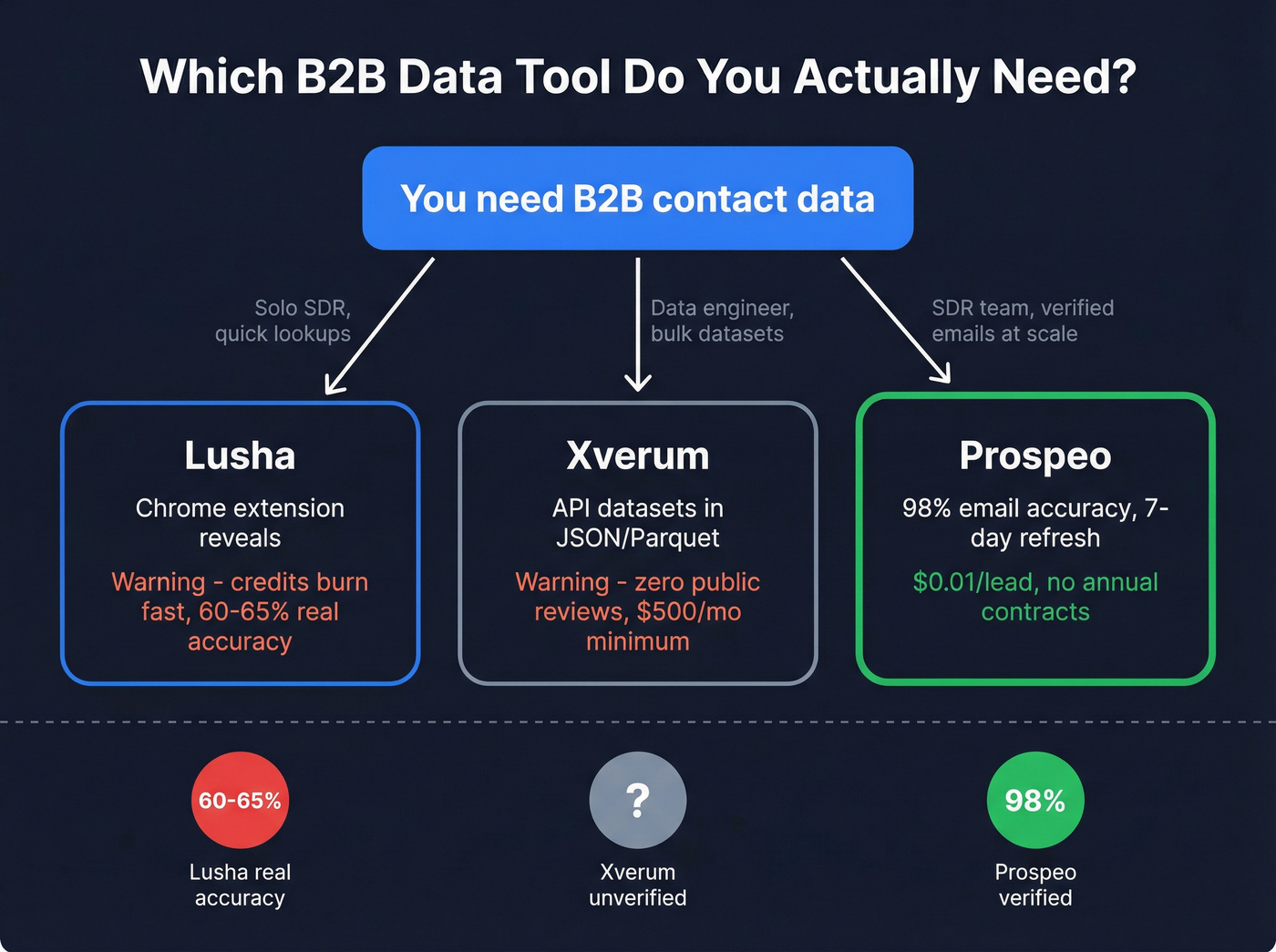
If your average deal size is under $15k and your team has fewer than 10 reps, you don't need either of these tools. You need verified emails at scale with a Chrome extension that works everywhere, and you need to stop paying per phone number like it's 2019 (see best sales prospecting databases).
A Better Fit for Most SDRs
In our testing, Prospeo's 98% email accuracy held up across thousands of lookups - with 143M+ verified emails, 125M+ verified mobiles with a 30% pickup rate, and data refreshed every 7 days. For context, the industry average refresh cycle sits around 6 weeks. The free tier gives you 75 emails and 100 Chrome extension credits per month. Paid plans run about $0.01/lead with no annual contracts (compare options in our data enrichment services roundup).
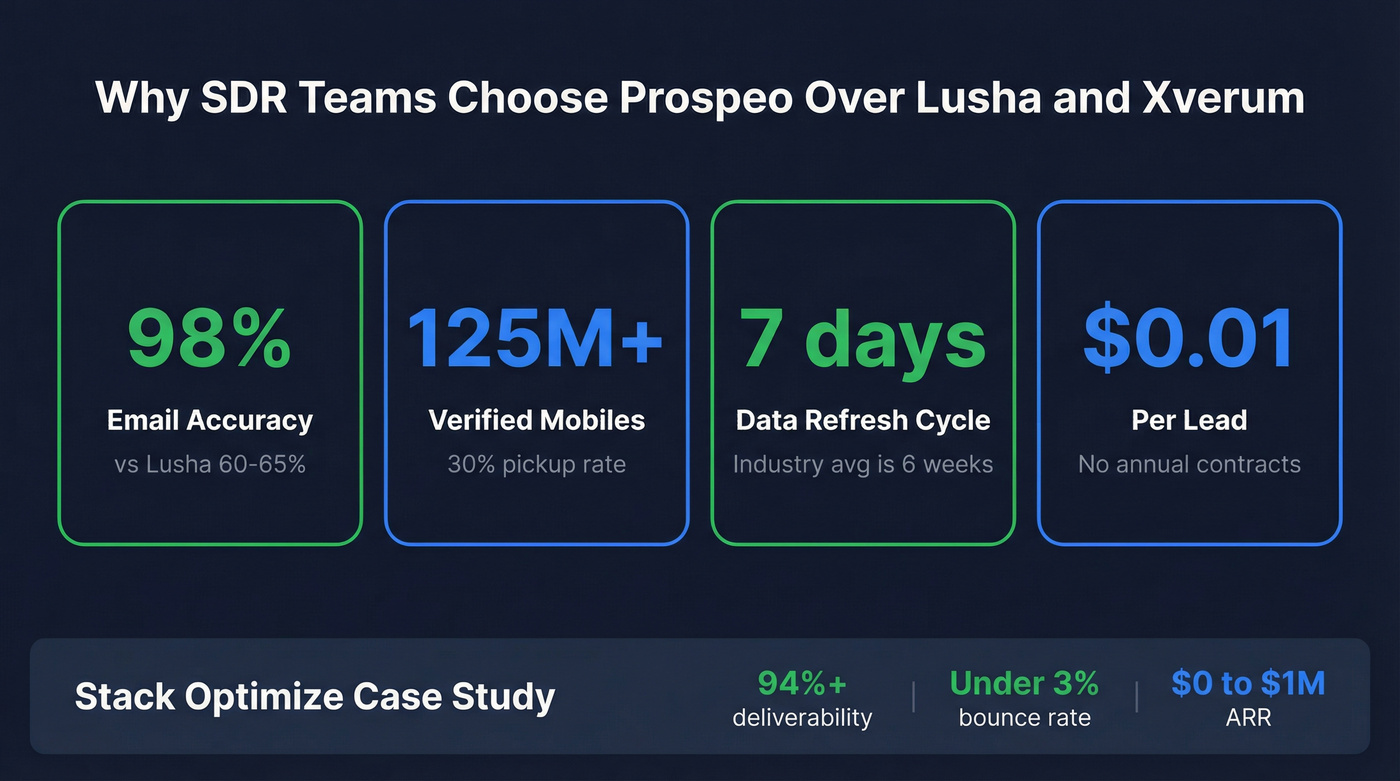
Beyond raw accuracy, 30+ search filters - including buyer intent powered by Bombora, technographics, job changes, and headcount growth - give SDRs the targeting depth that Lusha's basic filters can't match and that Xverum's raw datasets require a data team to replicate (see firmographic and technographic data). One of our agency customers, Stack Optimize, built from $0 to $1M ARR while keeping client deliverability above 94% and bounce rates under 3% - zero domain flags across all clients (benchmarks: email bounce rate).
Stack Optimize built a $1M agency on Prospeo data - 94%+ deliverability, under 3% bounce, zero domain flags. At $0.01/email with no annual contracts, you get enterprise-grade accuracy without Lusha's credit drain or Xverum's $500/mo minimum.
75 free emails per month. Validate the accuracy before you spend a dollar.
FAQ
Is Xverum a direct Lusha alternative?
No. Lusha is a per-contact reveal tool for SDRs via Chrome extension. Xverum is a bulk dataset provider for data teams and ML pipelines via API. They serve different buyers with entirely different workflows - comparing them only makes sense at the broadest "B2B data" category level.
Why does Xverum have zero G2 reviews?
Xverum primarily serves enterprise data teams who purchase datasets through marketplaces like Datarade, not self-serve SaaS buyers who leave G2 reviews. Founded in 2020, it has a single 5.0 Datarade rating from one verified buyer. Public adoption signals remain thin.
What's the most accurate email tool for SDRs in 2026?
Prospeo delivers 98% email accuracy with a 7-day refresh cycle across 143M+ verified addresses. That outperforms Lusha's user-reported 60-65% hit rate and Xverum's unverifiable 97-98% claim. The free tier - 75 emails/month - lets you validate accuracy before committing a dollar.