

Mailarrow vs Apollo.io: Different Tools, Different Problems
The Mailarrow vs Apollo.io debate keeps surfacing in cold email communities, but it's a false comparison. One is a delivery truck. The other is a warehouse with its own fleet. Pick the wrong one and you're solving a problem you don't have while ignoring the one you do.
30-Second Verdict
Apollo.io wins if you need a B2B database and outreach in one platform, especially for US-focused prospecting.
Mailarrow wins if you already have clean lead lists and want dead-simple sending with unlimited mailboxes at $39/mo.
Here's the thing: the sending layer is completely commoditized in 2026. Mailarrow, Instantly, Smartlead - they all push emails. The data layer is where campaigns succeed or fail. If your real bottleneck is verified emails that don't bounce, start with Prospeo for 98% email accuracy at ~$0.01/lead, then plug into whichever sending tool you prefer.
What Each Tool Actually Does
Apollo.io is a sales execution platform. It combines a 275M+ contact database with built-in email sequences and CRM integrations - you search for leads, build lists, and launch outreach without leaving the app.
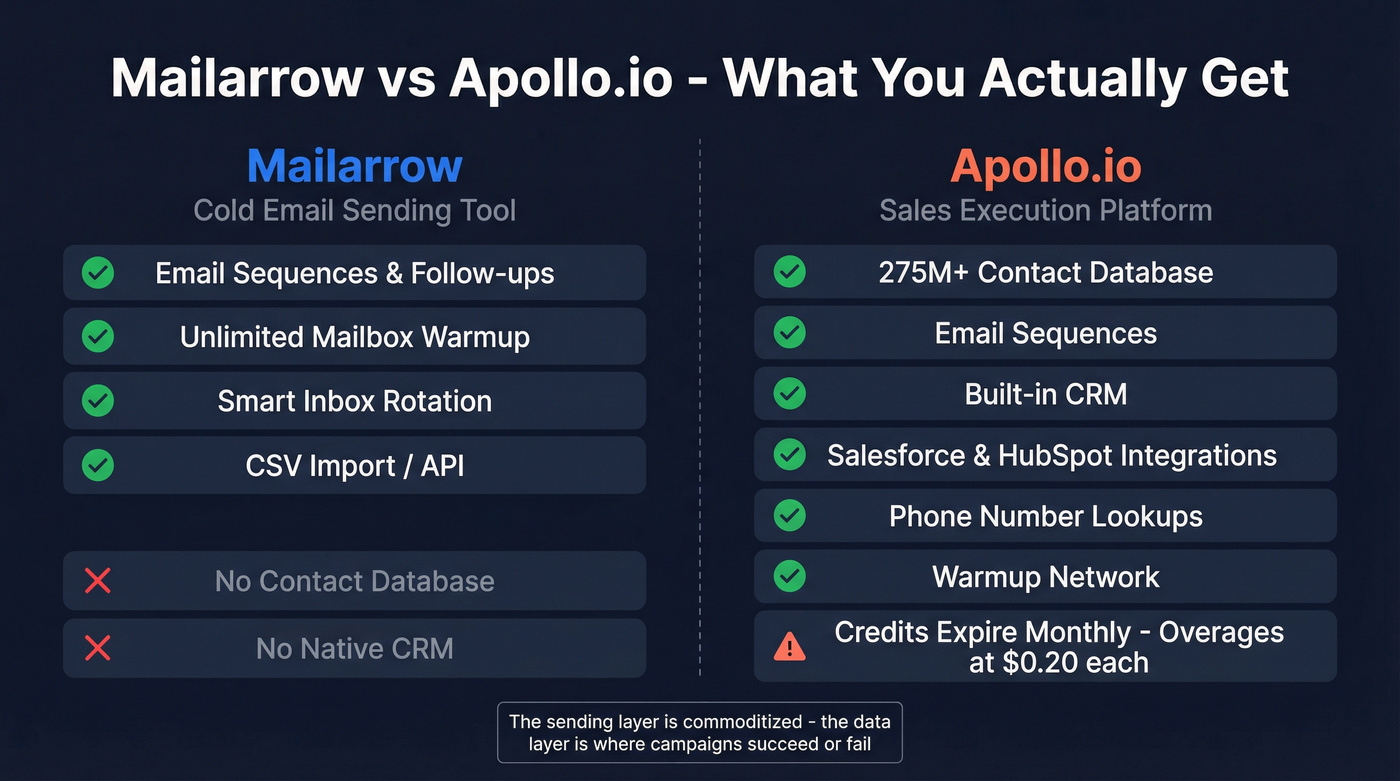
Mailarrow is a cold email sending tool. That's it. No database. You bring your own leads via CSV import, API, or copy-paste, and Mailarrow handles sequences, follow-ups, warmup, and inbox rotation. It's infrastructure for delivery, not discovery.
Features & Pricing Compared
This is where the architectural difference shows up in dollars.
| Feature | Mailarrow | Apollo.io | Edge |
|---|---|---|---|
| Contact database | ❌ None | ✅ 275M+ contacts | Apollo |
| Email sequences | ✅ | ✅ | Tie |
| Email warmup | ✅ Unlimited | ✅ Warmup network | Mailarrow |
| Mailbox limits | Unlimited | Varies by plan | Mailarrow |
| Smart inbox rotation | ✅ | ✅ | Tie |
| AI personalization | ✅ (Professional+) | ✅ | Tie |
| CRM integrations | Zapier | Salesforce, HubSpot, native CRM | Apollo |
| G2 reviews | 2 reviews (5.0) | Far more reviews | Apollo |
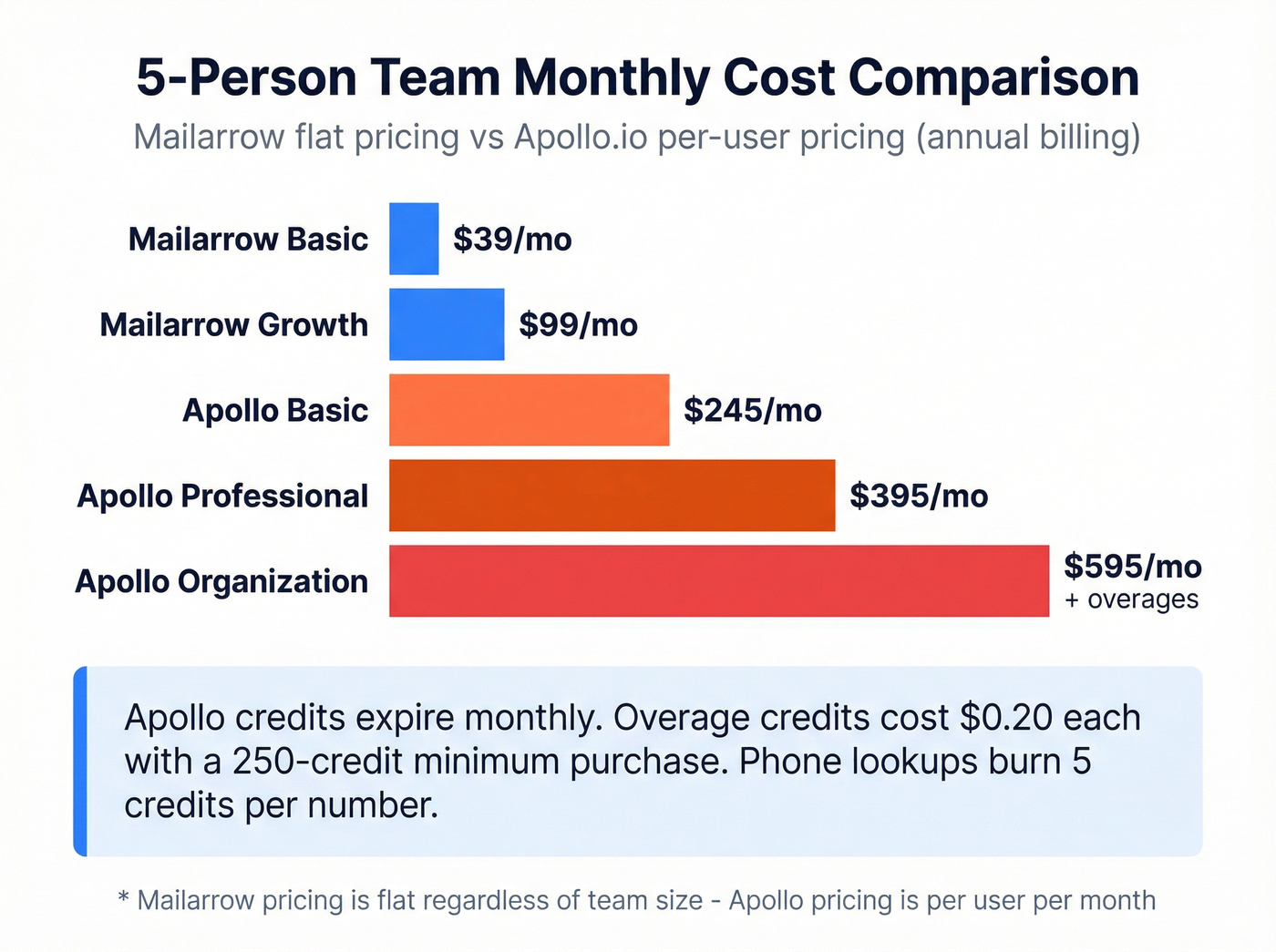
Now the money. Mailarrow uses flat monthly plans. Apollo charges per user, per month, with credits that expire each billing cycle.
| Mailarrow Basic | Mailarrow Professional | Mailarrow Growth | Apollo Basic (annual) | Apollo Professional (annual) | Apollo Organization (annual) | |
|---|---|---|---|---|---|---|
| Price | $39/mo | From $59/mo | $99/mo | $49/user/mo | $79/user/mo | $119/user/mo (3-user min) |
| Plan limits | 2,000 active prospects / 6,000 emails | 20,000 active prospects / 60,000 emails | 50,000 active prospects / 150,000 emails | Credit-based | Credit-based | Credit-based |
| 5-person team cost | $39-99/mo | - | - | ~$245/mo | ~$395/mo | ~$595/mo |
Apollo's credit mechanics are where costs sneak up. Credits expire monthly, overage credits cost $0.20 each with a 250-credit minimum purchase, and phone number lookups burn 5 credits per number. We've watched teams blow through their monthly allotment by week two, then scramble to buy overages or ration lookups for the rest of the cycle. On annual billing, a 5-person Professional team runs ~$395/mo before any of those overages hit.
For solo founders or two-person teams, Mailarrow's flat $39/mo is hard to beat on pure cost. But the moment you need data, you're paying for a separate provider on top of that.

Apollo's credits expire monthly and its "Verified" emails bounce at 30%+. Mailarrow has no data at all. Prospeo gives you 300M+ profiles with 98% email accuracy, refreshed every 7 days - then plug your clean list into whichever sending tool you want at ~$0.01/lead.
Stop debating sending tools. Fix the data feeding them.
Data Quality: The Part That Actually Matters
Apollo's database is massive, but massive doesn't mean accurate. One r/coldemail user exported ~900 "Verified" leads from Apollo - blue badge and all - then ran them through MillionVerifier. The results: 19% valid, 21% invalid, 60% catch-all. In practice, teams often see accuracy around 65-70%, with bounce rates of 15-25%.
If you're trying to reduce bounces systematically, treat this as an email bounce rate problem first, not a sequencer problem.
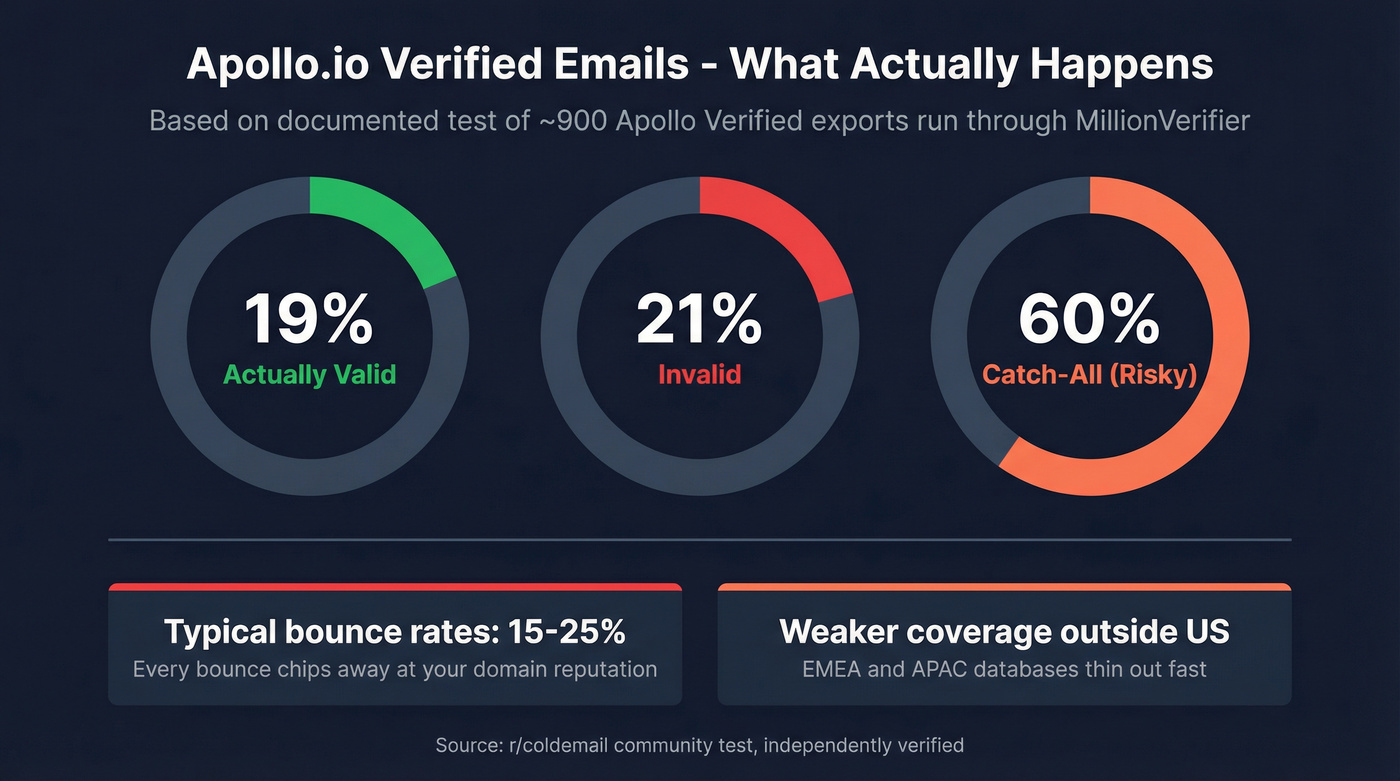
Two complaints come up constantly beyond raw accuracy: outdated contacts and weaker coverage outside the US. If you're prospecting in EMEA or APAC, Apollo's database thins out fast.
Apollo's verification uses third-party vendors like ZeroBounce through a 7-step process. That's decent, but it's not enough for teams running high-volume outbound where every bounce chips away at domain reputation. Mailarrow has no database at all, so you're fully dependent on wherever you source your leads. Neither tool solves data quality on its own - and in our experience, the data layer deserves more budget and attention than the sending layer.
Deliverability Breakdown
Mailarrow's unlimited warmup and smart inbox rotation look strong on paper. Both of its G2 reviews - and yes, there are only two, both incentivized - flag the same issue: emails landing in spam. That's worth taking seriously, even with a tiny sample size.
Apollo offers warmup via a private network, domain health monitoring, and recommends conservative sending limits: 50 emails/day per mailbox, 6 emails/hour, with a 600-second delay between sends.
Neither tool can fix deliverability if your list is garbage. Inbox placement starts upstream, with the data. If you want the full upstream checklist, use an email deliverability guide as your baseline.
The Missing Piece Both Tools Share
The practitioner consensus on r/coldemail is clear: Apollo alone leaves you with a 30-40% coverage gap. Mailarrow requires external data entirely. Smart teams now run a waterfall enrichment approach - layering multiple data providers to push hit rates from ~60% to 90%+.
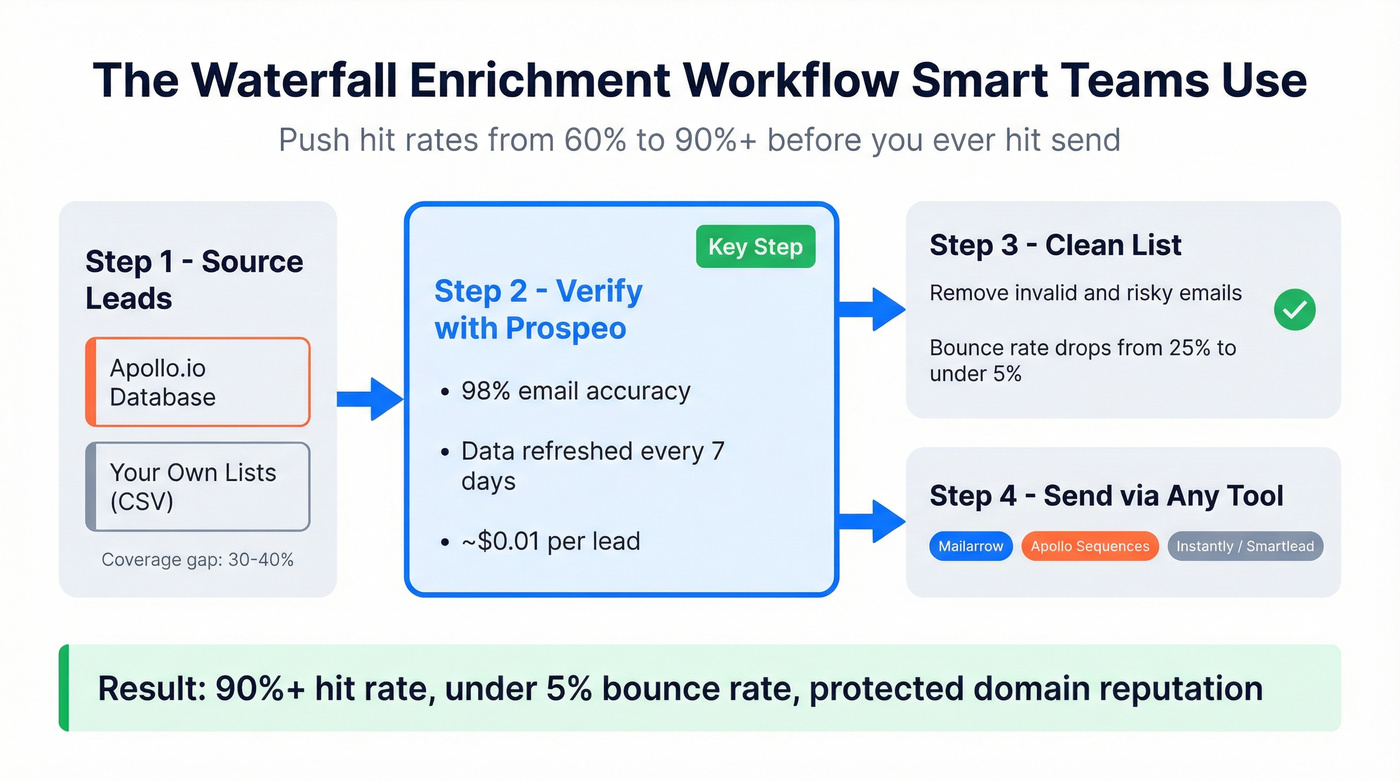
Prospeo's B2B database fills that gap with 300M+ professional profiles and 98% email accuracy, built on proprietary email-finding infrastructure with data refreshed every 7 days versus the 6-week industry average. At ~$0.01/lead, you can verify an Apollo export before hitting send or build a clean list from scratch and import it into Mailarrow. The free tier gives you 75 verified emails/month to test the workflow before committing anything.

Teams running waterfall enrichment push hit rates from 60% to 90%+. Prospeo's proprietary email-finding infrastructure and 7-day refresh cycle mean you're never sending to stale contacts - whether you export into Mailarrow, Apollo, or any other sequencer.
Get 75 verified emails free and see the difference before you commit.
Which Should You Choose?
You need data + outreach in one platform. Apollo.io is the pick. But verify your exports with a dedicated data provider before launching sequences. The 19% valid rate on "Verified" leads isn't a fluke - it's a pattern we've seen repeatedly.
If you're building a broader stack, it helps to compare SDR tools and data enrichment services separately instead of treating them as one category.
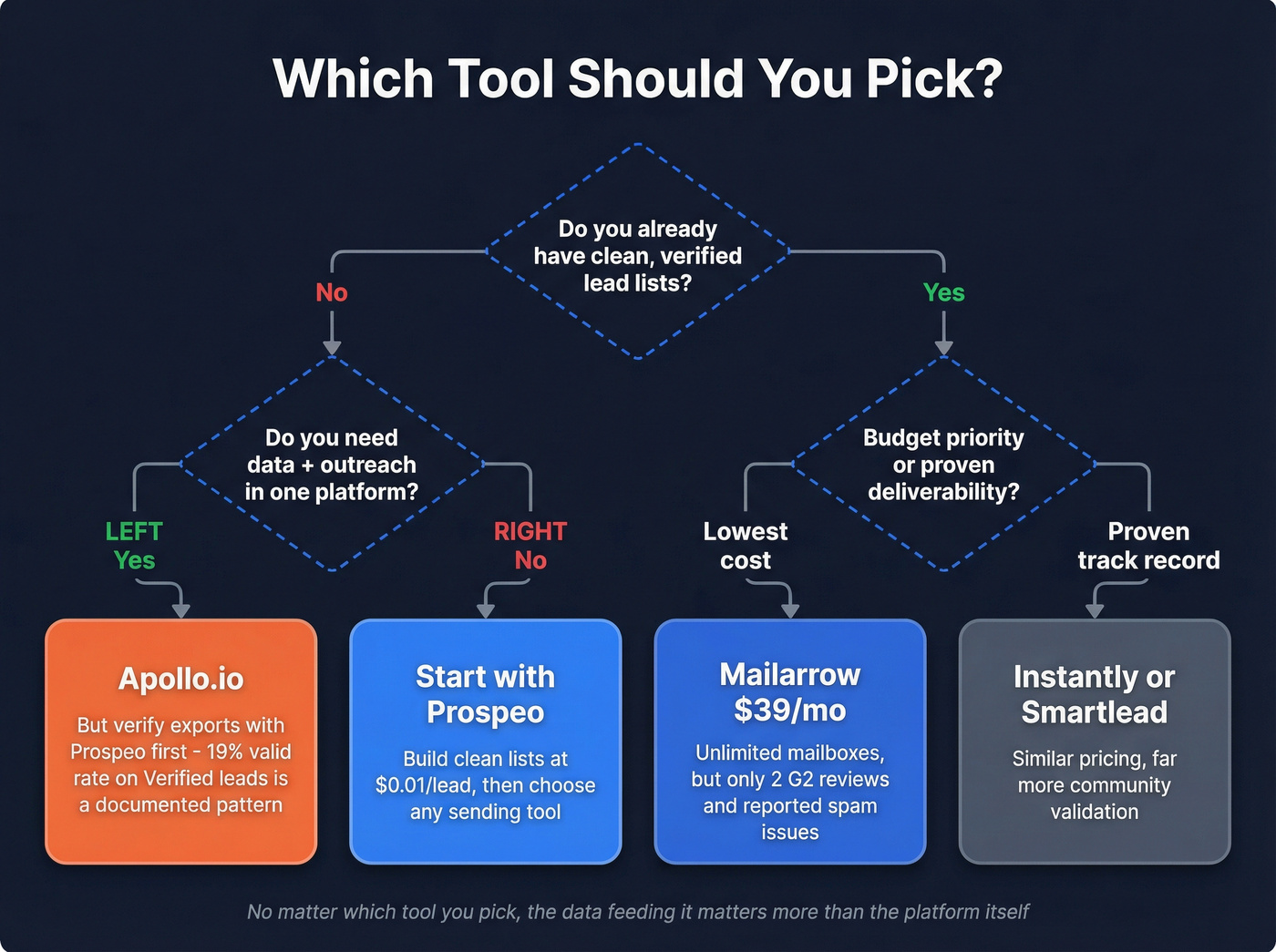
You already have clean lists and want cheap sending. Mailarrow at $39/mo with unlimited mailboxes is worth a trial. Just know you're betting on a tool with a tiny review footprint and documented spam issues. Skip it if you need proven deliverability right now - Instantly and Smartlead are more battle-tested alternatives in the same price range.
If you're scaling volume, make sure you understand email velocity before you ramp.
Your real problem is data quality. Get verified contacts first, then choose your sending tool. We've seen teams cut bounce rates from 25% to under 5% just by adding a verification layer before outreach - the ROI dwarfs whatever you save on sending software. Whether you're comparing Mailarrow vs Apollo.io or any other pair of outbound tools, the data feeding them matters more than the platform itself.
FAQ
Does Mailarrow have a B2B contact database?
No. Mailarrow is purely a sending tool. You'll need to source and import leads from a separate data provider before you can run any campaigns.
Why do Apollo's "Verified" emails still bounce?
Apollo's verification relies on third-party vendors through a 7-step process, but catch-all domains make up the bulk of the gap. One documented test found only 19% of "Verified" exports were actually valid after independent verification. Running exports through a dedicated verification tool before sending is standard practice for serious outbound teams.
Is Mailarrow worth it for a small team?
At $39/mo with unlimited mailboxes, it's one of the cheapest sending options available. But its two G2 reviews both report spam-folder issues, and the tool has minimal market presence. For teams that can't afford deliverability experiments, Instantly and Smartlead offer similar pricing with far more community validation and proven track records.