

MailMint vs Apollo.io (2026): Which One Actually Verifies Your Emails?
We exported 2,000 "verified" contacts from Apollo last quarter. Day one of the sequence: 18% hard bounces. That's not a verification problem - it's a category problem. Apollo is a prospecting platform that happens to verify emails. MailMint is a verification tool that only verifies emails. If you're weighing MailMint vs Apollo.io, you're comparing two fundamentally different things, and the decision hinges on what's actually breaking your outbound right now.
One clarification before we get into it: this covers MailMint the email verification service, not the WordPress email marketing plugin of the same name. Different product, different company.
30-Second Verdict
Use Apollo.io if you need a full prospecting platform with a 275M+ contact database and built-in sequence automation, and you don't mind running a secondary verification pass on exports.
Use MailMint if you already have a data source and need catch-all detection and verification using real test-email sending with tracking over up to 36 hours. No database, no outreach - single-purpose.
MailMint vs Apollo.io: Key Differences
| Feature | MailMint | Apollo.io |
|---|---|---|
| Primary function | Email verification | Prospecting platform |
| Database | None | 275M+ contacts |
| Verification method | Real test-email sending + tracking | SMTP checks + contributory network signals + additional datasets |
| Catch-all handling | Real test-email sending tracked up to 36 hours | Catch-all labeled as a distinct status you can filter on |
| Accuracy | Not publicly disclosed | 91% (Apollo's published claim) |
| Outreach/sequences | No | Yes, built-in |
| Integrations | API available | CRM integrations |
| Free tier | 200 credits | Yes, limited |
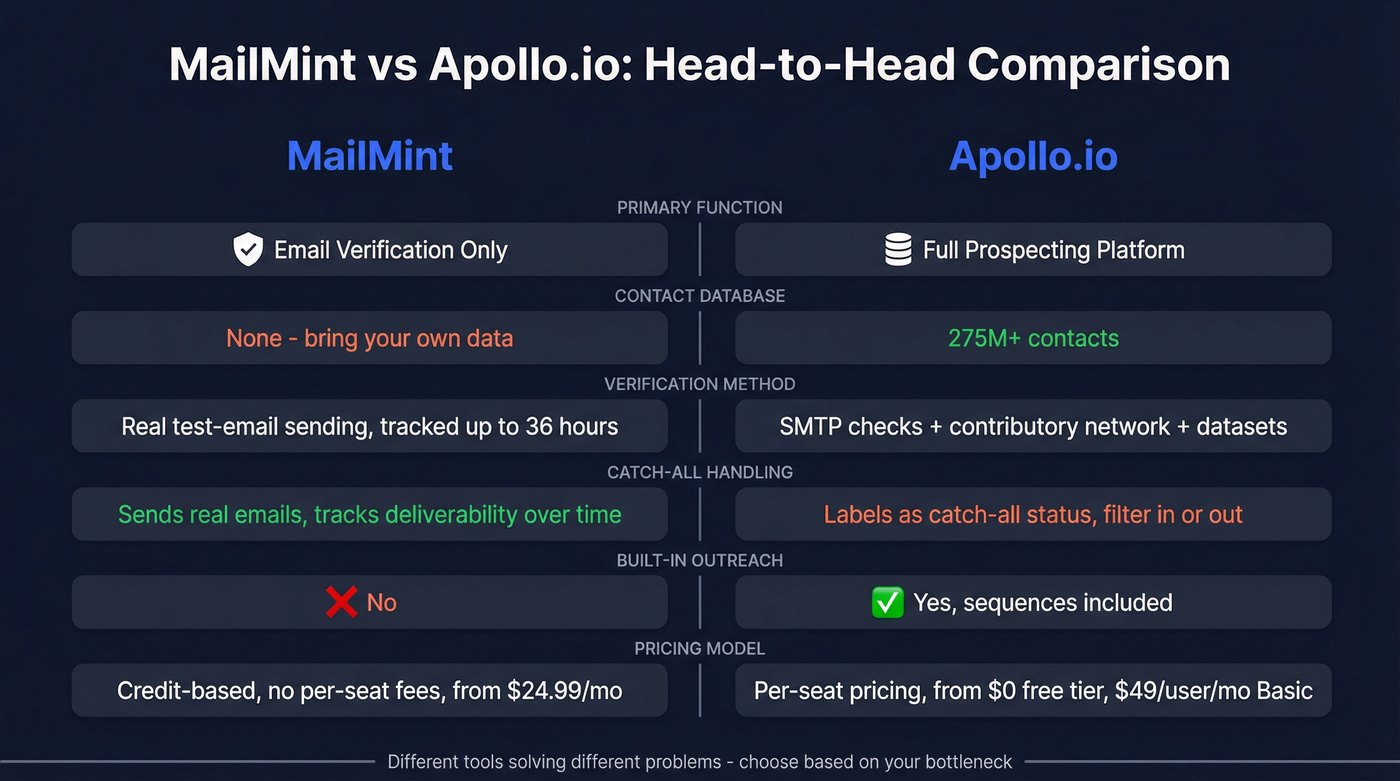
Apollo runs a 7-step verification process combining SMTP checks with its contributory data network and other datasets. On paper, that's sophisticated. In practice, we've seen Apollo exports bounce hard without secondary cleaning - including that 18% hard-bounce export we mentioned.
Apollo assigns six email statuses: Verified, Unverified, Update required, Unavailable, User managed, and Catch-all. Only "Verified" costs a credit. But "Verified" still isn't the same thing as "safe to send without cleaning."
MailMint takes a different approach entirely. It sends real test emails and tracks them over up to 36 hours, which is slower but built to turn catch-all situations into more actionable outcomes than a simple "unknown" label. The tradeoff? Near-zero third-party review presence on G2 or Capterra, so you're taking their claims more on faith than on community validation.
Catch-All Domains: Why This Matters So Much
Roughly 28% of B2B emails sit on catch-all domains. These servers accept mail to any address - valid or not - so standard SMTP verification can't definitively tell you if a mailbox exists.
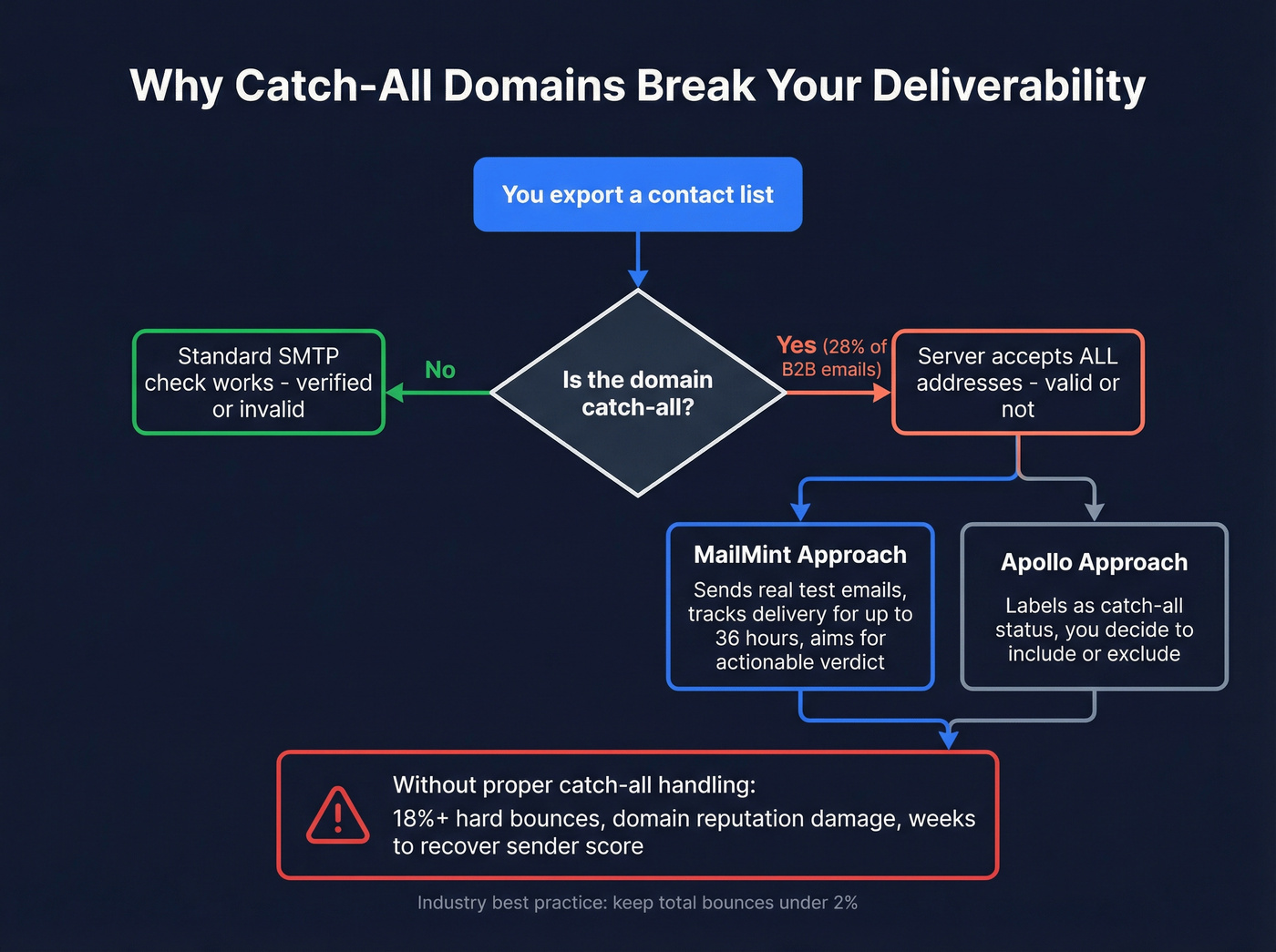
No verifier resolves 100% of catch-alls. But the gap between labeling them "catch-all/unknown" and giving you an actionable verdict is the difference between guessing and sending with confidence.
Apollo labels catch-all as a distinct status, and you can filter to include or exclude it. Labeling isn't resolving. One r/SaaS thread recommends scraping Apollo results and running them through a dedicated verifier to get bounce rates under 2%. That tracks with Validity's finding that 21% of emails never reach the inbox due to bad data. Industry best practice targets total bounces below 2% (see email bounce rate benchmarks).
Here's the thing: if you're sending Apollo exports without secondary verification, you're burning your domain reputation on a coin flip. Apollo's 30-day bounce credit refund is a nice safety net, but by the time you claim it, the deliverability damage is already done (and you may need to improve sender reputation afterward).

18% hard bounces from "verified" exports shouldn't be normal. Prospeo's 5-step verification with catch-all handling, spam-trap removal, and honeypot filtering delivers 98% email accuracy - no secondary cleaning tool required. Data refreshes every 7 days, not every 6 weeks.
Stop stitching MailMint and Apollo together. One tool, one workflow.
Pricing Breakdown
| Detail | MailMint | Apollo.io |
|---|---|---|
| Entry price | $24.99/mo | Free ($0) |
| Mid-tier | $49.99/mo | $49/user/mo (annual) |
| Top tier | $149.99/mo | $119/user/mo (annual, 3-user min) |
| Free tier | 200 credits | Yes, limited credits |
| Credits included | 2,500-20,000 | Free: 10 exports; Basic: 1,000; Pro: 2,000; Org: 4,000 |
| Overage cost | Contact sales | $0.20/credit (250 min) |
| Credit rollover | Yes | No, monthly reset |
| Per-seat pricing | No | Yes |
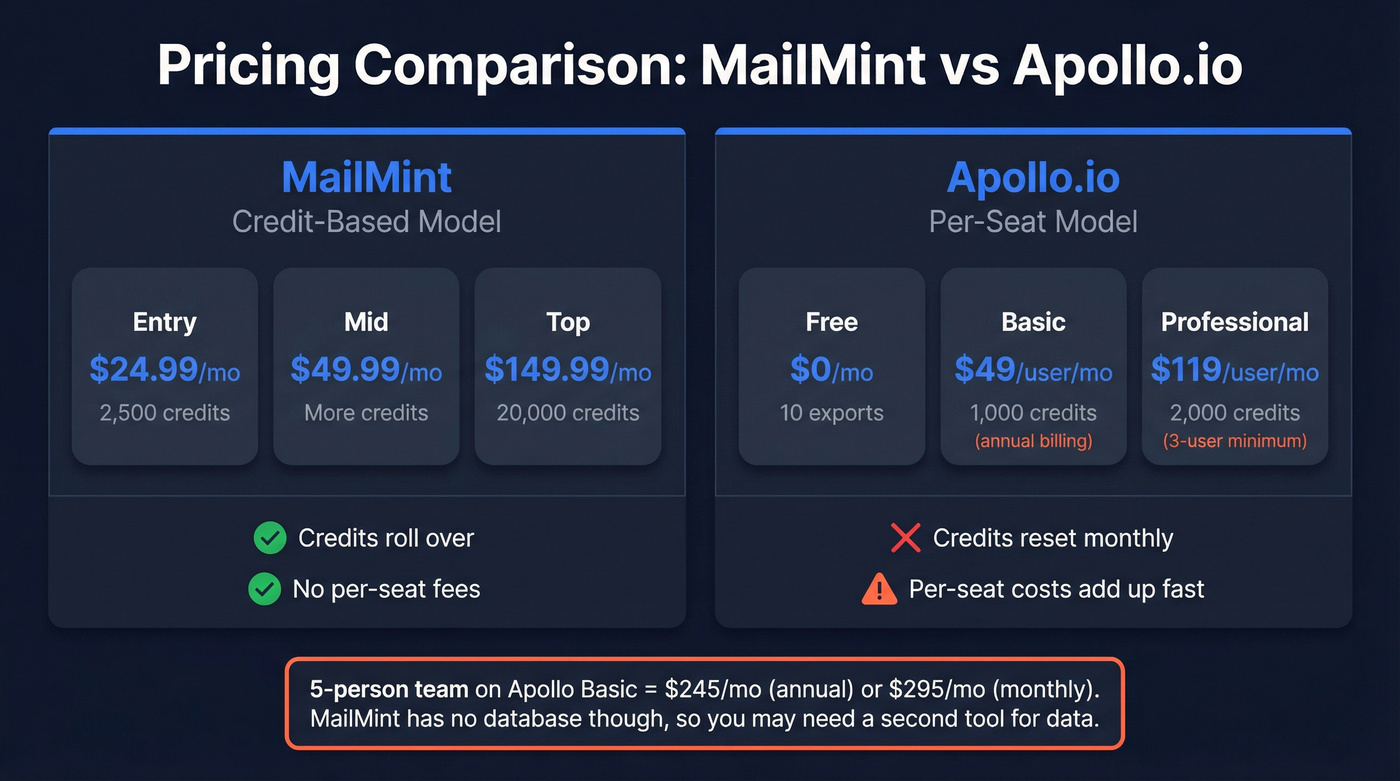
Apollo's per-seat model is where costs multiply fast. A 5-person team on Basic runs $245/mo on annual billing - $295/mo if you pay monthly. MailMint's credit-based model is simpler, but it has no database. In practice, that often means you're paying for two tools: a data source plus a verifier. Apollo at least bundles prospecting and verification together, even if you still end up cleaning exports elsewhere.
When Each Tool Makes Sense
Choose Apollo for Prospecting Workflows
Apollo is the better fit when your bottleneck is list-building: finding companies, filtering by role, exporting contacts, and pushing them into sequences or your CRM. If you're okay treating its verification as a first pass rather than a final gate, it can be a productive all-in-one for outbound motion (especially if you follow modern sales prospecting techniques).
Where teams get hurt is assuming "Verified" equals "deliverability-safe." In catch-all-heavy segments like financial services or healthcare, that assumption gets expensive fast - both in credits and in sender reputation that takes weeks to rebuild.
Choose MailMint for Verification-Only Needs
MailMint makes sense when you already have leads coming from somewhere else - forms, events, partners, scraped lists, another database - and you want a dedicated verifier explicitly designed to deal with accept-all behavior.
The tradeoff: it doesn't solve list-building, enrichment, or routing into your outbound stack. It's a specialist. If you need both prospecting and verification, you're stitching tools together.
One Workflow Instead of Two
Let's be honest: the real question isn't MailMint vs Apollo.io. It's whether you need two tools at all.
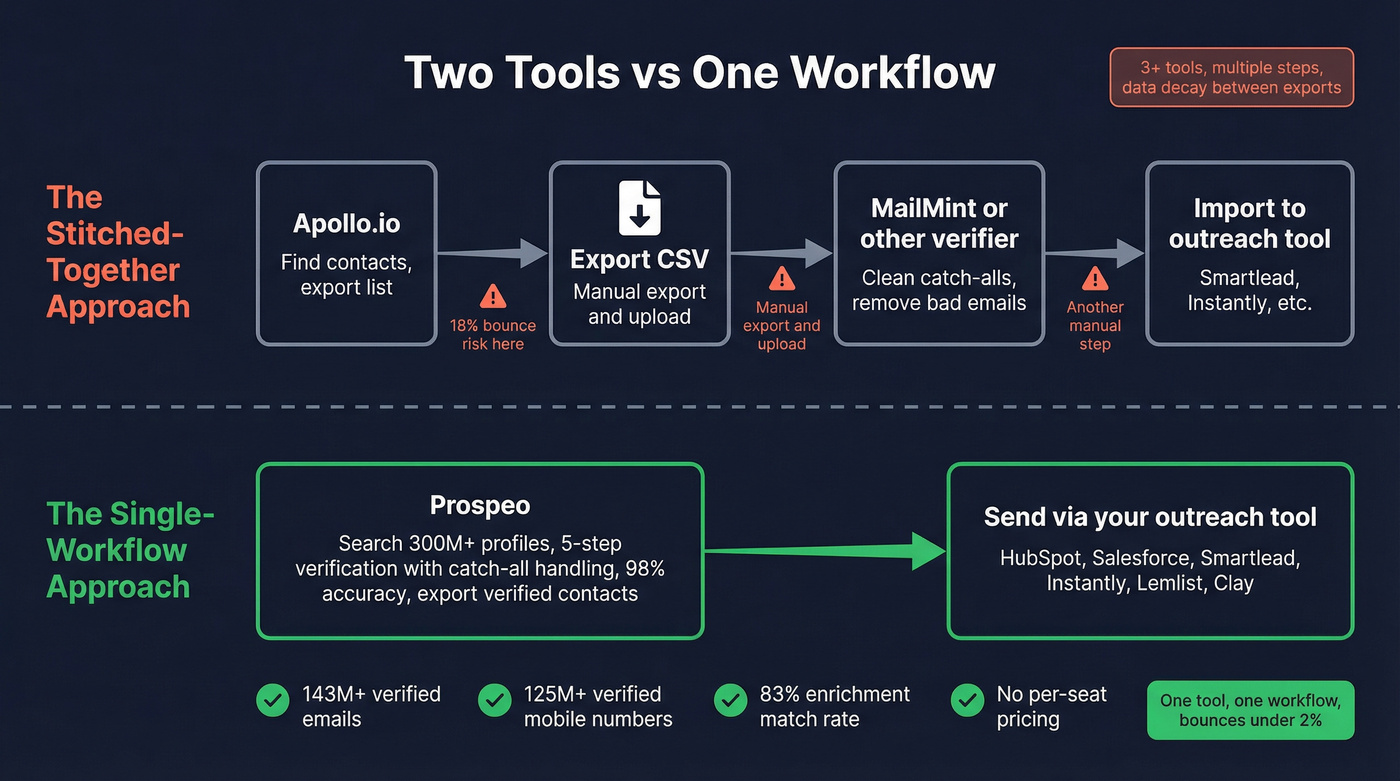
A few specifics that matter in day-to-day outbound:
- 143M+ verified emails and 125M+ verified mobile numbers - useful when email is noisy and you need a second channel (see cold texting considerations)
- 83% enrichment match rate - most leads come back with contact data when you enrich
- 92% API match rate for enrichment workflows
- Native integrations with HubSpot, Salesforce, Smartlead, Instantly, Lemlist, Clay, Zapier, and Make (more on data enrichment services if you're comparing stacks)
Instead of exporting from Apollo and cleaning with a separate verifier, you search, verify, and export in one workflow. Pricing starts free at 75 emails/month plus 100 Chrome extension credits/month, with paid plans around $0.01 per email and no annual contracts.
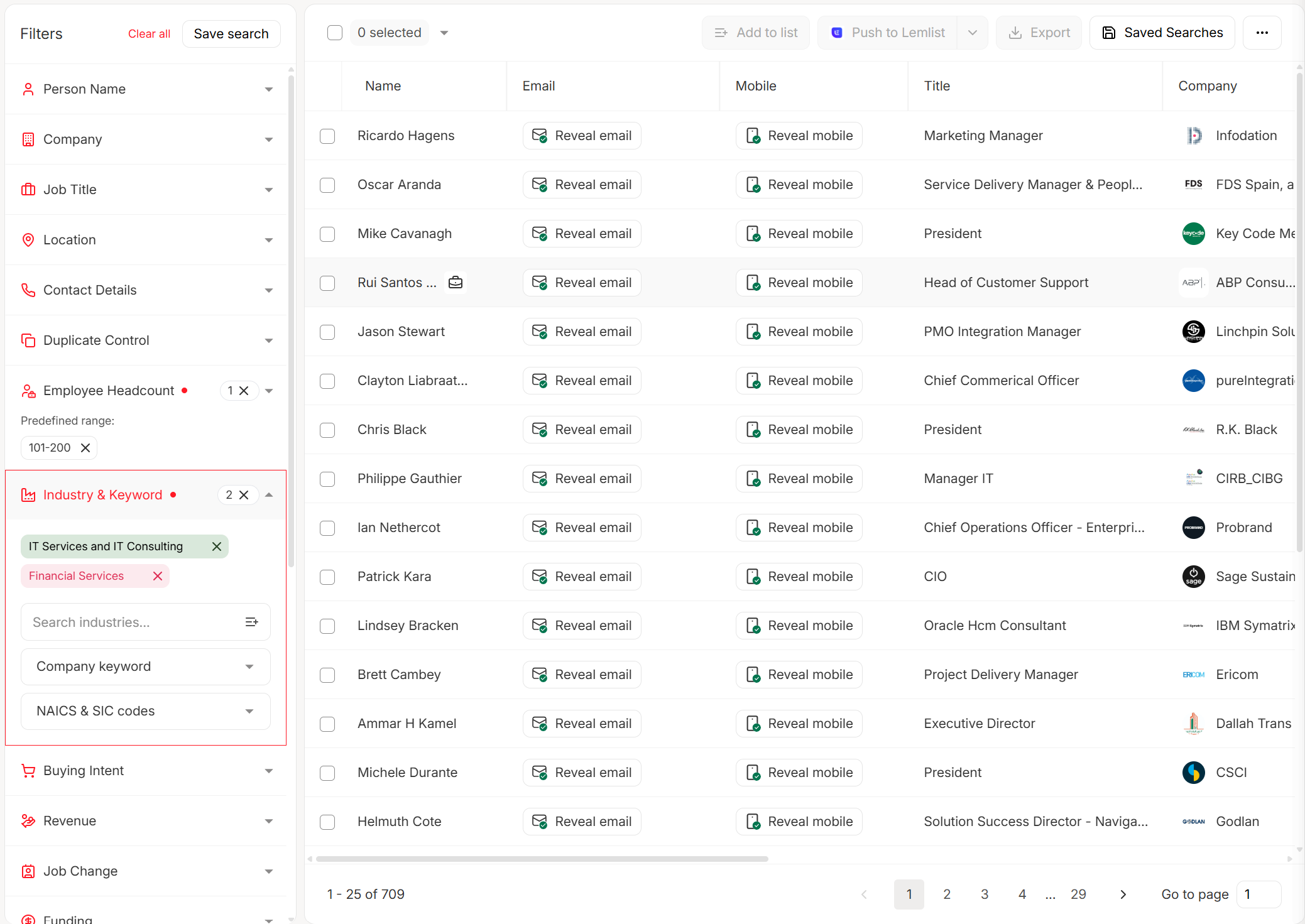
Why pay for a prospecting platform plus a standalone verifier? Prospeo combines 300M+ profiles, 143M+ verified emails, and built-in verification at ~$0.01 per email. No per-seat pricing. No annual contracts. 83% enrichment match rate out of the box.
Replace two tools with one that actually keeps bounce rates under 2%.
Summary
MailMint and Apollo solve different problems. One is built for verification depth around catch-alls. The other is built for prospecting scale with verification as a supporting feature. If your priority is deliverability protection, treat Apollo's verification as a first pass and plan on a second gate (use an AI email checker if you want extra screening). If you want a single workflow that handles both prospecting and verification without the tool-stitching headache, the MailMint vs Apollo.io decision often disappears entirely.
FAQ
MailMint vs the WordPress Plugin?
Mail Mint the WordPress plugin is for newsletters and WooCommerce email marketing. MailMint the verification service is for validating addresses and handling catch-all domains using real test-email sending tracked for up to 36 hours. If you're buying it to reduce bounces, you want the verification service - not the plugin.
Is Apollo's Built-In Verification Enough?
For most outbound teams, no - especially in catch-all-heavy industries where "Verified" can still bounce. Aim for under 2% total bounces. If you're seeing 5%+, add a dedicated verification pass before sending and tighten your list criteria.
What's the Best Option for Prospecting + Verification Together?
If you don't want to manage two separate tools, Prospeo pairs a 300M+ profile database with 98% email accuracy and 5-step verification including catch-all handling. You can also pull verified mobile numbers (125M+) to diversify outreach when email deliverability is fragile.