

Managing a BDR Team: Benchmarks, Cadences, and Frameworks That Work
You just got promoted. Yesterday you were the top rep on the board, and today you're responsible for eight people hitting their numbers. Nobody handed you a manual - they handed you a Salesforce login and a quota.
Here's the manual.
McKinsey research shows that structured sales management lifts productivity by up to 20%. That's not a marginal gain - it's the difference between a team that consistently hits and one that churns through reps every six months. Managing a BDR team well requires real structure, the kind that's sustainable and scalable when you go from eight reps to sixteen. Let's build it.
What You Need Before Monday's Standup
If you're a newly promoted BDR manager and need answers fast, here's the compressed version:
- Weekly rhythm: Daily standups (15 min), weekly 1:1s (30 min), monthly team meetings, quarterly business reviews. Protect these ruthlessly.
- Benchmarks to set: 40-50 calls/day, 80-100 total activities, 15 outbound meetings/month, 80% show rate.
- Comp structure: 60/40 base-to-variable split. Weight the variable across meetings booked (40%), opportunities created (30%), and pipeline influenced (30%).
- Three tools that matter: CRM + engagement platform + verified data provider. Everything else is optional until those three work together.
- The one mistake that kills teams: Activity without ICP discipline. Eighty calls into the wrong accounts burns your brand, your reps' motivation, and your pipeline - all at once.
The Weekly Operating Rhythm
The single most important thing you'll do as a BDR manager isn't hiring or comp design. It's building a cadence your team can rely on. The consensus on r/sales is clear: timeblocking is the most important habit an SDR/BDR team can develop, and that starts with you modeling it.
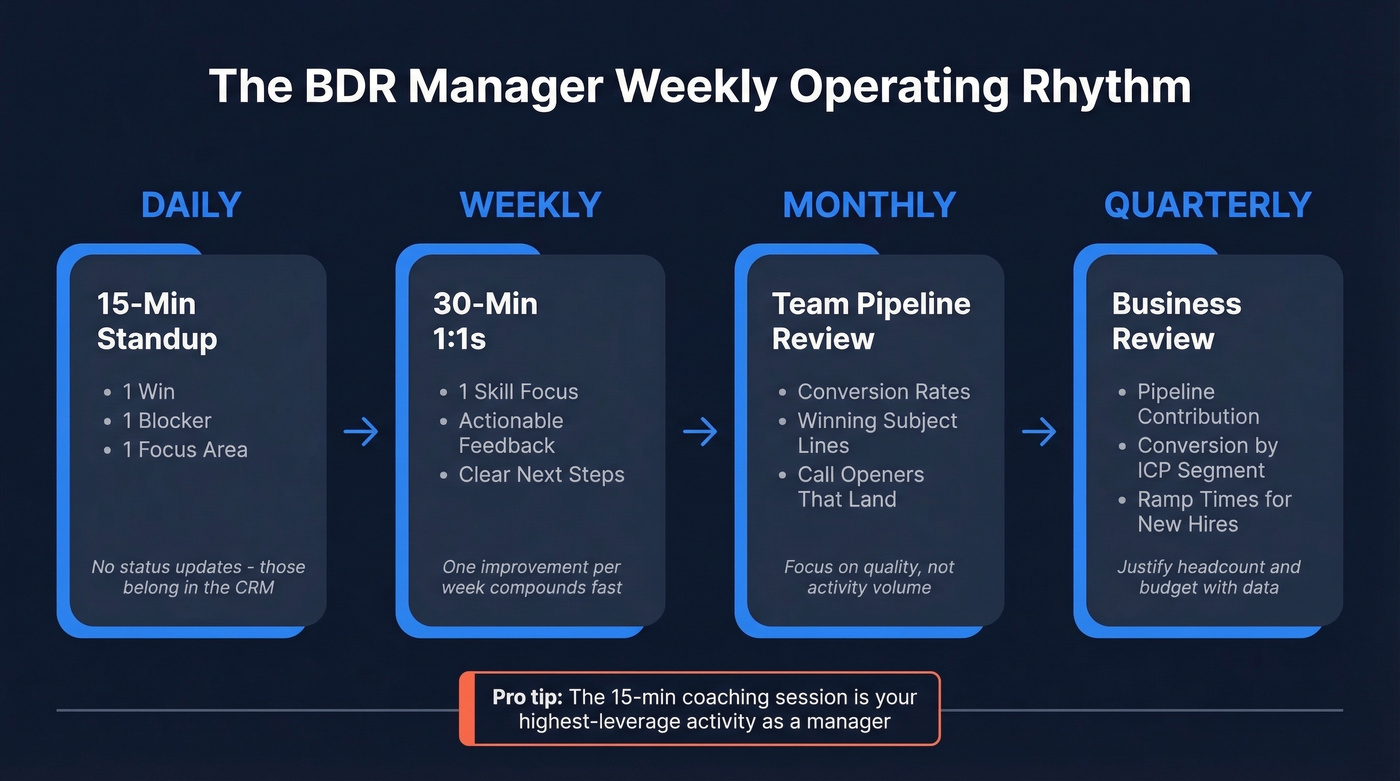
Daily: 15-minute morning standup. No status updates - those belong in the CRM. Use this for one win, one blocker, one focus area. Reps should walk away knowing exactly what their first hour looks like.
Weekly: 30-minute 1:1 with each rep. Structure it around one skill, actionable feedback, and clear next steps. Don't try to fix everything at once. A rep who improves one thing per week compounds fast.
Monthly: Team meeting focused on pipeline quality, not activity volume. Review conversion rates, not dial counts. Share what's working across the team - subject lines, call openers, objection handles that actually land.
Quarterly: Business review with leadership. Bring data: pipeline contribution, conversion rates by ICP segment, ramp times for new hires. This is where you justify headcount and budget.
The 15-minute coaching session deserves special attention. Coaching BDR teams well means focusing on one skill - maybe it's the permission-based opener, maybe it's handling the "send me an email" brush-off. Give specific, actionable feedback. Define what "better" looks like by next week. That's it.
BDR KPIs With Real Numbers
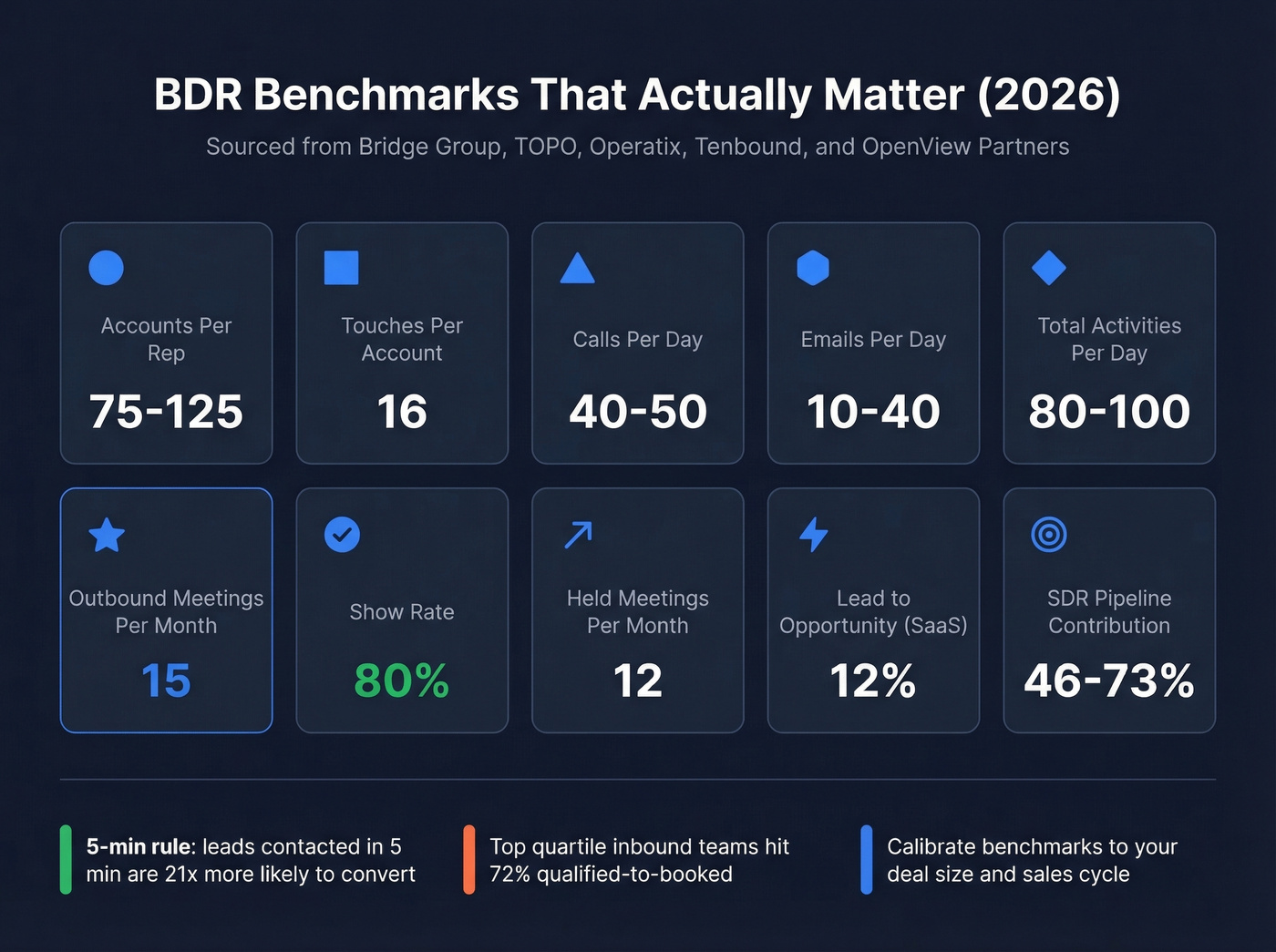
Most "KPI guides" list metrics without telling you what good looks like. Here are the benchmarks that actually matter, sourced from Bridge Group, TOPO, Operatix, Tenbound, and OpenView Partners:
| Metric | Benchmark |
|---|---|
| Accounts per rep | 75-125 |
| Touches per account | 16 |
| Calls/day | 40-50 |
| Emails/day | 10-40 |
| Total activities/day | 80-100 |
| Meetings/month (outbound) | 15 |
| Show rate | 80% |
| Held meetings/month | 12 |
| Lead-to-opportunity (SaaS) | 12% |
| SDR pipeline contribution | 46-73% |
For inbound teams, the numbers shift. A RevenueHero analysis of over one million B2B SaaS form submissions found a median qualified-to-booked rate of 62%, with top-quartile teams hitting 72% and the top 10% reaching 78%+. The five-minute rule still holds: leads contacted within five minutes are 21x more likely to convert than those contacted after thirty minutes.
These benchmarks are starting points, not gospel. A team selling six-figure enterprise deals will book fewer meetings at higher quality. A team running high-velocity SMB outbound will exceed these numbers but with lower conversion downstream. Calibrate to your deal size and sales cycle.
Building Your Effectiveness Dashboard
Four formulas every BDR manager should have on their dashboard:
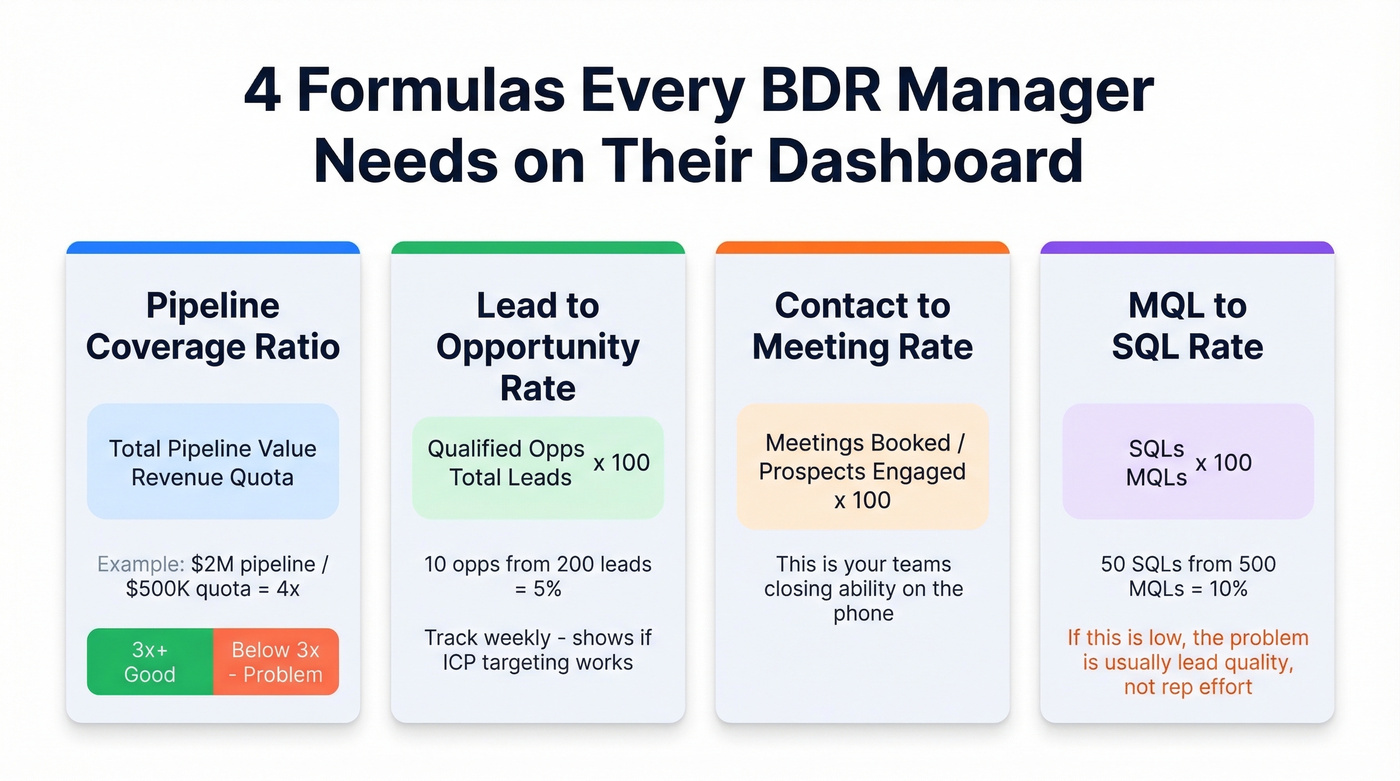
Pipeline coverage ratio = Total pipeline value / Revenue quota. If your team needs to close $500k and you've got $2M in pipeline, that's 4x coverage. Below 3x, you've got a problem.
Lead-to-opportunity rate = Qualified opportunities / Total leads x 100. Ten opportunities from 200 leads = 5%. Track this weekly - it tells you whether your ICP targeting is working.
Contact-to-meeting rate = Meetings booked / Prospects engaged x 100. This is your team's closing ability on the phone.
MQL-to-SQL rate = SQLs / MQLs x 100. Fifty SQLs from 500 MQLs = 10%. If this number is low, the problem is usually lead quality, not rep effort.
Outbound Process Design
We've seen teams run the same generic sequence to every prospect and wonder why conversion rates sit at 1%. The fix isn't more activity - it's ICP-based sequencing.
A BDR leader on r/sales who consistently hits quota described their approach: bucket cadences by ICP so emails stay relevant and easy to personalize. A fintech CFO gets a different sequence than a SaaS VP of Engineering. The messaging, pain points, and call-to-action all shift based on who you're talking to, what they care about, and what stage their company is in.
Here's what a consistently quota-hitting team's day looks like. Morning prospecting block: 60-90 minutes adding new accounts, researching prospects, building personalized first lines. Then dedicated cold-call windows - two 90-minute blocks work well. Email and other touches fill the gaps.
On calls, use a permission-based opener. Something like: "Hey, I know I'm calling out of the blue - do you have 30 seconds?" It disarms the prospect and earns you the next sentence. Only leave voicemails on the second call - the first attempt is a pure connect attempt. Keep emails short. The first line should reference something specific from the prospect's recent activity or company news. And never send outbound from your main domain. Set up a separate sending domain to protect deliverability.

You just read that activity without ICP discipline kills BDR teams. Prospeo's 30+ search filters - buyer intent, technographics, headcount growth, funding - let your reps target the right accounts before they ever pick up the phone. 98% email accuracy means fewer bounces, and your sending domains stay clean.
Stop burning your reps on bad lists. Start building pipeline that converts.
Comp Plans With Real Numbers
Compensation drives behavior. Get it wrong and you'll either burn cash on low-quality meetings or lose your best reps to companies that pay better.
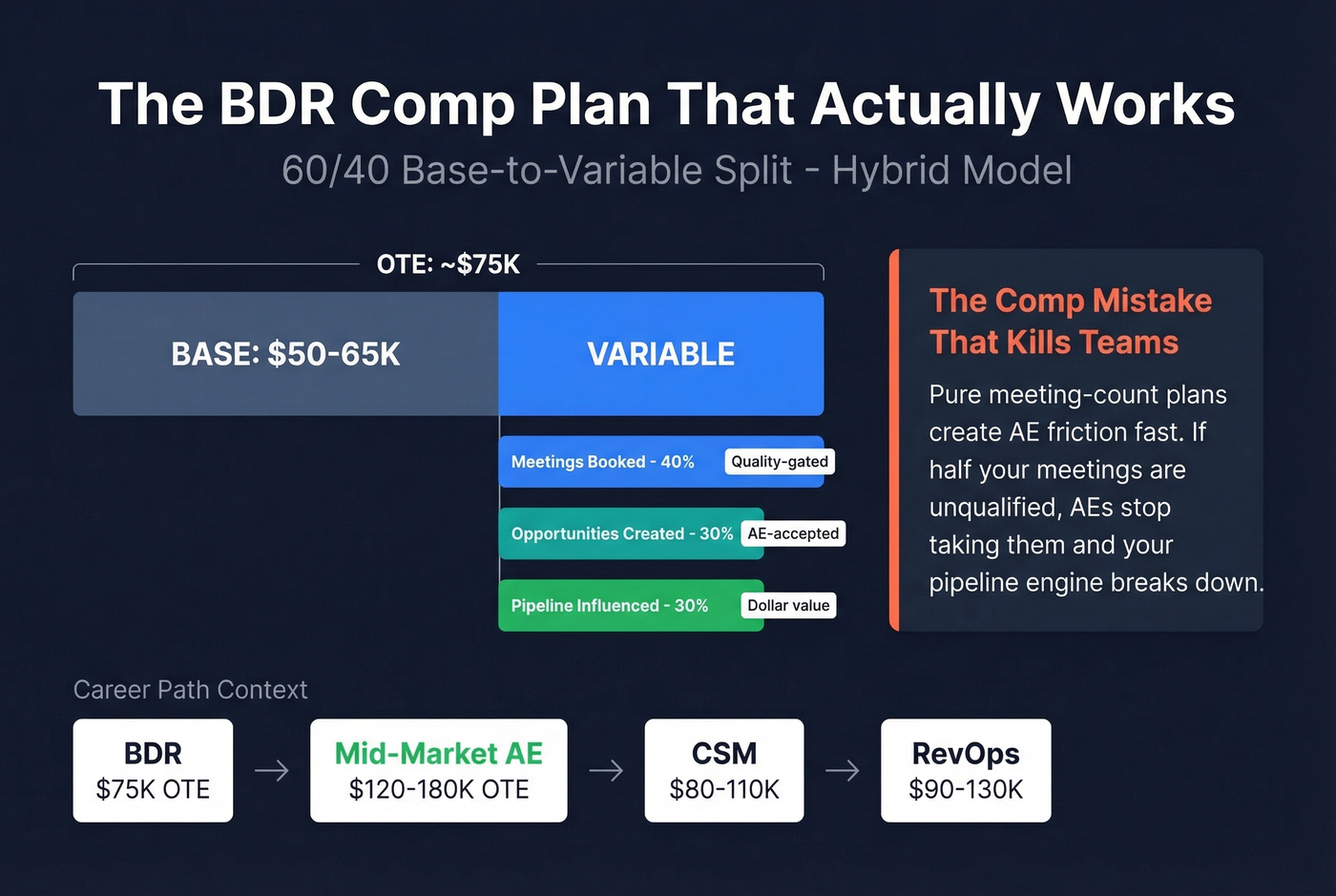
The standard split is 60% base / 40% variable. Base salary ranges for BDRs in 2026 run $50-65k across Betts Recruiting, RepVue, and Glassdoor data. Enterprise SDRs typically land around $55k base with $75k OTE.
| Component | Weight | Example |
|---|---|---|
| Meetings booked | 40% | Quality-gated |
| Opportunities created | 30% | AE-accepted |
| Pipeline influenced | 30% | Dollar value |
This hybrid model prevents the biggest comp mistake: rewarding meetings scheduled without caring whether they convert. Pure meeting-count plans create AE friction fast. Your AEs will stop taking BDR-sourced meetings if half of them are unqualified, and then your whole pipeline engine breaks down.
For career-path context:
| Role | Base | Total Comp |
|---|---|---|
| Mid-market AE | $60-80k | $120-180k OTE |
| CSM | $55-75k | $80-110k |
| RevOps | $65-85k | $90-130k |
The Tech Stack That Matters
Your engagement platform and CRM are only as good as the data flowing through them. Every BDR stack needs three layers.
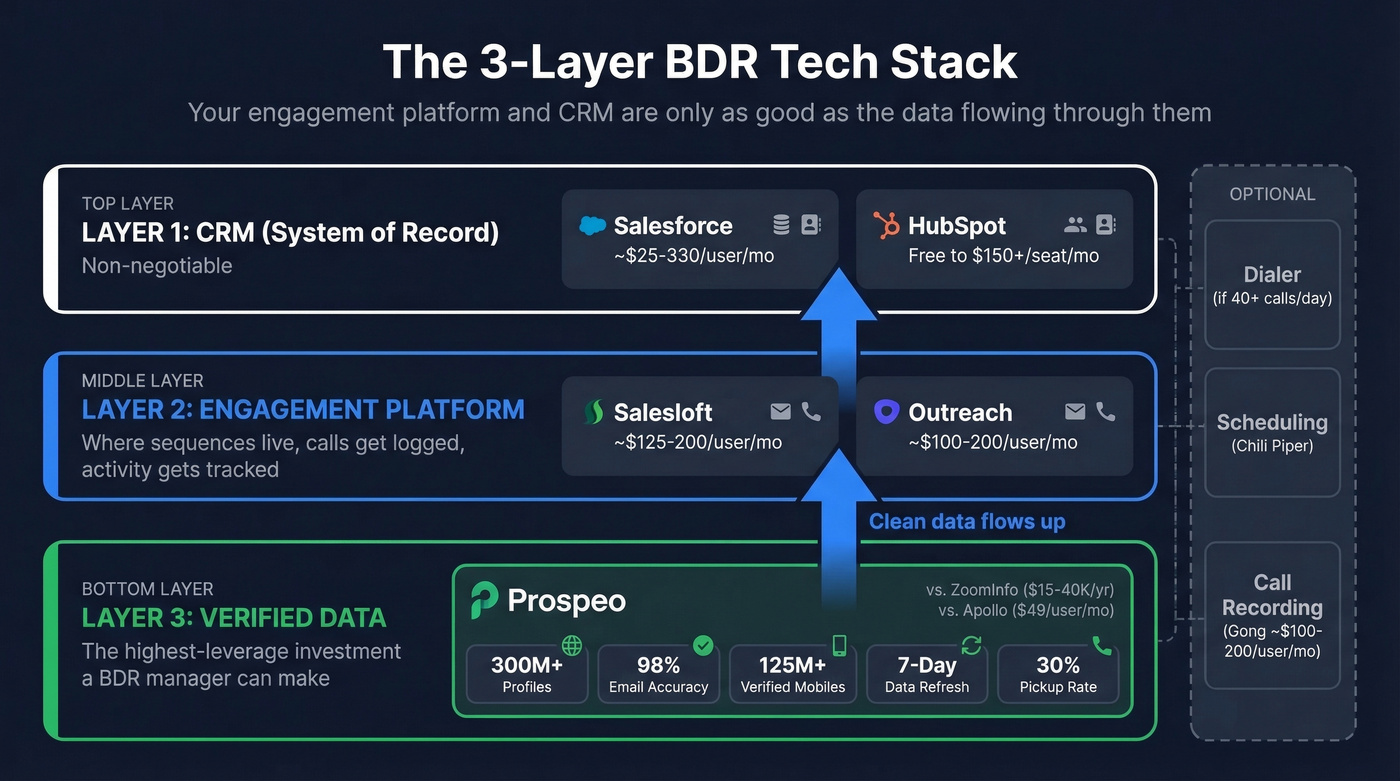
Layer 1: CRM. Salesforce (~$25-$330/user/mo depending on edition) or HubSpot (free tier available, paid Sales Hub ~$20-$150+/seat/mo). This is your system of record. Non-negotiable. (If you need a quick refresher on options, see examples of a CRM.)
Layer 2: Engagement platform. Salesloft (~$125-$200/user/mo) or Outreach (~$100-$200/user/mo). This is where sequences live, calls get logged, and activity gets tracked.
Layer 3: Verified data. This is where most teams get it wrong. They'll spend $40k/year on ZoomInfo or $49/user/month on Apollo and still have reps dialing disconnected numbers and bouncing emails. In our experience, data quality is the single highest-leverage investment a BDR manager can make - it determines whether all that activity actually reaches a human being. Prospeo covers 300M+ professional profiles with 98% email accuracy and 125M+ verified mobile numbers that hit a 30% pickup rate. The data refreshes every seven days, not the six-week industry average. It integrates natively with Salesforce, HubSpot, Salesloft, and Outreach, so your reps aren't copy-pasting between tabs. Pricing starts free: 75 emails and 100 Chrome extension credits per month, with paid plans running about $0.01 per email. No contracts, no annual commitments.

For context, one quota-hitting team's real-world stack is Salesloft + ZoomInfo + Chili Piper. Solid setup - but ZoomInfo typically runs $15-40k/year depending on seats and modules.
Optional layers: Dialer (if your engagement platform's built-in dialer isn't enough), scheduling tool like Chili Piper for inbound routing, and call recording like Gong (~$100-$200/user/mo, often sold annually) for coaching. Skip the dialer if your team runs fewer than 40 calls a day - the built-in option will be fine. If you're evaluating tooling, start with a shortlist of SDR tools.
Your BDRs need three tools that work together: CRM, engagement platform, and verified data. Prospeo covers the third with 300M+ profiles, 125M+ verified mobiles, and a 7-day data refresh cycle. Teams using Prospeo book 35% more meetings than Apollo users - that's the difference between 15 meetings/month and 20.
Give your team data that actually connects them to real buyers.
Hiring, Onboarding, and Retention
Who to Hire
Forget the "hire athletes" cliche. The three traits that predict BDR success are resilience (they'll hear "no" 50 times a day), coachability (they'll implement feedback between 1:1s), and competitive drive (they want to be on top of the leaderboard). Hire in pairs when possible - it gives you a natural A/B test for messaging, sequences, and call approaches. The average SDR:AE ratio runs about 2.6 AEs per SDR, so plan headcount accordingly.
Structured Onboarding
Look - "shadow a senior rep for a week" isn't onboarding. It's abdication.
Build a structured schedule covering three pillars: product knowledge (what you sell and why it matters), sales methodology (how your team prospects, qualifies, and hands off), and systems training (CRM hygiene, sequence setup, data tools). Week one is classroom. Week two is supervised live work. Week three is independent with daily check-ins. By week four, they should be running full cadences. We've found that teams with structured onboarding cut ramp time nearly in half compared to the "figure it out" approach, and early attrition drops dramatically. A simple way to operationalize this is a 30-60-90 day plan for new reps.
Career Pathing Beyond AE
The average BDR tenure is 14 months. That's not because the role is inherently unsustainable - it's because most companies don't give reps a visible path forward. If you don't have a clear promotion path by month 10, your best reps are already interviewing.
The standard SDR-to-AE timeline is 12-18 months, with high performers sometimes making it in 10-12. Promotion criteria should be objective: 90%+ quota attainment for two consecutive quarters. But AE isn't the only path. Customer Success (transition at 15-20 months), RevOps (18-24 months), and demand gen are all legitimate next steps. Make these paths visible from day one.
Mistakes That Kill BDR Teams
Mistaking activity for progress. Eighty calls into the wrong accounts doesn't build pipeline - it burns your brand and your reps' motivation. Activity metrics matter, but only when aimed at the right targets. This is a management failure, not a rep failure.
Comp plans that only reward meetings scheduled. When reps get paid for booking meetings regardless of quality, they'll book garbage. AEs stop trusting BDR-sourced pipeline. The whole system corrodes.
No ICP discipline. Spray-and-pray is the most expensive mistake in outbound. Every email sent to a bad-fit account is a wasted touch, a potential spam complaint, and a step toward domain reputation damage. Define your ICP tightly and enforce it. If you need a tighter system, use these sales prospecting techniques to standardize targeting and outreach.
Ignoring data quality. CRM data decays roughly 30% per year. If you aren't enriching and verifying continuously, your activity benchmarks are meaningless - reps are dialing dead numbers and bouncing emails into the void. At $0.01 per email with a 7-day refresh cycle, there's no excuse for making your team work stale lists.
No career path. That 14-month average tenure stat isn't an inevitability - it's a management indictment. Reps who can see their next role stay longer, work harder, and produce more. Build the ladder before you lose the people who'd climb it.
Leading BDRs Through Slumps
Even the best reps hit rough patches. When someone's numbers dip, resist the urge to pile on more activity targets. Diagnose the root cause first: is it data quality, messaging fatigue, or a confidence issue?
Showing up for your reps during slumps - sitting in on calls, co-building sequences, or simply acknowledging the grind - goes further than any Slack message ever will. I've watched managers turn around struggling reps in two weeks just by spending an hour a day in the trenches with them. The managers who retain top talent are the ones who show up when numbers are down, not just when the team is celebrating.
FAQ
How many BDRs should one manager oversee?
Six to eight is the standard span of control. Beyond eight direct reports, coaching quality drops measurably - you can't run meaningful weekly 1:1s and listen to enough calls to develop each rep. If you're managing more than eight, push for a team lead or second manager.
What's a good meeting-to-opportunity conversion rate?
TOPO data shows 58% of SDR-qualified leads become opportunities. Aim for 50% as a floor. Below that, the issue is usually qualification criteria - your reps are booking meetings that don't meet the threshold for a real opportunity.
Should I separate inbound and outbound BDRs?
Yes, once you hit four or more reps. Inbound reps optimize for speed-to-lead and qualification accuracy. Outbound reps optimize for prospecting volume and personalized multi-channel sequences. The skills, metrics, and cadences differ enough to warrant specialization.
How do I prevent BDR burnout?
Set realistic activity targets tied to ICP-qualified accounts, not raw dial counts. Protect morning prospecting blocks from meetings. Keep data clean so reps aren't wasting effort on dead contacts. Coach on skill development, not just output. And honestly? Give them a Friday afternoon off once a quarter when they've earned it. Small gestures compound.
What tools do BDR teams actually need?
Three essentials: a CRM (Salesforce or HubSpot), an engagement platform (Salesloft or Outreach), and a verified data provider for accurate emails and direct dials. Everything else - dialers, scheduling tools, call recording - is optional until those three work together seamlessly.