

The Manufacturing Buying Journey: Why 86% of Deals Stall (and How to Fix It)
A "qualified" manufacturing opportunity hits late-stage. The plant team likes you, the engineer's asked for CAD/BIM, procurement's requested an RFQ, and finance wants a payback model. Then - nothing. Weeks pass. The deal quietly dies.
That's not a fluke. In complex sales, 40% of qualified opportunities end in "no decision" - not lost to a competitor, just stuck until the initiative evaporates. Forrester's benchmark puts it even sharper: 86% of purchases stall somewhere in the journey.
Manufacturing is where this hurts most because the buying committee is bigger, the risk is higher, and implementation touches real operations. Let's break down how industrial buyer behavior actually works, stage by stage, and what you can do about it.
The Short Version
Manufacturing buying is now buyer-led, digitally self-served, and committee-driven. Most manufacturers lose not to competitors but to "no decision" because they don't enable internal consensus across 6-13 stakeholders. The three highest-impact fixes: publish pricing guidance, create persona-specific content for every stage, and verify your contact data before every outreach campaign.
2026 Manufacturing Buying Data
Manufacturing buyers aren't "hard to reach." They're hard to align.
They do most of the work without you, then pull you in late for validation, risk reduction, and commercial terms. The best manufacturing teams obsess less over "lead gen" and more over buyer enablement - making it easy for the committee to agree. Here are the numbers that matter:
- Sales cycles dropped from 11.3 months (2024) to 10.1 months (2025) as economic pressure pushed 49% of buyers to shorten buying cycles and 62% to engage sellers earlier.
- Buyers define requirements 83% of the time before talking to sales.
- 94% use LLMs during the buying process, but engineers remain skeptical when it comes to using AI to evaluate vendors.
- 61% prefer a rep-free buying experience.
- Only 17% of the journey is spent with vendors.
- The outcome is still messy: 81% end up dissatisfied with the provider they chose.
If buyers spend just 17% of their time with vendors, your website, spec pages, documentation, and pricing guidance are doing most of the selling. Every buyer survey confirms the same pattern: buyers want self-serve resources, not gated demos.
LLMs accelerate early research, but they also increase "option overload." More information doesn't create more confidence - it creates FOMU (Fear of Messing Up). Engineers are even more skeptical of AI-generated vendor content, with trust sitting at just 4.4 out of 10.
Five Stages of the Industrial Buying Journey
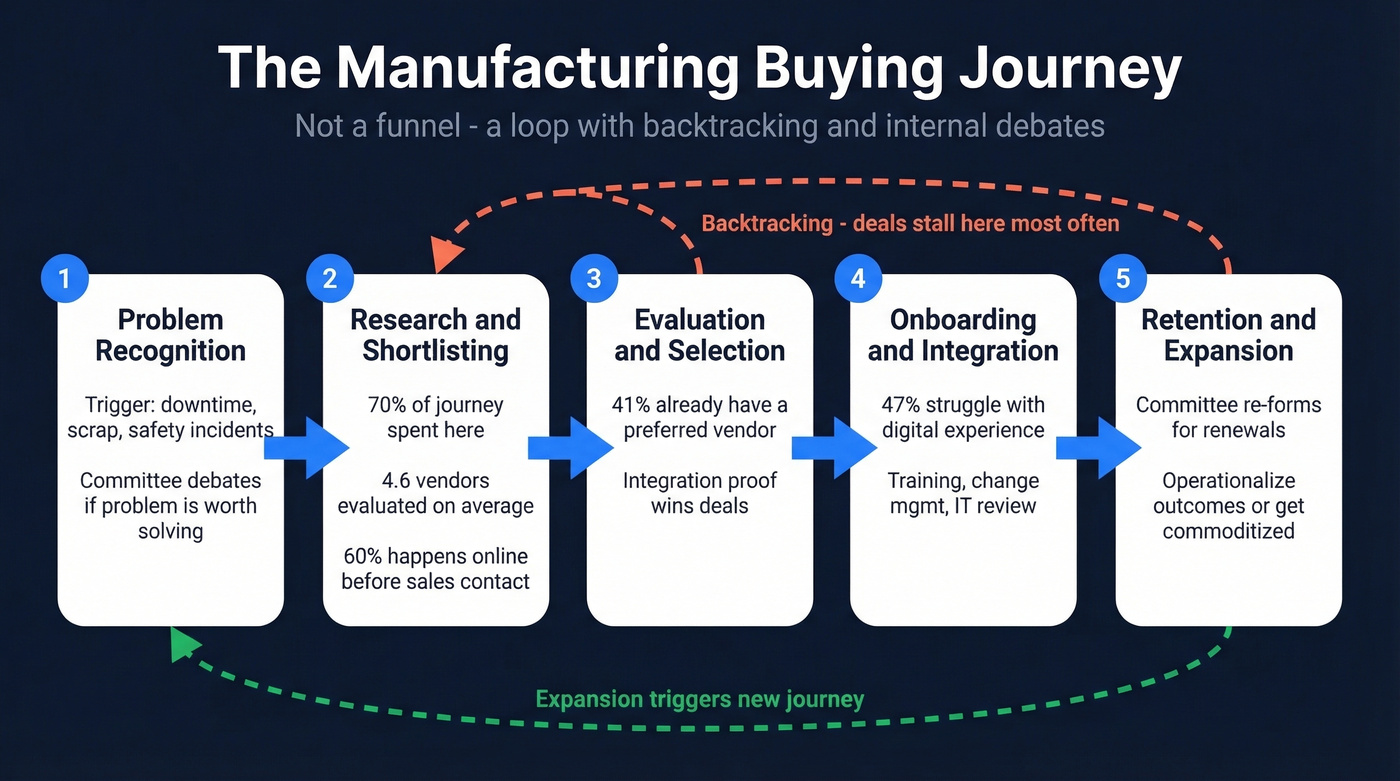
Most teams describe the journey like a neat funnel. It's not. It's a loop with backtracking, internal debates, and "we'll revisit next quarter" purgatory. Still, a five-stage model forces you to publish the right assets at the right time - and reveals where intent data can signal which accounts are actively in-market.
Stage 1: Problem Recognition
This stage starts with a trigger: downtime, scrap, safety incidents, capacity constraints, or an ERP/CRM/CPQ change that breaks a workflow. Buyers are framing the problem and building internal urgency.
The big miss here is talking about your product before the committee has agreed on the cost of the problem. Manufacturing buyers want a clear "why now" narrative tied to uptime, yield, compliance, or TCO. This is where the seller-buyer disconnect begins - vendors pitch solutions while the committee is still debating whether the problem is worth solving.
Stage 2: Research & Shortlisting
This is where the journey really happens. Buyers spend about 70% of the journey identifying a shortlist and favored vendor, and the average buying team evaluates 4.6 vendors before narrowing down. In industrial buying, 60% of the process happens online before engineers engage sales.
You're not competing against other vendors yet. You're competing against internal inertia and "good enough." Your job is to make the shortlist easy: clear specs, clear use cases, clear constraints. A pipeline analysis will almost always show that deals stall here, not at close.
Stage 3: Evaluation & Selection
By the time evaluation starts, the game is partially decided. 41% of buyers have a preferred vendor before formal evaluation even begins.
Manufacturing-specific proof wins here: test programs, reference architectures, implementation plans, and risk controls. If you can't show how you'll integrate with ERP, MES, SCADA, or existing maintenance workflows, you'll lose to "no decision" even if you're the best product. Delivering tailored ROI models for finance and integration specs for engineering is what separates winners from also-rans.
Stage 4: Onboarding & Integration
Implementation is part of the buying journey now, not "post-sale." Manufacturing buyers evaluate you on how painful onboarding will be: training time, change management, IT/security review, and whether the plant will actually adopt.
This is also where servitization shows up - manufacturers are investing in portals for documentation, order management, and predictive maintenance scheduling, yet 47% still struggle to deliver seamless digital customer experiences. The gap between buyer expectations and actual onboarding reality is where churn begins.
Stage 5: Retention & Expansion
The stage most vendors ignore, and the one where expansion is won. The committee that bought you will re-form for renewals, line expansions, and plant rollouts.
If you don't operationalize outcomes - uptime improvements, scrap reduction, safety compliance, payback - you'll get commoditized at renewal. Post-purchase content should look like enablement: training, QBRs, SLA dashboards, and "what great looks like" benchmarks. Email sequences tied to adoption milestones keep the relationship warm and surface expansion signals early.
Who's in the Room: The Buying Committee
Manufacturing buying committees are bigger than most sellers plan for. The average B2B purchase involves 13 stakeholders, and Gartner's benchmark is 6-10 decision makers, each bringing 4-5 pieces of research into internal discussions.
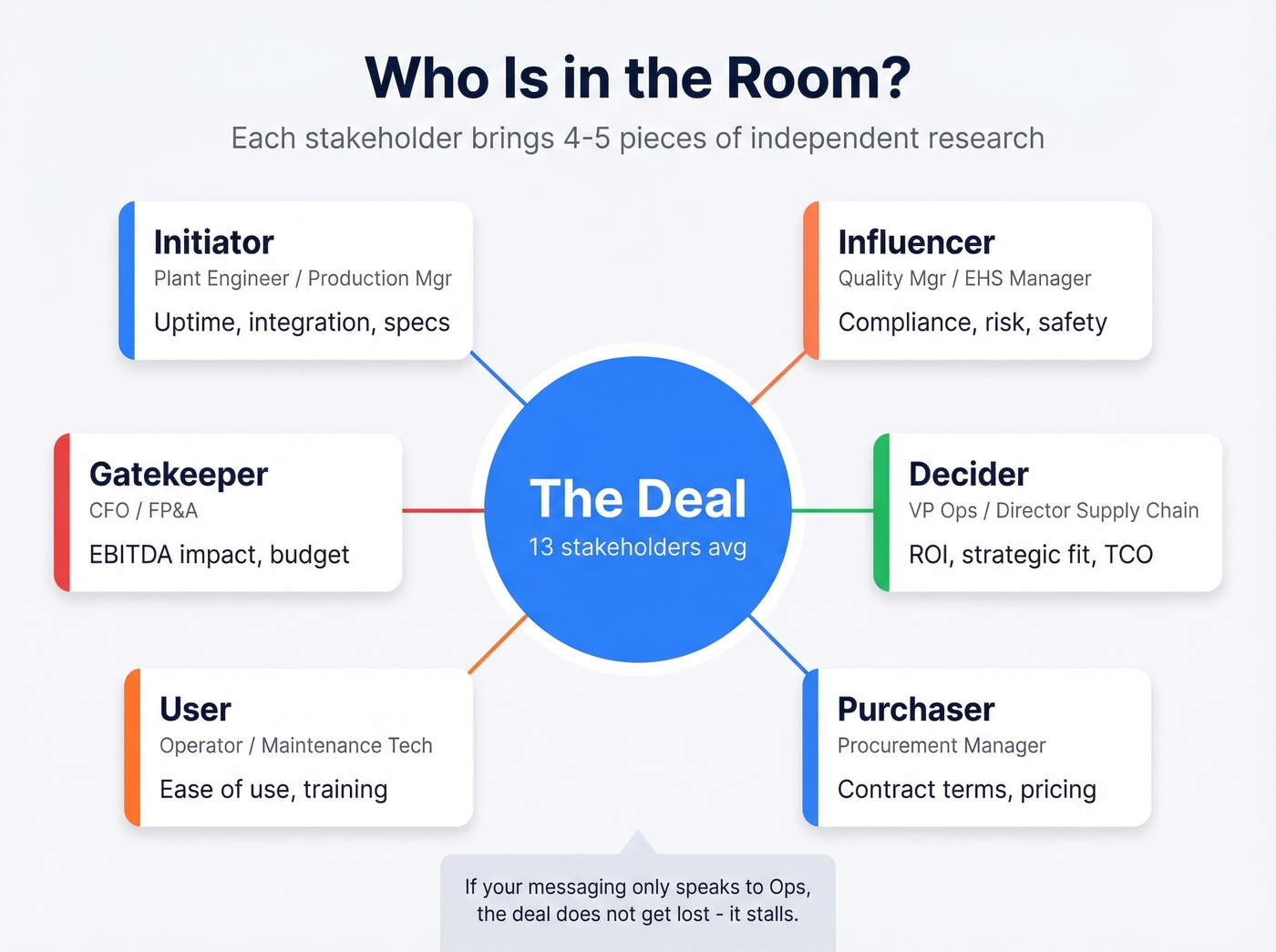
That's the real battleground: internal consensus, not your demo.
| Role | Typical Title | Primary Concern |
|---|---|---|
| Initiator | Plant Engineer / Production Mgr | Uptime, integration, specs |
| Influencer | Quality Mgr / EHS Manager | Compliance, risk, safety |
| Decider | VP Ops / Director Supply Chain | ROI, strategic fit, TCO |
| Purchaser | Procurement Manager | Contract terms, pricing |
| User | Operator / Maintenance Tech | Ease of use, training |
| Gatekeeper | CFO / FP&A | EBITDA impact, budget |
The persona split is straightforward: Ops cares about uptime and integration, Safety cares about risk, Procurement cares about continuity and contract lifecycle, Finance cares about EBITDA and TCO. If your messaging only speaks to Ops, the deal doesn't get "lost" - it stalls. Knowing the roles is step one; finding verified contact data for each is step two, and that's where most teams fall apart.
Why Manufacturing Deals Stall
Here's the thing most guides miss: cycles aren't getting longer, they're getting stuck.
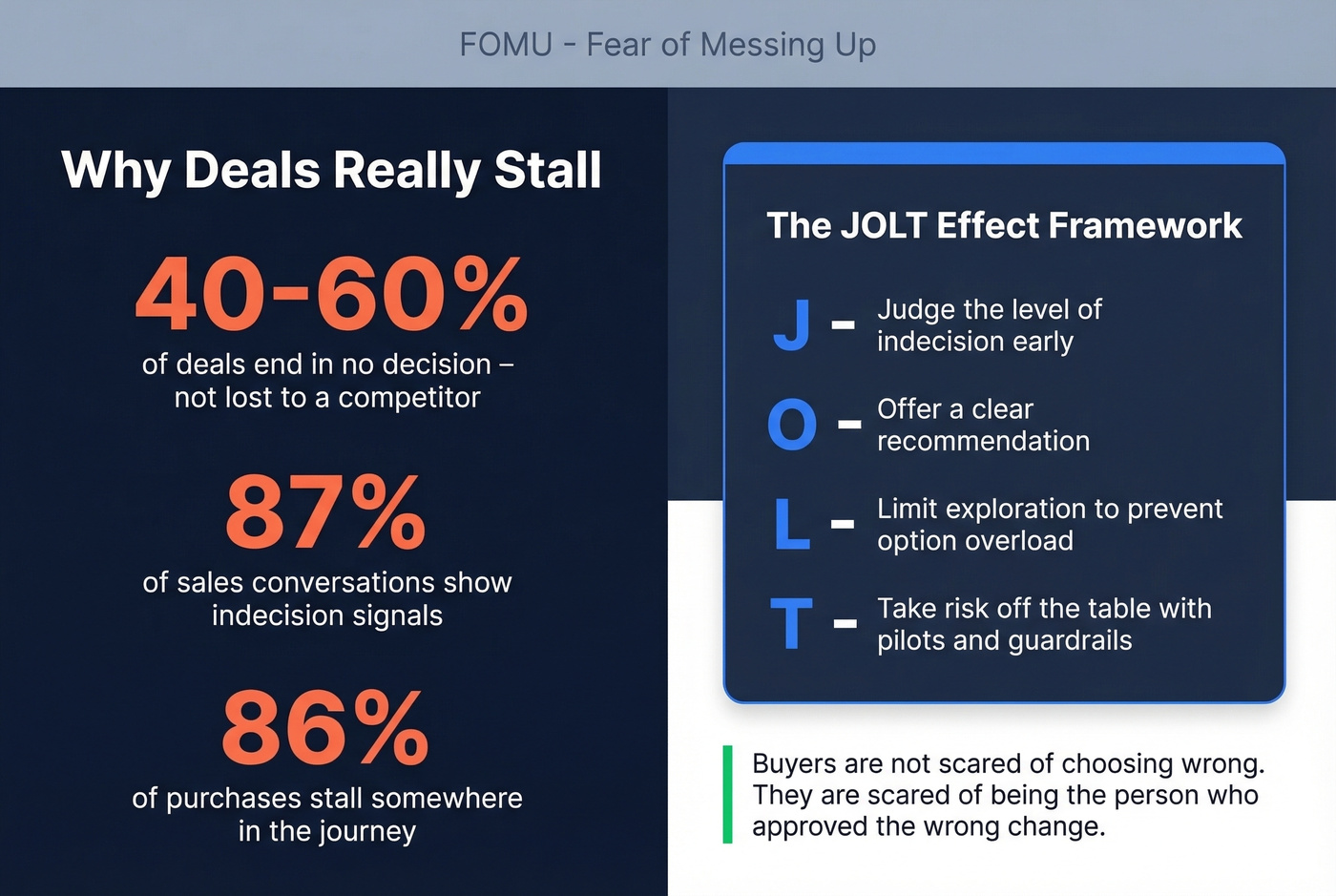
In complex sales, 40-60% of deals end in no decision, and 87% of sales conversations show indecision signals. Manufacturing amplifies this because the perceived blast radius is huge: downtime, safety exposure, quality escapes, missed ship dates. Sellers think they lost on features, but the committee simply couldn't reach consensus.
This is FOMU - Fear of Messing Up. Buyers aren't scared of choosing the wrong vendor; they're scared of being the person who approved the wrong change.
The fix isn't "more follow-ups." It's reducing decision friction. Two frameworks help:
Friction Gap: Buyers want a low-friction, information-symmetric path. Sellers still run high-friction motions built for one persona. When the path feels hard, committees default to delay.
JOLT Effect: Judge indecision, Offer a recommendation, Limit exploration, Take risk off the table. In manufacturing, "take risk off" looks like pilots, acceptance criteria, implementation timelines, and commercial guardrails.
We've seen bake-offs where the best technical solution lost because nobody could explain implementation risk in plain language to finance and EHS. The committee didn't pick a competitor - they picked "not now." Manufacturing buyers describe the same frustration from the other side: they've done 80% of the work, and the vendor's first call is a discovery session that asks questions already answered on the website. That mismatch alone can kill momentum.

86% of manufacturing deals stall because sellers can't reach the full buying committee. Prospeo gives you 98% accurate emails and 125M+ verified mobile numbers across all 6-13 stakeholders - from plant engineers to CFOs. With 30+ filters including job title, department, and company size, you build the complete committee map in minutes, not weeks.
Stop losing deals to "no decision" - reach every stakeholder directly.
How Technical Buyers Research
Engineers and technical stakeholders do deep research, but they're picky about where they trust information.
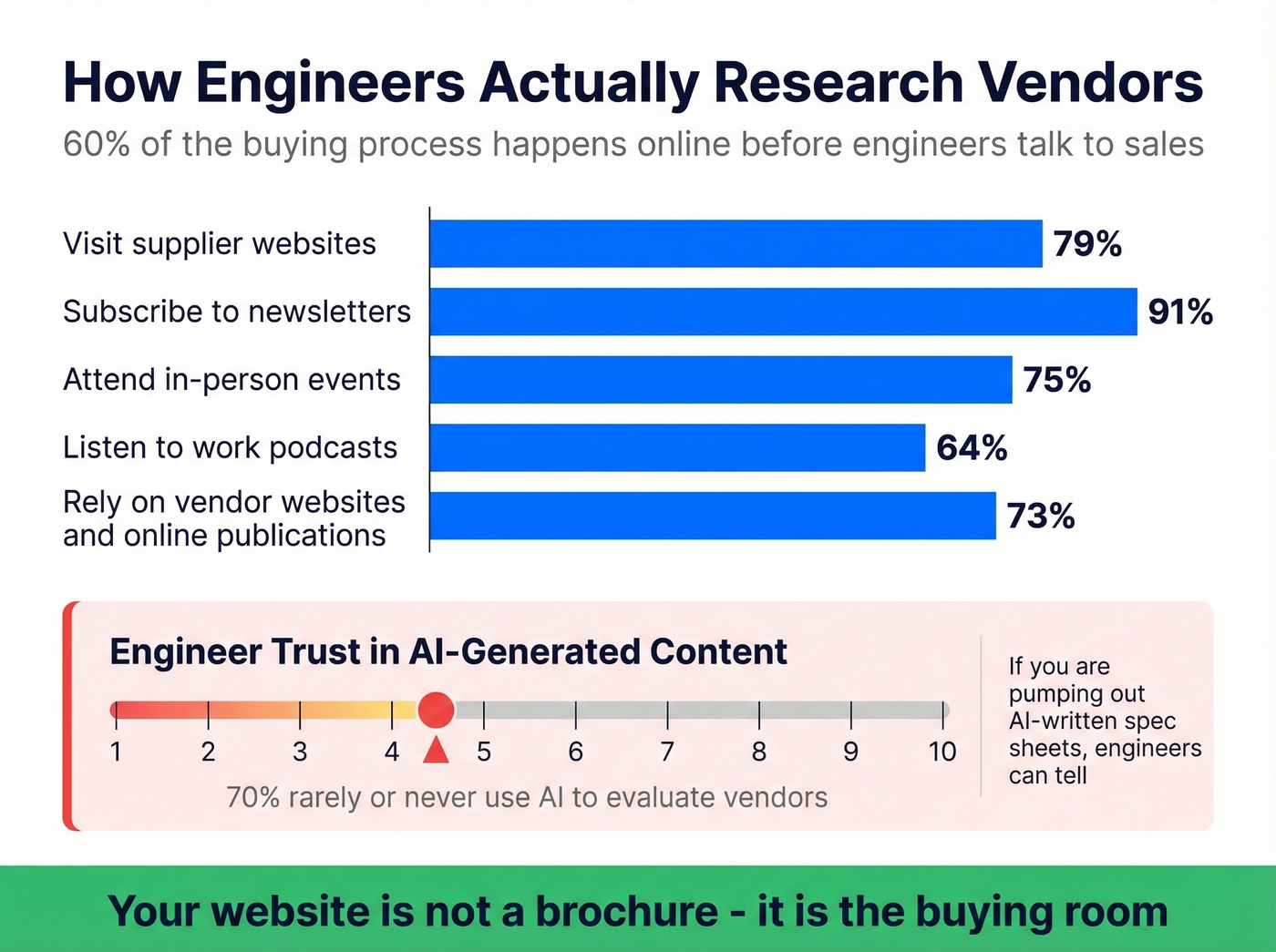
Per TREW Marketing / GlobalSpec's 2026 research, 60% of the buying process happens online before engineers engage sales, and 73% rely on vendor websites and online technical publications. Your spec sheets, application notes, and documentation are your first sales call.
The nuance most teams miss: LLM usage is high in buying overall, but engineers are skeptical about AI-generated evaluation content. 70% rarely or never use AI to evaluate vendors, and trust in AI-generated content sits at 4.4 out of 10. If you're pumping out AI-written spec sheets, engineers can tell - and they'll discount everything else you publish.
Engineers still rely on traditional channels, too. 91% subscribe to newsletters, 75% attend at least one in-person industry event, and 64% listen to work-related podcasts. And per Gartner's B2B buying research, 79% visit supplier websites at every stage of the journey. Your website isn't a brochure - it's the buying room.
Content Strategy by Journey Stage
If your content plan is "30 blog posts, 12 leads," it's because everything is top-of-funnel. You're publishing problem-awareness content while your buyers are begging for mid-funnel and bottom-funnel assets: specs, pricing guidance, implementation plans, and risk controls.
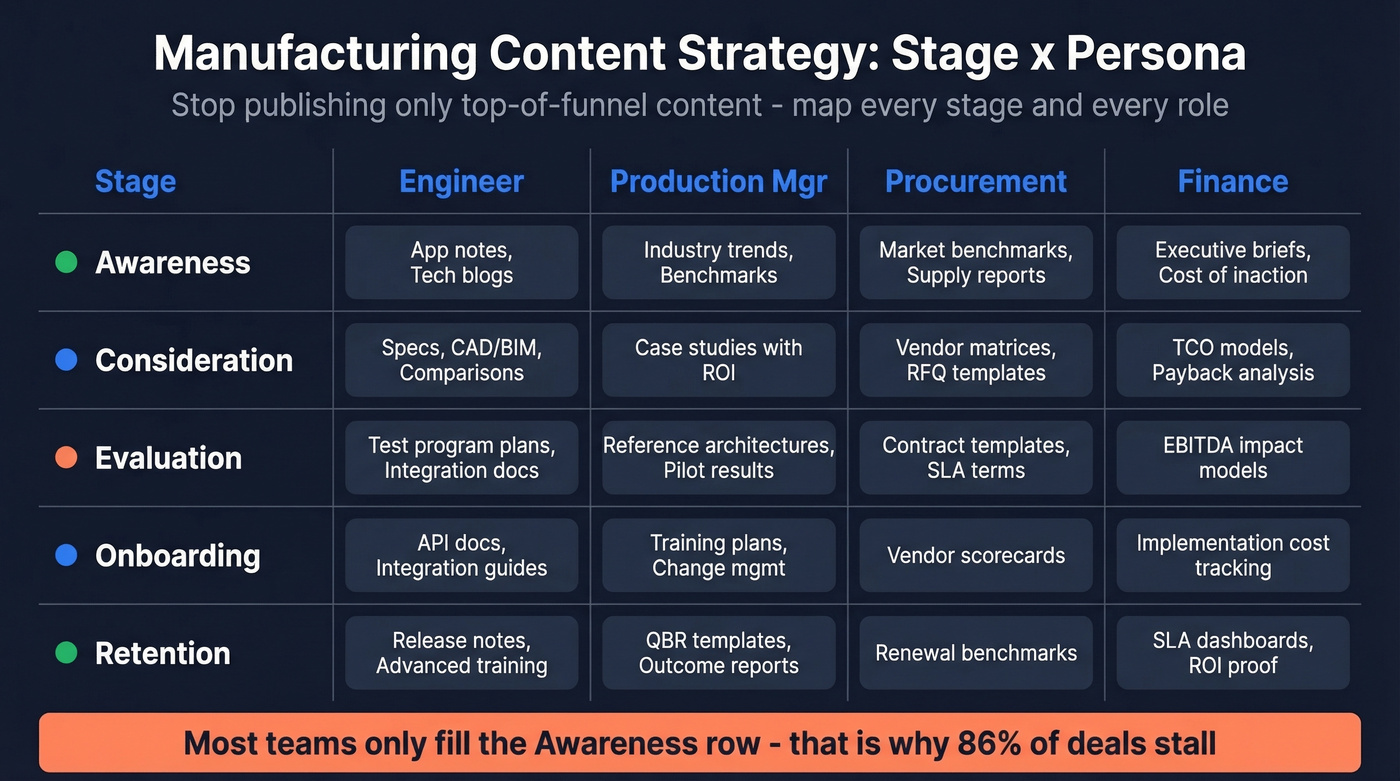
A manufacturing content strategy maps stage + persona. Engineers need CAD/BIM and spec sheets. Production wants ROI and timelines. Procurement wants vendor reliability and contract clarity. Finance wants TCO and payback.
| Stage | Engineer | Production Mgr | Procurement | Finance |
|---|---|---|---|---|
| Awareness | App notes, tech blogs | Industry trends | Market benchmarks | Executive briefs |
| Consideration | Specs, CAD/BIM, comparisons | Case studies w/ ROI | Vendor matrices | TCO models |
| Decision | Demos, trial programs | Implementation plans | Pricing guides | ROI calculators |
| Post-Purchase | API docs, tech docs | Training, onboarding | SLA dashboards | QBRs |
One opinionated rule: if you won't publish a pricing range, at least publish a pricing model. "We price by line/plant/seat/throughput" is enough to keep the deal moving. Content marketing costs 62% less than traditional outbound and generates up to 3x the leads - but only when you're publishing what the committee actually needs at each stage, not just awareness content. Interactive ROI calculators and configurable spec sheets outperform static PDFs every time.
A Note on Deal Size
Most manufacturing teams don't have a sales problem. They have a vendor evaluation problem.
If your average contract value is under $50K, you probably don't need a 13-person buying committee playbook. You need a website that answers every question procurement and engineering will ask, a pricing page that doesn't require a phone call, and fast quotes. The complex committee orchestration advice in this guide is for six- and seven-figure deals where "no decision" is the real competitor. Know which game you're playing - an SMB purchase looks nothing like a multi-plant capital expenditure decision.
Six Mistakes That Kill Deals
Slow Quotes
Speed-to-quote is a competitive weapon. 50% choose the vendor that responds first, and engagement jumps 9x when you respond within 5 minutes. If your RFQ/RFP process requires three internal handoffs before a buyer gets anything useful, you're training them to keep shopping. CPQ tools, auto-generated proposals, and instant pricing APIs eliminate the bottleneck.
No Follow-Up Strategy
Manufacturing deals don't close on one touch. 48% of sellers never follow up after the first contact, yet 80% of sales require 5+ follow-ups. Build a standard 6-8 touch cadence tied to buyer tasks - spec validation, stakeholder intro, commercial review - not "just checking in." If you need a starting point, use proven follow-up templates and adapt them to each persona. Each touchpoint should deliver value mapped to where the committee is in the cycle.
Selling to One Stakeholder
The classic stall pattern: one champion, one thread, one plant contact. But the buying reality is 6-10 decision makers, and the average purchase involves 13 stakeholders. If you don't multi-thread across Ops, Quality, EHS, Procurement, and Finance, you're leaving veto power untouched.
Hiding Your Pricing
Pricing opacity is a deal killer. 69% cite lack of transparent pricing as a frustration, and buyers see inconsistencies between vendor websites and what sellers say. You don't need a checkout cart. You need pricing guidance that lets procurement and finance model the decision without a hostage negotiation.
Leading with Features, Not Outcomes
Feature-first selling creates "random acts of sales." Manufacturing buyers buy outcomes: uptime, scrap reduction, compliance, throughput, labor efficiency, predictable maintenance. Lead with the metric they'll report to their VP, not the spec they'll forget by next week.
Prospecting with Stale Data
73% of B2B buyers actively avoid suppliers who send irrelevant outreach. When your contact data is months old, you're emailing people who've changed roles, left the company, or moved to a different plant. Every bounced email and wrong-number call erodes your sender reputation and your credibility with the account. Before your SDRs pick up the phone, verify the data - tools like Prospeo run on a 7-day data refresh cycle compared to the 6-week industry average, so you're not burning call blocks on dead numbers.
Reaching the Right Stakeholders
The multi-threading problem is painfully simple: you get one contact, and you've got no clean way to find the other 5-9 people who can approve or block the deal. Most teams resort to guessing at email formats, scrolling through professional profiles, or asking their one champion to "loop in" colleagues - which rarely happens with urgency. Then the initiative dies in an internal meeting you weren't in.
In our experience, the pattern is consistent across manufacturing accounts: the vendor who mapped the full committee and sent relevant, role-specific content to each stakeholder won the deal. The vendor who kept emailing one plant engineer lost to "no decision." Matching your outreach to where each stakeholder sits in their own evaluation is what turns a single thread into a closed deal.
For the actual contact discovery, we've found that searching by company, filtering by job title and department, and pulling verified emails at 98% accuracy plus mobile numbers makes multi-threading practical instead of theoretical. If you're building this motion, borrow a few modern sales prospecting techniques to standardize list building and routing. Layer in intent data across 15,000 topics to prioritize accounts that are actively in-market, and you're not just reaching the committee - you're reaching them at the right time. One proof point worth noting: Snyk took bounce rates from 35-40% to under 5% after switching to verified data, and their AE-sourced pipeline jumped 180%.
FAQ
How long is a typical manufacturing sales cycle?
For complex manufacturing solutions, expect 10-12 months. The broader B2B benchmark dropped from 11.3 to 10.1 months as economic pressure pushed buyers to engage sellers earlier, but "stuck" deals still dominate. Analyzing your own pipeline will reveal where time is actually spent - and it's rarely in the stages you'd expect.
How many stakeholders approve a manufacturing purchase?
Most manufacturing purchases involve 6-13 stakeholders. Each brings 4-5 independent research sources into internal alignment discussions. Multi-threading across all of them isn't optional.
Why do manufacturing deals end in "no decision"?
The committee can't align and the perceived risk feels too high. 40-60% of complex deals stall due to FOMU, not competitive loss. The fix is reducing risk and simplifying consensus - pilot programs, implementation guarantees, and role-specific ROI models.
How do you find contacts for a manufacturing buying committee?
Use a B2B data platform to search by company, filter by job title and department, then export verified emails and mobile numbers for every stakeholder. With 30+ search filters and 98% email accuracy, you can map the full committee - Ops, Quality, EHS, Procurement, and Finance - without guessing at email formats.
Manufacturing buyers define requirements 83% of the time before talking to sales. By the time you engage, your contact data is already stale. Prospeo refreshes every 7 days - not the 6-week industry average - so your outreach hits verified inboxes at the moment intent signals fire, not weeks after the committee has moved on.
Deals move fast when your data is 7 days fresh, not 6 weeks old.