

Market Outreach: Strategy, Benchmarks, and Tools for 2026
You sent 1,000 emails. 347 bounced. 12 replied - 8 said "remove me." Your boss asks what happened. The answer isn't your copy, your subject lines, or your timing. It's your data. Market outreach in 2026 lives or dies on the quality of your contact list, and most teams learn that the expensive way.
What Is Market Outreach?
Market outreach is any proactive effort to connect with people outside your organization to drive a business outcome. That's broader than most guides make it sound - the typical advice focuses narrowly on influencer outreach, which covers maybe 20% of the picture.
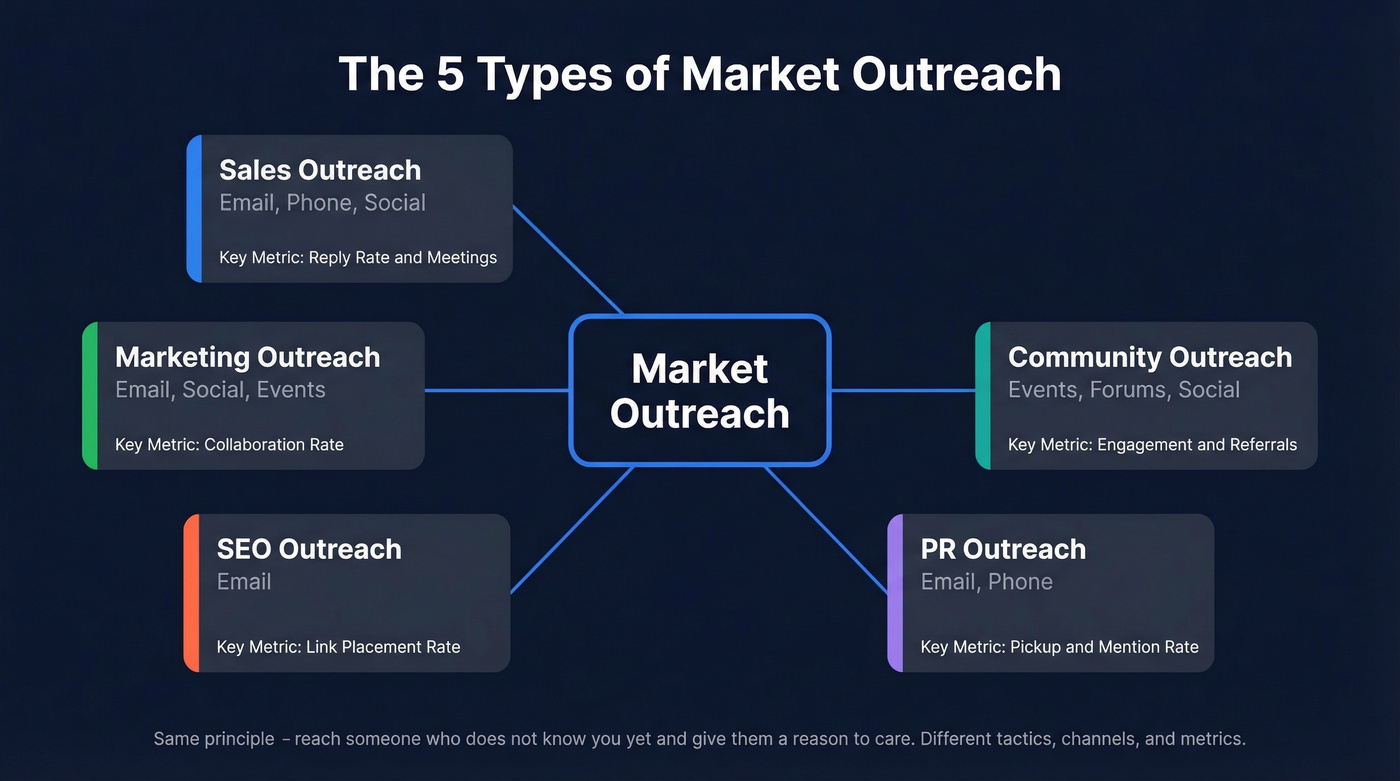
In practice, it spans five disciplines: sales prospecting through cold email, cold calling, and social selling; marketing outreach via influencer partnerships and co-marketing; SEO outreach including link building and guest posting; PR outreach covering media pitches and analyst relations; and community outreach through events, partnerships, and ecosystem plays. The principles overlap - you're reaching someone who doesn't know you yet and giving them a reason to care. The tactics, channels, and metrics differ significantly.
Sales outreach and outreach marketing are complementary but different functions. Confusing them leads to misaligned KPIs and wasted effort.
What You Need (Quick Version)
- Channel matters. LinkedIn outreach delivers 2x the response rate of cold email in 2026. Most teams underinvest in it.
- Fix your data first. About 20% of cold emails get flagged as spam. Bounce rates above 35% happen with stale lists - and they'll burn your sending domain.
- The ROI math works. Even at a 5% reply rate, a well-targeted campaign can return roughly 40x your investment. We break down the formula below.
Types of Outreach by Function
| Type | Goal | Primary Channel | Key Metric |
|---|---|---|---|
| Sales | Pipeline & revenue | Email, phone, social | Reply rate, meetings |
| Marketing | Partnerships & reach | Email, social, events | Collaboration rate |
| SEO | Backlinks & authority | Link placement rate | |
| PR | Media coverage | Email, phone | Pickup/mention rate |
| Community | Ecosystem presence | Events, forums, social | Engagement, referrals |
For marketing outreach specifically, influencer selection deserves more nuance than most teams give it. Engagement rate matters more than follower count - a micro-influencer with 8,000 engaged followers will outperform a 200K-follower account with 0.3% engagement in most cases. Vet for content relevance and audience overlap before reaching out.
SEO outreach also gets misunderstood. It's not just "link building." Good SEO outreach means evaluating donor sites carefully - organic traffic share should be 40% or higher, you should check indexation via the site: operator, and you need to screen for unnatural traffic spikes over 12-24 months. The relationship-driven approach separates real outreach from automated link schemes.
2026 Benchmarks by Channel
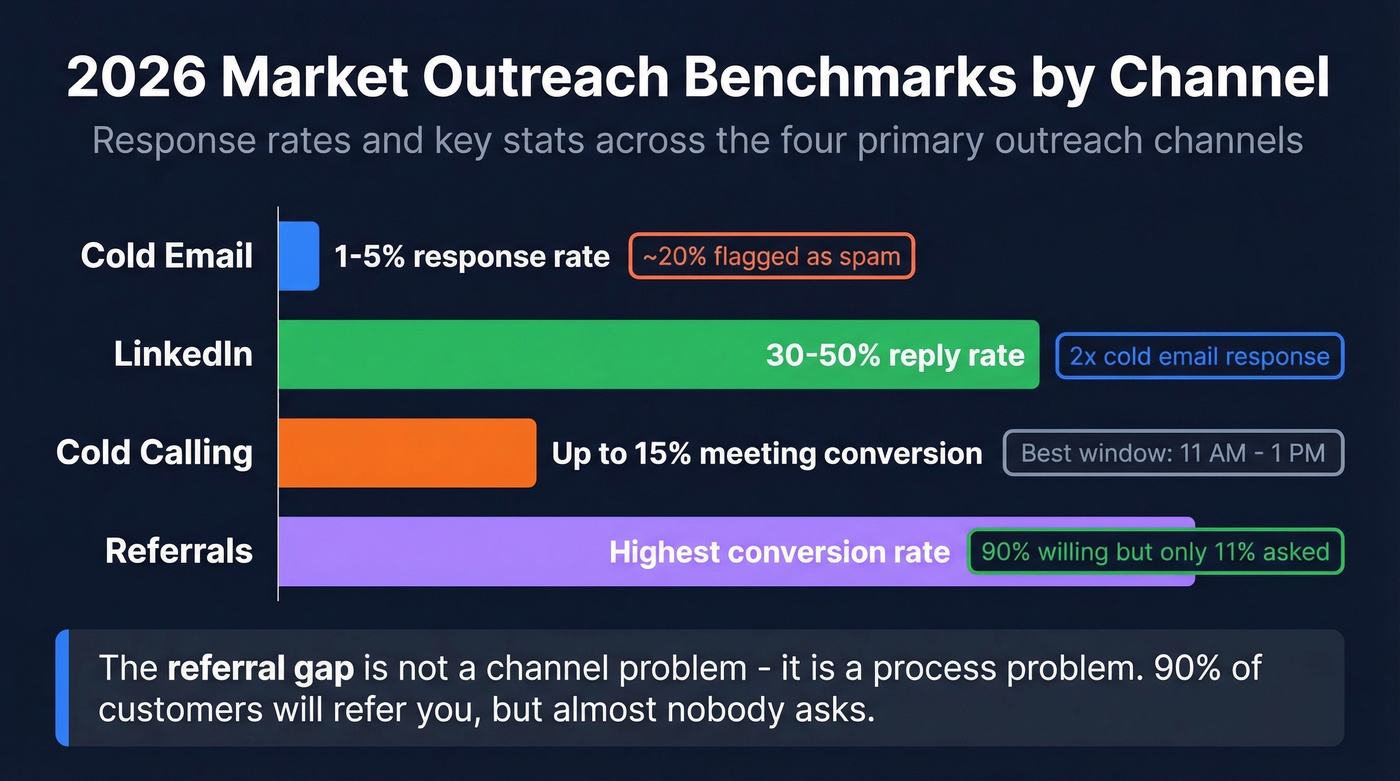
Here's what good looks like right now, based on data from SoPro's analysis of 151 million outreach points and LeadLoft's LinkedIn benchmarks:
| Channel | Response Rate | Key Stat | Notes |
|---|---|---|---|
| [Cold email | 1-5%](https://www.gmass.co/blog/average-cold-email-response-rate/) (avg 5.1%) | ~20% flagged as spam | Personalization doubles rates |
| 30-50% reply | 30-45% connection accept | 2x cold email response | |
| Cold calling | Up to 15% meeting conv. | Best: 11:00 AM-1:00 PM | Top performers only |
| Referrals | Highest conversion | 90% willing, 11% asked | Most underused channel |
LinkedIn's reply rates look dramatically higher than email, and they are - but they're harder to scale. You can send 500 cold emails in an afternoon. You can't send 500 personalized LinkedIn messages without getting restricted.
The referral stat should haunt every sales leader. More than 90% of customers are willing to give referrals, but only 11% of salespeople bother to ask. That's not a channel problem. It's a process problem.
Cold calling isn't dead, but the 15% meeting conversion rate only applies to top performers who've already warmed the prospect through other channels. In our testing, campaigns with verified data consistently hit the upper end of these ranges, while teams running unverified lists rarely break 2%.
Here's the thing: if your average deal size is under $10K, you probably don't need a multi-channel outreach stack. A clean email list and a solid 40-word message will outperform a bloated tech stack with bad data every time.

This article shows that 20% of cold emails get flagged as spam and bounce rates above 35% burn your domain. Prospeo's 5-step verification delivers 98% email accuracy - teams using it consistently hit the upper end of outreach benchmarks. At $0.01 per email with a 7-day data refresh, your market outreach runs on contacts that actually connect.
Stop losing 347 out of every 1,000 sends. Start with clean data.
How to Build a Market Outreach Strategy
Define Your ICP With Specifics
"We sell to mid-market SaaS companies" isn't an ICP. Try this instead: "B2B SaaS, $500K+ ARR, funded startups scaling past 50 employees, using HubSpot, with a VP of Sales who's been in the role less than 6 months." The specificity matters because at least 50% of prospects aren't a good fit for your product. Every minute spent on a bad-fit prospect is a minute not spent on someone who might actually buy.
Research Before You Reach Out
96% of prospects have already done their own research before talking to a sales rep. Your outreach needs to match their knowledge level, not start from scratch.
The signals that matter: funding rounds, team expansions, product launches, and tech stack changes. If a company just raised a Series B and posted three SDR roles, they're scaling outbound. If they just switched from Salesforce to HubSpot, their RevOps team is in buying mode. Intent data adds another layer - platforms tracking Bombora-powered topic signals can tell you which companies are actively researching solutions in your category before they ever fill out a form. Understanding how to reach out-of-market buyers - the 95% who aren't actively shopping yet - starts with these early intent signals, so you can warm them up before competitors even know they exist.
Build a Multi-Channel Sequence
The playbook that works in 2026: email first (low friction, scalable), LinkedIn DMs for engaged prospects, phone calls for warm engagers, and retargeting ads for anyone who's visited your site or engaged with your content.
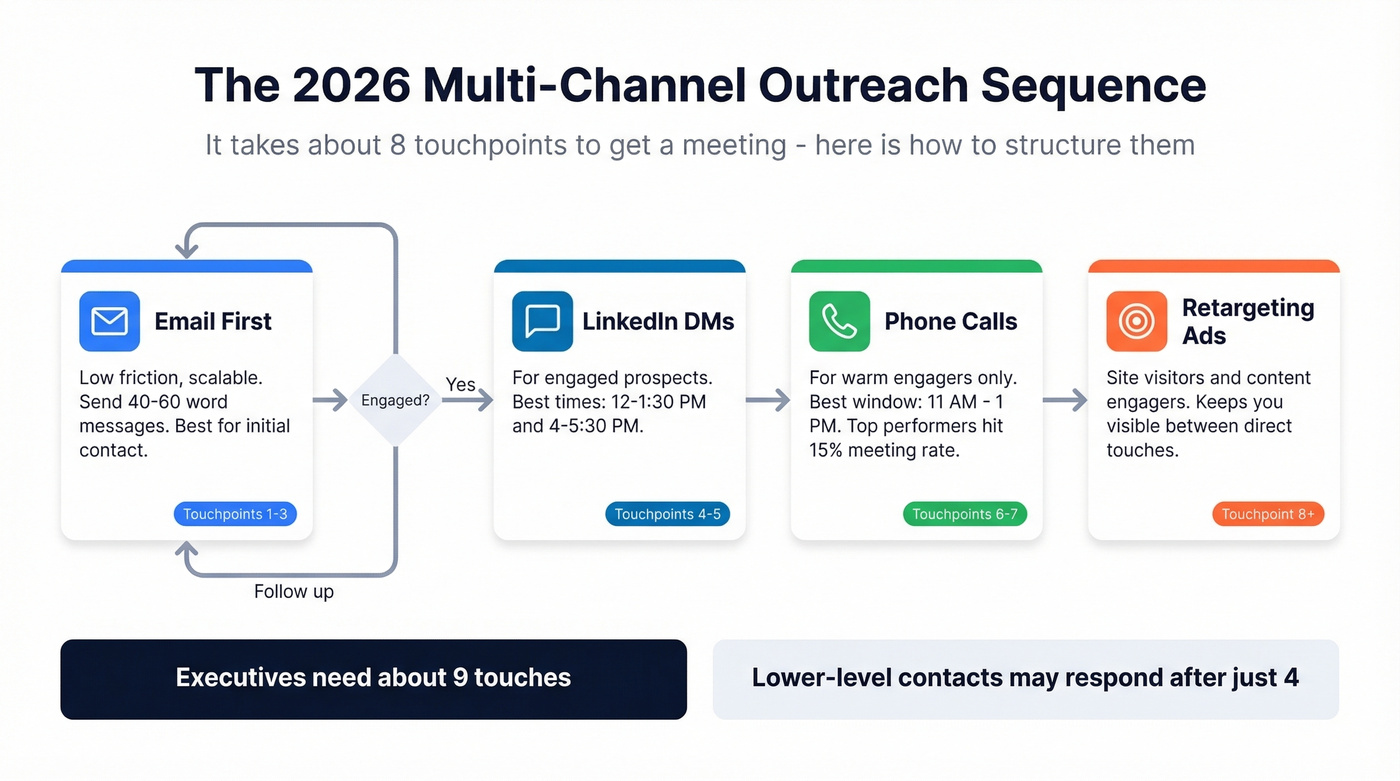
Timing windows matter more than most teams realize. LinkedIn messages typically perform best between 12:00-1:30 PM and 4:00-5:30 PM. Cold calls convert highest in the 11:00 AM-1:00 PM window. And the cadence itself needs patience - it takes about 8 touchpoints to get a meeting. Reaching executives often requires around 9 touches, while lower-level contacts sometimes respond after just 4.
Verify Your Data Before Sending
None of the strategy above matters if 35% of your emails bounce. A bounce rate that high doesn't just waste sends - it destroys your sender reputation, which means even your good emails start landing in spam. Before launching any campaign, run your list through an AI Email Checker or a verification tool that handles catch-all domains, spam traps, and honeypots. The difference between a 35% bounce rate and a sub-5% bounce rate is the difference between a campaign that works and one that burns your domain.

Writing Outreach Messages That Convert
The 40-60 Word Email Framework
The consensus on r/sales and every practitioner community we've followed is clear: shorter emails win. Top-performing reps list fewer product features in their outreach than lower performers - lead with outcomes, not capabilities. The sweet spot is 40-60 words with this structure:
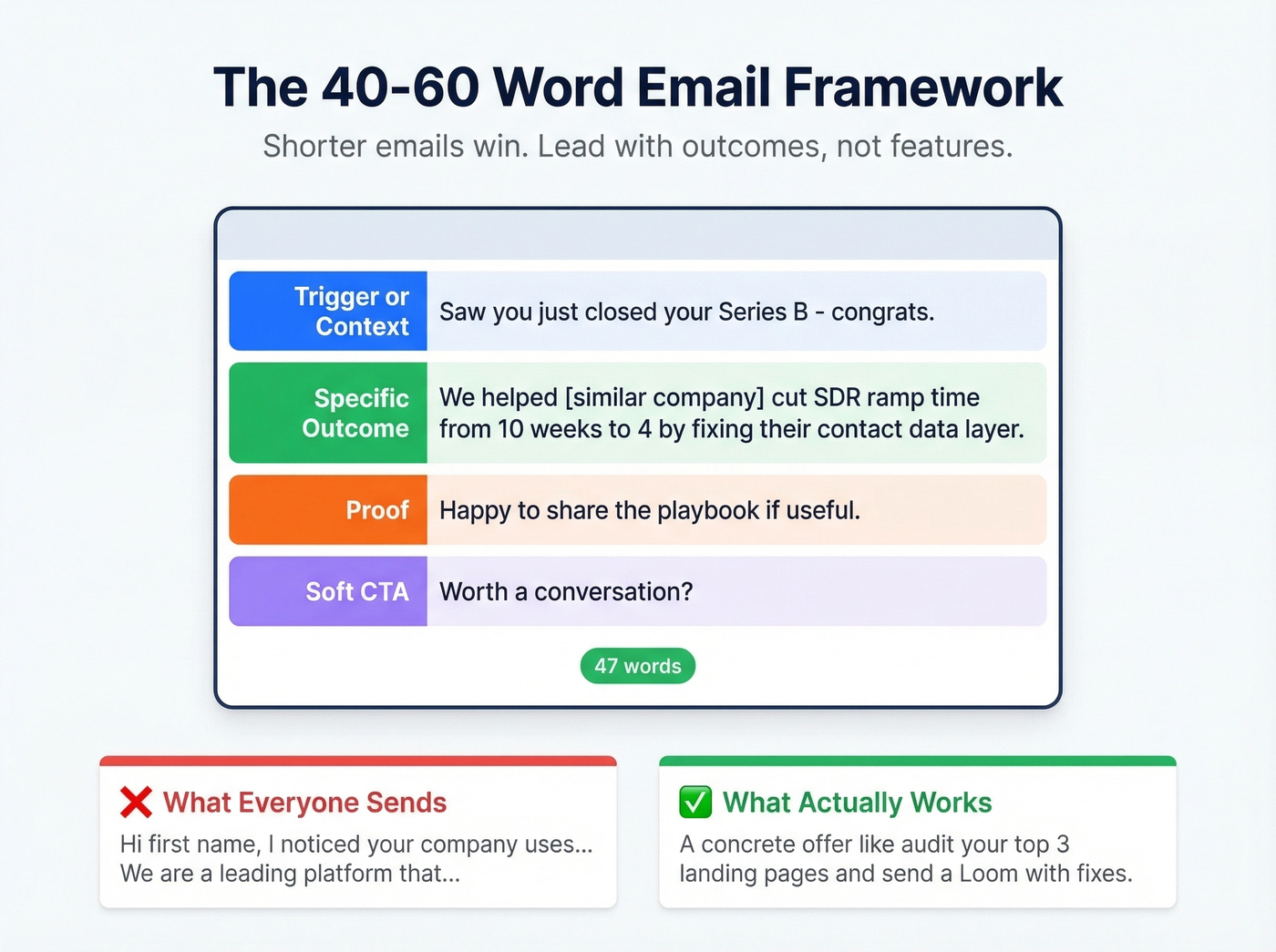
[Trigger/context] - one sentence showing you know their situation. [Specific outcome for their ICP] - what you can do, stated concretely. [Proof] - one line of social proof or a specific result. [Soft CTA] - "Worth a conversation?" beats "Book 15 minutes Tuesday."
Here's what that looks like filled out:
Saw you just closed your Series B - congrats. We helped [similar company] cut their SDR ramp time from 10 weeks to 4 by fixing their contact data layer. Happy to share the playbook if useful. Worth a conversation?
The offer does the heavy lifting, not the personalization tokens. "Hi {first_name}, I noticed your company..." is what every other email in their inbox says. A concrete offer - "audit your top 3 landing pages and send a Loom with fixes" - gives them a reason to reply.
The Personalization Spectrum
There's a tradeoff most guides gloss over. Trigger-based personalization - referencing a funding round, a job change, a product launch - scales well and meaningfully lifts response rates. You can do this for hundreds of prospects a day.
On the other end, ultra-personalized outreach means spending roughly an hour per email: deep website analysis, specific quick wins, a custom audit. An Assembly case study documented this approach - 5 emails sent, 3 responses, 3 meetings, 2 clients. That doesn't scale, but for five-figure monthly deals, it doesn't need to.
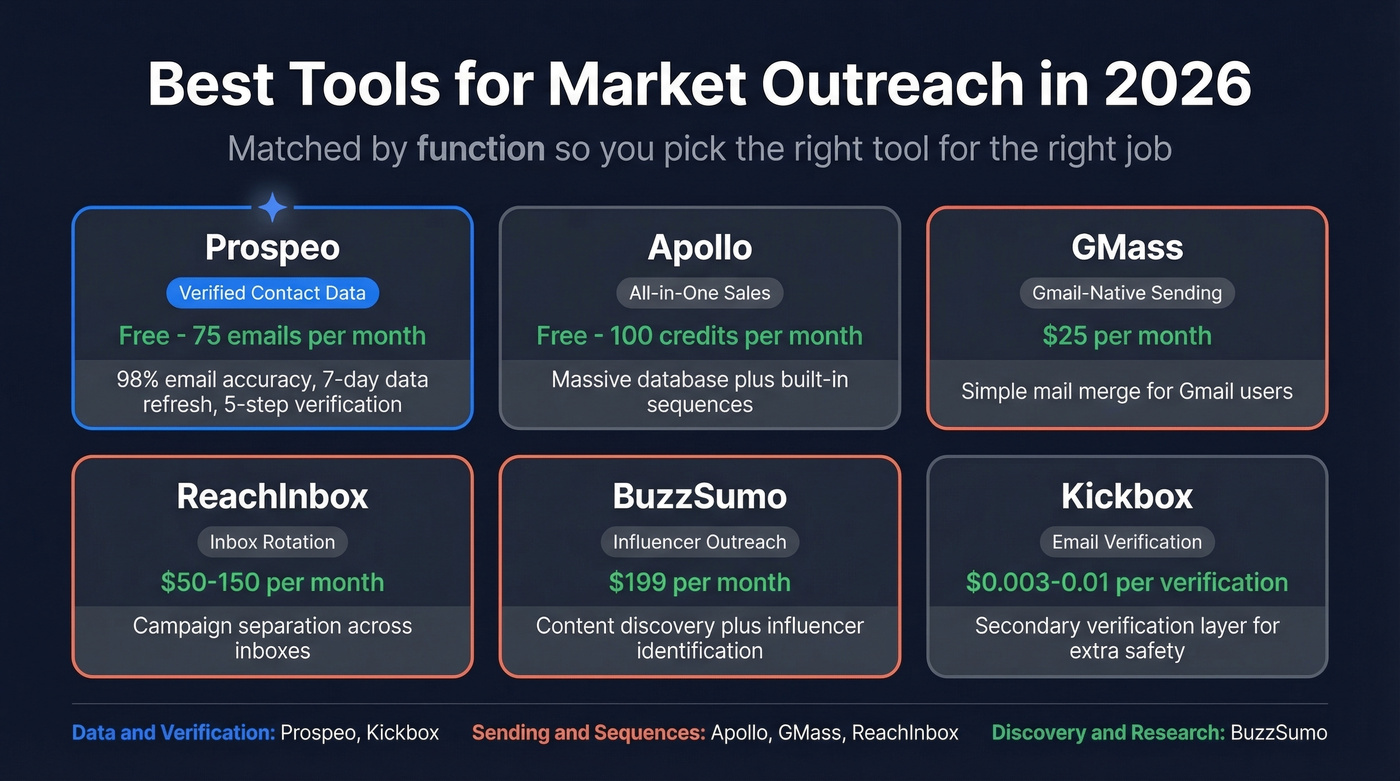
Best Tools for Market Outreach
| Tool | Best For | Starting Price | Key Feature |
|---|---|---|---|
| Prospeo | Verified contact data | Free (75 emails/mo) | 98% accuracy, 7-day refresh |
| Apollo | All-in-one sales | Free (100 credits/mo) | Database + sequences |
| GMass | Gmail-native sending | $25/mo | Simple mail merge |
| ReachInbox | Inbox rotation | ~$50-150/mo | Campaign separation |
| BuzzSumo | Influencer outreach | ~$199/mo | Content + influencer discovery |
| Kickbox | Email verification | ~$0.003-$0.01/verification | Secondary verification layer |
Prospeo
Most teams troubleshoot their copy when the real problem is their contact list. Prospeo covers 300M+ professional profiles with 143M+ verified emails and 125M+ verified mobile numbers, all refreshed on a 7-day cycle. Email accuracy sits at 98%, and mobile numbers carry a 30% pickup rate across all regions.
The 5-step verification process handles catch-all domains, spam traps, and honeypots - the stuff that silently kills deliverability. Snyk's team of 50 AEs cut bounce rates from 35-40% to under 5% after switching, and AE-sourced pipeline jumped 180%. The Chrome extension (40K+ users) lets you prospect directly from company websites and professional profiles without switching tabs.
Pricing runs about $0.01 per email with a free tier of 75 emails/month. No contracts, no sales calls required. Native integrations with Salesforce, HubSpot, Smartlead, Instantly, and Lemlist mean verified contacts flow straight into your sequences.
Apollo
Apollo is the obvious starting point for teams that want database, sequences, and email warmup in one platform. The free tier gives you 100 credits/month - enough to test the workflow. Paid plans start at $59/mo per user with 5,000 credits and 2 sequences, scaling to $149/mo for the Organization plan (minimum 3 seats).
Use this if you want a single tool for prospecting and sequencing and you're okay with a learning curve. The UI can overwhelm beginners.
Skip this if deliverability is your top priority. Apollo's native email accuracy doesn't match specialized verification platforms - we've seen teams run Apollo contacts through a second verification layer before sending and catch 15-20% invalid addresses that would've bounced.
GMass
Best budget option for Gmail-native outreach. $25/mo basic, $55/mo professional, $120/mo for a 5-user team. It's a mail merge tool, not a sales platform - no built-in database, no lead scoring, no intent data. Pair it with a data provider and it does exactly one thing well: sending personalized emails from your Gmail account with tracking.
ReachInbox
Inbox rotation and campaign separation for teams running multiple sending domains. Practitioners on r/salesdevelopment recommend it specifically for deliverability management. Expect $50-150/mo depending on volume.
BuzzSumo
Content research and influencer discovery - not a sales tool. Plans from about $199/mo. If your outreach is marketing or PR-focused (guest posts, co-marketing, influencer partnerships), BuzzSumo helps you find who to reach and what content resonates. Skip it for sales prospecting.
Kickbox
Email verification as a secondary layer. The community advice is sound: run lists through two verifiers. Kickbox works well as that second pass at around $0.003-$0.01 per verification.
You just read that ICP targeting needs funding signals, tech stack filters, and headcount growth data. Prospeo gives you all of that - 30+ search filters including buyer intent powered by Bombora, technographics, job changes, and department headcount - across 300M+ verified profiles. Layer intent data on 15,000 topics to reach in-market buyers before competitors know they exist.
Turn your ICP definition into a targetable list in under five minutes.
How to Calculate Outreach ROI
The formula is straightforward:
ROI = (Attributed Revenue - Total Cost) / Total Cost
The revenue side breaks down into a funnel:
Sends x Inbox Rate x Open Rate x Reply Rate x Meeting Rate x Close Rate x Avg Deal Value
Let's run a realistic example. You send 10,000 emails. 85% hit the inbox (8,500). 45% open (3,825). 5% reply (191). 20% of replies convert to meetings (38). 20% of meetings close (7-8 deals). At a $5,000 average deal value, that's roughly $38,250 in revenue.
Your costs: data platform ($100/mo), sending tool ($55/mo), verification ($50/mo), 2 sending domains ($24/mo), and about 40 hours of operator time ($2,000 at $50/hr). Total: around $2,229/mo. That's roughly 16x ROI - and it gets better as you optimize each conversion stage.
One sobering stat: B2B buyers spend only about 17% of their buying time meeting suppliers. Your outreach has to earn that sliver of attention.
Mistakes That Kill Response Rates
- Sending before verifying. Bounce rates above 35% burn your domain reputation. This is the #1 outreach killer and the easiest to fix. If you want the benchmarks and fixes, start with email bounce rate.
- Generic templates. "Hi {first_name}, I noticed your company..." - everyone notices. Reference a specific trigger or don't personalize at all. For more examples, see cold email subject line examples.
- Hard CTAs too early. "Book 15 minutes Tuesday" creates pressure. "Worth a conversation?" creates curiosity. Tighten your ask with an email call to action framework.
- Wrong timing. Calls outside the 11:00 AM-1:00 PM window, LinkedIn messages outside 12-1:30 PM - you're fighting the clock unnecessarily. Use these best time to send cold emails benchmarks as a baseline.
- No research. In B2B especially, triggers and signals are the difference between relevance and noise. Build a repeatable system for identifying buying signals.
- Over-contacting. Diminishing returns kick in hard after 8-9 touches. Know when to stop. This is easier with solid sequence management.
- Misleading subject lines. They boost short-term opens and destroy long-term trust. Not worth it.
FAQ
Is market outreach still effective in 2026?
Yes. Average cold email response rates sit at 5.1%, and LinkedIn outreach delivers 30-50% reply rates. The shift is toward precision over volume - verified data and multi-channel sequences are table stakes now.
How many touchpoints to book a meeting?
About 8 on average. Executives typically require around 9 touches across multiple channels, while lower-level contacts sometimes respond after 4. Mix email, social, and phone rather than hammering one channel.
What's a good cold email response rate?
The average is 5.1%. Anything above 5% is strong. Trigger-based personalization can double your baseline. If you're below 1%, your list quality is the problem - not your copy.
How do I keep outreach emails out of spam?
Verify every address before sending - a 5-step verification process that catches spam traps, honeypots, and catch-all domains makes the biggest difference. Beyond that, warm your sending domains gradually and rotate inboxes. Running lists through two separate verifiers (like Prospeo plus Kickbox) is the approach we've seen work best.
What does a full outreach stack cost?
Tool costs range from free tiers to $55-199/month for professional plans. The bigger expense is operator time - list building, research, and personalization easily run 20-40 hours per month.