

Marketing Data Enrichment: Costs, How It Works, and What Most Guides Won't Tell You
Your marketing ops lead just ran a CRM health audit and found that 23% of your contact records have outdated job titles, dead emails, or missing phone numbers. That's not a data problem. It's a marketing data enrichment problem disguised as one - and it's costing more than you think.
What Is Marketing Data Enrichment?
It's the process of taking the thin records you already have - an email address, a company name, maybe a job title - and appending verified, current data points to them. Firmographics, technographics, direct dials, revenue ranges, intent signals. One email in, a full person and company profile out.
Don't confuse it with data cleansing. Cleansing fixes what's broken: deduplication, standardization, removing invalid records. Enrichment adds what's missing. You need both, but they solve different problems. Cleansing is hygiene. Enrichment is intelligence.
The practical distinction matters because teams that skip cleansing and jump straight to enrichment end up appending fresh data onto garbage records. Duplicates get enriched twice, dead contacts get new phone numbers nobody will ever call. Clean first, then enrich.
Why It Matters in 2026
Poor data quality costs the average organization $12.9 million per year, per Gartner. That number sounds abstract until you realize it includes every bounced email sequence, every misrouted lead, every rep who spent 20 minutes researching a prospect who left the company six months ago.
B2B contact data decays at roughly 2.1% per month - that's about 22-25% of your database going stale every year. People change jobs, companies get acquired, phone numbers rotate. If you enriched your CRM in January and haven't touched it since, a quarter of those records are already unreliable.

The global data enrichment solutions market hit $2.37 billion in 2023 and is projected to reach $4.58 billion by 2030 at a 10.1% CAGR. Every GTM team is spending more on enrichment, not less. The question isn't whether to invest - it's whether you're investing wisely.
How Teams Actually Use Enriched Data
Most enrichment guides list theoretical benefits. Here's what marketing and RevOps teams actually do with enriched data, based on workflows we've seen shared across r/GrowthHacking and RevOps communities:
- Lead routing: Enrich inbound leads with company size, industry, and revenue at the moment of capture. Route enterprise leads to AEs, SMB leads to self-serve - automatically.
- Lead scoring: Append seniority, department headcount, and tech stack data. A VP at a 500-person SaaS company using Salesforce scores differently than a coordinator at a 20-person agency. (If you want the full framework, see lead scoring.)
- Signup personalization: Ask for an email address only. Enrich behind the scenes to personalize the onboarding flow - no 12-field forms.
- CRM refresh: Quarterly batch enrichment to catch job changes, company moves, and updated contact info before your sequences bounce.
- Ad segmentation: Build lookalike audiences from enriched customer profiles. Better firmographic data means tighter targeting and lower CPAs.
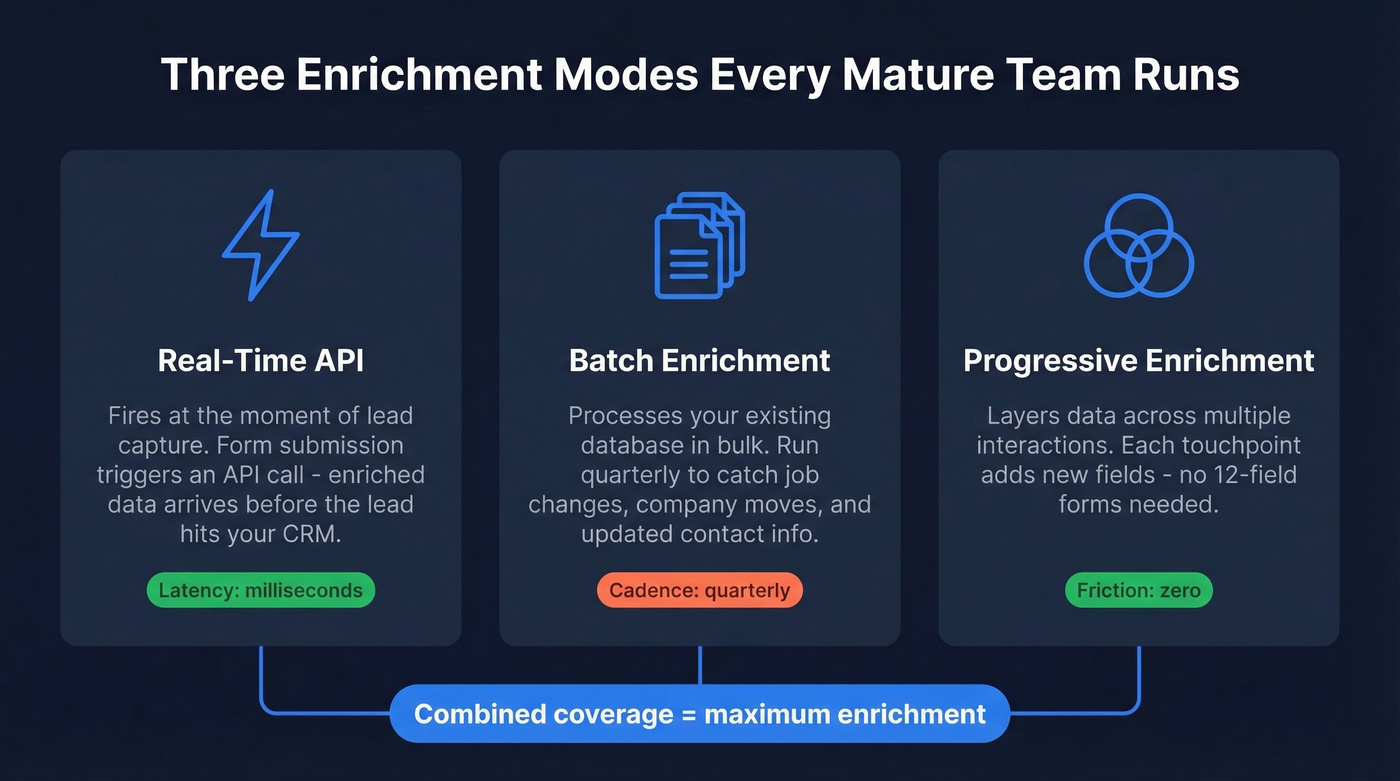
These workflows break into three enrichment modes. Real-time API enrichment fires at the moment of lead capture - a form submission triggers an API call that returns firmographic data before the lead even hits your CRM. Batch enrichment processes your existing database in bulk, typically on a quarterly cadence. Progressive enrichment layers data across multiple interactions, so each touchpoint adds new fields without asking the prospect to fill out another form.
Most mature teams run all three simultaneously.
Single-Source vs. Waterfall Enrichment
No single data provider covers your entire addressable market. A single-source architecture structurally caps email accuracy at roughly 80-85%, which means 15-20% of your target accounts stay invisible. Relying on one provider typically leaves 40-60% of qualified prospects unreachable.
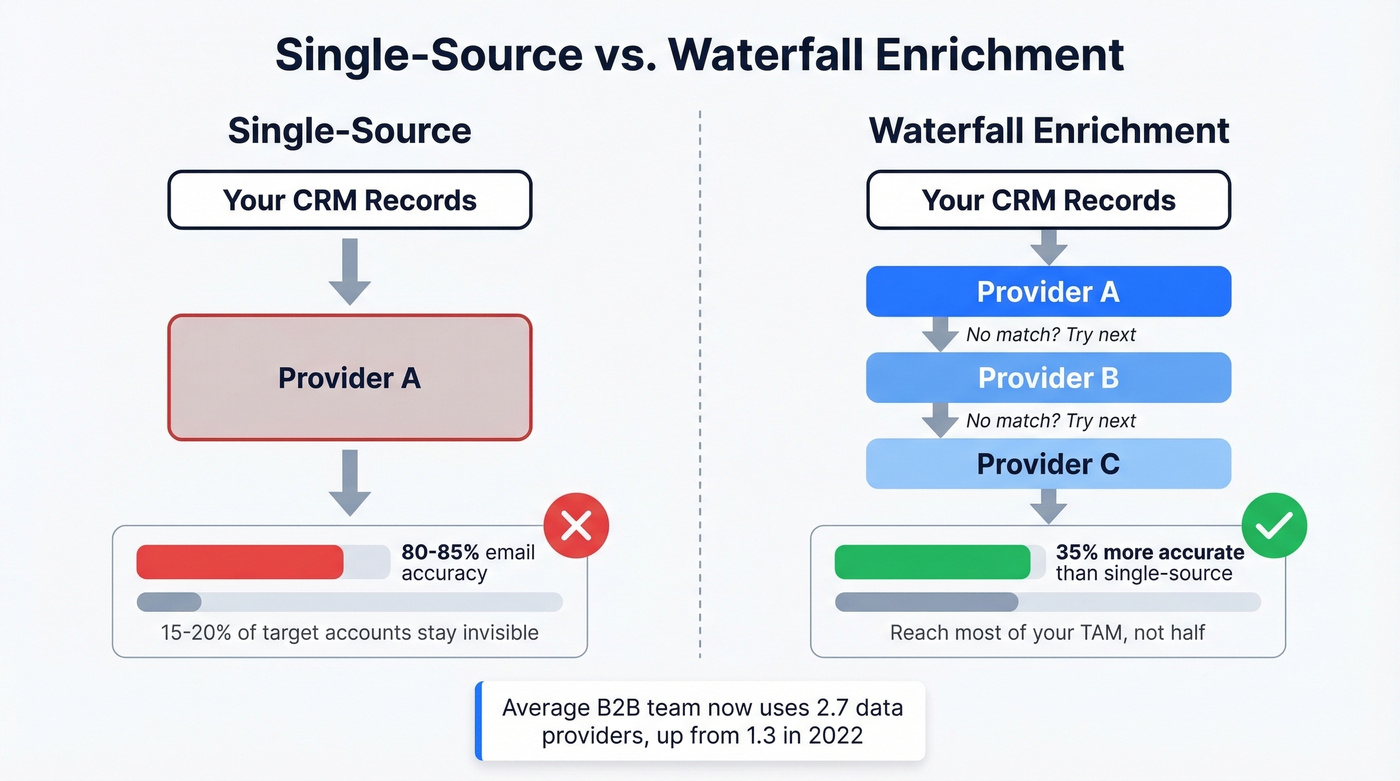
The industry has responded. The average B2B sales team now uses 2.7 data providers simultaneously, up from 1.3 in 2022. That shift created the waterfall enrichment model: query Provider A first, and if it doesn't return a verified contact, cascade to Provider B, then C, until you get a hit.
A 500-record benchmark test showed waterfall enrichment produced 35% more accurate results than any single-source tool alone. That's the difference between reaching half your TAM and reaching most of it. (If you're mapping coverage, start with TAM, SAM, SOM.)
For the email layer in a waterfall stack, Prospeo returns verified emails at 98% accuracy with a 7-day refresh cycle - a strong anchor point regardless of what other providers you're cascading through. Tools like Clay ($167-$446/mo) handle the orchestration layer, letting you chain multiple providers without writing custom code. If you're building this in practice, Clay list building is the fastest way to see the moving parts.

You just read that single-source enrichment caps accuracy at 85%. Prospeo's proprietary 5-step verification delivers 98% email accuracy with a 92% API match rate - returning 50+ data points per contact at ~$0.01 each. That's the anchor layer your waterfall stack needs.
Start enriching 75 contacts free and see the match rate yourself.
Enrichment Tools and What They Cost
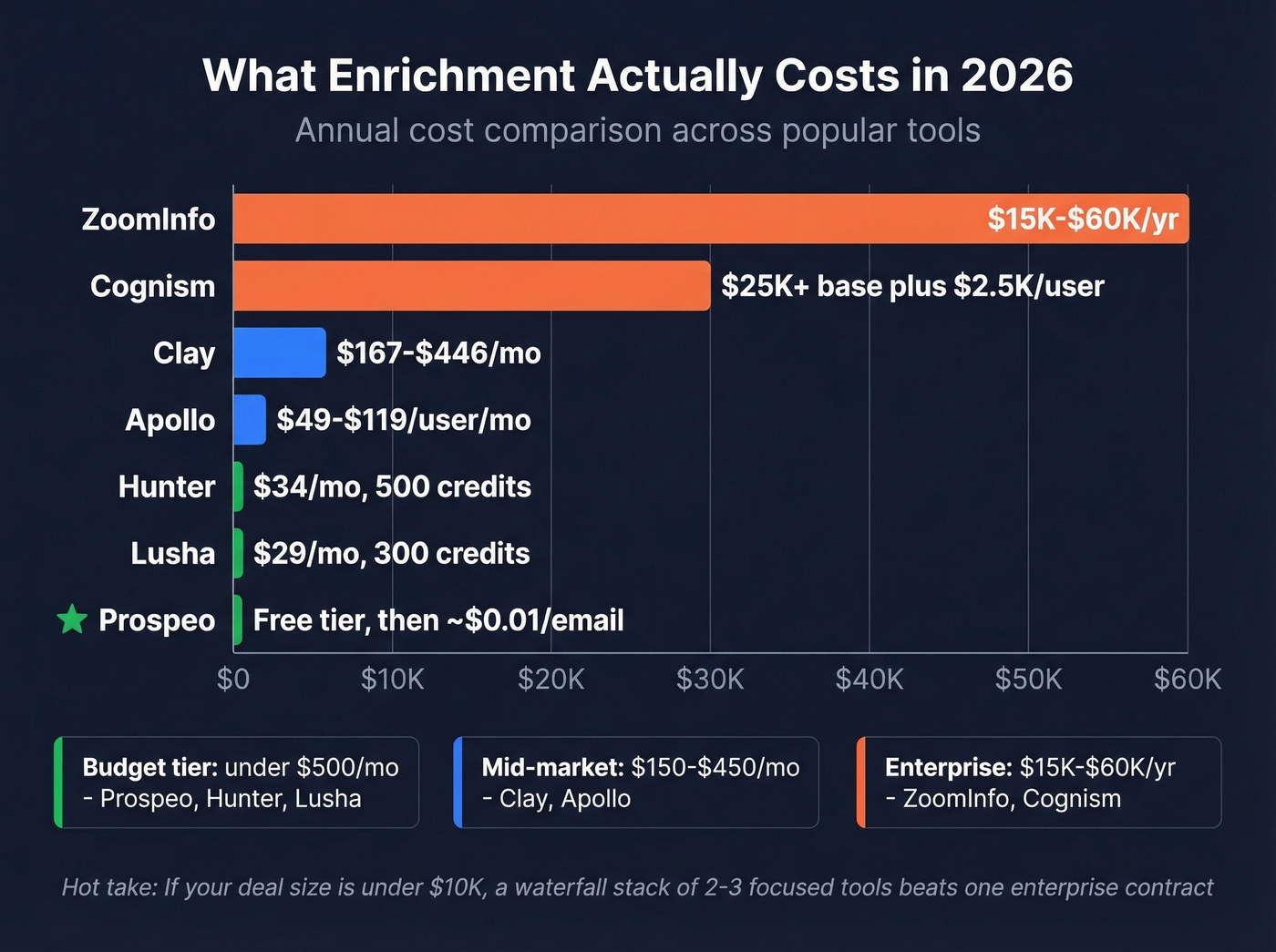
Here's the thing: most enrichment guides don't include a single dollar figure. Reddit cold-email communities routinely target $2 per 1,000 leads - a bar that only API-based tools can realistically hit. Enrichment tools charge across five models: monthly credits, per-seat, flat fee, pay-as-you-go, and enterprise custom quotes. The trap to watch for is unused credits that expire at the end of each billing cycle. Always ask whether failed lookups count against your credits - when your hit rate is 60-70%, that's a massive hidden cost. (Related: lead generation metrics are where these costs show up first.)
| Tool | Starting Price | Credits/Limits | Refresh Cycle | Best For |
|---|---|---|---|---|
| Prospeo | Free (75 emails/mo) | ~$0.01/email | 7 days | Email accuracy, API |
| ZoomInfo | $15K-$60K/yr | 5,000 credits (Professional) | 4-6 weeks | US enterprise depth |
| Apollo | Free (10K credits) | $49-$119/user/mo | Varies | SMB prospecting |
| Cognism | ~$25K + $2,500/user | Diamond Data verified mobiles | 60 days (VP+) | EU phone numbers |
| Clay | $167/mo (Launch) | Credit-based | N/A (orchestrator) | Waterfall workflows |
| Lusha | ~$29/mo | 300 credits, no rollover | Varies | Direct dials |
| Hunter | ~$34/mo | 500 credits, no rollover | Varies | Email-only lookups |
| People Data Labs | $0.01/record | API-based | Varies | Developer/bulk API |
| Clearbit (Breeze) | HubSpot bundle | 100+ attributes | Varies | HubSpot-native teams |
Hot take: If your average deal size is under $10K, you probably don't need ZoomInfo-level data. A waterfall stack of two or three focused tools will get you 90% of the coverage at 20% of the cost.
Top Picks in Detail
Prospeo is the transparent-pricing benchmark. The free tier gives you 75 verified emails per month plus 100 Chrome extension credits - enough to test against your current provider. Paid plans scale at roughly $0.01 per email with no contracts and no credit expiration. With 50+ data points per enrichment, a 92% API match rate, and a 7-day refresh cycle, it does one thing well - verified contact data - without bundling sequencing or CRM features you'd pay for but never use. Native integrations with Salesforce, HubSpot, and Clay push enriched data straight into your stack. (If you're comparing vendors, start with data enrichment services.)
ZoomInfo remains the deepest single-source database for US enterprise contacts. Real-world contracts run $25,000-$60,000/year, with 10-20% renewal increases. The coverage is unmatched domestically, but APAC and EMEA gaps are well-documented, and a 4-6 week refresh cadence means you're working with older data than you'd expect at that price point.
Apollo is where most budget-conscious teams start. The free tier includes 10,000 credits, and paid plans run $49-$119/user/month. Credits don't roll over, and extras cost $0.20 each. Accuracy runs lower than dedicated enrichment tools, but the built-in sequencing makes it a decent all-in-one for early-stage teams. Skip this if you need high-accuracy data for outbound at scale - the bounce rates will eat your domain reputation. (If you're running outbound, email deliverability is the constraint, not copy.)
Cognism wins on European phone accuracy with Diamond Data verified mobiles - 87% connect rate versus a 30% industry average on unverified numbers. Expect ~$25,000 base plus ~$2,500/user for Diamond access. North American coverage is thinner.
Clay isn't a data source - it's an orchestration layer for waterfall workflows. Lusha and Hunter are lightweight, credit-based options for simple lookup needs. People Data Labs at $0.01/record is the developer's choice for bulk API enrichment. Clearbit (now Breeze Intelligence inside HubSpot) appends 100+ attributes but is no longer positioned as a standalone product.
Real Results
Snyk's 50-person AE team cut bounce rates from 35-40% to under 5% after switching enrichment providers - that's the difference fresh data makes. Their AE-sourced pipeline jumped 180%, generating 200+ new opportunities per month. (If you're tracking impact, tie it to pipeline health metrics.)
One Reddit thread captures the buyer's frustration perfectly: a user stuck in an annual contract with Wiza lost thousands of credits to a bug and couldn't get a refund. Annual contracts with credit-based tools are a real risk, especially when the vendor's hit rate drops.
Data decays 2.1% per month. Most providers refresh every 6 weeks - by then, thousands of records are already stale. Prospeo refreshes every 7 days, so your lead scoring, routing, and ad segmentation run on data that's actually current. No contracts, no expired credits.
Stop enriching your CRM with data that's already outdated.
Common Enrichment Mistakes
Over-enriching everything. Appending 50+ fields to every record sounds thorough. In practice, it wastes budget and clutters your database with fields nobody queries. Prioritize the fields that drive conversion: title, seniority, company size, tech stack, and verified contact info.
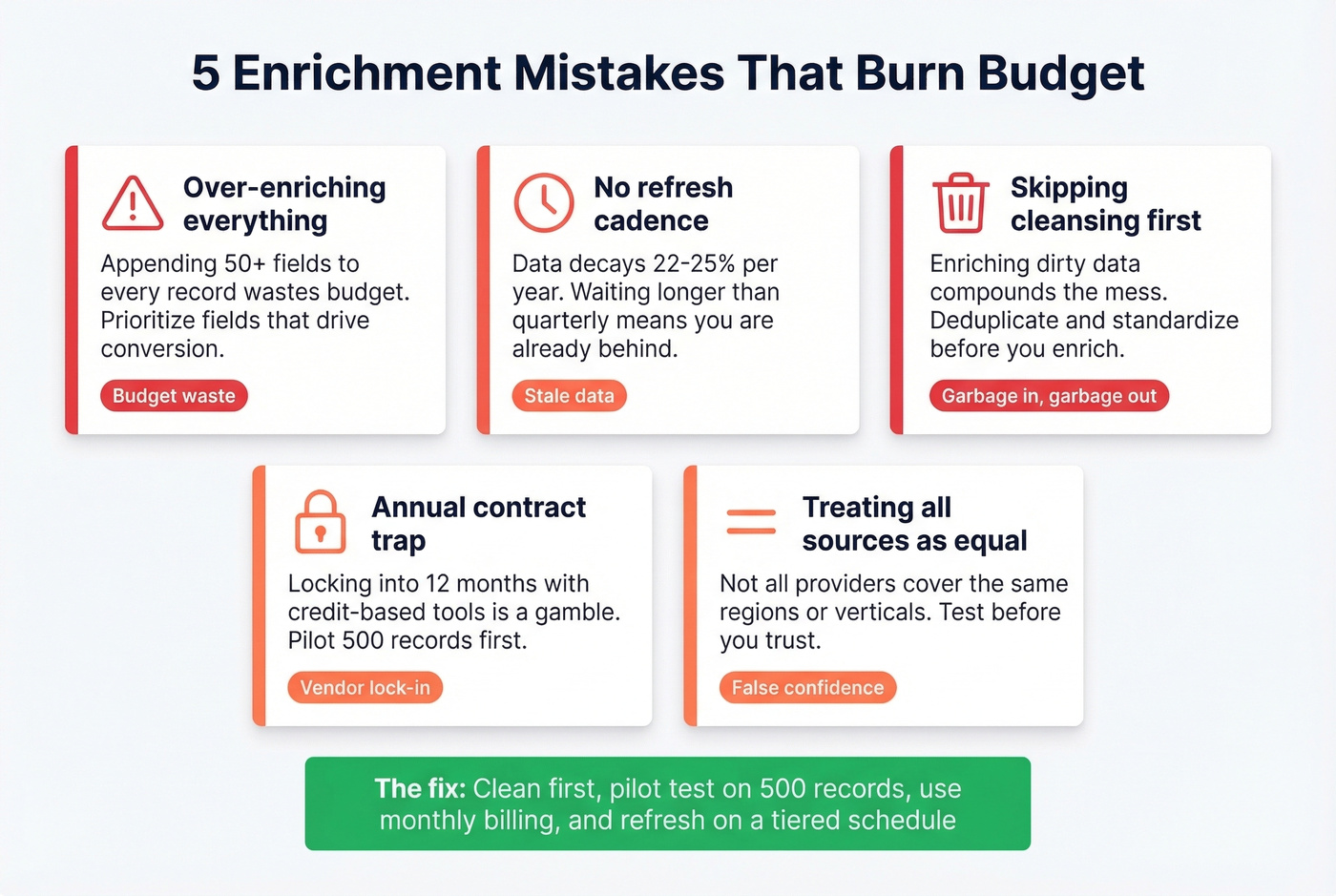
No refresh cadence. Set a tiered schedule: critical contacts monthly, active opportunities bi-monthly, general database quarterly. B2B data decays ~22-25% per year - waiting longer than quarterly means you're already behind.
Skipping cleansing before enrichment. Enriching dirty data compounds the mess. Deduplicate, standardize, and remove invalid records first.
The annual contract trap. Locking into a 12-month contract with a credit-based tool means you're betting that accuracy and usage patterns won't change. They will. In our experience, teams that pilot-test on 500 records before committing save themselves months of frustration. Prefer monthly or pay-as-you-go models whenever possible.
Treating all data sources as equal. Not every provider refreshes at the same cadence or verifies with the same rigor. A pilot test on 500 records tells you more than any sales deck ever will.
GDPR and Compliance
Enrichment touches personal data, which means GDPR applies if you're processing EU contacts. Five principles to operationalize:
- Lawfulness: Establish a legal basis - explicit consent or legitimate interest - before enriching. Document which one and why.
- Purpose limitation: Only enrich for the specific purpose you've declared. "Personalizing outbound sequences to ICP accounts" is defensible. "General marketing" isn't.
- Data minimization: Don't append fields you won't use. If you don't need personal phone numbers, don't collect them.
- Accuracy: Use providers with verified, regularly refreshed data. Stale enrichment data is a compliance liability.
- Storage limitation: Set retention policies. Enriched data sitting in your CRM for three years without a refresh or a business purpose is a risk.
2026 Trends: Enrichment in the Warehouse Era
The term "data clean room" is fading, but the capability is becoming infrastructure. NIQ launched a global data clean room on Snowflake in late 2025, specifically designed for enrichment and outcome measurement. First-party data gets enriched with privacy-compliant consumer signals inside a secure environment - data only leaves under approved aggregation rules.
AWS, Snowflake, and Google Cloud now offer out-of-the-box clean room capabilities, which means enrichment is moving closer to where your data already lives. The concept is composability: enrichment tools operating natively across warehouses and clouds rather than requiring data exports and imports. Industry consolidation - LiveRamp acquiring Habu, WPP acquiring InfoSum - is accelerating this shift.
Let's be honest about what this means for buyers: your next enrichment vendor will likely run inside your data warehouse, not alongside it. The tools that can't meet you there will lose relevance fast.
FAQ
How often should I refresh enriched data?
Critical contacts monthly, active opportunities bi-monthly, general database quarterly. B2B data decays roughly 2.1% per month - waiting longer than quarterly means roughly a quarter of your records are stale.
What's a good enrichment match rate?
Single-source tools typically cover 50-70% of records. Waterfall enrichment pushes that to 80-95%. Anything above 80% from a single provider is strong.
Is data enrichment GDPR compliant?
Yes, when you establish a lawful basis, document your processing purpose, and use providers that source data lawfully. Verify your vendor's sourcing practices and offer opt-out mechanisms to data subjects.
What's the cheapest way to start?
Prospeo's free tier (75 verified emails/month) and Apollo's free plan (10,000 credits) let you test enrichment workflows at zero cost. Run a 500-record pilot against your CRM to measure match rate and accuracy before committing budget.