

The 10 Best Marketing Data Platforms in 2026
Global digital ad spend is on track to surpass $870B in 2026, and somewhere between 40% and 47% of that money gets wasted. The average marketing team juggles 17-20 platforms, the martech landscape has exploded from 150 solutions in 2011 to over 14,000, and most of the data flowing between those tools is fragmented, stale, or flat-out wrong.
That's the problem a marketing data platform solves.
It sits at the center of your stack, connects your sources, and gives you a single place to analyze performance, unify customer profiles, or activate audiences. But the term means different things to different vendors - some are ETL pipes, some are CDPs, some are glorified reporting dashboards. Here are the 10 worth your attention, with real pricing and honest verdicts.
Our Picks at a Glance
| Use Case | Pick | Why |
|---|---|---|
| B2B data accuracy | Prospeo | 98% email accuracy, 7-day refresh, ~$0.01/email |
| Marketing data integration | Funnel.io | 500+ connectors, hands-on support, agency-friendly |
| Composable CDP | Hightouch | Warehouse-native, highest Gartner Peer Insights rating (4.6) |
| Enterprise CDP | Salesforce Data Cloud | Sole Leader in 2026 Gartner MQ, deep ecosystem |
| Budget connector tool | Supermetrics | Starts at $37/mo (annual), transparent pricing |
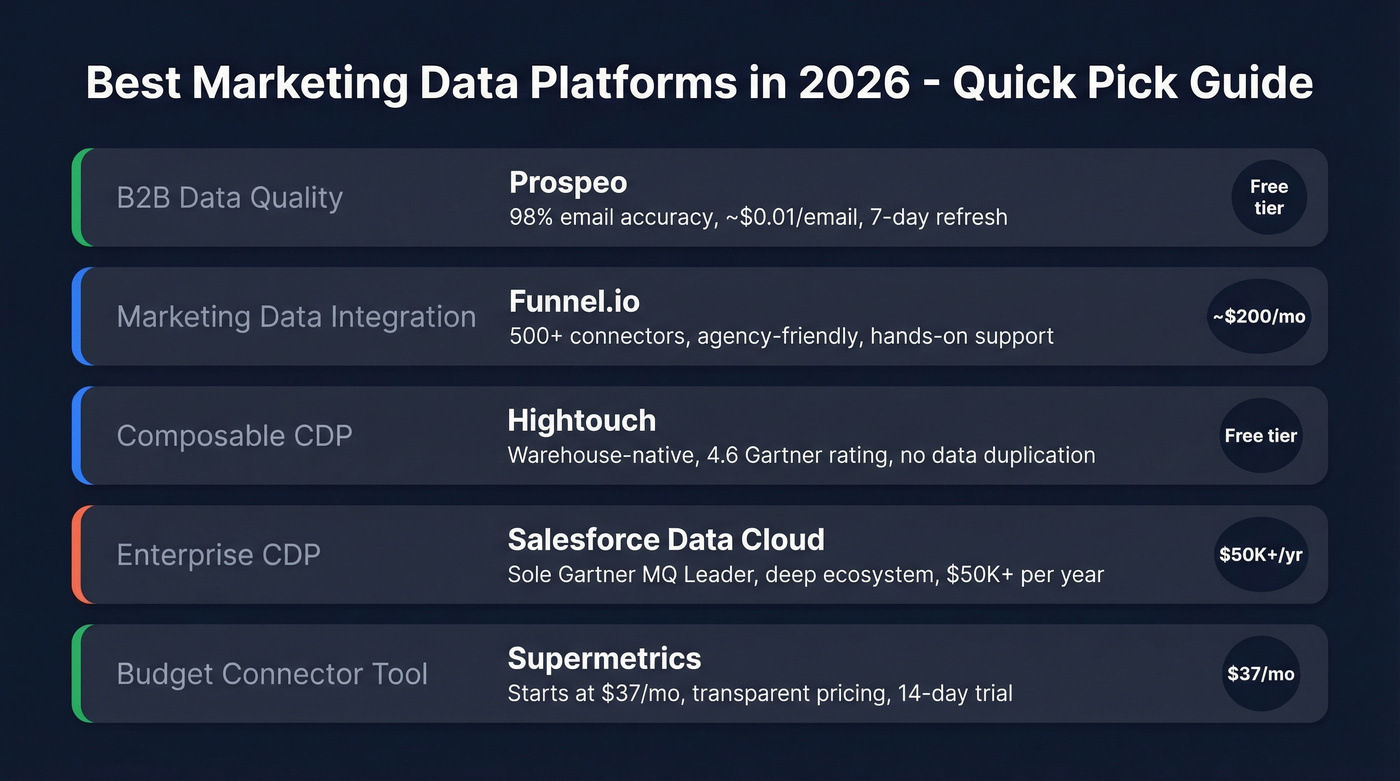
If you're short on time, start with the use case that matches your biggest pain. If you're not sure, keep reading - the category distinctions matter more than most people think.
What Is a Marketing Data Platform?
The term gets thrown around loosely, so let's pin it down. An MDP is a centralized system that integrates marketing, customer, and revenue data from multiple sources to analyze channel performance, attribute revenue, and optimize spend. It's the integration layer between your ad platforms, CRM, analytics tools, and reporting.
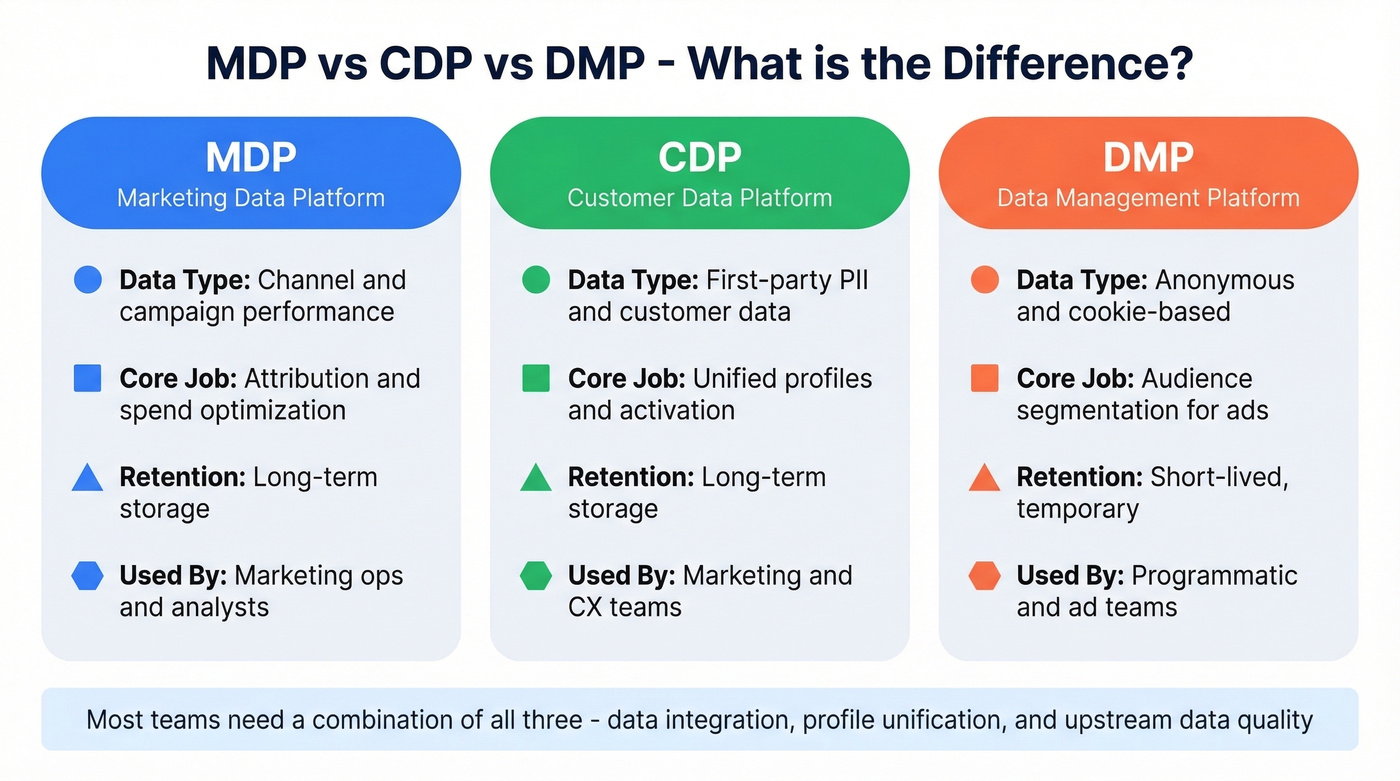
It's not the same thing as a CDP or a DMP, though modern platforms increasingly blur the lines. Gartner Peer Insights lists 70 CDP products alone - and that's just one sub-category.
| MDP | CDP | DMP | |
|---|---|---|---|
| Primary data | Channel/campaign performance | First-party PII | Anonymous/cookie-based |
| Core function | Attribution, spend optimization | Unified profiles, activation | Audience segmentation for ads |
| Data retention | Long-term | Long-term | Short-lived |
| Typical user | Marketing ops, analysts | Marketing, CX teams | Programmatic/ad teams |
A CDP collects and unifies first-party customer data, resolves identities, and activates unified profiles across channels. The CDP market is projected to grow from ~$9.7B to $37B+ by 2030, and most CDPs offer only 20-50 activation destinations - which is why composable approaches are gaining ground. A DMP deals in anonymous, cookie-based audience data with short retention windows, a shrinking category as third-party cookies fade.
Most teams need some combination of data integration (ETL/MDP), profile unification (CDP), and upstream data quality. The tools below cover all three.
How We Evaluated
We looked at six things across every platform:
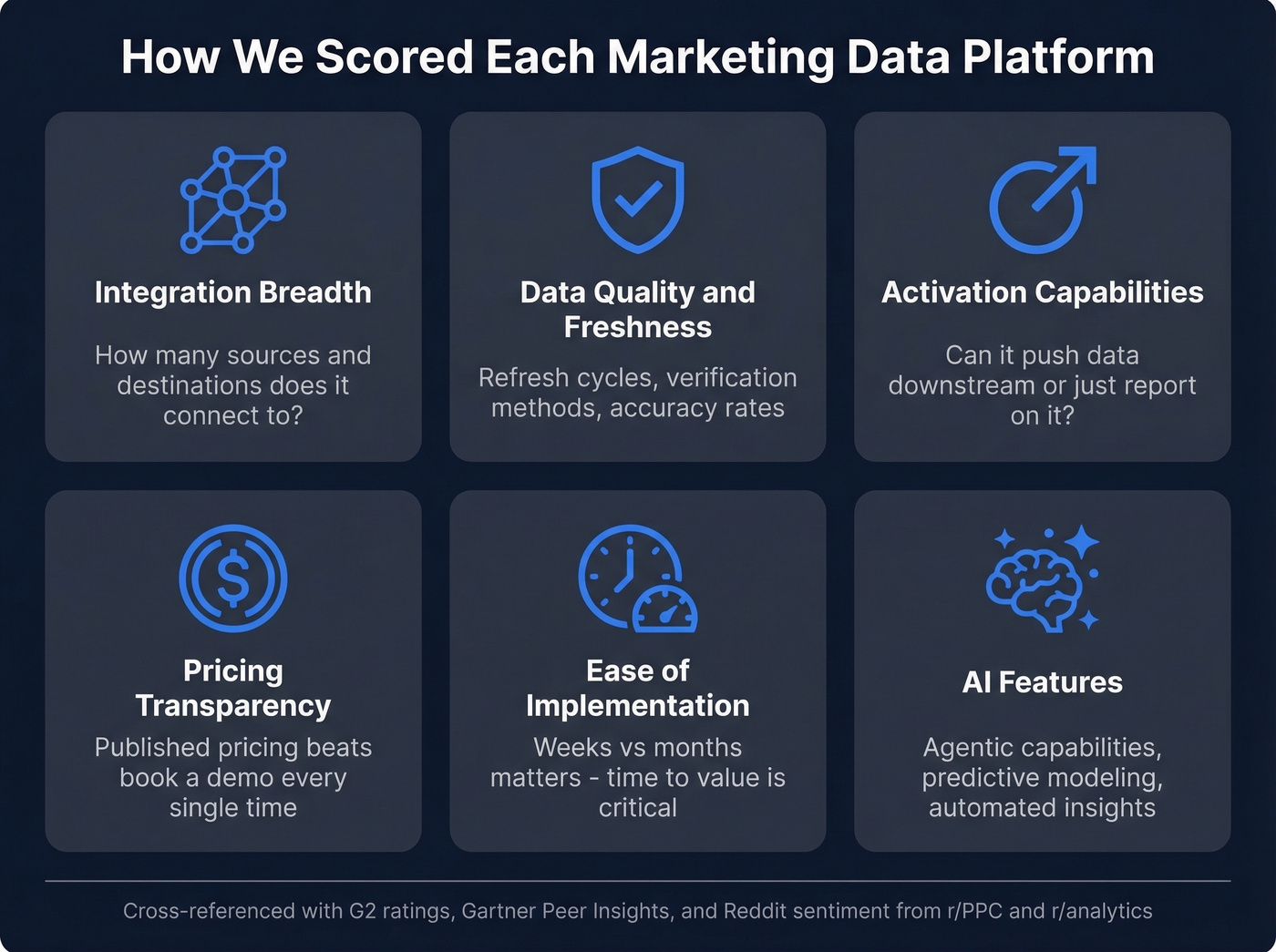
- Integration breadth - how many sources and destinations it connects
- Data quality and freshness - refresh cycles, verification, accuracy (see data enrichment)
- Activation capabilities - can it push data to downstream tools, or just report?
- Pricing transparency - published pricing beats "book a demo" every time
- Ease of implementation - weeks vs. months matters
- AI features - agentic capabilities, predictive modeling, automated insights
We cross-referenced G2 and Gartner Peer Insights ratings, checked Reddit sentiment in r/PPC and r/analytics, and reviewed official pricing pages where they exist.
The 10 Best Platforms for 2026
1. Prospeo - B2B Data Quality Layer
Prospeo isn't an ETL tool or a CDP. It's the data quality layer that sits upstream of everything else on this list. Every other platform here assumes your contact data is clean. Prospeo makes sure it actually is.

Use this if: Your marketing stack suffers from stale contacts, bounced emails, or bad phone numbers. Prospeo's database covers 300M+ professional profiles with 98% email accuracy and 125M+ verified mobile numbers with a 30% pickup rate. The 7-day data refresh cycle is dramatically faster than the 6-week industry average, which means your enrichment data doesn't go stale between campaigns. (If you're actively fighting bounces, see email bounce rate and email deliverability.)
Here's the proof point that sold us: Snyk's outbound team was running a 35-40% bounce rate before switching. After layering in Prospeo, bounces dropped under 5% and AE-sourced pipeline jumped 180%. That's not a marginal improvement - that's a different business.
The platform layers in 15,000 Bombora intent topics and 30+ search filters covering technographics, funding, headcount growth, and job changes, making it a powerful tool for building targeted prospect lists (more on sales prospecting techniques). It integrates natively with Salesforce, HubSpot, Lemlist, and Clay (see Clay list building). Pricing starts free at 75 emails/month and scales at roughly $0.01 per email with no contracts.
Skip this if: You only need marketing analytics and attribution, and you already have verified contact data flowing into your stack.
2. Funnel.io
Use this if: You're an agency or mid-market team that needs a central data hub with strong human support. Funnel connects 500+ data sources - 121 on the Starter tier, up to 590 on Enterprise - and pushes to 26-27 destinations across common BI and warehouse tools. G2 users rate it 4.5/5 across 105 reviews, and it holds SOC2 Type II certification.
The Reddit consensus on Funnel is telling: users praise the hands-on support and quick blended dashboards, but note that data manipulation in Google Sheets is clunkier than Supermetrics. The bigger frustration? Funnel removed its pricing calculator and now requires a demo for quotes. User reports peg the Starter plan around $200/mo, with Business and Enterprise scaling into four figures.
Skip this if: You live in Google Sheets, need sub-$100/mo pricing, or want full pricing transparency before talking to sales.
3. Hightouch
Use this if: You already have a data warehouse like Snowflake, BigQuery, or Databricks and want to activate it without duplicating data into a separate CDP. Hightouch is the composable CDP that earned the highest Gartner Peer Insights rating in the category at 4.6/5 across 66 reviews, and it was listed as a new entrant in the 2026 Gartner Magic Quadrant.
The core idea is elegant: your warehouse is already your system of record, so why copy all that data into another platform? Hightouch sits on top and activates segments, audiences, and profiles directly from your existing tables. No data duplication, no sync lag, no second copy to maintain.
There's a free tier available, with paid plans starting around $350/mo plus your warehouse costs. For teams already investing in a warehouse-first strategy, this approach avoids the redundancy of traditional CDPs entirely. If you don't have a warehouse, Hightouch doesn't make sense. But if you do, it's the most architecturally sound CDP approach we've seen.
Skip this if: You don't have a data warehouse, or you need a full-stack analytics and reporting solution.
4. Salesforce Data Cloud
Salesforce Data Cloud is the 800-pound gorilla in the CDP space - and Salesforce was the sole Leader in the 2026 Gartner Magic Quadrant. If you're already running Salesforce across sales, service, and marketing, this is the natural choice. If you're not, the switching cost alone makes it a non-starter.
Gartner Peer Insights rates it 4.4/5 across 150 ratings, and the platform delivers deep identity resolution, AI agents, and native integration across the Salesforce ecosystem. Pricing typically lands around $50K-200K+/year before implementation. That's a serious commitment, and we'd only recommend it for teams that are already deeply embedded in the Salesforce world (compare broader Salesforce pricing).
5. Supermetrics
For teams spending under $200/mo who primarily need to pipe ad platform data into spreadsheets or Looker Studio, Supermetrics is still the default. The Starter plan at $37/mo billed yearly (or $47/mo monthly) is the most transparent entry point in the category, and Growth at $177/mo yearly ($222/mo monthly) unlocks more sources and destinations.
The catch: Starter limits you to 3 data sources, 1 user, weekly refresh, and 50,000 API rows/month. Reddit threads consistently flag price increases that frustrate long-term users. G2 rates it 4.5/5 across 596 reviews, and it offers SOC2 Type II certification with a 14-day free trial. The Enterprise tier goes quote-based, which undermines the transparency advantage that got Supermetrics on the map in the first place.
6. Improvado
Improvado is enterprise-grade ETL with 500+ data sources and massive row limits - 200M to 1B rows/year depending on tier. It's SOC2, HIPAA, and GDPR compliant, checking every enterprise security box. Growth tier syncs up to 4x/day; Enterprise gets hourly refreshes.
The downsides are real, though. No public pricing whatsoever - everything requires a demo. Users report a steep learning curve and dated UI. Implementation takes roughly 2 months, and ROI timeline can stretch to 15 months based on review data. You'll also need a separate BI tool for reporting since Improvado is pure ETL, not a dashboard. If you're evaluating it, budget for a lengthy implementation and plan to pair it with Looker, Tableau, or Power BI.
7. Twilio Segment
Segment remains the go-to for product-led companies that need real-time event tracking piped into their marketing and analytics stack. It's the most developer-friendly standalone CDP available, with real-time event streaming and 300+ integrations. The free tier is genuinely useful for early-stage teams, and paid plans start from ~$120/mo. Gartner Peer Insights rates it 4.5/5 across 95 ratings.
The trade-off: enterprise pricing scales fast with event volume - expect $1K-5K+/mo at scale. Segment was listed as a Niche Player in the 2026 Gartner Magic Quadrant, which signals a narrowing competitive position against composable alternatives like Hightouch.
8. Whatagraph
Whatagraph combines reporting and data integration in one platform, aimed squarely at agencies. A forever-free plan gives you 5 source credits, with the Start plan at $229/mo and Boost at $463/mo. Agencies like Peak Seven report saving up to 63 hours per month on data analysis and reporting. It's a solid pick for smaller agencies that want reporting and data piping in a single tool, though it lacks the depth of Funnel or the warehouse activation of Hightouch.
9. Treasure Data
An enterprise CDP with AI and agentic capabilities, Treasure Data typically runs $50K-250K+/year and earns a 4.4/5 on Gartner Peer Insights across 121 ratings. It's a full-scale intelligence tool designed for organizations that need to unify billions of customer records across global operations. Unless you're operating at that scale, look elsewhere.
10. Adobe Real-Time CDP
Adobe's CDP typically sits at $75K-300K+/year and requires the Adobe Experience Platform ecosystem. Gartner Peer Insights rates it 4.3/5 across 82 ratings. Adobe was the only Visionary in the 2026 Gartner Magic Quadrant - strong on real-time profile activation, but the price and ecosystem lock-in limit it to teams already deep in Adobe's stack. Other notable CDPs like Tealium (4.4/5, 147 Gartner ratings) and BlueConic didn't make our top 10 but are worth evaluating for specific use cases.

Every platform on this list assumes your contact data is clean. Most isn't. Prospeo's 7-day refresh cycle and 98% email accuracy ensure your CDP, ETL pipes, and activation tools actually work - not just move bad data faster.
Fix your data layer before you optimize anything else.
Pricing Comparison
Let's lay it all out.
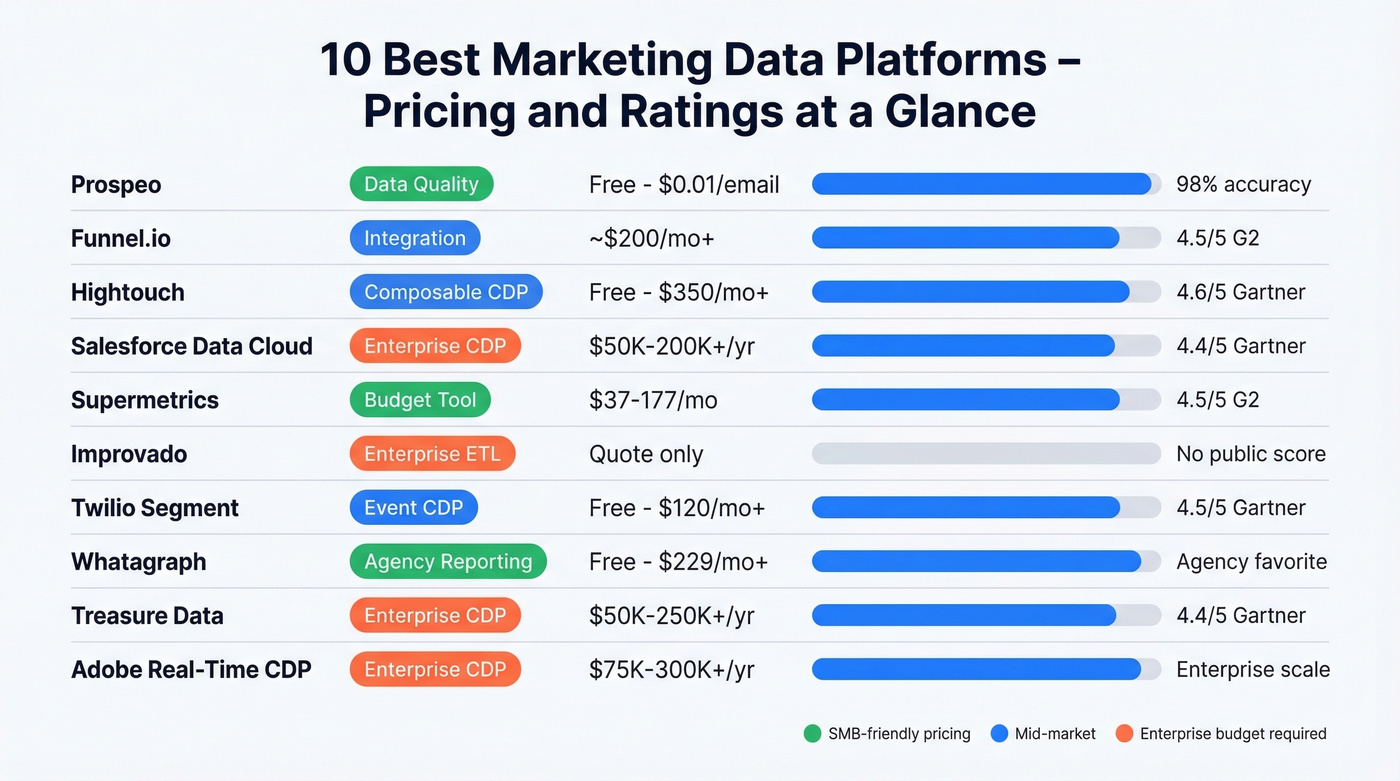
| Tool | Starting Price | Model | Free Tier |
|---|---|---|---|
| Prospeo | ~$0.01/email | Credit-based, self-serve | ✅ 75 emails/mo |
| Funnel.io | ~$200/mo (est.) | Tiered, demo required | ❌ |
| Hightouch | ~$350/mo | Tiered + warehouse costs | ✅ |
| Salesforce Data Cloud | ~$50K/yr | Enterprise, custom | ❌ |
| Supermetrics | $37/mo (billed yearly) | Tiered, transparent | ❌ (14-day trial) |
| Improvado | Not public | Enterprise, demo required | ❌ |
| Twilio Segment | ~$120/mo | Usage-based (events) | ✅ |
| Whatagraph | $229/mo | Tiered, transparent | ✅ (5 credits) |
| Treasure Data | ~$50K/yr | Enterprise, custom | ❌ |
| Adobe Real-Time CDP | ~$75K/yr | Enterprise, custom | ❌ |
The spread is enormous - from $37/mo to $250K+/year. Your company size and use case should narrow the field fast.
Should You Build or Buy?
A survey of 102 data professionals found that 61% take a buy-first, build-selectively approach. The top reason teams build is control and customization (64% cited this). The top reason teams buy is faster time-to-value (71%).
Here's the thing: 29% of teams regretted a build decision in the past year, compared to just 18% who regretted buying. Building gives you control, but it also gives you maintenance burden, hiring dependencies, and a longer path to ROI.
The hybrid approach is winning. Use your warehouse as the system of record, then layer a composable CDP like Hightouch, Census, or GrowthLoop as the system of action. Reverse ETL tools bridge the gap without forcing you to choose one extreme. For most mid-market teams that need flexibility without a 15-month implementation, this is the architecturally sound path forward.
Why Data Quality Matters Most
None of this infrastructure matters if the data flowing into it is garbage. And for most B2B teams, it is.
73% of GTM leaders find most reports and forecasts useless, and RevOps teams waste roughly 30% of their time on bad data, broken dashboards, and guesswork. We've seen this firsthand - teams spend six figures on a CDP, then wonder why their identity resolution keeps fragmenting profiles. The answer is almost always upstream data quality.

Hashed email matching, which most CDPs rely on for identity resolution, breaks with a single typo. One wrong character produces a completely different hash, and your "unified profile" fragments into two records. This is why upstream verification matters before data ever enters your platform. If your deal sizes are modest and your team is lean, you probably don't need a $50K CDP - but you absolutely need clean data feeding whatever system you do use (see lead enrichment).
How to Choose the Right Platform
Match your situation to the right starting point:
SMB or agency needing connectors - Supermetrics for budget, Funnel.io for more support and sources.
Mid-market wanting a CDP - Twilio Segment for developer-friendly event tracking, Hightouch for warehouse-native activation.
Enterprise in the Salesforce ecosystem - Salesforce Data Cloud is the obvious pick. Don't fight the gravity of your existing stack.
Any B2B team with data quality issues - Fix your data upstream before buying an MDP. Clean contacts save you from expensive problems downstream, and this is the step most teams skip (use an ideal customer profile to keep enrichment focused).
The most common mistake we see? Teams buy a $50K/year CDP before fixing the data feeding it. Start with quality, then add infrastructure. A marketing data platform is only as valuable as the records it processes.
Snyk cut their bounce rate from 35-40% to under 5% and grew AE-sourced pipeline 180% by fixing the data upstream. At $0.01 per email with no contracts, Prospeo costs less than one wasted campaign built on stale contacts.
Stop feeding your marketing stack garbage data.
FAQ
What's the difference between a CDP and a marketing data platform?
A CDP unifies first-party customer profiles for personalization and activation. A marketing data platform is broader - it covers performance analytics, channel integration, and revenue attribution across your entire stack. Modern tools increasingly combine both capabilities.
Do I need a CDP if I already have a data warehouse?
Not necessarily. Composable CDPs like Hightouch activate data directly from your warehouse without duplicating it. A reverse ETL layer is often all you need - skip the traditional CDP and save $50K+/year.
How much does a marketing data platform cost?
From $37/mo (Supermetrics Starter, billed yearly) to $250K+/year (enterprise CDPs like Adobe). Most mid-market tools fall in the $200-1,000/mo range. Upstream data quality tools like Prospeo start free and scale at ~$0.01/email.
What causes bad data in marketing platforms?
Stale contact records, typos, job changes, and infrequent refreshes. The industry-average refresh cycle is 6 weeks, meaning data decays before you use it. Tools with 7-day refresh cycles keep records current and reduce bounce rates below 5%.
Can I use multiple marketing data platforms together?
Yes, and most teams should. A typical lean stack: one integration layer to centralize channel data (Funnel, Supermetrics), one activation layer to push unified profiles downstream (Hightouch, Segment), and one data quality layer to verify contacts before they enter the system.