

The Marketing Sales Funnel Guide With Actual Numbers
96% of visitors aren't ready to buy when they hit your site. That's not a failure of your landing page - it's the reality of how buying decisions work. The marketing sales funnel exists to turn that 96% into a system you can measure, optimize, and actually improve.
Here's the thing: "marketing funnel," "sales funnel," and "marketing sales funnel" get used interchangeably across every blog, course, and sales deck. Most articles rehash the same AIDA diagram without a single conversion number. This guide has the numbers - stage-by-stage benchmarks by industry, worked funnel math, and the specific mistakes that kill conversion at each stage.
The Short Version
So what's a marketing funnel in practical terms? It's the full journey from stranger to customer. The sales funnel is a specific conversion experience - a landing page sequence, a webinar flow, a checkout process - that drives action at a particular stage. Most teams blend both into a single unified pipeline.
The benchmark that matters most for B2B SaaS: 39% of leads convert to MQLs, 38% of MQLs to SQLs, and 37% of SQLs to closed deals. If your numbers fall significantly below those, you've got a stage-specific problem - not a "we need more leads" problem.
The single highest-ROI fix: if your marketing-to-sales handoff doesn't have explicit MQL and SQL criteria that both teams agree on, start there. Not with more blog posts. Not with a new ad campaign. Define the handoff first.
What Is a Marketing Sales Funnel?
The industry can't agree on terminology, so let's settle it.
A marketing funnel maps the complete journey a buyer takes from stranger to loyal customer - awareness through purchase and beyond. A sales funnel is narrower: it's the page-by-page, step-by-step experience that drives a specific action at a particular stage. Think of a webinar registration flow, a free trial sequence, or a checkout process.
The classic framework is AIDA) - Awareness, Interest, Desire, Action. It's been around for over 100 years and still holds up as a mental model. But modern B2B funnels need more granularity than four stages, and they definitely need to extend past the initial purchase. When people search for this topic, they're usually looking for the combined system: how marketing attracts and nurtures, how sales qualifies and closes, and where the handoff happens. That's what we'll build here.
Marketing Funnel vs. Sales Funnel
The split is cleaner than most articles make it. Marketing owns the top and middle - attracting attention, educating prospects, and nurturing them until they're ready for a conversation. Sales owns the bottom - qualifying, presenting solutions, negotiating, and closing.
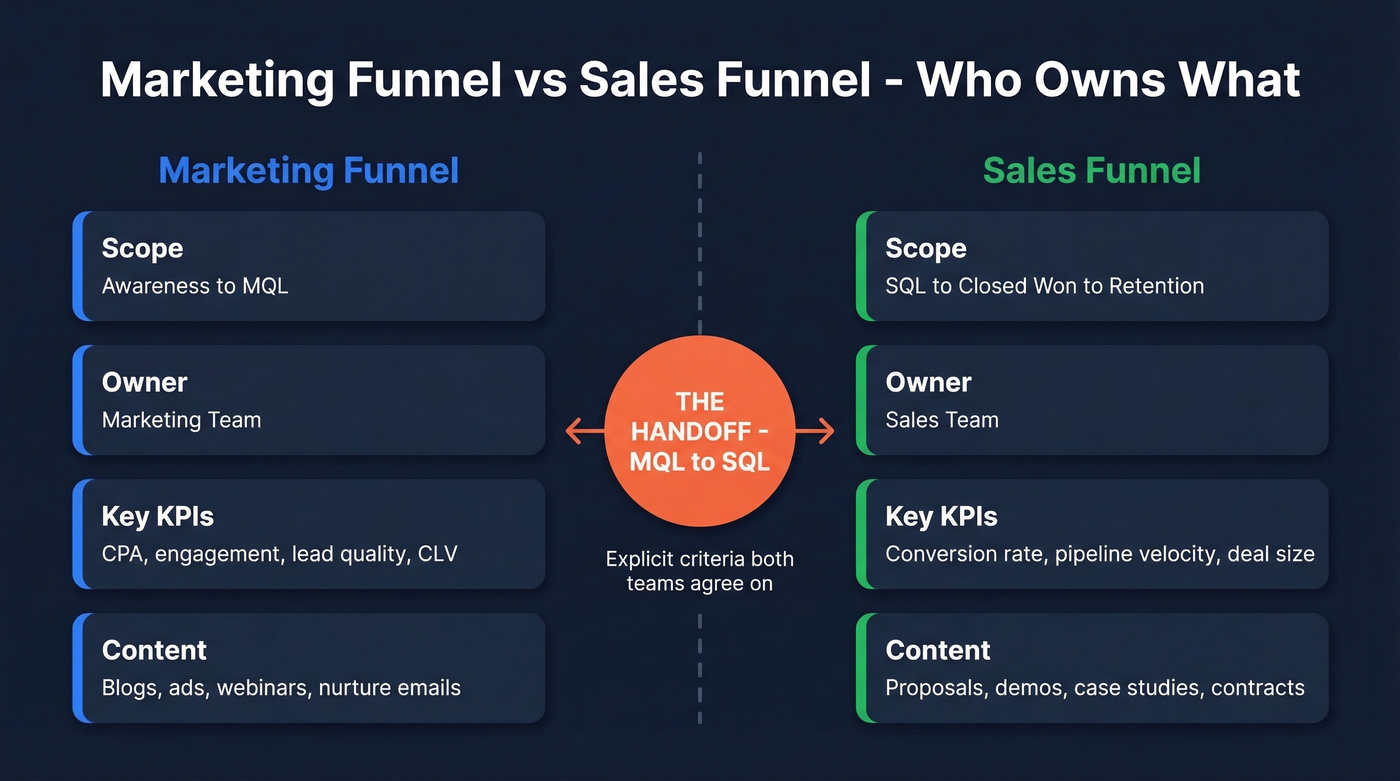
The handoff point is where most funnels break.
Marketing says "we sent you 500 leads." Sales says "those leads were garbage." It's a universal pain point in B2B teams, and we've seen it derail pipeline reviews at companies of every size. The fix is explicit criteria.
An MQL (marketing qualified lead) should mean something specific: they've taken a high-intent action like requesting a demo, downloading a pricing guide, or attending a product webinar, AND they match your ICP on firmographic criteria. An SQL (sales qualified lead) means a rep has confirmed budget, authority, need, and timeline - or whatever qualification framework your team uses.
| Marketing Funnel | Sales Funnel | |
|---|---|---|
| Scope | Awareness to MQL | SQL to Closed Won to Retention |
| Owner | Marketing team | Sales team |
| Key KPIs | CPA, engagement, lead quality, CLV | Conversion rate, pipeline velocity, deal size, churn |
| Content | Blogs, ads, webinars, nurture emails | Proposals, demos, case studies, contracts |
| Handoff | MQL to SQL with explicit criteria | Post-Sale to Customer Success |
On the sales side, stages get more granular: Lead Qualification, Needs Discovery, Solution Presentation, Proposal, Negotiation, Closing, Post-Sale. Each stage has its own conversion rate, and each one is a potential leak. The teams that win aren't the ones with the best top-of-funnel content OR the best closing process - they're the ones where the handoff between the two is airtight, with SLAs on response time, shared definitions, and a feedback loop when lead quality drifts.
The 6 Funnel Stages Explained
TOFU: Awareness and Interest
Awareness is where strangers first encounter your brand. They've got a problem but might not know your solution exists. The content here is educational, not promotional - blog posts, social media, SEO content, short videos, podcast appearances. Key metric: reach and engagement rate.
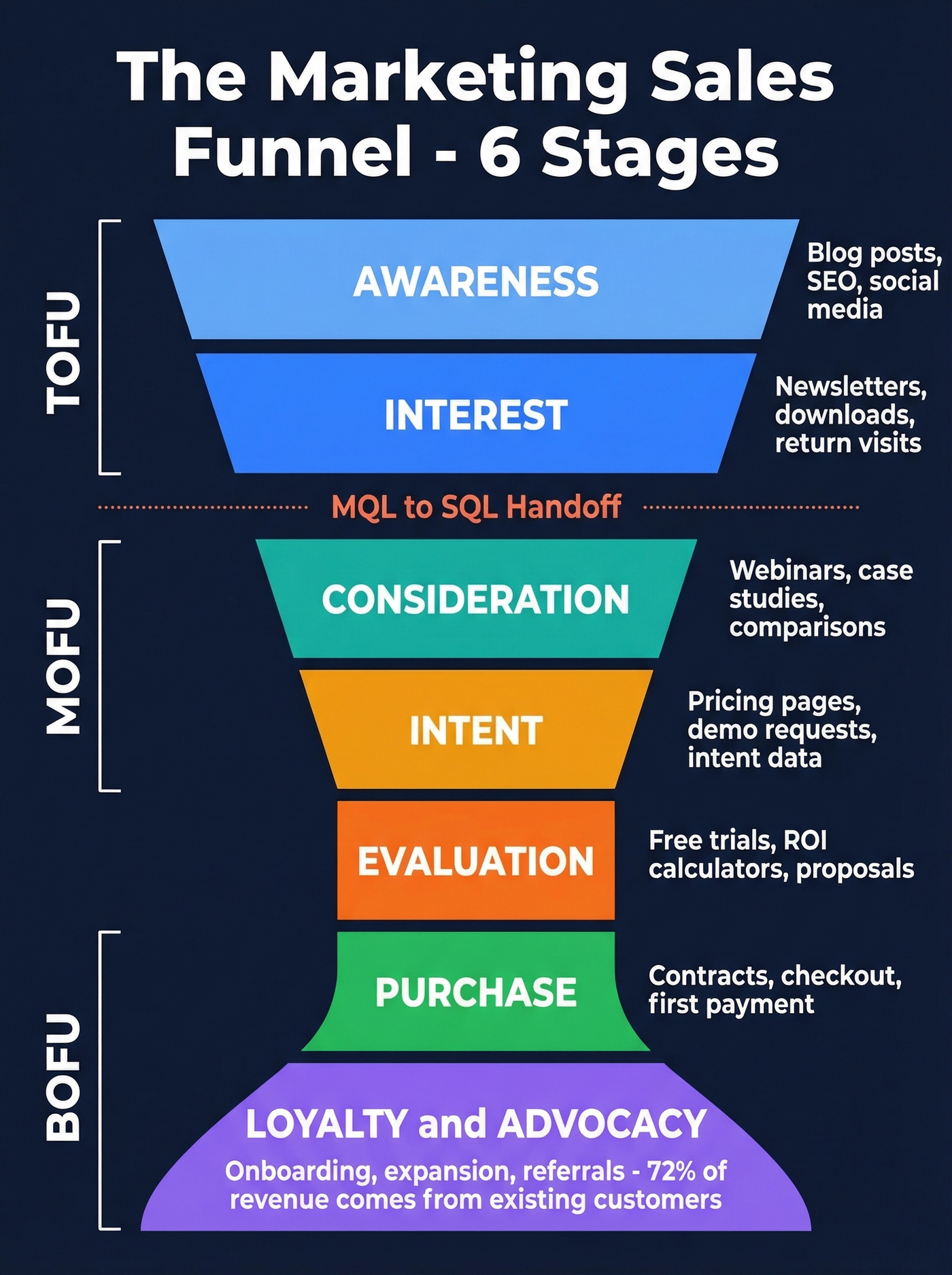
Interest is where they lean in. They've consumed your awareness content and want more. They subscribe to your newsletter, follow your company page, or download a general resource. You're measuring email signups, content engagement depth, and return visits.
MOFU: Consideration and Intent
Consideration is the evaluation phase. Prospects are actively comparing options - yours and your competitors'. This is where webinars, case studies, comparison guides, and detailed whitepapers earn their keep. The metric that matters is MQL conversion rate.
Intent signals that a prospect is moving toward a decision. They're visiting your pricing page, requesting a demo, or engaging with bottom-funnel content. Intent data - tracking which companies are researching topics related to your product - lets you prioritize the prospects most likely to convert. You're measuring demo requests, pricing page visits, and intent signal volume.
BOFU: Evaluation and Purchase
Evaluation is the final comparison. The prospect has a shortlist and is making their decision. Free trials, ROI calculators, detailed proposals, and customer testimonials do the heavy lifting here. Sales reps are actively involved, and the metric is opportunity-to-close rate.
Purchase is the conversion event - signed contract, completed checkout, first payment. But it's not the end of the funnel.
Post-Purchase: Loyalty and Advocacy
This is the stage most funnels ignore entirely, and it's arguably the most valuable. Up to 72% of company revenue stems from existing customers. The probability of selling to an existing customer runs 60-70%, compared to 5-20% for a new prospect. Onboarding sequences, customer success check-ins, expansion offers, and referral programs all live here. Key metrics: net revenue retention and NPS.
Funnel Conversion Benchmarks (2026)
This is where most funnel guides fall apart - they describe stages without telling you what good looks like.
Stage-by-Stage Benchmarks
Data from First Page Sage's benchmark report, drawn from anonymized client data across roughly 65% B2B, 20% B2C, and 15% both:
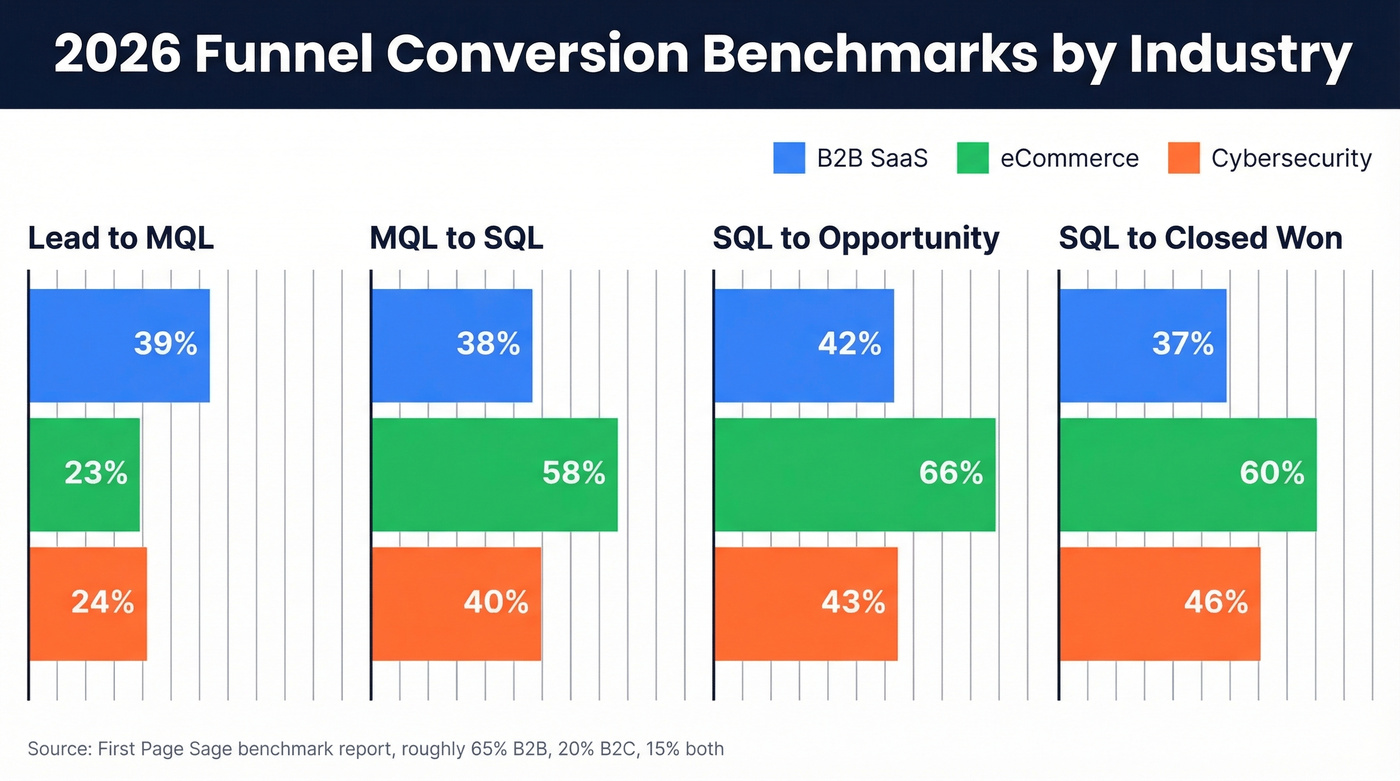
| Industry | Lead to MQL | MQL to SQL | SQL to Opp | SQL to Closed |
|---|---|---|---|---|
| B2B SaaS | 39% | 38% | 42% | 37% |
| eCommerce | 23% | 58% | 66% | 60% |
| Cybersecurity | 24% | 40% | 43% | 46% |
General ranges from VWO's analysis across mixed funnel types:
| Stage | Low End | High End |
|---|---|---|
| Visitor to Lead | 1% | 5% |
| Lead to MQL | 25% | 35% |
| MQL to SQL | 13% | 26% |
| SQL to Opportunity | 50% | 62% |
| Opp to Closed Won | 15% | 30% |
Funnel Math - A Worked Example
Let's walk through a realistic B2B funnel using mid-range benchmarks:
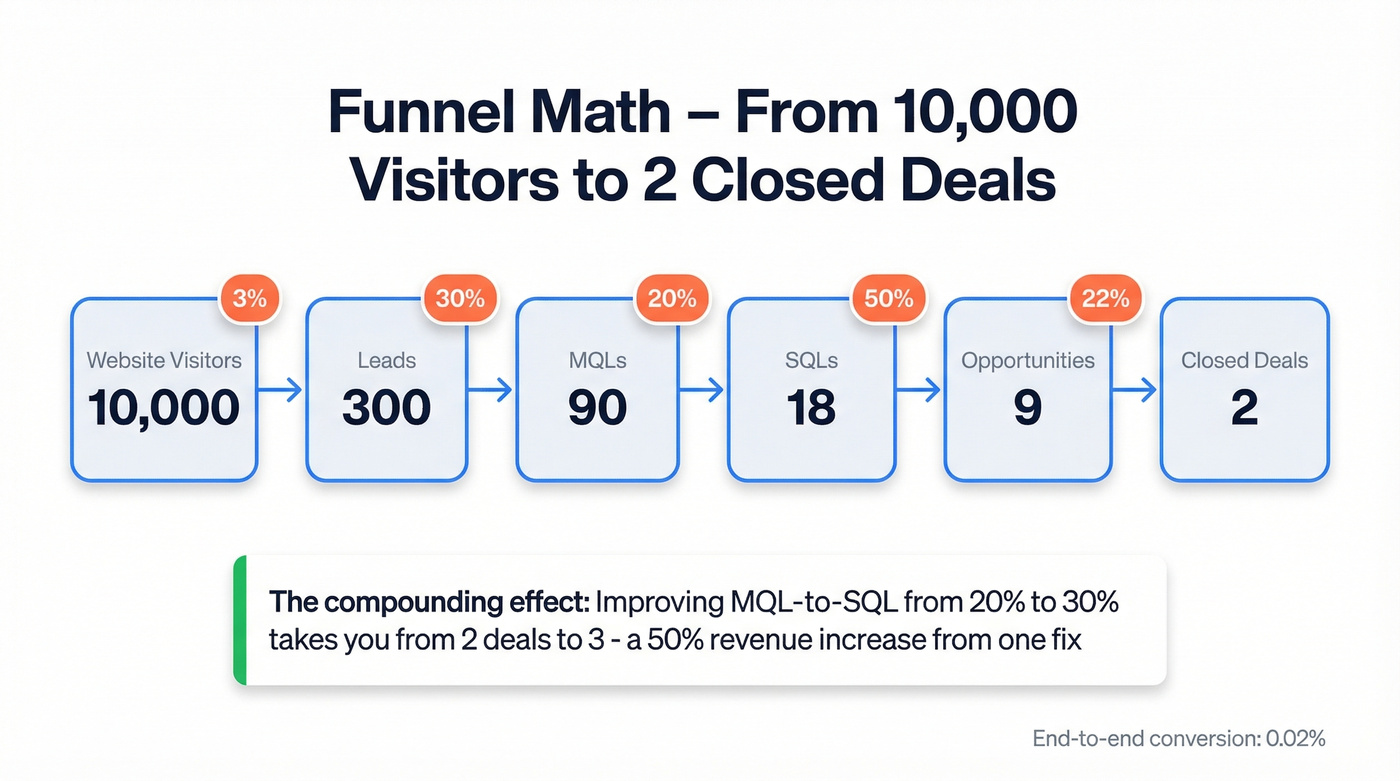
- 10,000 website visitors - 300 leads (3% visitor-to-lead rate)
- 300 leads - 90 MQLs (30% lead-to-MQL)
- 90 MQLs - 18 SQLs (20% MQL-to-SQL)
- 18 SQLs - 9 opportunities (50% SQL-to-opp)
- 9 opportunities - 2 closed deals (22% close rate)
Two deals from 10,000 visitors. That's a 0.02% end-to-end conversion rate - and it's normal.
The insight isn't that funnels are inefficient. It's that small improvements at any single stage compound dramatically. Bump your MQL-to-SQL rate from 20% to 30%? You just went from 2 deals to 3. That's a 50% revenue increase from one handoff improvement.
Most teams obsess over top-of-funnel traffic when the real money is in fixing the middle. If your average deal size is under $10k, you probably don't need more leads - you need better handoff criteria and cleaner data.
For teams running LinkedIn ads specifically, Sales-Mind.ai's benchmarks give you channel-specific numbers to plan against: TOFU CTR of 0.45-0.9%, CPC of $8-15, MOFU CPL of $120-250, and BOFU SQL cost of $200-450. Recommended budget split: 60% TOFU, 25% MOFU, 15% BOFU.

Your MQL-to-SQL conversion rate means nothing if half those leads bounce. Prospeo delivers 98% email accuracy with a 7-day refresh cycle, so every lead entering your funnel has verified contact data - not stale records from six weeks ago.
Stop feeding bad data into a good funnel. Start with verified contacts.
B2B vs. B2C Funnels
The same framework applies to both, but execution looks completely different.
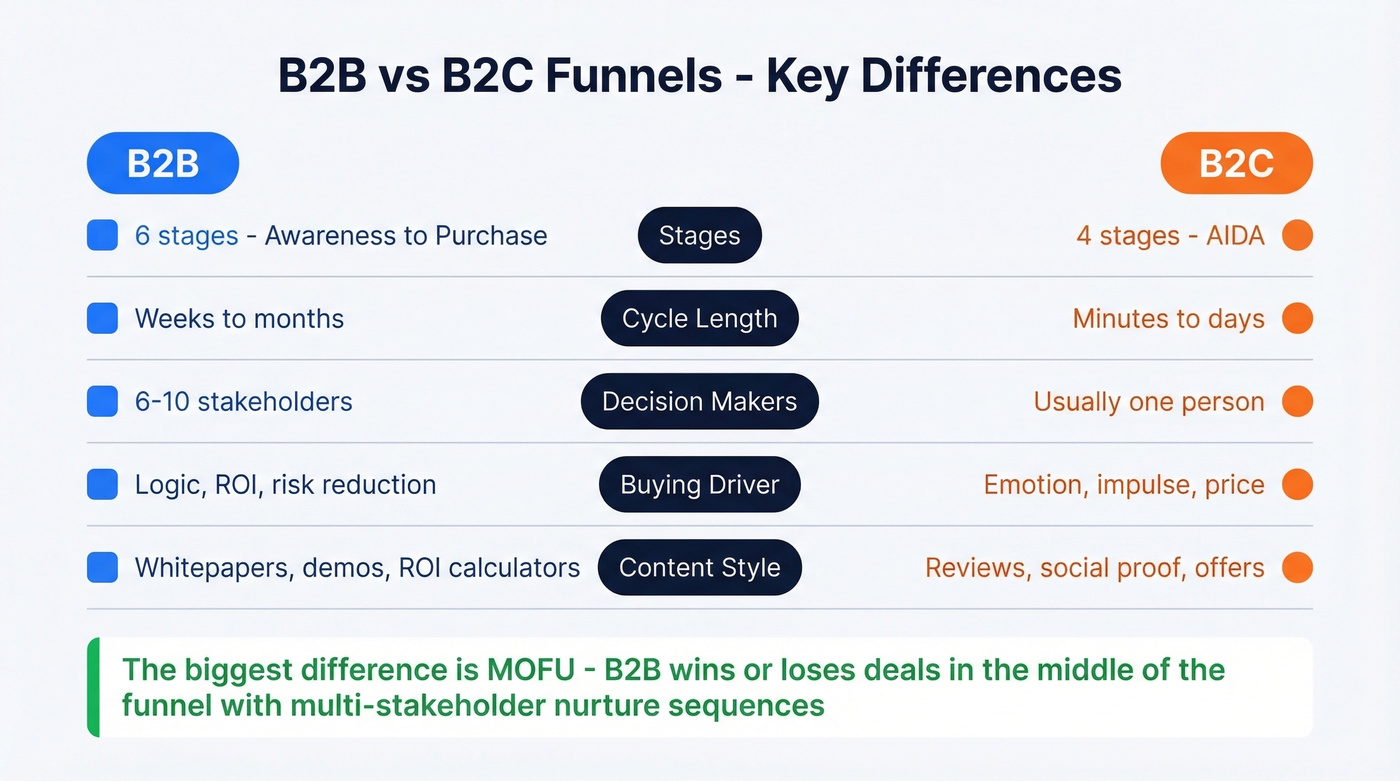
| Dimension | B2B | B2C |
|---|---|---|
| Stages | 6 (Awareness to Purchase) | 4 (AIDA) |
| Cycle length | Weeks to months | Minutes to days |
| Decision-makers | 6-10 stakeholders | Usually one person |
| Buying driver | Logic, ROI, risk reduction | Emotion, impulse, price |
| Content style | Whitepapers, demos, ROI calcs | Reviews, social proof, offers |
The biggest practical difference is the middle of the funnel. B2B MOFU is where deals are won or lost - it's where you build trust with multiple stakeholders over weeks of nurture sequences, case studies, and technical evaluations. B2C MOFU is often just a retargeting ad and an abandoned cart email.
For B2B teams, plan for a longer consideration phase and multi-threaded outreach to buying committees. For B2C, invest heavily in reducing friction at checkout and recovering abandoned carts.
Common Funnel Types
Not every funnel looks the same. The right structure depends on your business model, price point, and buyer behavior.
For building your pipeline: The lead generation funnel captures contact info in exchange for a resource and feeds a nurture sequence. It's the workhorse of B2B marketing. The webinar funnel takes this further - registration, attendance, pitch, offer - and works best for complex products that need education before purchase. If your product requires a 10-minute explanation, skip the lead magnet and go straight to webinars.
For driving direct purchases: A sales page funnel uses a long-form page to drive a single purchase decision, best for mid-ticket products with a clear value proposition. The tripwire funnel flips the economics - a low-cost offer ($7-$27) converts a lead into a buyer, then upsells. eCommerce and info product companies swear by this model because it recoups ad spend before the real sale even happens.
For creating urgency: Product launch funnels build pre-launch buzz, run a launch event, and close with a limited-time offer. Application funnels go the opposite direction - the prospect applies to work with you, creating scarcity and qualification. High-ticket consultants and agencies use application funnels to filter out tire-kickers before a single call gets booked.
For list building at scale: The squeeze page funnel is a minimal page focused entirely on email capture. A reverse squeeze page - showing content before asking for the email - can raise conversions by up to 85%. The VSL (video sales letter) funnel lets the video do the selling, with a CTA that follows. Products that benefit from demonstration see the highest conversion rates here.
How to Build Your Funnel
Define Your ICP and Buyer Personas
Everything starts here. Who are you selling to? What triggers their search? What objections will they raise? An undefined ICP means you're targeting everyone and converting no one.
Get specific: industry, company size, job titles, tech stack, budget range, and the business pain that makes them care. We've seen teams skip this step and spend six months producing content that attracts the wrong audience entirely.
Map Stages and Set Criteria
Write down your funnel stages and define explicit criteria for each transition. What makes a lead an MQL? What makes an MQL an SQL? These can't be vibes - they need to be measurable actions or attributes.
Set handoff SLAs between marketing and sales. When marketing passes an MQL, sales has 24 hours to follow up. When sales rejects a lead, they log a reason so marketing can adjust targeting. This feedback loop is what separates functional funnels from finger-pointing.
Build Content Per Stage
TOFU needs awareness content - blog posts, social content, SEO-driven guides, short videos. MOFU needs nurture material - webinars, case studies, comparison guides, email sequences. BOFU needs conversion assets - free trials, demos, proposals, customer testimonials, ROI calculators.
The most common mistake is producing mountains of TOFU content while MOFU is a desert. If you've got traffic but no pipeline, look at your middle-of-funnel content first. The Forbes Advisor funnel template guide offers a free framework for mapping content to stages if you need a starting point.
Populate With Verified Data
Your funnel is only as good as the data entering it. If 30% of your outbound emails bounce, you're not running a funnel - you're running a spam cannon.
This is where data quality tools earn their keep. Prospeo's B2B database covers 300M+ professional profiles with 30+ search filters - buyer intent, technographics, job changes, headcount growth, funding signals. Email accuracy runs 98%, and every record refreshes on a 7-day cycle. You can filter by intent topic, build a targeted list, and export verified contacts directly into your sequencer or CRM.

Instrument and Optimize
Set up stage-by-stage conversion tracking from day one. Compare your numbers against the benchmarks above. Identify your biggest leak - the stage with the worst conversion rate relative to benchmarks - and fix that first.
Don't try to optimize everything simultaneously. One stage improvement at a time, measured over 2-4 weeks, with a clear before-and-after. That's how you compound gains without losing your mind.
Mistakes That Kill Conversion
No Agreed MQL Definition
When marketing and sales don't share a definition of "qualified," every handoff becomes an argument. Sit in a room, agree on criteria, write them down, and revisit quarterly.
Undefined ICP
Targeting "anyone who might buy" is the fastest way to waste budget. We've watched teams run outbound campaigns to lists of 50,000 contacts with no firmographic filtering and wonder why reply rates sit under 1%. Narrow your ICP, and conversion rates at every stage improve.
Skipping MOFU Entirely
Jumping from "here's a blog post" to "book a demo" ignores the entire consideration phase. Prospects need nurture - case studies, comparison content, email sequences that build trust over time. The middle of the funnel is where B2B deals are actually won. If you're only producing top-of-funnel content and bottom-of-funnel CTAs, you've got a gap the size of a canyon where your pipeline should be.
Bad Contact Data
This one's a silent killer. Bounce rates of 35-40% don't just waste rep time - they destroy your sender reputation, which tanks deliverability for every future campaign. Snyk faced exactly this problem: bounce rates dropped from 35-40% to under 5% after cleaning up their data pipeline, and AE-sourced pipeline jumped 180% with over 200 new opportunities per month. Clean data isn't optional. It's infrastructure. (If you're diagnosing this, start with email bounce rates and an email deliverability audit.)
No Post-Purchase Strategy
A 5% increase in retention can boost profits 25-95%, yet most funnels end at "closed won" and hand the customer to a support inbox. Build onboarding sequences, expansion offers, and referral programs into your funnel from the start. (If you want the math, see churn analysis and renewal rate.)
Cart Abandonment Neglect
For B2C funnels, average cart abandonment sits at 70%. That's the majority of your potential revenue walking away. Two-step checkout processes improve conversion 20-40%, and recovery email sequences at 1 hour, 24 hours, and 48 hours post-abandonment recapture a meaningful chunk. Skip this if you're purely B2B - but if you sell anything with a self-serve checkout, this is money on the table.
Measuring Vanity Metrics
Tracking "leads generated" without stage-by-stage conversion rates is like measuring a restaurant's success by how many people walk past the door. Total leads mean nothing if your MQL-to-SQL rate is 5%. Instrument every stage, benchmark against industry data, and optimize the weakest link. (For a KPI list, use these funnel metrics and lead generation metrics.)
The article says 39% of leads convert to MQLs. But that number assumes you're reaching real buyers. Prospeo's 30+ filters - including buyer intent tracking across 15,000 topics - let you fill your TOFU with prospects already researching your category. At $0.01 per email, your cost per MQL drops fast.
Fill your funnel with in-market buyers, not random contacts.
Is the Funnel Dead?
Every few years, someone declares the funnel obsolete. The core critique is fair: buyers don't move linearly. They bounce between channels - reading a community thread, watching a YouTube review, clicking a retargeting ad, asking a peer on Slack - before ever filling out a form. Attribution breaks. The funnel "ends" at purchase and ignores retention.
Three alternatives have gained traction. The flywheel model, popularized by HubSpot, puts the customer at the center and treats retention and referrals as growth engines. The McKinsey customer decision journey maps a looping, non-linear path through consideration and evaluation. The bow-tie model mirrors the funnel after purchase, adding expansion and advocacy stages.
Real talk: the funnel isn't dead - it's incomplete. Use the marketing sales funnel for measurement and planning. It gives you stage-by-stage conversion rates, identifies leaks, and creates accountability between teams. Use the flywheel for organizational design - making sure customer success, product, and marketing all contribute to retention and expansion. They're complementary frameworks, not competitors.
FAQ
What's the difference between a marketing funnel and a sales funnel?
The marketing funnel covers the end-to-end journey from stranger to customer. A sales funnel is a specific conversion experience - a landing page sequence, webinar flow, or checkout process - driving action at a particular stage. Most teams combine both into a unified pipeline covering first touch through closed deal.
What's a good funnel conversion rate?
Overall visitor-to-customer rates fall between 3% and 10%, but measure stage by stage. B2B SaaS benchmarks: Lead to MQL 39%, MQL to SQL 38%, SQL to Opp 42%, SQL to Closed 37%. If you're significantly below any single stage, that's your optimization target.
How many funnel stages should I use?
B2B teams typically use 6 stages: Awareness, Interest, Consideration, Intent, Evaluation, Purchase. B2C teams often use 4: Awareness, Interest, Desire, Action. Start with fewer stages and add complexity only when you have data to justify the split.
Why do most funnels leak at the middle?
Two reasons: undefined MQL/SQL criteria so marketing and sales disagree on lead quality, and bad contact data causing bounced emails and wrong numbers. Fix the handoff definition first, then verify your data. In our experience, cleaning up email accuracy alone - getting bounce rates from 35%+ down to under 5% - can transform mid-funnel conversion overnight.
Is the marketing funnel outdated?
No, but it's incomplete. Buyers don't move linearly - they loop between channels before converting. The fix isn't abandoning the funnel; it's layering in the flywheel for retention and the bow-tie model for post-purchase expansion. Use the funnel for measurement, the flywheel for growth strategy.