

The Best Mass Email Software in 2026: Tested, Priced, and Ranked
A Mailchimp user on Reddit recently shared their bill: $308/month to send daily emails to 7,000 subscribers. That's about $3,696 a year - and it's driving teams to rethink their entire mass email software stack. Meanwhile, independent testing shows roughly 17% of marketing emails never reach the inbox at all. You're paying more and reaching fewer people.
Picking the wrong type of bulk email tool wastes more money than picking the wrong tool within a category. We evaluated 15+ platforms on deliverability benchmarks, pricing at scale, free tier generosity, and automation depth. Here's what we found.
Our Picks at a Glance
| Use Case | Pick | Why | Starting Price |
|---|---|---|---|
| Best overall | Brevo | 88.3% inbox + best value | Free, then $9/mo |
| Best deliverability | ActiveCampaign | 94.2% inbox - highest tested | $15/mo |
| Best for developers | Amazon SES | $0.10/1K emails, unbeatable | $0.10/1K emails |
| Best free plan | MailerLite | 12K emails/mo (up to 500 subs) | Free |
| Best for ecommerce | Omnisend | Deep Shopify integration | Free, then $16/mo |
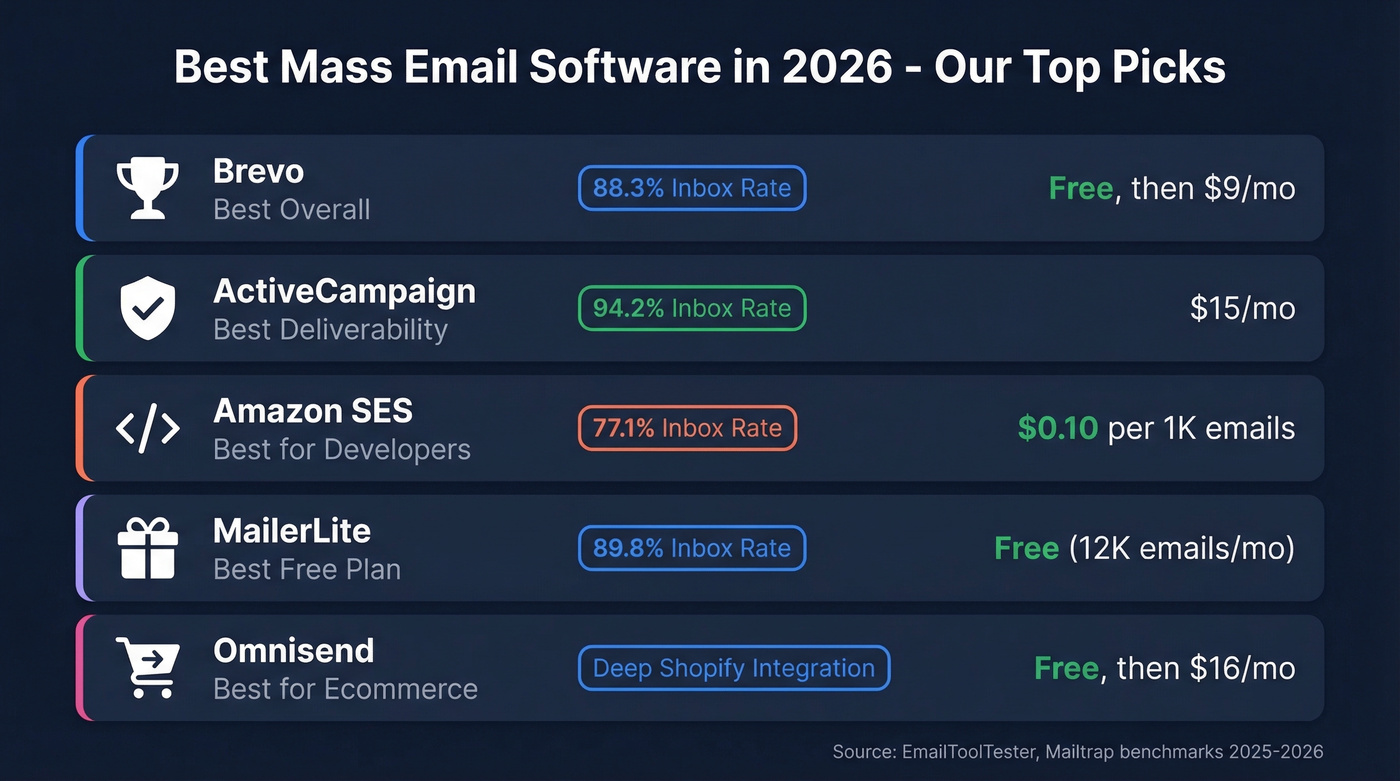
ActiveCampaign wins on deliverability. Brevo wins on value. Amazon SES wins on raw cost. But none of them matter if your list is full of invalid addresses - clean your data before any ESP touches it.
Which Type Do You Actually Need?
Not all mass email tools solve the same problem. Before comparing features, figure out which category you're shopping in.
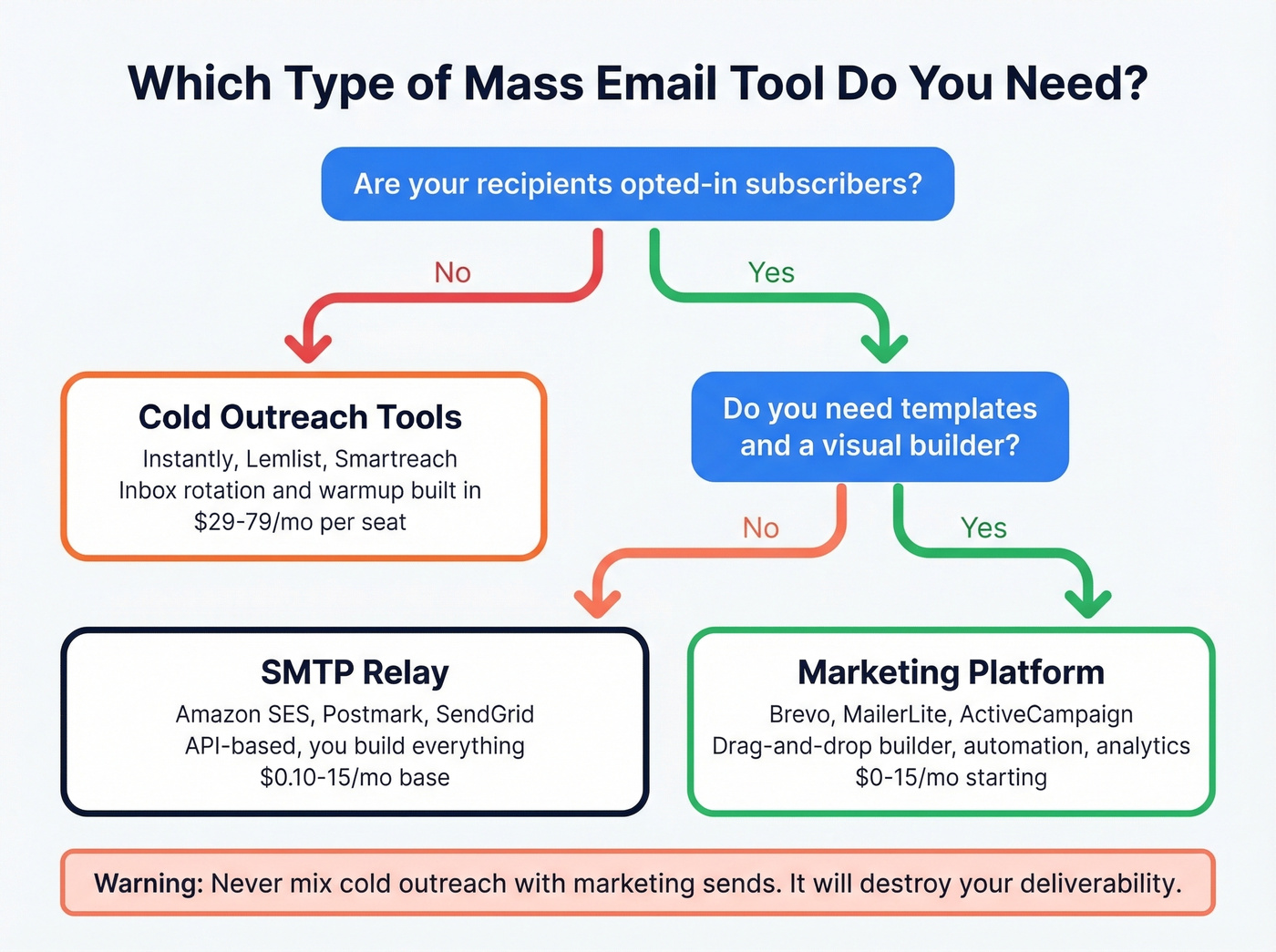
| Marketing Platforms | SMTP Relays | Cold Outreach Tools | |
|---|---|---|---|
| Examples | Brevo, MailerLite, ActiveCampaign | Amazon SES, Postmark, SendGrid | Instantly, Lemlist, Smartreach |
| Best for | Newsletters, promos, automation | Transactional + bulk via API | Prospecting to cold lists |
| Builder | Drag-and-drop | None (API/SMTP) | Sequence-based |
| Pricing model | Per subscriber or sends | Per email sent | Per inbox/seat |
Marketing platforms give you templates, automation, and analytics in one package. SMTP relays are raw infrastructure - cheaper per email, but you're building everything yourself. Cold outreach tools are an entirely different animal: they manage inbox rotation, warmup, and deliverability for emails sent to people who didn't opt in.
Here's the thing: mixing these streams kills deliverability. If you're sending transactional receipts and marketing newsletters from the same infrastructure, a spam complaint on your promo blast can tank delivery of your password reset emails. The best setups isolate these streams completely. Brevo does this with separate IP pools, Postmark uses Message Streams, and Amazon SES can be configured with dedicated IPs per use case.
If you're emailing purchased or scraped lists, stop reading this article and look at cold outreach tools instead. Instantly runs about $30/mo, Lemlist $55-79/mo, and Smartreach around $29/mo. Any bulk email tool designed for marketing assumes opt-in subscribers - sending cold emails through Mailchimp or Brevo will get your account banned.
Best Mass Email Platforms Ranked
Brevo - Best Overall
Brevo hits the sweet spot most teams need: solid deliverability, generous free tier, and pricing that doesn't explode as your list grows.
Use this if you want one platform for marketing emails, transactional messages, and basic automation without paying enterprise prices. The free plan gives you 300 emails/day to up to 100,000 contacts - that's 9,000/month with no credit card. Starter runs $9/mo for 5,000 emails, and Business is $18/mo.
Skip this if deliverability is your single highest priority. Brevo's 88.3% inbox placement is solid but trails ActiveCampaign by nearly 6 points. For high-stakes campaigns where every percentage point of inbox placement translates directly to revenue, that gap is real.
ActiveCampaign - Best Deliverability
ActiveCampaign scored 94.2% in EmailToolTester's benchmark - the highest of any marketing platform tested. That's not a marginal win.
The automation builder is genuinely best-in-class, with conditional logic, split actions, and goal tracking that most competitors can't match. It also doubles as a bulk personalization tool, letting you dynamically tailor content blocks, subject lines, and send times based on contact behavior and tags. No free plan though - just a 14-day trial. Pricing starts at $15/mo for 1,000 contacts and 10x your contact limit in monthly sends, scaling steeply as your list grows.
If you're sending to 50K+ subscribers and need every email to land, this is the tool. Full stop.
Amazon SES - Best for Developers
The math on Amazon SES is hard to argue with. At $0.10 per 1,000 emails, sending 250,000 emails/month costs roughly $25.77. The free tier gives you 3,000 message charges/month for your first 12 months.
The tradeoff is everything else. No templates, no drag-and-drop builder, no visual interface. You're writing API calls, managing bounce handling, and building your own analytics. Dedicated IPs run $24.95/mo each. Watch out for the Virtual Deliverability Manager add-on - when it's enabled, each email counts as two message charges, and it adds $0.07/1K emails on top of the base rate. In SMTP relay testing, SES hit 77.1% inbox placement on shared IPs - decent but behind Postmark's 83.3%.
Best value if you have a developer. Worst value if you don't.
MailerLite - Best Free Plan
MailerLite's free plan covers 12,000 emails/month for up to 500 subscribers - roughly 400 emails/day, which handles most early-stage newsletters. The UI is clean, the drag-and-drop builder works well, and paid plans start at $10/mo. Deliverability sits at 89.8%, right in the middle of the pack.
Skip this if you need advanced automation or deep segmentation. MailerLite keeps things simple, which is a feature until it isn't.
Mailchimp - The Incumbent
Mailchimp is coasting on brand recognition. Pricing climbed while deliverability sits mid-pack at 89.5%. The free plan is borderline useless: 500 emails/month to 250 subscribers, capped at 250/day. That's a demo, not a plan.
There's no reason to choose Mailchimp over Brevo or MailerLite in 2026 unless you're already embedded in the ecosystem and migration cost outweighs the savings. The Reddit complaints write themselves - users report bills doubling without warning, and that $308/month for 7K subscribers story isn't an outlier. The consensus on r/Mailchimp is pretty clear: people are leaving.
If you're seeing inbox rates slide, read our breakdown of Mailchimp deliverability issues before you double down.
Postmark - Best SMTP Deliverability
Postmark takes deliverability seriously in a way other SMTP relays don't. In Mailtrap's head-to-head test, Postmark hit 83.3% inbox placement on shared IPs - the highest of any relay tested, with only 0.9% of emails going missing entirely. Starts at $15/mo, with dedicated IPs at $50/mo extra.
Best for reliable transactional email delivery. Skip this if you need a visual campaign builder - Postmark is infrastructure-first.
Moosend - Budget Automation
Moosend delivers 90.1% inbox placement at $9/mo for 500 contacts with unlimited sends. No free plan, but the 30-day trial is generous. The automation builder punches above its weight - conditional workflows, event triggers, and decent segmentation at a fraction of ActiveCampaign's price.
Skip this if your list exceeds 10K contacts, where pricing scales quickly.
Sender
Free plan covers 2,500 subscribers and 15,000 emails/month - the most generous free limits on this list. Paid plans from $7/mo. Best for bootstrapped teams who need volume without a credit card, though automation is limited compared to Brevo or MailerLite.
SendGrid
Essentials from ~$19.95/mo. Here's the problem: SendGrid scored just 61% inbox placement in independent testing, with 20.9% of emails going missing entirely. That's not a deliverability issue - it's a black hole. We can't recommend it for anything reputation-sensitive.
Omnisend
Free plan: 500 emails/month to 250 contacts. Standard plan $16/mo for 6,000 emails. Built specifically for ecommerce with deep Shopify integration, pre-built automation for cart abandonment and browse triggers. If you're not running an online store, look elsewhere.
Also Considered
We evaluated GetResponse (90.9% deliverability but pricing gets complex), Kit (formerly ConvertKit - strong for creators, limited for general use), and Beehiiv (newsletter-focused, not a full bulk email platform). None cracked the top picks for general use cases.
Deliverability Benchmarks Compared
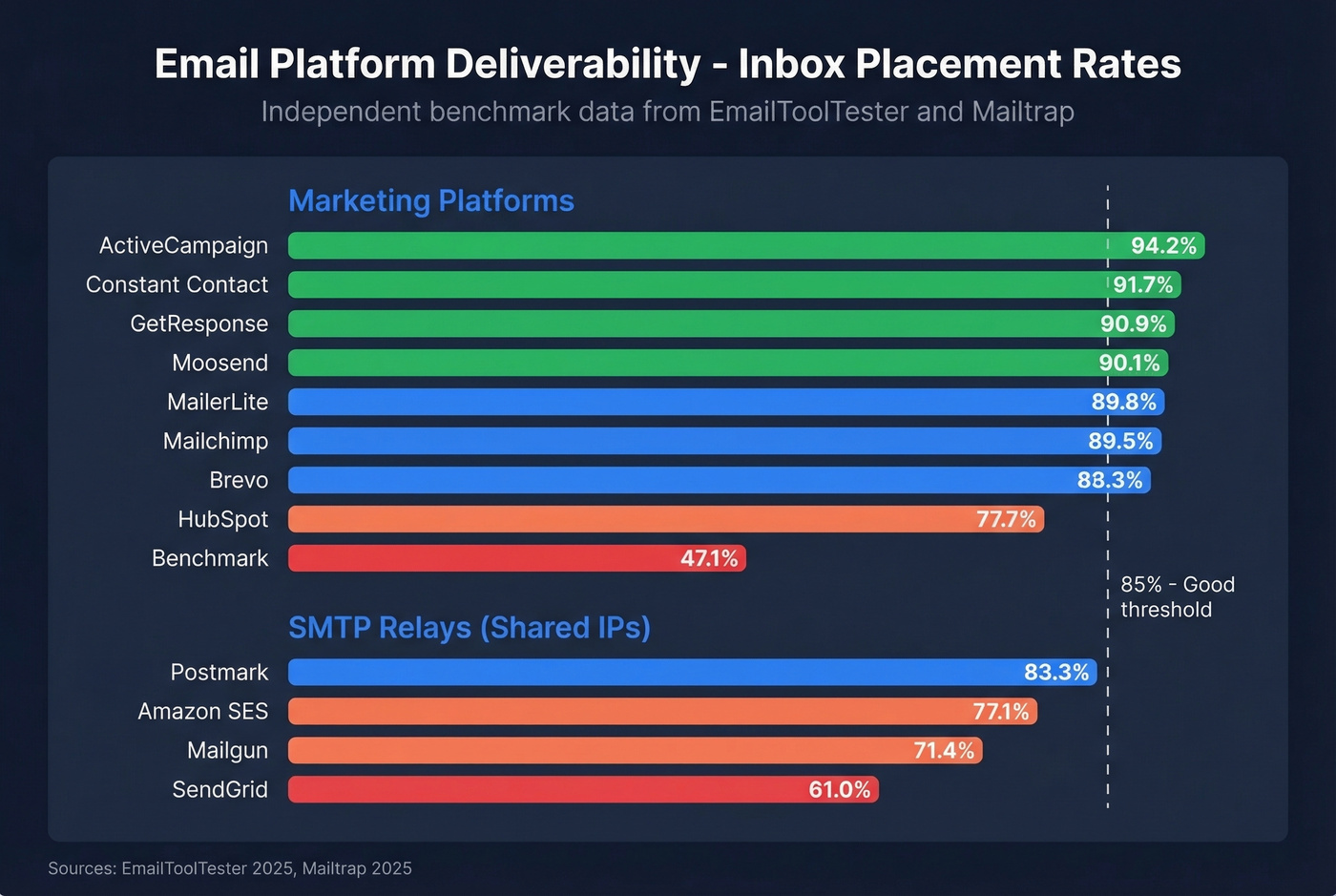
Every bulk email guide says "good deliverability" without a single number. Here are the actual numbers from the most recent independent cross-platform benchmarks available.
Marketing Platform Inbox Placement (EmailToolTester)
| Platform | Inbox Rate |
|---|---|
| ActiveCampaign | 94.2% |
| Constant Contact | 91.7% |
| GetResponse | 90.9% |
| Moosend | 90.1% |
| MailerLite | 89.8% |
| Mailchimp | 89.5% |
| Brevo | 88.3% |
| HubSpot | 77.7% |
| Benchmark | 47.1% |
The gap between ActiveCampaign and HubSpot is 16.5 percentage points. That's the difference between a campaign that works and one that doesn't. In a survey of 1,100+ senders, 48% said staying out of spam was their top deliverability challenge. Inbox Placement by Mailbox Provider
| Provider | Inbox | Spam | Missing |
|---|---|---|---|
| Gmail | 87.2% | 6.8% | 6.0% |
| Yahoo/AOL | 86.0% | 4.8% | 9.2% |
| Apple Mail | 76.3% | 14.3% | 9.4% |
| Microsoft | 75.6% | 14.6% | 9.8% |
Microsoft and Apple Mail are significantly harder to land in than Gmail. If your audience skews enterprise with Outlook-heavy inboxes, deliverability matters even more - and if you're running bulk email sequences through Outlook or Microsoft 365 directly, you'll hit daily sending limits fast, which is why dedicated platforms exist.
SMTP Relay Inbox Placement (Mailtrap test, shared IPs)
| Relay | Inbox | Spam | Missing |
|---|---|---|---|
| Postmark | 83.3% | 14.3% | 0.9% |
| Amazon SES | 77.1% | 20.0% | 1.0% |
| Mailgun | 71.4% | 23.8% | 1.0% |
| SendGrid | 61.0% | 17.1% | 20.9% |
A dedicated IP typically doesn't make sense if you're sending fewer than 100,000 emails/month. Below that volume, you can't build enough reputation on the IP to outperform a good shared pool.

Every ESP on this list punishes you for bounces. Brevo, ActiveCampaign, Mailchimp - they all throttle or ban accounts when bounce rates spike. Prospeo's 98% email accuracy and 5-step verification keep your bounce rate under 4%, so your mass email software actually performs.
Fix your data before it wrecks your deliverability.
What 250K Emails Actually Costs
For a clean "at scale" baseline, Amazon SES is the easiest reference point: sending 250,000 emails/month costs about $25.77 at $0.10 per 1,000 emails.
If you’re trying to model safe volume ramps, daily caps, and reputation risk, use an email velocity framework instead of guessing.
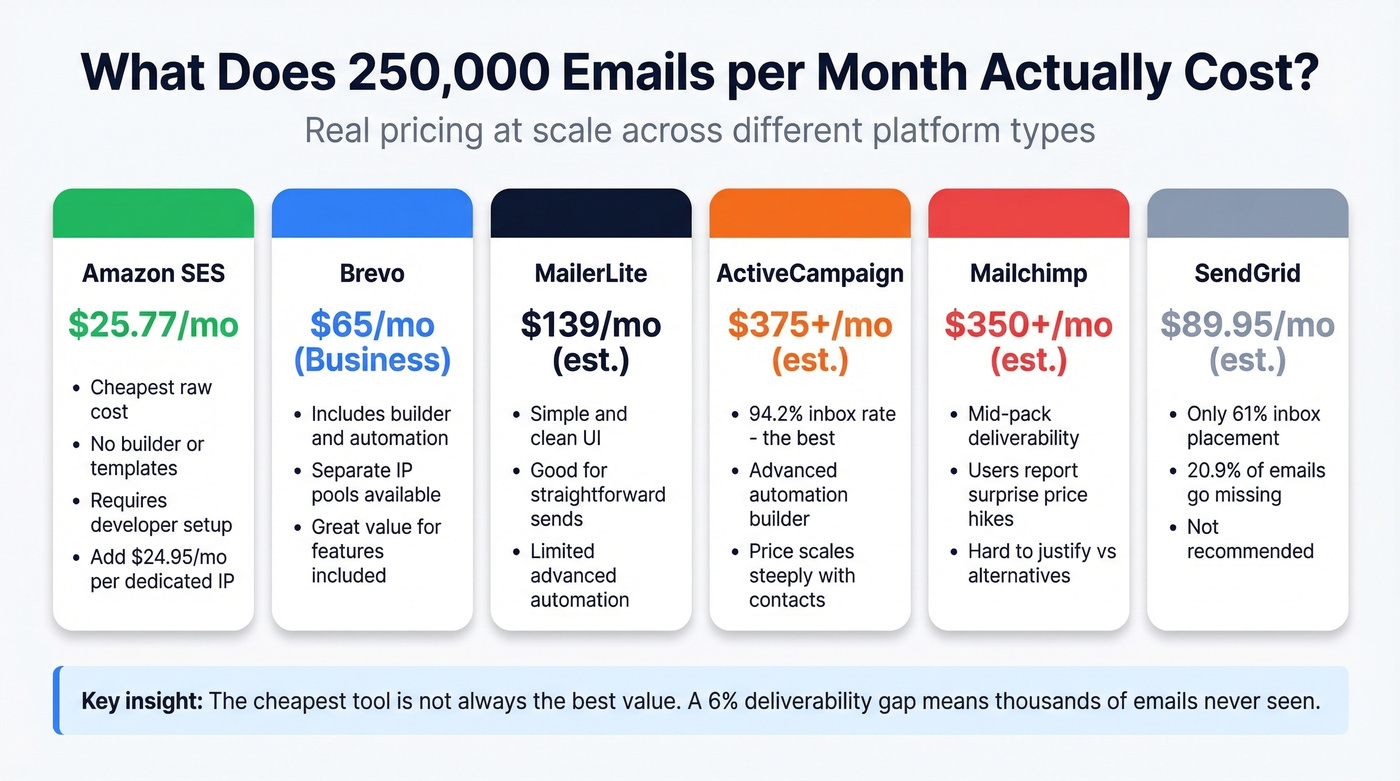
The tradeoff is you're buying infrastructure, not a marketing platform. If you want templates, automations, segmentation, and a UI, you'll pay more - but you'll also ship faster.
Let's be honest: if your average campaign value is under $5,000/month in revenue, you probably don't need anything beyond a value-first marketing platform like Brevo. Most teams overspend on bulk email tools because they're buying features they'll never configure.
Verify Before You Send
None of these tools matter if your list is dirty. We've seen teams launch a campaign through a top-tier ESP and watch their bounce rate spike to 8% on the first send - and that wasn't an ESP problem. It was a list problem. Once your sender reputation takes that hit, even ActiveCampaign's 94.2% deliverability can't save you.
If you’re not sure what “too high” looks like, start with email bounce rate benchmarks and the most common root causes.
The workflow is straightforward: upload your CSV to a verification tool, run it through multi-step validation that catches invalid addresses, spam traps, and honeypots, export the clean list, then push to your ESP. Prospeo handles this with a 5-step verification process - 98% email accuracy across 143M+ verified emails, with a 7-day data refresh cycle versus the 6-week industry average. Stack Optimize built their agency to $1M ARR using this exact approach: 94%+ deliverability and under 3% bounce rate across every client campaign, with zero domain flags.
Think of verification as Step 0 in every mass email campaign. Free tier gives you 75 email verifications/month. Paid plans run roughly $0.01 per email with no contracts.
If you want the full system (authentication, list hygiene, content, and monitoring), follow our email deliverability guide next.
You just read that 17% of marketing emails never reach the inbox. Half that problem is your ESP. The other half is your list. Prospeo refreshes 300M+ contacts every 7 days - not every 6 weeks - so you're never blasting stale addresses that trigger spam filters.
Stop paying your ESP to send emails that bounce.
Compliance Rules You Can't Ignore
Google and Yahoo's 2024 bulk sender requirements changed the game, and enforcement has only tightened through 2026.
SPF, DKIM, and DMARC authentication are non-negotiable - minimum DMARC policy of p=none. No authentication, no inbox. You also need one-click unsubscribe using RFC 8058, which means the header-based unsubscribe, not just a link buried in the footer.
If you’re implementing policy and alignment properly, see DMARC alignment and these SPF record examples before you publish DNS changes.
Keep your spam complaint rate below 0.1% - that's 1 complaint per 1,000 emails. Hit 0.3% and you're very likely landing in spam. CAN-SPAM basics still apply: physical address, honest subject lines, functioning opt-out, with violations carrying fines up to $50,000+ per email. And if you're emailing EU contacts, GDPR requires a legitimate basis for processing, data subject rights, the works.
DMARC adoption jumped to 54% from under 43% in 2023. But 70% of senders still don't use free tools like Google Postmaster Tools to monitor their reputation. That's like driving without a dashboard - you won't know you have a problem until you've already crashed.
How to Stay Out of Spam
Deliverability isn't a feature you buy. It's a practice you maintain.
- Never buy email lists. This tanks sender reputation faster than anything else. (If you’re debating it, read is it illegal to buy email lists.)
- Don't email stale contacts. If someone hasn't opened in 6 months, sunset them.
- Permission-based only. Every recipient should have opted in explicitly.
- Segment your audiences. Generic blasts to your entire list trigger spam filters and complaints.
- Don't use no-reply addresses. Allow replies - engagement signals help deliverability.
- Clean your list quarterly at minimum. Run it through a verification tool before every major send.
- Authenticate everything. SPF, DKIM, DMARC - all three, every sending domain.
- Monitor with Google Postmaster Tools. It's free. 70% of senders don't bother. Be in the 30%.
- Invest in automation over blasts. Klaviyo's data shows automated flows generate 41% of email revenue from just 5.3% of sends. Campaigns account for 94.7% of volume but dramatically lower engagement.
Real talk: most deliverability problems aren't technical. They're behavioral. Teams blast their entire list, ignore bounces, skip authentication, and then blame the ESP when emails land in spam. Fix the behavior first.
FAQ
What is mass email software?
Mass email software sends emails to large lists - hundreds to millions of recipients - with deliverability management, templates, and compliance features built in. Marketing platforms like Brevo and ActiveCampaign offer visual builders and automation, while SMTP relays like Amazon SES and Postmark provide API-based sending infrastructure.
Is sending bulk email legal?
Yes, provided you follow CAN-SPAM (US), GDPR (EU), and similar regional laws. Requirements include opt-in consent, a physical mailing address in every email, one-click unsubscribe via RFC 8058, and honest subject lines. Fines for violations can exceed $50,000 per email.
How many emails can you send per day for free?
Brevo: 300/day. MailerLite: ~400/day. Sender: 500/day. Amazon SES: ~100/day (first 12 months only). Mailchimp's free plan caps at 250/day - barely enough for testing.
What's the cheapest way to send bulk emails at scale?
Amazon SES at $0.10 per 1,000 emails - sending 250,000 emails/month costs roughly $25.77. It requires developer setup with no drag-and-drop builder or template library. For non-technical teams, Brevo's $18/month Business plan offers the best balance of price and usability.
How do I verify my email list before sending?
Upload your CSV to a verification tool that checks for invalid addresses, spam traps, and honeypots. Prospeo's 5-step verification process delivers 98% accuracy across 143M+ verified emails, with a free tier of 75 verifications/month. Run verification before every major campaign to keep bounce rates under 3%.