

The MEDDPICC Paper Process: A Tactical Close Guide for 2026
It's the last week of the quarter. Legal has had the MSA for 12 days. Your champion is "following up internally." The deal you forecasted at 90% is about to slip - not because the buyer changed their mind, but because nobody mapped the steps between "yes" and "signature."
That's a MEDDPICC paper process failure, and it's the most preventable reason enterprise deals miss the quarter.
What You Need (Quick Version)
Paper Process is the legal, procurement, security, and finance gauntlet after the buying decision - where most enterprise deals actually slip. You don't need a CRM dropdown. You need a concrete checklist with steps, owners, and timelines. Build a Mutual Action Plan with your champion in week one of the evaluation, not after the verbal yes.
What Is Paper Process in MEDDPICC?
Paper Process was originally buried inside Decision Process in the old MEDDICC framework. It earned its own letter because end-of-cycle contracting complexity became the number-one reason deals slipped out of the quarter. The buying decision and the contract execution are two completely different animals.
The definition is straightforward: Paper Process covers the legal, security, procurement, and finance steps required to finalize a contract after the buying decision is made. Enterprise architecture reviews, InfoSec questionnaires, redline cycles, vendor onboarding, PO creation - all of it.
Gartner's research shows the average B2B buying group is 6-10 people, and 77% of buyers say the purchasing process is "too complex." That complexity doesn't ease up after the verbal yes. It intensifies. And there aren't many people at your buyer's organization who know the entire end-to-end contracting process. If you don't map it, nobody will.
Why Unmapped Contracting Kills Deals
The data is brutal. Conga surveyed 1,200+ decision-makers and found that 93% say deals routinely struggle to move through sales, legal, finance, pricing, and IT. Even worse, 45% admitted to losing a deal in the last six months because quote approval took too long. Not because the product was wrong. Because the paper moved too slowly.
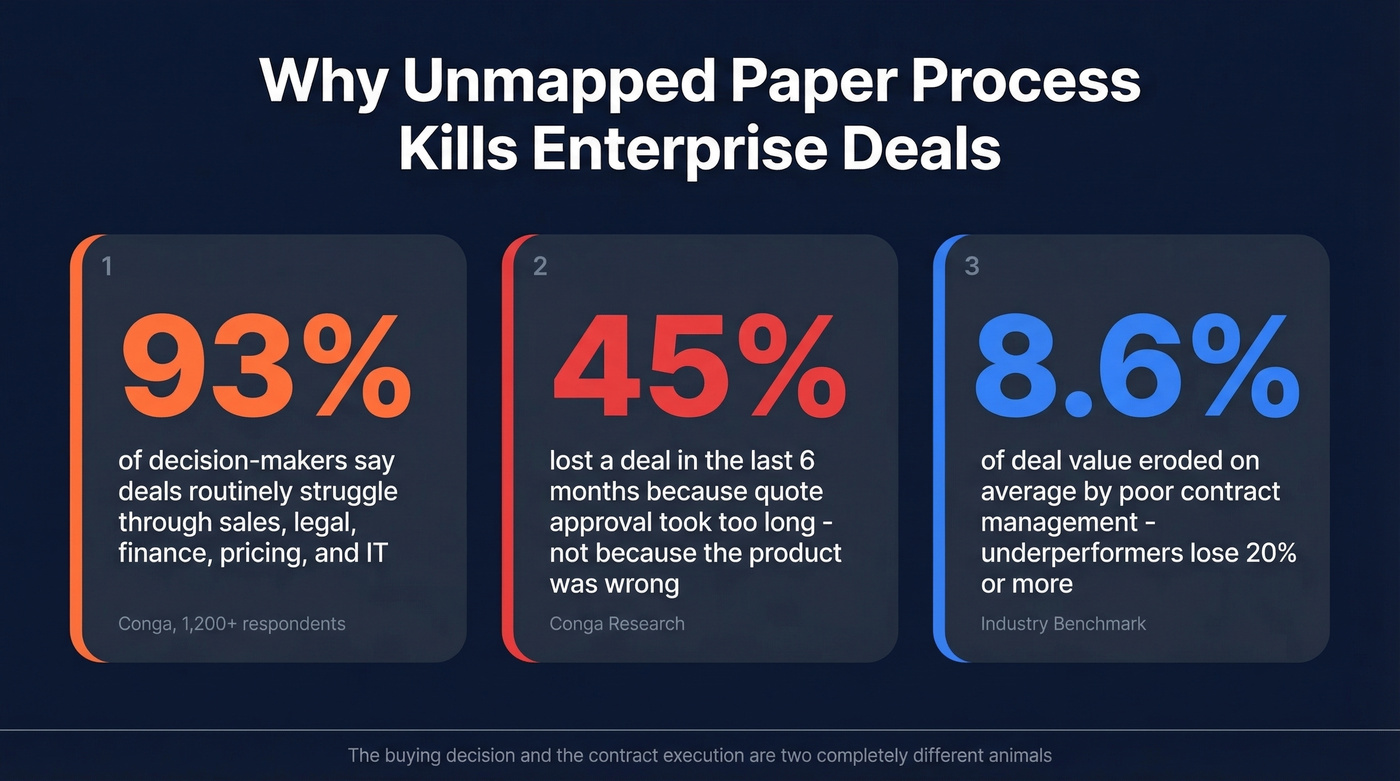
The financial impact compounds fast. Poor contract management erodes an average of 8.6% of deal value, and underperformers lose 20% or more. That's margin destruction, not slippage. As HubSpot's MEDDPICC guide puts it: "Handshake agreements aren't the same as signatures. Enthusiasm doesn't sign contracts - procurement departments do."
In our experience, the deals that close on time are the ones where contracting steps were mapped before the demo, not after the verbal yes.
In practice, this is part of enterprise B2B sales: you win or lose in the last mile.

Deals slip when you can't reach the people who control the paper process. Prospeo gives you verified emails for procurement leads, legal counsel, and security reviewers - the stakeholders your champion can't always introduce you to. 98% accuracy. $0.01 per email. No forwarded intros needed.
Stop waiting on your champion to make introductions that never happen.
The Paper Process Checklist
Every enterprise deal runs through some version of these steps. Durations vary by company size and industry, but the sequence is remarkably consistent.
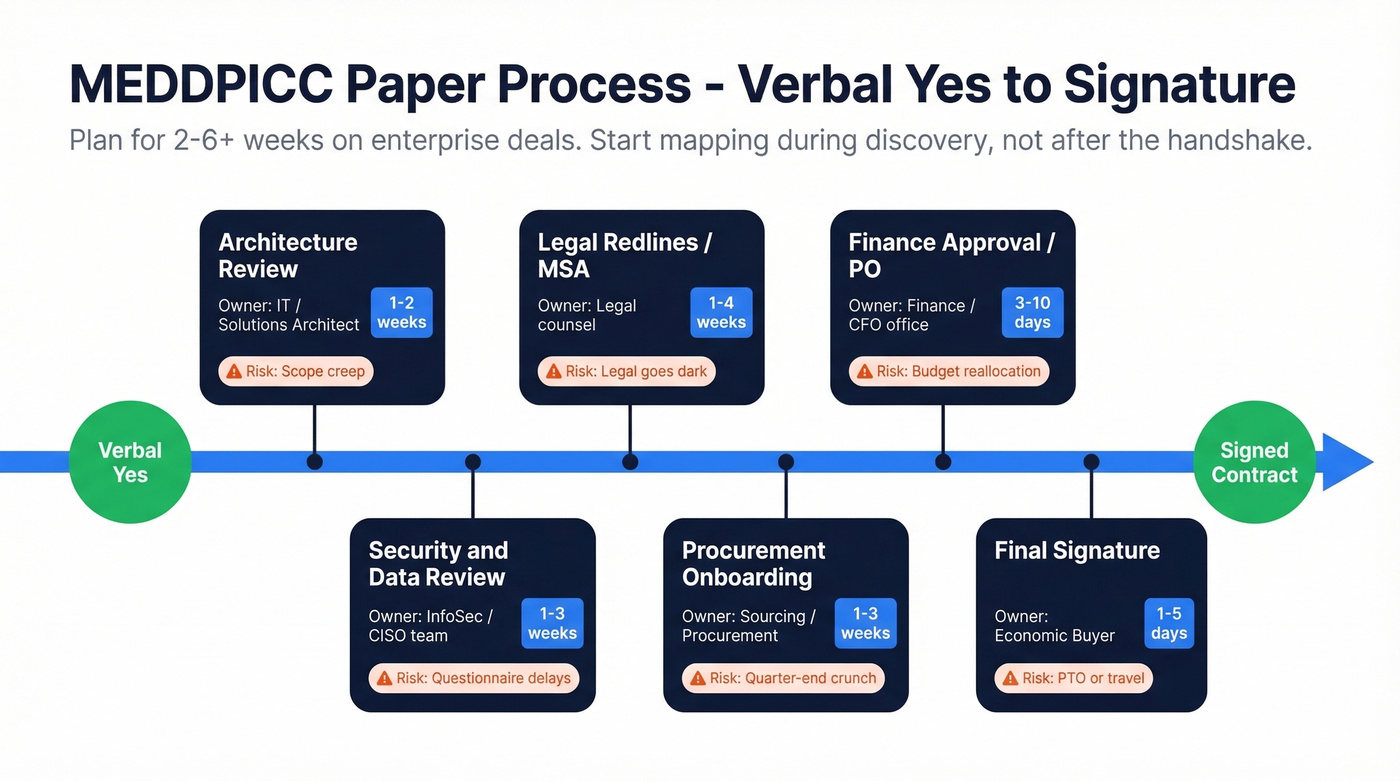
| Step | Typical Owner | Duration | Common Risk |
|---|---|---|---|
| Architecture review | IT / Solutions Architect | 1-2 weeks | Scope creep |
| Security & data review | InfoSec / CISO team | 1-3 weeks | Questionnaire delays |
| Legal redlines / MSA | Legal counsel | 1-4 weeks | Legal goes dark |
| Procurement onboarding | Sourcing / Procurement | 1-3 weeks | Quarter-end crunch |
| Finance approval / PO | Finance / CFO office | 3-10 days | Budget reallocation |
| Final signature | Economic Buyer | 1-5 days | PTO / travel |
Plan for 2-6+ weeks from verbal yes to signature on an enterprise deal. That's why mapping starts during discovery, not after the handshake.
Discovery Questions to Map Contracting Steps
Ask these early - ideally in the first or second meeting.
Mapping the Process
- Walk me through what happens between a "yes" from your team and a signed contract.
- Who needs to sign off, and in what order?
- Is there a standard security questionnaire, or does each vendor get a custom review?
Identifying Owners
- Who on your side shepherds contracts through legal and procurement?
- Is there a single person who knows the full end-to-end process?
- Who has final signature authority?
Surfacing Risks
- What's the longest a contract has been stuck in legal review?
- Are there compliance or security requirements that could add steps?
Creating Urgency
- If we mapped out every step with owners and deadlines today, would that help you move faster internally?
- What would need to happen for this to be signed by [target date]?
Building a Mutual Action Plan
A Mutual Action Plan (MAP) is a buyer-facing shared checklist with milestones, owners, due dates, and status. It isn't your internal spreadsheet - it's a collaborative document both sides own. Dock's framework recommends including a value summary, 8-12 key milestones, key constraints like budget and go-live date, and project documents.
This is also where sales communication breaks down: the MAP has to be buyer-readable, not rep-readable.
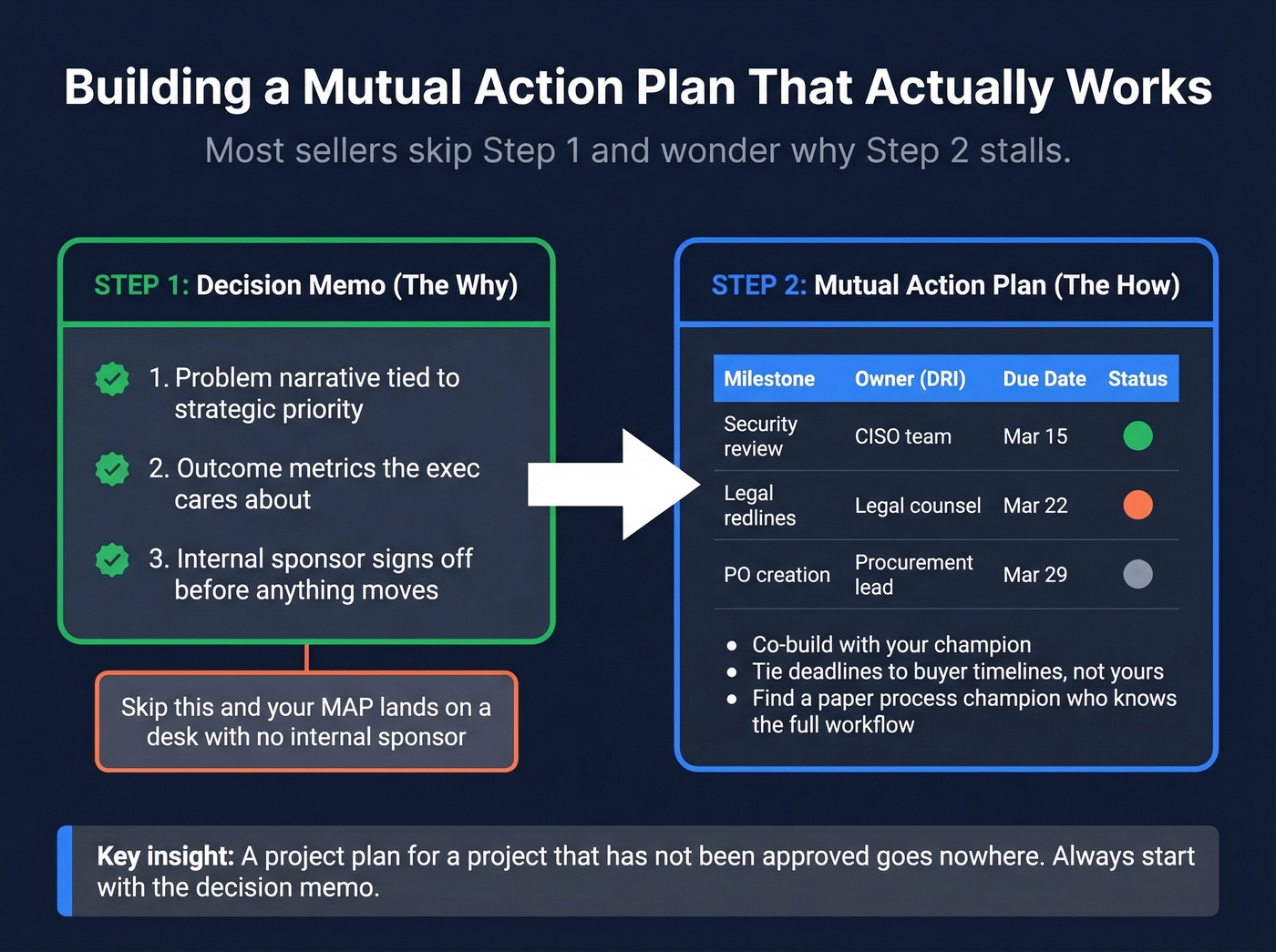
Most sellers get this backwards. A Senior DevOps Director managing ~$2M in annual spend explained it this way: a project plan helps them gauge effort, but it doesn't sell executives internally. They write a "decision memo" first - the why - before the MAP - the how. Skip the decision memo and your MAP lands on a desk with no internal sponsor. Nobody acts on a project plan for a project that hasn't been approved.
Here's the practical sequence: help your champion build the decision memo (problem narrative tied to strategic priority plus outcome metrics), then co-build the MAP with steps across security, legal, procurement, and finance. Assign a directly responsible individual and deadline per task. Tie due dates to buyer timelines - go-live dates, fiscal quarters - to create real urgency rather than manufactured pressure.
Some orgs require reps to identify a "paper process champion" on the buyer side - someone who knows the internal contracting workflow end-to-end and can shepherd the deal through each gate. Find that person early. They're worth more than your Economic Buyer during this phase.
There's a practical problem with all of this, though: your MAP requires direct contact with people your champion barely knows. The procurement lead, the legal counsel, the security reviewer - your champion gives you a name but no email. Tools like Prospeo's email finder return verified emails for those stakeholders in seconds at 98% accuracy, so you're not waiting for forwarded introductions while the clock ticks.
If you need a repeatable way to source those stakeholders, start with sales prospecting techniques that target procurement and InfoSec, not just end users.
Mistakes That Stall Deals
Here's the thing - most of these mistakes come from the same root cause: treating the contracting phase as something that happens to you rather than something you manage.
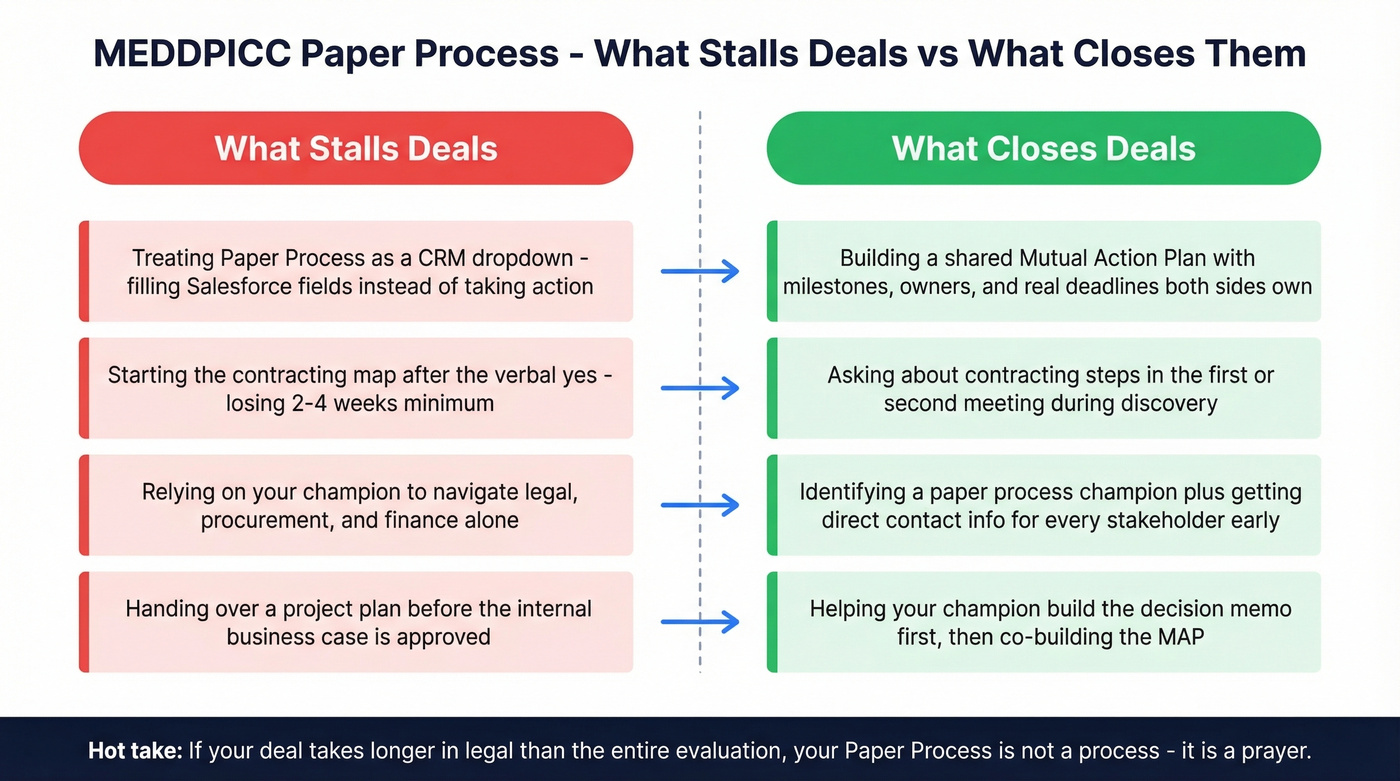
Treating Paper Process as a CRM dropdown, not a living plan. Sales reps on r/sales call MEDDPICC a "CRM exercise disguised as methodology." They're right when it's implemented as fields to fill rather than actions to take. Your contracting plan should be a shared MAP, not a Salesforce picklist.
We've watched deals slip quarter after quarter because the rep assumed their champion knew how procurement worked. They didn't. The rep handed over a project plan, and it sat in an inbox for two weeks because nobody above the champion had bought in yet. That's two mistakes in one: skipping the decision memo and relying on a single person to navigate the entire contracting process. The fix for both is the same - map procurement, IT, finance, and legal stakeholders early, get direct lines to each, and help your champion build the internal business case before you hand them a timeline.
Starting the mapping after the verbal yes. This is the most common mistake we see. By the time you ask "so what does your legal process look like?" after the handshake, you've already lost weeks. Ask about contracting steps in the first or second meeting. And simplify your own side too - clean pricing, pre-approved contract templates, and fast turnaround on redlines remove friction you control.
If your follow-ups are getting stuck in internal limbo, use a tighter cadence from these sales follow-up templates to keep owners accountable without being annoying.
Hot take: If your average deal takes longer to get through legal than it took to run the entire evaluation, your Paper Process isn't a process - it's a prayer. The best enterprise reps treat the MEDDPICC paper process as a qualification criterion. When the buyer can't articulate their own contracting steps, that's a yellow flag on the deal, not a problem to solve after the verbal yes. Skip deals where nobody can tell you how a contract gets signed. You'll thank yourself at quarter end.
This is also a classic sales pipeline challenges issue: late-stage risk that was never operationalized.
Your Mutual Action Plan has 6 steps, 6 owners, and zero direct contact info for half of them. Prospeo's email finder and Chrome extension surface verified emails and direct dials for legal, procurement, and finance contacts in seconds - across 300M+ profiles refreshed every 7 days.
Every day without direct access to a signer is a day your deal slips.
FAQ
What's the difference between Paper Process and Decision Process?
Decision Process is how the buyer evaluates and chooses a vendor. Paper Process is the legal, procurement, security, and finance steps that happen after that decision - where 45% of deals stall due to slow approvals, according to Conga's research.
When should you start mapping Paper Process?
During discovery - first or second meeting. Waiting until after the verbal yes costs you 2-4 weeks minimum. Top reps ask "walk me through what happens between a yes and a signed contract" before they ever demo.
How long does enterprise contracting typically take?
Two to six-plus weeks for enterprise SaaS, depending on security review complexity and legal redline cycles. Deals over $100K with InfoSec requirements routinely hit the six-week mark.
How do you reach procurement and legal contacts you've never met?
Your champion often knows names but not contact details. An email finder with verified data lets you engage procurement leads, legal counsel, and security reviewers directly instead of waiting for forwarded introductions that arrive three days late.