

7 MillionVerifier Alternatives That Actually Deliver
You've been running MillionVerifier for months, maybe years, and something's off. Your card keeps getting declined and support ghosts you. The bulk API returns "unknown" for emails that pass fine through single-check. You're looking for alternatives because the tool that was supposed to be set-and-forget just... isn't.
Why People Switch from MillionVerifier
The Reddit threads tell a consistent story: payment processing failures lock users out with no fix. One long-time user simply couldn't get MV to accept their card and had to find something new overnight.
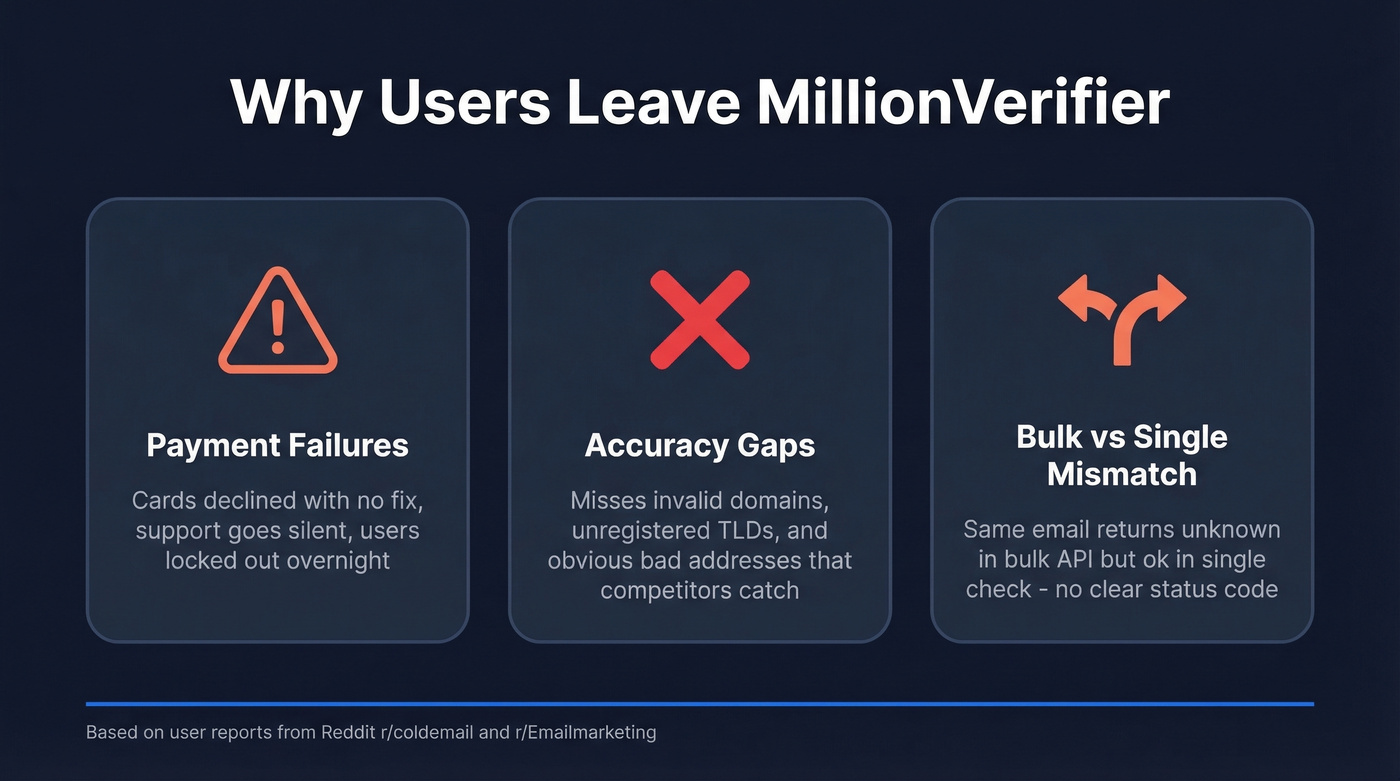
Then there's accuracy. Users who switched from ZeroBounce to MV for the lower price report that MV misses obviously invalid domains - unregistered domains, invalid TLDs, the stuff that should be easy catches. And the bulk API vs. single-check discrepancy is real: the same Yahoo address comes back "unknown" in bulk but "ok" in single-check, with support blaming server connections rather than adding a distinct status code. That's frustrating when your domain reputation is on the line.
Our Top Picks (TL;DR)
| Use case | Pick | Why |
|---|---|---|
| Find + verify in one step | Prospeo | 98% email accuracy, 7-day refresh, free tier |
| Best pure verification accuracy | ZeroBounce | Catches edge cases MV misses, unknowns free |
| Best budget at high volume | DeBounce | From $0.00045/check, 97.5% deliverability guarantee |

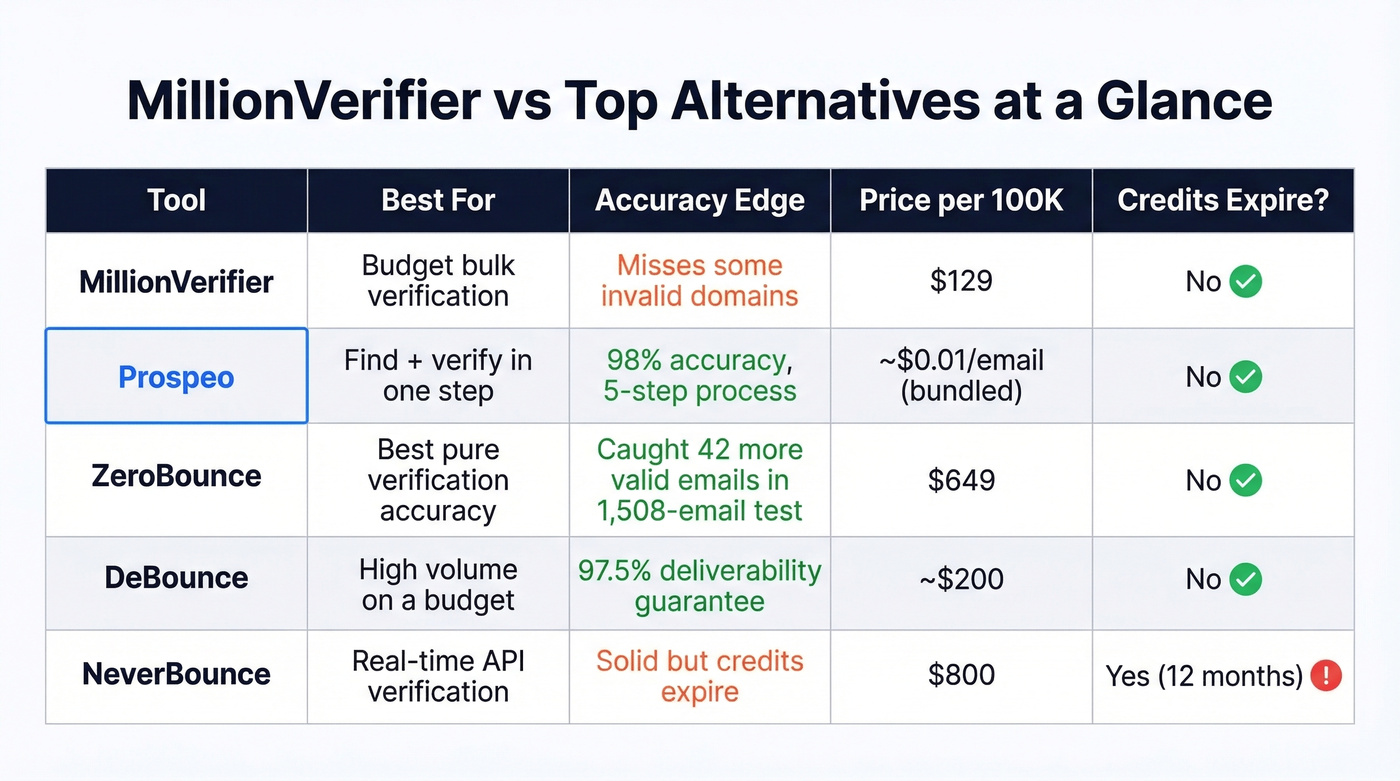
MillionVerifier verifies emails someone else found. Prospeo finds and verifies them in a single workflow - 5-step verification with catch-all handling, spam-trap removal, and honeypot filtering built in. 98% email accuracy at ~$0.01/email, with data refreshed every 7 days so you're never cleaning stale lists.
Stop paying twice for finding and verifying. Do both in one step.
The Best Alternatives to MillionVerifier
Prospeo
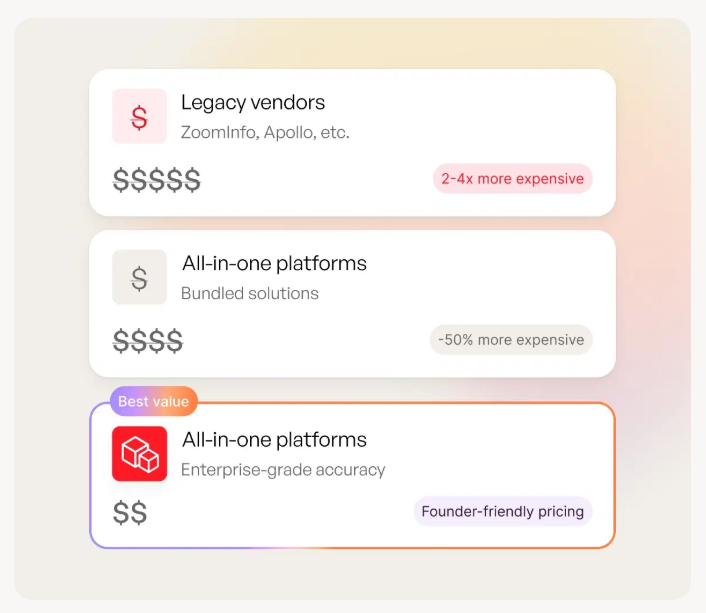
If you're paying for a standalone verification tool and a separate data provider, you're already one step behind. Prospeo finds and verifies emails in a single workflow - its 5-step verification process handles catch-all domains, strips spam traps, and filters honeypots before you ever export a list. The result is 98% email accuracy across 143M+ verified emails, with no contracts and self-serve pricing.

The 7-day data refresh cycle is the real differentiator here. Many data platforms refresh around 6 weeks, which means you're verifying stale data - and stale data bounces no matter how good your verifier is. Prospeo refreshes weekly, so the emails you pull are already current. At ~$0.01 per email, you're paying for finding and verification bundled together. The free tier gives you 75 emails and 100 Chrome extension credits per month to test it out.
If you're building prospect lists from scratch, it also helps to tighten up your overall lead generation workflow so verification isn’t a last-minute patch.
Best for teams building prospect lists from scratch who want verified data out of the gate - no separate cleaning step needed.
ZeroBounce
ZeroBounce catches what MillionVerifier misses. In a 1,508-email head-to-head test, ZeroBounce marked 42 more emails as safe to send. The campaign using ZeroBounce's approved list saw just 2 bounces out of 1,226 passed. That's the kind of edge-case detection that matters when your sending domain is on the line.
If you’re trying to reduce bounces systematically (not just “clean a CSV”), it’s worth understanding email bounce rate benchmarks and root causes.
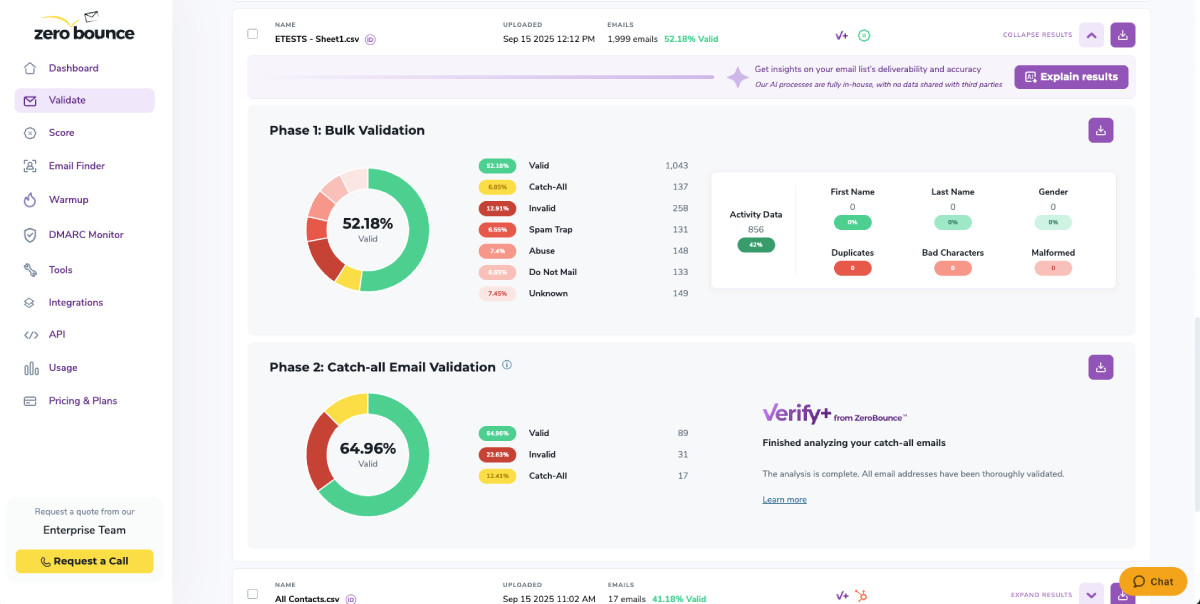
The tradeoff is price. The minimum purchase is $39 for 2,000 credits, and 100K credits run $649 versus MV's $129 - roughly 5x more. But unknowns are free, credits never expire, and you get 100 free monthly verifications with a business email signup. ZeroBounce is worth the premium for teams where a single bounce spike can torch a sending domain.
Skip this if you're verifying 500K+ emails monthly on a tight budget.
Bouncer
Bouncer is the quiet workhorse of this list. At $8 per 1,000 credits scaling down to $2,000 for a million, it sits in a comfortable middle ground - cheaper than ZeroBounce, more reliable than the ultra-budget options. Credits never expire, and you won't get charged for duplicates or unknowns. The 100 free credits let you test before committing.
For teams running monthly list hygiene on 10K-100K contacts, Bouncer is a solid default choice. Nothing flashy. It just works.
If you want more options in this category, see our breakdown of Bouncer alternatives.
DeBounce
DeBounce is the volume play. At $0.00045 per check at scale, it's one of the cheapest email verification tools available, backed by a 97.5% deliverability guarantee and a 4.8/5 rating on Trustpilot across 1,340 reviews. One caveat: catch-all validation costs 10 credits per check instead of 1, so factor that into your math if you're heavy on catch-all domains. The 100 free credits are enough for a quick test run.
If you’re comparing DeBounce to “all-in-one” prospecting stacks, this DeBounce vs Apollo.io comparison helps clarify what you’re actually buying.
NeverBounce
NeverBounce runs $8 per 1,000 PAYG or $49/mo for up to 10,000 verifications. The API is solid for real-time verification baked into signup forms or CRM workflows. No credit card required to start.
Here's the dealbreaker for some teams: credits expire 12 months after purchase. NeverBounce is the only tool on this list with that policy. For steady-volume teams, that's fine. For sporadic verifiers, it's a trap. We've seen this catch more people than you'd expect - teams buy a bulk pack, use half, then lose the rest when a quiet quarter hits.
If you’re building verification into outbound, make sure it aligns with your cold email marketing process (volume, warmup, and list sourcing).
Emailable
Emailable charges $38 for 5,000 credits, credits never expire, and unknowns plus duplicates get refunded automatically. The 250 free credits are generous for a test. Speed is a quiet strength - it processes 10,000 emails in 2-3 minutes. Not much else to say. It does verification well without trying to be a platform.
If you’re deciding between verifiers, it can help to start with the basics of how to check if an email exists so you know what “verification” can and can’t prove.
Clearout
Clearout runs on a subscription model: $23/mo for 3,000 credits, $58/mo for 10,000. In a Sparkle test of 2,500 emails, it returned 88% valid in about 26 minutes. The 100 lifetime free credits are stingy, but the subscription pricing works if you verify consistently each month. For higher volumes, Enterprise pricing is custom.
Pricing Comparison
| Tool | 10K emails | 100K emails | Credits expire? | Unknowns refunded? |
|---|---|---|---|---|
| MillionVerifier | $37 | $129 | No | Yes (bulk) |
| ZeroBounce | $129 | $649 | No | Yes |
| Bouncer | $60 | $400 | No | Yes |
| DeBounce | ~$50 | ~$200 | No | Yes |
| NeverBounce | $80 | $800 | Yes (12 mo) | Not specified |
| Emailable | ~$76 | ~$500 | No | Yes |
| Clearout | $58/mo plan | Custom (Enterprise) | N/A (subscription) | No |
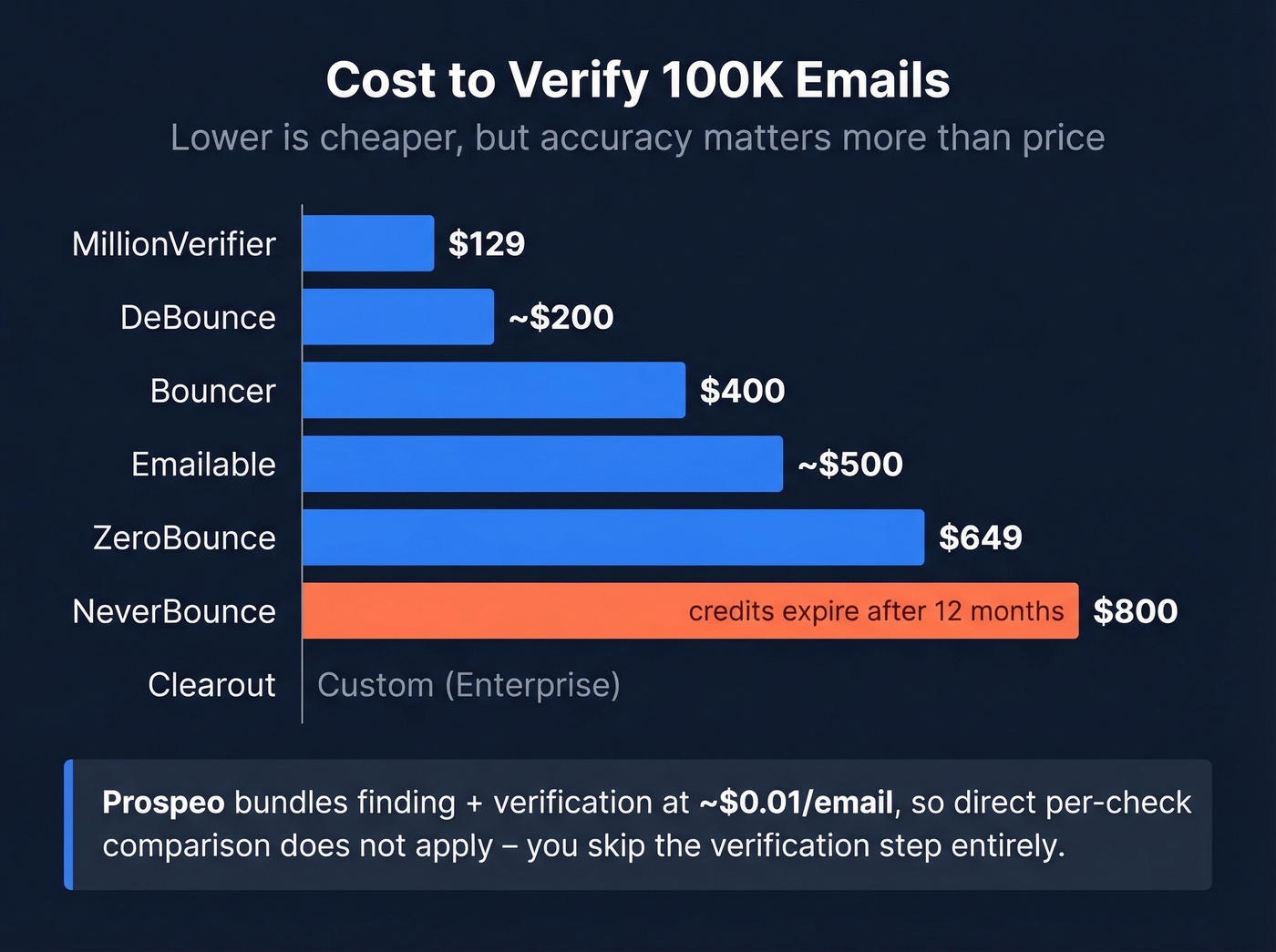
Let's be honest: MillionVerifier is still the cheapest pure verifier on this list at common bulk tiers like 100K for $129. But cheap verification of stale data is worse than paying more for data that's already clean. If you're running low-ACV deals and sending 50K+ cold emails a month, sure, optimize for cost per check. Everyone else should optimize for accuracy per dollar.
If deliverability is the constraint, pair verification with a real email deliverability guide so you’re not fixing symptoms only.
How to Choose the Right Tool
Start with one question: do you already have lists, or are you building them?
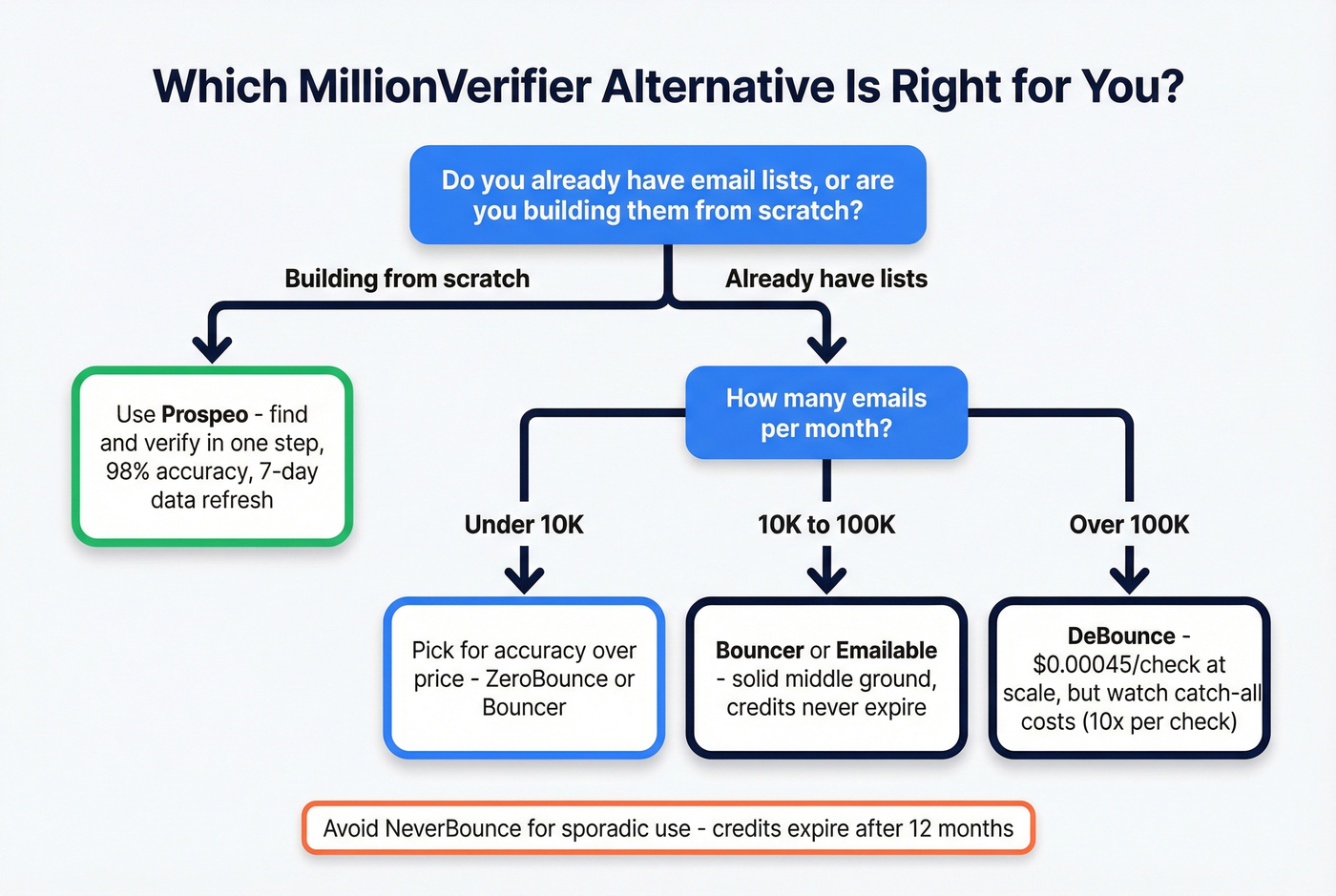
If you're building from scratch, a find-and-verify platform eliminates the separate cleaning step entirely - you pull contacts that are already verified, which means fewer tools, fewer steps, and fewer bounces. If you already have lists sitting in your CRM, a pure verifier is all you need.
After that, volume decides everything. Below 10K emails per month, the absolute dollar differences between these tools are usually small enough to ignore - pick the one with the best accuracy for your use case and move on. Above 100K, DeBounce's per-check pricing pulls away from the pack. Watch out for catch-all handling, though. Some tools refund those credits, others charge 10x per check, and your catch-all percentage directly impacts your real cost in ways that aren't obvious from the pricing page.
If you’re scaling outbound, it’s also worth tracking email velocity so list quality and sending volume don’t compound into deliverability issues.
The real cost of bad verification isn't the per-check price - it's the bounced emails that torch your sending domain. Prospeo's 7-day data refresh means the emails you pull are already current, not 6-week-old records that bounce no matter what verifier you run them through. Free tier included: 75 emails + 100 Chrome extension credits/month.
Fresh data doesn't need a separate verification tool. Test it free.
FAQ
Is MillionVerifier accurate?
MillionVerifier's approved set produces near-zero bounces, but users on r/coldemail report it misses obviously invalid domains that ZeroBounce catches. Accuracy depends on whether you mean "low bounces on approved emails" or "catching every bad address." For edge-case detection, ZeroBounce or Prospeo's 5-step verification outperform it.
Do email verification credits expire?
Most verification tools offer credits that never expire - including ZeroBounce, Bouncer, DeBounce, and Emailable. The exception is NeverBounce, where PAYG credits expire 12 months after purchase. Always check expiration policies before buying bulk packs.
What are the best MillionVerifier alternatives in 2026?
For pure verification accuracy, ZeroBounce leads with the fewest missed invalid addresses. For high-volume budget verification, DeBounce wins at $0.00045/check. To skip verification as a separate step entirely, Prospeo finds and verifies emails in one workflow with 98% accuracy and a 7-day data refresh cycle.