

The Mock Pitch Playbook: Script, Scoring Rubric, and How to Actually Prepare
It's 9 PM the night before your final-round interview. You know there's a mock pitch coming. You've read the job description six times, skimmed the company's website, and you're about to wing it - which is exactly how most candidates blow the round that matters most. Gartner's research shows sellers forget 70% of training information within a week. A simulated sales conversation you haven't rehearsed isn't a pitch. It's improvisation with your career on the line.
What You Need (Quick Version)
Three things separate candidates who get offers from those who don't:
- A timed structure. Not a loose plan - a minute-by-minute script that keeps you from monologuing or running out of time before you close.
- A sales framework. SPIN for SDR/BDR roles, MEDDICC for AE and enterprise roles. Frameworks give your discovery a spine so you're not just asking random questions.
- Reps. Plural. AI role-play tools make solo practice possible at midnight with no partner needed. One rehearsal is better than zero. Three is better than one.
What Is a Mock Pitch?
A mock pitch is a simulated sales conversation - typically a role-play where you sell a product to an interviewer acting as a prospect. It tests whether you can run discovery, articulate value, handle objections, and close, all within 10-20 minutes. It's the single highest-signal round in a sales hiring process because it shows what you actually do, not what you say you've done.
There are two distinct flavors. A mock sales pitch interview is what you'll face when applying for SDR, BDR, or AE roles - a live role-play evaluated on sales fundamentals. A mock investor pitch is what founders rehearse before pitching VCs or entering competitions. Same word, very different stakes and structure. We'll cover both.
What Interviewers Actually Score
Here's the thing: anyone can lie about quota attainment. That's the whole reason these role-plays exist. A practitioner on r/sales put it bluntly - interviewers aren't testing your company knowledge beyond the basics. They want to see if you can actually run a call: build rapport, ask follow-ups, uncover pain, and set next steps.
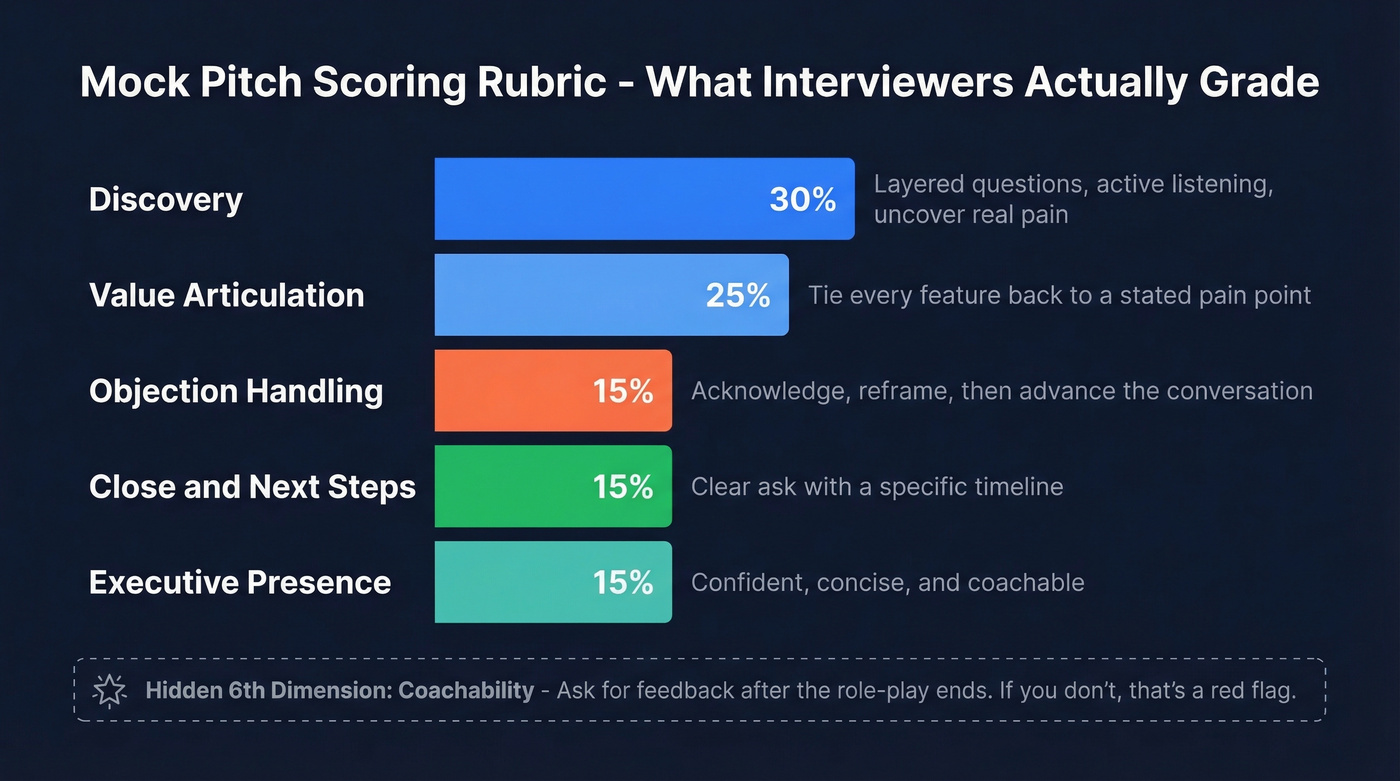
Most interviewers score across five categories, whether they use a formal rubric or not. Here's the weighted breakdown we recommend for self-evaluation:
| Category | Weight | What a 5 Looks Like | What a 1 Looks Like |
|---|---|---|---|
| Discovery | 30% | Layered Qs, active listening | Feature dump, no questions |
| Value Articulation | 25% | Pain tied to product outcomes | Generic pitch, no tailoring |
| Objection Handling | 15% | Acknowledge, reframe, advance | Defensive or ignores pushback |
| Close & Next Steps | 15% | Clear ask with timeline | Trails off, no close attempt |
| Executive Presence | 15% | Confident, concise, coachable | Nervous, rambling, rigid |
The hidden sixth dimension is coachability. After the role-play ends, the interviewer will often ask what you'd do differently. If you don't ask for feedback yourself, that's a red flag. They're testing whether you can take coaching - because that's what the first 90 days on the job look like.
The 15-Minute Script
Most mock pitches run 10-20 minutes. Plan for 15. Here's the minute-by-minute structure that keeps you on track without sounding robotic.
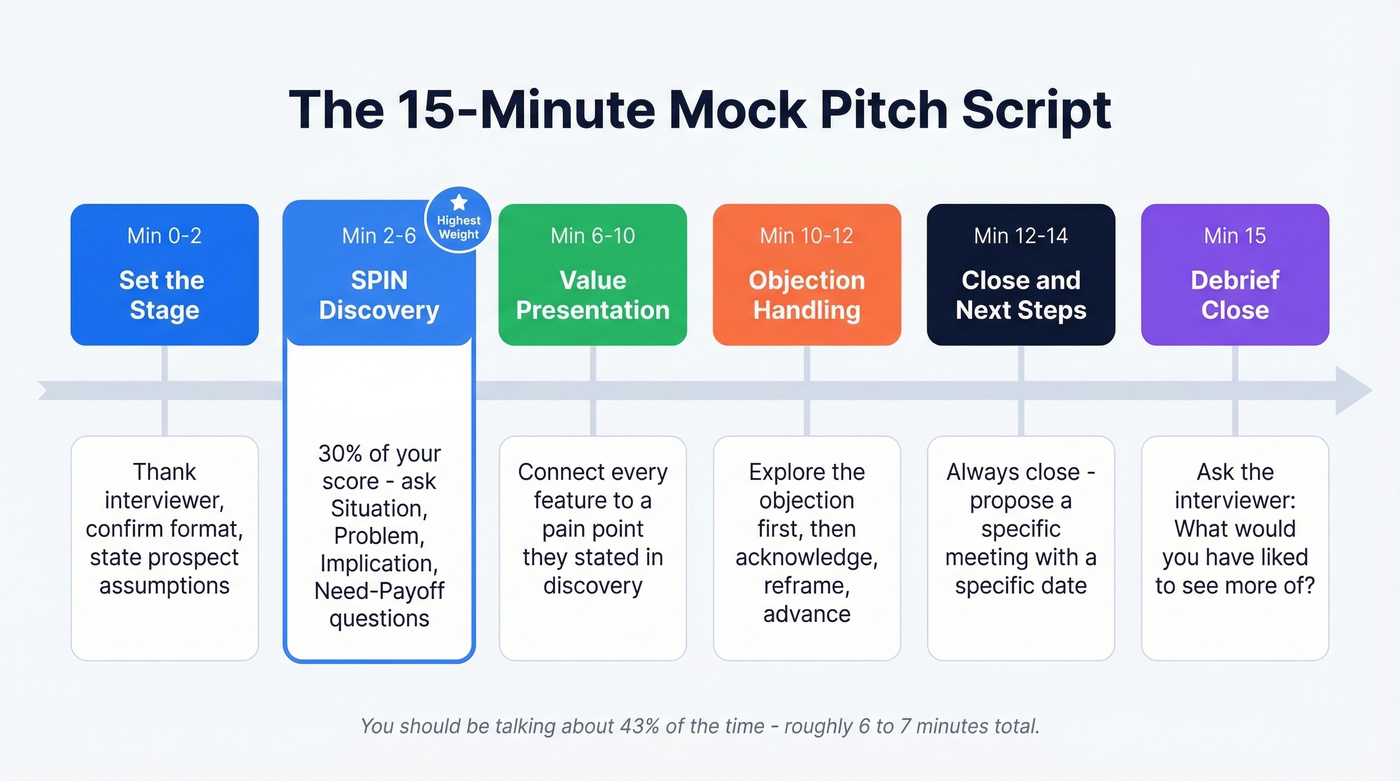
Minutes 0-2: Set the Stage
Thank the interviewer, confirm the format ("I'll spend a few minutes on discovery, then walk through how we solve what I uncover - sound good?"), and state your assumptions about the prospect's role and company. If you've researched a real prospect profile - title, company size, industry - your role-play immediately feels grounded instead of generic. Prospeo's B2B database makes this a two-minute task with 30+ filters across 300M+ profiles.
Here's a tactic that separates good candidates from great ones: if the panel has multiple interviewers, send a brief email beforehand assigning roles and pre-assigning pain points. "Would you be open to playing the VP of Sales dealing with rep ramp time, while your colleague plays the IT Director concerned about integrations?" This mirrors how top AEs prep for multi-stakeholder calls, and it signals exactly the behavior hiring managers want to see.
Minutes 2-6: Discovery with SPIN
This is 30% of your score. Don't rush it. Spend 4+ minutes on discovery - ask situation questions to confirm context, then problem questions to surface pain, then implication questions to quantify the cost of inaction, then need-payoff questions to let the prospect articulate the value themselves. Four minutes feels short. It's enough if your questions are sharp. If you want a tighter talk track, borrow from a dedicated sales discovery call script and adapt it to the role-play.
Minutes 6-10: Value Presentation
Connect every feature back to something the prospect said during discovery. "You mentioned your team spends 3 hours a day on manual data entry - here's how we eliminate that." Never present a feature without tying it to a stated pain point.
Minutes 10-12: Objection Handling
Plan for 1-2 objections. Don't rush to rebut - explore the objection first. Ask "What's driving that concern?" before you reframe. Then acknowledge, reframe, and advance: "That's a fair point - most of our customers had the same concern before they saw the ROI data. Can I walk you through a quick case study?" If you need drills, use a simple client objection handling framework to practice.
Minutes 12-14: Close and Next Steps
Always close. Even in a role-play. "Based on what we've discussed, I'd recommend a 30-minute technical deep-dive with your team next week. Does Thursday work?" Candidates who trail off without closing almost never get the offer. If closing is your weak spot, keep a few direct close examples ready.
Minute 15: The Debrief Close
You closed the prospect on next steps. Now close the interviewer on feedback. Ask: "What would you have liked to see more of?" Don't defend your choices - listen, nod, and show you can incorporate feedback. This is the close that actually gets you the job.
Scott Schwartz, a VP of Sales quoted in Close's interview prep guide, loves when candidates send questions beforehand and collaborate on the format. It signals the same behavior they'd bring to real prospect calls.

Your mock pitch script says 'set the stage with a real prospect profile.' Prospeo's 30+ search filters let you pull a prospect's title, company size, tech stack, and growth signals in under two minutes - so your role-play sounds like a real call, not a guess.
Stop pitching fictional prospects. Research real ones at $0.01 each.
Pick a Sales Framework
SPIN for SDR/BDR Roles
SPIN - Situation, Problem, Implication, Need-Payoff - is the right framework when you're running a shorter, discovery-heavy role-play, which is typical for SDR and BDR interviews. The structure forces you to ask before you tell. For more examples you can rehearse, pull from a list of SPIN questions.
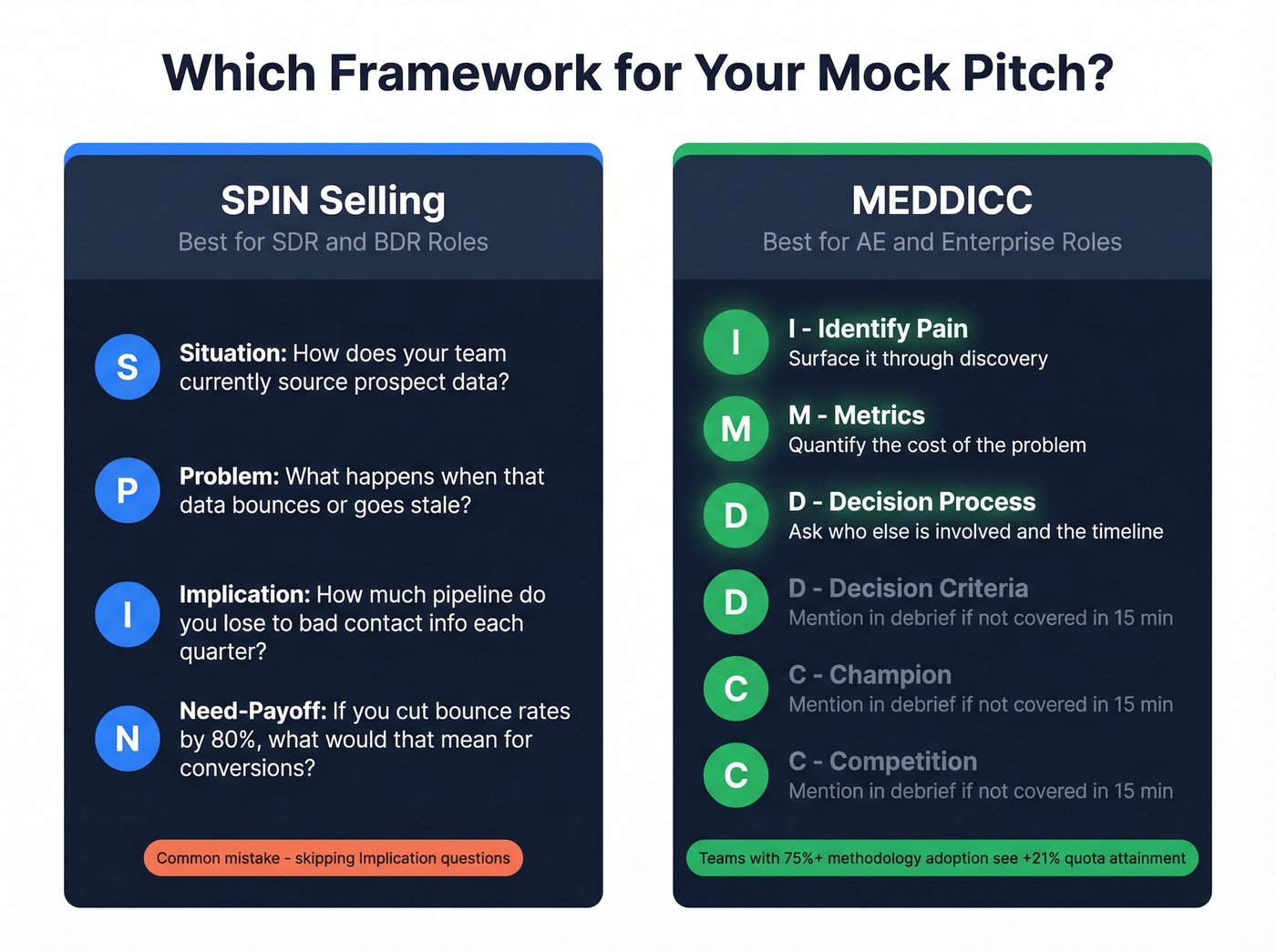
Mapped to a practice pitch:
- Situation: "How does your team currently source prospect data?"
- Problem: "What happens when that data bounces or goes stale?"
- Implication: "How much pipeline do you estimate you lose to bad contact info each quarter?"
- Need-Payoff: "If you could cut bounce rates by 80%, what would that mean for your team's conversion numbers?"
The most common SPIN mistake in role-plays is skipping implication questions and jumping straight from problem to pitch. Implication questions build urgency. Skip them and your pitch has no teeth.
MEDDICC for AE/Enterprise Roles
For AE or enterprise interviews, the panel wants to see MEDDICC thinking - Metrics, Economic Buyer, Decision Criteria, Decision Process, Identify Pain, Champion, Competition. You won't hit all seven in 15 minutes, but you should demonstrate awareness of the framework. If you want a refresher, use a MEDDIC sales qualification cheat sheet.
Focus on three during the role-play: Identify Pain through discovery, Metrics to quantify the cost of the problem, and Decision Process by asking who else is involved and what the timeline looks like. Mentioning MEDDICC by name during your debrief shows the interviewer you speak their language.
Korn Ferry's research backs this up: teams that reach >75% adoption of a structured methodology see +21% quota attainment and +15% win rates. Frameworks aren't academic exercises - they're the difference between structured discovery and random questions.
What Should You Pitch?
You'll typically get one of three options: the interviewer's product, your previous company's product, or a random object (the classic "sell me this pen").
Use their product if you've done deep research, tried the free trial, and can speak to the ICP. This impresses interviewers because it shows initiative. Skip it if you only have surface-level knowledge - you'll get exposed during objection handling.
Use your old product if you can demonstrate real discovery and closing skills without relying on feature knowledge as a crutch. A candidate on r/sales chose this route specifically because they could "drive the conversation" with confidence. Smart move.
Skip the random object. Unless they insist. It tests creativity, not sales skill, and it's nearly impossible to run meaningful discovery on a pen.
Whichever product you pick, research actual prospects - pull up a real persona with specific title, company size, and industry details. Pitching to "Sarah Chen, VP of Sales at a 200-person fintech hiring 15 reps" beats pitching to a generic "VP of Sales at a mid-market company" every time. If you need help defining the ICP fast, use a simple account intelligence checklist.

Mistakes That Get You Rejected
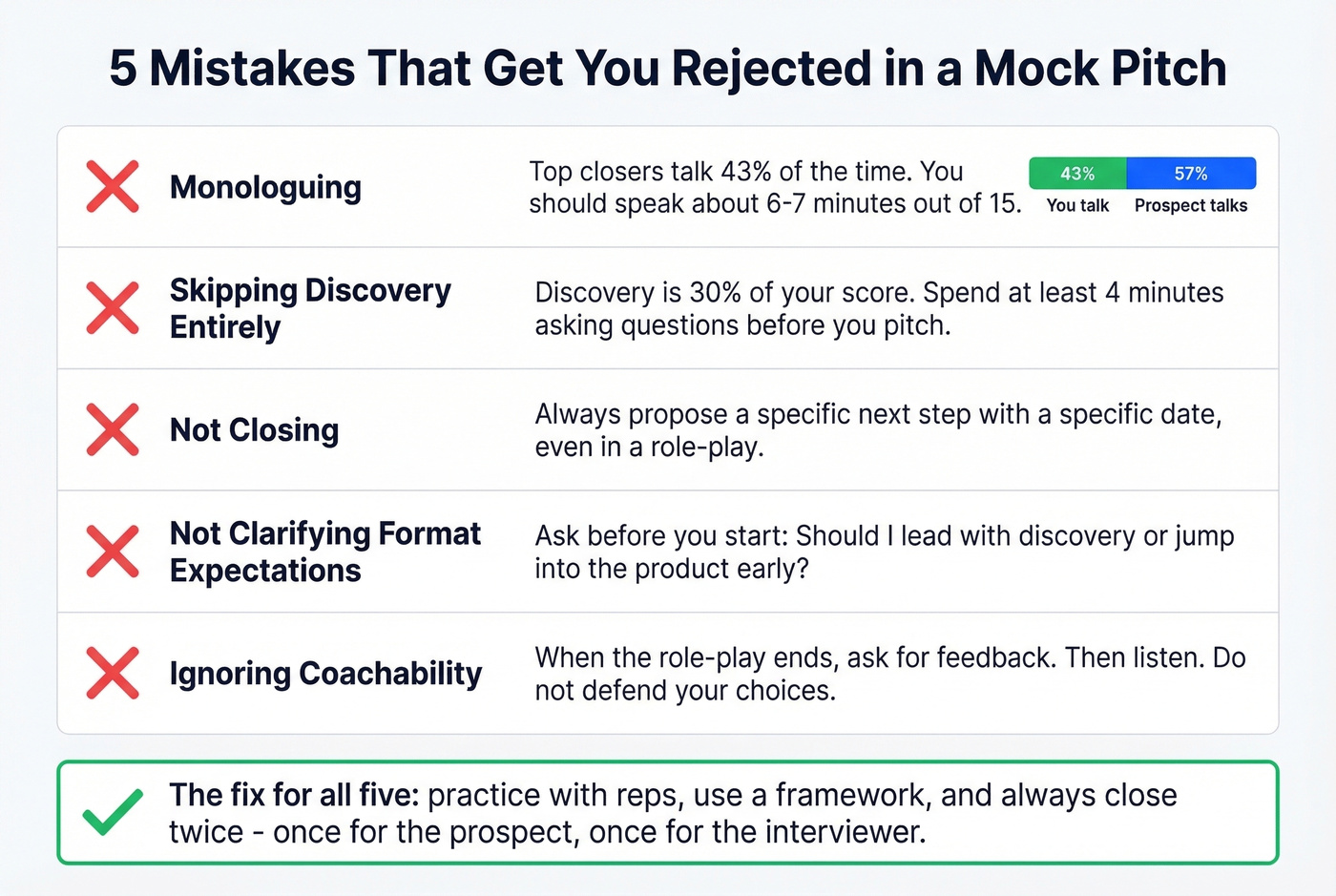
Monologuing
Top closers talk 43% of the time. Average performers talk 65%. In a 15-minute role-play, you should be talking around 6-7 minutes. If you're filling all the silence, you're doing a presentation, not discovery.
Skipping Discovery Entirely
Some candidates jump straight into a product demo or feature walkthrough. This is the fastest way to score a 1 on the highest-weighted category. Even with only 15 minutes, spend at least 4 on questions. Discovery isn't optional - it's the whole point. If you want a bank of prompts, keep a short list of discovery call questions nearby.
Not Closing
If you don't ask for next steps, the interviewer assumes you won't ask prospects either. "I'd like to schedule a follow-up with your technical team - does next Tuesday work?" It doesn't matter that it's a role-play. Close it.
Not Clarifying Format Expectations
One candidate on r/techsales got rejected for "not pitching hard enough during discovery" - the panel expected feature pitching earlier than enterprise norms dictate. Before the role-play starts, ask: "Would you like me to lead with discovery, or jump into the product early?" Two seconds of clarification can save the entire round.
Ignoring Coachability
When the role-play ends, don't just sit there. Ask what the interviewer would have liked to see more of. Then listen. Don't defend. The debrief is part of the evaluation, and candidates who skip it miss an easy win.
Mock Pitches for Founders
For founders, "mock pitch" means something different - it's rehearsal for investor conversations, demo days, and pitch competitions. The stakes are funding, not a job offer.
The Founder Institute offers a clean one-sentence pitch formula: "My company ___ is developing ___ to help ___ solve ___ with ___." Getting it tight enough to deliver in one breath takes more practice than most founders expect. Bill Gurley frames the pitch deck itself as "a structured scientific proof" - you're walking the listener through a logical argument for why this will be an amazing business.
Where do you practice? Pitch competitions are the best forcing function we've seen. Startup World Cup runs 60+ regional events culminating in Silicon Valley with a $1,000,000 investment prize. TechCrunch Startup Battlefield selects 20 finalists from 200+ applicants for $100K in equity-free funding. They're not just practice - they're live reps with real feedback from investors who've heard thousands of pitches.
Founder Institute alumni have raised $1.85B+ in funding. Whether or not you join their program, their pitch templates - one-sentence, elevator, one-minute, and full VC deck - are worth studying. The progression from one sentence to a full deck teaches you to expand and compress your story on demand, which is exactly what investor Q&A requires.
Practice with AI Role-Play Tools
Sellers forget 70% of training within a week. The only antidote is repetition, and AI role-play tools make that possible without needing a partner or a manager's calendar. 43% of enablement leaders already use AI-powered role-play for coaching, and sellers who regularly practice achieve 20-45% higher win rates.
Let's be honest: if your deal sizes are under five figures, you don't need a $250/month AI role-play platform. You need a free tool and three reps out loud the night before. Overthinking the tooling is a form of procrastination.
| Tool | Price | Best For |
|---|---|---|
| Yoodli | Free - $8/user/mo | Individual candidates |
| Second Nature | ~$30-40/user/mo | Small team practice |
| Hyperbound | ~$150-250/user/mo | Enablement programs |
If you can only try one, Yoodli is free and good enough for interview prep. It gives you feedback on filler words, pacing, and talk ratio - exactly the metrics that matter in a 15-minute role-play. Second Nature is the best value for teams that want to standardize practice. Hyperbound is overkill for most individual candidates but powerful for enablement leaders building a coaching program.
We've tested all three enough to recommend them confidently. The full market is bigger, but these cover the spectrum from free to enterprise. The important thing isn't which tool you pick - it's that you practice out loud at least twice before the real thing. If you want to go deeper on the workflow, pair practice with discovery call coaching so each rep has a specific focus.
The SPIN framework only works when your discovery questions reference real pain points. Prospeo gives you 50+ data points per contact - including intent signals across 15,000 topics - so you walk into every mock pitch (and every real call) with ammunition, not assumptions.
Nail discovery with data that's refreshed every 7 days, not 6 weeks.
FAQ
How long should a mock pitch be?
Plan for 15 minutes: 4-5 on discovery, 5 on value presentation, and 3-4 for objections, close, and debrief. If the interviewer specifies a different window, scale each phase proportionally - but never cut discovery below 25% of total time.
What if I don't know the product well?
Interviewers test whether you can run a sales conversation, not recite features. Research the basics - ICP, top three capabilities, one competitor - then focus 80% of your energy on discovery and closing. Strong process beats deep product knowledge every time.
Should I use slides in a mock pitch?
Only if the interviewer explicitly asks. Most role-plays are conversational. If you do use slides, cap them at five and let your discovery questions carry the conversation - panels score dialogue skills, not deck design.
How can I find realistic prospect data to practice with?
Use a B2B data tool to pull real prospect profiles - title, company size, industry, tech stack. Prospeo's free tier includes 75 email credits and 100 Chrome extension credits per month, which is enough to build a detailed persona for any practice scenario. Pitching to a researched contact with specific details beats targeting a generic "VP of Sales" every time.
What's the biggest mistake in a mock sales pitch interview?
Skipping discovery. It carries 30% of the typical scoring rubric, yet most candidates spend under 60 seconds on questions before launching into features. Spend at least 4 minutes asking layered questions - situation, problem, implication, need-payoff - before you present a single capability.