

Account Intelligence: The Practitioner's Guide to What It Actually Takes
Enterprise sellers spend 2-4 hours per account doing manual research - digging through CRMs, scanning news, piecing together org charts. Then the deal stalls, a new champion emerges, and every bit of that context evaporates.
One Reddit user with 6-9 month sales cycles nailed it: their setup treats each campaign as a "fresh start," losing engagement history, stakeholder context, and signals from months ago. That's the problem account intelligence solves.
What You Need (Quick Version)
Account intelligence is company-level data - firmographic, technographic, intent, engagement, and contact - aggregated so sales and marketing can prioritize at the account level, not just the lead level. Enterprise teams run Demandbase or 6sense ($30K-$100K+/yr). Mid-market teams pair ZoomInfo for signals with a verified contact source.
Here's the thing: most teams don't need a $50K platform. They need clean data and a CRM that reps actually use.
What Is Account Intelligence?
Lead intelligence tells you about a person. Account intelligence tells you about a company - and everyone inside it who matters to your deal. The scope, the alignment model, and the use cases are fundamentally different.
This isn't a niche category. The market is projected to grow from $2.1B in 2024 to $4.8B by 2029 at an 18.2% CAGR. McKinsey reports that data-driven B2B sales strategies drive EBITDA increases of 15-25%. Intent data can surface in-market accounts 3-6 months before traditional indicators like inbound form fills, which is why companies using B2B account insights effectively report up to 208% higher revenue. Adoption is accelerating fast.
Five Data Types That Matter
Account intelligence isn't one data set. It's five, layered together.
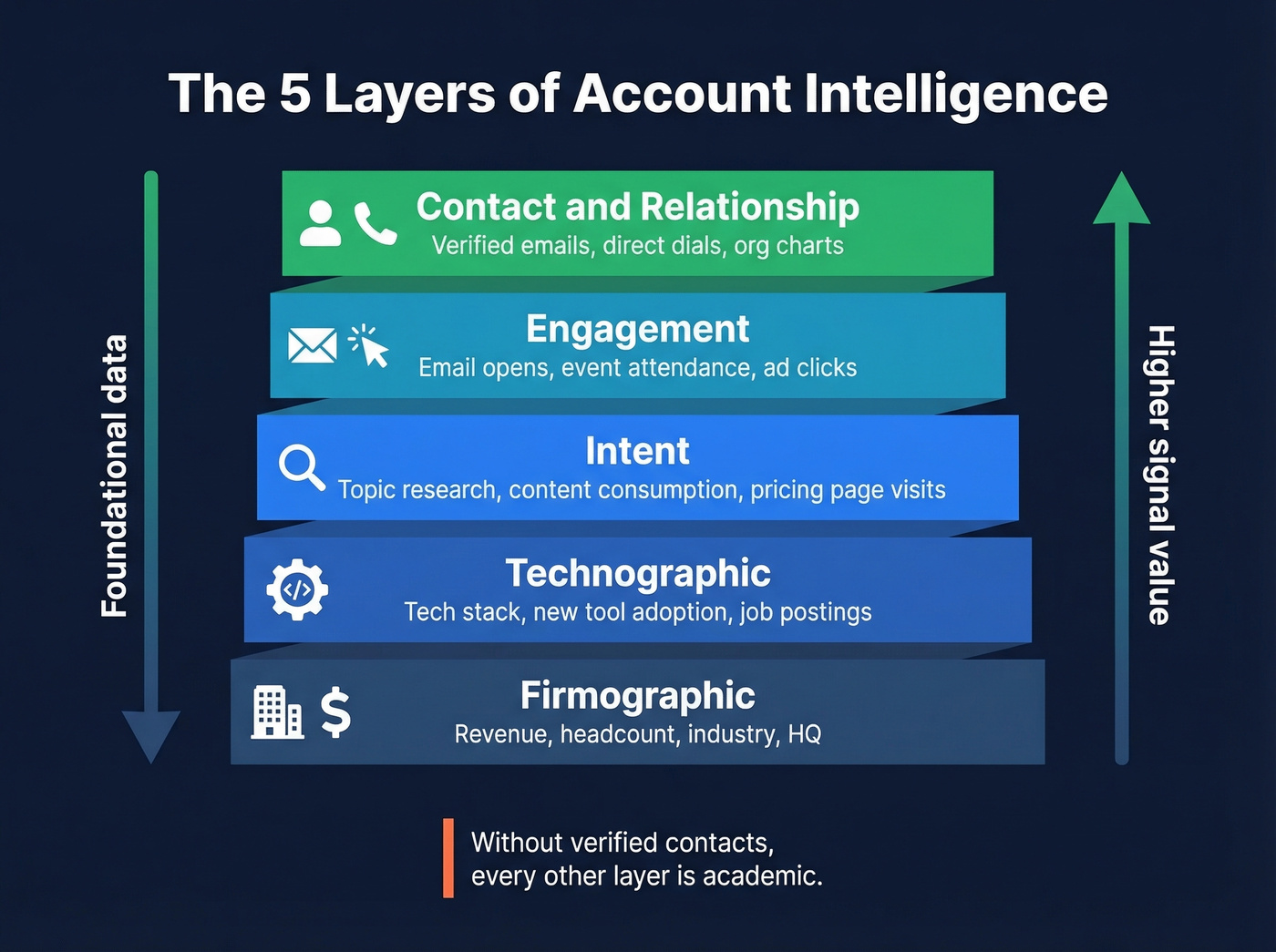
| Data Type | What It Includes | Signal Source |
|---|---|---|
| Firmographic | Revenue, headcount, industry, HQ | CRM, third-party databases |
| Technographic | Tech stack, new tool adoption | Wappalyzer, job postings |
| Intent | Topic research, content consumption | Your site + Bombora, G2 |
| Engagement | Email opens, event attendance, ad clicks | MAP, sales engagement tools |
| Contact/Relationship | Verified emails, direct dials, org charts | B2B data platforms |
First-party intent - pricing page visits, demo signups - is high-confidence but low-volume. Third-party intent gives you earlier signal from topic-level research behavior tracked across publisher networks, but the data is noisier. The hardest layers to get right are real-time company events and fragmented cross-platform intent, which is why most teams still struggle even after buying a platform.
The contact layer is foundational. Without verified emails and direct dials for the buying committee, every other layer of data is academic.

Most teams burn hours on manual account research because their contact layer is broken. Prospeo combines intent data across 15,000 Bombora topics with 30+ firmographic and technographic filters - then delivers verified emails at 98% accuracy on a 7-day refresh cycle. At ~$0.01/email, you get account intelligence that actually connects reps to buyers.
Build your account intelligence stack for 90% less than legacy platforms.
Why Most Teams Get It Wrong
They treat it as just contact data
A list of names and emails isn't intelligence. Without behavioral signals, intent data, and engagement history, you're cold-calling with better formatting.
If your emails aren't verified, you're also burning sender reputation and deliverability - which is why teams often pair account intelligence with an email verifier and ongoing data enrichment.
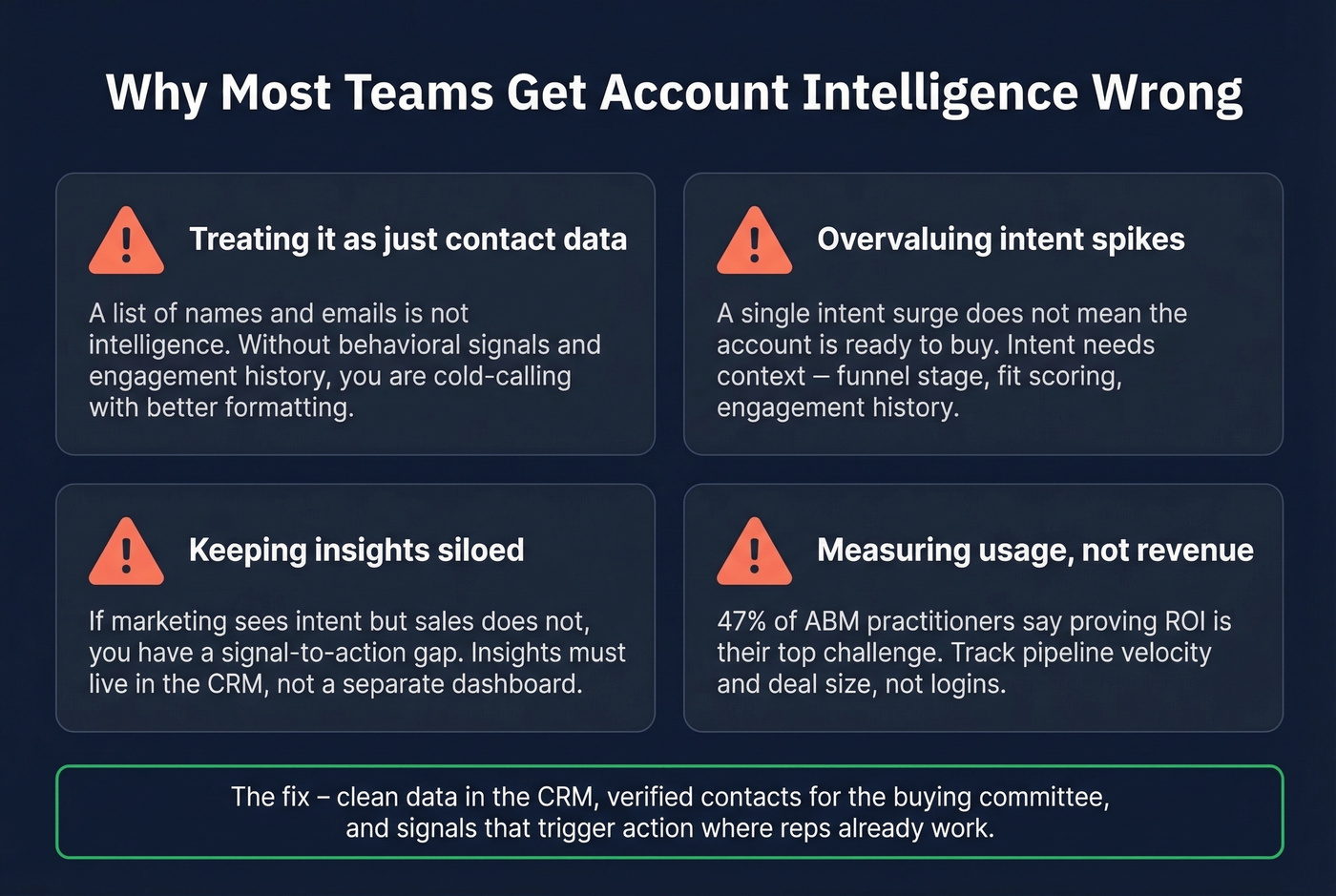
They overvalue intent spikes
A single intent surge doesn't mean the account is ready to buy. Intent needs context - funnel stage, engagement history, fit scoring. Without that, your SDRs chase noise.
They keep insights siloed
If marketing sees intent data but sales doesn't, you've got a signal-to-action gap. The window between detecting a signal and executing outreach is where deals die. Account-level insights need to live where reps already work - inside the CRM and sequencer, not a separate dashboard nobody checks.
This is also where CRM automation and lead-to-account matching make the difference between “interesting data” and booked meetings.
They measure usage instead of revenue
47% of ABM practitioners say proving ROI is their top challenge. That's because they're tracking logins instead of pipeline velocity and deal size. If you can't tie insights to revenue, the CFO will cut the budget. And honestly? They'd be right to.
If you want a clean way to operationalize this, start by tracking account executive KPIs and tying insights to pipeline velocity.
What It Actually Costs
A full stack isn't cheap. These ranges reflect what mid-market and enterprise teams typically spend.
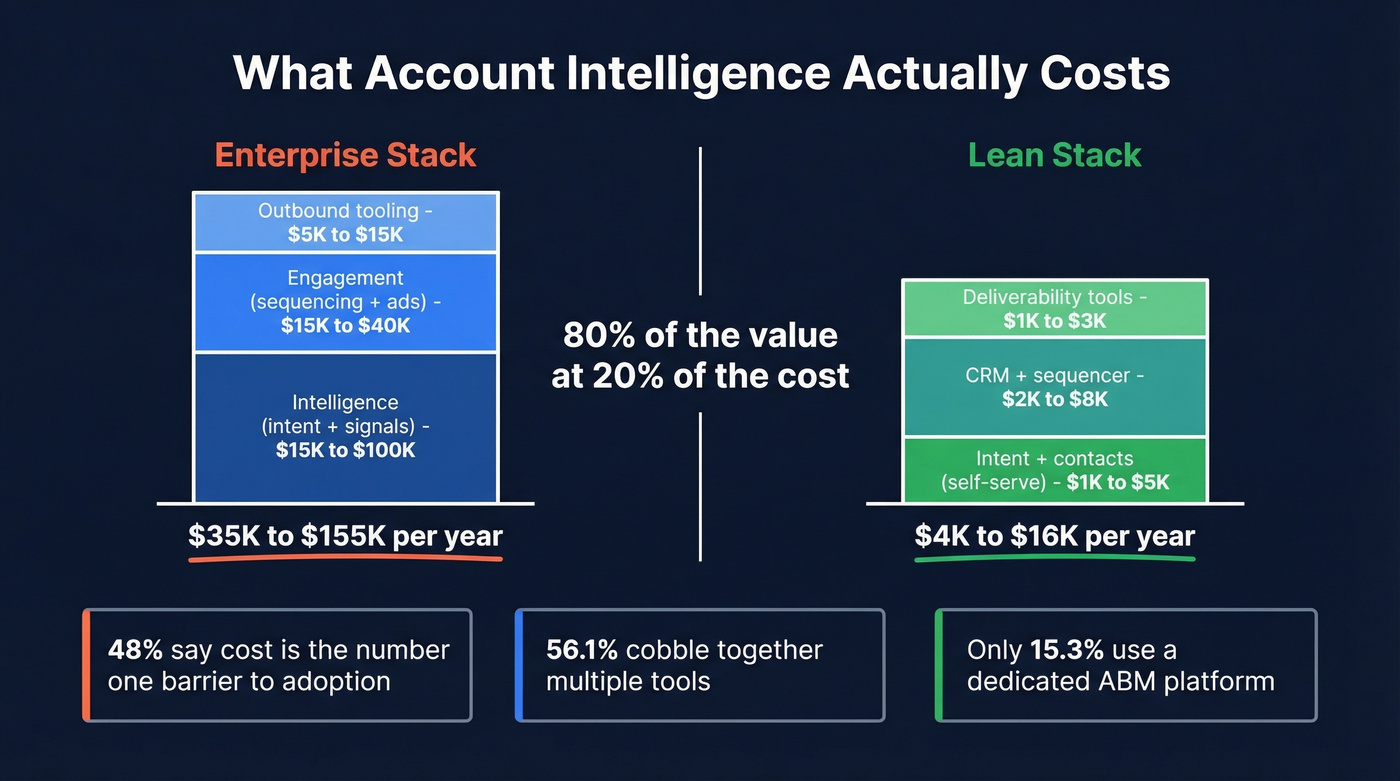
| Stack Layer | Typical Annual Cost |
|---|---|
| Intelligence (intent + signals) | $15,000-$100,000 |
| Engagement (sequencing + ads) | $15,000-$40,000 |
| Supporting outbound tooling (automation + deliverability) | $5,000-$15,000 |
| Total | $35,000-$155,000 |
Yet only 15.3% of teams use a dedicated ABM platform. The majority - 56.1% - cobble together a combination of tools. Cost is the #1 barrier at 48%, followed by limited internal resources at 34.2%.
We've seen mid-market teams get 80% of the value at 20% of the cost by skipping the monolithic platform and assembling a focused stack instead.
How to Start Without a $50K Platform
You need three things: a way to identify in-market accounts, verified contact data for the buying committee, and a CRM that connects the two.
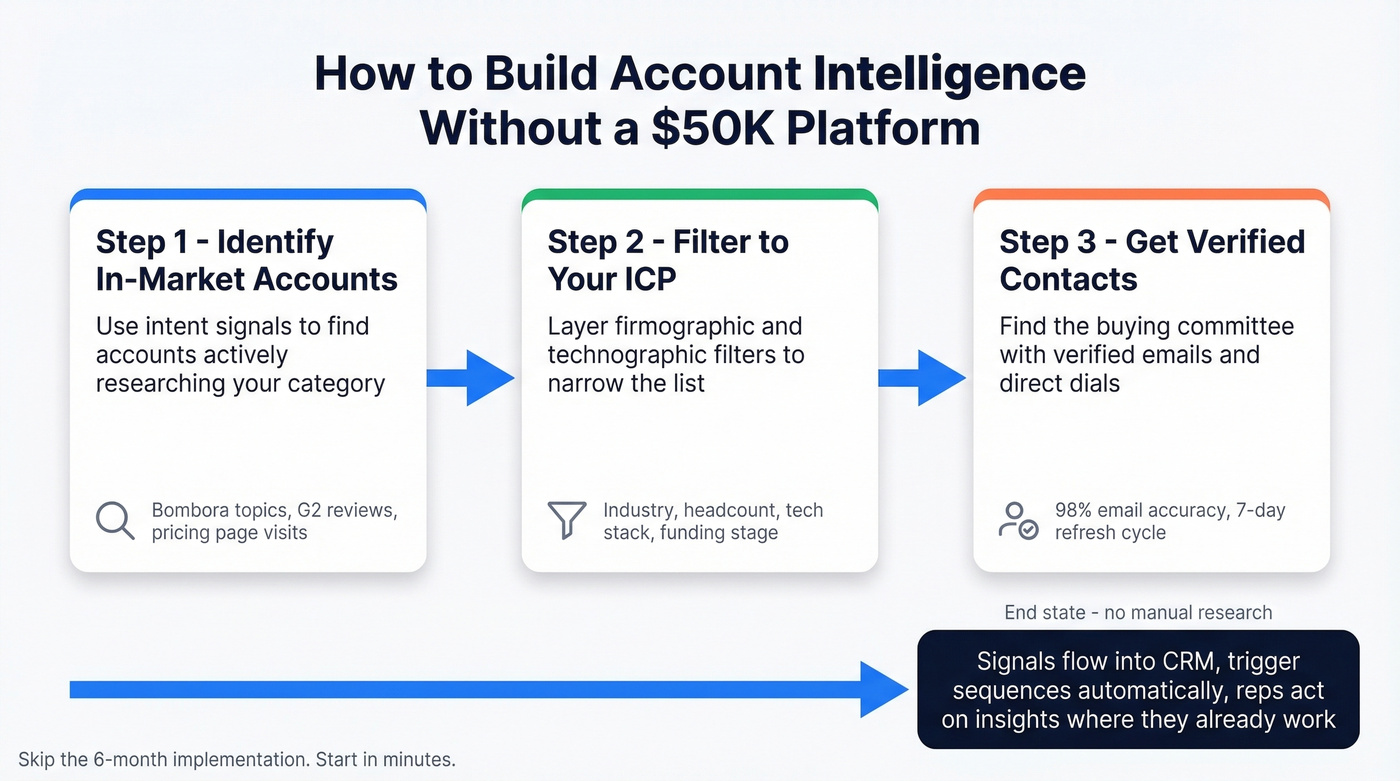
Start with intent signals - which accounts are actively researching your category? Layer on firmographic and technographic filters to narrow to your ICP. Then get verified contacts so reps can actually reach the right people. In our experience, teams that nail this sequence before buying a full platform see faster time-to-value and higher rep adoption. Automated workflows where signals flow directly into your CRM and trigger sequences without manual research are the end state, but you don't need a six-figure contract to get there.
Prospeo's B2B database handles the signal and contact layers in one self-serve tool. It tracks intent across 15,000 Bombora topics, offers 30+ search filters including technographics and headcount growth, and delivers 98% email accuracy on a 7-day refresh cycle. You're searching, filtering, and exporting verified contacts in minutes - not spending six months on implementation.

Account intelligence is useless without verified contacts for the buying committee. Prospeo gives you 300M+ profiles, 125M+ verified mobiles with a 30% pickup rate, and 143M+ verified emails - all searchable by intent signals, tech stack, headcount growth, and funding. No six-month implementation. No annual contract.
Turn account signals into booked meetings, not another dashboard nobody checks.
Platforms Worth Evaluating
The B2B category spans pure intelligence platforms, orchestration suites, and standalone data providers. G2 groups orchestration platforms together, so make sure you're comparing within the right sub-category for your needs.
| Tool | Best For | Typical Cost |
|---|---|---|
| Demandbase | Full ABX platform | ~$30K-$100K+/yr |
| Prospeo | Contact data + intent signals | Free tier; ~$0.01/email |
| 6sense | Predictive scoring | ~$30K-$100K+/yr |
| ZoomInfo | Scale (100M+ company profiles) | ~$15K-$40K+/yr |
| HockeyStack | Mid-market attribution | ~$20K-$60K/yr |
| Bombora | Standalone intent data | ~$20K-$50K/yr |
6sense is stronger on predictive analytics and orchestration. Demandbase is broader - advertising, engagement, and ABM analytics in one platform. Both require significant implementation time and carry enterprise price tags.
If those budgets make you flinch, skip them for now. ZoomInfo for signals paired with a verified contact source covers the core use case at a fraction of the cost. If you're comparing data sources, start with a shortlist of the best B2B database options and the best verified contact database providers.
Let's be honest - you can always upgrade once pipeline justifies the spend, but you can't get back the six months you lost on a platform rollout that reps never adopted.
FAQ
What's the difference between account intelligence and sales intelligence?
Account intelligence focuses on company-level signals - firmographics, intent, and engagement across the buying committee. Sales intelligence is broader, encompassing individual contact data alongside company data. Think of account intelligence as a subset, zoomed in on the company as the unit of analysis.
Do I need an ABM platform for account intelligence?
No. Only 15.3% of teams use a dedicated ABM platform. Most combine a CRM, an intent data source like Bombora, and a verified contact database to cover the essentials - then upgrade to Demandbase or 6sense once the model is proven and pipeline justifies the spend.
How often should the data be refreshed?
Weekly is ideal. Contacts change roles, companies get acquired, and intent signals decay fast. The industry average refresh cycle is around 6 weeks, which means your buying committee data is already stale by the time reps act on it. Look for providers that refresh on a 7-day cycle - anything longer and you're working with outdated contacts.