

Negotiation Tactics That Actually Work (With Scripts and Data)
55% of people accept the first salary offer without negotiating. Among those who do push back, roughly two-thirds walk away with more money - and one studies roundup found an average uplift of 18.83% above the initial offer. Over a career, that gap compounds into hundreds of thousands of dollars.
Salary is just one negotiation. Vendor contracts, SaaS renewals, partnership terms, equity splits - the tactics below work across all of them.
Five Tactics That Matter Most
If you read nothing else, master these five. Everything in this article is a variation or extension of them.
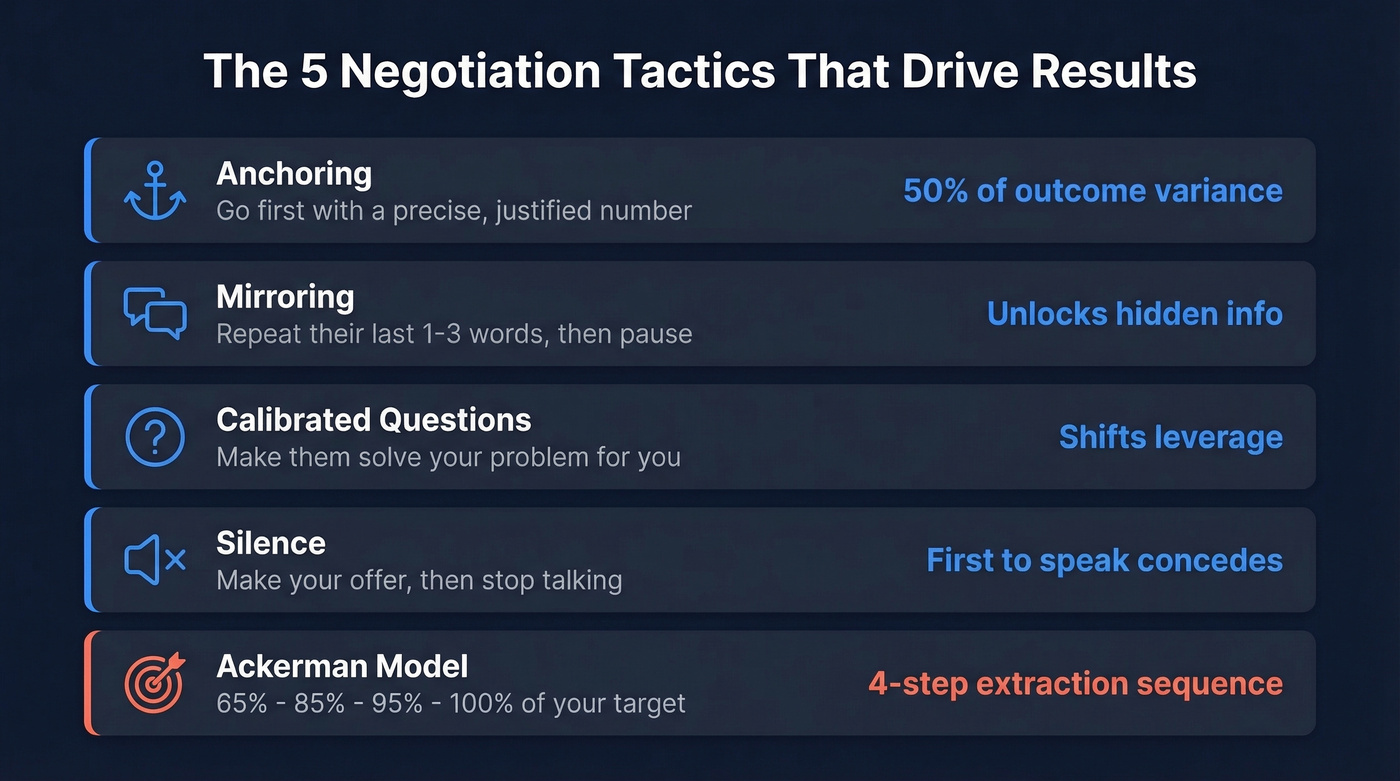
- Anchoring. Go first with a precise, justified number. Up to 50% of outcome variance ties to the first offer.
- Mirroring. Repeat the last 1-3 words the other person said. Pause. Let them fill the silence with information you need.
- Calibrated questions. "How am I supposed to do that?" forces the other side to solve your problem for you.
- Silence. Make your offer, then stop talking. The person who speaks first usually concedes.
- The Ackerman model. A structured bargaining sequence (65% -> 85% -> 95% -> 100% of your target) that extracts maximum value while still reaching agreement.
Each one gets a full breakdown with scripts below.
Tactics vs. Strategies
Most people blur this line. A strategy is your overall approach - collaborative, competitive, or somewhere in between. A tactic is an in-the-moment move you deploy within that strategy.
Anchoring is a tactic. "We're going to build a long-term partnership and use that as leverage for better terms" is a strategy. You need both, but this article focuses on tactics: the specific moves you can practice, script, and deploy in your next conversation. Strategy without tactics is a philosophy lecture. Tactics without strategy is just improvisation.
The Psychology Behind Every Tactic
Every effective tactic works because of a cognitive bias. Understanding the bias makes the move sharper - and helps you spot when someone's using it on you.
Anchoring Bias
Kahneman and Tversky identified the anchoring effect in 1974, and it remains one of the most powerful forces in any deal. The first number thrown out creates psychological inertia. Everything that follows is an adjustment from that anchor, and humans consistently adjust too little.
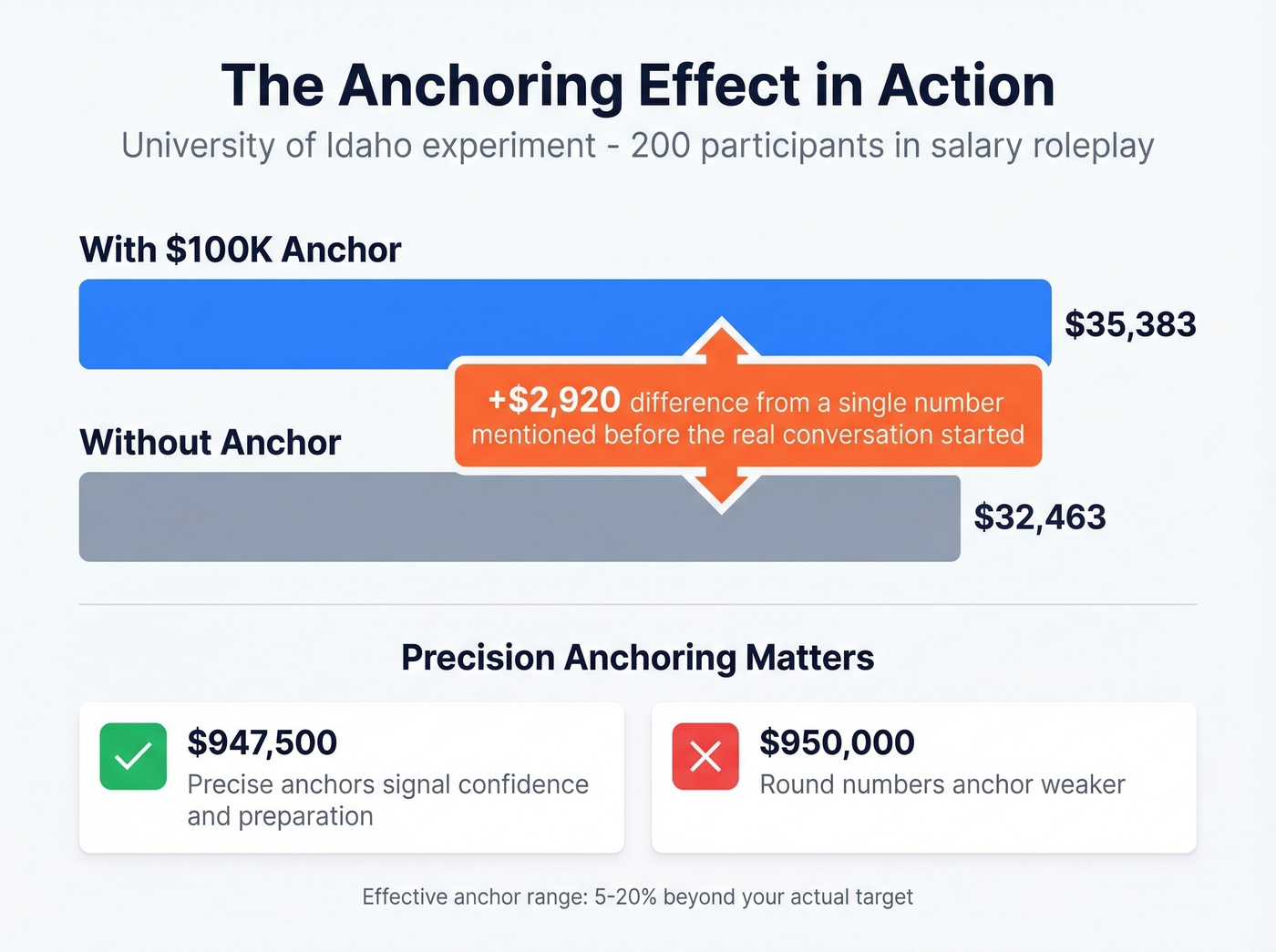
In a University of Idaho experiment with 200 participants in a salary roleplay, those given a $100,000 anchor produced average offers of $35,383. Without the anchor, offers dropped to $32,463. A $3,000 swing from a single number mentioned before the real conversation even started.
Precision matters too. Research published in Attorney Journals found that precise first offers ($947,500 instead of $950,000) anchor harder than round numbers. They signal confidence and preparation. Effective anchor ranges tend to fall 5-20% beyond your actual target - aggressive enough to shift the range, reasonable enough to avoid getting laughed out of the room. For a deeper breakdown, see our guide on anchoring.
Loss Aversion and Reciprocity
People feel losses more intensely than equivalent gains. Framing a concession as "I'm giving up X" hits harder than framing the same move as "you're gaining X." Smart negotiators use loss aversion to make their concessions feel expensive.
The reciprocity principle pairs with this perfectly. When you concede something, the other side feels psychologically compelled to concede in return. But here's the critical rule from Huthwaite's research: never give anything away for free. Always trade. "I can do that, but I'd need you to move on delivery timeline" is infinitely better than "Sure, we can do that."
Iceberg Theory and Expectations
Karrass calls it the Iceberg Theory - the stated position is the tip; underneath are motivators like autonomy, competence, job security, and relationships. Your job in preparation is to map what's below the waterline.
A classic Karrass experiment split participants into two groups. One expected outcomes around $7.50; the other expected $2.50. Results tracked almost perfectly with expectations. Your expectations set your ceiling. Walk in expecting to win, and you'll push harder, concede less, and anchor more aggressively.
Preparation Framework
Here's the thing: you don't have a negotiation problem. You have a preparation problem. Scotwork's research found that 80% of companies have no formal negotiation process, and 85% of sales negotiators don't establish what the other side wants before the conversation starts. That's not negotiating. That's guessing.
Define Your BATNA and Walkaway
BATNA - Best Alternative to a Negotiated Agreement - is the single most important concept in negotiation theory. It answers one question: "What happens if I walk away from this table?" A strong BATNA (three other vendors competing for your business) means you negotiate from power. A weak one (this is the only job offer you have) means you need to strengthen it before the conversation.
When your BATNA is genuinely weak, don't pretend otherwise. Get a second quote. Apply to another job. Line up an alternative vendor. Even a mediocre BATNA gives you a walkaway point, which prevents you from accepting a terrible deal out of desperation. If you want a step-by-step method, use this walkaway point guide.
Map the ZOPA
The Zone of Possible Agreement is the overlap between what you'll accept and what they'll accept. If you'll sell for no less than $80,000 and they'll pay up to $95,000, the ZOPA is $80K-$95K. Your job is to close the deal as close to $95K as possible.
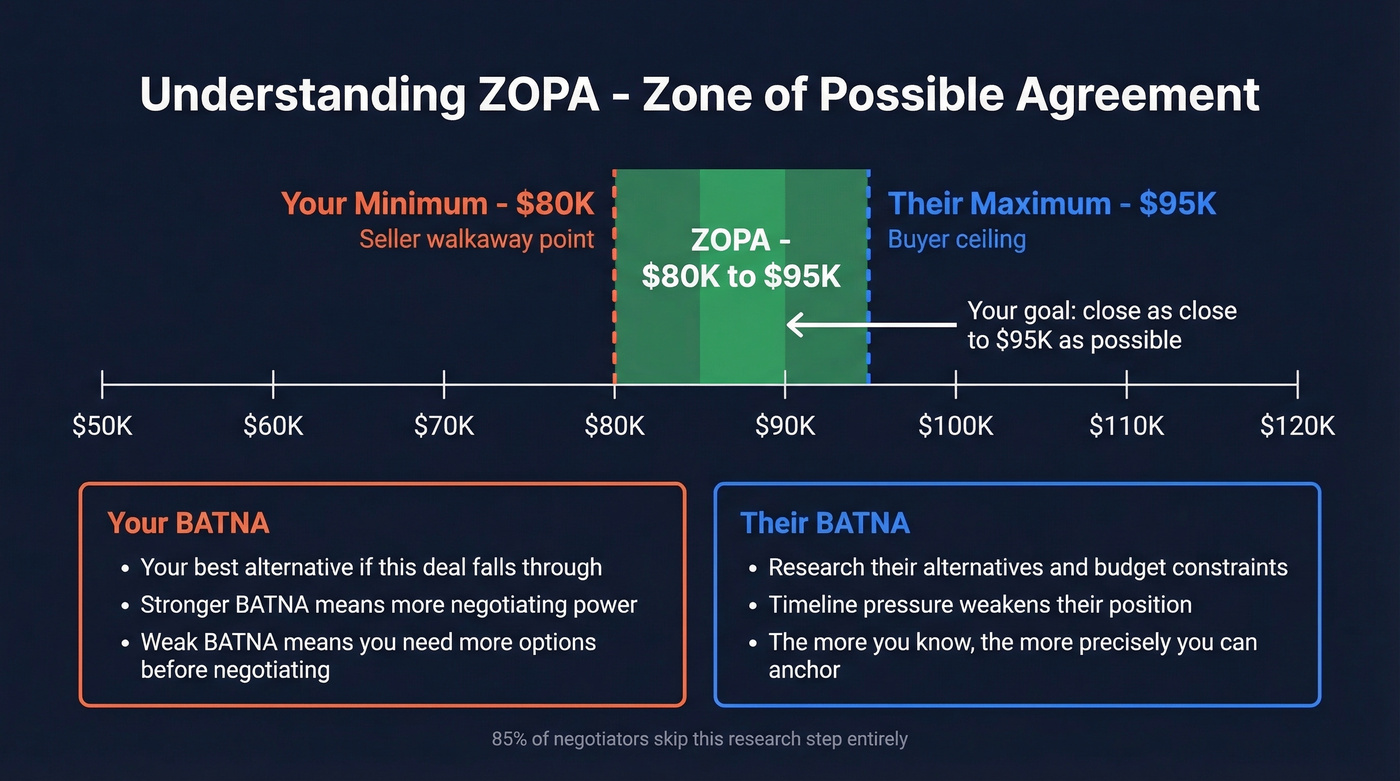
The hard part is estimating their range. Research their alternatives, budget constraints, and timeline pressure. The more you know about their ZOPA boundary, the more precisely you can anchor.
Research the Other Side
Before any significant negotiation, you need answers to four questions: Who's the actual decision-maker? What's their company context - growth, contraction, funding round, budget cycle? What competing options do they have? And what are their real pain points, not the stated ones, but the ones driving urgency?
Skip this step and you're flying blind. Do it well and you'll walk in knowing more about their position than they expect. If you want a repeatable way to structure this, borrow a sales-style Ideal Customer Profile approach to map stakeholders and constraints.
Offensive Moves
These are the moves you deploy when you're driving the conversation forward.
Anchoring in Practice
You understand the psychology. Here's the execution.
Go first when you have an information advantage - when you've done your research and know the fair range better than the other side. Use a precise number, not a round one. Justify it with data.
Script (SaaS renewal): "Based on our usage data and what comparable platforms charge for this tier, we're looking at $87,400 annually. That reflects the 15% volume discount we discussed and aligns with the three-year commitment we're offering."
Specific, justified, and anchored well below what the vendor probably wants. They now have to argue against your number rather than proposing their own. When you don't have information advantage, let them go first - their anchor gives you data about their expectations.
Framing and Bracketing
The same deal can feel completely different depending on how you frame it. "This will cost you $50,000" triggers loss aversion. "This will save you $200,000 over three years" triggers gain framing. Same deal, different emotional response.
Bracketing is the tactical version. If your target is $100,000, open at $120,000 - knowing they'll counter lower, and you'll meet somewhere near your actual target. Combined with anchoring, it's extremely effective at controlling where the deal lands.
Silence
We've watched experienced negotiators lose deals simply because they couldn't tolerate 10 seconds of quiet. The person who speaks first after an offer is on the table usually concedes. They fill the void with justifications, softened positions, or outright reductions.
The execution is dead simple. Make your offer. State your number. Stop talking. Don't explain. Don't justify. Don't ask "What do you think?" Just wait.
The Flinch
A visible reaction of surprise - a sharp inhale, a raised eyebrow, a "Wow, that's higher than I expected" - signals that the other side's offer is unreasonable. The flinch creates doubt about whether their position is defensible, regardless of whether you're genuinely surprised.
Use it when you receive an opening offer. Don't overact; a subtle flinch is more credible than theatrical shock. Then follow with silence. Let them start justifying.
Deadline Pressure
Real deadlines create urgency. Artificial deadlines create resentment - if the other side figures out your deadline is fake, you lose credibility permanently.
Tie deadlines to external events: "Our board meets on the 15th, and I need to present a signed agreement." When someone uses deadline pressure on you, test it: "What happens if we need another week?" If the deadline is real, they'll explain the consequence. If it's artificial, they'll extend it without hesitation.
Nibbling and the Bogey
Nibbling is the art of small asks after the main deal is agreed. "Can you throw in an extra month of onboarding support?" These feel trivial after a big agreement, so people say yes reflexively.
The Bogey works differently. You feign deep concern about a minor issue - "I'm really worried about the implementation timeline" - to extract concessions on what you actually care about: price, terms, or scope.
Collaborative Value Creation
Let's be honest: the best negotiators aren't the ones who "win" the most. They're the ones who find value the other side didn't know existed. Stanford GSB research found that 20-35% of negotiators miss value-creation opportunities because of fixed-pie thinking - the assumption that one side's gain is the other's loss.
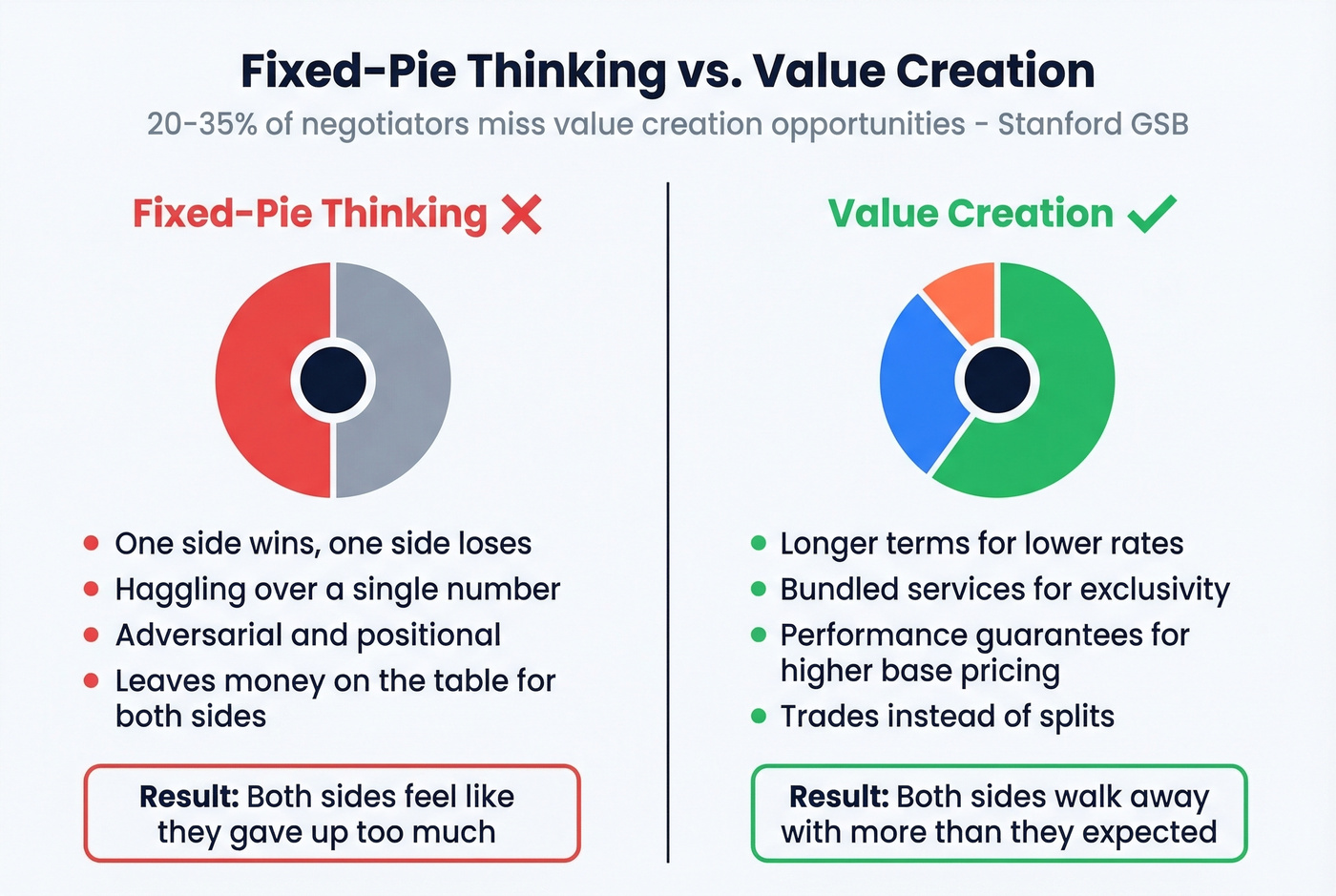
In practice, this means looking for trades instead of splits. Longer terms for lower rates. Bundled services for exclusivity. Performance guarantees for higher base pricing. If you're only haggling over one number, you're leaving money on the table for both sides.

You just read that 85% of sales negotiators don't research what the other side wants before the conversation. Prospeo gives you 50+ data points per contact - job title, company funding, headcount growth, tech stack, and buyer intent signals across 15,000 topics. Walk into every negotiation knowing more than they expect.
Stop guessing. Start negotiating with data the other side doesn't have.
The Chris Voss Framework
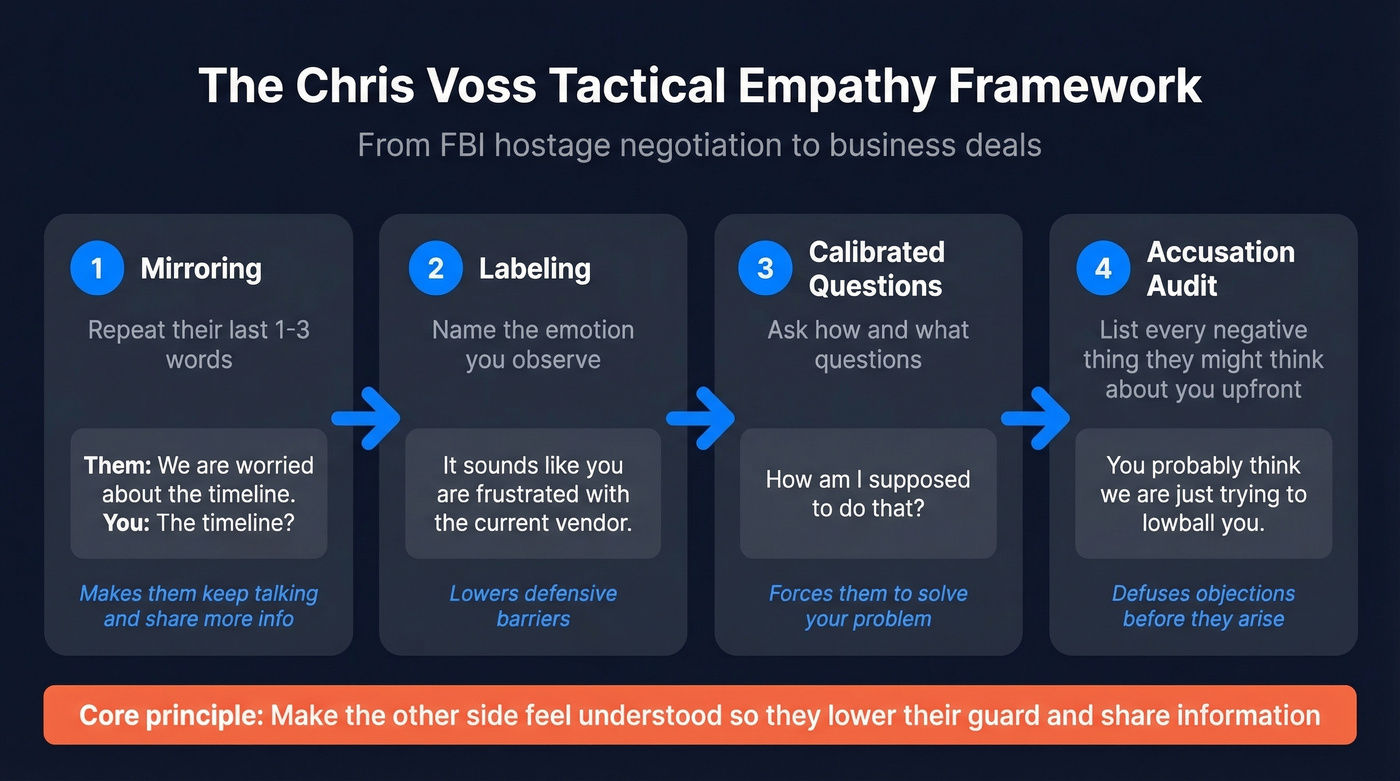
Former FBI hostage negotiator Chris Voss built a framework that translates surprisingly well to business negotiations. His approach - Tactical Empathy - isn't about being nice. It's about making the other side feel understood so they lower their guard and share information.
Mirroring
Here's a mistake I see constantly: people ask direct questions when they should just mirror.
Script:
Them: "We're really concerned about the implementation timeline."
You: "The implementation timeline?"
Them: "Yeah, our last vendor took six months and we lost two key accounts during the transition..."
That's it. Repeat the last 1-3 words, then pause. People interpret the repetition as genuine interest and keep talking. More talking means more information, and information is leverage.
Labeling
The wrong way: Asking "Are you worried about the budget?" The right way: "It seems like the budget is the real constraint here, not the timeline."
Labeling means naming the emotion or dynamic you're observing, using "It seems like..." or "It sounds like..." When you label correctly, the other side feels understood and expands. When you label incorrectly, they correct you - which is equally valuable because now you have better information.
Calibrated Questions
"How am I supposed to do that?" is the signature move. It's a what or how question that forces the other side to solve your problem.
Other examples: "What does a successful outcome look like for your team?" "How would we move forward if we can't meet that number?" "What's the biggest challenge you're facing with the current vendor?"
Avoid "why" questions - "Why do you need that?" triggers defensiveness. "What makes that important to your team?" gets the same information without the confrontation. Voss also advocates "no-oriented" questions: "Is this a bad time to talk?" instead of "Do you have a minute?" People feel safer saying no, which paradoxically opens the conversation.
The "That's Right" Trigger
Summarize the other side's position - their concerns, constraints, and priorities - until they say "that's right." Not "you're right" (which is dismissive), but "that's right" (which means they feel genuinely understood).
This is a confirmation feedback loop. You describe where you think they're coming from, get feedback, and refine until you've nailed it. Once they say "that's right," their resistance drops dramatically. They've confirmed you understand them, and now they're psychologically open to your proposal.
The Ackerman Model
This is the most structured bargaining tactic in the framework, and it works beautifully for price negotiations.
The steps:
- Set your target price.
- Open at 65% of your target.
- Calculate three raises: 85%, 95%, and 100% of your target.
- Use empathy and calibrated questions between each raise.
- On your final offer, use a precise, non-round number ($109,897, not $110,000).
- Add a non-monetary item at the final offer to signal you're at your limit.
Scenario (vendor contract): Your target is $170,000/year. You open at $110,500. After pushback, you move to $144,500, then $161,500, then your final offer of $169,873 - plus you ask them to include quarterly business reviews at no extra charge. The precise number and the non-monetary add signal that you've hit your ceiling.
Countering Hardball Tactics
Not everyone negotiates in good faith. Here's how to handle the most common hardball moves, drawing from Harvard's Program on Negotiation framework.
| Hardball Tactic | What It Looks Like | How to Counter |
|---|---|---|
| Extreme anchor | Absurdly high/low first offer | Re-anchor with data: "Market rate is X" |
| Good cop / bad cop | One friendly, one aggressive | Address both as one unit: "What does your team need?" |
| Ultimatum | "Take it or leave it" | Redirect: "Let's discuss what works for both sides" |
| Limited authority | "I'd love to, but my boss won't approve" | Get them on the call: "Let's solve this together" |
| Bluffs / threats | "We have three other vendors ready" | Call it calmly, reference your BATNA |
The universal counter to any hardball tactic is composure. Name the tactic (even silently to yourself), refuse to react emotionally, and redirect to problem-solving. Hardball works because it triggers panic. Remove the panic, and the tactic collapses.
Salary Negotiation Scripts
The data is stark. 55% accept the first offer without negotiating. And 73% of employers expect candidates to negotiate. Not negotiating isn't playing it safe - it's leaving money on the table that the other side already budgeted for.
Among those who do negotiate: 28% got exactly what they asked for, 38% got more than the initial offer but less than they requested, and 35% got only the original offer. That means roughly two-thirds of people who negotiate walk away with more money.
Pay transparency laws are shifting things too. Colorado's salary posting requirement was associated with a ~3.6% increase in posted salaries, giving candidates better anchoring data before conversations even start.
Harvard's Program on Negotiation offers one critical piece of advice: don't ask "Is this negotiable?" Just counter. Asking permission to negotiate gives the employer an easy out. Instead, respond with a researched counteroffer: "Based on market data for this role in this geography, and given my experience with X and Y, I'd like to discuss a base of $Z."
Negotiate beyond salary. Signing bonuses, remote work flexibility, title, professional development budget, equity acceleration, and PTO are all on the table. Many hiring managers have more flexibility on these items than on base compensation.
Script for "This is the best we can do": "I appreciate that. I'm genuinely excited about this role. Could we explore adjusting the signing bonus or the review timeline to bridge the gap? I want to make this work."
B2B and Sales Negotiation
Your vendor just sent a renewal quote 25% higher than last year. You have 30 days before the contract expires. What do you do?
Start with preparation. Verify you're talking to the actual decision-maker - not a gatekeeper who'll relay your carefully crafted anchor through a game of telephone. Map all stakeholders before the conversation starts. The person you're talking to might love your proposal, but procurement has different incentives, and finance has a different budget threshold. For B2B outreach, tools like Prospeo can verify you're reaching the right person with accurate contact data, so you're not wasting leverage on someone who can't sign anything.

In practice, the moves that come up most often in B2B aren't the academic frameworks - they're silence, anchoring, and simply being willing to walk away. The consensus on r/sales tends to agree: the side with more information and a credible walkaway wins. Everything else is decoration. If you want to systematize that information advantage, use modern sales prospecting techniques to build leverage before the call.
Multi-stakeholder dynamics make B2B deals uniquely complex. In our experience, the biggest mistake teams make is negotiating with someone who can't actually say yes. If you're deploying the Ackerman model on a mid-level account manager who needs three levels of approval, none of these tactics matter. Find the decision-maker first. In enterprise deals, this is where MEDDPICC economic buyer mapping pays off.
Negotiating Over Zoom, Email, and Slack
Virtual negotiations strip away most nonverbal cues, which means miscommunication risk goes up and trust-building takes more intentional effort. Your digital body language - camera positioning, posture, eye contact with the lens - replaces the handshake.
A few rules that make remote negotiations work:
- Camera on, always. You need whatever visual signals you can get.
- Vocal clarity over speed. Slow down. Enunciate. Pauses feel longer over Zoom, which actually makes silence an even more powerful tool.
- Written summaries after every session. "Here's what we agreed to" emails prevent selective memory. Send them within an hour.
- Explicit next steps with deadlines. "I'll send the revised proposal by Thursday at 3pm, and we'll have a 30-minute call Friday at 10am to finalize" keeps momentum. "Let's reconnect next week" is meaningless.
- Don't multitask. If you're checking Slack during a negotiation, you're signaling the conversation isn't important. The other side notices.
If you want more scripts for remote calls, use these remote sales meeting tips.
Common Mistakes
In our experience, these seven mistakes account for the vast majority of negotiation failures - and most happen before the conversation starts.
No BATNA. 80%+ of negotiators have no fallback plan. Without one, you can't walk away, and the other side knows it.
Fixed-pie thinking. Assuming every gain requires an equal loss. Look for trades, not just splits.
Giving concessions for free. Every concession should be traded. "I can do that if you can move on X" is the only acceptable format.
Accepting too fast. If you accept immediately, the other side assumes they left money on the table. Even if the offer is fair, take a beat.
Underestimating your own power. Your perception of their power matters more than their actual power. If you believe they hold all the cards, you'll negotiate like it - even when they don't.
Combative mindset. Negotiations that feel like fights produce worse outcomes for both sides. The relationship survives the deal.
Failing to listen. 85% of sales negotiators don't establish what the other side wants. You can't create value if you don't know what they value. Strong sales communication habits fix this faster than any single “tactic.”
Your BATNA is only as strong as your pipeline. With 300M+ profiles, 30+ search filters, and 98% email accuracy at $0.01 per lead, Prospeo ensures you never negotiate from desperation. More qualified conversations means more leverage at every table.
Build the pipeline that gives you the power to walk away.
FAQ
What's the most effective negotiation tactic?
Anchoring backed by thorough preparation. The first credible offer shapes the entire range - up to 50% of outcome variance ties to that opening number. Pair a precise anchor ($109,897 vs. $110,000) with silence, and you have the most consistently effective combination supported by empirical research.
How do you negotiate with no leverage?
Strengthen your BATNA before the conversation starts. Even a weak alternative gives you a walkaway point. During the conversation, use calibrated questions like "How am I supposed to do that?" to shift problem-solving to the other side without revealing your position.
What is Tactical Empathy?
Chris Voss's framework built on five core moves: mirroring (repeat their last words), labeling emotions ("It seems like..."), calibrated questions ("How" and "What" questions), the "That's right" trigger, and the Ackerman bargaining model (65% -> 85% -> 95% -> 100%). Full breakdown with scripts above.
Should you make the first offer?
Yes, when you have an information advantage and know the fair range. Precise first offers anchor harder and signal preparation. Only let the other side go first when you lack market-rate data - their anchor reveals expectations you can use to re-anchor more favorably.
How do you find the right decision-maker for a B2B negotiation?
Use a verified contact database to confirm titles, reporting lines, and direct contact details before the conversation. Pair contact data with intent signals to time your outreach so you're reaching people when they're actively evaluating options - not cold.