

How to Write a New Point of Contact Email (Without Losing the Account)
You just got assigned a book of business you know nothing about. Your predecessor left two weeks ago, the CRM notes are sparse, and half the contact emails bounce. You need to send a new point of contact email to clients this week - without sounding like a stranger reading from a script.
Poor follow-up causes 41% of lost accounts, and a botched handoff is the ultimate poor follow-up. With B2B SaaS retention averaging just 74%, you can't afford to fumble the introduction. Most template pages get this backwards - they lead with the sender's credentials instead of the client's needs. You don't need 15 templates. You need one framework and the discipline to keep it short.
The Handoff Checklist (Before You Write)
The email isn't the whole solution. The best transitions follow a simple sequence: get context, align internally, warm up the customer, talk live for high-value accounts, then send a short recap email.
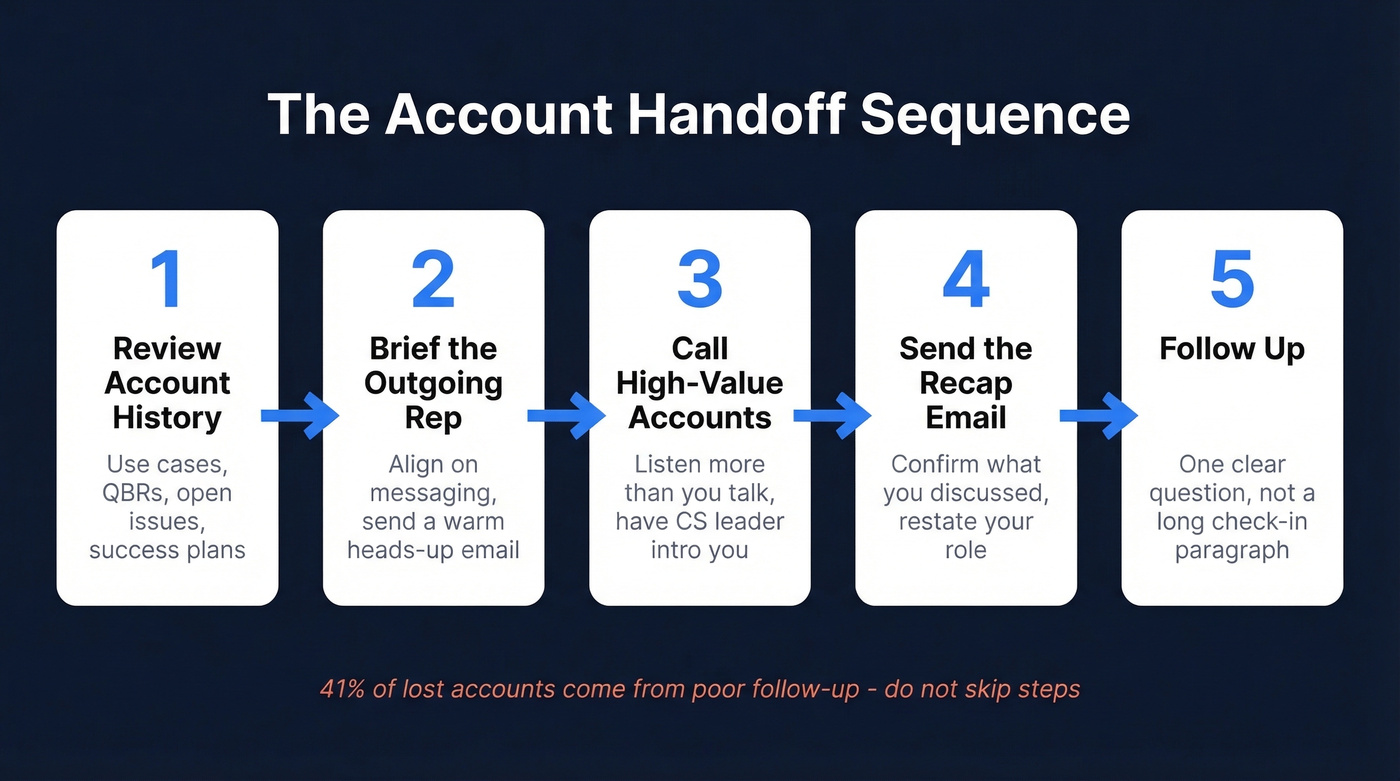
- Review account history - use cases, QBRs, open issues, success plans, and what "success" means for this client. They shouldn't have to re-explain their situation.
- Brief the outgoing contact - align on the message and have them send a short heads-up with the reason and timeframe.
- Call first for high-value accounts - listen more than you talk. For your top-tier accounts, have your CS leader make the introduction directly.
- Send the email as a recap - confirm what you discussed, restate your role, include a specific next step.
- Follow up - if they don't respond, nudge with one clear question. Not a long "checking in" paragraph.
Anatomy of an Effective Introduction Email
Every effective transition email has six components, and the whole thing should stay under 100 words. Lead with the client's needs, not your resume.
If you need more examples, borrow structure from proven handoff email template formats and adapt the tone to the existing relationship.
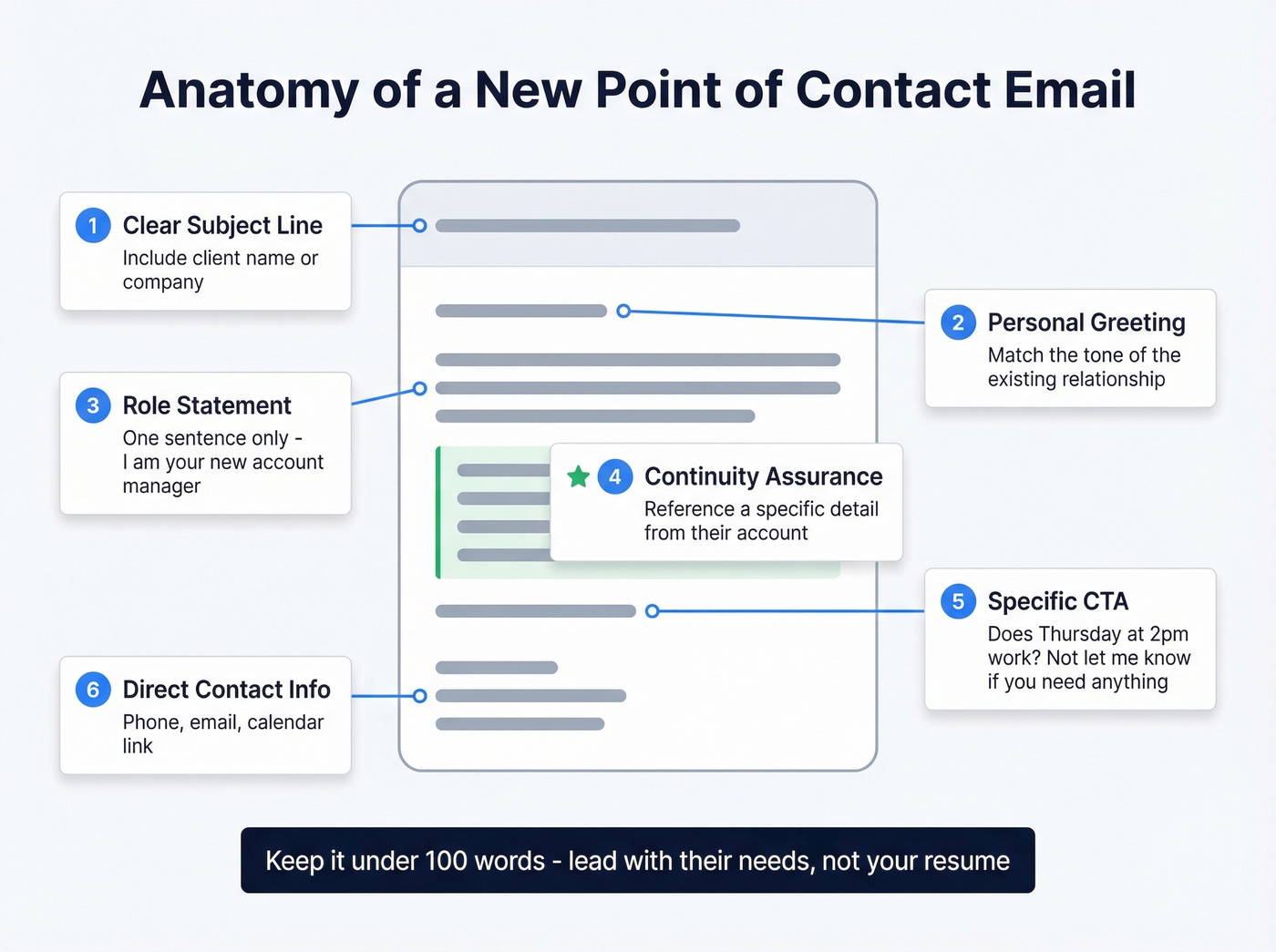
Start with a clear subject line - the client's name or company should appear. Use their first name in the greeting and match the tone of the existing relationship. Your role statement needs exactly one sentence: "I'm your new account manager" is enough.
Here's the piece that separates good transitions from bad ones: the continuity assurance. Saying "I've reviewed your account and I'm up to speed on [specific thing]" tells the client you did your homework. It takes ten minutes of CRM review and saves you weeks of rebuilding trust. Close with direct contact info and a specific CTA - not "let me know if you need anything," which is a dead end. "Does Thursday at 2pm work for a 15-minute intro call?" gives them something to respond to.
Subject Lines That Get Opened
47% of recipients decide whether to open based on the subject line alone. For transition emails, clarity beats cleverness every time.
If you want more options, pull from a larger swipe file of email subject line examples.
- Your new point of contact at [Company]
- [Your Name] x [Client Name] - introduction
- Please meet [Your Name], your new [Title]
- Quick intro - taking over from [Previous Name]
- New [CSM/AM] for [Client Company]
- Picking up where [Previous Name] left off
- [Client Company] + [Your Company]: meet your new contact
- Transition update: [Your Name] joining your account

Half of account handoffs fail because the intro email bounces. Prospeo's email finder delivers 98% accuracy on a 7-day refresh cycle - so your new point of contact email actually reaches the client, not their old inbox.
Verify your inherited contact list before you hit send.
5 Templates That Work
Account Manager Replacement
Subject: Your new account manager at [Company]
Hi [Name], I'm [Your Name], taking over from [Previous Name]. I've reviewed your account, including [specific detail], and nothing will fall through the cracks. I'd love 15 minutes this week - here's my calendar: [link]
[Your Name] | [Phone] | [Email]
New CSM Introduction
Use this when the client relationship is healthy and the handoff is routine. Keep it warm.
Subject: New CSM - [Your Name]
Hi [Name], I'm [Your Name], your new Customer Success Manager. My job is making sure you get full value from [Product]. Can we grab 15 minutes to discuss your goals? [Booking link]
PS - Congrats on [recent milestone].
Project Handoff
This one is all about momentum. The client needs to know the project isn't stalling.
Subject: Project update - new contact
Hi [Name], [Previous Name] has transitioned off [Project Name] and I'm picking up. Current status: [one-sentence summary]. We're on track for [milestone] by [date]. Please CC me on all future correspondence. I'll send a detailed update by [day].
[Your Name] | [Phone] | [Email]
Support Contact Change
Subject: Your new support contact at [Company]
Hi [Name], I'm [Your Name], your new support contact effective [date]. All open tickets - including [ticket #] - are on my radar. Reach me at [email/phone] for anything urgent.
When the Previous Contact Left Badly
Subject: Moving forward - your new contact at [Company]
Hi [Name], I'm [Your Name], managing your account going forward. Your success with [Product] is my top priority. I'd like to start with a call to hear from you - what's working, what's not. Does [day/time] work?
Don't explain the departure. Don't apologize for someone else. Focus entirely forward.
For the follow-up sequence after this intro, use a tight set of sales follow-up templates so you don't drift into "checking in" emails.
5 Mistakes That Kill the Transition
Writing your life story. One practitioner on r/CustomerSuccess put it well: long personal backgrounds in intro emails are "pointless at best and tacky peacocking at worst." We've seen this firsthand - the shorter the email, the higher the reply rate.
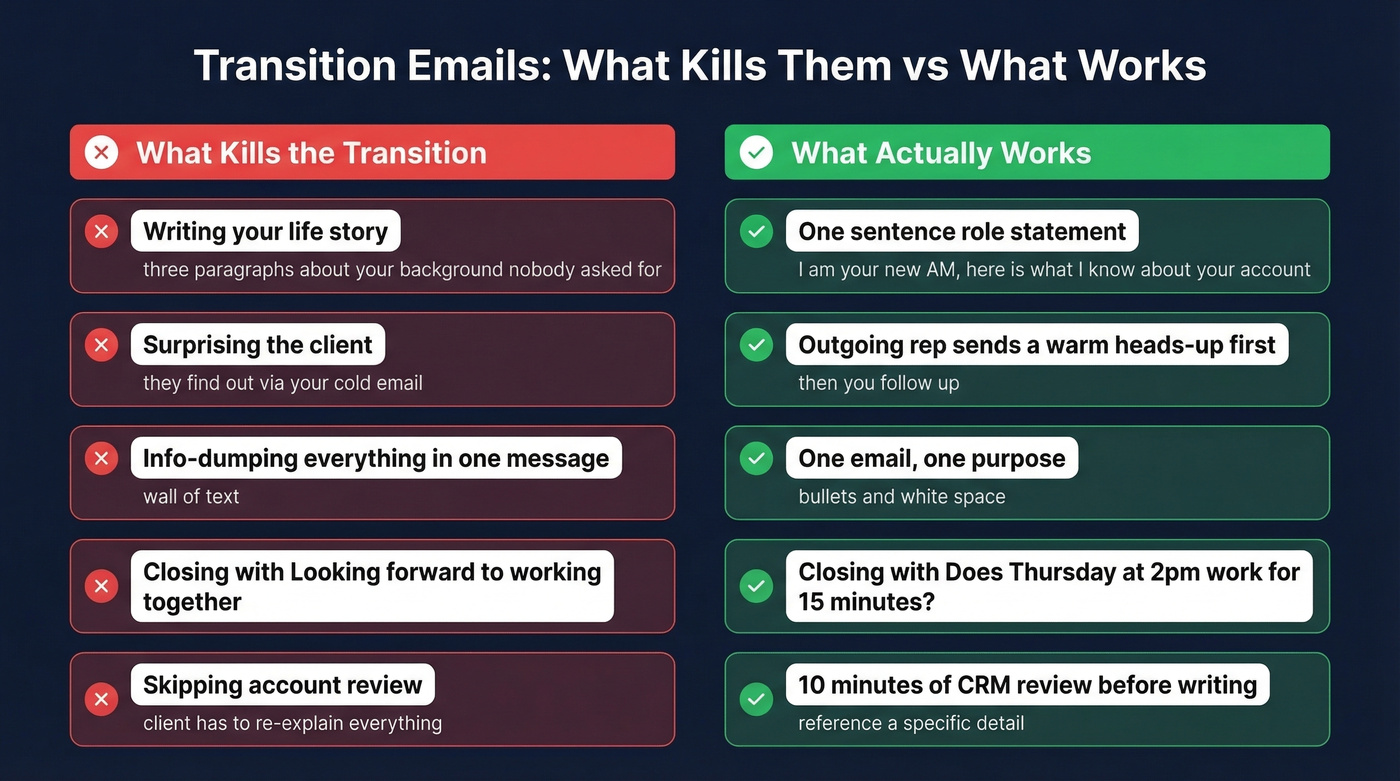
Surprising the client. I've watched a client react with genuine sadness and "big shoes to fill" comments after a surprise transition email. A quick call prevents that shock. When you're introducing yourself as the new point of contact, always have the outgoing rep send a warm heads-up first.
Info-dumping in one message. One email, one purpose. Use bullets and white space to keep it scannable. If you need a stronger structure, lean on proven email copywriting patterns.
Closing with "looking forward to working together." That's not a CTA. "Does Thursday at 2pm work?" is a CTA. (More CTA ideas: email call to action.)
Skipping account review. If your client has to re-explain their situation, you've signaled their business isn't worth preparing for. In our experience, the biggest transition killer isn't the email itself - it's the lack of prep behind it.
Verify Contact Data Before Sending
Let's be honest about a problem nobody talks about: you've written the perfect introduction email, but half your contact list bounces. Inherited accounts come with stale CRM records - people change roles, emails go dead, and suddenly your carefully crafted new point of contact email lands nowhere.
If you're seeing bounces, start with email bounce rate benchmarks and fixes so you know what's normal vs. a list-quality problem.
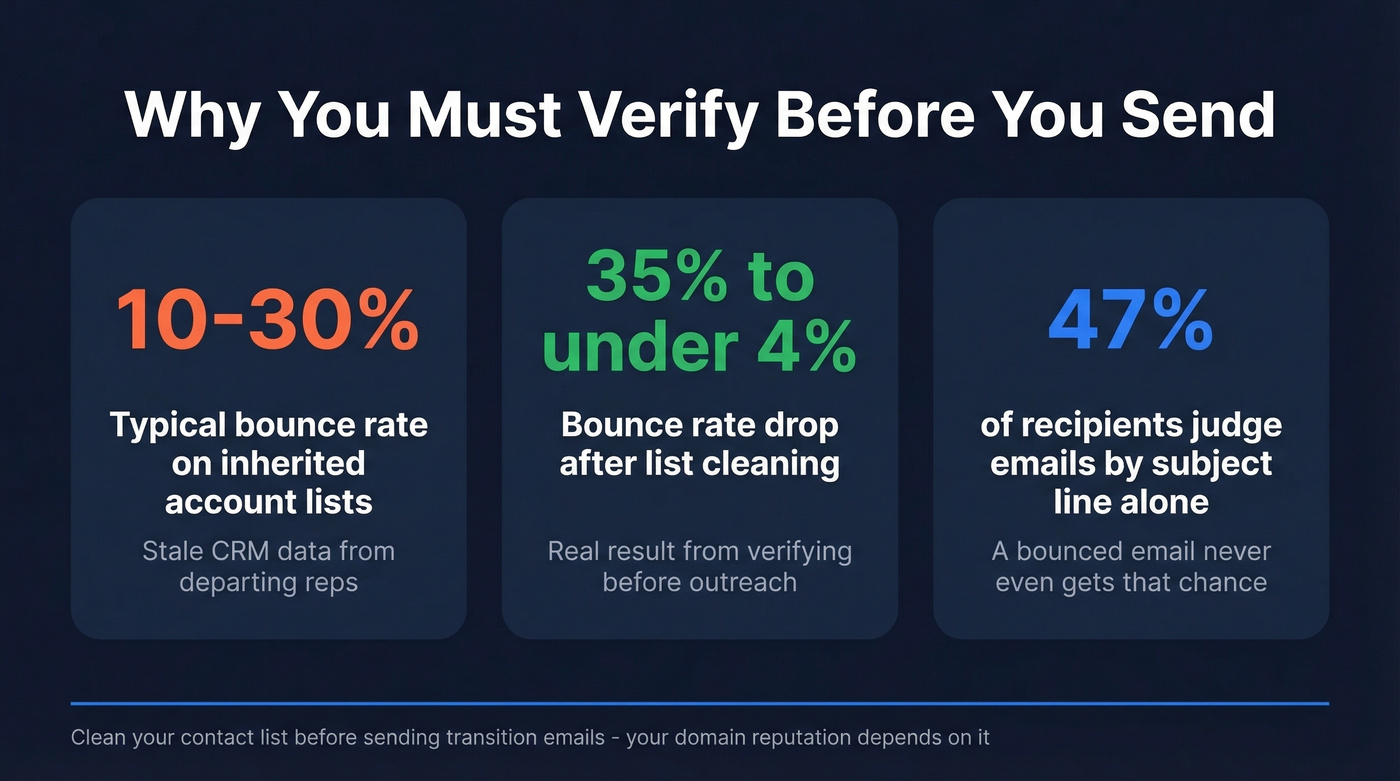
If you've inherited a messy CRM list, it's common to see double-digit bounce rates until you clean it up. Before you send those intro emails, run your contacts through Prospeo's email finder - 98% email accuracy with a 7-day refresh cycle. The free tier covers 75 emails per month, more than enough for a transition batch. You can also enrich sparse CRM records with 50+ data points per contact, filling in direct dials and updated job titles so your email actually lands in the right inbox.
If you're comparing vendors, start with a shortlist of data enrichment services before you commit.
Skip this step if your CRM data is less than 90 days old and you're confident in the records. But for anything inherited from a departing rep? Verify first. One client we spoke with cut their bounce rate from 35% to under 4% just by cleaning their list before outreach.

Sparse CRM notes are bad. Stale contact data is worse. Prospeo enriches every record with 50+ data points - updated job titles, verified emails, and direct dials - so your transition emails land with the right person at the right address.
Clean your book of business in minutes, not days.
FAQ
How long should a new point of contact email be?
Under 100 words. State your role, what you're responsible for, and one specific next step. Brevity beats biography - your client needs to know how to reach you, not your career history.
Should I call or email first?
Call first for high-value accounts, then send the email as a recap. For large books of business, email-first works - but follow up with a call within 48 hours for your top 20% of accounts by ARR.
How do I handle a transition when the previous contact was fired?
Don't explain the departure. State your role, reference one specific account detail to show preparation, and propose a concrete next step. The client needs forward momentum, not backstory.
What if my contact's email bounces during the handoff?
Run your inherited list through an email verification tool before sending. Stale CRM data causes 10-30% bounce rates on inherited accounts. Verifying upfront protects your domain reputation and ensures your introduction actually arrives.